Asbestos in Properties: Identification, Risk Assessment, and Management Strategies
By Housey · Last reviewed 19th of May 2026
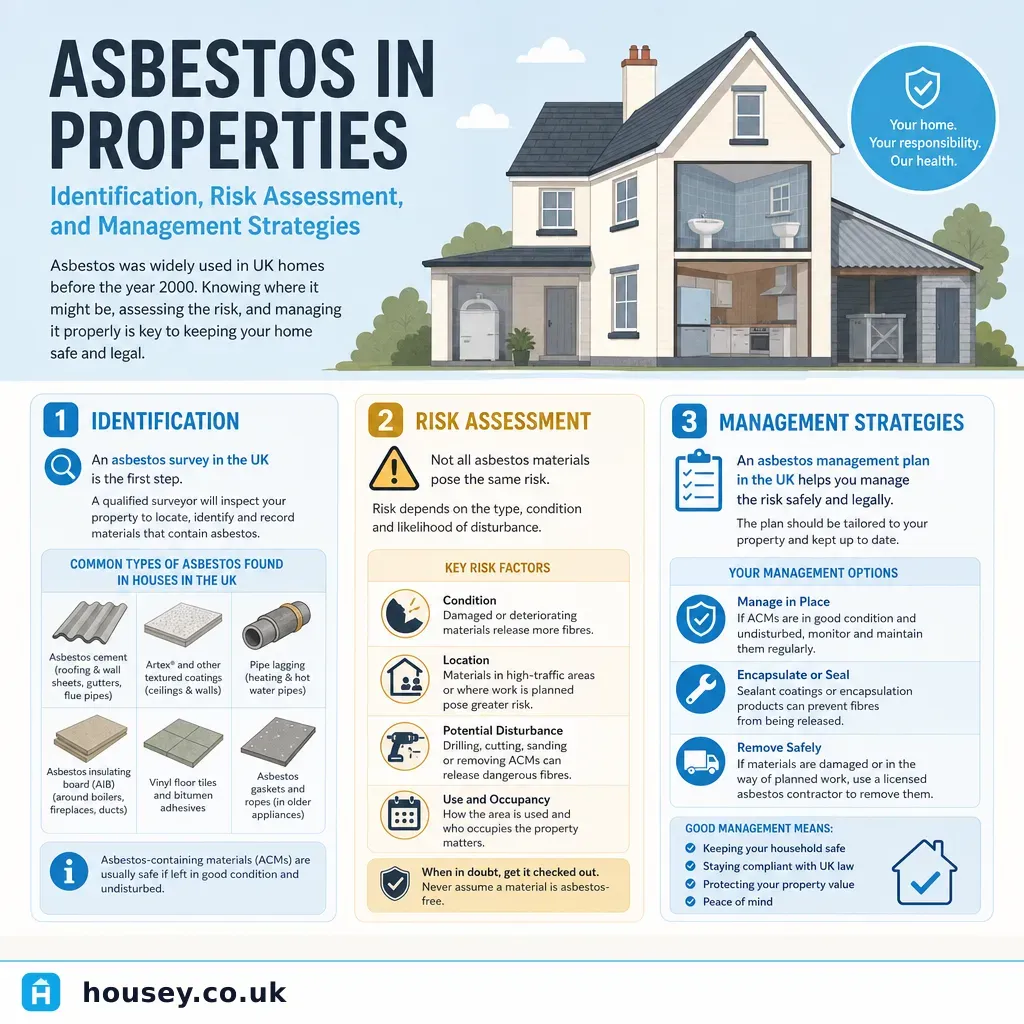
Asbestos in Properties: Identification, Risk Assessment, and Management Strategies
Asbestos was used extensively in UK construction from the 1950s until its full ban in 1999, making it one of the most widespread legacy hazards in British housing stock. Whether you are buying an older property, planning renovation works, or managing a rental, understanding whether asbestos-containing materials (ACMs) are present — and what your legal and practical obligations are — can have serious consequences for health, safety, and project costs.
Key points
- Any property built or significantly refurbished before 2000 may contain asbestos; the Health and Safety Executive (HSE) estimates that around half a million non-domestic buildings and many residential properties still contain ACMs.
- The Control of Asbestos Regulations 2012 (CAR 2012) places a legal duty to manage asbestos in non-domestic premises; residential landlords have overlapping obligations under the Health and Safety at Work etc. Act 1974.
- There are two main survey types under HSG264: a management survey for routine occupation and maintenance, and a refurbishment/demolition survey required before any intrusive works or structural changes.
- Three commercially used asbestos types are most commonly found in UK buildings: chrysotile (white), amosite (brown), and crocidolite (blue) — blue and brown are generally considered more hazardous, though all three are regulated.
- Undisturbed asbestos in good condition is often safest to leave in place and manage via an asbestos management plan, rather than remove.
Where asbestos is commonly found in UK properties
Asbestos was incorporated into a wide range of building products during the post-war construction boom. The table below covers the most common locations in residential and light commercial properties built before 2000.
Location | Common ACM product | Typical asbestos type | Condition concern |
|---|---|---|---|
Artex and textured ceiling coatings | Textured decorative coating | Chrysotile (white) | Risk increases if sanded, scraped, or drilled |
Insulated pipe lagging | Pipe insulation blankets | Amosite (brown) or chrysotile | Often deteriorated in older properties |
Roof and garage sheeting | Corrugated cement sheets | Chrysotile | Weathering can release fibres; do not pressure-wash |
Vinyl floor tiles and sheet flooring | Floor tile or sheet product | Chrysotile | Usually low risk if intact; sanding or cutting raises risk |
Boiler and heating flues | Insulation board | Amosite | Often found in 1960s–1980s boiler cupboards |
Ceiling tiles | Insulating board | Amosite or chrysotile | Risk if broken or drilled |
Soffit boards and fascias | Asbestos cement board | Chrysotile | Common in 1970s–1990s housing estates |
Presence is confirmed by sampling and laboratory analysis only — visual identification alone is not reliable.
Which asbestos survey do you need?
The type of survey required depends on what you plan to do with the property.
- Choose a management survey if you are buying, occupying, or maintaining a property without planned intrusive works. This survey identifies ACMs likely to be disturbed during normal occupancy and routine maintenance.
- Choose a refurbishment/demolition survey if you are planning any intrusive works — including kitchen or bathroom renovation, loft conversion, extension, rewiring, or demolition of any part of the structure. This involves destructive inspection of all areas affected by the planned works.
- Consult your surveyor if the property has had previous asbestos removal works, has mixed usage (for example, a flat above a commercial unit), or if you are unsure which survey type applies to your situation.
- Check with your local planning authority if the property is listed or in a conservation area, as works permissions may interact with asbestos management requirements.
Both survey types should be carried out by a surveyor accredited by UKAS (United Kingdom Accreditation Service) under ISO 17020. Accreditation can be verified on the UKAS website.
Understanding your asbestos management plan
If ACMs are identified, the survey report classifies each material by condition and risk of disturbance, using a priority scoring methodology aligned with CAR 2012 guidance. Management recommendations typically fall into one of three categories:
- Manage in place — low risk, good condition, unlikely to be disturbed. The ACM is recorded, labelled where safe to do so, and monitored periodically.
- Repair or encapsulate — moderate condition with some surface damage. A specialist contractor stabilises or seals the material to prevent fibre release.
- Remove — poor condition, high disturbance risk, or located within a planned works zone. Most notifiable ACM removal must be carried out by a CAR 2012 licensed contractor. A smaller category of lower-risk materials may be removed by a trained operative under the CAR 2012 Regulation 3 exemptions — your surveyor will confirm which category applies.
For non-domestic premises, an asbestos management plan is a legal requirement under CAR 2012. For residential properties, a management plan is best practice and may be required by insurers, lenders, or prospective buyers.
Important limitations
This article provides general information about asbestos in UK properties. The presence, type, condition, and risk of asbestos-containing materials varies significantly between individual buildings. Nothing in this guide constitutes a health and safety assessment or legal advice. Only a UKAS-accredited asbestos surveyor can determine what is present and recommend appropriate action for your specific property.
Regulatory obligations differ between domestic, landlord-managed, commercial, and mixed-use premises. If you are uncertain about your duties under CAR 2012 or the Health and Safety at Work etc. Act 1974, seek advice from a qualified asbestos consultant or contact the HSE directly.
When this becomes urgent
Stop work immediately and seek professional advice if any of the following apply:
- Renovation or maintenance work has unexpectedly disturbed a material that may contain asbestos — powdery or fibrous insulation, crumbling ceiling coatings, or damaged pipe lagging.
- Artex or textured coatings are being dry-abraded, sanded, or scraped in a pre-2000 property without a prior survey and air monitoring in place.
- A roofing or demolition contractor has broken or cut cement sheets without prior sampling.
- A pre-purchase survey report has flagged suspected ACMs and intrusive works are about to begin.
- You are a landlord and a tenant has reported damage to materials suspected to contain asbestos.
If you believe asbestos fibres have been released into an enclosed space, evacuate the area, keep others out, and contact a UKAS-accredited analyst to carry out air monitoring before re-entry.
What to ask a qualified professional
Before commissioning an asbestos survey or instructing a removal contractor, ask:
- Are you UKAS-accredited under ISO 17020 (surveyors) or licensed under CAR 2012 (removal contractors)?
- Which survey type do you recommend for my specific situation, and why?
- Will samples be sent to a UKAS-accredited laboratory for analysis?
- What will the report include — location plans, condition scoring, photographs, and management recommendations?
- If removal is recommended, is the material notifiable to the HSE under CAR 2012 Regulation 9? Notifiable work requires a licensed contractor and written notification to the HSE at least 14 days before works begin.
- What air monitoring is included during and after removal works?
- Will you provide a clearance certificate confirming the area is safe after removal is complete?
When to get professional help
Do not attempt to identify, test, disturb, or remove suspected asbestos yourself. The following situations all require professional assessment before any work proceeds:
- Any property built before 2000 where renovation or significant maintenance is planned.
- A RICS home survey that notes suspected ACMs and recommends further investigation.
- Visible deterioration of suspected asbestos materials — crumbling, flaking, or water damage to textured coatings, pipe lagging, or insulation board.
- Any works requiring breaking, drilling, sanding, or cutting into materials in a pre-2000 building without prior sampling and a written risk assessment.
How Housey can help
Housey connects homeowners and buyers with UKAS-accredited asbestos survey professionals who can carry out management surveys, refurbishment and demolition surveys, and targeted sampling for pre-2000 properties across the UK. Use Housey to compare quotes and understand exactly what each survey covers before you commit.
Frequently asked questions
Do I need an asbestos survey before buying a house in the UK?
There is no legal obligation on a buyer to commission an asbestos survey before purchase, but it is strongly advisable for any property built before 2000. A standard RICS Level 2 or Level 3 survey notes the possibility of ACMs but will not sample or confirm their presence. If the survey flags concerns, or if you plan to renovate, a management survey before exchange gives you reliable information for negotiating price or planning future works.
Can I remove asbestos myself in my own home?
The law does not automatically prohibit a householder from removing certain lower-risk ACMs in their own home, but the HSE strongly advises against it. For most notifiable materials — including sprayed coatings, pipe lagging, and loose-fill insulation — a CAR 2012 licensed contractor is required by law. Even for non-notifiable materials, the risk of fibre release without proper protective equipment, containment, and legal disposal procedures is significant. Always seek professional advice before any removal attempt.
What does an asbestos management survey involve?
A management survey involves a visual inspection and, where safe and accessible, sampling of suspected ACMs throughout the property. Samples are sent to a UKAS-accredited laboratory for analysis. The surveyor produces a report detailing the location, type, condition, and priority score of each identified ACM, along with management recommendations. It is not a destructive survey — wall cavities and concealed voids are not opened up.
Is all asbestos equally dangerous?
All three commercial types found in UK buildings — chrysotile (white), amosite (brown), and crocidolite (blue) — are regulated and linked to serious health conditions including mesothelioma and asbestosis. Blue and brown asbestos are generally considered more hazardous per fibre, but chrysotile is by far the most commonly found type in UK housing. The condition of the material and likelihood of disturbance are the key risk factors for any ACM, regardless of type.
How long does an asbestos survey take?
A management survey for a typical three-bedroom house usually takes two to four hours on site. Laboratory results from a UKAS-accredited lab typically take three to five working days. A refurbishment or demolition survey for the same property may take longer, depending on the extent of intrusive access required and the number of samples collected.
Sources and further reading
- HSE: Asbestos — The Survey Guide (HSG264) — Health and Safety Executive
- Control of Asbestos Regulations 2012 — legislation.gov.uk
- HSE: Asbestos in the Home — Health and Safety Executive
- UKAS accreditation directory — United Kingdom Accreditation Service
- HSE: Asbestos guidance for duty holders — Health and Safety Executive
Useful next reads
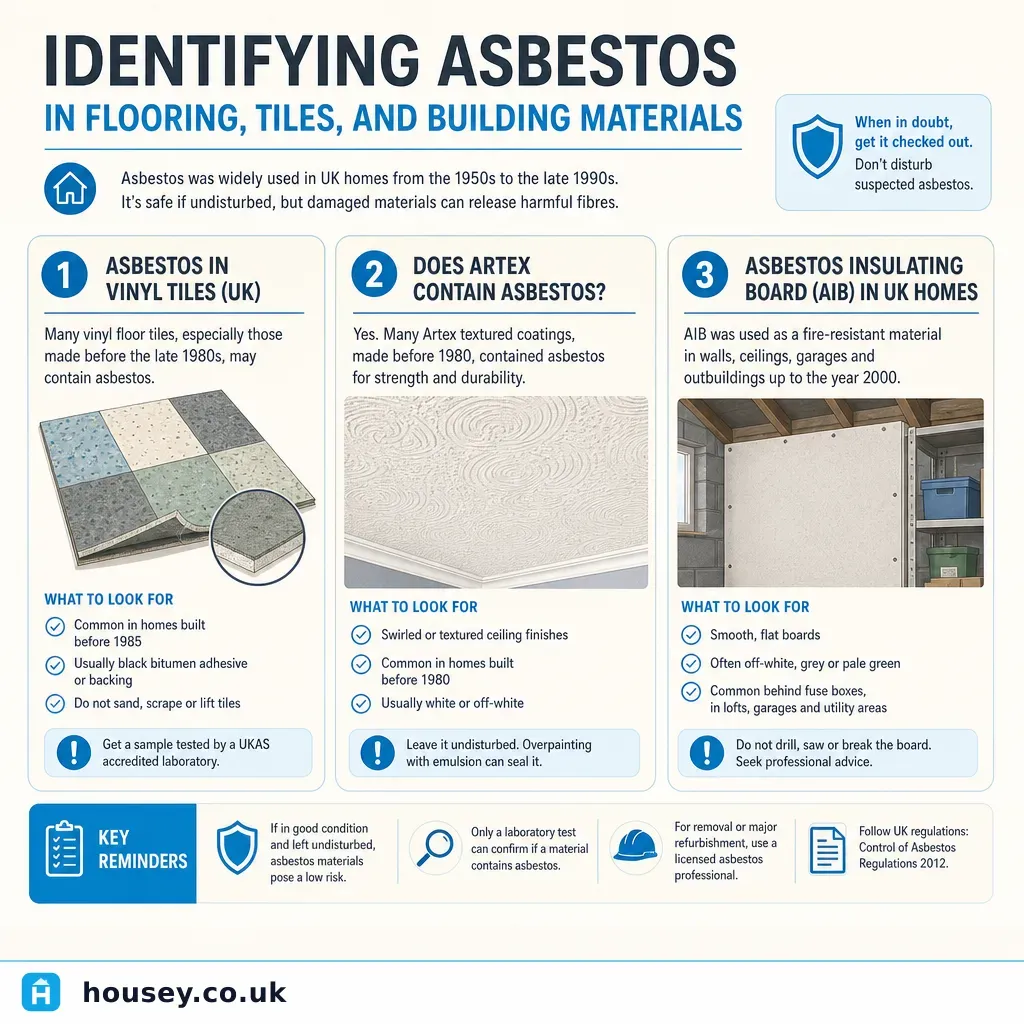 Surveys & Inspections
Identifying asbestos in flooring, tiles, and building materials
Asbestos-containing materials are common in UK properties built or refurbished before 2000.
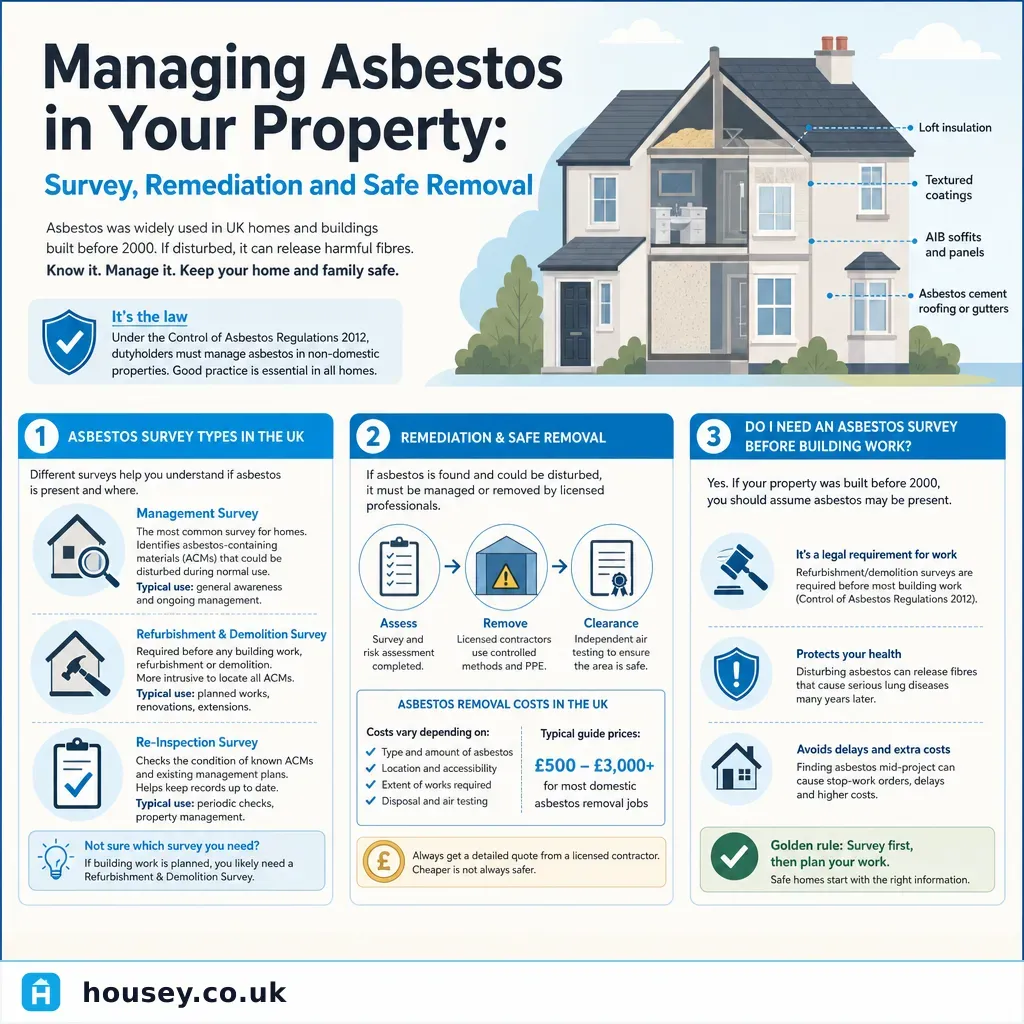 Surveys & Inspections
Managing Asbestos in Your Property: Survey, Remediation and Safe Removal
Asbestos was commonly used in UK buildings until its full ban in 1999.
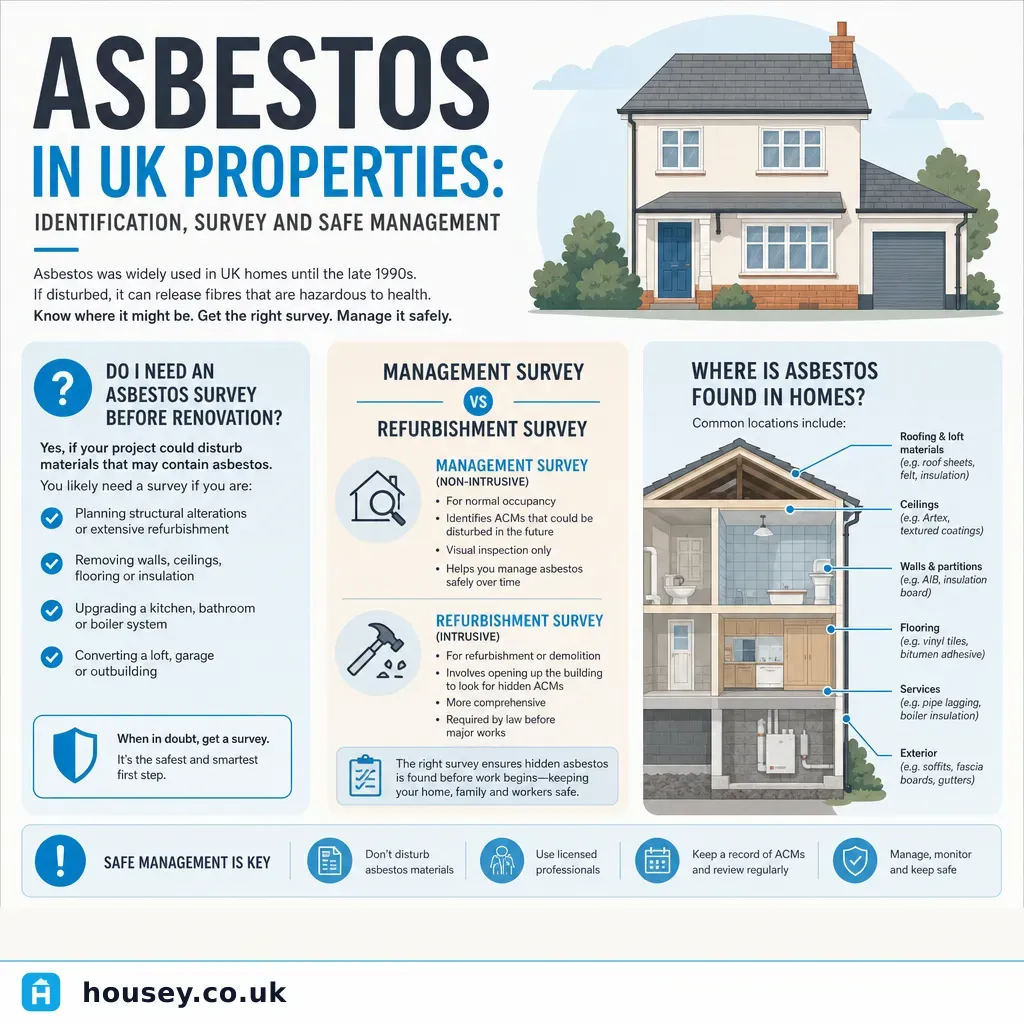 Surveys & Inspections
Asbestos in UK Properties: Identification, Survey and Safe Management
Asbestos may be present in any UK property built or refurbished before 2000.
 Surveys & Inspections
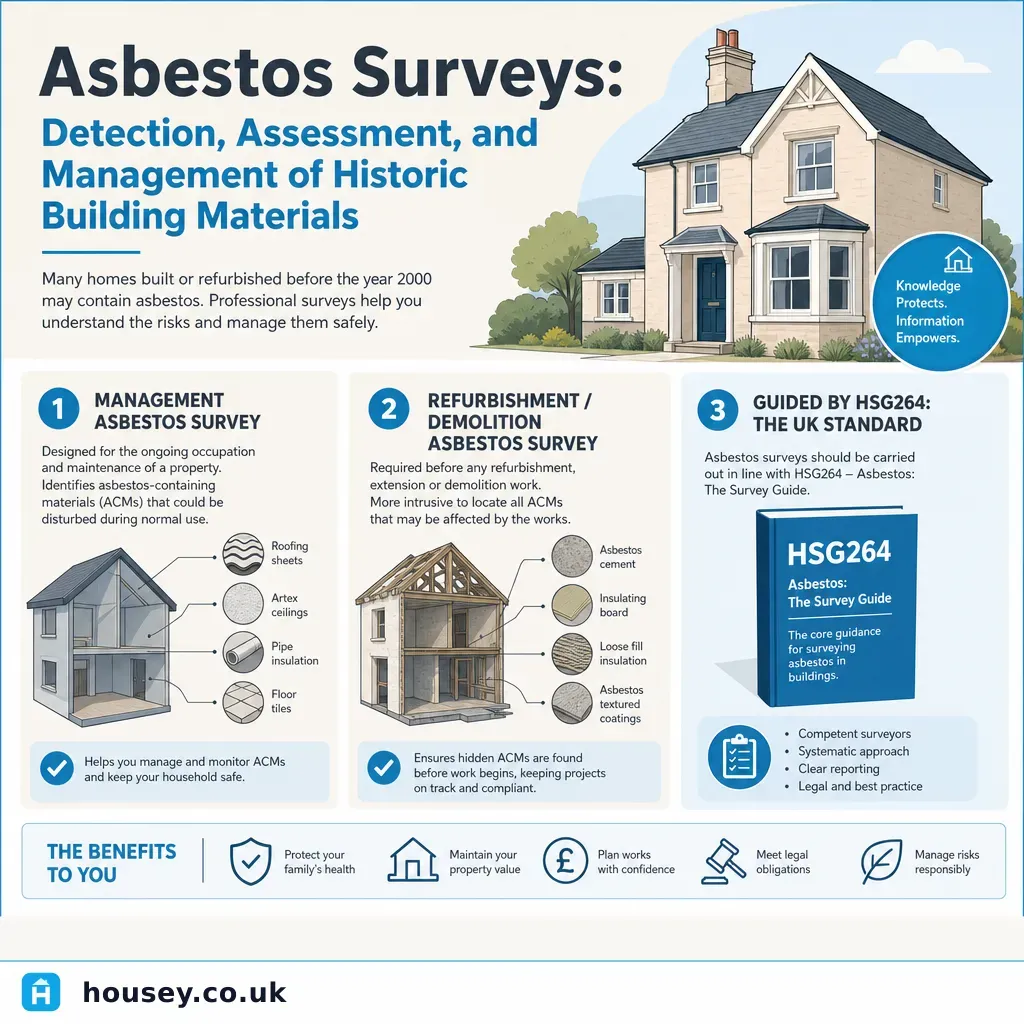
Asbestos Surveys: Detection, Assessment, and Management of Historic Building Materials
There are two main survey types in the UK: a Management Survey for buildings in normal occupation, and a Refurbishment and Demolition Survey required before any building work on a pre-2000 property.
 Surveys & Inspections
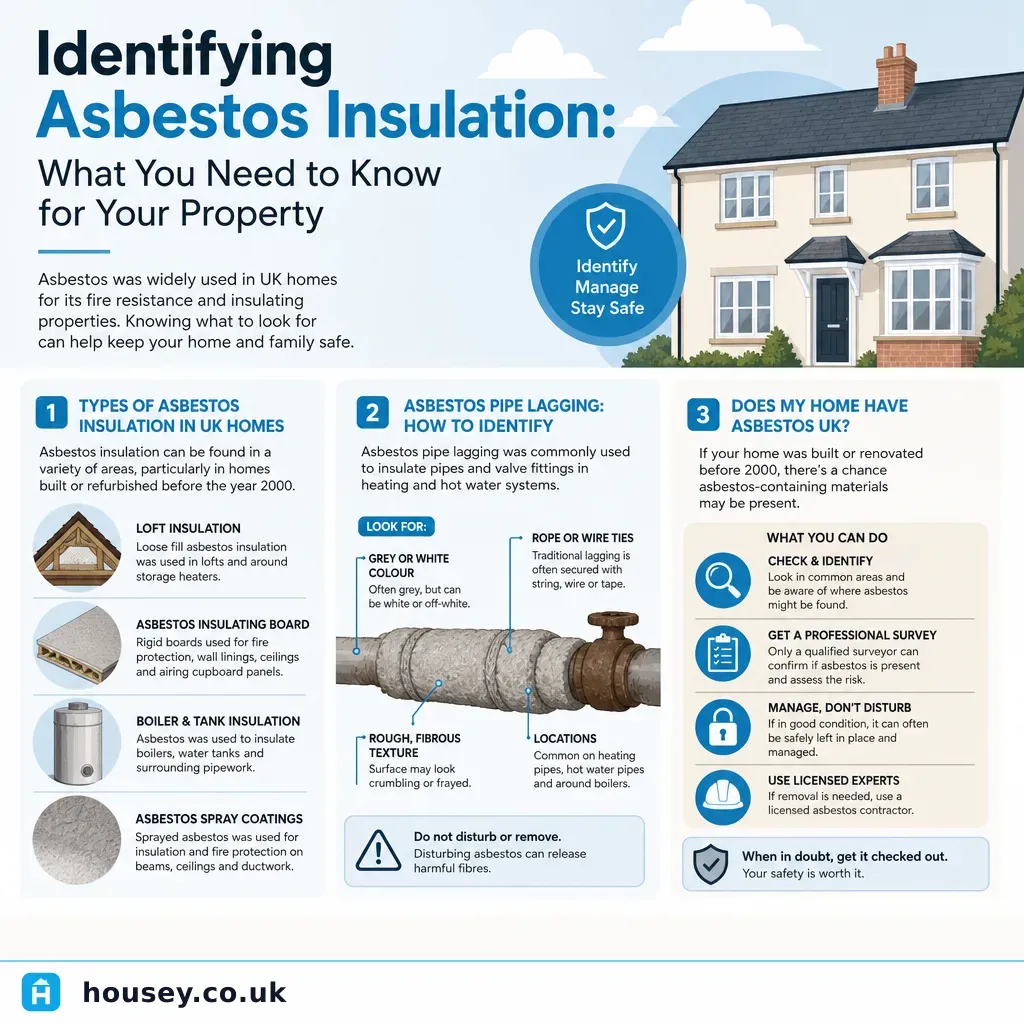
Identifying Asbestos Insulation: What You Need to Know for Your Property
Asbestos insulation was widely used in UK properties built before 2000, commonly found in pipe lagging, ceiling tiles, loose-fill loft insulation, and around boilers.