Asbestos Surveys: Detection, Assessment, and Management of Historic Building Materials
By Housey · Last reviewed 18th of May 2026
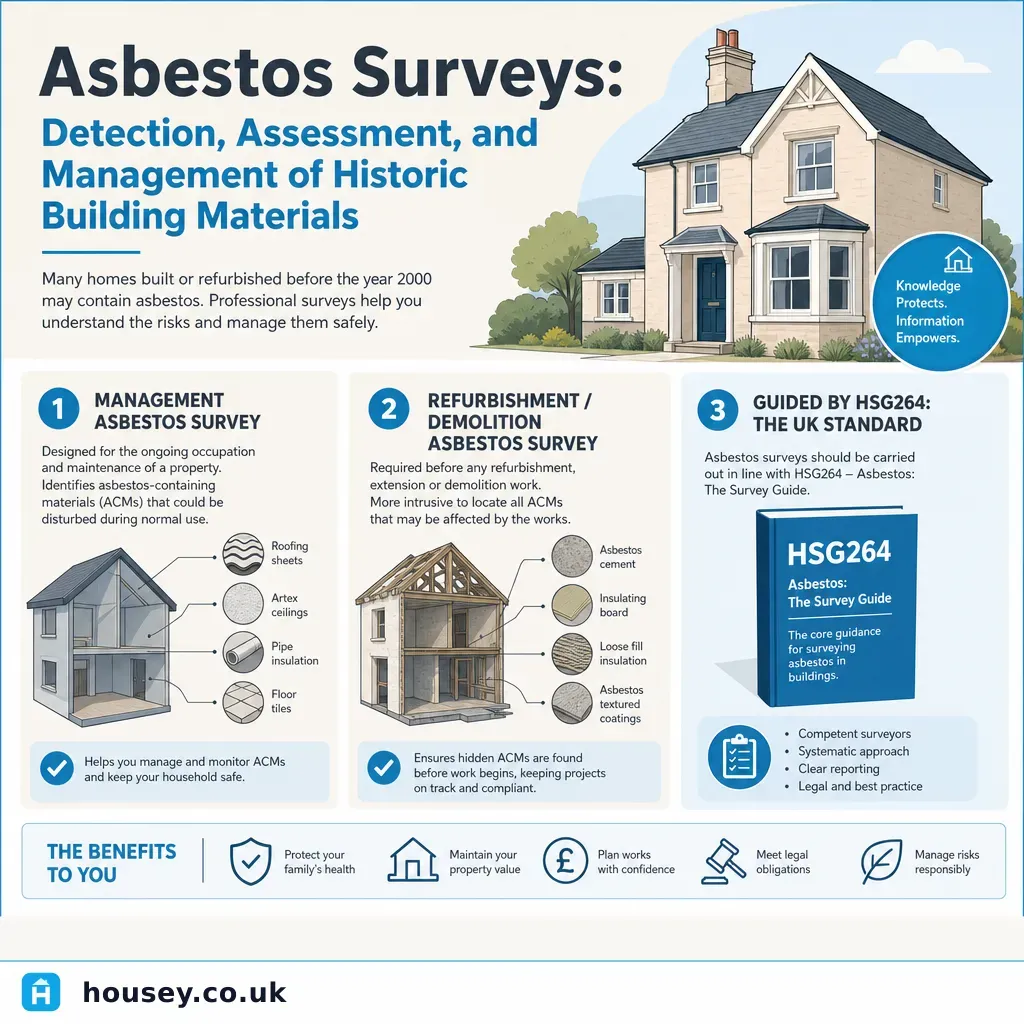
Asbestos Surveys: Detection, Assessment, and Management of Historic Building Materials
Before renovation, refurbishment, or demolition work begins on any building constructed before 2000, an asbestos survey is an essential legal and practical step. In non-domestic premises, the duty to manage asbestos requires a systematic approach to identifying, recording, and managing all asbestos-containing materials (ACMs). In domestic settings, a survey protects contractors and occupants from inadvertent exposure during building works — and is often a condition imposed by contractors before they will start.
Key points
- There are two main survey types defined in HSG264 (the HSE's guidance document on asbestos surveying): the Management Survey and the Refurbishment and Demolition (R&D) Survey.
- Surveyors should hold a personal BOHS P402 qualification (or equivalent) and work for an organisation accredited by UKAS to ISO/IEC 17020 as an inspection body.
- A Management Survey is required as part of the duty to manage under Regulation 4 of the Control of Asbestos Regulations 2012 (CAR 2012) for non-domestic premises.
- A Refurbishment and Demolition Survey must be completed in the specific areas to be worked on before any refurbishment, repair, or demolition that may disturb the building fabric.
- Survey outputs must include an Asbestos Register; non-domestic premises also require an Asbestos Management Plan under CAR 2012 Regulation 4.
What is an asbestos survey?
An asbestos survey is a systematic inspection of a building to identify materials that may contain asbestos, assess their condition, and estimate the risk they pose to building users and workers. The surveyor takes representative bulk samples from suspect materials for laboratory analysis using polarised light microscopy (PLM) to identify fibre type and confirm presence.
All asbestos survey work in the UK should follow HSG264 Asbestos: The Survey Guide, published by the HSE.
The two types of asbestos survey
Survey type | Purpose | When required | Sampling approach | Indicative cost |
|---|---|---|---|---|
Management Survey | Locate ACMs present during normal occupation; assess condition and risk | Duty-to-manage obligation for non-domestic premises; recommended before buying or letting any pre-2000 property | Non-destructive; accessible areas only | £200–£600 for a typical domestic or small commercial property |
Refurbishment and Demolition (R&D) Survey | Identify all ACMs in areas to be worked on, including concealed locations | Before any refurbishment, major repair, or demolition work that may disturb the building fabric | Destructive and intrusive sampling required | £300–£1,500+ depending on scope and building size |
Indicative UK costs, last reviewed 2026-05-18. Costs vary by building size, number of samples required, complexity, and location.
A Management Survey is not adequate before refurbishment work. An R&D Survey must be commissioned for the affected areas, as it requires intrusive sampling to locate concealed ACMs that a non-destructive survey would not identify.
Which survey type do you need?
- Choose a Management Survey if you need to meet the duty-to-manage obligation for a non-domestic premises in normal occupation, or if you are buying or letting a pre-2000 property and need to understand the asbestos position.
- Choose a Refurbishment and Demolition Survey if any part of the building fabric will be disturbed during planned building work — even if the scope is limited to a small repair or partial renovation.
- If both apply — for example, managing an occupied building where part is being refurbished — commission an R&D Survey for the work area and a Management Survey for the remaining occupied areas.
- Ask your surveyor whether an existing Management Survey is sufficiently recent to rely on, or whether reinspection of materials previously assessed as deteriorating is needed.
What does a surveyor look for?
Asbestos was incorporated into a wide range of building products before the UK ban in 1999. Common locations a surveyor will check include:
Inside the building:
- Textured coatings (for example, Artex) on ceilings and walls — particularly in properties decorated between the 1960s and late 1980s
- Vinyl, thermoplastic, and cork-backed floor tiles
- Asbestos insulation board (AIB) used as partition walls, ceiling tiles, fire doors, and service duct linings
- Pipe lagging and boiler insulation in older heating systems
- Rope seals around boilers and solid fuel appliances
Outside the building:
- Corrugated and flat asbestos cement roofing on garages and outbuildings
- Asbestos cement cladding panels
- Rainwater goods such as guttering and downpipes on older commercial buildings
What happens during a survey?
A UKAS-accredited surveyor will:
- Inspect all accessible areas of the building systematically, recording material type, location, and extent.
- Identify suspect materials and assess their condition using the criteria set out in HSG264.
- Take representative bulk samples — typically small pieces of 1–3 cm — from each suspect material for laboratory analysis.
- Assign a risk priority rating to each identified or presumed ACM, based on condition, accessibility, and likely disturbance during normal use or planned works.
- Produce a written report containing an Asbestos Register and, for non-domestic premises, an Asbestos Management Plan.
Sample analysis is carried out in a UKAS-accredited laboratory using polarised light microscopy. Results typically take 2–5 working days, and the final report is usually issued within 5–10 working days of the survey.
What do the survey results mean?
The Asbestos Register produced by the surveyor categorises each identified or presumed ACM by:
- Material type — for example, asbestos insulation board, textured coating, or asbestos cement
- Condition — assessed as good, fair, poor, or very poor in line with HSG264 criteria
- Risk priority score — based on condition, likelihood of disturbance, and human exposure potential
- Recommended action — manage in place, monitor at defined intervals, encapsulate, or arrange removal
Materials marked as "presumed present" have not been sampled but are assessed as likely to contain asbestos based on their appearance and the construction date. These should be treated as asbestos-containing unless laboratory analysis confirms otherwise.
What is an Asbestos Management Plan?
For non-domestic premises, the duty holder must produce and maintain an Asbestos Management Plan (AMP) — a document that sets out how identified ACMs will be managed, who is responsible, what monitoring intervals apply, and how information will be communicated to contractors and maintenance staff. The plan must be reviewed when the condition of ACMs changes, when building work is planned, or at regular intervals defined within the plan.
Domestic homeowners are not legally required to produce an AMP, but it is good practice to retain the survey report and brief any contractors on ACM locations before they begin work.
Important limitations
This article is general information only. Asbestos identification, risk assessment, and management decisions must be made by appropriately qualified professionals with direct access to the specific property and its history. Legal duties differ between domestic properties, non-domestic premises, and houses in multiple occupation (HMOs). Do not substitute a Management Survey for a Refurbishment and Demolition Survey when building work is planned in any area of a pre-2000 building.
When this becomes urgent
Seek professional advice without delay if:
- Building work has already started and suspect materials have been disturbed without a prior survey being commissioned.
- An ACM in poor or very poor condition is found deteriorating in an occupied area of the building.
- A contractor discovers unexpected pipe lagging, loose-fill insulation, or other friable materials during renovation work.
- You manage a non-domestic building and have no current Asbestos Register or Asbestos Management Plan in place.
If materials are disturbed accidentally, stop work, isolate the area, and contact a licensed asbestos contractor or the HSE for guidance before the area is re-entered.
What to ask a qualified professional
Before commissioning an asbestos survey:
- Is your organisation UKAS-accredited to ISO/IEC 17020 for asbestos surveying, and can you provide your UKAS schedule number?
- Do your surveyors hold a personal BOHS P402 qualification or equivalent?
- Does your laboratory use polarised light microscopy for sample analysis, as required by HSG264?
- Will the report include a full Asbestos Register and — where applicable — an Asbestos Management Plan?
- What is included in the quoted price: the site visit, laboratory analysis fees, and the written report?
- How long will results take, and will I receive a certificate of analysis for each sample?
- If ACMs are found, can you advise on management options or recommend licensed removal contractors?
When to get professional help
Always commission an asbestos survey from a UKAS-accredited body before any refurbishment, renovation, or demolition work on a pre-2000 building. Do not rely on a visual inspection or an assumption that a building is asbestos-free — many ACMs are indistinguishable from non-asbestos products without laboratory analysis.
Red flags suggesting a survey may not meet the required standard:
- The survey report does not reference HSG264 or the Control of Asbestos Regulations 2012.
- The surveyor cannot demonstrate UKAS accreditation or provide a UKAS schedule number on request.
- No laboratory analysis certificates are included with the report.
- No intrusive sampling was carried out despite the survey being commissioned for a refurbishment scope.
How Housey can help
Housey can connect you with UKAS-accredited asbestos surveyors for management surveys and refurbishment and demolition surveys across the UK. Commissioning the right type of survey before any building work starts on a pre-2000 property is the essential first step in managing asbestos safely and legally.
Frequently asked questions
Does a domestic homeowner need an asbestos survey?
The statutory duty to manage asbestos under CAR 2012 Regulation 4 does not apply to owner-occupied domestic dwellings. However, if you are planning any renovation or building work, a Refurbishment and Demolition Survey in the affected area is strongly recommended — both to protect contractors, who have their own legal duties under CAR 2012, and to prevent accidental exposure to occupants.
How long does an asbestos survey take?
A management survey for a typical three-bedroom house usually takes 2–4 hours on site. A refurbishment and demolition survey — which requires intrusive sampling in concealed voids — may take a full day or more depending on scope and building size. Laboratory analysis and the written report typically follow within 5–10 working days of the survey visit.
Can I commission an asbestos survey before buying a property?
Yes, and it is advisable for any pre-2000 property. A management survey can be commissioned during the conveyancing period, though you will need the vendor's permission for access and sampling. If ACMs in poor condition are identified, survey findings may support renegotiation of the purchase price or inform a decision on remediation before completion.
What is the difference between a management survey and a refurbishment and demolition survey?
A management survey is designed for buildings in normal occupation — it is non-destructive and covers accessible areas only. A refurbishment and demolition survey is intrusive: surveyors access concealed voids, take more extensive samples, and cover all areas where building work will take place. Using a management survey in place of an R&D survey before renovation is a common and potentially serious error.
Sources and further reading
- HSG264 Asbestos: The Survey Guide — Health and Safety Executive
- Control of Asbestos Regulations 2012 — legislation.gov.uk
- HSE duty to manage asbestos — Health and Safety Executive
- UKAS accreditation for inspection bodies — UKAS
- HSE asbestos surveys guidance — Health and Safety Executive
Useful next reads
 Surveys & Inspections
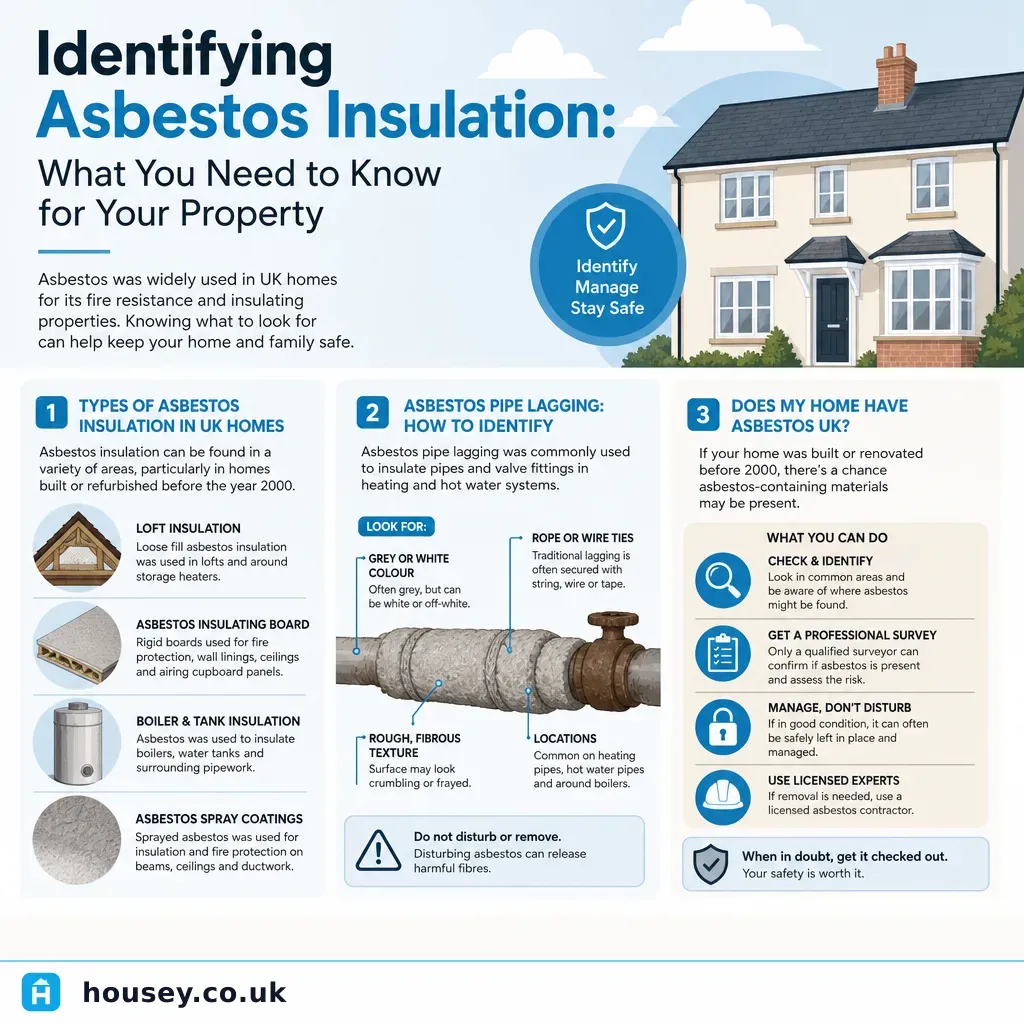
Identifying Asbestos Insulation: What You Need to Know for Your Property
Asbestos insulation was widely used in UK properties built before 2000, commonly found in pipe lagging, ceiling tiles, loose-fill loft insulation, and around boilers.
 Surveys & Inspections
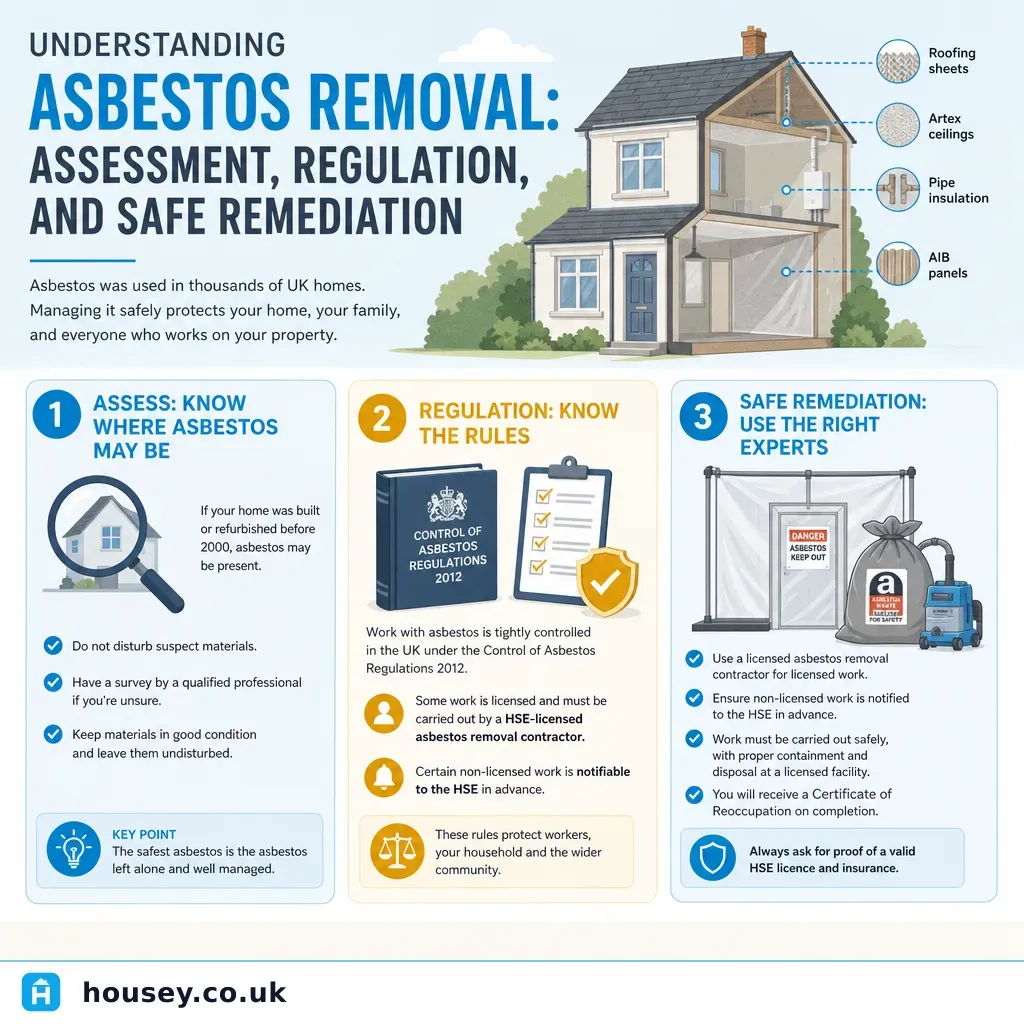
Understanding Asbestos Removal: Assessment, Regulation, and Safe Remediation
In the UK, asbestos removal is governed by the Control of Asbestos Regulations 2012.
 Surveys & Inspections
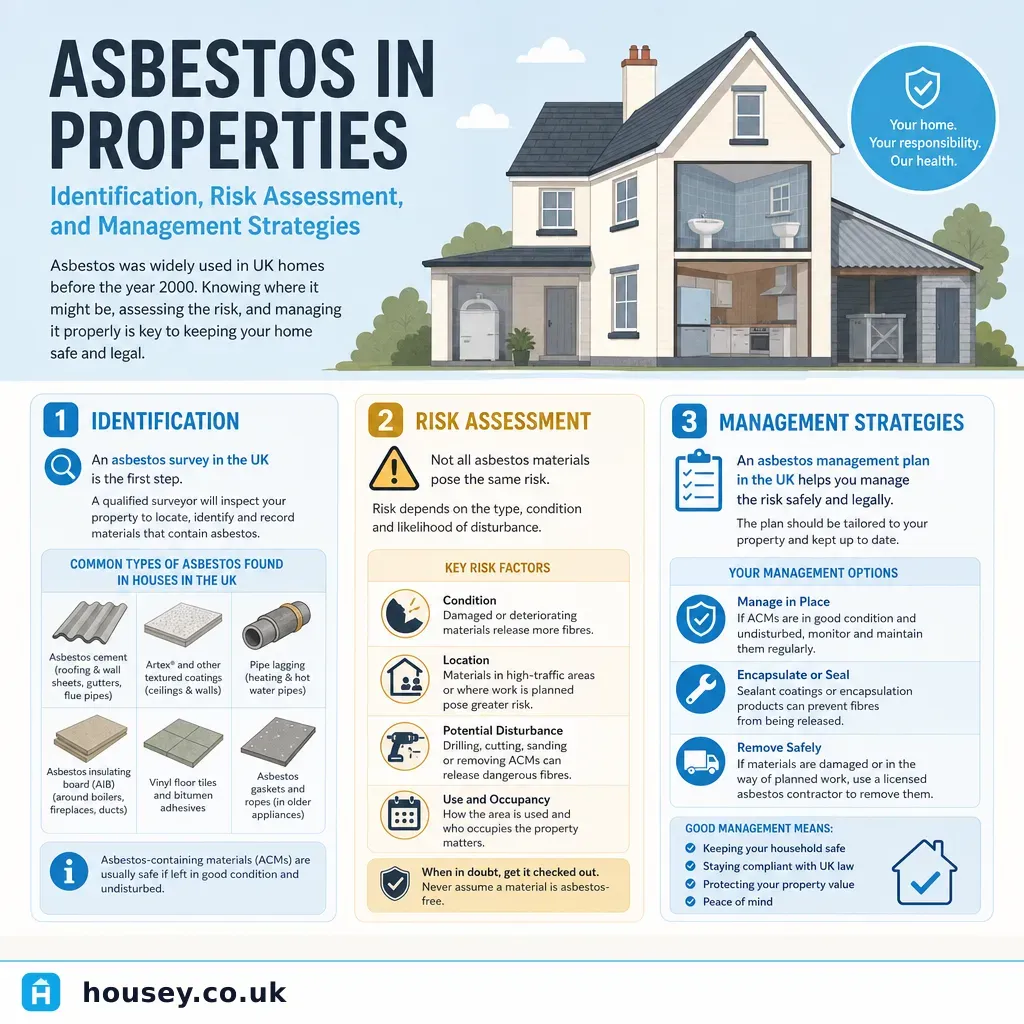
Asbestos in Properties: Identification, Risk Assessment, and Management Strategies
Asbestos-containing materials may be present in any UK property built before 2000.
 Surveys & Inspections
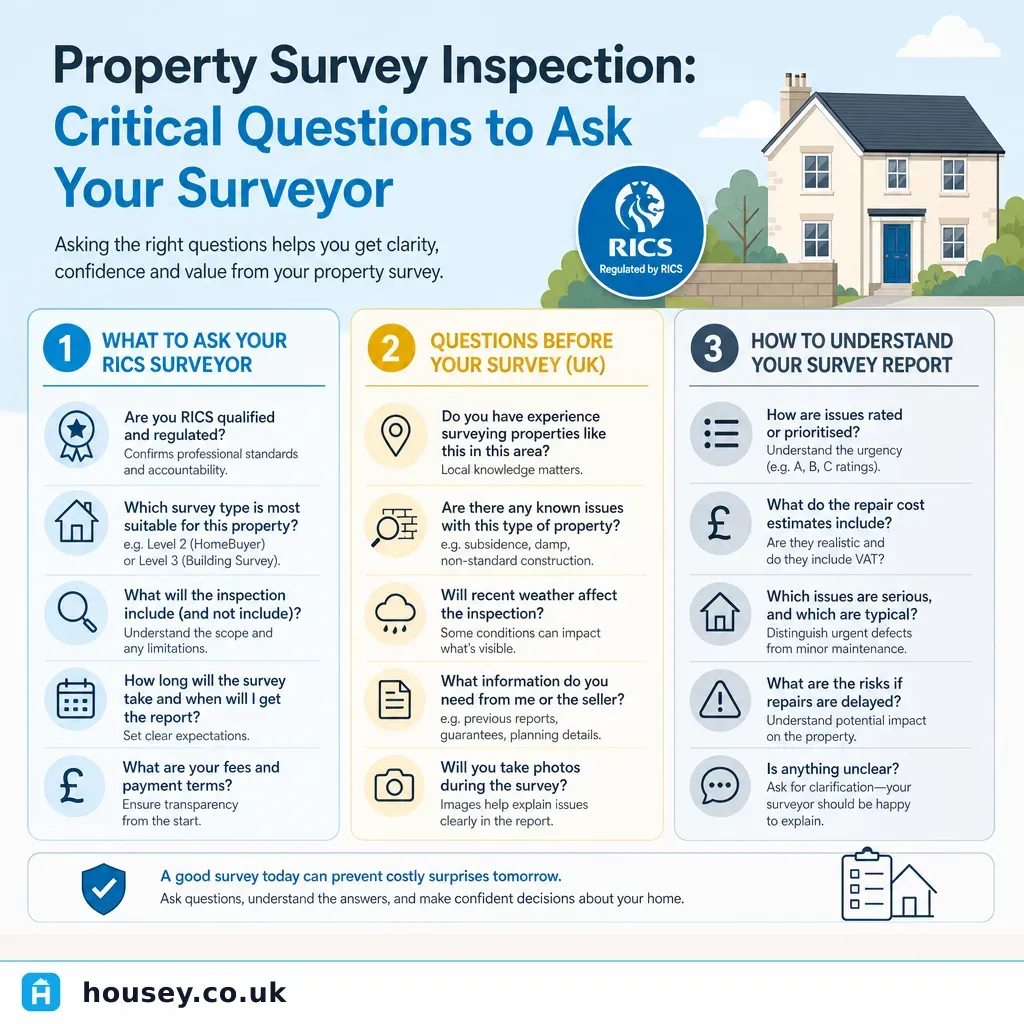
Property Survey Inspection: Critical Questions to Ask Your Surveyor
Before instructing a surveyor, ask which RICS level suits your property and what the report will and will not cover.
 Surveys & Inspections
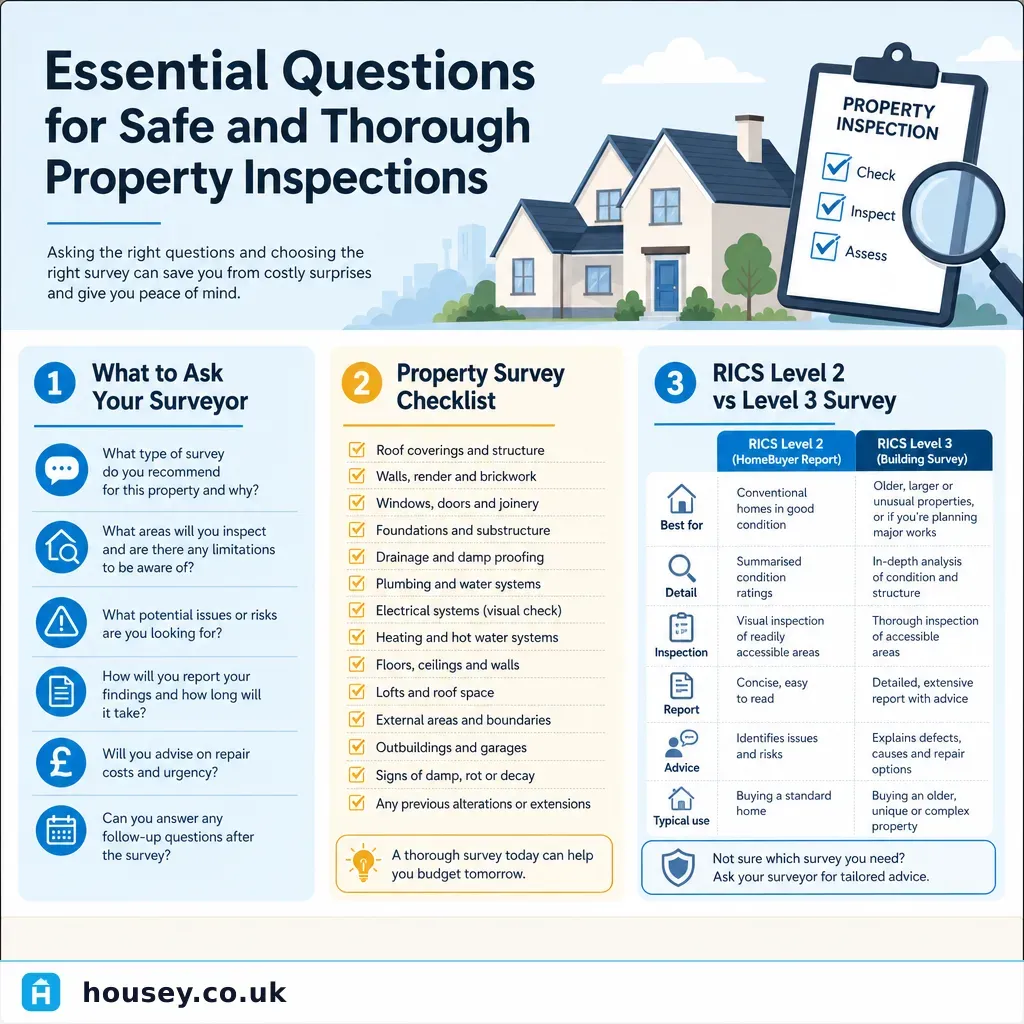
Essential Questions for Safe and Thorough Property Inspections
Before commissioning a property survey, confirm what type of inspection suits your property's age and condition, ask the surveyor what defects they will and will not assess, and understand what the report will recommend.