Asbestos Remediation and Safe Disposal
By Housey · Last reviewed 5th of May 2026
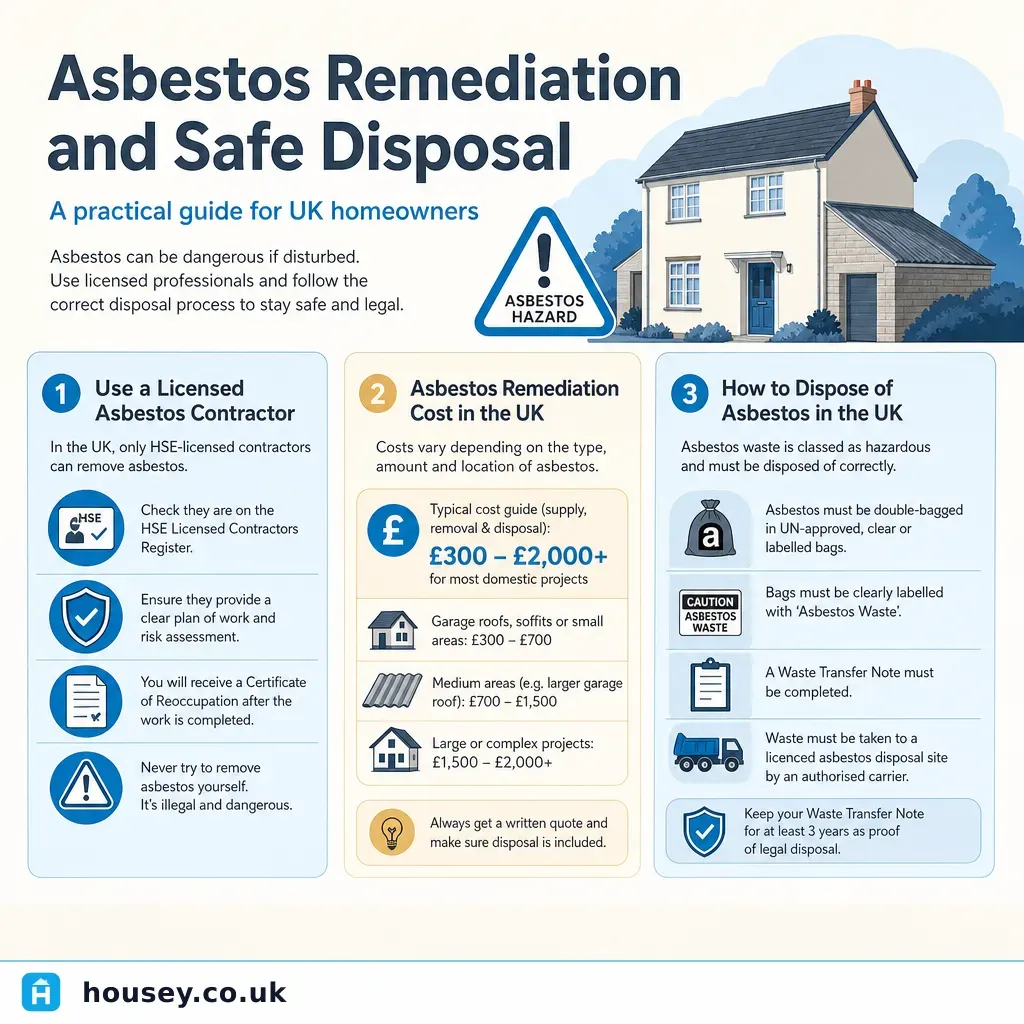
Asbestos Remediation and Safe Disposal
Properties built or refurbished before 2000 may contain asbestos-containing materials (ACMs), and disturbing these during building work or renovation carries serious health risks. Asbestos-related diseases — including mesothelioma, lung cancer, and asbestosis — can develop decades after exposure, which makes correct identification, safe remediation, and lawful disposal essential steps in any project that involves disturbing older building fabric.
Key points
- The Control of Asbestos Regulations 2012 (CAR 2012) is the primary UK legislation governing the management, removal, and disposal of asbestos-containing materials.
- All three commercial asbestos types — white (chrysotile), brown (amosite), and blue (crocidolite) — have been banned from use in UK buildings since 1999 and may be present in any property built or refurbished before that date.
- The highest-risk asbestos work — including removal of sprayed asbestos coatings and asbestos insulation board (AIB) — must be carried out by an HSE-licensed asbestos contractor.
- A refurbishment and demolition (R&D) survey, completed by a UKAS-accredited inspector, is required before any work that will disturb building fabric where asbestos may be present.
- All asbestos waste is classified as hazardous waste under the Hazardous Waste Regulations 2005 and must be transported by a registered carrier and disposed of at a permitted facility.
Asbestos types and where they are commonly found
All three main commercial asbestos types were banned from UK buildings by 1999. Any building constructed or significantly refurbished before 2000 should be treated as potentially containing ACMs until a survey confirms otherwise.
Material | Where typically found | Work category |
|---|---|---|
Sprayed asbestos coatings | Structural steelwork, ceiling voids in commercial and public buildings | Licensed work |
Asbestos insulation board (AIB) | Ceiling tiles, partition walls, fire doors, pipe boxing | Licensed work |
Pipe lagging and thermal insulation | Around boilers and older heating pipework | Licensed or NNLW depending on condition |
Asbestos cement (AC) sheets | Roof sheets, soffit boards, gutters, garage roofs, water tanks | Non-Licensed Work (NLW) |
Vinyl floor tiles and adhesive backing | Older residential and commercial floors | Non-Licensed Work (NLW) |
Textured decorative coatings (e.g. Artex) | Ceilings and walls in homes built pre-1990 | Non-Licensed Work (NLW) |
Gaskets and rope seals | Older boilers and industrial plant | Non-Licensed Work (NLW) |
Even materials in the non-licensed category require competent handling and appropriate precautions under CAR 2012. The classification relates to contractor licensing requirements, not an indication that the material is safe to disturb without controls.
The legal framework: Control of Asbestos Regulations 2012
CAR 2012 sets out the duties that apply to anyone working with, managing, or commissioning asbestos removal in the UK. The key requirements relevant to property owners and those commissioning building work include:
- Duty to manage (Regulation 4): Those responsible for the maintenance of non-domestic premises must identify ACMs and manage the risk. For domestic properties, the duty arises when commissioning works that may disturb building fabric.
- Survey requirement before work: A refurbishment and demolition (R&D) survey must be completed before any building work that could disturb ACMs where asbestos may be present.
- Notifiable Non-Licensed Work (NNLW): Certain lower-risk asbestos work must be notified to the relevant enforcing authority — HSE or the local authority Environmental Health Officer — at least 14 days before work commences, and workers must undergo health surveillance.
- Licensed work requirements: The highest-risk materials require a contractor holding a current HSE asbestos licence covering the specific work type.
- 4-stage clearance for licensed work: On completion of licensed removal, air monitoring must be carried out and a certificate of reoccupation issued before the area can be reoccupied.
Failure to comply with CAR 2012 may result in prohibition notices, enforcement action, or prosecution by the HSE.
Survey types: what you need before remediation
Selecting the correct survey type is an important first step before any asbestos remediation.
Management survey: Used for buildings in normal occupation that are not being refurbished or demolished. Access is limited and not fully intrusive. Suitable for managing known or suspected ACMs and informing an asbestos management plan — not sufficient as the sole basis for remediation works.
Refurbishment and demolition (R&D) survey: Fully intrusive survey required before any building work that will disturb the fabric of a building where asbestos may be present. The survey identifies, locates, and assesses the condition of all ACMs likely to be disturbed. It must be carried out by a competent surveyor — ideally one whose organisation is accredited by UKAS under ISO 17020 for inspection bodies. The R&D survey report forms the basis of the remediation plan and informs contractor specifications.
Licensed vs non-licensed asbestos work: the key distinction
Work category | Typical examples | Contractor requirement | Health surveillance | Notification |
|---|---|---|---|---|
Licensed work (LW) | Sprayed coatings removal, AIB removal, high-risk lagging removal | HSE-licensed contractor only | Required | Notify HSE |
Notifiable Non-Licensed Work (NNLW) | Minor asbestos cement work, lower-risk AIB under specific conditions | Competent contractor; specialist training required | Required | Notify HSE or EHO at least 14 days before work |
Non-Licensed Work (NLW) | Asbestos cement sheets, vinyl floor tiles, textured coatings, gaskets | Competent contractor; training required | Not mandatory | No notification required |
Always verify a contractor's current HSE licence status before instructing anyone to carry out licensed asbestos removal. The HSE maintains a public register of licensed asbestos contractors on its website.
Asbestos waste disposal: the legal requirements
Asbestos waste — including ACMs, contaminated personal protective equipment, dust, and associated debris — is classified as hazardous waste under the Hazardous Waste Regulations 2005. The specific requirements are:
- Packaging: ACMs must be double-bagged in UN-approved, clearly labelled asbestos waste sacks, or wrapped and sealed in polythene sheeting before transport.
- Carrier registration: Waste must be collected by a carrier registered with the Environment Agency (England), Natural Resources Wales, SEPA (Scotland), or NIEA (Northern Ireland) as a hazardous waste carrier.
- Licensed disposal site: Asbestos waste must be taken to a permitted hazardous waste landfill or licensed transfer station — it cannot be deposited at a household waste recycling centre, in a general skip, or in household refuse.
- Consignment notes: A hazardous waste consignment note must accompany each load. The consignor must retain their copy for a minimum of three years.
Disposing of asbestos waste unlawfully is a criminal offence under both environmental and health and safety legislation.
Red flags when hiring an asbestos contractor
The following warning signs suggest a contractor may not be operating correctly:
- No current HSE licence for the proposed scope of work — check the HSE public licensed contractor register before instructing anyone.
- Unable or unwilling to provide their asbestos licence, evidence of worker training, or public liability insurance documentation.
- Does not mention a refurbishment and demolition survey as a prerequisite, or discourages you from having one.
- Cannot explain the 4-stage clearance process or does not propose to arrange post-removal air monitoring.
- Proposes to dispose of asbestos waste in a general skip or makes no mention of hazardous waste consignment notes.
- Substantially lower price than all other quotes with no clear explanation of scope differences.
- No written risk assessment and method statement (RAMS) provided before works commence.
Important limitations
This article provides general information about the asbestos remediation and disposal process in the UK and is not a substitute for professional advice tailored to your specific property and circumstances. The classification of asbestos work, the correct survey type required, and the applicable regulatory framework can vary based on the type and condition of materials present, the nature of the proposed works, and whether the premises are domestic or non-domestic.
The Health and Safety Executive (HSE) is the primary source of authoritative guidance on asbestos management in Great Britain. If you suspect a material may contain asbestos, do not disturb it. Keep the area undisturbed, restrict access, and arrange an assessment with a UKAS-accredited surveyor.
What to ask a qualified professional
Before instructing an asbestos surveyor or remediation contractor, ask:
- Are you UKAS-accredited for asbestos surveying, or do you hold a current HSE asbestos licence for the specific type of removal work proposed?
- Can I see your current HSE licence and confirm its scope covers the materials in question?
- Will a refurbishment and demolition survey be completed and reported before any removal work begins?
- What does the 4-stage clearance process involve, and who will carry out the post-removal air monitoring?
- How will asbestos waste be packaged and transported? Can I see your Environment Agency hazardous waste carrier registration?
- Will I receive a written risk assessment and method statement (RAMS) before works commence?
- What is the procedure if additional ACMs are discovered during the works?
- Will I receive copies of all hazardous waste consignment notes for my records?
When to get professional help
Arrange a professional asbestos assessment without delay if:
- You are planning any refurbishment, extension, or building work on a property built or refurbished before 2000.
- Any building material is crumbling, damaged, or likely to be disturbed during maintenance or repair.
- You are purchasing a property built before 2000 and want to understand the asbestos position before exchanging contracts.
- You are a landlord or duty holder with asbestos management responsibilities in non-domestic premises.
- Building materials suspected of containing asbestos have already been disturbed — stop work immediately, seal off the area, and contact an asbestos specialist.
Do not attempt to remove, sample, cut, drill, or otherwise disturb any material suspected of containing asbestos. Even small disturbances can release airborne fibres that are invisible to the naked eye and cause serious long-term harm.
How Housey can help
Housey can help you find and compare qualified asbestos survey specialists across the UK. Whether you need a management survey, a refurbishment and demolition survey before building works, or guidance on finding a licensed remediation contractor, Housey connects you with accredited professionals who can assess your property and provide written reports and quotes.
Frequently asked questions
How do I know if my property contains asbestos?
There is no reliable way to confirm the presence of asbestos by sight alone — only sampling and laboratory analysis can confirm it. Any property built or refurbished before 2000 should be treated as potentially containing ACMs. A management survey or refurbishment and demolition survey by a UKAS-accredited surveyor is the only reliable method for identifying and assessing ACMs before any building work begins.
Can I remove asbestos myself?
For licensed asbestos materials — such as asbestos insulation board and sprayed coatings — no: removal must be carried out by an HSE-licensed contractor. For non-licensed materials, competent contractors with appropriate training can undertake the work, but compliance with CAR 2012 is still required. The HSE strongly discourages any DIY disturbance of suspected asbestos-containing materials due to serious long-term health risks from fibre release.
How much does asbestos removal cost in the UK?
Costs vary based on the type, quantity, and location of ACMs and the work category. Indicative UK costs (last reviewed 2026-05-05): a management survey for a typical house may cost £250–£500; an R&D survey £400–£800+; removal of asbestos cement roof sheets from a domestic garage approximately £600–£1,500; licensed AIB removal from a single room can range from £1,000 to £5,000+. Always obtain at least two written, itemised quotes.
What is the difference between a management survey and a refurbishment and demolition survey?
A management survey locates and assesses ACMs in a building in normal occupation with limited intrusive access, supporting an ongoing asbestos management plan. A refurbishment and demolition (R&D) survey is fully intrusive and is required before any building work that will disturb fabric in a pre-2000 building. Always commission an R&D survey as the basis for any remediation works.
How long does asbestos removal take?
Timescales depend on the type and quantity of ACMs, the work category, and the complexity of the area. A single licensed removal job — for example, removing AIB ceiling tiles from one room — might take two to three days including setup, removal, and 4-stage clearance. Larger projects requiring decontamination units and air monitoring across multiple areas can take considerably longer.
Sources and further reading
- HSE: Asbestos guidance — Health and Safety Executive
- Control of Asbestos Regulations 2012 — legislation.gov.uk
- HSE: Licensed asbestos contractor register — Health and Safety Executive
- HSE: Types of asbestos work — Health and Safety Executive
- GOV.UK: Hazardous waste — your responsibilities — GOV.UK
- UKAS: Inspection body accreditation — United Kingdom Accreditation Service
Useful next reads
 Surveys & Inspections
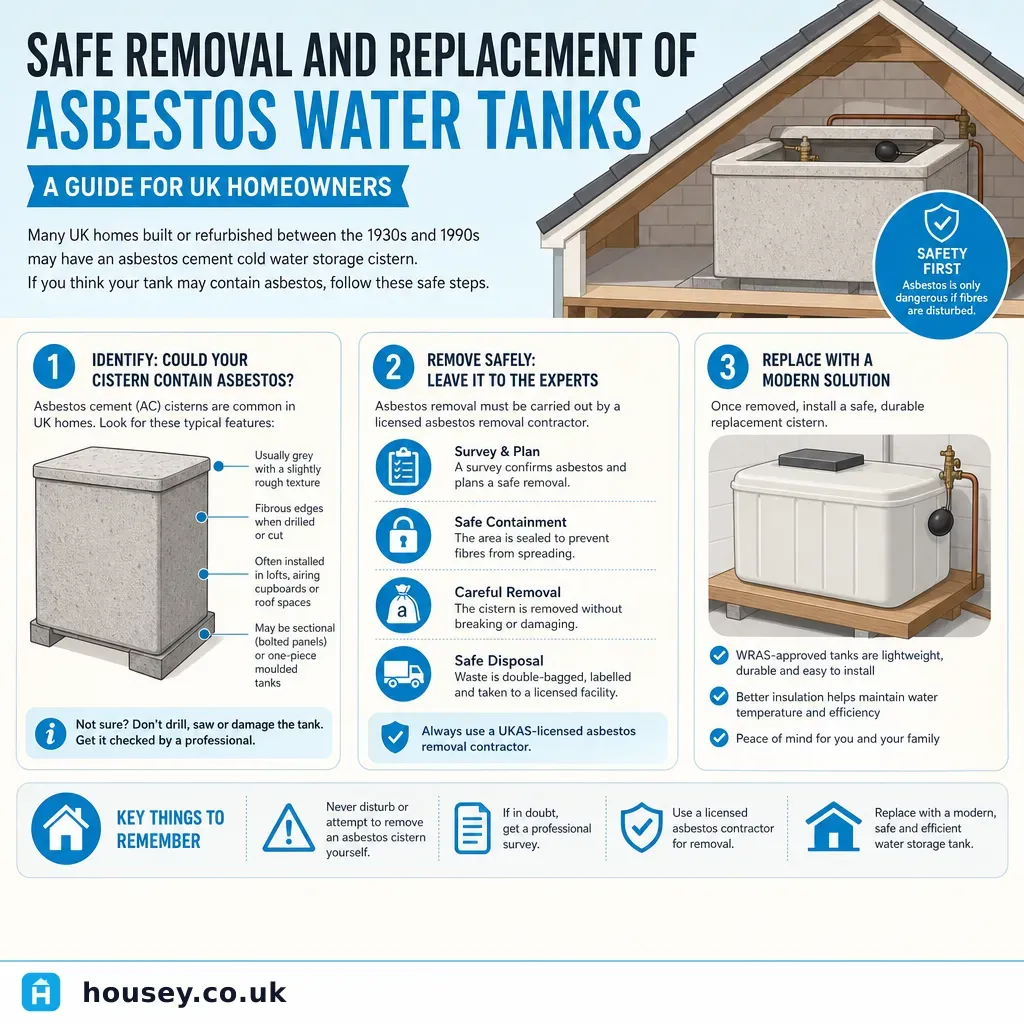
Safe Removal and Replacement of Asbestos Water Tanks
Asbestos cement cold water tanks, found in many UK homes built before about 1980, must not be drilled, cut, or broken without proper controls.
 Surveys & Inspections
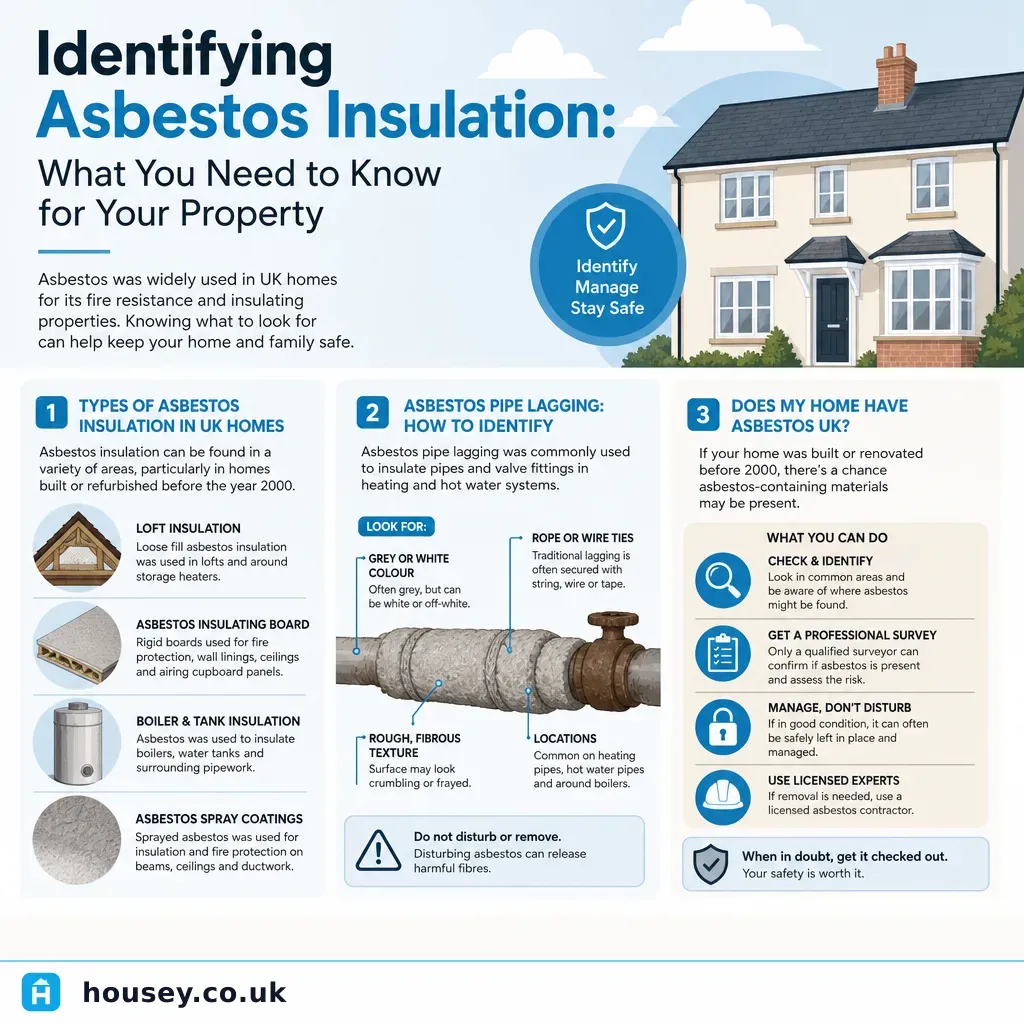
Identifying Asbestos Insulation: What You Need to Know for Your Property
Asbestos insulation was widely used in UK properties built before 2000, commonly found in pipe lagging, ceiling tiles, loose-fill loft insulation, and around boilers.
 Surveys & Inspections
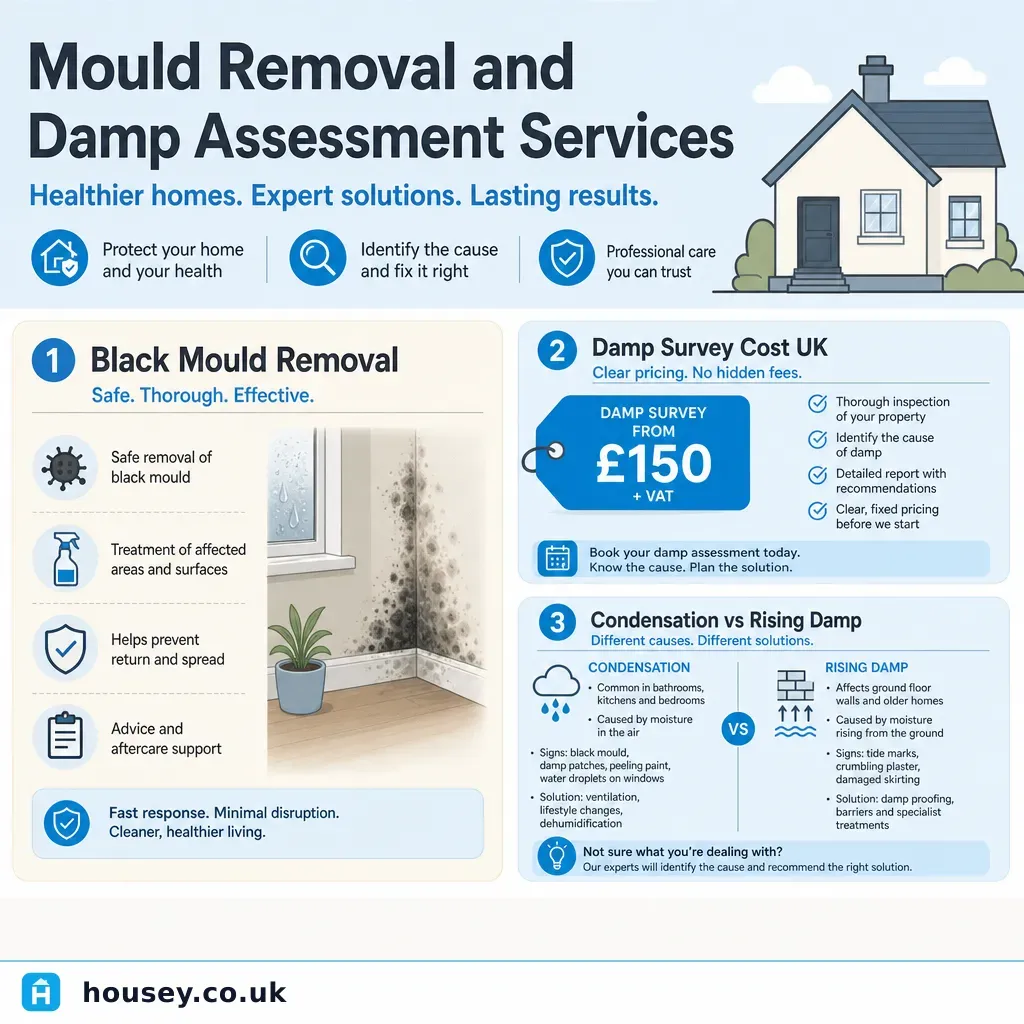
Mould Removal and Damp Assessment Services
Professional mould removal and damp assessment starts with identifying the moisture source—condensation, rising damp, or penetrating damp—before any treatment begins.
 Surveys & Inspections
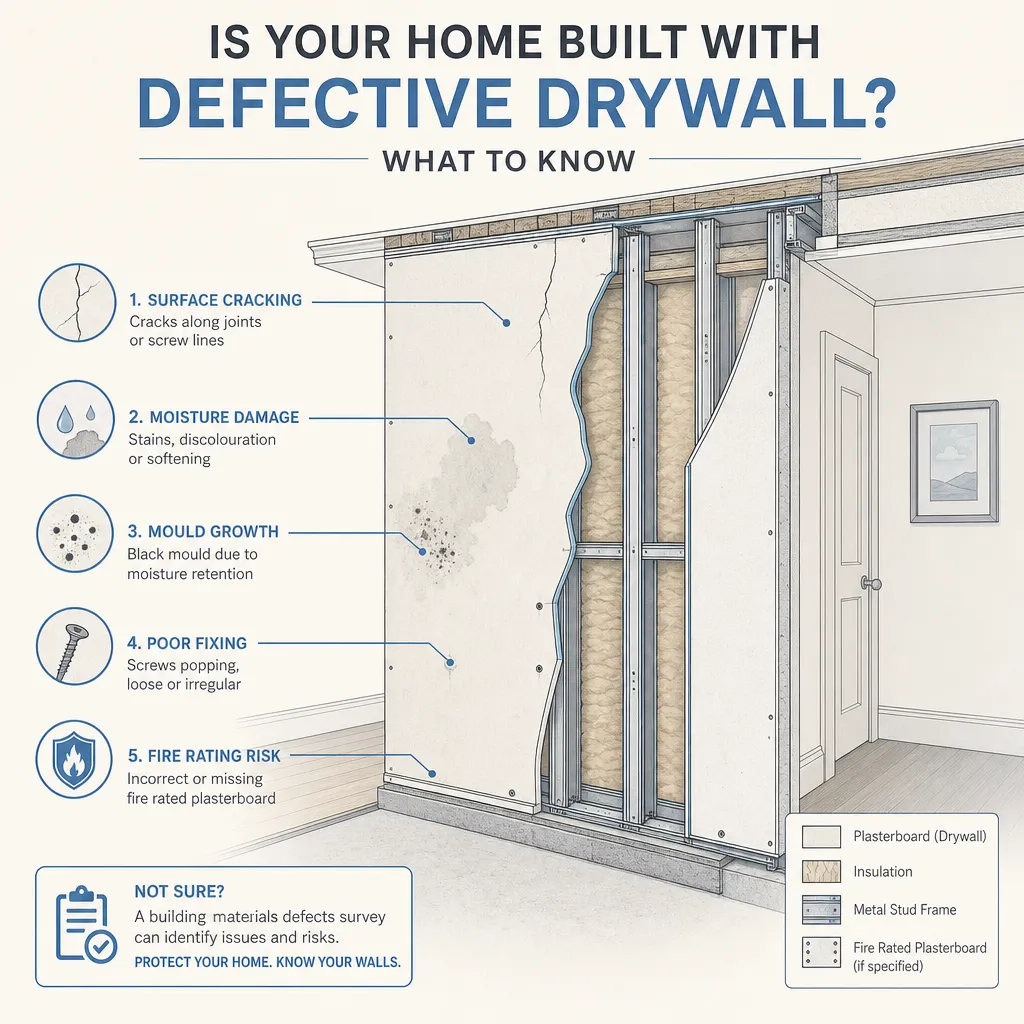
Is Your Home Built with Defective Drywall? What to Know
Contaminated Chinese drywall — as seen in US homes built 2001 to 2009 — is not a documented widespread problem in UK properties, where plasterboard is manufactured primarily to European standards.
 Surveys & Inspections
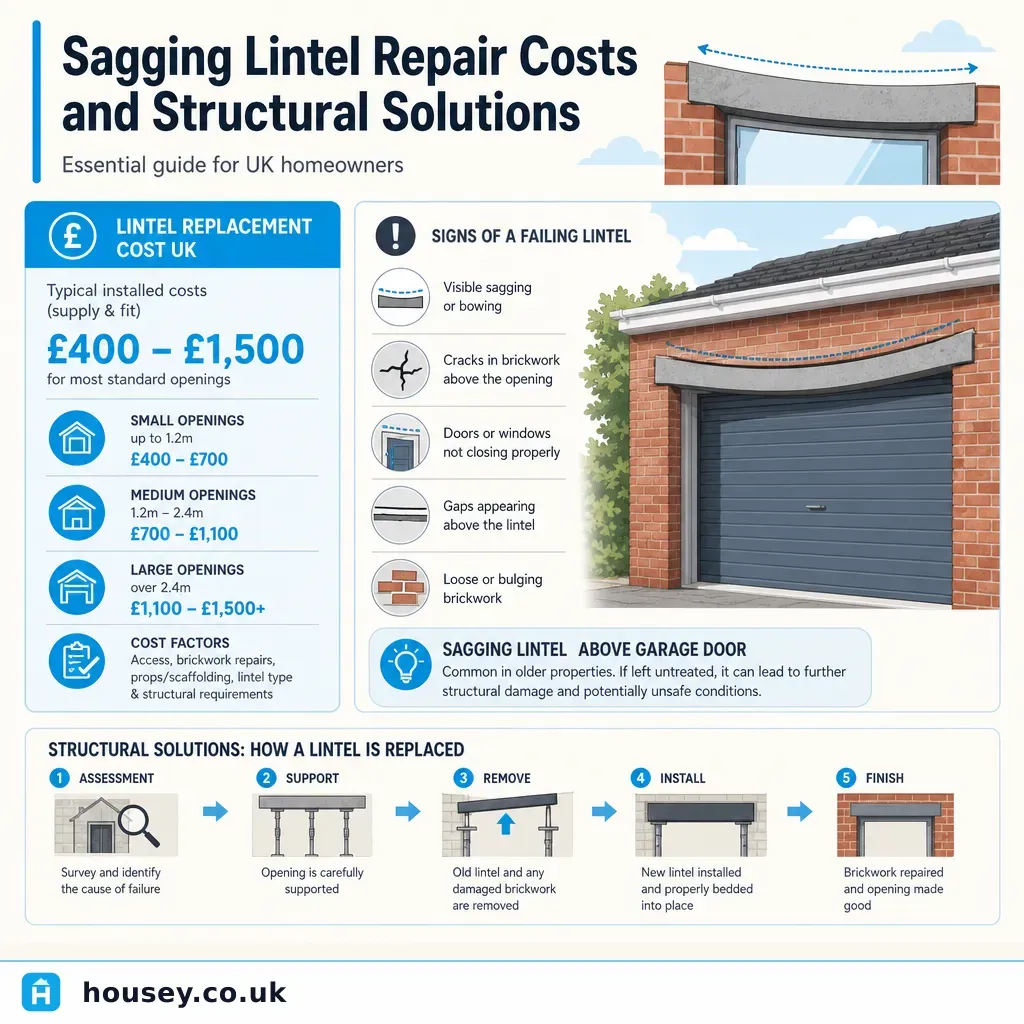
Sagging Lintel Repair Costs and Structural Solutions
A sagging lintel is a structural defect requiring prompt professional assessment.