Mould Removal and Damp Assessment Services
By Housey · Last reviewed 31st of May 2026
Mould Removal and Damp Assessment Services
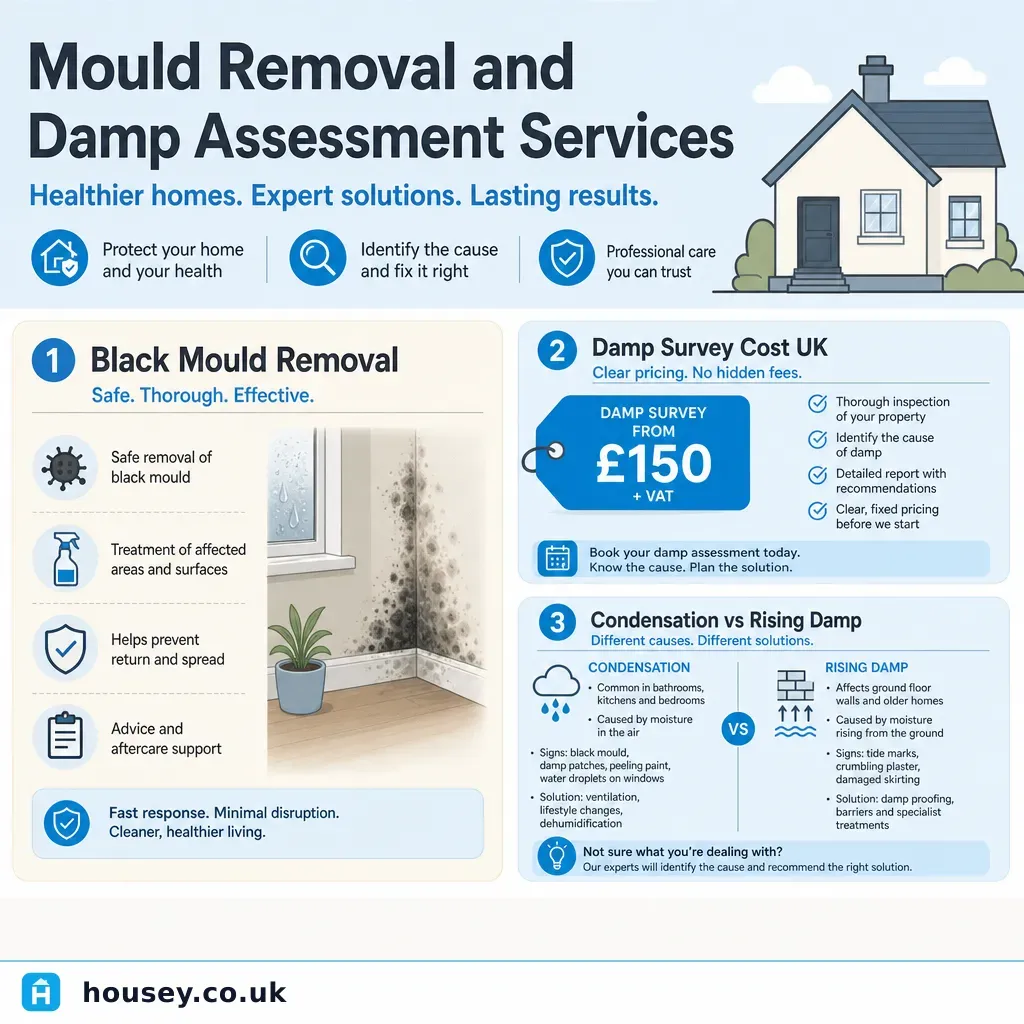
Damp and mould are among the most persistently misdiagnosed problems in UK housing stock. When black mould appears on bedroom walls or plaster shows tide marks near skirting boards, the instinct is often to treat immediately—but without identifying whether the cause is condensation, rising damp, or penetrating damp, any remediation is likely to prove temporary. The question of which service to instruct arises for homeowners who have cleaned mould repeatedly only to see it return, and for buyers who have received a flag in a RICS survey and need to understand what it means.
Key points
- Rising damp travels through masonry by capillary action and rarely reaches above 1–1.5 m above floor level; damp appearing higher on a wall is almost always penetrating damp or condensation-related.
- BS 5250:2021 is the British Standard governing the management of moisture in buildings; PAS 2035 sets the standard for moisture risk assessment in whole-house retrofit projects.
- Black mould species including Stachybotrys chartarum and Cladosporium are classified by HSE as potential respiratory irritants; large-scale mould remediation (over 1 m²) should be carried out by a trained operative using appropriate RPE.
- RICS-registered surveyors and Property Care Association (PCA)-accredited surveyors are the recognised professionals for independent damp assessment in England and Wales.
- A damp-proof course (DPC) is required under Building Regulations Approved Document C; chemical injection DPC carries a typical guarantee of 20–30 years from PCA-member installers.
What causes damp and mould in UK homes?
Three distinct mechanisms cause damp in UK homes, and each requires a different remedy. Conflating them—or applying the wrong treatment—is the most common and costly mistake.
Cause | Typical signs | Typical location | Primary fix |
|---|---|---|---|
Condensation | Black mould on cold surfaces, north-facing walls, window reveals | Bathrooms, kitchens, bedrooms, corners | Improved ventilation (MEV, MVHR, trickle vents); thermal bridging reduction |
Rising damp | Tide mark up to ~1 m, salt crystallisation, plaster damage near floor | Ground-floor walls at base | DPC repair or chemical injection; tanking |
Penetrating damp | Damp patches linked to rain, often higher on the wall; worse after rainfall | External walls, around windows, chimneys, parapets | Repair of external defect: repointing, flashing, render |
Condensation is by far the most common cause of mould in UK homes—particularly in post-1960s properties with poor ventilation, and in heavily insulated homes where cold bridges promote surface moisture.
Which professional do I need?
Choosing the wrong professional for a damp problem often generates unnecessary work and cost. A contractor who both surveys and installs remediation has a commercial interest in the outcome; an independent survey from a RICS-registered or PCA-accredited surveyor is usually a better starting point.
Situation | Recommended professional | Why |
|---|---|---|
Recurring mould, no obvious source | RICS-registered or PCA-accredited independent surveyor | Impartial diagnosis before committing to remediation |
Confirmed rising damp | PCA-accredited damp-proofing specialist | Can survey, specify, and carry out injection DPC |
Mould linked to cold roof space or poor insulation | Retrofit assessor or ventilation engineer | May require PAS 2035 assessment if part of a wider energy-efficiency programme |
Large-scale mould (>1 m²) | Specialist remediation contractor with HSE-compliant procedures | Requires containment and appropriate RPE; not a DIY task |
Damp linked to roof, parapet, or chimney | Roofing contractor or structural surveyor | External defect must be repaired before any internal treatment |
Decision tree: survey or remediation first?
- Arrange a professional damp survey first if: the mould recurs despite repeated cleaning, the damp patch is on an external wall, you can see tide marks or salt deposits near the skirting, or the property is over 20 years old.
- Proceed to remediation if: an independent survey has already confirmed the root cause has been resolved, and the affected area is under 0.5 m² and clearly linked to condensation in a poorly ventilated room.
- Ask a structural surveyor if: cracks are present alongside the damp patch, the damp appeared after structural work nearby, or the building is listed or of unusual construction.
- Contact your local authority environmental health team if: the property is rented and the landlord has not responded to repair requests—the Homes (Fitness for Human Habitation) Act 2018 may apply.
What a professional damp and timber survey involves
A professional damp and timber survey from an independent surveyor typically takes 1–3 hours and covers:
- Moisture meter readings at multiple points across walls, floors, and skirtings
- Visual inspection of external walls, gutters, downpipes, pointing, and render condition
- Ventilation assessment—trickle vents, extractor fans, sub-floor ventilation bricks
- Inspection of the DPC level and any materials bridging it (soil build-up, rendered paths, external paving)
- Roof space inspection if accessible
- Written report with diagnosis, recommended remediation options, and indicative costs
Indicative UK costs: £200–£500 for a standalone damp and timber survey from an independent surveyor. Free surveys offered by damp-proofing contractors should be treated with caution—the commercial model can incentivise over-specification of remediation works. Indicative costs, last reviewed 2026-05-31; quotes vary by location, property size, and surveyor.
Important limitations
This guide provides general information about damp assessment and mould removal in UK residential properties. Damp diagnosis is inherently complex—moisture often has multiple concurrent causes, and the appropriate remedy depends on a full site inspection. Nothing in this article constitutes a survey, structural assessment, or professional recommendation for a specific property. Professional qualifications, guarantee terms, and remediation requirements can vary by property type and region.
What to ask a qualified professional
Before instructing a damp surveyor or remediation contractor, ask:
- Are you RICS-registered or PCA-accredited, and can you confirm your membership number?
- Is this survey paid and independent, or does the fee contribute to a subsequent remediation quote?
- Will you assess all three potential causes—condensation, rising damp, and penetrating damp—and provide moisture meter readings?
- Will the report include a written diagnosis, photographs, and specific remediation options?
- If you recommend injection DPC or tanking, what guarantee do you provide, and is it insurance-backed through the PCA guarantee scheme?
- What ventilation improvements do you recommend alongside any physical damp-proofing works?
When to get professional help
Arrange a professional damp and timber survey without delay if:
- Mould covers more than 1 m² of wall or ceiling surface
- A household member has asthma, COPD, or a compromised immune system
- The damp patch has expanded over several weeks with no change in weather conditions
- Salt crystallisation (efflorescence) is visible on internal plaster—this indicates moisture has been migrating through the wall for some time
- The property is going on the market and a buyer's survey is likely to flag the issue
How Housey can help
Housey connects you with independent damp and timber survey professionals and damp proofing specialists who can assess your property, diagnose the root cause, and recommend the appropriate remediation—without the conflict of interest that arises when a contractor surveys and treats.
Frequently asked questions
Can I remove black mould myself?
Small areas of surface mould on paintwork (under 0.5 m²), where the underlying cause has been fixed, can be cleaned with a dilute bleach solution or a proprietary mould cleaner with adequate ventilation. For areas larger than 1 m², or where mould has penetrated plasterboard, HSE guidance recommends a trained contractor using appropriate respiratory protective equipment (RPE).
Does a damp survey affect my house sale?
A report from a PCA-accredited independent surveyor can support a sale by showing the problem has been properly diagnosed and any remediation is guaranteed. Unresolved damp flagged in a buyer's RICS Level 2 or Level 3 survey is more likely to cause a price reduction or abortive transaction than a resolved, documented issue.
How long does damp treatment last?
Chemical injection DPC from a PCA-member contractor typically carries a 20–30 year guarantee, provided the external moisture source—bridged DPC, failed render, drainage problem—has also been addressed. Surface mould treatments applied without resolving the underlying moisture source have no meaningful service life.
Is condensation damage covered by home insurance?
Most standard UK home insurance policies exclude gradual damage caused by condensation or inadequate ventilation. Sudden water ingress from a burst pipe or storm damage is usually covered—check your policy schedule carefully and speak to your insurer before instructing contractors.
Sources and further reading
- Homes (Fitness for Human Habitation) Act 2018 guidance — GOV.UK
- HSE: biological agents and mould guidance — Health and Safety Executive
- Building Regulations Approved Document C: site preparation and resistance to moisture — GOV.UK
- English Housing Survey 2022–23 headline report — Department for Levelling Up, Housing and Communities
- Property Care Association: damp surveying accreditation — Property Care Association
Useful next reads
 Surveys & Inspections
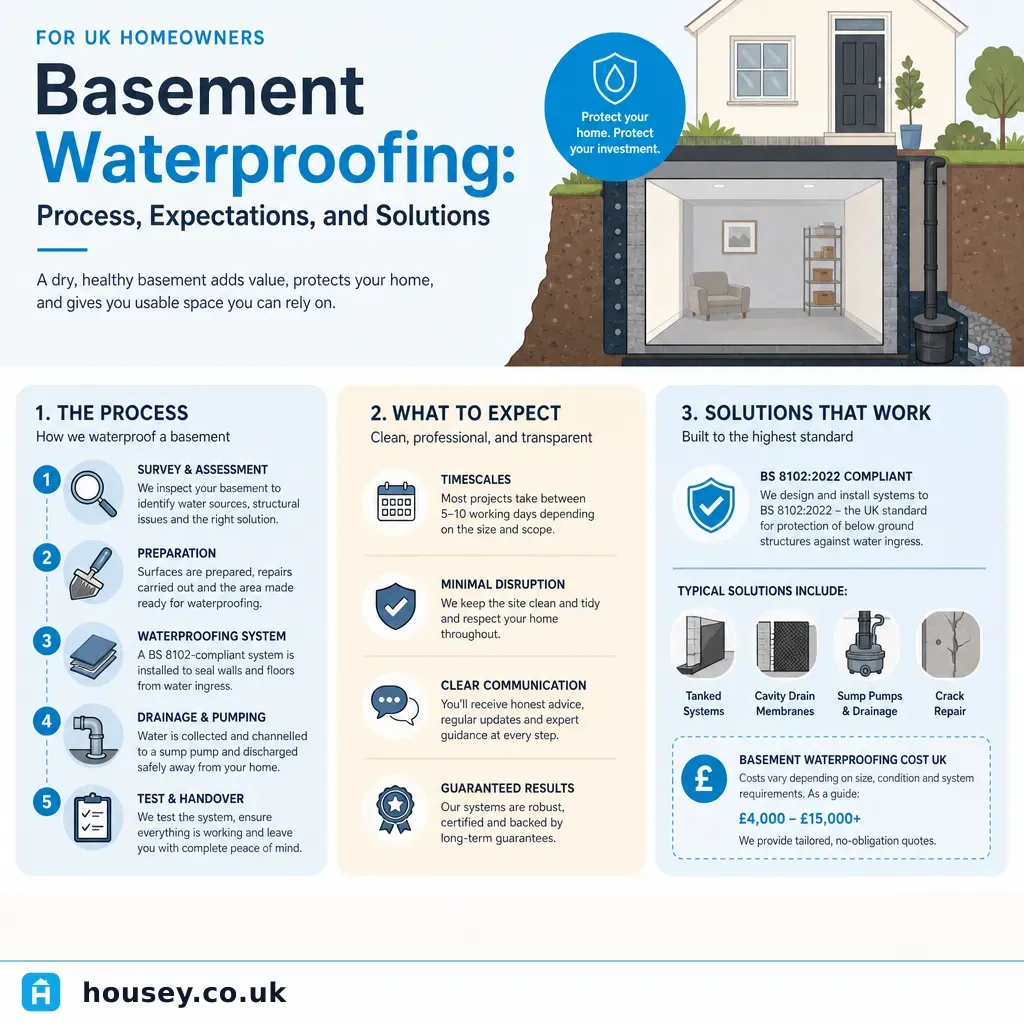
Basement Waterproofing: Process, Expectations, and Solutions
Basement waterproofing in the UK is governed by BS 8102:2022, which defines three protection grades and three system types: Type A barrier tanking, Type B structurally integral concrete, and Type C cavity drain membranes.
 Surveys & Inspections
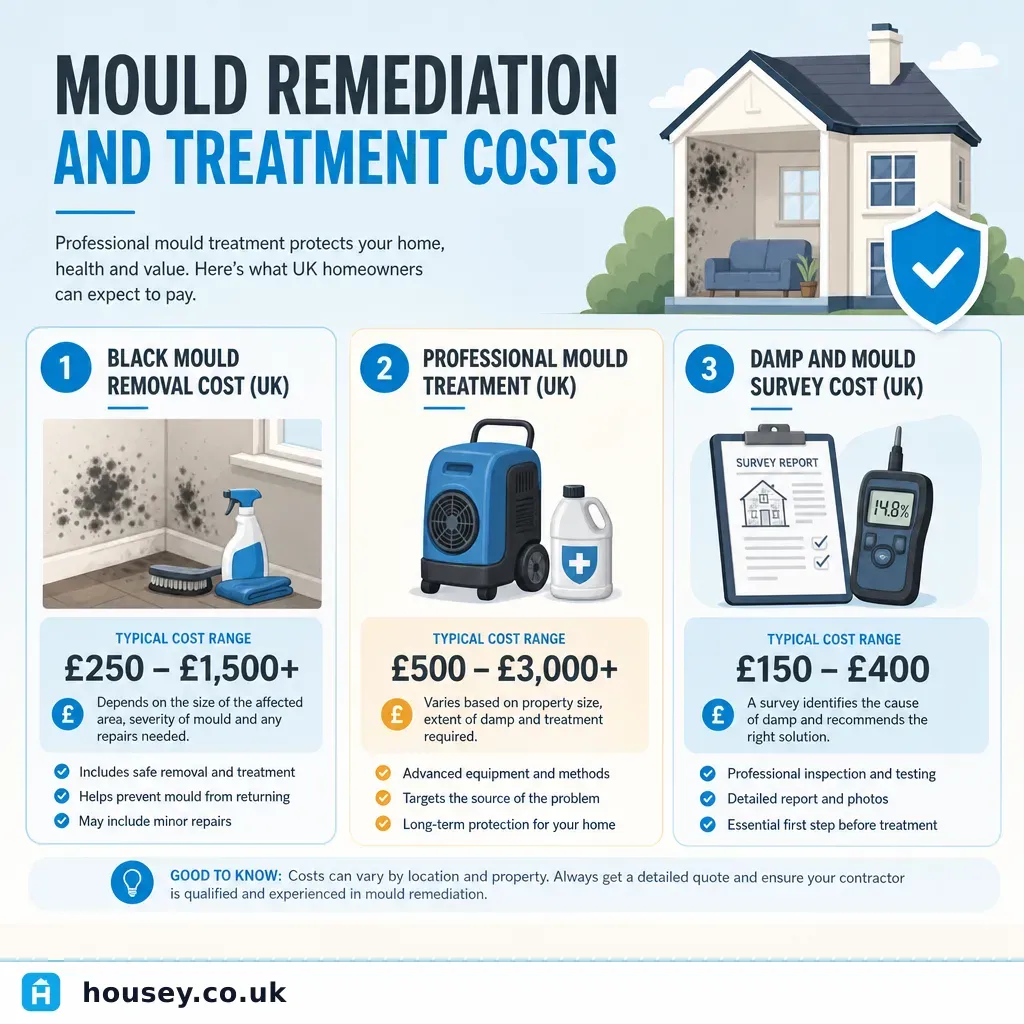
Mould Remediation and Treatment Costs
Professional mould remediation in the UK typically costs £150–£1,500+ depending on the extent of growth, underlying cause, and materials affected.
 Surveys & Inspections
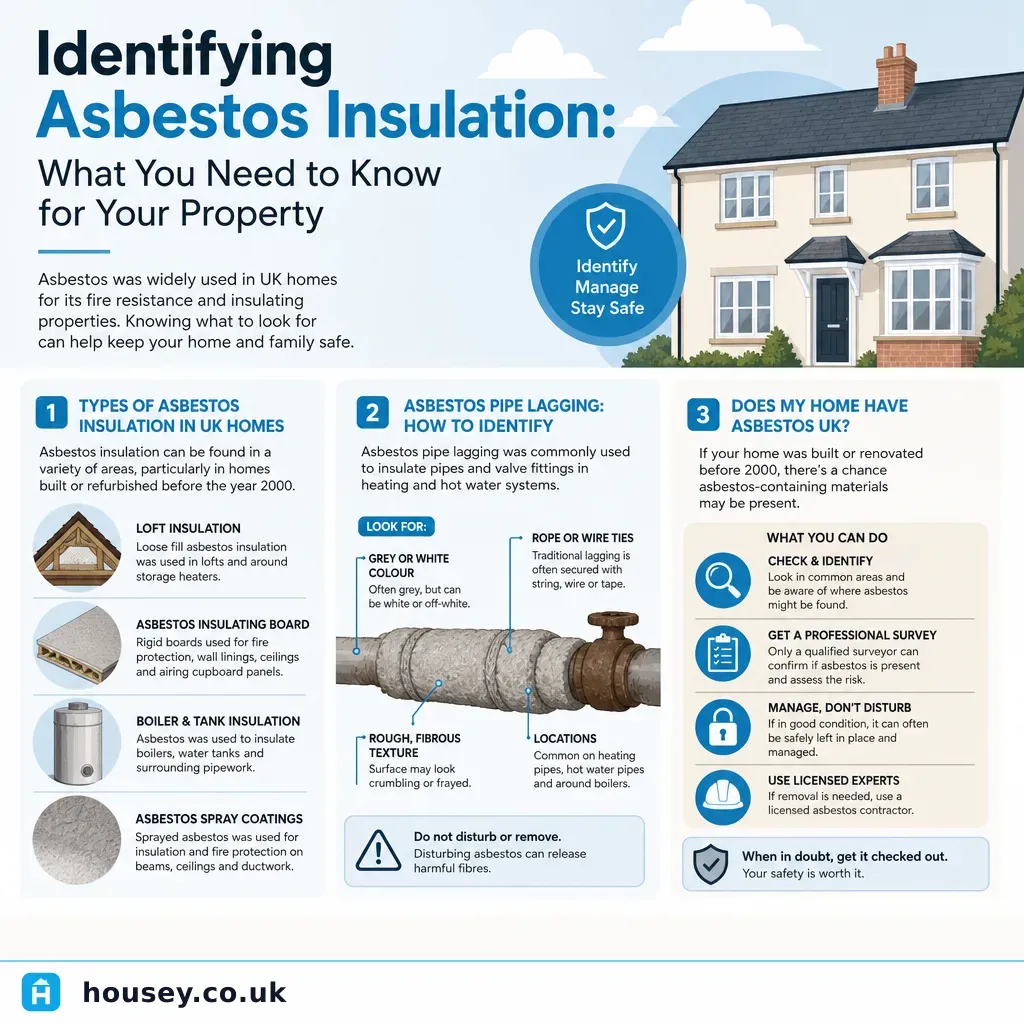
Identifying Asbestos Insulation: What You Need to Know for Your Property
Asbestos insulation was widely used in UK properties built before 2000, commonly found in pipe lagging, ceiling tiles, loose-fill loft insulation, and around boilers.
 Surveys & Inspections
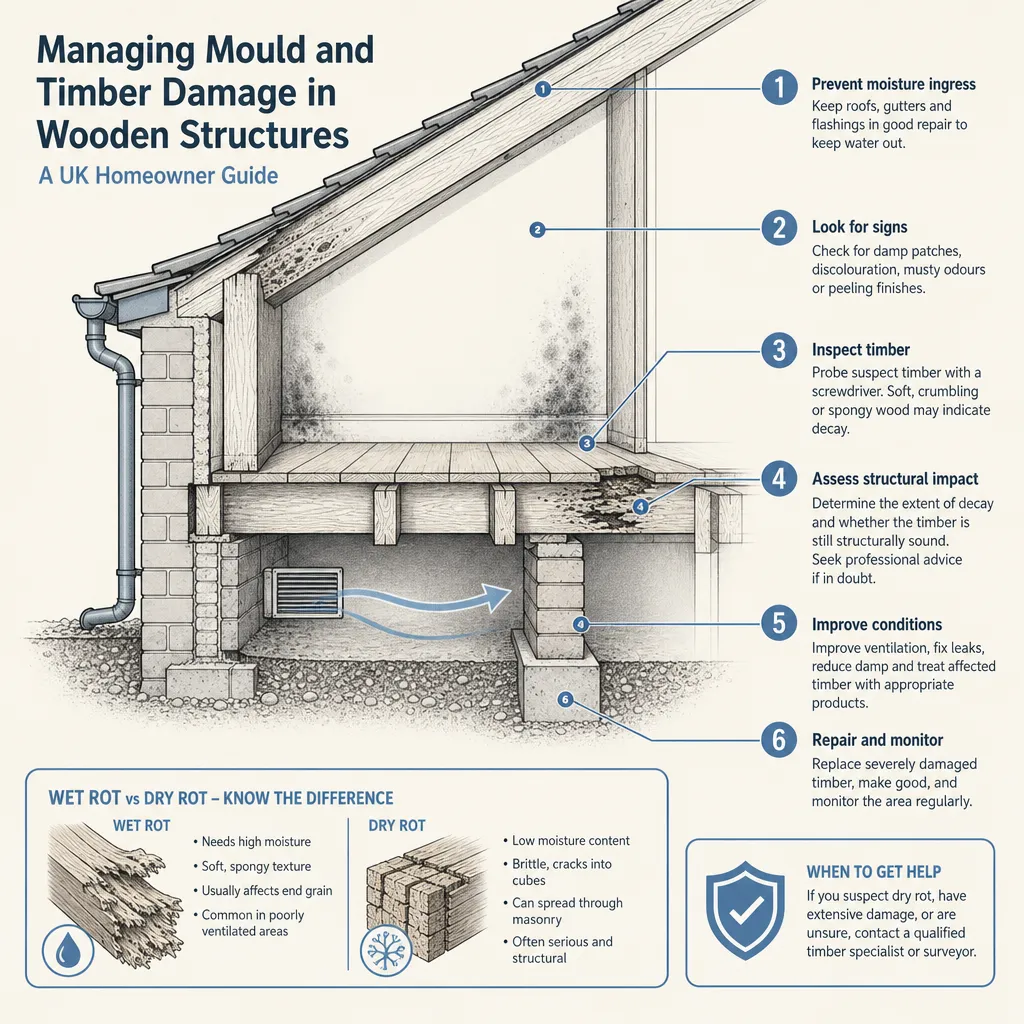
Managing Mould and Timber Damage in Wooden Structures
Mould and timber decay in wooden structures are usually symptoms of excess moisture rather than standalone problems.
 Surveys & Inspections
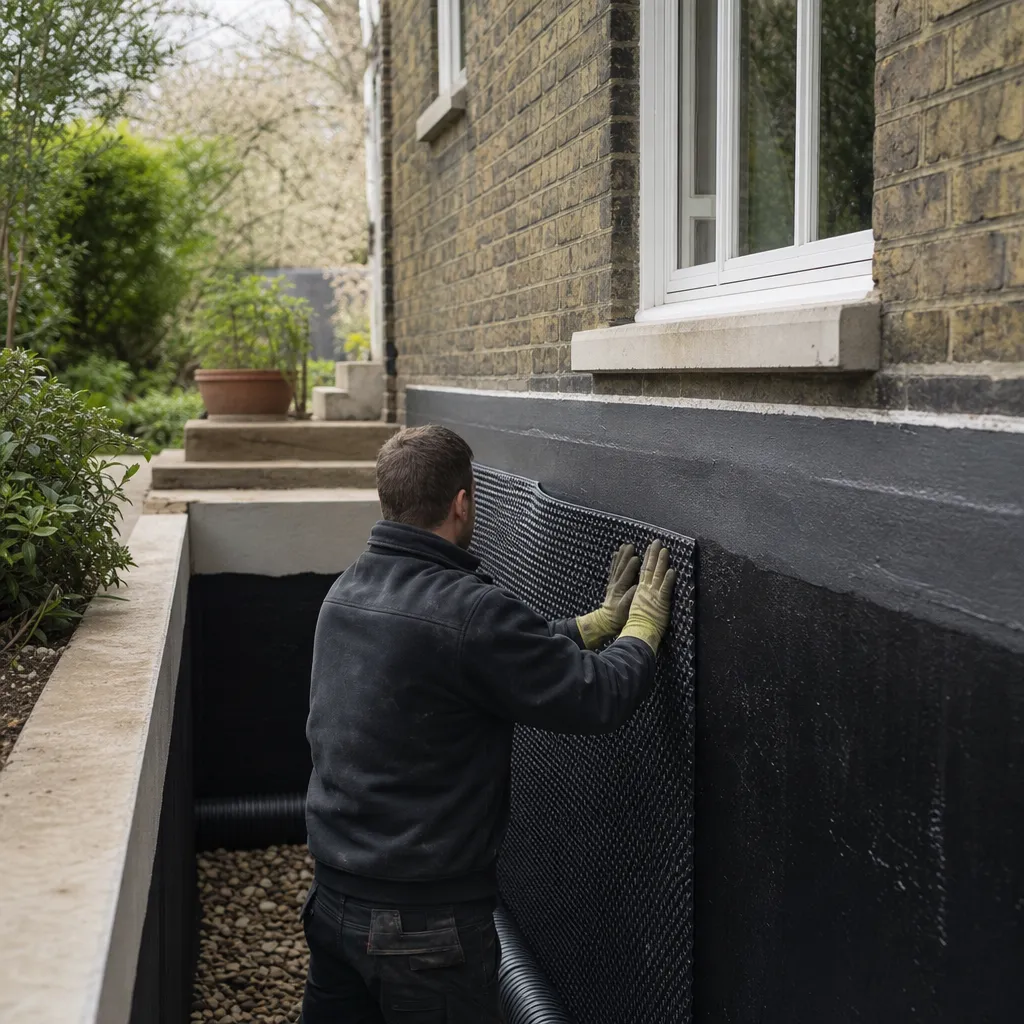
Basement Waterproofing Solutions for Damp Prevention
Basement waterproofing in the UK is governed by BS 8102:2022, which defines three system types: Type A (barrier coatings), Type B (structurally integral concrete), and Type C (cavity drain membrane with sump pump).