Understanding Asbestos Removal: Assessment, Regulation, and Safe Remediation
By Housey · Last reviewed 18th of May 2026
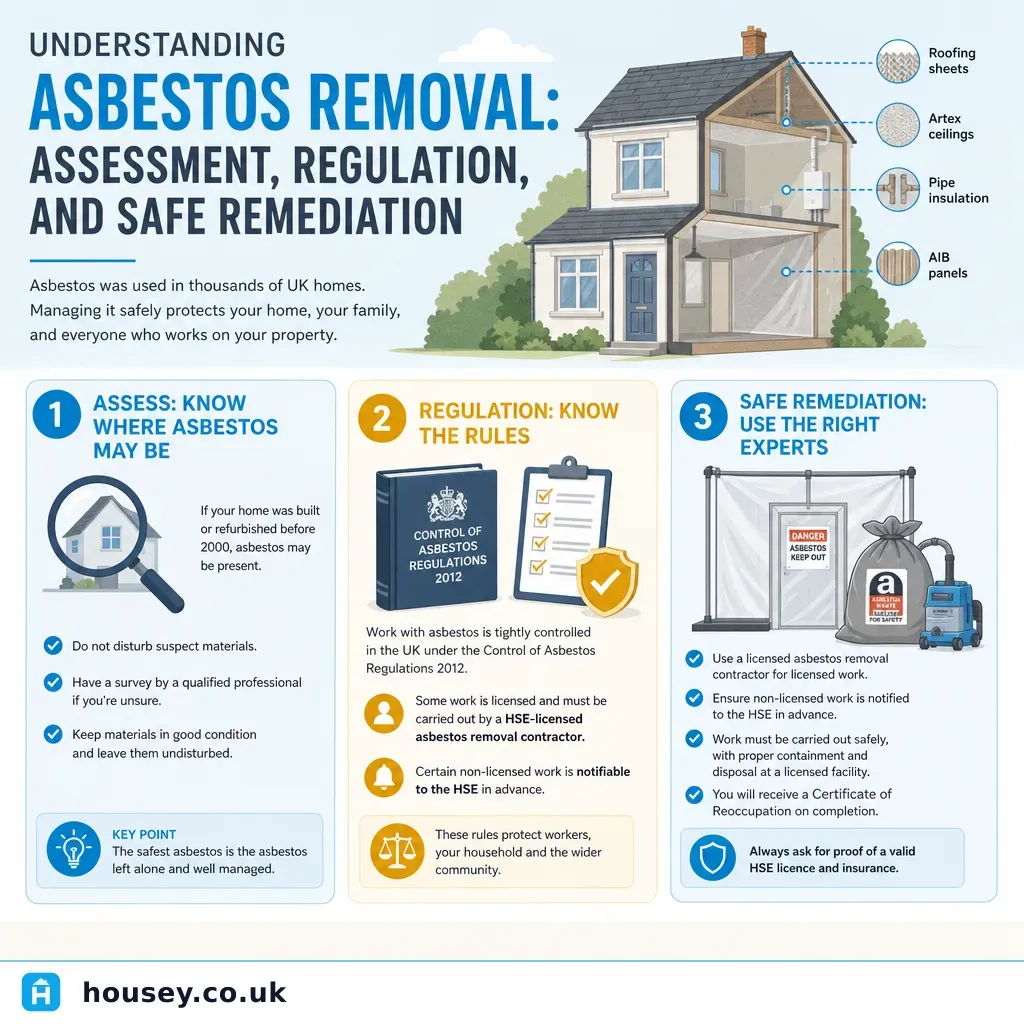
Understanding Asbestos Removal: Assessment, Regulation, and Safe Remediation
Asbestos-containing materials (ACMs) are present in millions of UK homes and commercial buildings constructed before 2000. When renovation or demolition work disturbs these materials, the fibres released can cause serious lung diseases including mesothelioma and asbestosis. The legal framework governing asbestos removal in the UK is strict, and certain categories of work may only be carried out by contractors licensed by the HSE.
Key points
- The Control of Asbestos Regulations 2012 (CAR 2012) is the primary UK legislation governing asbestos work; it applies to all non-domestic premises and to domestic properties where contractors are working.
- Licensable work — including removal of asbestos insulation, asbestos insulation board (AIB), and asbestos coating — must be carried out by a contractor holding a current licence from the HSE.
- Notifiable Non-Licensed Work (NNLW) must be notified to the relevant enforcing authority at least 14 days before work begins using the HSE's ASB5 notification process.
- Asbestos was banned from use in UK construction in 1999; any building constructed or last substantially refurbished before that date may contain ACMs.
- Asbestos waste is classified as hazardous waste and must be consigned to a licensed disposal facility under the Environmental Permitting (England and Wales) Regulations 2016 and equivalent devolved legislation.
When is asbestos removal necessary?
Asbestos does not always need to be removed. If ACMs are in good condition and will not be disturbed by building work or normal occupation, leaving them in place and managing them is often the preferred approach — particularly for materials encapsulated in a stable matrix such as floor tiles or textured coatings in sound condition.
Removal is typically necessary when:
- The ACM is in poor or deteriorating condition and is generating, or likely to generate, fibres.
- Renovation, refurbishment, or demolition work will disturb the material.
- The ACM poses an ongoing risk that cannot be managed by encapsulation or monitoring alone.
- A Refurbishment and Demolition Survey has identified ACMs in areas to be worked on.
Types of asbestos removal work
Under CAR 2012, asbestos work is divided into three categories with different legal requirements.
Category | Common examples | Legal requirement |
|---|---|---|
Licensable work | Asbestos insulation (pipe lagging, loose fill), asbestos insulation board (ceiling tiles, fire doors), asbestos coating | HSE-licensed contractor only; notify HSE at least 14 days before work; air monitoring and health surveillance required |
Notifiable Non-Licensed Work (NNLW) | Textured coatings containing more than 0.1% asbestos; some short-duration AIB work | Notify enforcing authority at least 14 days before work; health records required; no licence required |
Non-licensed work | Asbestos cement in good condition (garage roofs, guttering) in short-duration, low-disturbance conditions | No licence or notification required, but CAR 2012 still applies; risk assessment and protective measures needed |
For most homeowners commissioning renovation work, the critical question is whether the contractor holds a current HSE licence if licensable materials are present. The HSE maintains a searchable public register of licensed asbestos removal contractors (LARCs).
How asbestos removal works in practice
A licensed asbestos removal project typically follows these steps:
1. Refurbishment and Demolition Survey: Confirms the location, type, and condition of ACMs in the work area. A survey must be completed before any refurbishment or demolition work begins — a management survey alone is not sufficient.
2. Method statement and risk assessment: The licensed contractor prepares detailed documentation before work starts, covering scope of removal, controls, personal protective equipment (PPE), decontamination procedures, and the disposal route.
3. HSE notification: For licensable work, the HSE must be notified at least 14 days in advance using the online ASB5 form.
4. Site preparation and enclosure: The work area is sealed using polythene sheeting and negative pressure units (NPUs) to prevent fibre spread into adjacent areas. Warning signs must be displayed.
5. Removal: Operatives certificated in asbestos removal and wearing appropriate respiratory protective equipment (RPE) and disposable coveralls remove the ACM, using wet methods to suppress fibre release where practicable.
6. Air monitoring: Air monitoring is carried out during and after removal — usually by an independent UKAS-accredited analytical laboratory — to verify that fibre levels remain below the control limit of 1 fibre per cubic centimetre as a 4-hour time-weighted average (TWA).
7. Four-stage clearance procedure: Before the enclosure is dismantled, an independent analyst carries out a visual inspection, background air sampling, aggressive sampling under disturbed conditions, and a final clearance check.
8. Waste disposal: Asbestos waste is double-bagged in UN-approved sacks, labelled with the appropriate hazard mark, and transported to a licensed hazardous waste site with correct consignment note documentation.
How much does asbestos removal cost?
Indicative UK costs, last reviewed 2026-05-18. Costs vary significantly by material type, quantity, access conditions, location, and disposal charges. Always obtain at least two quotes from HSE-licensed contractors.
Project type | Indicative cost range |
|---|---|
Textured coating (Artex) removal — one room | £500–£1,500 |
Asbestos insulation board ceiling tiles — one room | £800–£2,500 |
Asbestos cement garage roof — standard single garage | £700–£2,000 |
Pipe lagging or asbestos insulation — small area | £1,000–£4,000+ |
Independent air monitoring and clearance certificate | £300–£700 |
These are illustrative ranges only. Costs are typically higher in London and the South East. Hazardous waste disposal and consignment fees are additional.
Important limitations
This article provides general information about asbestos removal in the UK. It does not constitute legal advice, health and safety advice, or a substitute for a site-specific risk assessment. Required procedures, legal duties, and enforcement responsibilities vary by material type, quantity, location, building type, and local authority. Always commission a survey by a UKAS-accredited surveyor before making decisions about ACMs, and engage HSE-licensed contractors for all licensable removal work.
When this becomes urgent
Stop work immediately and seek professional advice if:
- Suspected ACMs are disturbed unexpectedly during renovation work.
- An asbestos-containing material is found to be deteriorating or generating visible dust in an occupied area.
- Workers or occupants have been exposed to asbestos fibres without appropriate respiratory protection.
If suspected ACMs have already been disturbed, evacuate and isolate the area, and contact a licensed asbestos contractor or the HSE before anyone re-enters.
What to ask a qualified professional
Before commissioning any asbestos removal work:
- Is your company currently HSE-licensed for this category of asbestos work, and can you provide your licence number for verification?
- Who will carry out air monitoring — is it an analyst independent of the removal contractor?
- What does the four-stage clearance procedure involve, and will I receive a written clearance certificate?
- How will asbestos waste be consigned and disposed of, and will I receive the waste transfer documentation?
- What is included in the quoted price, and what circumstances might increase the cost once work begins?
- What decontamination and containment arrangements are in place for the work area and adjacent spaces?
- Can you provide references or evidence of previous comparable projects?
When to get professional help
Any decision about asbestos — whether to remove, encapsulate, or manage in place — should follow a professional survey by a UKAS-accredited surveyor. For licensable materials, only HSE-licensed contractors may legally carry out the work. Do not attempt to remove asbestos insulation, asbestos insulation board, or asbestos coating yourself.
Red flags that mean you should stop work and call a professional immediately:
- Unexpected discovery of pipe lagging, loose-fill insulation, or ceiling board suspected of containing asbestos during building work.
- Any suspect material has been cut, drilled, or broken without prior testing or a survey.
- A contractor claims no survey is needed before removing materials that may contain asbestos.
- Removal is being carried out without a proper sealed enclosure, air monitoring, or adequate PPE.
How Housey can help
Before any removal work can be planned, a professional survey is essential. Housey can connect you with UKAS-accredited asbestos surveyors working across the UK to complete the management or refurbishment survey you need before any building work starts on a pre-2000 property.
Frequently asked questions
Do homeowners have a legal duty to manage asbestos?
The duty to manage asbestos under Regulation 4 of CAR 2012 applies to non-domestic premises and common parts of multi-occupancy residential buildings. It does not apply to owner-occupied domestic dwellings for the owner's own benefit. However, contractors working in domestic properties are still bound by CAR 2012 and must protect their employees and others from exposure.
Can I remove asbestos cement myself from my own home?
Non-licensed work — such as carefully removing undamaged asbestos cement sheets in low-risk conditions — is not legally prohibited for homeowners on their own domestic property. However, asbestos cement can still release fibres when handled, and safe disposal as hazardous waste requires correct consignment documentation. The HSE recommends engaging professional contractors even for non-licensed work.
How do I find an HSE-licensed asbestos removal contractor?
The HSE maintains a public register of licensed asbestos removal contractors (LARCs) on its website at hse.gov.uk. You can search by company name or region. Always verify that a contractor's licence is current and covers the specific category of material before instructing them on any licensable removal work.
What is a four-stage clearance certificate?
A four-stage clearance is a procedure — and associated written certificate — issued by an independent analyst after verifying that a licensed asbestos removal enclosure is free from debris and that air fibre levels are below the clearance criterion. It is a legal requirement before a licensed enclosure is dismantled and the area is returned to normal use.
Sources and further reading
- Control of Asbestos Regulations 2012 — legislation.gov.uk
- HSE guidance on licensed asbestos work — Health and Safety Executive
- HSE register of licensed asbestos removal contractors — Health and Safety Executive
- Environmental Permitting (England and Wales) Regulations 2016 — legislation.gov.uk
- HSE asbestos overview and health risks — Health and Safety Executive
Useful next reads
 Surveys & Inspections
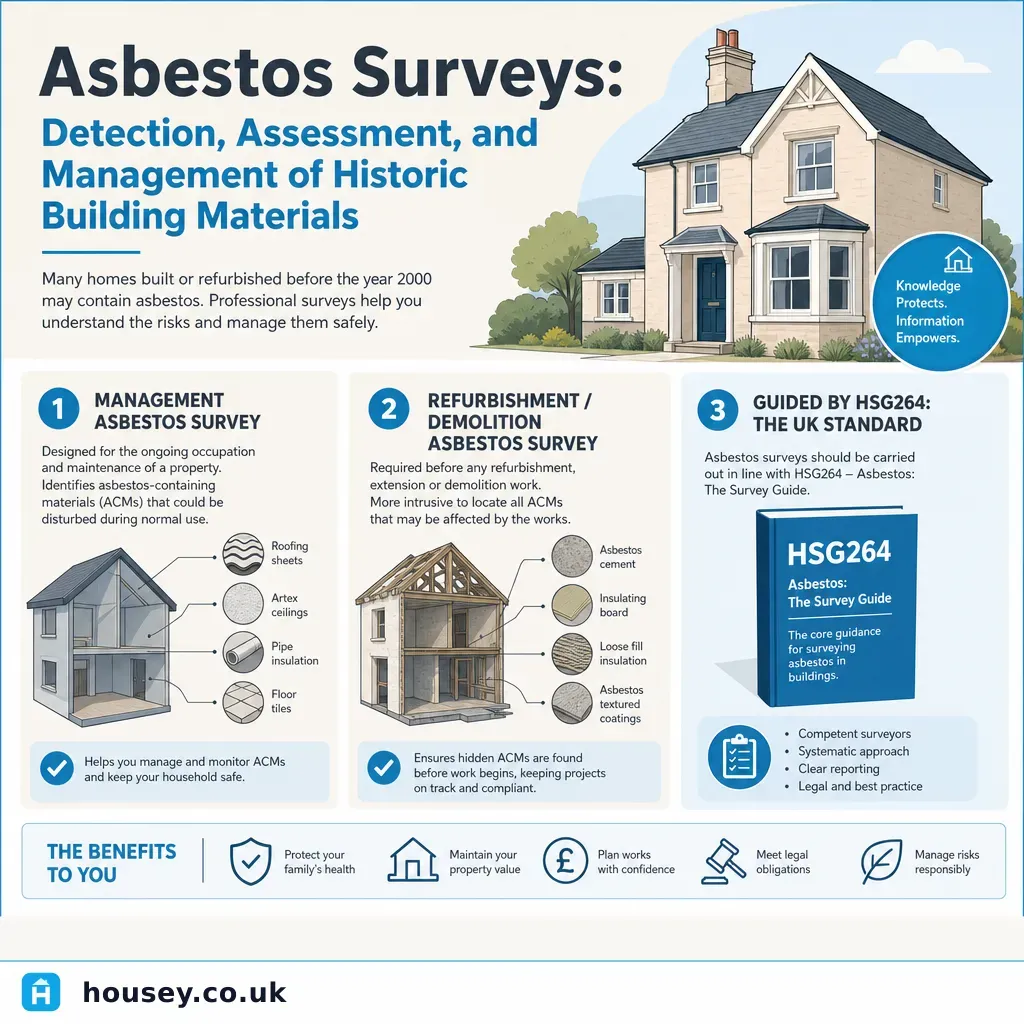
Asbestos Surveys: Detection, Assessment, and Management of Historic Building Materials
There are two main survey types in the UK: a Management Survey for buildings in normal occupation, and a Refurbishment and Demolition Survey required before any building work on a pre-2000 property.
 Surveys & Inspections
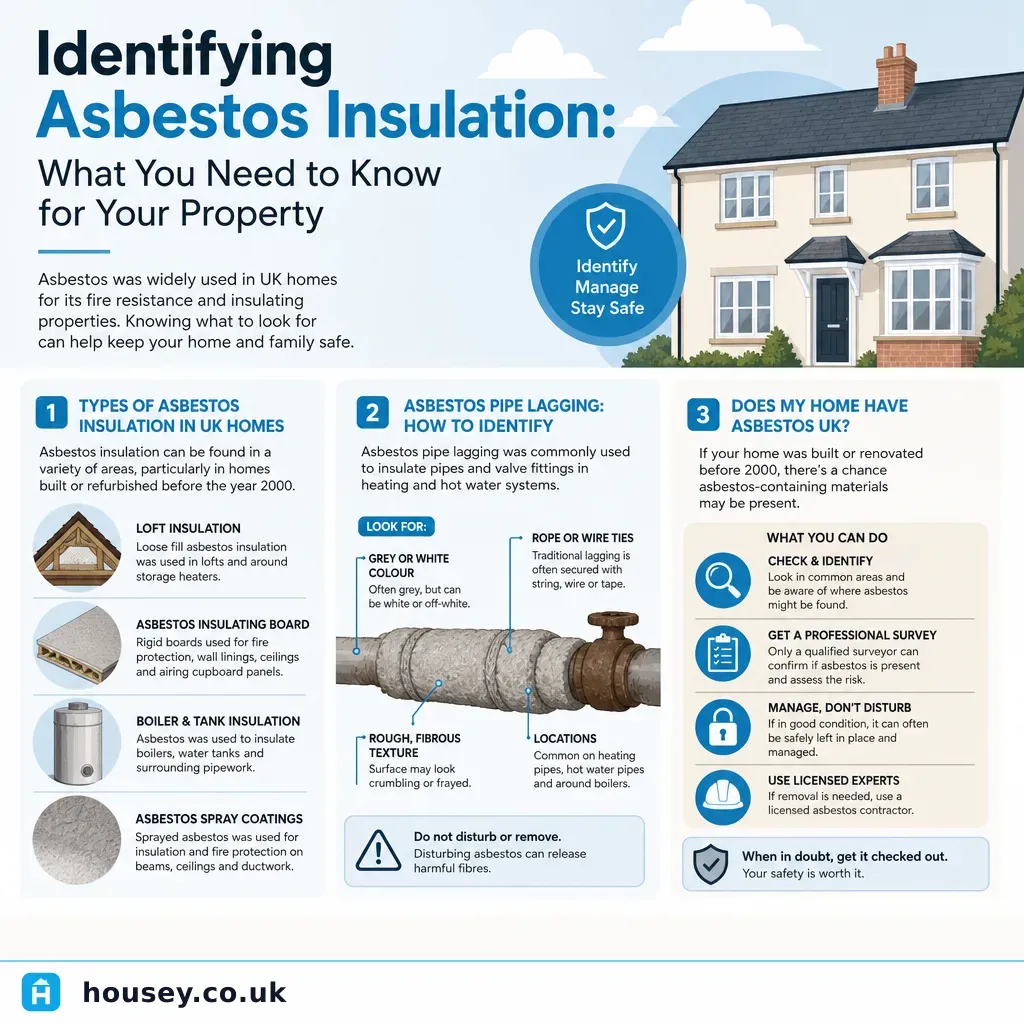
Identifying Asbestos Insulation: What You Need to Know for Your Property
Asbestos insulation was widely used in UK properties built before 2000, commonly found in pipe lagging, ceiling tiles, loose-fill loft insulation, and around boilers.
 Surveys & Inspections
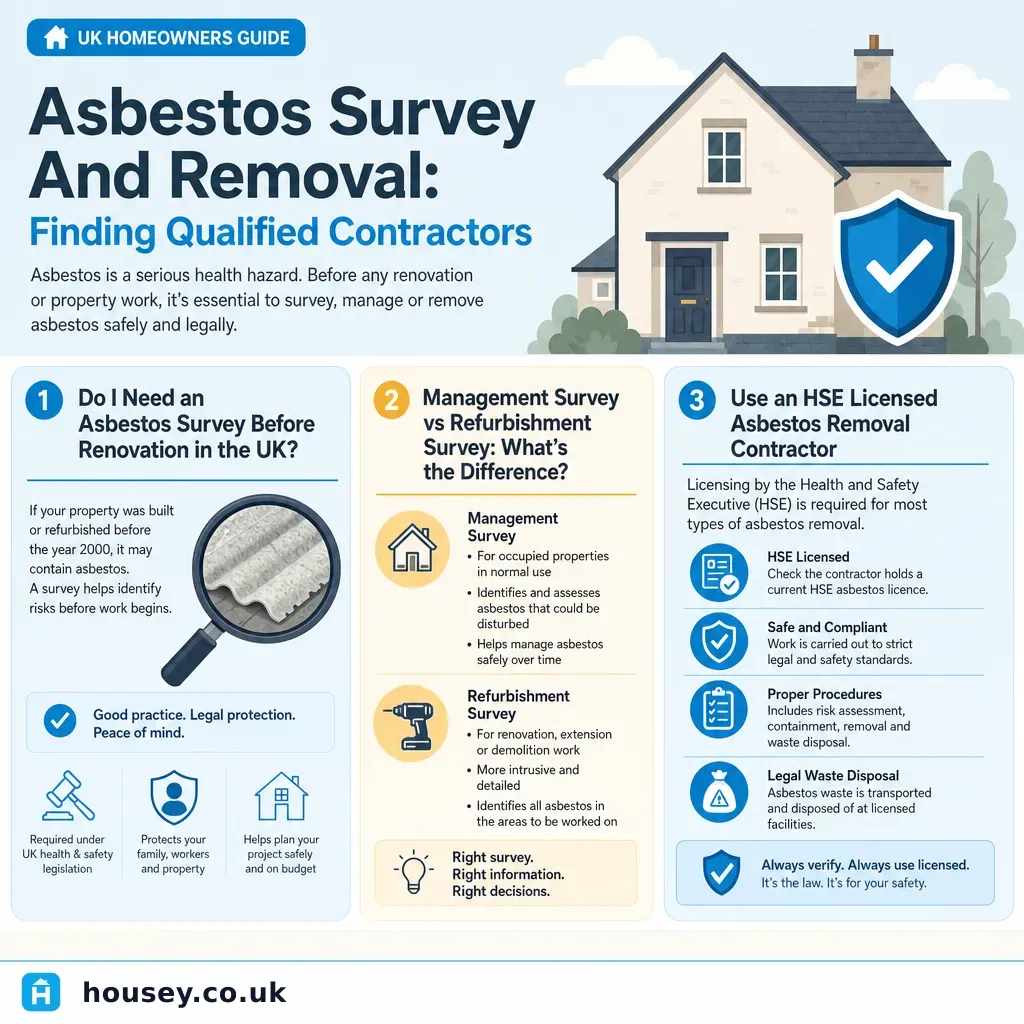
Asbestos Survey And Removal: Finding Qualified Contractors
An asbestos survey establishes whether asbestos-containing materials are present in your property and their condition.
 Surveys & Inspections
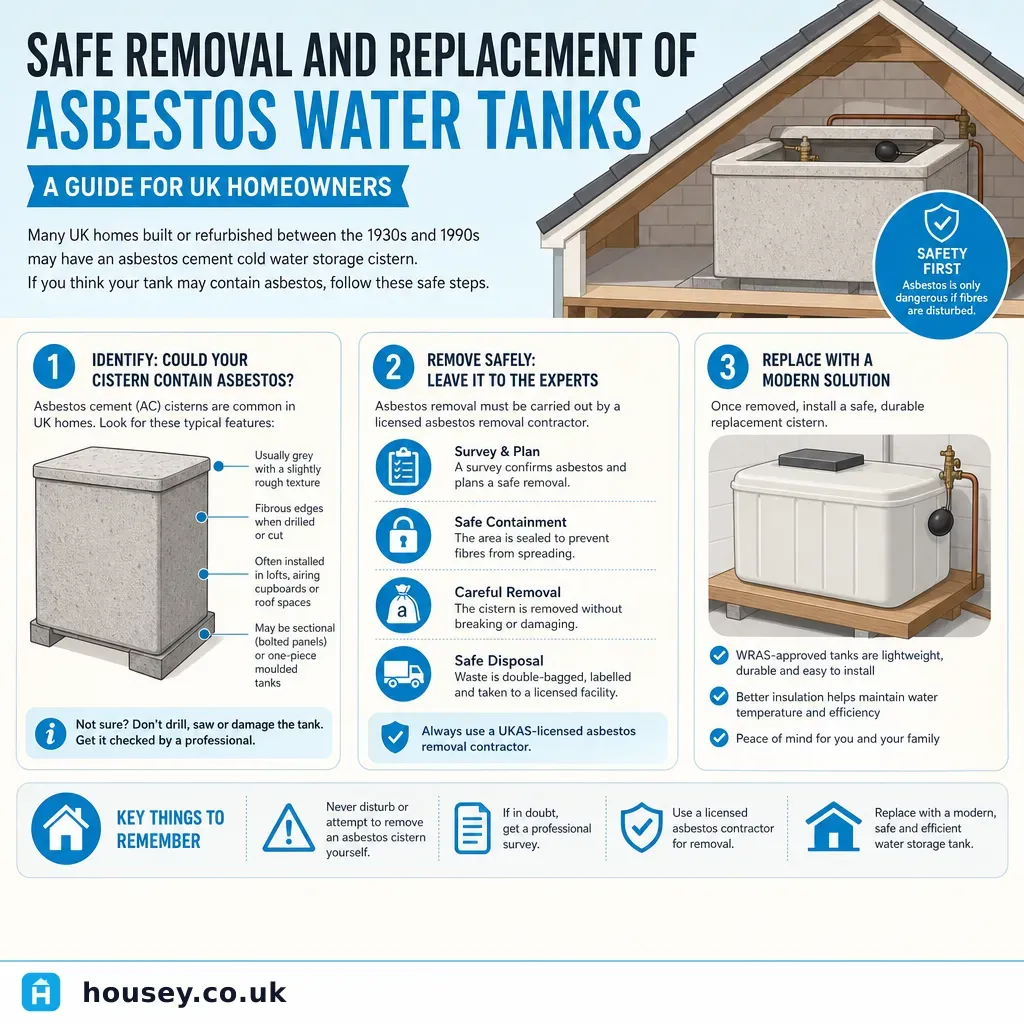
Safe Removal and Replacement of Asbestos Water Tanks
Asbestos cement cold water tanks, found in many UK homes built before about 1980, must not be drilled, cut, or broken without proper controls.
 Surveys & Inspections
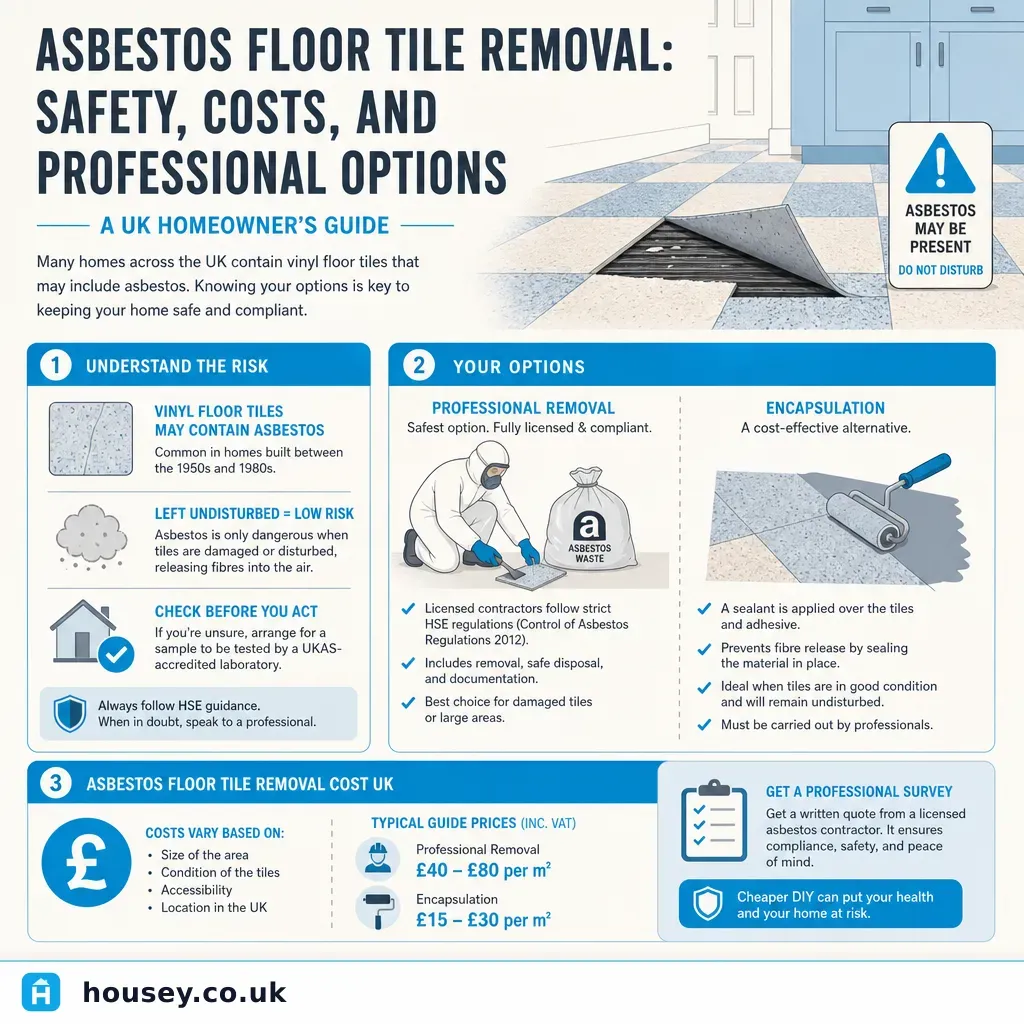
Asbestos Floor Tile Removal: Safety, Costs, and Professional Options
Asbestos floor tiles — common in UK homes built between the 1950s and late 1980s — must not be disturbed without a professional assessment.