Assessing Property Structural Condition: What Buyers and Owners Should Know
By Housey · Last reviewed 1st of June 2026
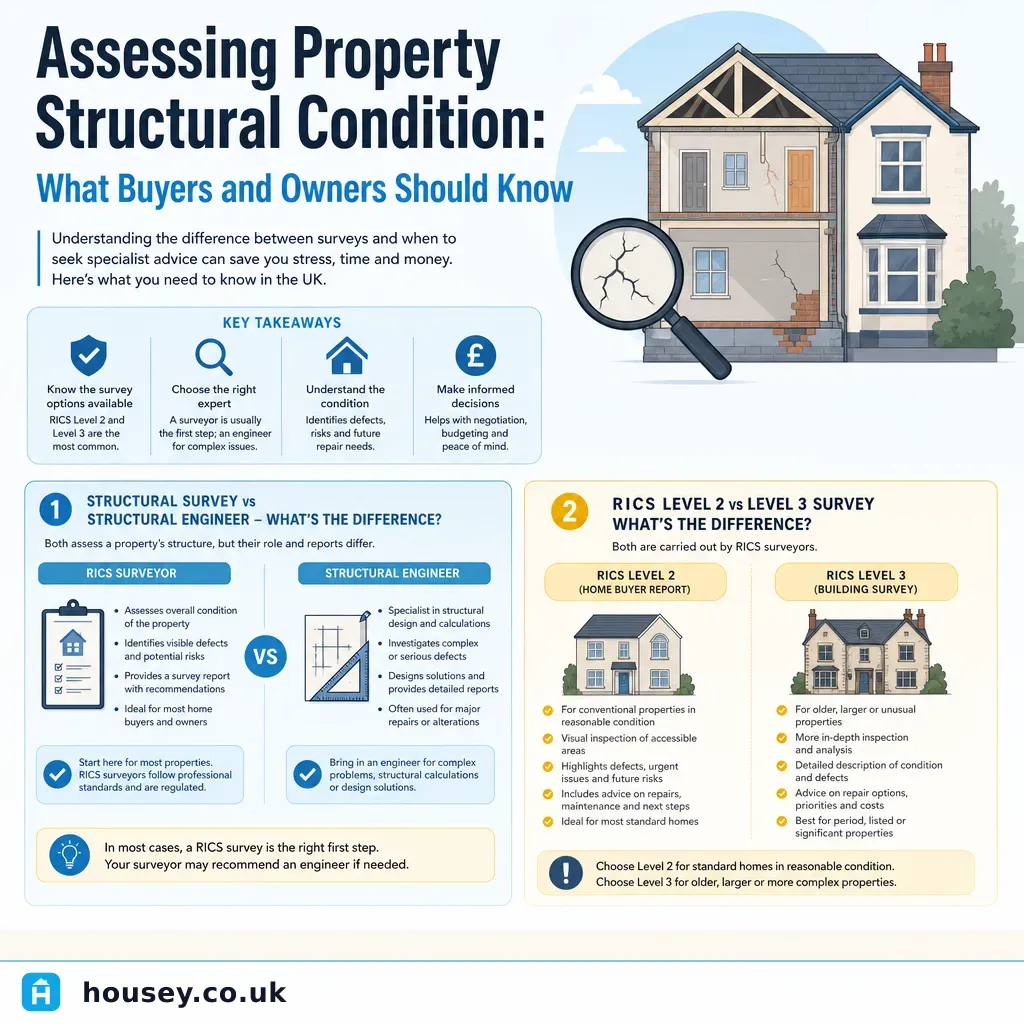
Assessing Property Structural Condition: What Buyers and Owners Should Know
Questions about a property's structural condition arise at two critical points: when a buyer weighs up whether to proceed after an offer is accepted, and when an owner notices something that was not there before — a new crack, a sticking door, or a floor that has developed a noticeable slope. In both cases the stakes are real: structural issues range from routine settlement that is entirely normal in older British buildings to genuine defects affecting safety, insurability, and mortgageability.
Key points
- A RICS Level 2 Home Survey (formerly the HomeBuyer Report) is a visual inspection suited to conventional homes in reasonable condition; a RICS Level 3 Building Survey is more appropriate for older, larger, altered, or visibly defective properties and provides a more detailed assessment of construction and defects.
- A structural engineer is a separate professional from a surveyor: surveyors identify concerns and advise on further investigation; structural engineers diagnose the cause of defects and specify remedial works — both may be needed for a serious concern.
- Building Regulations in England require structural calculations for many alterations (extensions, loft conversions, removal of load-bearing walls); if previous owners carried out undocumented work, a surveyor or engineer should assess whether it was correctly executed.
- Cracking in brickwork or render does not automatically indicate serious structural movement — hairline settlement cracks in the mortar are common in older properties; stepped cracks running through bricks, cracks that are widening, or cracks accompanied by other distress signs warrant professional assessment.
- Indemnity insurance is available for some undocumented building works but does not make defective structural work safe; it covers financial loss from enforcement action, not the cost of remedial repairs.
Important limitations
This article provides general information for buyers and homeowners. Structural assessment of a specific property must be carried out by a qualified professional — a RICS-registered surveyor or a chartered structural engineer (MIStructE or CEng). Findings depend on the property's age, construction type, location, ground conditions, and any alterations carried out since original construction. Nothing in this article constitutes a professional opinion on any individual property.
Types of structural assessment and when to use each
Assessment type | Carried out by | Best for | Typical output | Main limitation |
|---|---|---|---|---|
RICS Level 2 Home Survey | RICS-registered surveyor | Conventional homes in reasonable condition; pre-exchange due diligence | Written report with condition ratings (1, 2, 3) and recommendations for further investigation | Visual inspection only; does not open up hidden areas or provide engineering diagnosis |
RICS Level 3 Building Survey | RICS-registered surveyor | Older, unusual, altered, or defective properties; listed buildings | Detailed written report; description of construction; identified defects with repair advice | Still largely visual unless specific additional tests are agreed in advance |
Specific defect survey | RICS surveyor or structural engineer | One known or suspected issue (e.g. a crack, damp ingress, failing lintel) | Focused report on the defect with cause and remedy | Narrow scope — may not identify unrelated issues |
Structural engineer assessment | Chartered structural engineer (MIStructE) | Properties with movement, significant cracking, altered load paths, or following a survey recommending further investigation | Technical assessment of cause; often includes specification of remedial works | Does not cover non-structural condition (damp, services, finishes) |
New-build snagging inspection | Independent snagging surveyor | New-build homes within the developer's defects period | Snagging list for the developer to address | Developer's structural warranty (NHBC Buildmark or similar) handles serious structural defects separately |
Which assessment does your situation call for?
- Choose a RICS Level 2 survey if the property is a conventional post-war estate house or flat, shows no obvious defects, and is of standard construction and materials.
- Choose a RICS Level 3 survey if the property is pre-1919, has been significantly extended or altered, shows visible cracking, damp, or settlement, or is of unusual construction (timber frame, thatched, or a converted building).
- Commission a structural engineer if a surveyor's report flags suspected movement, failing structural elements, or undocumented alterations to load-bearing walls or roof structure — the surveyor identifies the concern; the engineer diagnoses and specifies the remedy.
- Commission a specific defect survey if you own the property and have one clearly identified concern that has appeared recently — a new crack, a section of wall bowing outward, or a roof element that appears to be deflecting.
- Speak to your solicitor and local planning authority if undocumented building work has no building regulations sign-off — indemnity insurance is a legal and financial tool and does not address structural integrity.
What structural surveys can and cannot tell you
Surveys carried out under RICS standards are visual inspections unless additional investigation is agreed in writing beforehand. A surveyor will not lift floorboards, open up wall cavities, or conduct invasive testing unless specifically instructed. This is not a shortcoming unique to UK surveyors — it reflects the agreed boundary between inspection and investigation.
A surveyor will typically assess:
- Visible cracks in internal and external walls, ceilings, and chimneys
- Signs of roof spread, sagging, or structural movement
- Evidence of damp penetration (damp meter readings, visible staining)
- Condition of visible structural elements — floor joists where accessible, lintels, bressummers
- Apparent condition of drainage gullies and external features
A surveyor will not typically do without additional instruction:
- Test electrical, gas, or heating systems in detail
- Inspect behind wall panelling, under fitted carpets, or inside wall cavities
- Provide structural engineering calculations or diagnose root cause
- Recommend a specific contractor (though they may identify the type of specialist needed)
Red flags that need professional investigation
- Stepped cracks running diagonally through brickwork courses, particularly if wider at one end than the other
- Cracks that have been previously filled but have re-opened
- Doors or windows that have recently started sticking, or no longer close flush without force
- Floors that feel springy, bounce underfoot, or have a visible slope (a slope exceeding 20 mm per metre is generally worth investigating with a spirit-level check)
- Bulging or leaning walls visible from outside the property
- Roof ridge or eaves line that has dropped or deviated from horizontal
- Evidence of previous underpinning — check the property information forms and ask the seller directly
- Cracking at the junction between an extension and the main structure, particularly in older rear additions
What to ask a qualified professional
Before instructing a surveyor or structural engineer, ask:
- Are you RICS-registered (for surveyors) or a chartered member of the Institution of Structural Engineers (MIStructE or CEng) for structural engineers?
- What level of survey do you recommend for this property, and why?
- Will the inspection include any invasive investigation — lifting boards, opening up areas — or is it visual only, and what would trigger the recommendation for further investigation?
- How will defects be reported — will you provide a condition rating and approximate cost guidance, or identify the concern and refer on to a specialist?
- What professional indemnity insurance do you hold, and what are the limits?
- If you find a structural concern, will you recommend the appropriate specialist and help me understand their findings?
- How long have you been inspecting properties in this area, and are you familiar with the common construction types and ground conditions here?
When this becomes urgent
Seek professional assessment without delay — do not wait for a sale to progress — if:
- A crack has appeared suddenly or is visibly widening over days or weeks
- A wall is leaning or bowing and appears to be progressing
- A roof section has dropped or shifted position
- You can see daylight through the roof covering that was not there before
- The property has recently undergone subsidence insurance reinstatement — confirm whether works were signed off and whether insurer reinstatement warranties apply
When to get professional help
Structural concerns should always be assessed by a RICS-registered surveyor or a chartered structural engineer. A general contractor's opinion, however well-meaning, is not an adequate substitute for a professional inspection. Commission a professional if:
- You are buying a property and have concerns after viewing or after receiving a Level 2 survey report
- You notice new cracking, movement, or distortion in a property you own
- A previous owner's building works have no building regulations sign-off and you are unsure whether the work was structurally sound
- You are planning alterations — removing a wall, forming a new structural opening — and need to establish whether elements are load-bearing
How Housey can help
Housey can connect you with RICS-registered surveyors offering RICS Level 2 surveys, RICS Level 3 Building Surveys, structural surveys, and specific defect surveys — matched to your property type, location, and the specific concern you need assessed.
Frequently asked questions
Can I buy a house with structural problems?
Yes, subject to your mortgage lender's conditions. Some lenders will decline or restrict lending on properties with active subsidence or unresolved structural defects until remedial work is completed and signed off. Obtain a structural engineer's report and, if works are required, agree costs with the seller before exchange of contracts.
What does a Condition Rating 3 mean on a RICS Level 2 survey?
A Condition Rating 3 means the element has defects that are serious and need to be repaired, replaced, or investigated urgently. It does not necessarily mean the property is unsafe or unmortgageable, but the rated element requires professional attention before or shortly after purchase.
Should I get a survey if buying a new build?
The developer's structural warranty — typically NHBC Buildmark or Premier Guarantee — provides some protection, but an independent snagging inspection carried out before legal completion, or within the defects period, is recommended to document issues the developer should address under the warranty.
How long does a structural survey take?
A RICS Level 3 Building Survey of an average three or four-bedroom house typically takes 3–4 hours on site. The written report usually follows within a few working days. A focused structural engineer's assessment may take less time on site but could take longer if complex calculations are required.
Sources and further reading
Useful next reads
 Surveys & Inspections
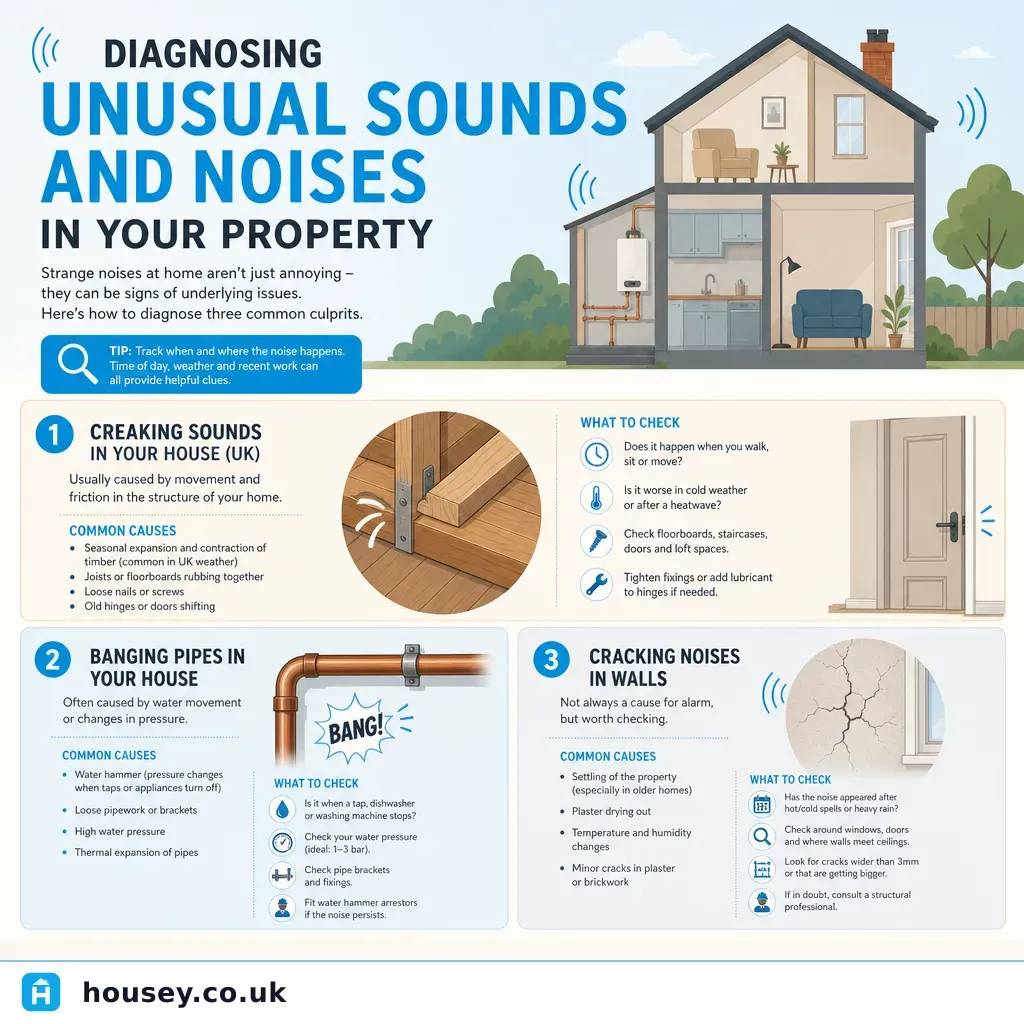
Diagnosing Unusual Sounds and Noises in Your Property
Most unusual sounds in a UK home have benign causes — thermal movement in roof timbers, water hammer in heating pipes, or normal settlement in new builds.
 Surveys & Inspections
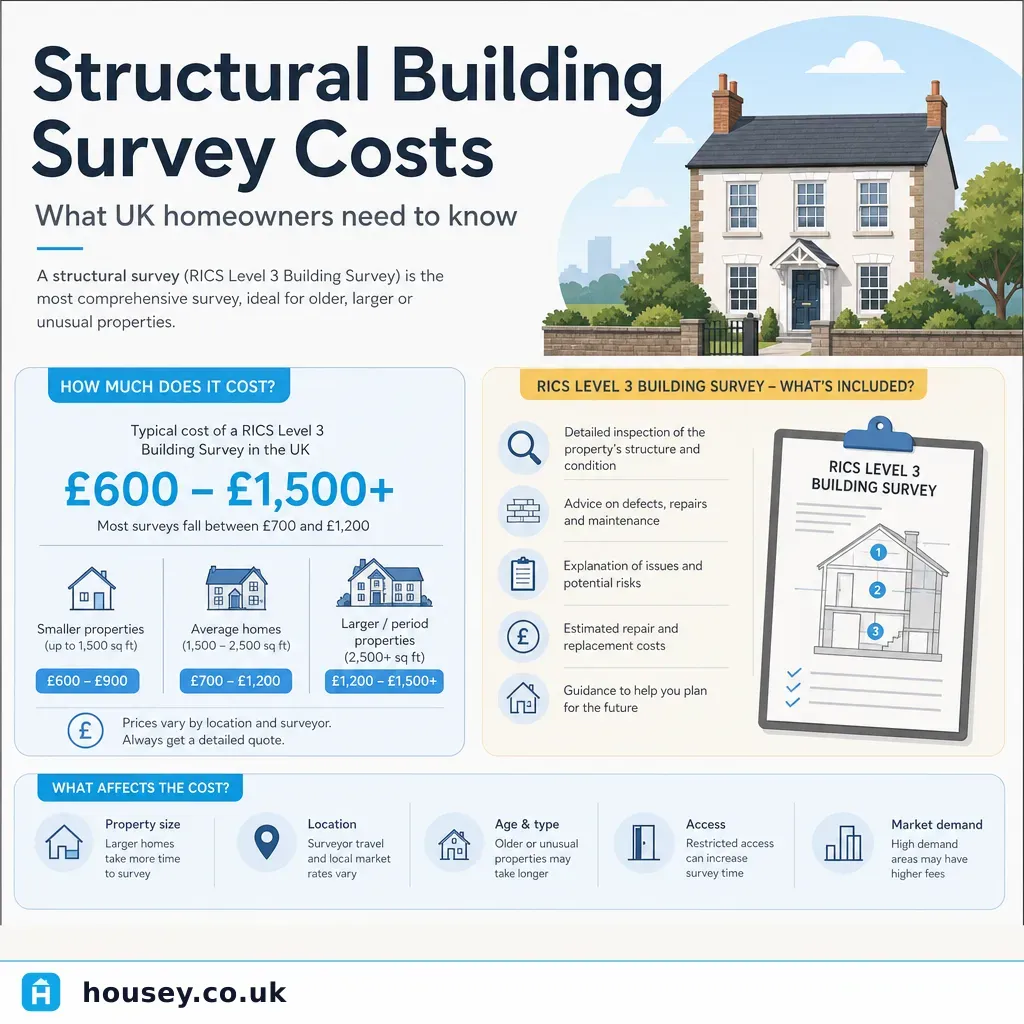
Structural Building Survey Costs
A RICS Level 3 Building Survey typically costs £500–£1,500 in the UK, depending on property size, age, and location.
 Surveys & Inspections
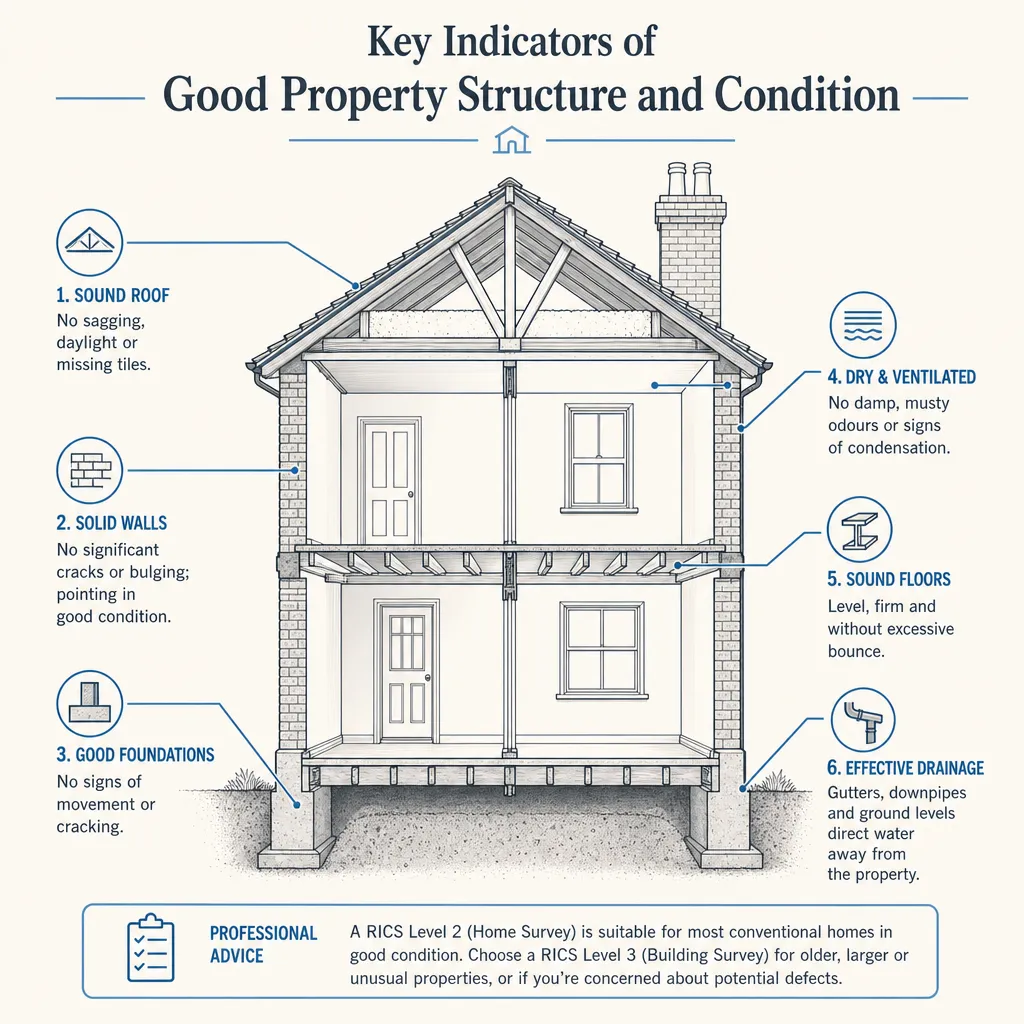
Key Indicators of Good Property Structure and Condition
Good property structure is indicated by plumb walls, level floors, crack-free masonry at corners and above openings, an intact roof covering, and dry internal surfaces.
 Surveys & Inspections
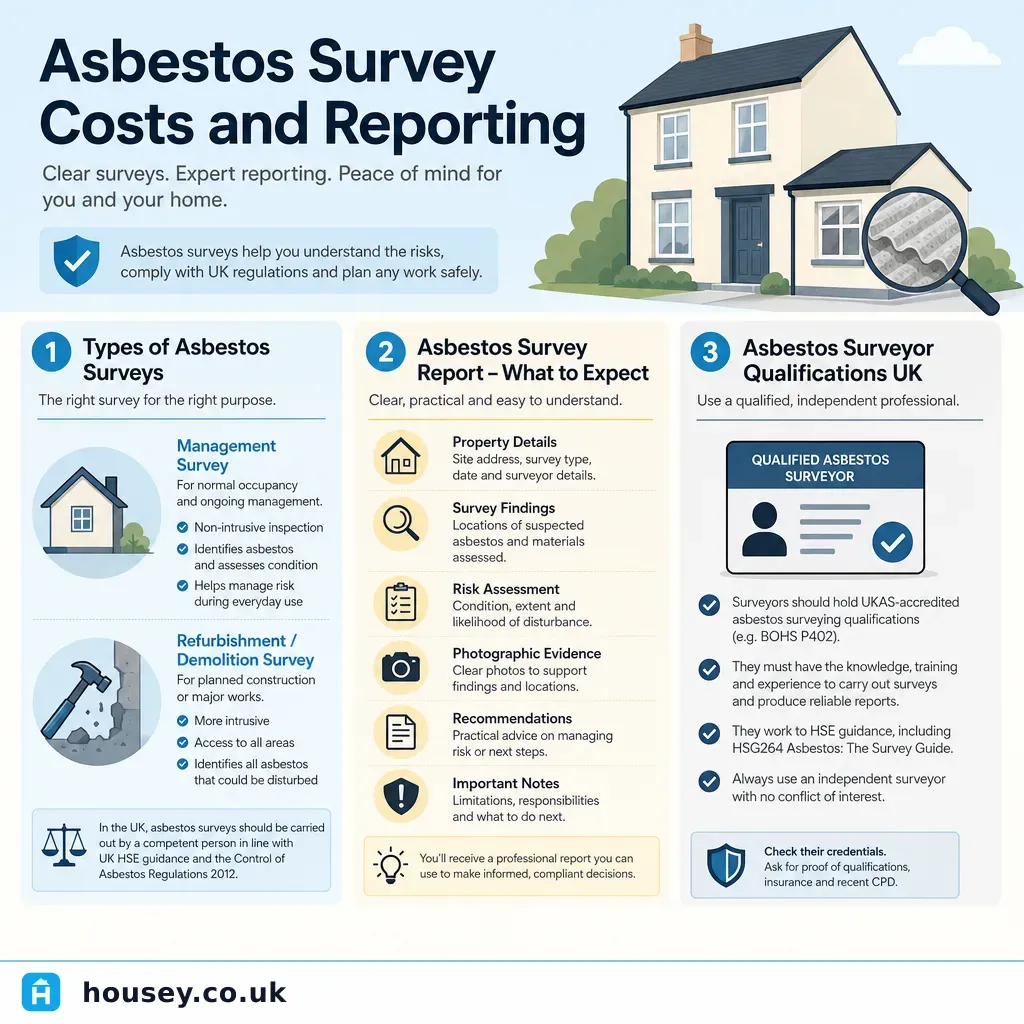
Asbestos Survey Costs and Reporting
A management asbestos survey typically costs £200–£400 for a standard UK home.
 Surveys & Inspections
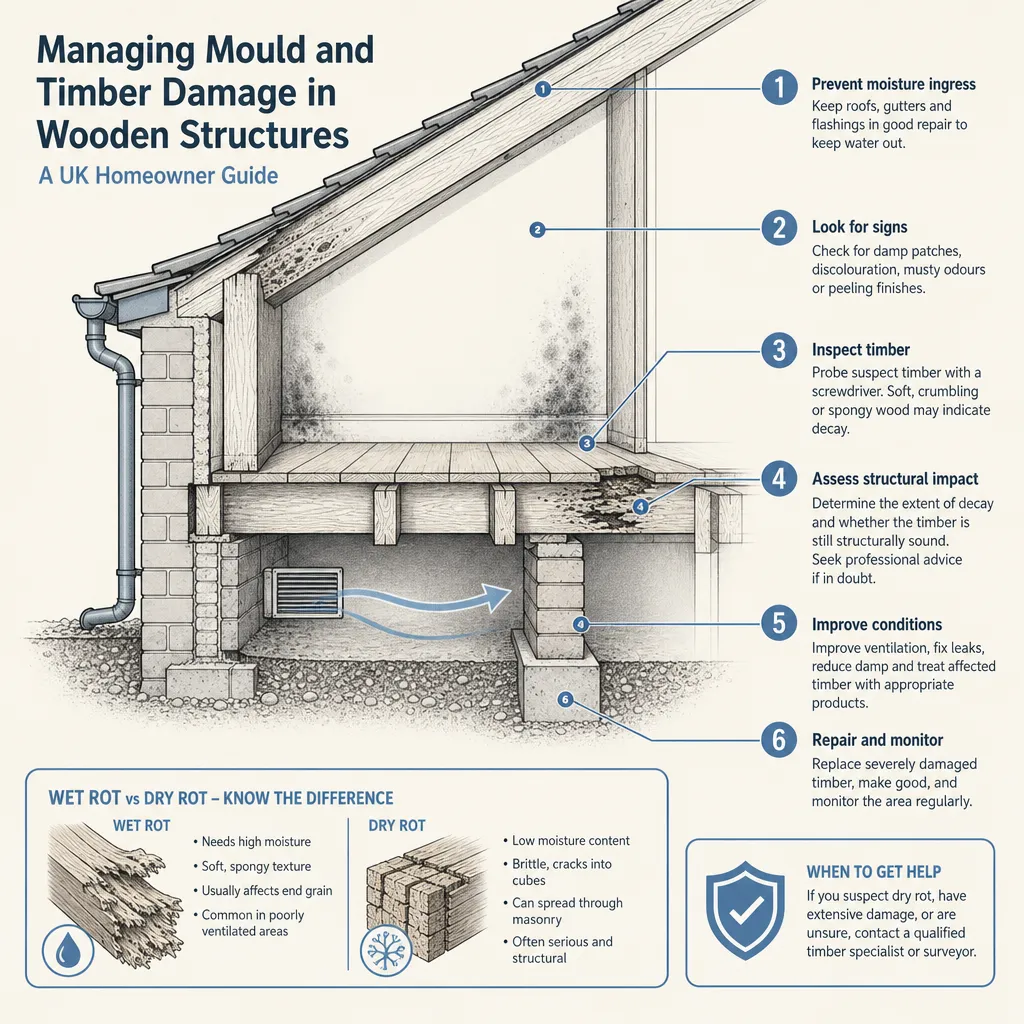
Managing Mould and Timber Damage in Wooden Structures
Mould and timber decay in wooden structures are usually symptoms of excess moisture rather than standalone problems.