Diagnosing Unusual Sounds and Noises in Your Property
By Housey · Last reviewed 1st of June 2026
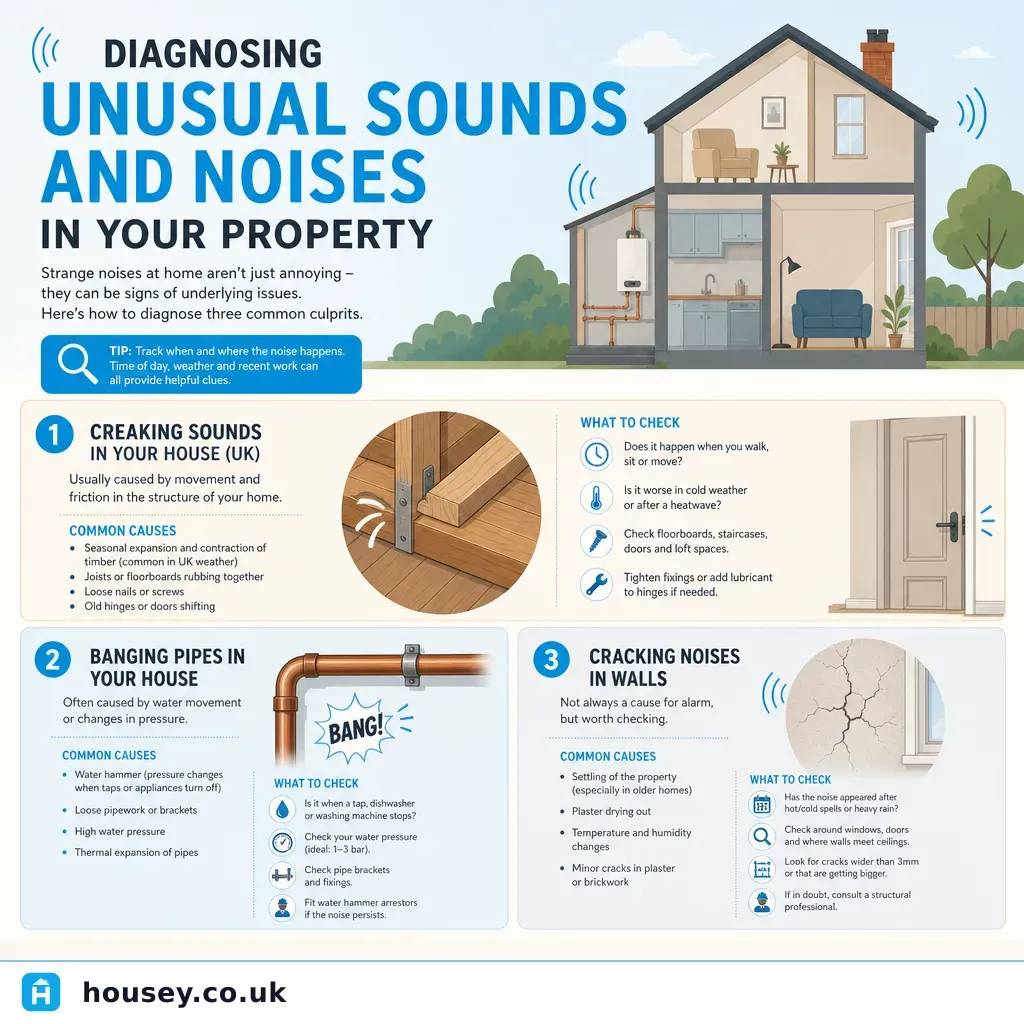
Diagnosing Unusual Sounds and Noises in Your Property
Unfamiliar noises in a UK home — whether a creak from the roof space of a Victorian terrace, a bang in the pipes of a 1930s semi, or a persistent click from a new-build flat — are among the most common reasons homeowners seek professional advice. Most sounds have mundane explanations rooted in thermal movement, heating system pressure, or drainage, but some are early indicators of defects that worsen if ignored. Understanding what you're hearing and what context points toward a genuine problem helps you decide whether to monitor, investigate further, or call a professional promptly.
Key points
- Thermal movement in roof timbers is the single most common cause of cracking and creaking sounds in UK homes, particularly in loft spaces during evening temperature drops.
- Water hammer — a banging or thudding in pipes — is caused by sudden pressure changes and is not structural; it is typically resolved by fitting a hydraulic shock arrestor or adjusting a pressure-reducing valve.
- Clicking or ticking from radiators usually indicates trapped air, incorrect system pressure, or thermal expansion of pipework — not a serious defect.
- Structural cracking that is widening, stepped through mortar joints, or accompanied by sticking doors or sloping floors requires assessment by a chartered surveyor or structural engineer, not just monitoring.
- A RICS Level 3 Building Survey is the appropriate inspection for properties where sounds coincide with multiple visible symptoms — cracks, wall bowing, floor slopes, or damp.
Common sounds: a diagnostic reference
Sound | Where heard | Most likely cause | Concerning if |
|---|---|---|---|
Creaking or cracking | Loft, ceiling, roof timbers | Thermal expansion and contraction in timber roof structure | Combined with visible ridge sag or cracking at ceiling-to-wall junctions |
Banging or hammering | Pipes, under floors, behind walls | Water hammer from rapid pressure change in supply or heating pipes | Accompanied by damp patches, pipe leaks, or visible pipe damage |
Ticking or clicking | Radiators, pipework | Thermal expansion of hot water pipes; trapped air in system | Persistent when heating is off; accompanied by wet patches near pipework |
Hissing | Near gas appliances, meter, or pipes | Possible gas leak | Always — leave the property immediately and call 0800 111 999 |
Cracking in walls | Plaster, brickwork, party wall | Thermal movement, settlement, or structural movement | Stepped cracks through mortar, horizontal cracks, or cracks widening over weeks |
Scratching or scurrying | Walls, loft, under floors | Rodent or bird activity | Persistent; combined with droppings, damaged insulation, or visible entry holes |
Gurgling | Drains, toilets, soil stacks | Partial blockage or failed drain trap | Combined with slow drainage, sewage smell, or damp at ground level |
Low boom or thud | Structural elements, above windows | Thermal movement in large spans, or deflecting lintel | Coincides with new or widening cracks above door or window openings |
Sounds that rarely indicate serious problems
Thermal movement
The most common source of apparently alarming sounds in a UK property is thermal movement in roof timbers. As the building heats and cools through the day, timber expands and contracts — this movement creates cracking, ticking, and occasional sharp pops, most pronounced in loft spaces and properties with large spans of exposed timber. Both Victorian cut roofs and modern trussed rafter systems exhibit this behaviour regularly.
These sounds require no intervention unless accompanied by visible movement, a bowing ridge line, or progressive cracking in walls or ceilings.
Heating system sounds
A functioning central heating system will produce ticking and clicking as pipes warm and cool — this is normal. Persistent banging, particularly when taps are closed quickly, usually indicates water hammer: a pressure surge, not a structural problem. A Gas Safe registered engineer should service the boiler and check system pressure at least annually.
What not to assume
- Don't assume creaking means structural movement. The vast majority of roof and floor creaks in UK homes are thermal — not defects requiring repair.
- Don't assume banging pipes mean a leak. Water hammer is a pressure issue. Investigate only if dampness appears alongside the noise.
- Don't assume new-build sounds are normal. New builds can have defects from poor workmanship; the NHBC Buildmark warranty covers major structural defects for 10 years from completion.
- Don't assume sounds will go away. Sounds associated with widening cracks or movement in structural elements tend to worsen unless the underlying cause is addressed.
- Don't assume a survey will always identify the source. Some sounds are intermittent or condition-dependent; a surveyor can only report what is observable at the time of inspection.
Red flags: sounds that need urgent attention
The following combinations require prompt professional investigation — do not delay:
- Hissing from any gas appliance, meter, or pipe: leave the property immediately, do not use any electrical switches, and call the National Gas Emergency Service on 0800 111 999.
- Cracking sounds combined with widening or stepped cracks in masonry or plasterwork, especially if they have changed over the past few weeks.
- Banging pipes followed by new damp patches or water staining on walls and ceilings.
- Structural thumping or popping that coincides with movement you can feel underfoot in floors or walls.
- Low booming accompanied by new cracks above lintels — this may indicate a deflecting or failed structural lintel.
- Scurrying combined with visible entry holes or signs of damaged wiring — rodents can create fire risk through cable damage and require both pest control and a building inspection.
Choosing the right professional
Sound and symptom combination | Recommended professional | Survey type |
|---|---|---|
Sounds only, no visible defects | Monitor; consider a survey if buying, selling, or symptoms recur | |
Sounds with visible cracks or movement | Chartered surveyor or structural engineer | |
Sounds with sticking doors, cracks, and floor slopes | Structural engineer | |
Single suspected defect such as a failed lintel | Specialist surveyor | |
Hissing near gas | National Gas Emergency Service, then Gas Safe engineer | Emergency inspection |
Banging pipes | Qualified plumber | Service visit |
Gurgling drains | Drainage contractor with CCTV survey equipment | Drain survey |
Important limitations
This guide provides general diagnostic information only. Property sounds can have multiple simultaneous causes and the correct interpretation depends on the age, construction type, and condition of the specific property. Nothing in this article should be taken as confirmation that any particular sound is harmless. Where you have any doubt — particularly where sounds coincide with visible defects — commission a professional survey.
What to ask a qualified professional
Before booking a survey or inspection for property sounds, ask:
- What type of survey covers the symptoms I'm describing, and what will it include or exclude?
- Can you assess intermittent sounds, or will you only report on what is visible at the time of inspection?
- If the cause is not identified at first inspection, what follow-up tests are available — moisture meter readings, thermal imaging, drain CCTV, or borescope inspection?
- Will your report specify whether further investigation by a structural engineer, Gas Safe engineer, or drainage contractor is needed?
- Is this a standalone targeted inspection or part of a wider property condition survey?
When to get professional help
Book a professional inspection rather than just monitoring if:
- Any sound has changed in character, frequency, or intensity over the past few weeks
- Sounds coincide with visible cracks, damp patches, sticking doors, or bowing walls
- You are buying or selling the property and sounds could affect the transaction or the mortgage valuation
- The property is Victorian, Edwardian, or interwar construction with a history of alterations or extensions
- Your mortgage lender has flagged the property as unusual or required a more detailed survey
How Housey can help
Housey connects you with qualified professionals who can investigate property sounds systematically. For properties with concerning symptoms, a RICS Level 3 Building Survey provides the most thorough assessment of structure and condition. For a single suspected defect, a specific defect survey may be more targeted and cost-effective. Where structural movement is suspected, a structural survey provides engineering-level diagnosis. Compare quotes from local specialists through Housey.
Frequently asked questions
Why does my house make cracking noises at night?
Most nighttime cracking in a UK home is caused by thermal contraction — as outdoor temperatures drop, roof timbers, floorboards, and structural timbers contract slightly, producing cracking or popping sounds. This is most noticeable in loft spaces and properties with exposed timber frames. It is generally harmless unless accompanied by visible movement, ridge sag, or progressive cracking in walls or ceilings.
Is water hammer in pipes dangerous?
Water hammer is a pressure surge caused by rapid change in water flow, most often when a tap is closed quickly. It is not structurally dangerous, but repeated pressure shocks can stress pipe joints and fittings over time, potentially leading to leaks. A plumber can fit a hydraulic shock arrestor or pressure-reducing valve. If dampness appears alongside the banging, investigate promptly.
When do property sounds indicate structural movement?
The key indicator is whether sounds coincide with other symptoms: widening or stepped cracks in masonry, horizontal cracks at damp-proof course level, sticking doors or windows, visible wall bowing, or sloping floor surfaces. Sounds in isolation are rarely diagnostic of structural movement — it is the combination with visible evidence that requires urgent professional assessment by a chartered surveyor or structural engineer.
Can a surveyor diagnose what's causing a sound?
A RICS surveyor will carry out a visual inspection and note visible evidence that might explain sounds — cracking, movement, damp, or pest activity. They cannot always identify intermittent or acoustically complex sounds. Where the cause is unclear, they may recommend follow-up investigations: a drain survey, structural engineer's assessment, thermal imaging, or a Gas Safe engineer's inspection.
Sources and further reading
- RICS Home Survey Standard — RICS
- Gas Safety — what to do if you smell gas — Health and Safety Executive (HSE)
- NHBC Buildmark Warranty — homeowner information — NHBC
- Citizens Advice — getting a survey done — Citizens Advice
- Electrical Safety First — warning signs in the home — Electrical Safety First
Useful next reads
 Surveys & Inspections
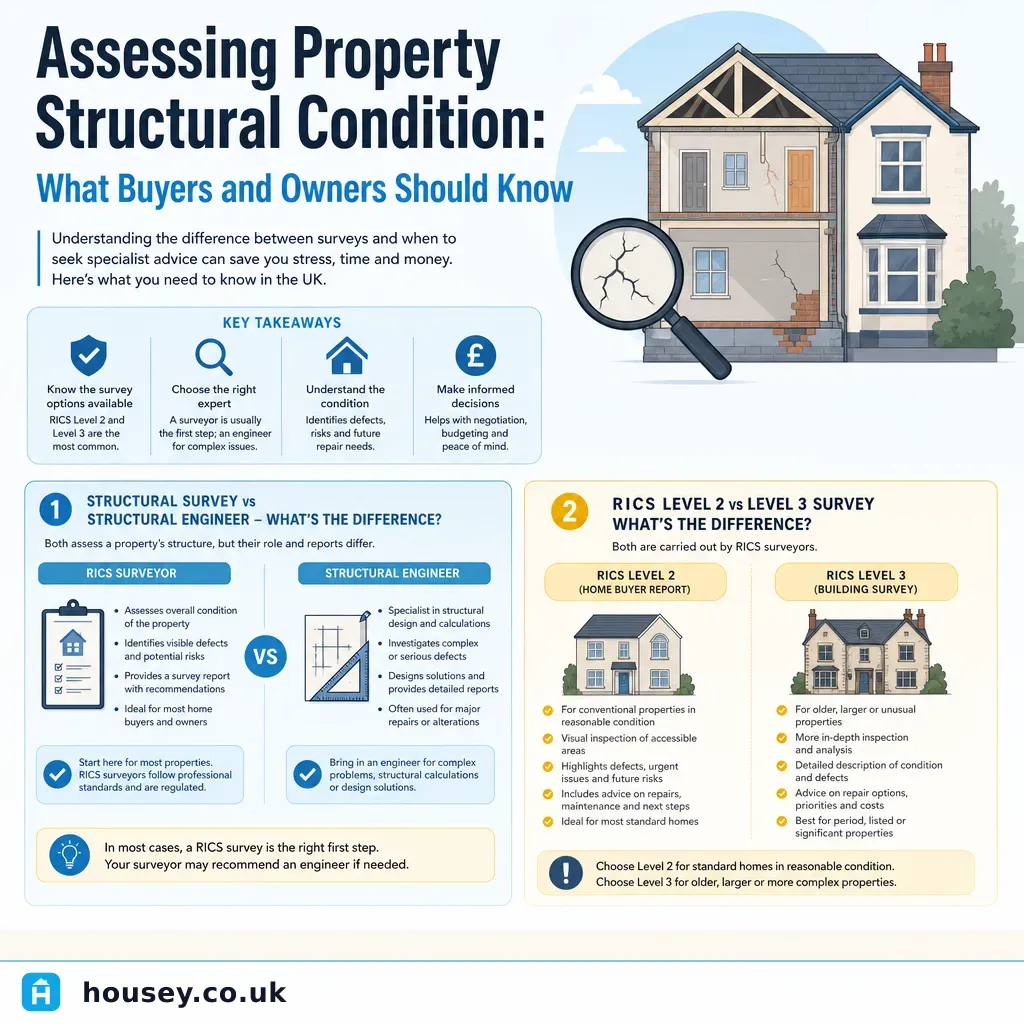
Assessing Property Structural Condition: What Buyers and Owners Should Know
A RICS Level 2 Home Survey suits conventional post-war properties in reasonable condition.
 Surveys & Inspections
Investigating and Diagnosing Unexpected Odours in Your Property
Unexpected odours in a UK property usually indicate drainage faults, rising or penetrating damp, decaying timber, or mould growth.
 Surveys & Inspections
Asbestos Survey Costs and Reporting
A management asbestos survey typically costs £200–£400 for a standard UK home.
 Surveys & Inspections
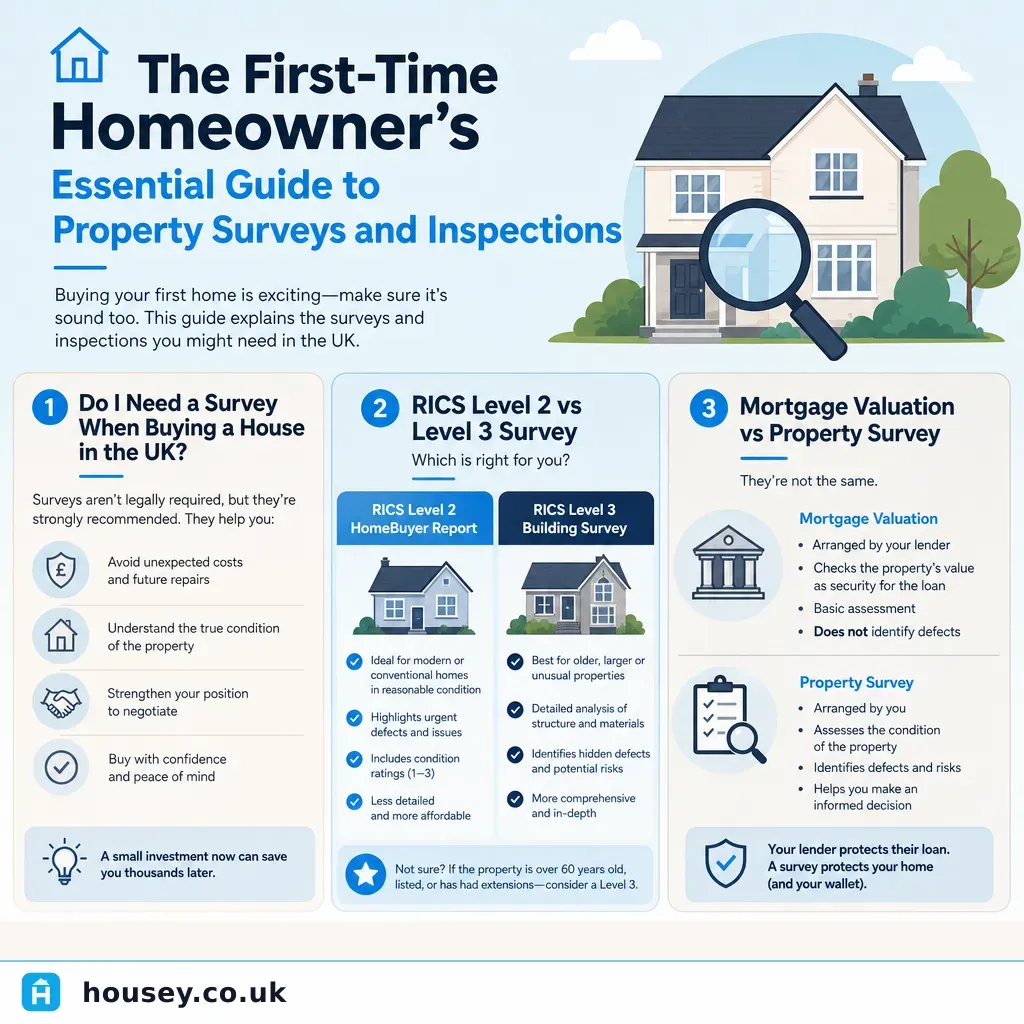
The First-Time Homeowner's Essential Guide to Property Surveys and Inspections
First-time buyers in the UK need more than the mortgage valuation — that report protects the lender, not you.
 Surveys & Inspections
Asbestos Testing: Finding a Qualified Surveyor
Finding a qualified asbestos surveyor means choosing a company accredited by UKAS to ISO/IEC 17020, with analysts holding BOHS P402 or equivalent qualifications.