Essential Questions for Safe and Thorough Property Inspections
By Housey · Last reviewed 18th of May 2026
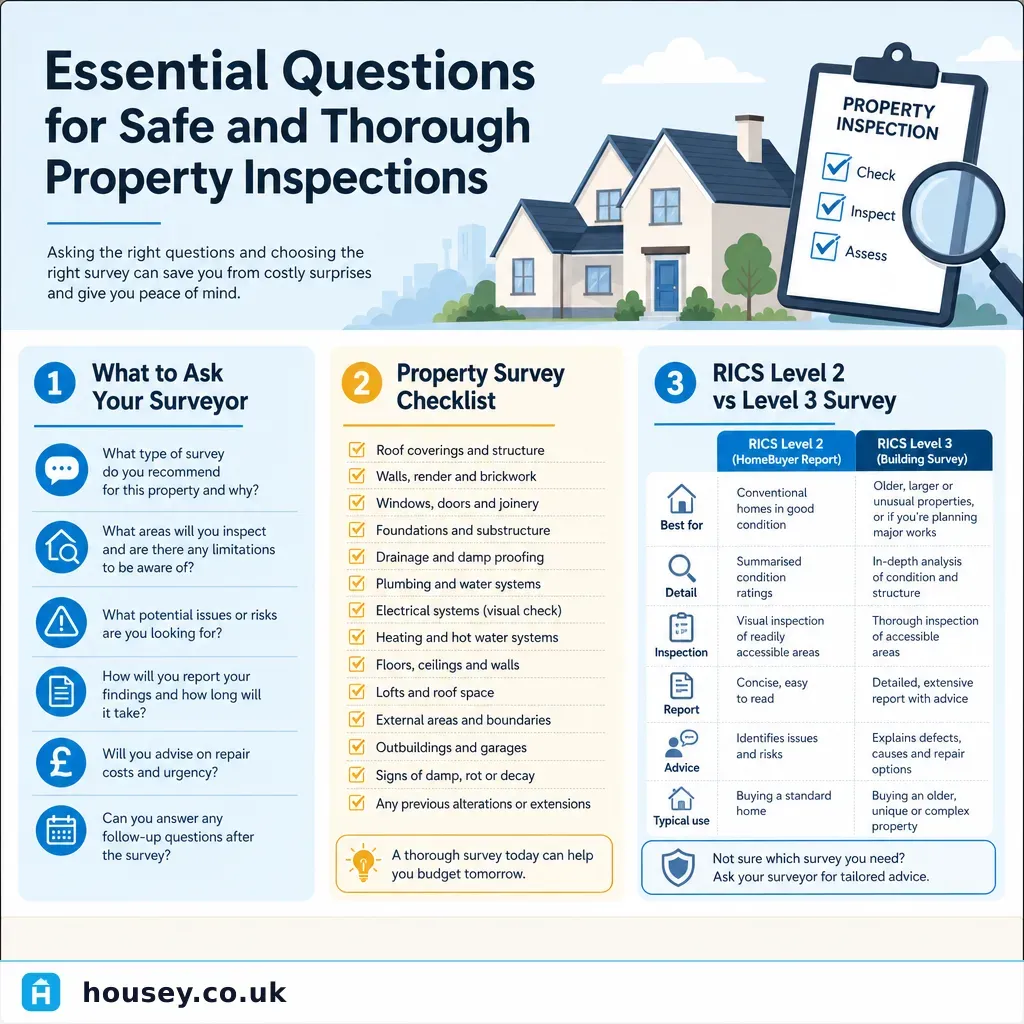
Essential Questions for Safe and Thorough Property Inspections
The questions you ask before and during a property inspection can determine whether you exchange with confidence or discover a costly defect after completion. Survey preparation is often underestimated — buyers frequently accept the first survey type suggested without considering whether it matches the property's age, construction, or visible condition. Getting the right inspection at the right time protects your negotiating position and, in some cases, prevents a harmful purchase.
Key points
- A RICS Level 2 Home Survey is generally suited to conventionally built homes in reasonable condition built after around 1900; a RICS Level 3 Building Survey provides greater depth and is more appropriate for older, unusual, extended, or visibly defective properties.
- RICS surveyors inspect accessible areas only — they do not move furniture, open sealed roof spaces, or test services such as gas, drainage, or electrics in detail; specialist reports may be needed separately.
- An Electrical Installation Condition Report (EICR) and a Gas Safe inspection are entirely separate from a RICS survey and should be considered for properties with unknown or ageing installation history.
- Stepped cracks in brickwork, cracks wider than approximately 5 mm, or cracks that taper from narrow to wide may indicate structural movement and deserve investigation before exchange.
- Listed buildings and properties in conservation areas may face restrictions on remedial works that affect the cost and practical feasibility of addressing defects identified in a survey.
Which survey do you need?
Choosing the right survey begins with understanding what each type covers, and where its limits lie.
Survey type | Best for | Not ideal for | Typical output | Key limitation |
|---|---|---|---|---|
RICS Level 2 Home Survey | Conventionally built homes post-1900 in reasonable condition, no obvious defects | Pre-1900 properties, listed buildings, visible defects, major alterations, unusual construction | Traffic-light condition ratings; key issues highlighted; maintenance notes | Less detailed than Level 3; no cost estimates; limited investigation of concealed areas |
RICS Level 3 Building Survey | Older or unusual properties; visible defects; planned major works; extended or significantly altered homes | New-build homes (snagging survey more appropriate) | Detailed description of condition, defect causes, repair options; optional reinstatement cost estimate | More expensive; does not include electrical, gas, or drainage testing |
Structural engineer's report | Properties with active or wide cracks, suspected subsidence, failed previous repairs, or unusual foundations | General condition assessment of the whole property | Engineering assessment of specific structural elements with remediation recommendations | Narrower scope; focused on structure only, not overall condition |
Snagging survey | New-build properties within the developer's defect liability period | Second-hand homes | Itemised list of defects for the developer to remedy | No RICS qualification required; quality varies — check the inspector's credentials carefully |
Mortgage valuation | Lender's lending decision | Buyer's due diligence — not a condition report | Confirmation of property value for lending purposes only | Does not identify defects; provides no buyer protection |
Questions to ask before commissioning a survey
Before instructing a surveyor, ask these questions to ensure you commission the right inspection for your property:
- What level of survey do you recommend for this specific property, and why? A good surveyor will ask about the property's age, construction type, and any visible concerns before suggesting a level.
- Are you RICS-regulated and insured for this type of property? For listed buildings, unusual construction, or suspected structural issues, confirm the surveyor has relevant experience.
- What will you inspect and what is excluded? Ask specifically about the roof space, subfloor void (if accessible), outbuildings, and any extensions.
- Will you test services — electrics, gas, drainage, heating? RICS surveys do not typically include detailed service testing; you may need a separate EICR, Gas Safe inspection, or drain survey.
- Will the report include repair cost estimates? RICS Level 3 surveys can include reinstatement cost assessments; Level 2 surveys typically do not.
- How will you communicate urgent findings? Ask whether the surveyor will call you if something serious is discovered before the written report is issued.
- What happens if access to part of the property is restricted? Understand whether access limitations result in caveat statements or recommended further investigations.
What to look for at a viewing
A viewing is not a survey, but careful observation helps you decide which level of inspection to commission and which concerns to flag to your surveyor in advance.
Red flags at viewing
Watch for these during your visit:
- Cracks in internal or external walls — hairline cracks in plaster are common in older homes; stepped cracks in brickwork, cracks at lintel level above windows, or cracks that taper from narrow at one end to wide at the other warrant closer attention.
- Damp patches or tide marks — look at chimney breasts, below windows, in ground-floor corners, and in bathrooms and kitchens. A musty smell can indicate concealed damp.
- Sagging or uneven roofline — visible from the pavement; may indicate rafter failure, spread, or rot in the roof structure.
- Sticking doors or uneven floors — can indicate structural movement or foundation settlement. This may be historic and stable, or active and ongoing.
- Fresh decoration or recent isolated painting — new plaster or paint in patches can sometimes conceal a recently repaired defect. Ask the agent when and why works were carried out.
- Evidence of extensions or alterations — ask whether planning permission, building regulations approval, and a completion certificate were obtained. Missing paperwork can complicate a purchase.
- Flat roofs and older roof coverings — felt flat roofs typically have a 20–30 year lifespan. Ask the age of any flat roof covering and check for pooling water or obvious patch repairs.
Questions to ask the estate agent at viewing
Estate agents are not surveyors, but they can provide useful background:
- Has the property had any planning permission, building regulations approvals, or completion certificates issued for works carried out?
- Is there any history of flooding, subsidence, or Japanese knotweed on or near the property?
- What tenure is the property — freehold or leasehold? If leasehold, what is the remaining lease length and what are the annual service charge and ground rent?
- Are there any known neighbour disputes, ongoing boundary issues, or significant planning applications nearby?
- When was the property last surveyed, and were any issues identified at that time?
Important limitations
This article is for general guidance only. Property inspections, surveys, and structural assessments are professional services requiring qualified practitioners. The suitability of any survey type depends on the specific property's condition, construction, history, age, and tenure — none of which can be properly evaluated without physical inspection by a qualified professional.
Descriptions of defects or structural indicators in this article are illustrative only. They should not be used to self-diagnose property conditions. If you have concerns about a specific property, instruct a RICS-regulated surveyor or a Chartered Structural Engineer to carry out an inspection. Rules relating to planning, listed building consent, building regulations, and conservation areas vary by local authority.
When this becomes urgent
Treat the following as signals to act immediately rather than wait:
- Your surveyor calls during the inspection to report a significant structural concern — seek a specialist structural engineer's opinion before proceeding to exchange.
- Your solicitor's search results reveal a history of subsidence insurance claims on the property — instruct a structural engineer before exchanging contracts.
- Completion is imminent but you have not yet commissioned a survey — even with limited time, a RICS survey can often be arranged within a few days and provides important legal and negotiating protection.
- A crack you noticed at the initial viewing appears noticeably wider when you revisit the property — active movement should be assessed by a structural engineer promptly.
What to ask a qualified professional
Before instructing a surveyor or structural engineer, ask:
- Are you RICS-regulated (for surveyors) or a Chartered Engineer (for structural work)? Can you provide your membership or registration number?
- Do you have experience with this specific type of property — Victorian terrace, timber frame, thatched, listed, or similar?
- What access will you need on the day, and what happens if part of the property cannot be accessed?
- Will the report make specific recommendations about further investigations, and who should carry those out?
- If you identify something serious during the inspection, will you contact me before the written report is issued?
- What professional indemnity insurance do you hold, and what is the level of cover?
- How long will the report take to produce, and in what format will it be delivered?
When to get professional help
You should instruct a professional surveyor whenever you are making an offer on a property you intend to purchase — a viewing alone is not sufficient. Escalate to specialist advice in these situations:
- Visible wide or stepped cracks at viewing — ask a RICS-regulated surveyor or structural engineer to assess before exchange.
- Pre-1919 construction — solid wall construction, lime mortars, and older drainage arrangements warrant at minimum a RICS Level 3 Building Survey.
- Listed buildings or conservation area properties — instruct a surveyor with listed building experience; defects in these properties often carry significantly higher remediation costs and require specialist consents.
- Suspected Japanese knotweed — this requires a separate specialist survey; many mortgage lenders will decline to lend without a professionally prepared management plan in place.
- Flat roofs, timber frame, or non-standard construction — a RICS Level 3 survey is more appropriate, and you may also need a specialist roofing or structural inspection.
How Housey can help
Housey connects buyers with RICS-regulated surveyors and structural specialists across England, Wales, and Scotland. Whether you need a RICS Level 2 survey for a post-war estate home, a RICS Level 3 survey for a Victorian terrace or rural cottage, a structural survey for a property showing signs of movement, or you want to explore your options through RICS Home Surveys, Housey helps you find and compare qualified local surveyors before you commit.
Frequently asked questions
What is the difference between a RICS Level 2 and a RICS Level 3 survey?
A RICS Level 2 Home Survey provides traffic-light condition ratings and highlights key issues for a conventionally built home in reasonable condition. A RICS Level 3 Building Survey provides a more detailed narrative including the likely cause of defects, repair options, and (optionally) reinstatement costs. Level 3 is more appropriate for older, larger, extended, unusual, or visibly defective properties.
Can I rely on the lender's valuation as a property survey?
No. A mortgage valuation is carried out for the lender's benefit only — it confirms the property is adequate security for the loan and is not a condition report. It provides no buyer protection and typically identifies only the most obvious defects. Always commission your own independent survey from a RICS-regulated firm regardless of what the lender's valuation shows.
What should I do if the survey identifies major defects?
Review the report carefully with your conveyancing solicitor. Options typically include renegotiating the purchase price to reflect remediation costs, requesting the seller carry out specified repairs before exchange, or in serious cases withdrawing from the purchase. For complex structural issues, ask the surveyor whether a structural engineer's report is recommended before making a final decision.
Do I need a separate damp survey in addition to a RICS survey?
Damp is frequently flagged in RICS surveys; the report may recommend further investigation by a specialist. If so, instruct an independent damp specialist rather than one recommended by a damp-proofing company, which may have a commercial interest in the outcome. Rising damp, penetrating damp, and condensation have different causes and very different remediation costs, so diagnosis matters.
Should I attend the property survey on the day?
You can request to attend — many RICS surveyors welcome it, particularly toward the end of the inspection. Being present allows you to ask questions, understand concerns in context, and receive early verbal feedback on anything significant. Confirm with the surveyor beforehand whether they prefer to inspect the property alone first before inviting you to join them.
Sources and further reading
- RICS Home Survey Standard — RICS
- Buying or selling your home — GOV.UK
- Surveys and valuations when buying a home — Citizens Advice
- Find a RICS-regulated firm — RICS
- Advice for owners of listed buildings and historic homes — Historic England
Useful next reads
 Surveys & Inspections
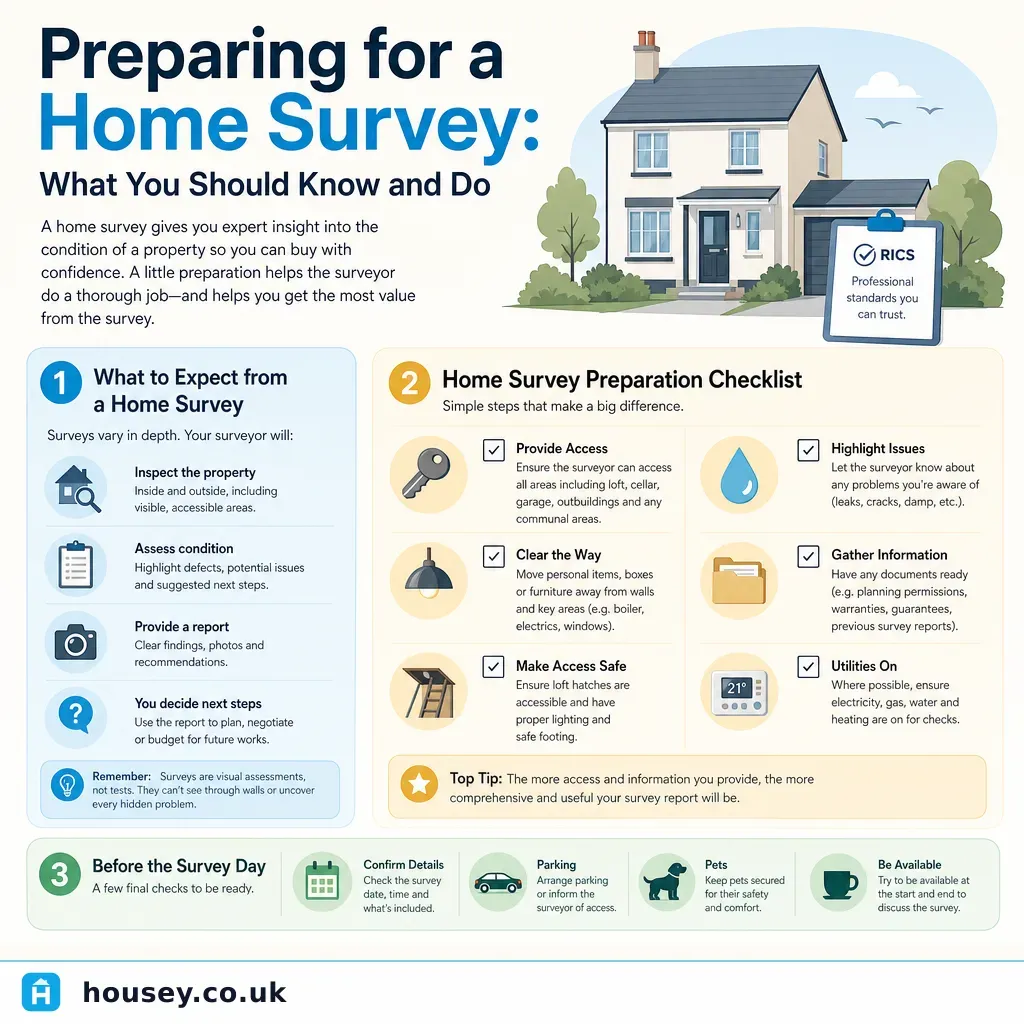
Preparing for a Home Survey: What You Should Know and Do
Preparing for a home survey means giving the surveyor clear access to all parts of the property, gathering relevant documents such as planning permissions and Building Regulations certificates, and knowing in advance which survey level has been instructed.
 Surveys & Inspections
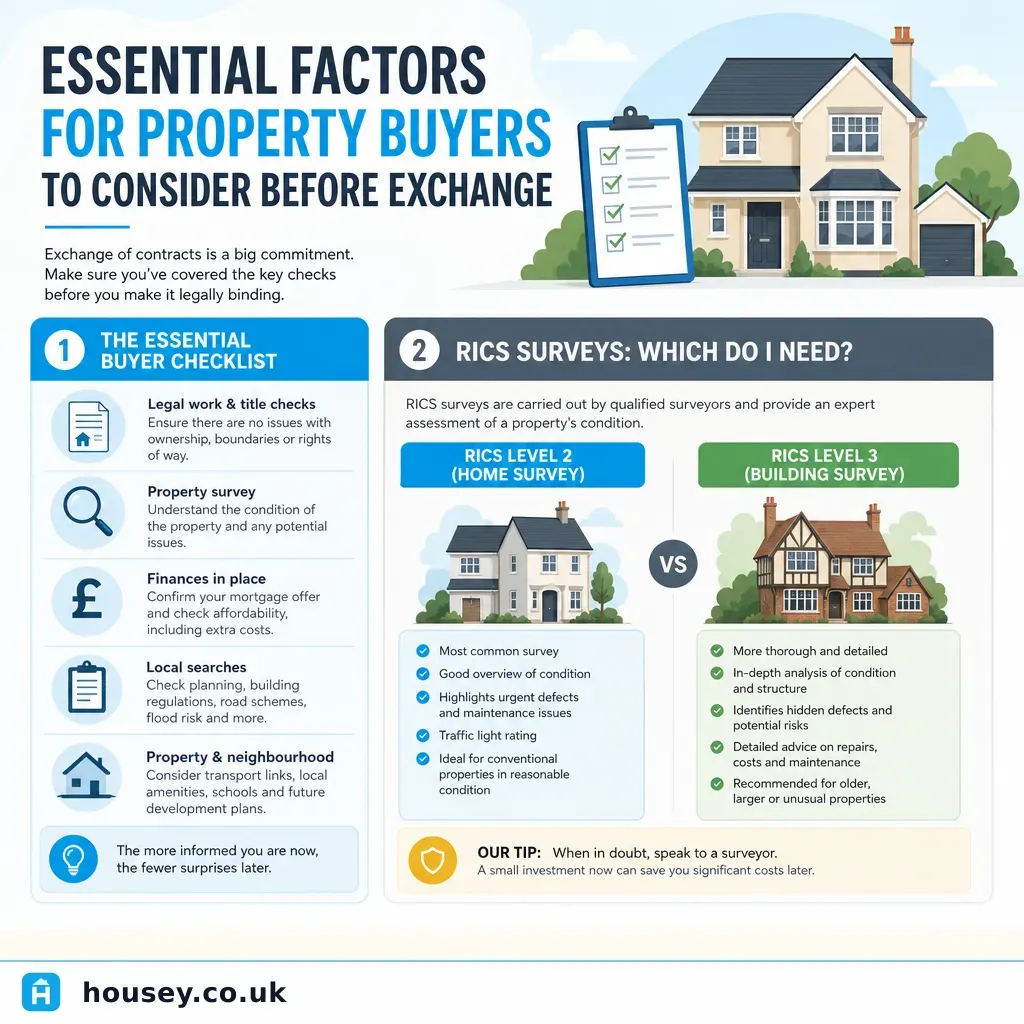
Essential Factors for Property Buyers to Consider Before Exchange
Before exchanging contracts on a UK property, buyers should commission an appropriate RICS survey, review the property's legal title and search results, check the planning history, assess structural condition, and confirm the EPC rating.
 Surveys & Inspections
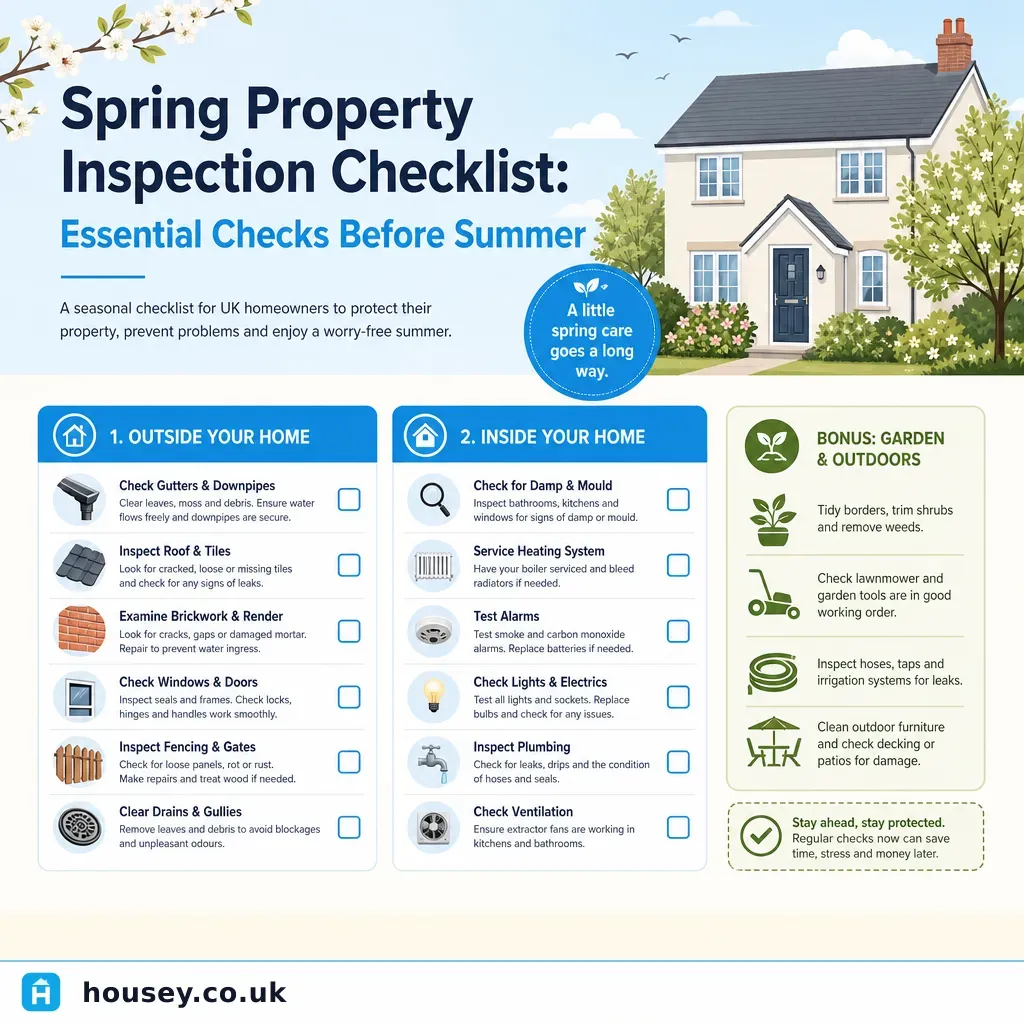
Spring Property Inspection Checklist: Essential Checks Before Summer
Each spring, UK homeowners should check the roof covering, gutters, flashings, drainage, external walls, and window seals for signs of winter damage.
 Surveys & Inspections
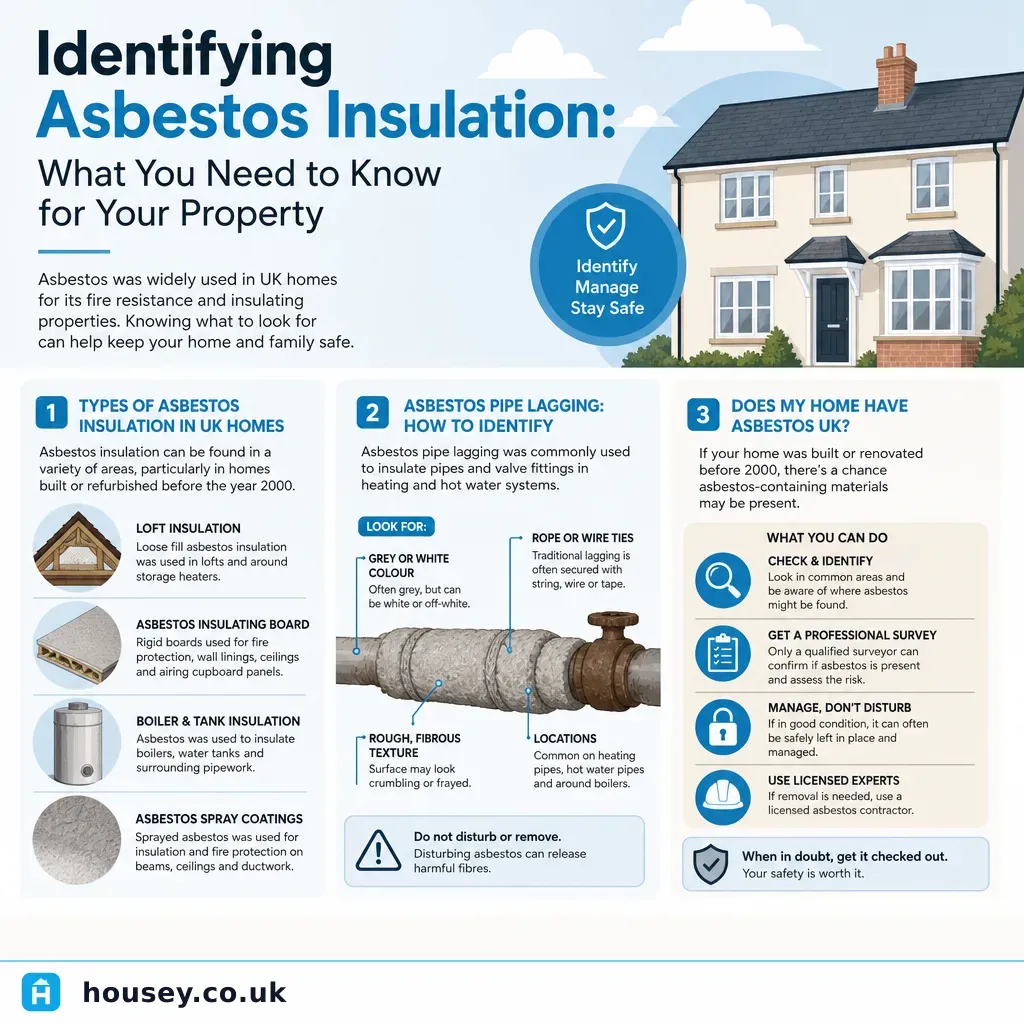
Identifying Asbestos Insulation: What You Need to Know for Your Property
Asbestos insulation was widely used in UK properties built before 2000, commonly found in pipe lagging, ceiling tiles, loose-fill loft insulation, and around boilers.
 Surveys & Inspections
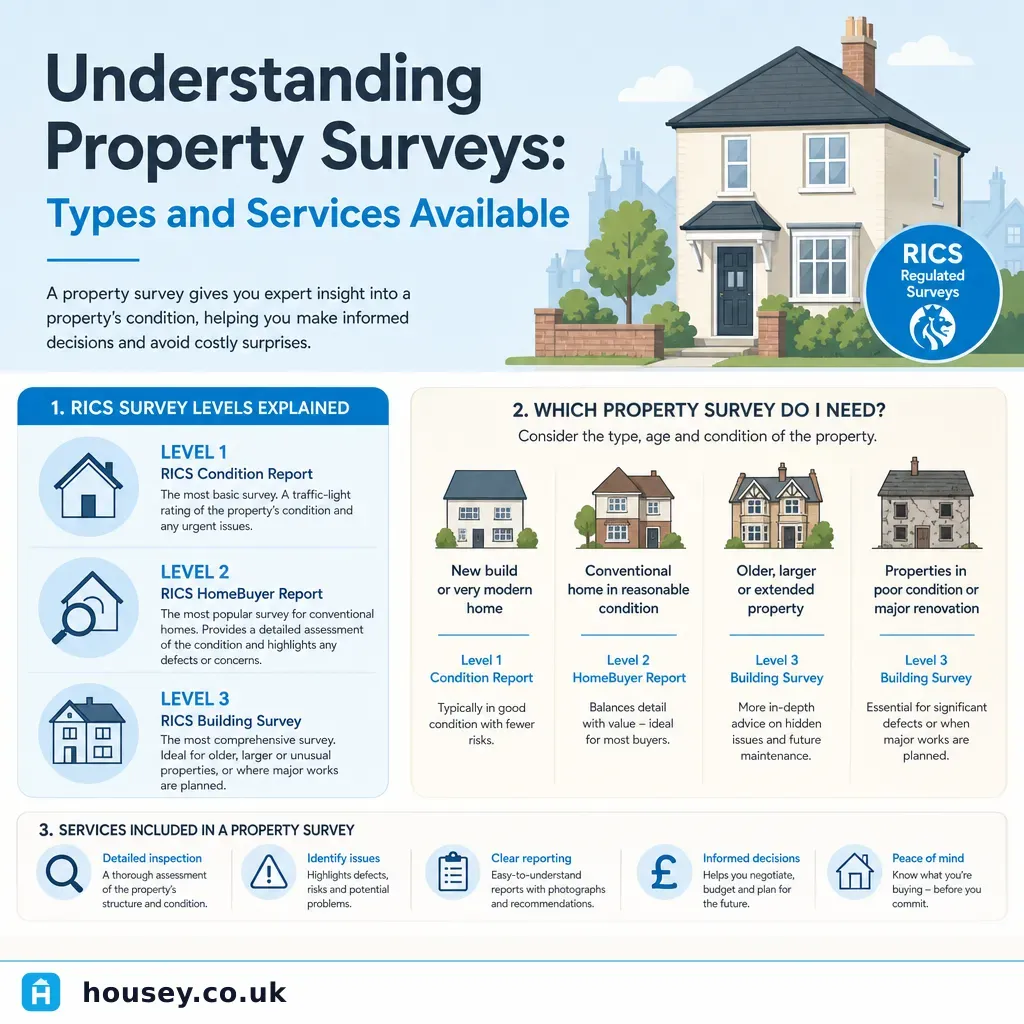
Understanding Property Surveys: Types and Services Available
UK property surveys follow three RICS-defined levels: Level 1 (Condition Report), Level 2 (Home Survey), and Level 3 (Building Survey).