Property Survey Inspection: Critical Questions to Ask Your Surveyor
By Housey · Last reviewed 7th of May 2026
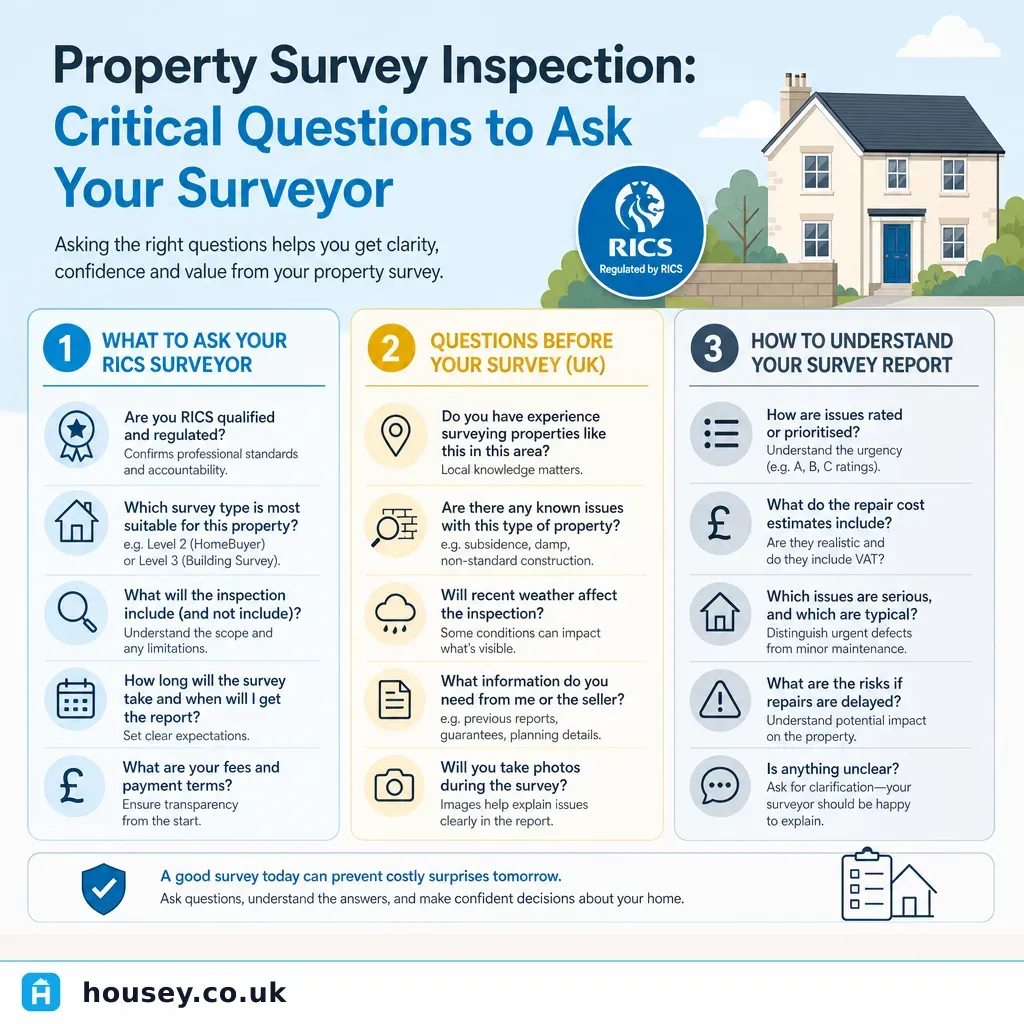
Property Survey Inspection: Critical Questions to Ask Your Surveyor
Most buyers receive a RICS survey report, skim the condition ratings, and move on — without ever speaking to the surveyor who inspected the property. That conversation, whether before or after the inspection, is often where the most useful guidance sits. Knowing which questions to ask can change how you interpret findings, which specialist reports you commission, and how you approach price negotiation before exchange.
Key points
- RICS Home Surveys are structured at three levels: Level 1 (Condition Report), Level 2 (HomeBuyer Report), and Level 3 (Building Survey) — the appropriate level depends on the property's age, size, and visible condition.
- RICS surveyors use a traffic-light Condition Rating system: Rating 1 (no repair needed), Rating 2 (defects requiring attention but not urgent), and Rating 3 (serious defects requiring urgent repair or investigation).
- Survey reports typically exclude inaccessible areas — roof spaces without a hatch, zones behind fixed linings, or subfloor voids — and should state clearly what was not inspected.
- A standard RICS Level 2 or Level 3 survey does not assess drainage, gas installations, electrical systems, or asbestos; these require separate specialist inspections.
- Under RICS guidance, surveyors should be available to discuss findings with the client after the report is issued — a follow-up call is normal and encouraged.
Which survey level is right for your property?
Choosing the correct survey level before instructing is the first critical question to resolve. A Level 2 HomeBuyer Report suits most conventionally built homes in reasonable condition built after roughly 1900. A Level 3 Building Survey is more thorough and appropriate for older, larger, significantly altered, or potentially defective properties.
Survey type | Best for | Not ideal for | Typical output | Main limitation |
|---|---|---|---|---|
RICS Level 2 (HomeBuyer Report) | Post-1900 standard construction, no obvious defects | Older, unusual, or visibly deteriorating properties | Condition-rated report, optional market valuation | Limited access areas; no invasive investigation |
RICS Level 3 (Building Survey) | Pre-1900, solid wall, altered, or defective properties | Buyers who need only a headline view | Detailed written report with recommended next steps | Does not include specialist tests (drainage, electrical, gas) |
Structural engineer assessment | Properties with suspected movement, cracking, or structural alteration | General condition assessment | Engineering diagnosis and recommendations | Focused on a specific structural concern only |
Specific defect survey | A known single issue (damp patch, roof, chimney) | Whole-property assessment | Targeted report on the specific element | Narrow scope by design |
Before instructing, ask the surveyor: "Given what I've described about this property, which survey level do you recommend, and why?"
Questions to ask before the survey
Asking the right questions before the inspection helps you understand exactly what you are commissioning — and what is outside its scope.
Before instructing, ask:
- Which RICS survey level do you recommend for this property, based on what I've described?
- What will the survey cover, and what is explicitly excluded from scope?
- Will you personally carry out the inspection, or will it be a colleague?
- What happens if access is restricted on the day — a locked loft hatch, no key for outbuildings?
- How long will the inspection take, and when will I receive the report?
- Will the report include a reinstatement cost assessment for insurance purposes, or is that a separate instruction?
- Are follow-up questions included in the fee, or is a phone consultation charged separately?
For older or unusual properties, add: "Have you surveyed other properties of this construction type or age?"
Questions to ask after the survey
Once you receive the report, a follow-up call is often the single most useful step you can take. A written report may flag concerns clearly, but direct conversation helps you understand urgency, likely costs, and the appropriate next steps.
After reading the report, ask:
- Can you walk me through the Condition Rating 3 items in order of urgency?
- For each serious defect, is this primarily cosmetic, maintenance, or something that could affect structure or safety?
- Which defects do you recommend investigating with a specialist, and what type of specialist would you use?
- In your judgement, would any of these findings affect the property's market value or its insurability?
- Is there anything you were unable to inspect that warrants further investigation?
- Are there signs of previous remedial work that may have masked an underlying problem?
- What is the likely age of the roof covering, and when might it need replacing?
- Did anything suggest the property may have been extended or altered without building control consent?
What a standard survey does not cover
Many buyers are surprised by what falls outside a standard RICS survey's scope. Before exchange, consider whether any of the following specialist reports are needed:
- Drainage CCTV survey — particularly for older properties or where drainage problems are suspected.
- Electrical Installation Condition Report (EICR) — an assessment of the wiring, consumer unit, and electrical installation is a separate instruction from a RICS survey.
- Gas safety inspection — checking boilers, flues, and gas pipework requires a Gas Safe registered engineer.
- Asbestos survey — pre-2000 properties may contain asbestos in artex ceilings, floor tiles, pipe lagging, or roofline materials; a RICS survey flags potential risk areas but does not sample.
- Damp and timber specialist report — recommended where the RICS survey identifies damp penetration or signs of timber decay.
- Detailed roof survey — a dedicated inspection can identify defects not visible from ground level or a standard loft hatch inspection.
- Structural survey — if the RICS report flags movement, cracking, or structural concerns, a structural engineering assessment is often the appropriate next step.
Red flags in a survey report
Some findings deserve particular attention, even when worded cautiously. Watch out for:
- "Further investigation is recommended" — this is not a minor caveat; it typically means the surveyor cannot rule out a serious defect from what was accessible.
- Condition Rating 3 on roof, walls, or foundations — serious defects on structural elements can affect safety, insurability, or mortgage eligibility.
- Evidence of movement described as "monitored" or "historic" — even apparently stable cracking should be assessed by a structural engineer when flagged in a survey.
- Damp and timber concerns appearing together — these may indicate a more systemic problem than a single localised repair.
- Non-standard construction flagged — properties built with timber frame, no-fines concrete, or prefabricated panel systems may be harder to mortgage or insure; check with your lender before proceeding.
- Key areas not inspected — if the surveyor could not access the roof void, undercroft, or significant sections of the property, factor that uncertainty into your purchase decision.
When to get professional help
Your survey is professional help — but knowing when to extend it matters. Consider instructing a specialist if:
- Your surveyor recommends further investigation on any Condition Rating 3 item.
- There are signs of structural movement, significant cracking, or subsidence indicators.
- The property was built before 2000 and the presence of asbestos has not been assessed.
- You are buying with a mortgage and the lender's valuer has independently flagged concerns.
- The property has had significant alterations and building control completion certificates cannot be located.
Do not proceed to exchange without understanding what each Condition Rating 3 finding means for the property, its insurability, and your position as buyer.
How Housey can help
Housey helps you find and compare qualified surveyors for the right level of inspection. Whether you need a RICS Level 2 survey for a post-war semi, a detailed RICS Level 3 building survey for an older or altered property, or a focused structural survey following a concerning RICS finding, you can request quotes from vetted professionals through RICS Home Surveys on Housey.
Frequently asked questions
Can I speak to my surveyor after I receive the report?
Yes. RICS guidance expects surveyors to be accessible to their clients. Most will take a follow-up call to walk through findings, particularly Condition Rating 3 items. If your surveyor is unavailable, that is a service issue worth raising. Ask before instructing whether follow-up calls are included in the fee or charged separately.
What does Condition Rating 3 mean in a RICS survey?
Condition Rating 3 is the most serious rating in the RICS traffic-light system. It indicates defects that are serious and need to be repaired, investigated, or monitored urgently. This does not necessarily mean the purchase cannot proceed, but you should understand the cause and likely cost of repair before committing to exchange.
What is not included in a standard RICS survey?
A RICS Level 2 or Level 3 survey does not cover drainage systems, electrical installations, gas appliances, or asbestos testing. It also cannot inspect areas inaccessible on the day — locked loft hatches, sealed subfloor voids, or areas concealed behind fixed linings. The report will state what was not inspected.
Should I be present during the property survey?
You are not required to be present, and many surveyors prefer to work uninterrupted. Ensure the surveyor has keys and access to all areas. A brief conversation after the inspection — before the formal report is issued — is often helpful for flagging specific concerns or asking about any access restrictions encountered on the day.
How do I know if I need a specialist report after a survey?
Your surveyor will usually state when specialist follow-up is recommended. Look for phrases such as 'further investigation is advised' in the report body. If uncertain, ask the surveyor directly which type of specialist they would consult for the specific concern raised, and whether urgency affects your exchange timeline.
Sources and further reading
- RICS Home Survey Standard — Royal Institution of Chartered Surveyors
- Buying or selling your home: surveyors — GOV.UK
- Buying a home — Citizens Advice
Useful next reads
 Surveys & Inspections
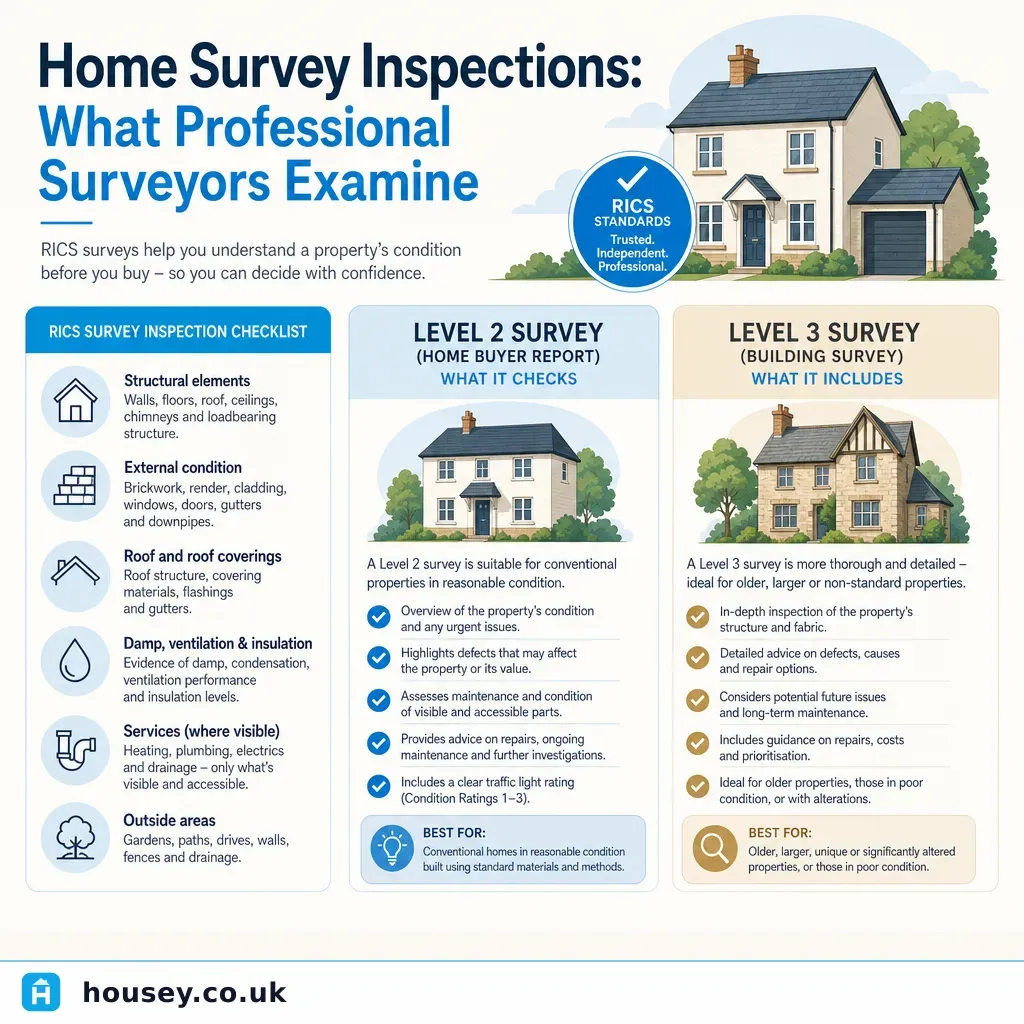
Home Survey Inspections: What Professional Surveyors Examine
A RICS home survey involves a visual inspection of a property's structure, roof, walls, floors, and services.
 Surveys & Inspections
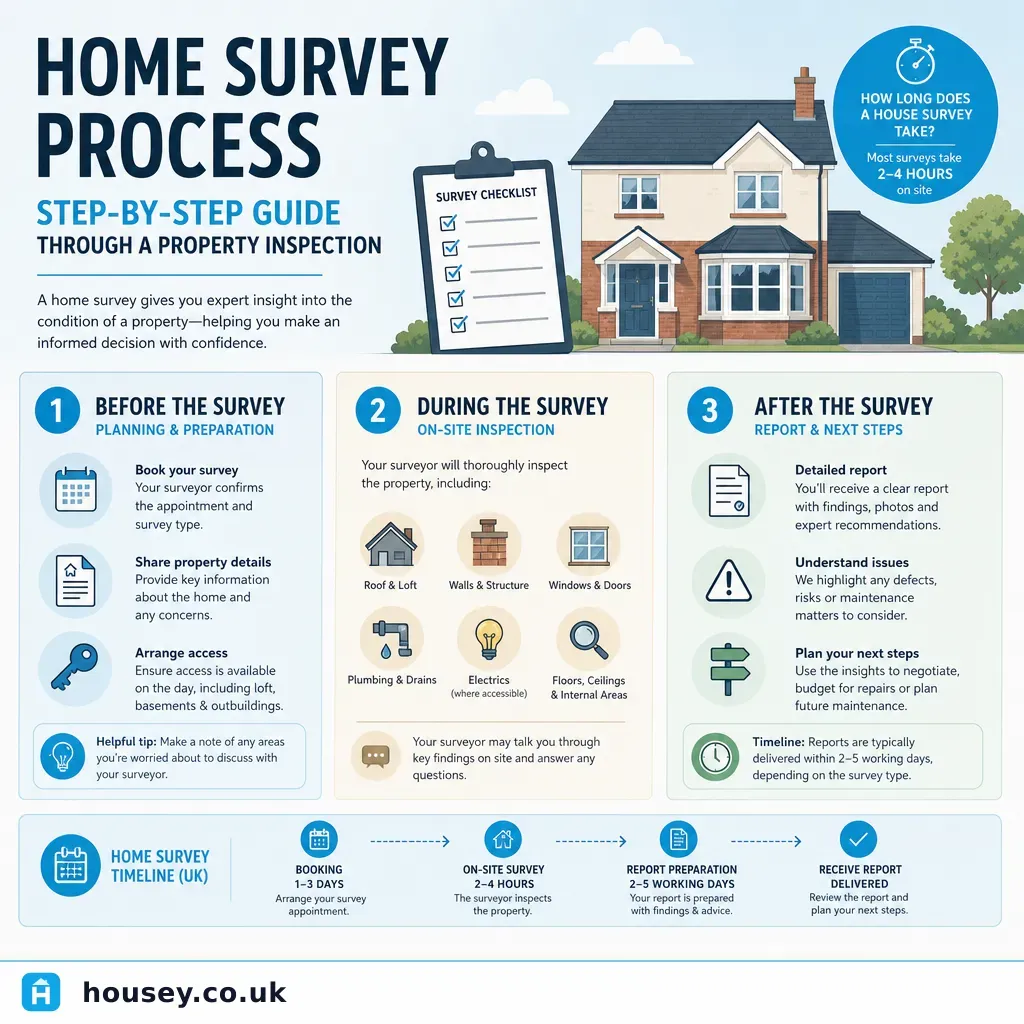
Home Survey Process: Step-by-Step Guide Through a Property Inspection
A RICS surveyor books and attends the property — usually 1–2 weeks after instruction — inspects accessible internal and external elements over 2–4 hours, and delivers a written report within 3–5 working days.
 Surveys & Inspections
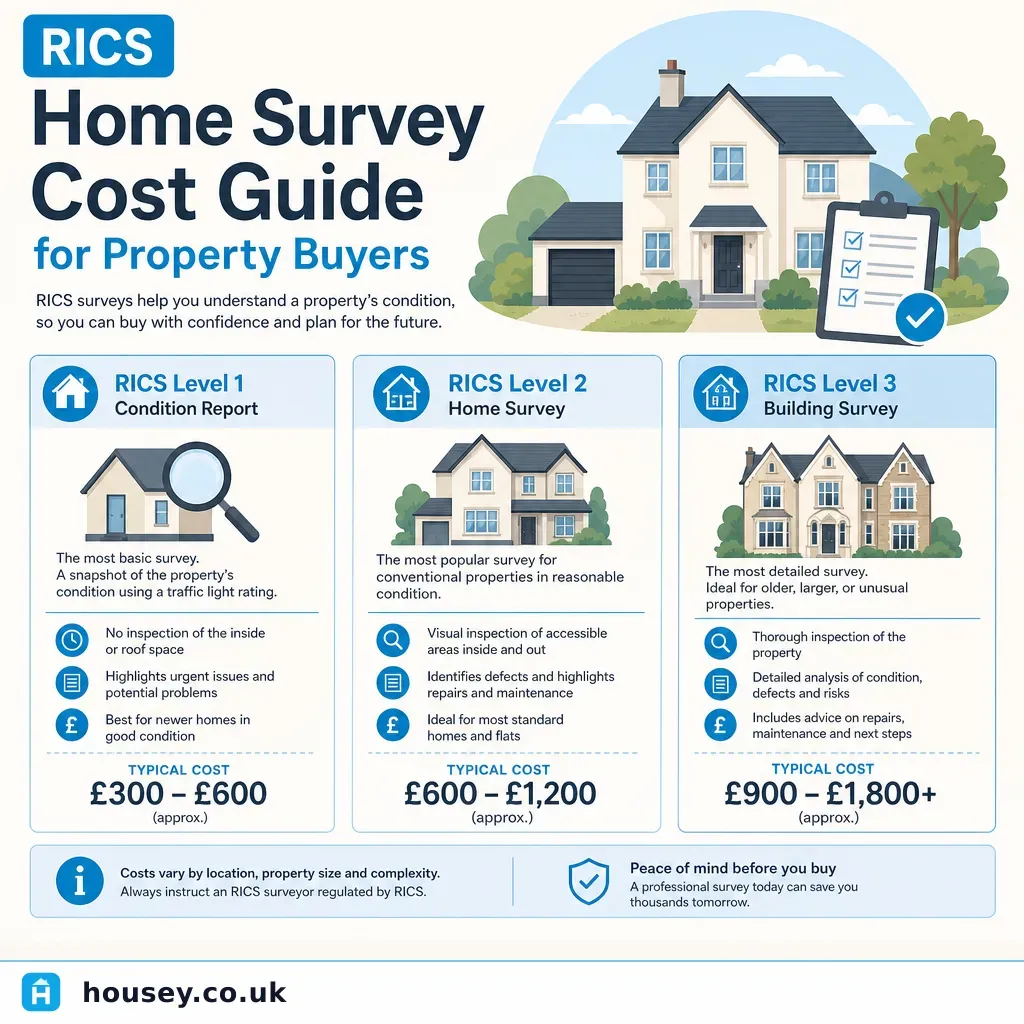
RICS Home Survey Cost Guide for Property Buyers
A RICS Level 2 Home Survey typically costs £400–£700 in the UK, while a Level 3 Building Survey ranges from £600 to £1,500 or more.
 Surveys & Inspections
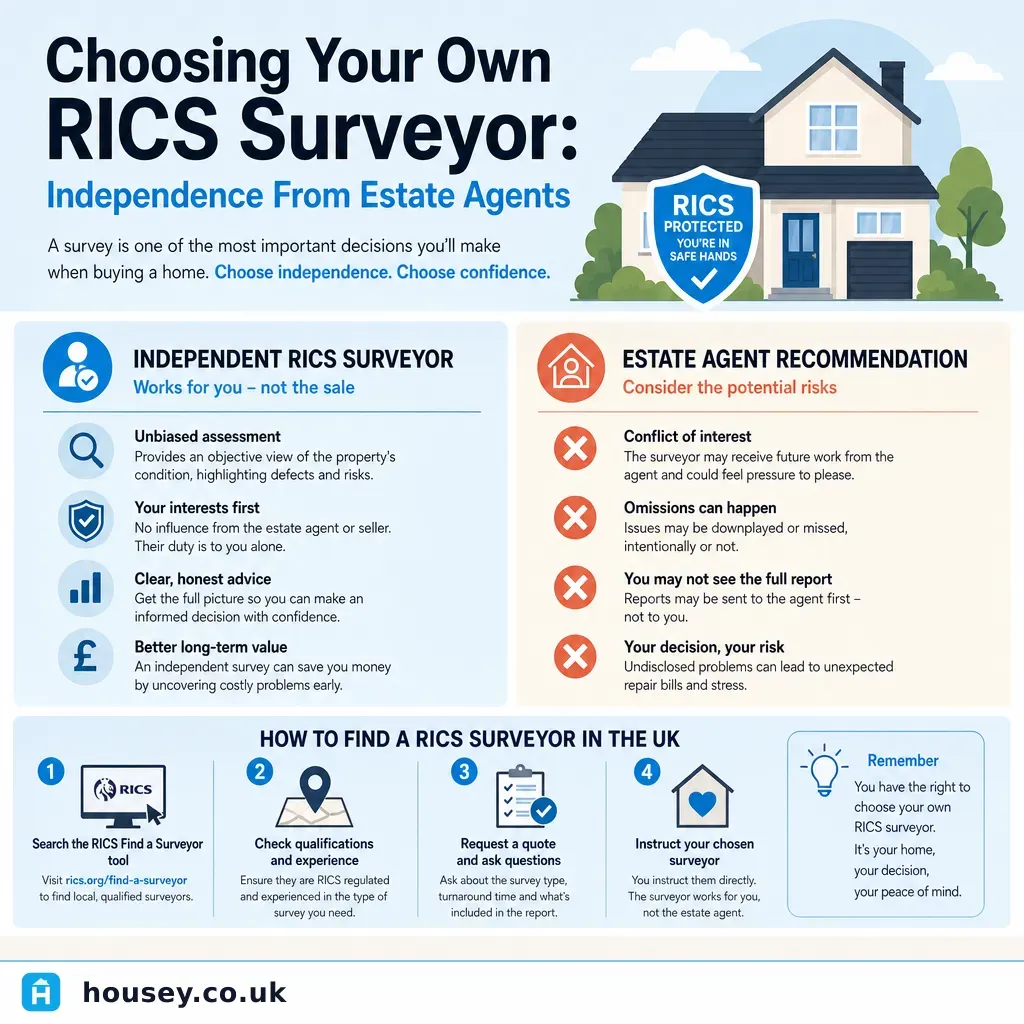
Choosing Your Own RICS Surveyor: Independence From Estate Agents
You have every right to choose your own RICS surveyor independently of your estate agent's recommendation.
 Surveys & Inspections
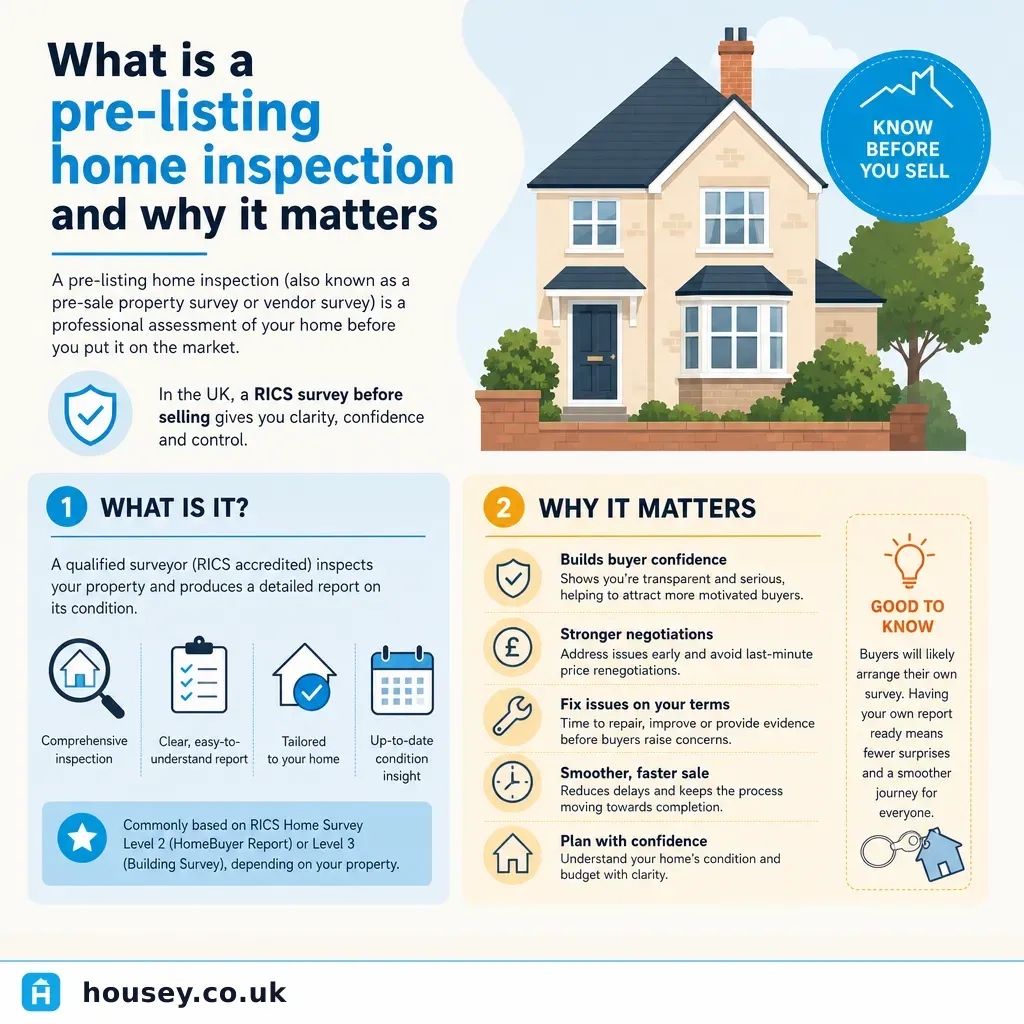
What is a pre-listing home inspection and why it matters
A pre-listing home inspection is a survey commissioned by the seller before marketing begins.