Full House Rewiring: Costs and Safety Compliance
By Housey · Last reviewed 10th of May 2026
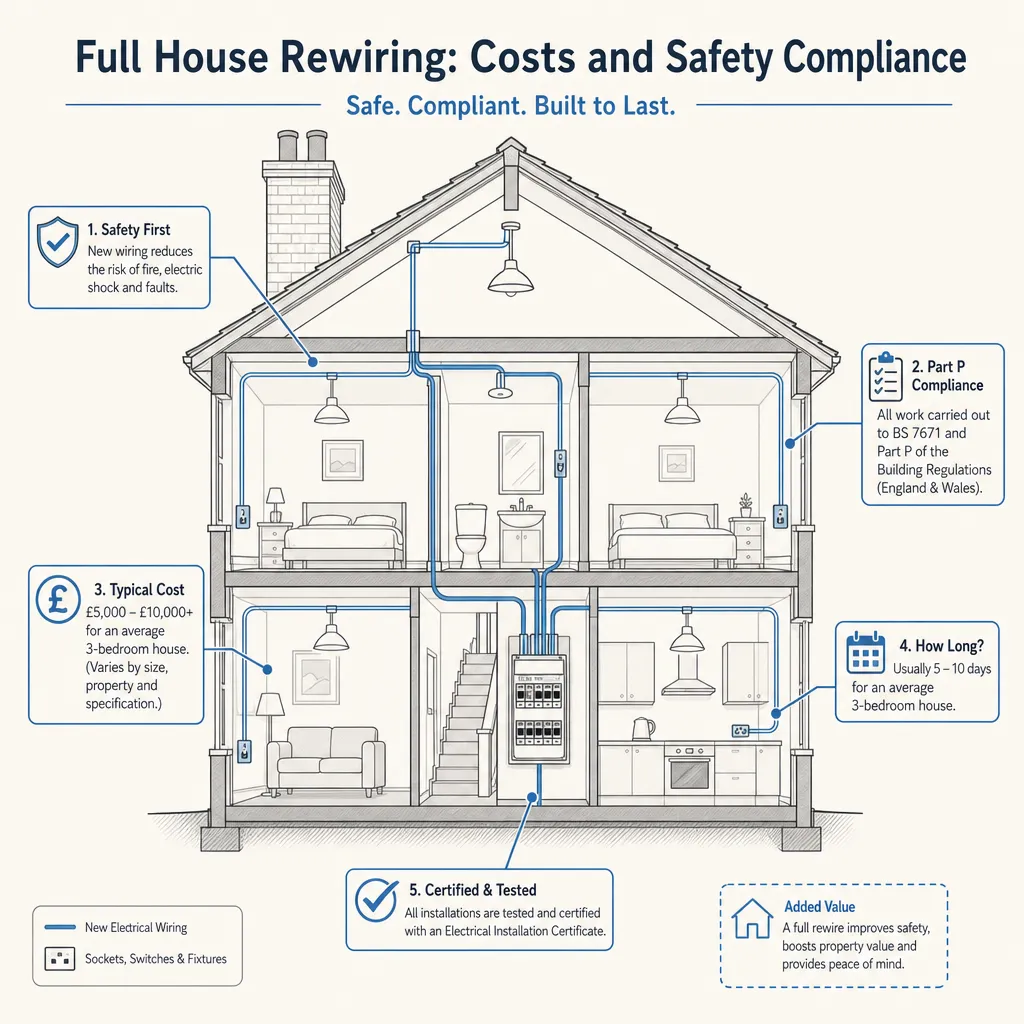
Full House Rewiring: Costs and Safety Compliance
A full house rewire is one of the most significant electrical projects a UK homeowner will ever undertake, but it is often unavoidable in properties where ageing wiring presents a genuine fire or electrocution risk. In England and Wales, all fixed electrical installation work in dwellings must comply with BS 7671:2018 (the 18th Edition IET Wiring Regulations) and must be notified under Building Regulations Part P — either by a registered competent-person scheme electrician, or via a separate building control application. Understanding what a rewire involves, what it costs, and what documentation to expect helps homeowners avoid unsafe work and unqualified contractors.
Key points
- All rewiring work in England and Wales must comply with BS 7671:2018 and be notified under Building Regulations Part P; using a registered competent-person scheme member (NICEIC, NAPIT, or ELECSA) is the standard route.
- An Electrical Installation Condition Report (EICR) classifies defects as C1 (danger present), C2 (potentially dangerous), or C3 (improvement recommended) — it is the most objective way to establish whether a full rewire is genuinely needed before committing.
- A full rewire of a three-bedroom semi-detached house typically costs £3,500–£6,000 including VAT; cost varies by property size, cable routing difficulty, and whether making good is included in the scope.
- On completion, the homeowner must receive an Electrical Installation Certificate (EIC) and a Building Regulations notification reference — both are required by solicitors and conveyancers on resale.
- Under the Electrical Safety Standards in the Private Rented Sector (England) Regulations 2020, landlords must hold a valid EICR and carry out any C1 or C2 remedial work within 28 days of the report — which may include a full or partial rewire.
When does a property need a full rewire?
Not every property with old wiring needs an immediate full rewire. An EICR carried out by a registered electrician will classify the installation condition:
- C1 (Danger present): Immediate remedial action required — the affected circuit should not be used.
- C2 (Potentially dangerous): Urgent remedial action required before the installation is used further.
- C3 (Improvement recommended): Not immediately unsafe, but advisable to address in due course.
- FI (Further investigation required): More information is needed before a final classification can be issued.
A full rewire is most likely needed when:
- Wiring is the original rubber-insulated or fabric-braided type, typically found in pre-1960s properties, which becomes brittle and dangerous with age.
- The consumer unit is an old ceramic-fuse type with no RCDs or RCBOs for fault and shock protection.
- The EICR returns multiple C1 or C2 codes across several circuits.
- Significant extension or conversion work has created a patchwork of incompatible wiring generations.
- Non-compliant DIY electrical work is discovered that cannot be economically remediated circuit by circuit.
What is included in a full house rewire?
A full rewire typically covers:
- All fixed mains wiring: ring main circuits for socket outlets, radial circuits for lighting, and dedicated circuits for cookers, electric showers, EV chargers, and similar high-demand appliances.
- Consumer unit replacement with a modern unit fitted with RCDs, RCBOs, and a surge protective device (SPD) to 18th Edition requirements.
- All socket outlets, light switches, and faceplates throughout the property.
- All ceiling roses, pendant fittings, or LED driver housings.
- Main earthing conductor and main protective bonding to gas, water, and structural metalwork.
- First-fix electrical work for any new socket or lighting positions agreed before work begins.
It does not usually include: making good plasterwork, tiles, or paintwork disturbed during first fix (often quoted separately); fitting of decorative light fittings or appliances supplied by the homeowner; or installation of smart home devices unless specifically scoped.
Comparing rewire scope options
Scope | Best for | Typical duration | Documentation issued |
|---|---|---|---|
Full rewire (all circuits) | Pre-1970s properties; multiple C1/C2 codes; post-extension patchwork wiring | 5–10 working days | EIC, Part P notification reference |
Partial rewire (targeted circuits) | Isolated faulty circuits; single-floor addition | 1–3 days | EIC for altered or new circuits |
Consumer unit replacement only | Modern wiring in good condition; old ceramic fuse board | 1 day | EIC, Part P notification reference |
Like-for-like socket or switch replacement | Cosmetic update; existing wiring compliant and intact | Hours | Minor works certificate (where applicable) |
How much does a full house rewire cost in the UK?
Indicative UK costs, last reviewed 2026-05-10:
Property size | Approx. rewire cost (incl. VAT) |
|---|---|
1-bedroom flat | £1,500–£3,000 |
2-bedroom house | £2,500–£4,500 |
3-bedroom semi-detached | £3,500–£6,000 |
4-bedroom detached | £5,500–£10,000+ |
5+ bedroom or complex layout | £10,000–£15,000+ |
Indicative ranges only — London and the South East typically attract higher rates. Always obtain at least three quotes from NICEIC- or NAPIT-registered electricians.
Key cost drivers include:
- Number of floors, rooms, and circuits required.
- Cable routing difficulty — open timber joists are far easier than solid concrete floors or restricted roof voids.
- Whether the property is occupied during works (phased access adds time).
- Making good requirements: plastering, tiling, and decoration after chasing walls and ceilings.
- Whether an asbestos survey is required before chasing in pre-1985 construction.
Building Regulations and compliance
All full rewiring work in England and Wales must comply with Part P of the Building Regulations. There are two compliant routes:
- Registered competent person scheme: An electrician registered with NICEIC, NAPIT, ELECSA, or another government-approved scheme can self-certify the work, notify building control directly, and issue an EIC without a separate application. This is the most common route and is strongly preferred by solicitors and mortgage lenders.
- Building control application: If you engage an unregistered electrician, the work must be submitted to your local building control authority for inspection. This adds time, cost, and scheduling uncertainty — most homeowners and conveyancers strongly recommend the competent person route.
In Scotland, equivalent requirements apply under the Building (Scotland) Regulations; SELECT is the primary electrical trade body. In Northern Ireland, the Building Regulations (Northern Ireland) apply.
Documents you must receive on completion
- Electrical Installation Certificate (EIC): Confirms compliance with BS 7671:2018. Must be signed by the designer, installer, and inspector — often the same person on domestic projects.
- Building Regulations completion notification reference: Issued directly by the competent person scheme to building control; you should receive a copy.
- Minor works certificates for any supplementary alterations carried out alongside the main rewire.
Keep all documentation safely — it is required by solicitors, conveyancers, and mortgage lenders on resale, and by landlords as evidence of compliance with the Electrical Safety Standards Regulations 2020.
What to ask before accepting a quote
Use this checklist when comparing quotes from electricians:
Important limitations
Electrical installation work is regulated under Building Regulations Part P and must comply with BS 7671:2018. This article provides general information only and does not constitute electrical, safety, or legal advice. Requirements are subject to periodic revision — confirm current regulations with a registered electrician, NICEIC, or your local building control authority before proceeding. Rules differ between England and Wales, Scotland, and Northern Ireland.
When this becomes urgent
Do not delay seeking professional help if:
- A current EICR has returned C1 codes — the affected circuits present an immediate danger and should not be used.
- You can smell burning from sockets, switches, or the consumer unit.
- Circuit breakers or fuses trip repeatedly without an identifiable cause.
- You have identified rubber-insulated or fabric-sheathed wiring anywhere in the property.
- A buyer's surveyor or mortgage lender has made a rewire a condition of the survey or mortgage offer.
What to ask a qualified professional
Before instructing an electrician for a full rewire:
- What EICR classification would you give the current installation based on your initial inspection?
- Which competent person scheme are you registered with, and where can I verify this online?
- Is there any asbestos risk in this property that should be assessed before chasing walls or ceilings?
- How will you phase the work to minimise extended power outages if the property is occupied throughout?
- What scope could expand once work begins — for example, if non-compliant wiring is found in areas not included in the original quote?
When to get professional help
Never carry out rewiring work yourself unless you are a qualified, registered electrician. Consumer unit replacement in particular is restricted to registered scheme members under Building Regulations Part P and the Electrical Safety Standards in the Private Rented Sector (England) Regulations 2020. DIY electrical work that has not been certified creates liability on resale and may invalidate your buildings and contents insurance.
Contact a registered electrician immediately if you have any concern about the safety of existing wiring.
How Housey can help
Start with an independent Electrical Installation Condition Report (EICR) to establish the condition of your wiring before committing to a full rewire. For compliance questions or notifiable work, building control consultants on Housey can help you understand your obligations under Part P and navigate the certification process.
Frequently asked questions
Do I need to move out during a house rewire?
Many electricians will phase the work room by room so that parts of the property remain liveable. However, expect periods without power to specific circuits or the whole property during each working day. If the property is occupied with young children or vulnerable occupants, ask your electrician to provide a detailed phasing plan before work starts.
How long does a full house rewire take?
A typical three-bedroom semi-detached property usually takes five to eight working days for the rewire itself, not including making good plasterwork or redecoration. Larger or more complex properties take longer. Delays can occur when hidden non-compliant or DIY wiring is discovered during the project.
Will a rewire add value to my home?
A property with a modern, certified electrical installation and a satisfactory EICR is more marketable than one with ageing wiring. While a rewire may not add measurable open market value directly, outdated or C1-coded installations are increasingly flagged by mortgage lenders and buyers' solicitors as conditions of sale — making a rewire essential rather than optional for many properties.
Does a full rewire include testing?
Yes — a compliant full rewire must include inspection and testing in accordance with BS 7671:2018, resulting in an Electrical Installation Certificate (EIC). Some electricians also carry out a follow-up EICR to formally confirm the condition of the new installation. Confirm that testing and certification are included in any quote before you agree to proceed.
Sources and further reading
- Building Regulations Approved Document P — GOV.UK
- NICEIC — find a registered electrician — NICEIC
- NAPIT — registered electricians search — NAPIT
- Electrical Safety First — wiring guidance — Electrical Safety First
- IET Wiring Regulations BS 7671:2018 — IET
- Electrical Safety Standards in the Private Rented Sector Regulations 2020 — legislation.gov.uk
Useful next reads
 Surveys & Inspections
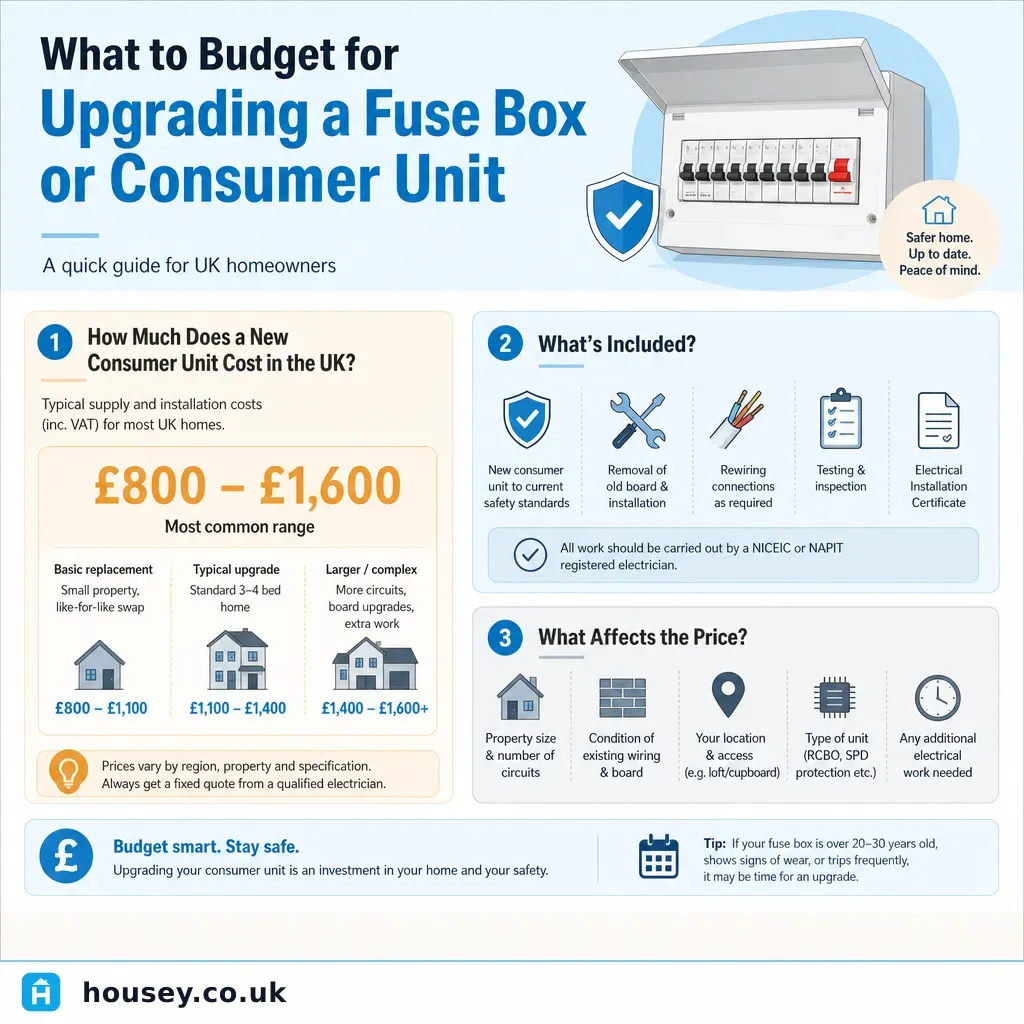
What to Budget for Upgrading a Fuse Box or Consumer Unit
Replacing a consumer unit (fuse box) in the UK typically costs £400–£900 for a straightforward installation by a Part P registered electrician.
 Surveys & Inspections
Safe Removal and Replacement of Asbestos Water Tanks
Asbestos cement cold water tanks, found in many UK homes built before about 1980, must not be drilled, cut, or broken without proper controls.
 Surveys & Inspections
Gas Safety: Identifying Leaks and Professional Inspections
If you smell gas or suspect a leak, leave the building immediately, avoid using switches or flames, and call the National Gas Emergency Service on 0800 111 999.
 Surveys & Inspections
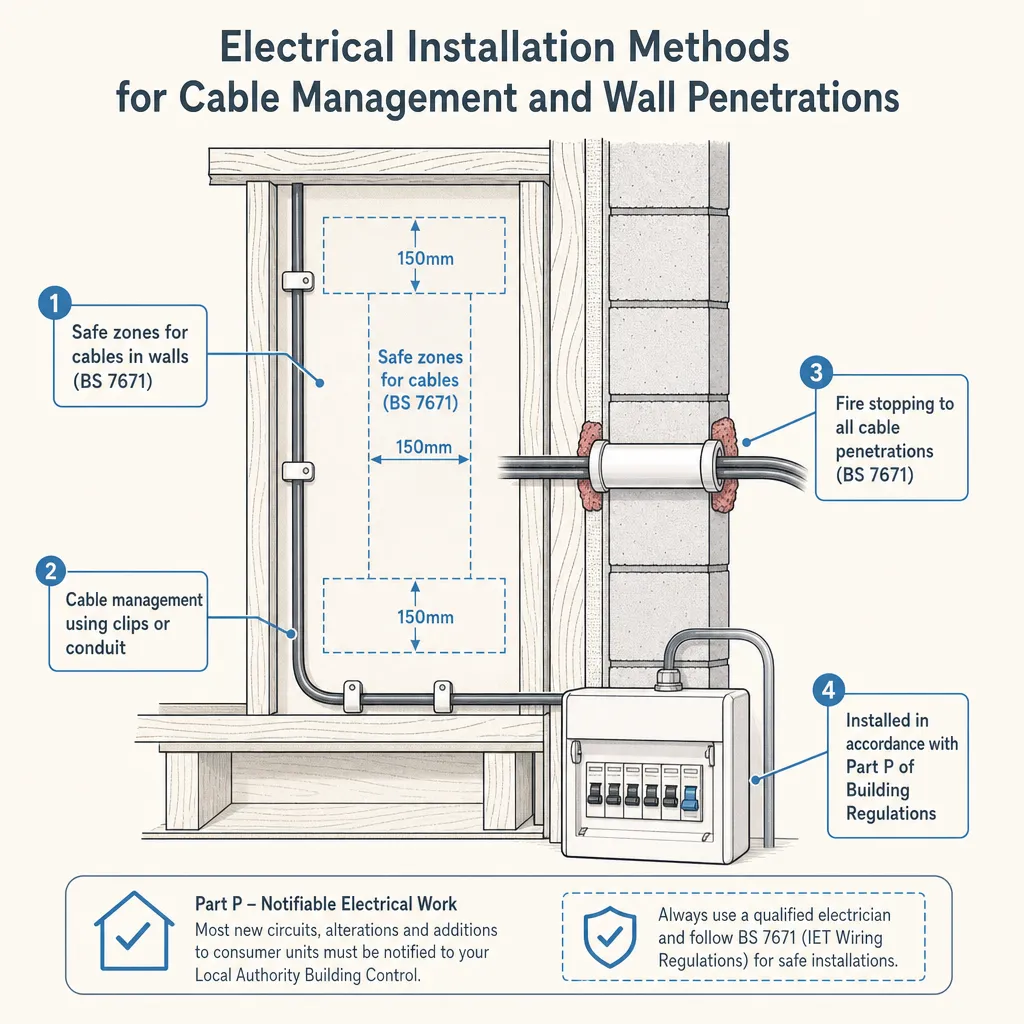
Electrical installation methods for cable management and wall penetrations
Cables concealed in walls must follow safe-zone routes or be protected by earthed metallic conduit under BS 7671 Regulation 522.
 Surveys & Inspections
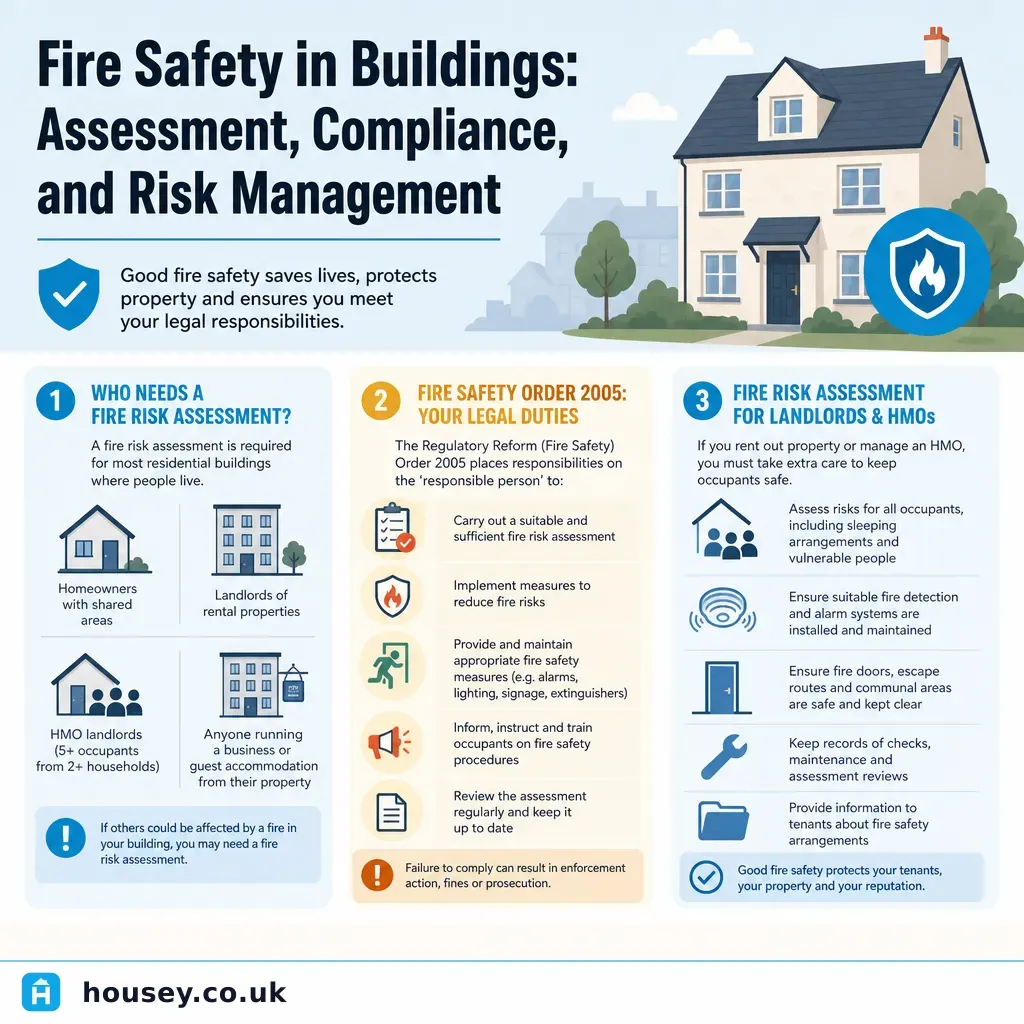
Fire Safety in Buildings: Assessment, Compliance, and Risk Management
The Regulatory Reform (Fire Safety) Order 2005 requires most non-domestic and multi-occupied residential buildings to have a written fire risk assessment carried out by a competent person.