Asphalt Driveways: Installation, Maintenance, and Durability Considerations
By Housey · Last reviewed 19th of May 2026
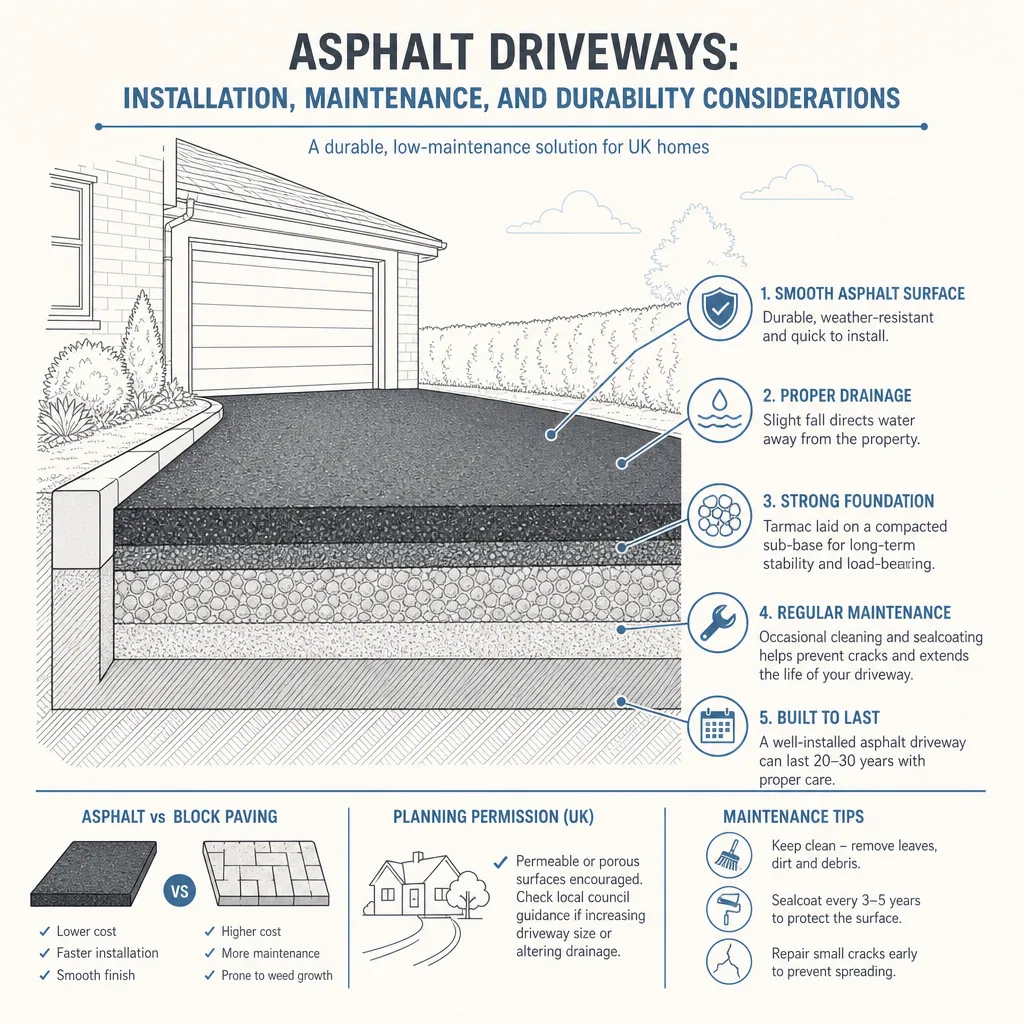
Asphalt Driveways: Installation, Maintenance, and Durability Considerations
Replacing or installing a driveway is one of the more visible home improvements a UK homeowner can make, and asphalt — commonly called tarmac — remains one of the most popular choices for residential driveways across Britain. Whether you are comparing surface materials, planning a first installation, or looking to extend the life of an existing asphalt driveway, understanding the key decisions before work starts will help you avoid costly mistakes and choose the right contractor.
Key points
- Impermeable driveways covering more than 5 m² generally require planning permission unless run-off drains to a lawn, border, or soakaway within the property boundary — this rule applies in England under the Town and Country Planning (General Permitted Development) (England) Order 2008.
- A well-installed asphalt driveway on a correctly prepared MOT Type 1 sub-base should last 20–30 years; inadequate sub-base preparation is the most common cause of premature failure.
- Indicative UK installation costs for asphalt driveways are £50–£100 per m², though regional variation, site conditions, and access significantly affect price (Indicative UK costs, last reviewed 2026-05-19).
- Cold-lay asphalt products are suitable for small patch repairs only; full driveway installations require hot-lay asphalt laid by a professional for adequate durability.
- Edging restraints — block, concrete, or metal — are essential to prevent the asphalt surface from creeping and crumbling at the margins; their absence is a leading cause of edge failure.
Asphalt vs other driveway surfaces: a comparison
Choosing a driveway surface involves balancing upfront cost, durability, drainage requirements, and aesthetics. The table below covers the most common residential options.
Surface | Best for | Not ideal for | Typical lifespan | Approx. cost per m² (UK, 2026) |
|---|---|---|---|---|
Asphalt/tarmac | Larger driveways, practical use, budget-conscious projects | Steep slopes without drainage planning; premium kerb appeal | 20–30 years | £50–£100 |
Block paving | Aesthetics, easy individual block repair, permeable options | Higher upfront cost; ongoing joint weeding | 20–25 years | £70–£130 |
Gravel | Low cost, good natural drainage, flexible installation | Movement under vehicles, requires regular topping-up | 10–20 years | £20–£50 |
Resin-bound | Premium finish, fully permeable, weed resistant | Higher cost, specialist installer required | 15–25 years | £70–£150 |
Concrete | Very durable, minimal maintenance | High upfront cost; freeze-thaw cracking risk in exposed positions | 25–40 years | £80–£140 |
Indicative UK costs, last reviewed 2026-05-19. Regional variation, site conditions, and existing surface removal significantly affect price. Obtain at least three written quotes before committing.
What affects the cost of an asphalt driveway?
Several factors drive the installed cost of an asphalt driveway in the UK:
- Driveway size and shape: Larger driveways generally attract lower per-m² costs; complex shapes and curves increase labour time.
- Existing surface removal: Breaking out and disposing of existing concrete, block paving, or old asphalt typically adds £5–£15 per m² for labour and skip hire (Indicative UK costs, last reviewed 2026-05-19).
- Sub-base preparation: A correctly compacted MOT Type 1 sub-base of 100–150 mm depth is essential. If the existing ground is unsuitable, excavation and new base material add significantly to overall cost.
- Asphalt specification: Residential driveways typically use a 40–60 mm wearing course. A binder course beneath the wearing course adds durability for heavier or more frequent vehicle use.
- Drainage: Permeable channels, gullies, or soakaways to meet SUDS requirements add cost but may remove the need for a planning application on impermeable surfaces.
- Site access: Restricted or narrow access increases labour time and may limit equipment options, increasing overall cost.
- Region: Labour rates in London and the South East are typically higher than in the Midlands or North.
Planning permission: do you need it for an asphalt driveway?
Under the Town and Country Planning (General Permitted Development) (England) Order 2008, a new or replacement driveway of more than 5 m² does not require planning permission if:
- The surface is permeable (water drains through it), or
- Run-off from an impermeable surface is directed to a lawn, border, or other permeable area within the property boundary.
Standard asphalt is impermeable. To comply without a planning application, you will typically need to incorporate permeable drainage channels, route surface water to a soakaway, or direct run-off to a planting area on the property. If the driveway drains directly to the public highway or a neighbour's land, a planning application is likely required.
Rules in Wales, Scotland, and Northern Ireland differ — always check with your local planning authority before works begin. Properties in conservation areas or those with listed building consent may face additional restrictions.
What to ask before accepting a quote
Before instructing any contractor for asphalt driveway installation, work through this checklist:
- Does the written quote itemise sub-base depth, asphalt thickness, edging type, drainage provision, and surface finish?
- Is the contractor a member of a recognised trade body such as the National Federation of Builders (NFB) or a CHAS-accredited contractor?
- Do they carry public liability insurance? Ask to see the certificate before work begins.
- Will they provide a written workmanship guarantee? Reputable installers typically offer two to five years.
- Does the price include skip hire, machine hire, and clearance of the site after works?
- Is VAT included in the quoted price?
- Can they provide references or photographs from recent comparable installations in your area?
Be wary of doorstep traders offering to lay asphalt using "leftover material" at unusually low prices — this is a common indicator of substandard cold-lay material, inadequate sub-base preparation, and no formal guarantee.
Maintaining your asphalt driveway
Regular maintenance extends driveway life significantly and avoids costly resurfacing:
- Seal coating: Apply a bitumen-based sealant every three to five years to protect against UV degradation, oil penetration, and water ingress. Use a product specifically formulated for asphalt or tarmac surfaces.
- Crack repair: Address surface cracks promptly using appropriate filler before water penetrates and destabilises the sub-base. Hot-pour crack filler gives longer-lasting results than cold-fill products.
- Oil and fuel spills: Clean up promptly using a suitable degreaser; petroleum-based spills can soften the asphalt binder over time.
- Edge maintenance: Check edging restraints annually and repair displaced sections. Failed or absent edging is the most common cause of edge crumbling at driveway margins.
- Drainage: Keep channels, gullies, and soakaways clear of debris to prevent water pooling on the surface.
- Weed control: Asphalt is largely weed-resistant, but edges and cracks can allow growth. Apply a suitable herbicide or edge sealant after carrying out repairs.
When to get professional help
Contact a qualified driveway contractor rather than attempting DIY repair if:
- The driveway shows extensive cracking, rutting, or surface depressions — these indicate sub-base failure that surface patching alone cannot fix.
- Water pools persistently after rain, suggesting drainage is not functioning correctly.
- Driveway edges are breaking down significantly despite restraints being present — this may indicate a sub-base or drainage problem rather than surface wear alone.
- You are extending an existing driveway and are unsure whether planning permission or a SUDS drainage solution is required.
How Housey can help
Housey connects homeowners with vetted driveway installation professionals across the UK who can advise on surface options, drainage requirements, and planning considerations, and provide itemised quotes for comparison. Getting multiple quotes through Housey helps you assess cost, scope, and workmanship guarantees before committing to a contractor.
Frequently asked questions
How long does asphalt driveway installation take?
Most residential asphalt driveway installations take one to two days on site, depending on size and the extent of sub-base preparation required. You should avoid driving on a newly laid surface for at least 24–48 hours while it cures. In warm weather, avoid concentrated loads such as vehicle jacks for several days, as asphalt can remain slightly soft in high temperatures.
Can I lay asphalt over an existing concrete driveway?
In some cases, asphalt can be overlaid on existing concrete if the concrete is structurally sound, level, and adequately drained. A contractor should assess whether overlay is appropriate or whether break-out is necessary. Overlaying a damaged, cracked, or poorly drained concrete base is likely to cause premature failure of the asphalt surface and is generally not recommended.
Does an asphalt driveway add value to my home?
A well-installed and well-maintained driveway can improve kerb appeal and may be a positive factor for buyers in areas where off-street parking is in demand. There is no standardised UK data on the precise value uplift attributable to driveway surface material alone. The condition and appearance of the driveway tend to matter more than the choice of surface material in most buyer assessments.
What is the difference between asphalt and tarmac?
In everyday UK usage, 'tarmac' is widely used as a generic term for black bituminous driveway surfaces. The word originally referred to tar macadam, a historical material now largely obsolete. Modern residential driveways use bitumen-bound asphalt aggregate. The terms are used interchangeably by most consumers and many contractors, though technical distinctions exist within the construction industry.
Sources and further reading
- Planning permission: when it is required — Planning Portal / GOV.UK
- Town and Country Planning (General Permitted Development) (England) Order 2008 — legislation.gov.uk
- Sustainable drainage systems (SUDS) guidance — GOV.UK
- Driveways and hardstandings: planning guidance — Planning Portal
Useful next reads
 Improvement & Build
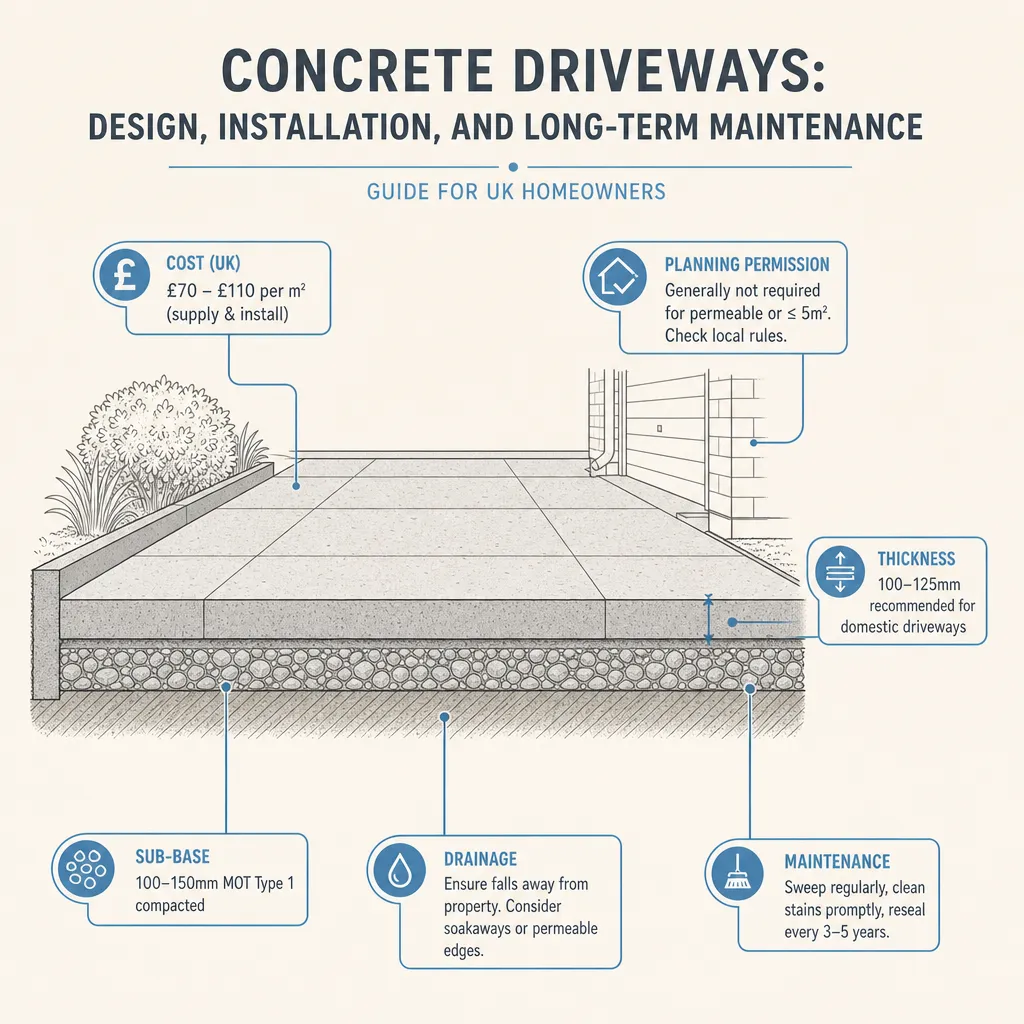
Concrete Driveways: Design, Installation, and Long-Term Maintenance
A concrete driveway requires a compacted sub-base of at least 150mm and a concrete slab of at least 100mm for domestic use.
 Improvement & Build
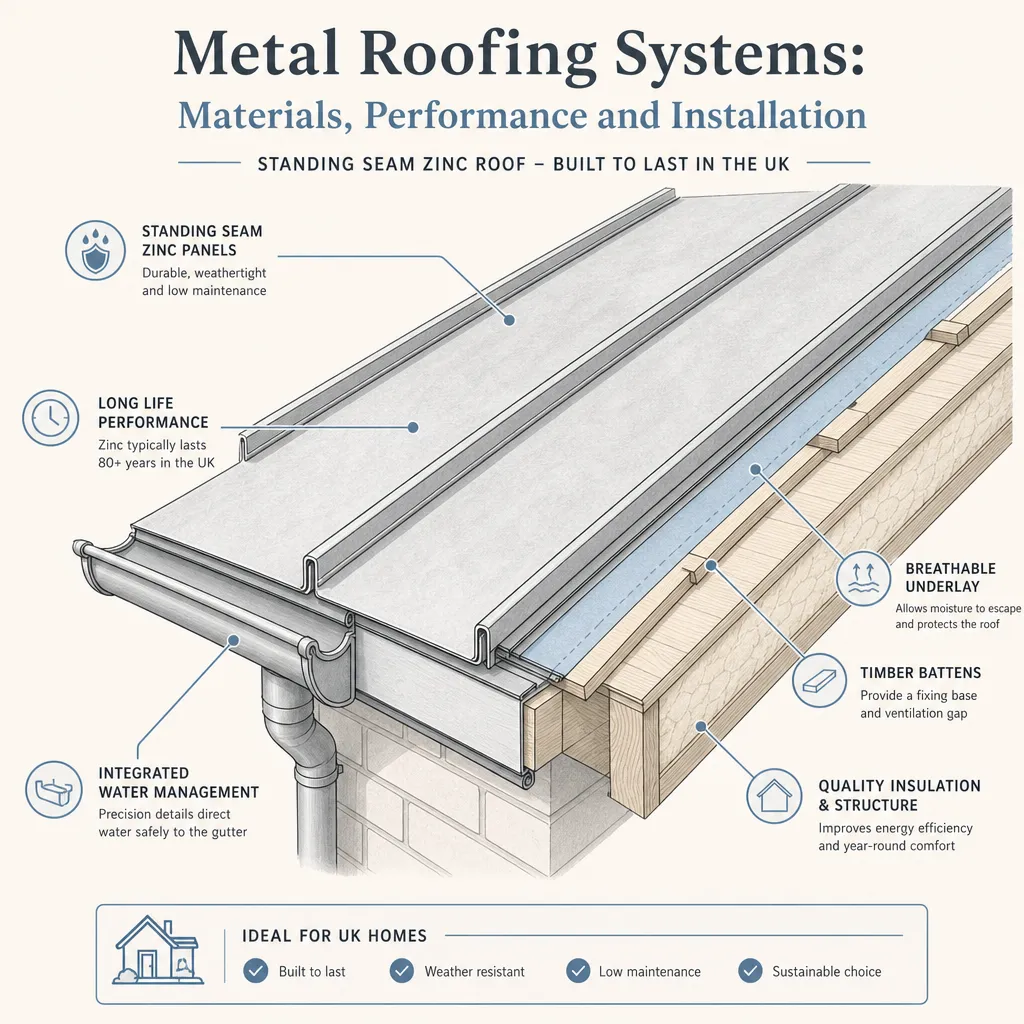
Metal Roofing Systems: Materials, Performance and Installation
Metal roofing systems in the UK include standing seam zinc, coated steel, aluminium, and copper panels, as well as profiled sheets.
 Improvement & Build
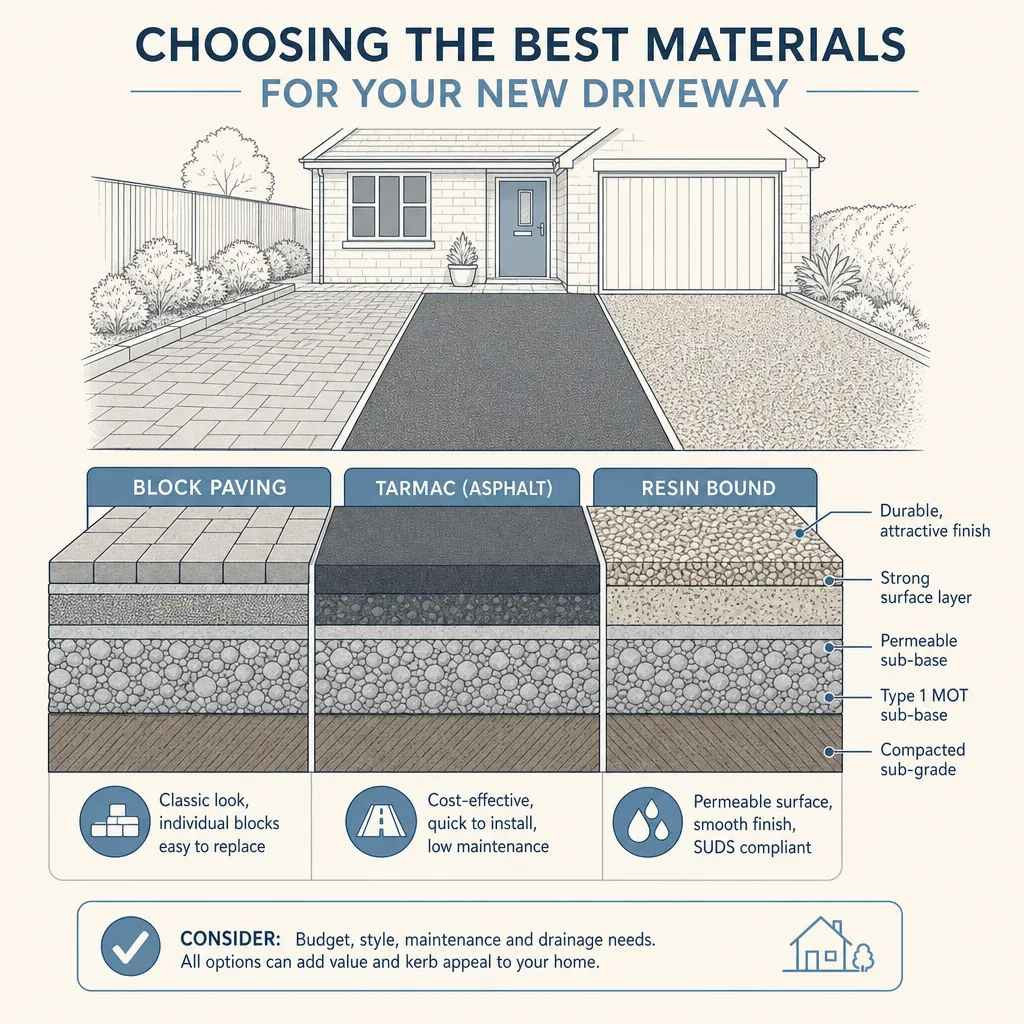
Choosing the best materials for your new driveway
The most common driveway materials in the UK are tarmac, block paving, resin-bound surfacing, concrete, and gravel.
 Improvement & Build
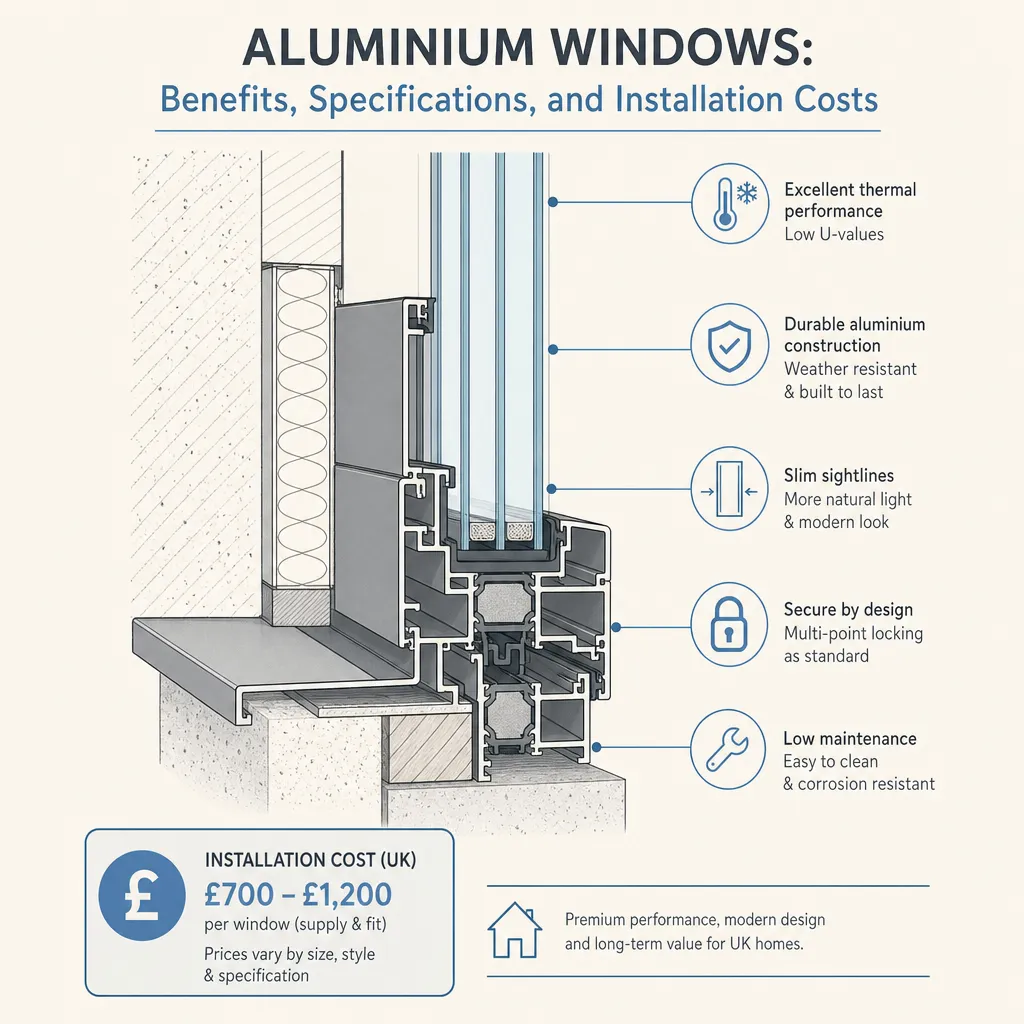
Aluminium Windows: Benefits, Specifications, and Installation Costs
Aluminium windows typically cost £600–£1,800 per window installed in the UK, depending on size and specification.
 Improvement & Build
Window Screens and Insect Mesh: Options and Installation
UK window screens fall into four main types: fixed frame, roller retractable, pleated folding, and magnetic snap-fit.