Metal Roofing Systems: Materials, Performance and Installation
By Housey · Last reviewed 26th of May 2026
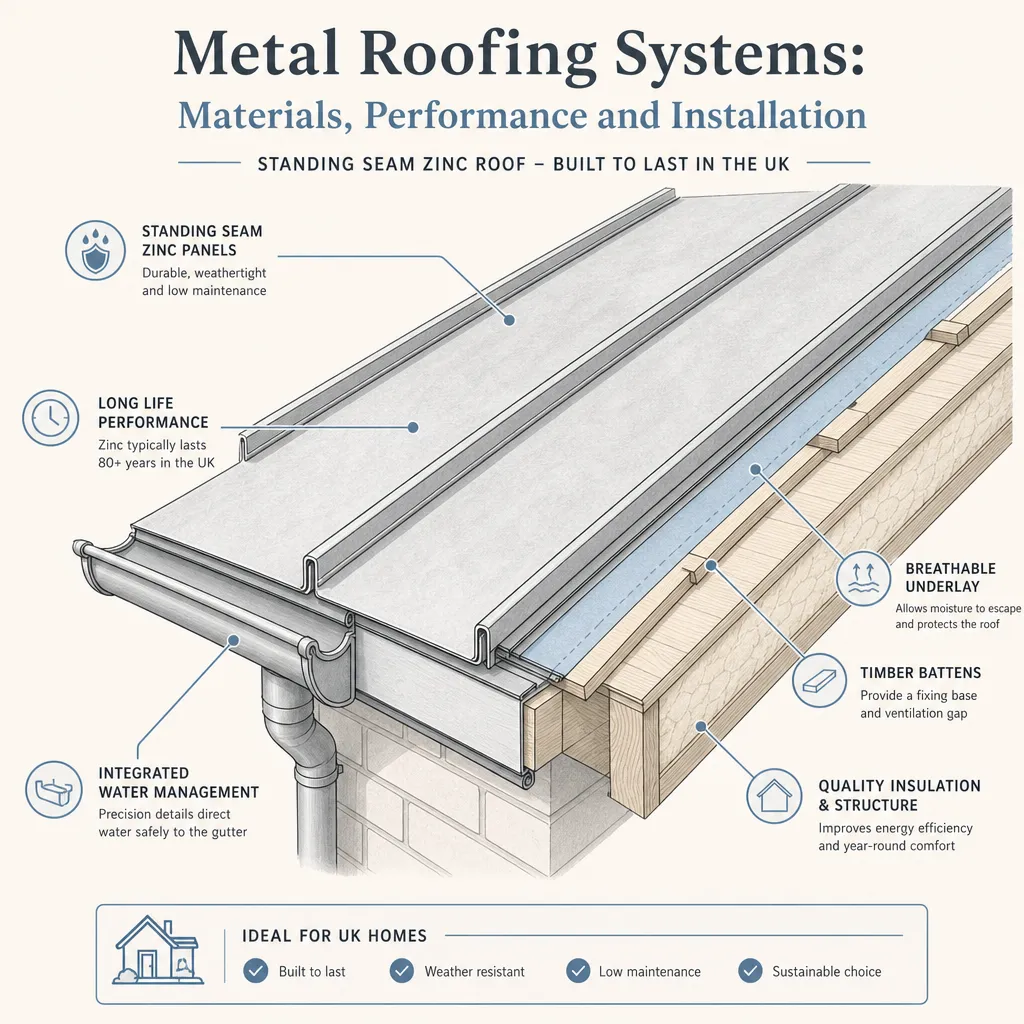
Metal Roofing Systems: Materials, Performance and Installation
Metal roofing has moved from agricultural and commercial buildings into mainstream residential construction in the UK, driven by longevity, low maintenance demands, and improving sustainability credentials. Homeowners considering a roof replacement, a flat-to-pitch conversion, or a self-build increasingly encounter standing seam zinc, aluminium, and coated steel as credible alternatives to concrete tiles. Understanding the differences between systems — and what drives cost and long-term performance — helps you commission the right specification from the outset.
Key points
- Standing seam zinc carries an expected lifespan of 80–100 years and develops a natural protective patina (zinc carbonate) without any surface treatment or painting over its life.
- Under Building Regulations Approved Document L1B, any roof covering replacement on an existing dwelling must achieve a minimum thermal performance of 0.16 W/m²K (pitched roof) regardless of the external cladding material chosen.
- Aluminium roofing weighs approximately 2–4 kg/m² — roughly one-third the weight of steel — making it suitable for structures with limited load-bearing capacity.
- Profiled (corrugated) steel and aluminium sheets are the most cost-effective metal roofing option but carry a more industrial aesthetic and are less commonly specified on mainstream residential schemes.
- Metal roofing on a residential property may require planning permission if it materially alters the building's appearance — particularly in a conservation area or for a listed building.
Metal roofing materials compared
Zinc
Zinc is widely regarded as the premium choice for residential standing seam roofing in the UK. It develops a natural patina of zinc carbonate over 10–20 years that protects the metal from further corrosion. Natural zinc is dark grey on installation and weathers to blue-grey or grey-green depending on local atmospheric conditions. Pre-patinated and factory-coloured zinc — in anthracite, graphite, and quartz tones — is also available for a consistent appearance from day one.
Lifespan: 80–100 years. Self-healing minor scratches via re-patination. Fully recyclable at end of life. Expands and contracts significantly with temperature change, requiring careful thermal movement detailing in long-run applications.
Coated steel
Structural steel roofing panels — hot-dip galvanised with a factory-applied polyester or plastisol colour coat — are durable and cost-effective. Products such as Tata Steel's Colorcoat Urban range are available in a wide range of colours, including dark near-neutral shades suited to contemporary residential design.
Lifespan: 40–60 years for premium coated products, depending on coating specification and maintenance. Heavier than aluminium at typically 8–12 kg/m². Coating integrity is critical — damaged areas can initiate corrosion and accelerate deterioration.
Aluminium
Aluminium roofing is lightweight, naturally corrosion-resistant without a protective coating, and suitable for both standing seam and profiled systems. Common in flat-to-pitched conversions over existing buildings where structural loads are constrained.
Lifespan: 50–80 years. Weight: 2–4 kg/m². Softer than steel and more susceptible to physical impact damage. More expensive per square metre than steel but imposes lower loading on the building structure.
Copper
Copper has a long history on UK heritage buildings — churches, civic buildings, and listed properties. It develops a distinctive green-blue verdigris patina over decades and is extremely durable. Lifespan: 100 years or more. Cost is significantly higher than zinc, steel, or aluminium, and copper is typically reserved for heritage restoration or prestige residential projects.
Profiled sheet (corrugated and trapezoidal)
Profiled steel or aluminium sheets are the most affordable metal roofing option. Common in agricultural and light industrial buildings, they are occasionally used on contemporary outbuildings, garden rooms, and utility structures. Their industrial aesthetic limits their use on mainstream residential schemes.
Material comparison table
Material | Typical lifespan | Approx. installed cost per m²* | Weight (kg/m²) | Self-healing patina? | Common finish |
|---|---|---|---|---|---|
Zinc (standing seam) | 80–100 years | £80–£150 | 4–7 | Yes | Natural grey-blue or pre-patinated |
Coated steel | 40–60 years | £40–£80 | 8–12 | No | Factory colour coat |
Aluminium (standing seam) | 50–80 years | £70–£130 | 2–4 | No (inherently corrosion-resistant) | Mill finish, anodised, or coated |
Copper | 100+ years | £150–£300+ | 4–6 | Yes (verdigris) | Natural copper ageing to verdigris |
Profiled steel/aluminium | 25–50 years | £20–£50 | 3–10 | No | Galvanised or factory coated |
*Indicative UK costs, last reviewed 2026-05-26. Prices include materials and installation on a straightforward pitch. Costs vary significantly with roof complexity, access, and regional labour rates. Always obtain multiple itemised quotes.
Performance considerations
Thermal performance
Metal roofing panels have negligible intrinsic insulation value. Insulation must be incorporated separately — as rigid board between or over rafters, or as a built-up insulated panel system. Any replacement roof covering on an existing dwelling must comply with Approved Document L1B minimum U-value requirements of 0.16 W/m²K for pitched roofs. This is a Building Regulations obligation regardless of the external cladding material.
Condensation and ventilation
Metal roofing requires careful detailing to manage interstitial condensation risk. Cold-roof constructions require ventilation above the insulation layer; warm-roof constructions need a continuous vapour control layer below the insulation. BS 5250 (Code of Practice for the Control of Condensation in Buildings) informs specification, and PAS 2035 applies where the roof forms part of a whole-house retrofit.
Rain noise
In a properly specified system with substrate, sarking board, and underlay, rain noise is not typically a significant issue on residential buildings. Problems occur in lightweight, poorly detailed systems more common in agricultural or outbuilding applications. Ask your contractor for acoustic build-up details if noise sensitivity is a concern.
Fire performance
Zinc, steel, aluminium, and copper are non-combustible and achieve Class A1 reaction-to-fire rating (Euroclass). This makes them suitable where Building Regulations or planning conditions restrict the use of combustible cladding materials.
Red flags when selecting a metal roofing contractor
- No demonstrable experience with the specific material — zinc and copper require specialist fabrication and jointing skills. Ask for examples of completed residential projects and check references before instructing.
- No discussion of substrate, sarking, and ventilation build-up — metal cladding without proper detailing leads to condensation problems that are expensive to diagnose and remediate.
- A quote that does not address insulation and compliance with Approved Document L1B.
- No mention of thermal movement detailing in the specification for zinc or long-run steel panels.
- Lack of manufacturer network membership or accreditation (for example, VMZINC Approved Installer status or equivalent for the product specified).
- Missing provision for flashings, ridges, valleys, and abutments in the quote — these critical junctions account for a disproportionate share of long-term failure risk.
When to get professional help
Metal roofing work should always be carried out by an experienced specialist contractor. Key considerations:
- Working at height is inherently hazardous. Only use contractors with a documented safe working-at-height plan and appropriate equipment, as required under the Work at Height Regulations 2005.
- Thermal movement detailing and condensation risk management require technical knowledge — mistakes cause failures that are costly to diagnose and repair.
- If the property is in a conservation area or is listed, engage a contractor familiar with planning and listed building consent requirements before finalising the material specification.
- For large or structurally complex roof areas, a structural engineer may need to confirm that the existing structure can carry the load and any new fixings.
How Housey can help
Housey connects homeowners with experienced specialist roofers who work with metal roofing systems including zinc, aluminium, steel, and copper. Submit a brief describing your roof area, preferred material, any heritage or planning constraints, and your project timeline, and receive quotes from vetted local contractors to compare.
Frequently asked questions
How long does a metal roof last in the UK?
Lifespan depends on material. Standing seam zinc typically lasts 80–100 years; aluminium standing seam 50–80 years; premium coated steel 40–60 years; and copper 100 years or more. Longevity also depends on installation quality, detailing at flashings and junctions, and the level of maintenance carried out. Always confirm the manufacturer's stated expected service life before specifying a product.
Is planning permission needed for a metal roof?
Replacing a roof covering like-for-like generally falls within permitted development for most dwellings. However, if the new material significantly changes the appearance of the building, or if the property is in a conservation area, an Area of Outstanding Natural Beauty, or is a listed building, planning permission or listed building consent may be required. Always check with your local planning authority before specifying an unusual or visually distinctive material.
Does a metal roof increase noise during rain?
In a properly specified residential system with adequate substrate, sarking board, and underlay, rain noise is not typically a significant issue. Problems arise in lightweight or poorly detailed systems. If noise is a concern, ask your contractor to detail the acoustic build-up and compare product specifications before committing to a system.
Sources and further reading
- Building Regulations Approved Document L1B: Conservation of fuel and power in existing dwellings — GOV.UK
- BS 5250: Code of practice for control of condensation in buildings — BSI Group
- Historic England: metals in historic buildings — Historic England
- HSE: working at height — the basics — Health and Safety Executive
Useful next reads
 Improvement & Build
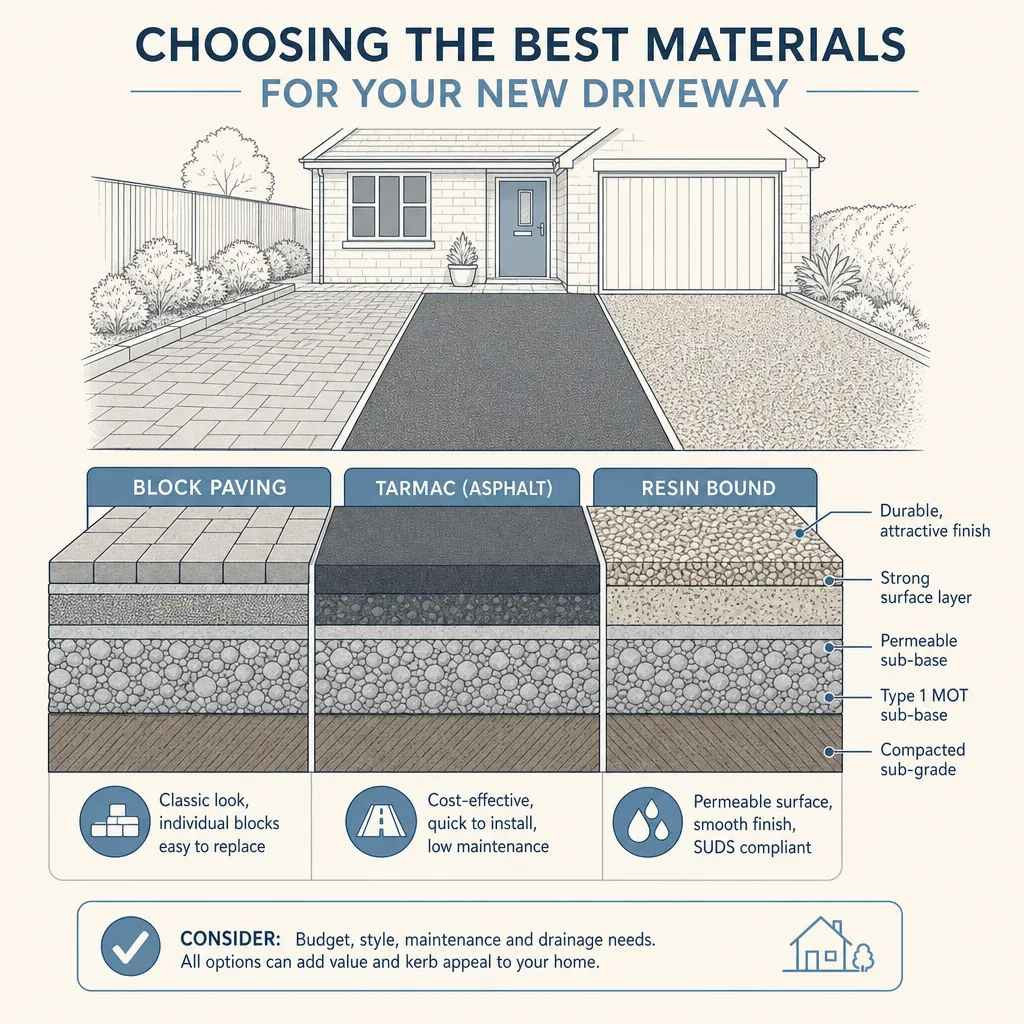
Choosing the best materials for your new driveway
The most common driveway materials in the UK are tarmac, block paving, resin-bound surfacing, concrete, and gravel.
 Improvement & Build
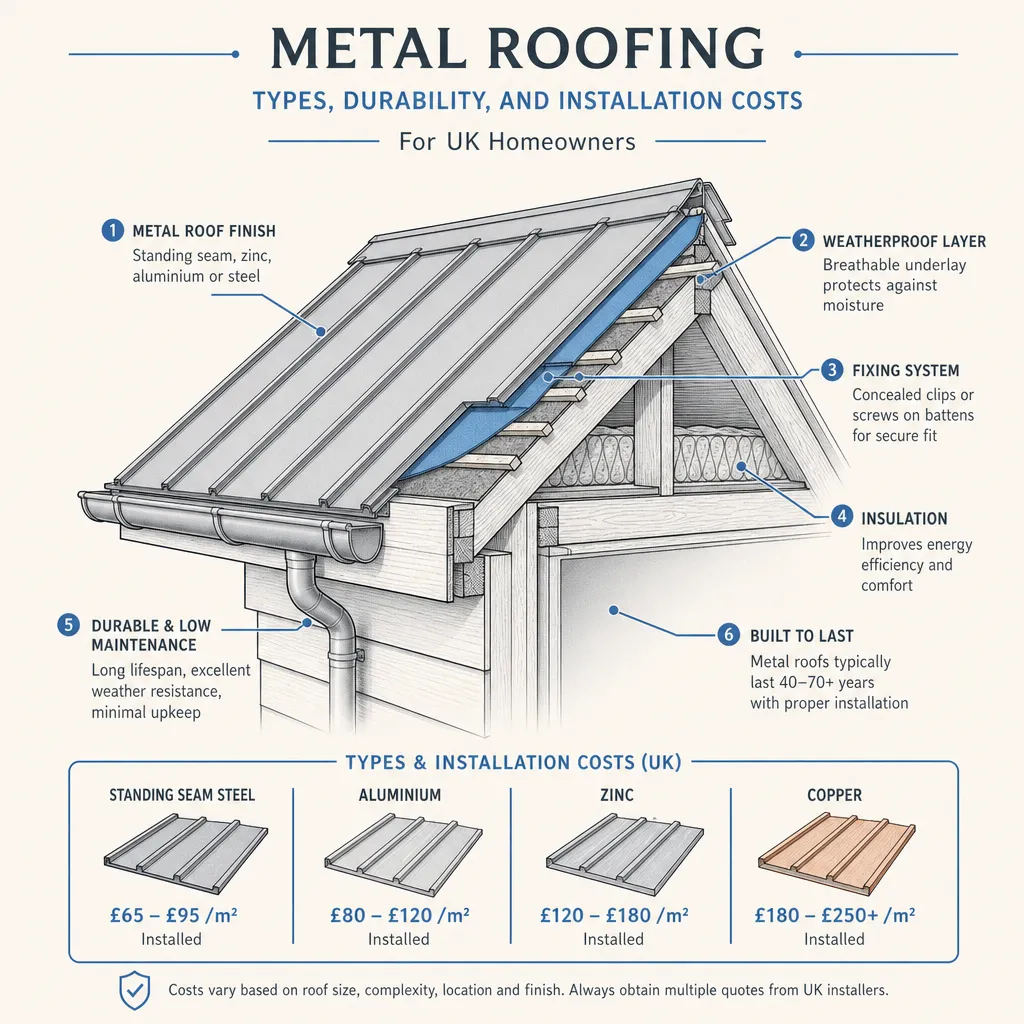
Metal Roofing: Types, Durability, and Installation Costs
Metal roofing in the UK includes standing seam, corrugated sheet, and metal tile systems in steel, aluminium, zinc, or copper.
 Improvement & Build
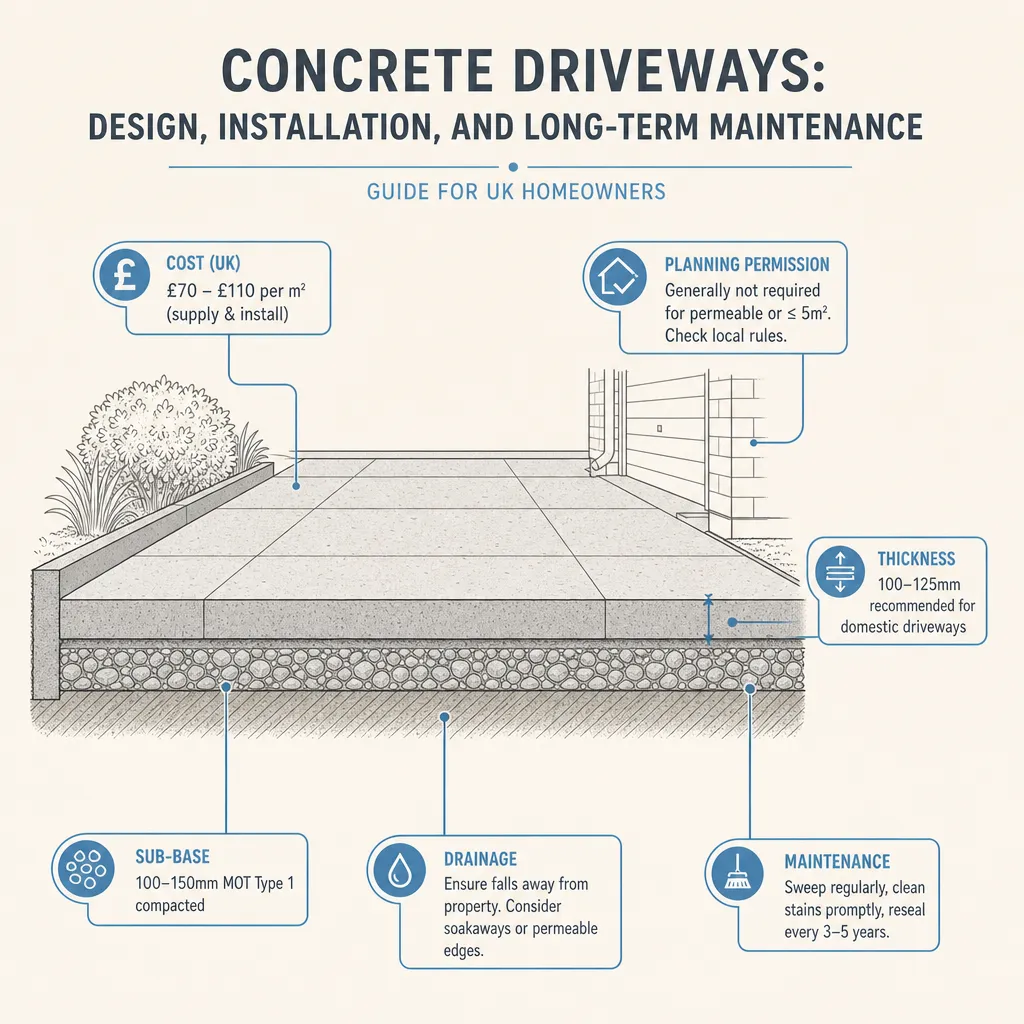
Concrete Driveways: Design, Installation, and Long-Term Maintenance
A concrete driveway requires a compacted sub-base of at least 150mm and a concrete slab of at least 100mm for domestic use.
 Improvement & Build
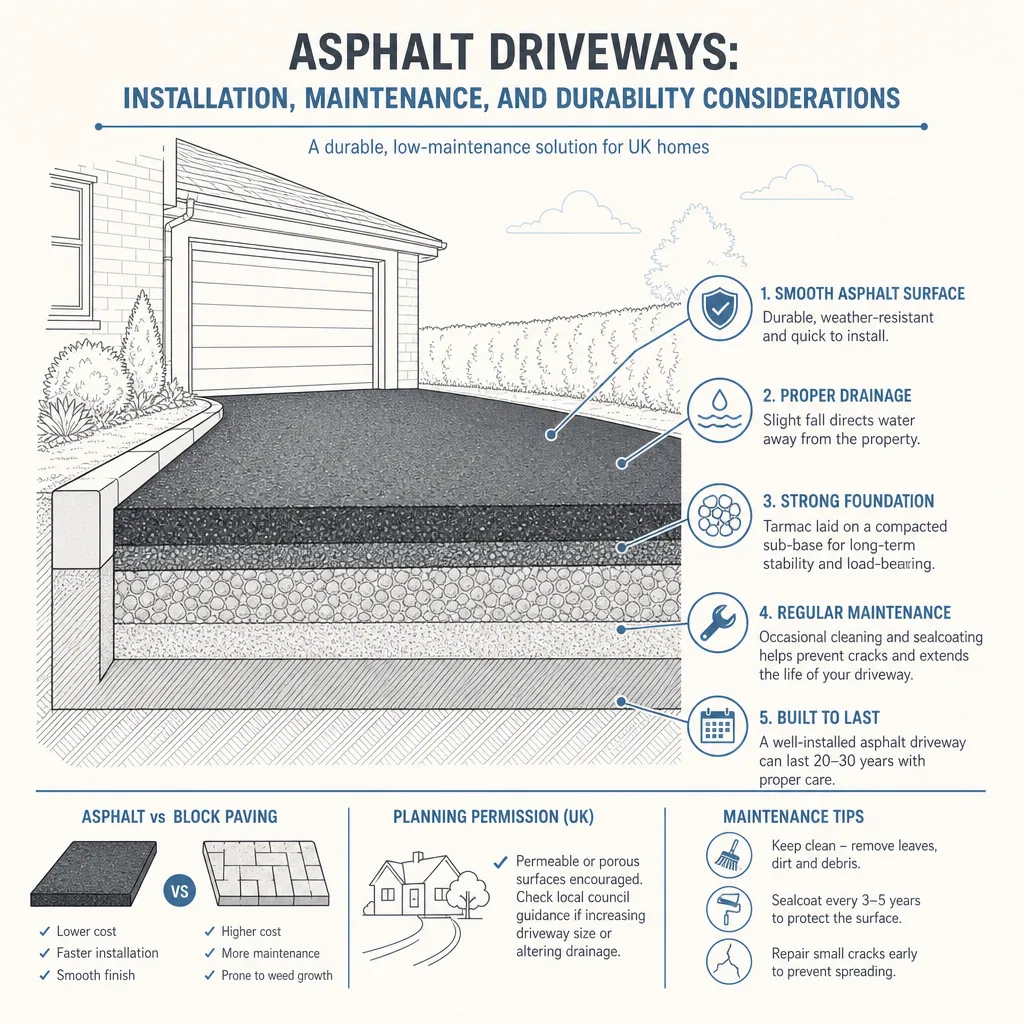
Asphalt Driveways: Installation, Maintenance, and Durability Considerations
An asphalt driveway typically costs £50–£100 per m² in the UK and should last 20–30 years with proper installation and maintenance.
 Improvement & Build
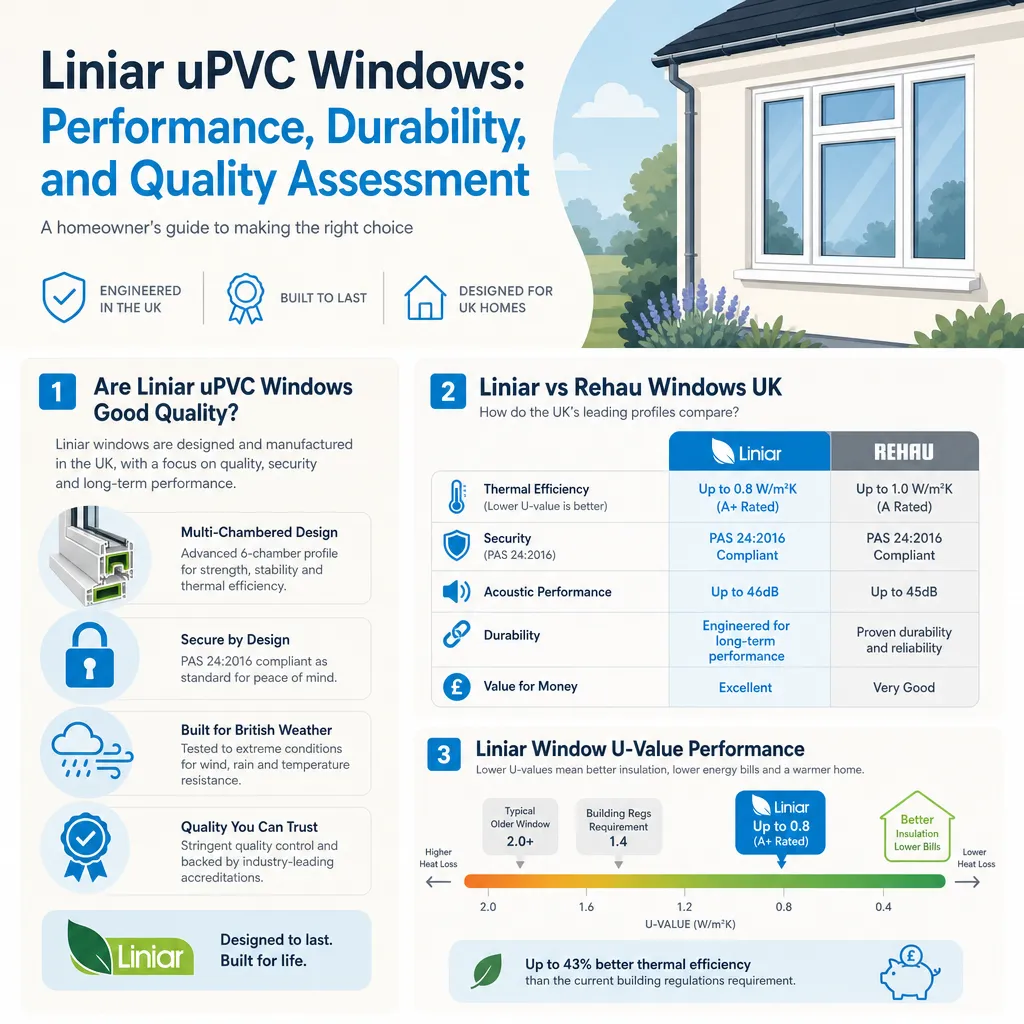
Liniar uPVC Windows: Performance, Durability, and Quality Assessment
Liniar uPVC window profiles are manufactured in the UK using multi-chambered, foamed frames.