Key Indicators of Good Property Structure and Condition
By Housey · Last reviewed 30th of May 2026
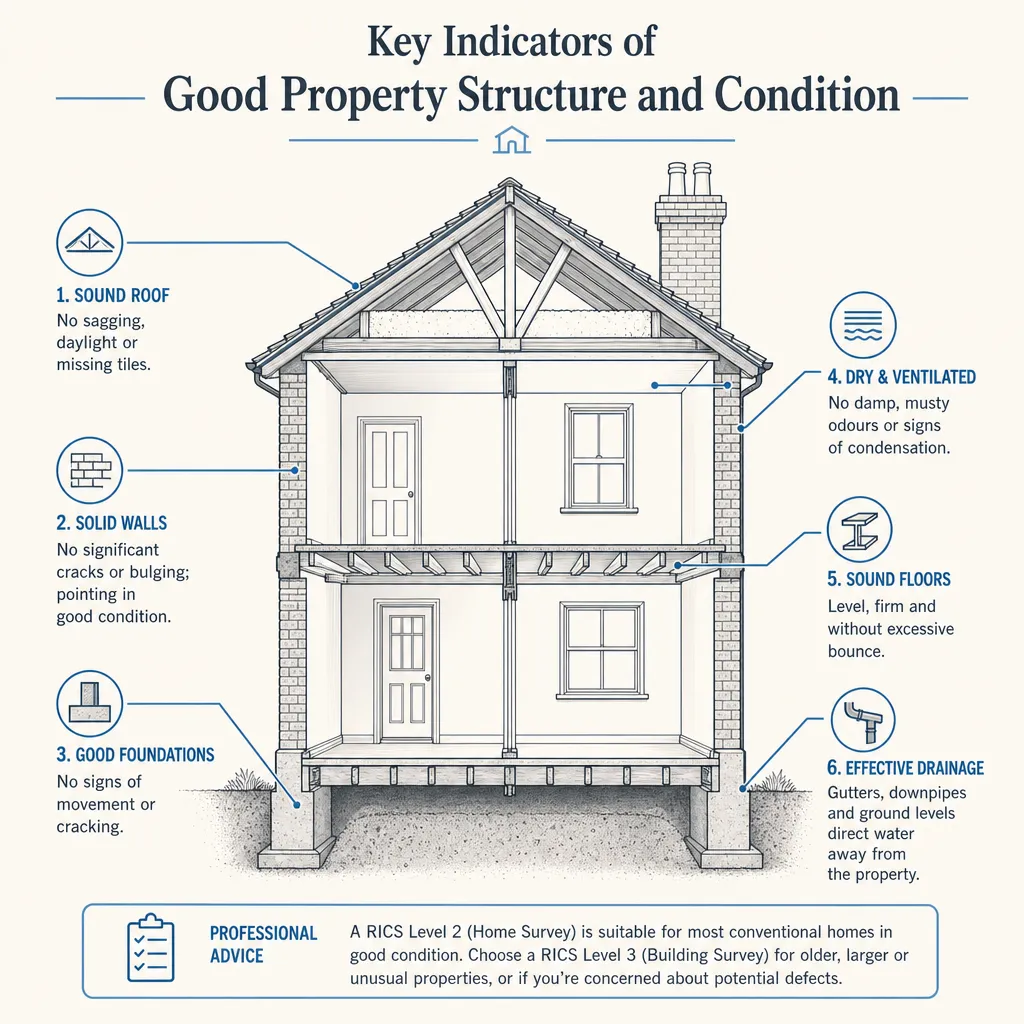
Key Indicators of Good Property Structure and Condition
When viewing a property to purchase — or assessing a home you already own before planning significant works — understanding the basic indicators of structural health and sound condition helps you ask better questions and spot potential problems early. These visual cues are not a substitute for a professional survey, but they inform your conversation with a surveyor and may influence whether you commission a RICS Level 2 Home Survey or a more detailed RICS Level 3 Building Survey before exchange of contracts.
Key points
- Level floors, plumb walls, and crack-free masonry at corners and above window and door openings are among the clearest visual signs of structural stability in a UK property.
- Stepped diagonal cracks in external brickwork — particularly at corners, above lintels, or running through the masonry rather than just the mortar joints — may indicate differential settlement and warrant professional assessment.
- Roof covering condition is one of the most important indicators of long-term maintenance history: a sagging ridge line, missing slates or tiles, and blocked or overflowing gutters frequently signal deferred maintenance.
- The presence of original features in good condition — timber joinery, period flooring, fireplaces — often suggests careful stewardship rather than disruptive previous works or concealed remediation.
- A RICS Level 2 Home Survey or RICS Level 3 Building Survey provides the only reliable professional assessment of structural condition; visual inspection alone cannot diagnose hidden defects in substructure, roof structure, or concealed services.
What does good structure actually mean?
The phrase "good bones" is commonly used in property, but it refers to something more specific than general appearance. A structurally sound UK property typically has:
- Stable foundations: No significant differential settlement, no active subsidence, and no evidence of heave. In clay soils — common across London, the East Midlands, and parts of the South East — seasonal shrinkage and swelling can cause movement. Look for cracks that appear or widen during dry summers and partially close in winter, which may indicate shrinkage-related movement.
- Sound load-bearing walls: In traditional masonry construction (pre-1920s brick, stone, or a mix), walls should be plumb and undamaged at the critical points — corners, wall junctions, and above openings. In timber-framed properties, any visible racking or distortion of the frame warrants investigation.
- Intact roof structure: The roof carries significant loading and must drain reliably. A sagging ridge line, bowing rafters visible from the loft hatch, or evidence of patch repairs rather than comprehensive maintenance are all worth noting.
- Sound floor structure: Timber ground floors should feel firm underfoot, with no significant bounce or soft spots that might indicate joist decay or a failed sub-floor. Concrete ground floors may show cracking or heave if the sub-base has shifted or if a solid floor has been laid over a failing original.
Visual checklist: what to look for on a viewing
These indicators do not replace a survey but help you decide what level of survey to commission and what questions to raise with the selling agent.
External
Internal
Red flags that warrant immediate professional assessment
Certain signs should prompt you to commission a more detailed survey or a specialist report before proceeding:
- Stepped diagonal cracks wider than 5 mm in external brickwork, particularly where they run through the masonry rather than only along the mortar joints. The Building Research Establishment (BRE) Digest 251 provides the crack classification system used by structural engineers and RICS surveyors — cracks classified as Category 3 (5–15 mm) and above warrant professional assessment.
- Leaning or bowing walls — any visible departure from the vertical of more than a few centimetres over a single storey should be assessed by a structural engineer before exchange.
- Active damp — surfaces wet to the touch or visible mould growth are more concerning than historic dry staining. Penetrating damp and rising damp have different causes and require different remedies; a specialist damp survey provides the correct diagnosis.
- Evidence of previous subsidence or underpinning — ask the seller for documentation. Previous underpinning does not necessarily indicate ongoing risk, but must be disclosed on the property information form (TA6).
- Roof structure showing rot, sagging timbers, or evidence of wood-boring beetle damage — these issues are not always visible from the rooms below.
- Absence of building regulations completion certificates for previous extensions, loft conversions, or structural alterations, which may indicate unapproved works that could affect mortgage and insurance.
Which survey do you need?
Scenario | Survey to consider | Why |
|---|---|---|
Modern or recently built home in good apparent condition | RICS Level 2 Home Survey | Standard inspection for conventional, well-maintained properties |
Pre-1920s, unusual construction, or visibly defective property | RICS Level 3 Building Survey | More detailed investigation of construction, defects, and hidden condition |
Significant cracking, movement, or suspected structural failure | RICS Level 3 plus structural engineer's report | A general survey identifies risk; an engineer diagnoses cause and recommends remedy |
Active or suspected damp | Independent damp and timber survey | Specialist assessment before agreeing to or paying for remediation works |
Older flat with service charge history | RICS Level 2 plus leasehold legal advice | Condition plus financial and legal context for leasehold ownership |
A RICS-registered surveyor is required for Level 2 and Level 3 surveys. The surveyor should hold MRICS or FRICS status and carry professional indemnity insurance. For structural engineer referrals, look for MIStructE or MICE membership alongside experience in the relevant construction type.
A worked example: assessing a 1930s semi-detached
Consider a 1930s semi-detached house in the East Midlands:
- Cavity brick walls. Wall tie condition is not visible externally, but the property falls within the age range (1920s–1980s) where cavity wall tie corrosion and failure is a documented risk — the surveyor should assess this.
- Metal Crittall windows, original but recently reglazed and in good decorative order — a positive sign of maintenance rather than neglect.
- Concrete pantile roof covering, all tiles present, ridge line recently repointed — a positive indicator of upkeep.
- Internal floors level, no sticking doors, no cracks around frames — positive.
- One diagonal crack above the rear extension following the mortar line — worth investigation. The surveyor should classify it against the BRE Digest 251 system and advise on monitoring or repair.
- No visible damp internally, gutters clear and functioning — positive.
This property shows broadly sound structure with one area warranting closer attention. A RICS Level 2 Home Survey would be a reasonable starting point, but the diagonal crack above the extension means the buyer should be prepared for the surveyor to recommend monitoring or a specialist structural follow-up.
When to get professional help
Visual inspection during a viewing provides useful context but cannot substitute for a professional survey by a RICS-registered surveyor. Commission a survey whenever you are making or accepting an offer, when visible defects are present, or when the property is pre-1920s, has been significantly altered, or has a known history of structural problems.
Never rely on a mortgage valuation as a structural assessment — it is prepared for the lender's purposes and provides you with no protection or detailed condition findings.
How Housey can help
Housey connects buyers and homeowners with RICS-registered surveyors for RICS Home Surveys and RICS Level 2 surveys across the UK. Where movement, cracking, or more complex concerns require an engineering opinion, Housey can also connect you with specialists who carry out structural surveys beyond the scope of a standard inspection.
Frequently asked questions
Is a mortgage valuation the same as a structural survey?
No. A mortgage valuation is carried out for the lender to confirm the property is adequate security for the loan. It is not a survey of condition and provides the buyer with no protection or detailed findings. A RICS Home Survey — Level 2 or Level 3 — is a separate instruction made directly with a RICS-registered surveyor; the report is prepared for your benefit and provides professional findings on condition.
What crack size should I be concerned about?
The BRE Digest 251 crack classification system rates cracks from Category 0 (hairline, below 0.1 mm) to Category 5 (very severe, above 25 mm). Categories 0–2 are generally not structurally significant. Category 3 (5–15 mm) and above warrants professional assessment. The pattern and location matter as much as size — a stepped diagonal crack through masonry at a corner is more significant than a hairline vertical crack in plaster.
Can I find out whether a property has had structural problems before?
The seller must disclose known structural issues on the property information form (TA6 in England and Wales). You can also check HM Land Registry for evidence of previous building regulations approvals, though records are not comprehensive. Your RICS surveyor may also identify signs of previous repairs, movement, or underpinning during inspection and will note these in the report.
Does a well-presented property mean it is structurally sound?
Not necessarily. Cosmetic renovation can conceal structural, damp, or electrical problems. A recently painted, fully refurbished property may still have failing foundations, concealed damp, or substandard electrical work behind the finish. This is one reason why surveys are particularly important on recently renovated properties — the surveyor can assess the fabric and structure beyond the décor.
Sources and further reading
- RICS Home Survey Standard — RICS
- BRE Digest 251: Assessment of damage in low-rise buildings — Building Research Establishment
- GOV.UK: Property information forms — GOV.UK
- Electrical Safety First: EICR guidance for homeowners — Electrical Safety First
- NHBC: Standards and guidance — NHBC
Useful next reads
 Surveys & Inspections
Getting a Valuation Survey Before Selling Your Property
Before selling, a free estate agent appraisal gives a market price guide, but only a RICS Red Book valuation carries formal professional standards and legal weight.
 Surveys & Inspections
Why Insurance Valuations Matter: What Insurers Assess in Property Inspections
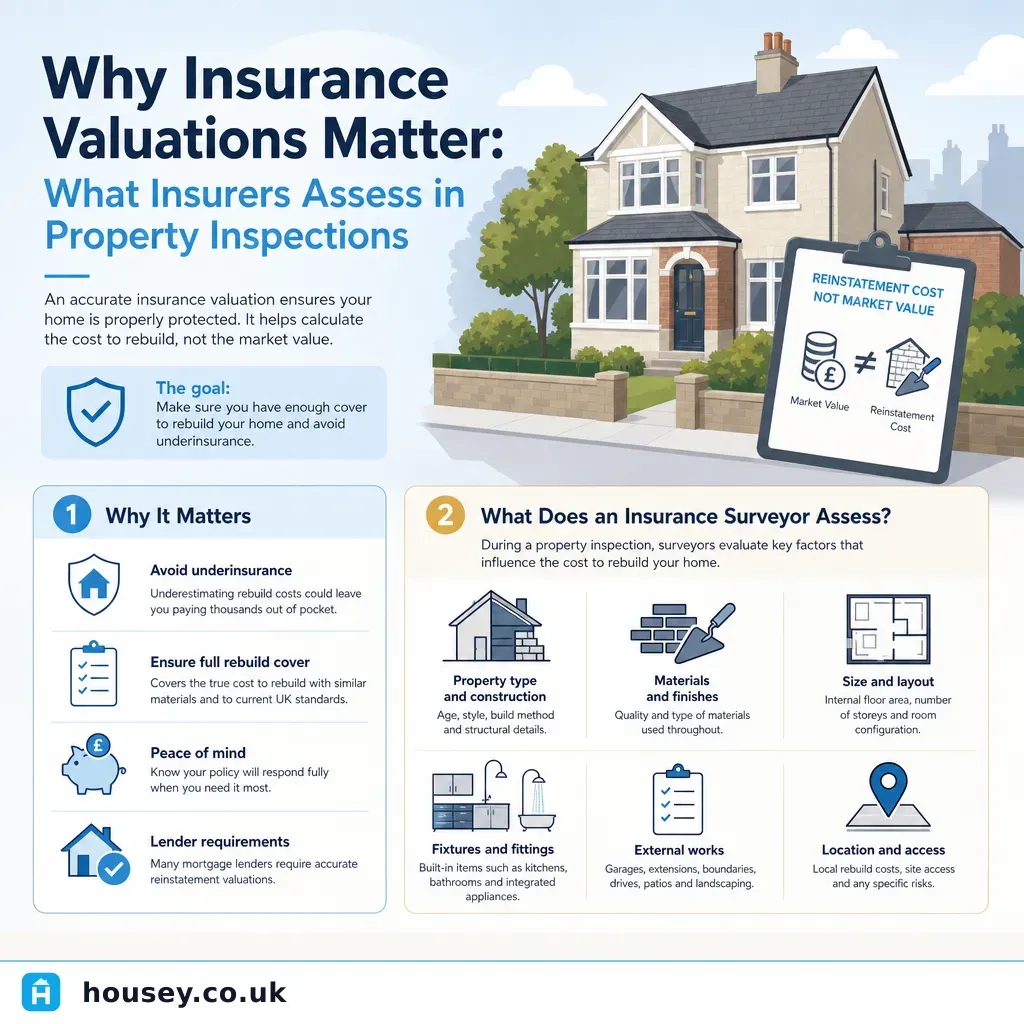
An insurance valuation establishes the reinstatement cost of your property — what it would cost to demolish and rebuild it — not its market value.
 Surveys & Inspections
Assessing Property Structural Condition: What Buyers and Owners Should Know
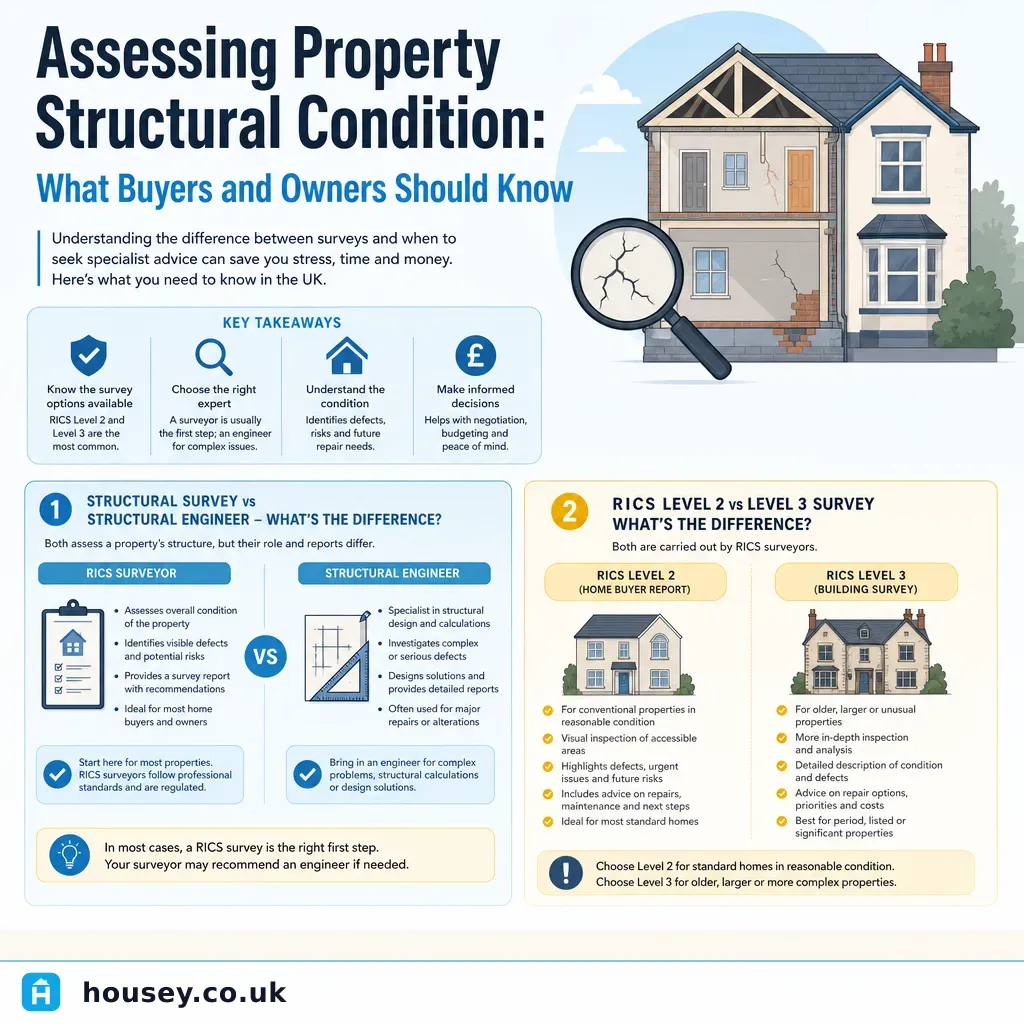
A RICS Level 2 Home Survey suits conventional post-war properties in reasonable condition.
 Surveys & Inspections
Essential Tools and Techniques for Home Inspection
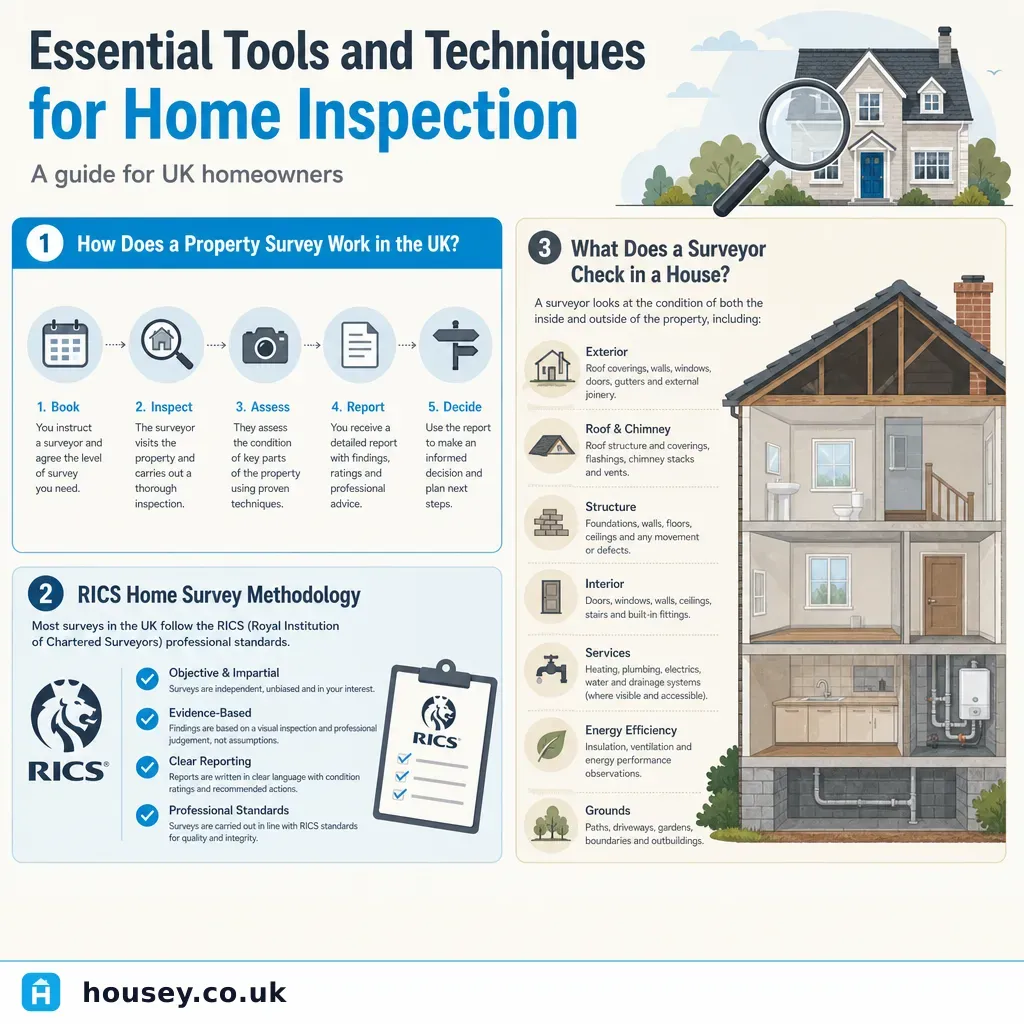
UK property surveys are visual, non-invasive inspections carried out by chartered surveyors using equipment such as moisture meters, damp probes, binoculars, and torches.
 Surveys & Inspections
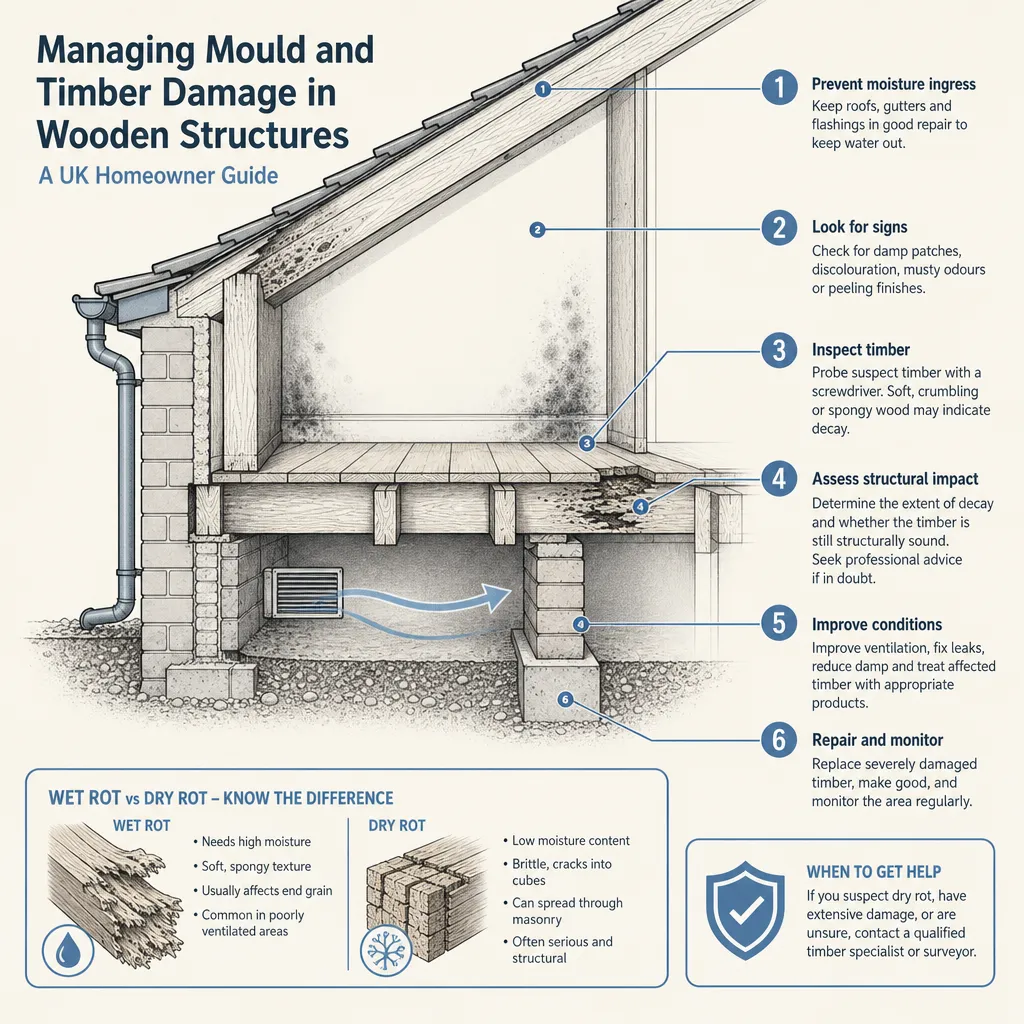
Managing Mould and Timber Damage in Wooden Structures
Mould and timber decay in wooden structures are usually symptoms of excess moisture rather than standalone problems.