Managing Mould and Timber Damage in Wooden Structures
By Housey · Last reviewed 30th of May 2026
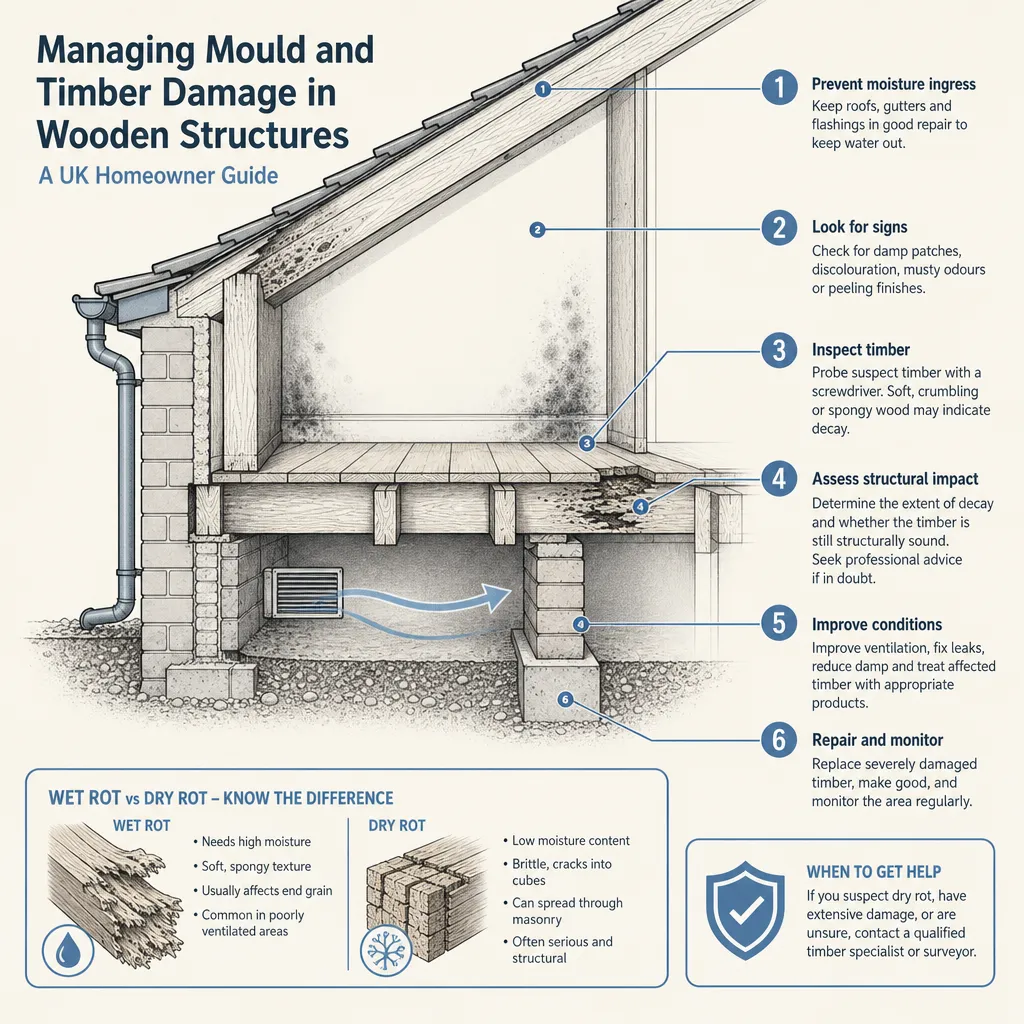
Managing Mould and Timber Damage in Wooden Structures
Mould growth and timber decay in wooden structures — from suspended floor joists and roof timbers to window frames and stud walls — are among the more serious defects a UK homeowner, buyer, or surveyor can encounter. They are symptoms of underlying moisture problems that, if left unaddressed, can spread within building fabric, weaken structural elements, and create conditions for ongoing fungal growth. In habitable rooms, persistent mould also carries recognised respiratory health risks under UK housing law.
Key points
- Wet rot and dry rot are caused by different fungal species with very different behaviours: wet rot is generally confined to the damp zone; dry rot (Serpula lacrymans) can spread through masonry and mortar far beyond the original moisture source and is considerably harder to eradicate.
- A Property Care Association (PCA)-accredited damp and timber survey is the recognised starting point for diagnosis — treatment without identifying the moisture source routinely fails within a few years.
- RICS Level 2 and Level 3 surveys can flag visible signs of rot and damp, but a dedicated specific defect or timber decay survey provides the detailed investigation needed to scope remediation works accurately.
- Mould in habitable rooms is linked to respiratory health risks; the Homes (Fitness for Human Habitation) Act 2018 creates legal obligations for landlords where Category 1 hazards under the Housing Health and Safety Rating System (HHSRS) are present.
- PAS 2035:2023 requires moisture risk to be evaluated before insulation or airtightness work on older buildings; poorly planned energy improvements can accelerate timber decay by disrupting existing ventilation paths.
Important limitations
This article provides general information about the types, causes, and assessment of mould and timber decay in wooden structures. It does not constitute structural, health, or legal advice. The severity of decay, appropriate treatment, and structural implications vary significantly by property type, construction method, moisture source, and extent of damage. A qualified professional — typically a PCA-accredited specialist or chartered building surveyor — should inspect any suspected timber decay before remediation work is planned or undertaken.
Wet rot vs dry rot: understanding the difference
Correctly identifying the type of decay determines the scope and cost of remediation.
Feature | Wet rot | Dry rot |
|---|---|---|
Common species | Coniophora puteana (cellar fungus) and others | Serpula lacrymans |
Appearance | Dark brown, fibrous, localised; timber feels soft and spongy | White or grey mycelium sheets; mushroom-like fruiting bodies; rust-red spore dust |
Spread pattern | Generally confined to the wet zone | Spreads through masonry, mortar, and adjacent drier materials |
Moisture requirement | Needs consistently high moisture (>20% wood moisture content) | Needs moisture to establish; can spread into drier areas once established |
Structural risk | Significant if load-bearing timber is affected; usually localised | Potentially severe across a wider area |
Treatment approach | Fix moisture source; replace affected timber; apply fungicidal preservative | Professional treatment essential; all affected timber and masonry must be treated or replaced |
DIY suitability | Limited to minor, non-structural surface cases only | Not appropriate — professional treatment required |
How to identify the warning signs
Wet rot indicators
- Soft, spongy, or springy sections of timber that should feel firm.
- Darkening or discolouration of wood — often dark brown or black.
- Paint cracking or bubbling over timber surfaces.
- A musty or earthy smell in subfloor voids, around window frames, or in loft spaces.
- Visible dark brown threads or patches in persistently wet areas.
Dry rot indicators
- White or grey fluffy mycelium on walls, floors, or timber surfaces.
- Cuboidal cracking of timber — breaks into brick-like pieces along and across the grain.
- Rust-coloured fruiting bodies (sporophores), often with a white fringe.
- Rust-red spore dust on adjacent surfaces.
- Timber that crumbles or powders when pressed, even in areas that appear relatively dry.
Surface mould in habitable rooms
Surface mould on internal walls, ceilings, or window reveals is most commonly caused by condensation — inadequate heating and ventilation — rather than structural timber decay, though causes can overlap. Black or green surface patches, musty odour, and persistent condensation on cold external walls are typical indicators. Professional diagnosis is needed to distinguish condensation mould from penetrating damp or rising damp.
Worked example: discovering decay in a Victorian terrace
A buyer of an 1890s mid-terrace in the East Midlands commissions a RICS Level 3 Building Survey. The surveyor notes suspected moisture ingress at ground-floor subfloor level and recommends a specialist timber and damp report. A PCA-accredited surveyor subsequently lifts floorboarding and finds wet rot affecting approximately 40% of the suspended timber floor joists, caused by a blocked airbrick preventing cross-ventilation in the subfloor void.
Treatment involves clearing and supplementing airbricks to restore ventilation, cutting out and replacing rotted joist sections with pre-treated timber, and applying fungicidal preservative to adjacent at-risk timbers. The buyer uses the report to negotiate a price reduction of approximately £4,500 — the estimated cost of full remediation.
This scenario illustrates two common patterns: a simple maintenance failure causing progressive structural damage; and the value of commissioning a specialist report before exchange when a general survey flags concern.
Red flags: when to seek urgent professional advice
Do not delay professional assessment if you notice:
- Cuboidal cracking in any structural timber — a classic dry rot indicator that spreads rapidly.
- Mycelium visible on walls or behind plasterwork — dry rot can travel through masonry; the visible extent often understates the true spread.
- Multiple areas of decay on different floors or elevations — may indicate a systemic moisture problem such as roof failure, defective guttering, rising damp, or interstitial condensation.
- Springy or noticeably deflecting floors — softened joists can fail under load without warning.
- Structural timbers (main beams, wall plates, ridge boards, purlins) that feel soft or show visible decay — these carry significant loads.
- Decay recurring in a previously treated area — means the moisture source was not resolved or the treatment was incomplete.
When this becomes urgent
If floor joists are soft to probe pressure, if a roof structure shows active decay near the ridge or wall plate, or if dry rot fruiting bodies are visible anywhere in the building, treat the situation as urgent. Avoid placing full load on affected floor areas while awaiting assessment. Do not attempt to remove or disturb dry rot fruiting bodies without professional guidance — disturbance releases large quantities of airborne spores.
What to ask a qualified professional
Before commissioning a damp and timber survey or remediation works, ask:
- Are you a member of the Property Care Association, and will this survey carry a PCA-backed guarantee?
- Will you identify and specify the moisture source, not just the visible decay?
- Which timbers will be probed or opened up — will you lift floorboards or access roof and subfloor voids?
- What remediation options will you specify — replacement, consolidation, or chemical treatment — and what are the relative pros and cons of each?
- If chemical treatment is recommended, what products are proposed and what are the relevant safety data sheets?
- Will the completed works carry a guarantee, for how long, and is that guarantee backed by insurance?
- If structural timbers are affected, do you recommend a structural engineer's assessment alongside the timber treatment?
When to get professional help
A PCA-accredited damp and timber specialist is the appropriate starting point for any suspected structural decay. Additional professionals may be needed:
- Chartered structural engineer: if load-bearing elements are significantly affected.
- Chartered building surveyor (RICS): for a broader assessment of causes and building fabric condition.
- Retrofit coordinator (PAS 2035): if planned energy improvements could be affected by or worsen existing moisture conditions.
Avoid instructing remediation contractors without first obtaining an independent survey — some remediation companies have a commercial incentive to recommend more extensive treatment than is necessary.
How Housey can help
Housey connects homeowners with qualified professionals for damp and timber surveys, damp proofing and timber treatment specialists, and specific defect surveys where a focused investigation of a known concern is needed. Compare quotes from accredited surveyors and get independent advice before committing to any remediation works.
Frequently asked questions
What is the difference between mould and dry rot?
Mould is surface fungal growth caused by condensation on cold surfaces and does not structurally degrade timber. Dry rot (Serpula lacrymans) digests the structural cellulose in timber, causing significant loss of strength. Both can coexist but require different responses — professional diagnosis is needed to distinguish them reliably and determine the appropriate treatment.
Can I treat wet rot myself?
Minor surface wet rot on non-structural external joinery — window sills, door frames — can be addressed with proprietary two-part filler systems and fungicidal primer, provided the moisture source is also resolved. Wet rot affecting structural timbers — floor joists, roof members — should be assessed and treated by a PCA-accredited specialist. Do not disturb suspected dry rot without professional guidance.
How much does a damp and timber survey cost in the UK?
A specialist damp and timber survey typically costs £200–£500 depending on property size and the extent of investigation required. This is indicative, last reviewed 2026-05-30, and is separate from treatment costs, which depend on decay type and extent. An independent survey is strongly recommended before accepting a remediation quote from a treatment contractor.
Does timber decay affect a property's mortgage or value?
Yes. Active dry rot can cause lenders to decline or limit lending until a specialist treatment report is in place. Some lenders require a PCA-guaranteed treatment scheme before releasing funds. Buyers should commission specialist reports before exchange if a RICS survey flags suspected timber decay, as the cost and extent of remediation can be significant.
Sources and further reading
- Property Care Association: Timber decay and damp — Property Care Association
- Homes (Fitness for Human Habitation) Act 2018 — GOV.UK
- Historic England: Damp in historic buildings — Historic England
- HSE: Wood dust — Health and Safety Executive
- RICS: Home surveys — RICS
Useful next reads
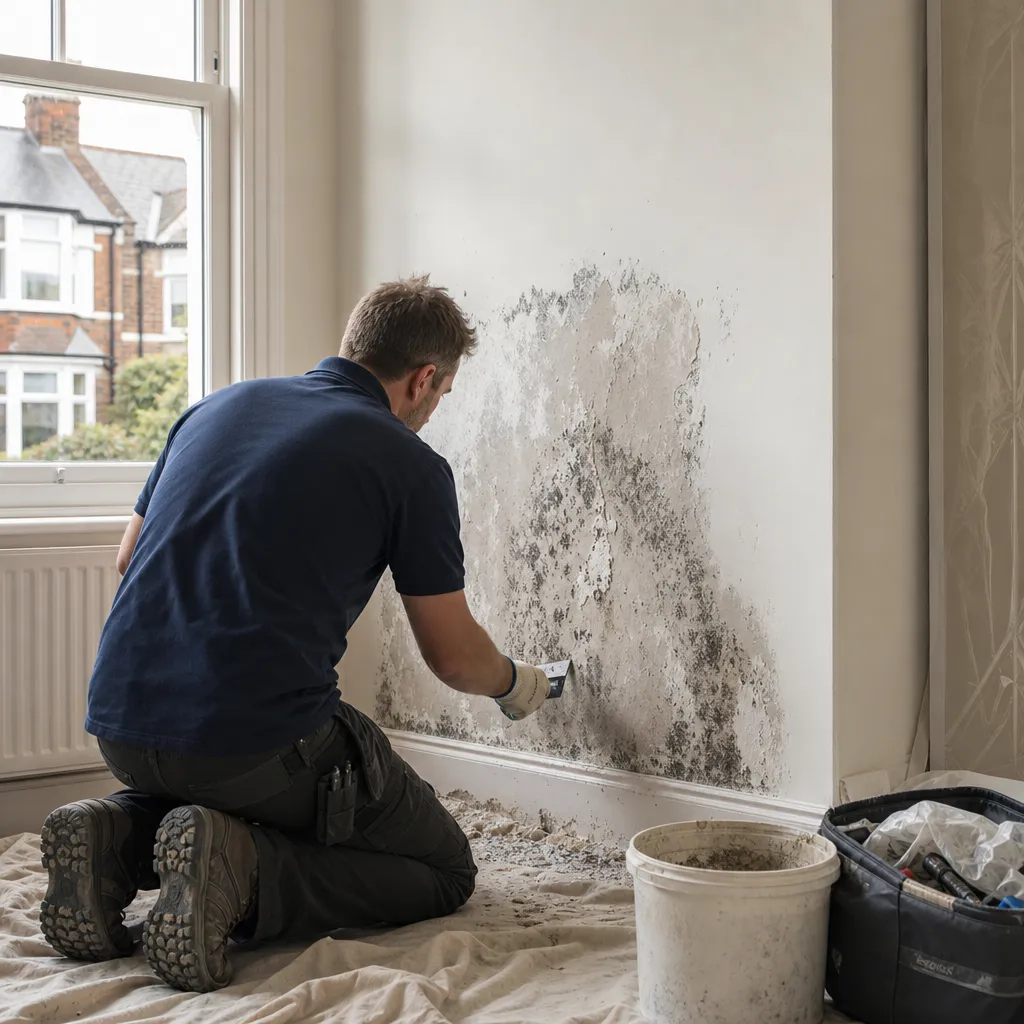 Surveys & Inspections
Treating Mould Contamination in Interior Walls
Mould on interior walls is caused by excess moisture — from condensation, penetrating damp, rising damp, or a plumbing leak.
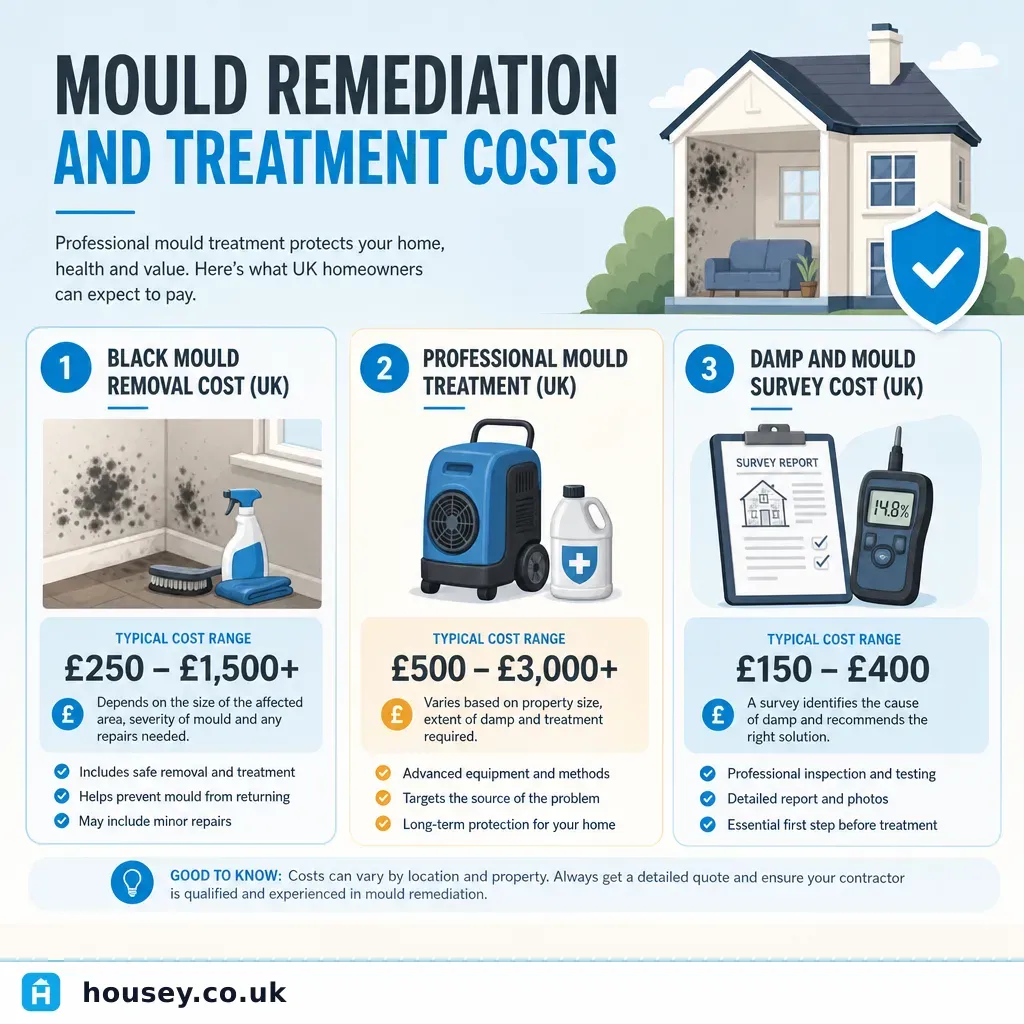 Surveys & Inspections
Mould Remediation and Treatment Costs
Professional mould remediation in the UK typically costs £150–£1,500+ depending on the extent of growth, underlying cause, and materials affected.
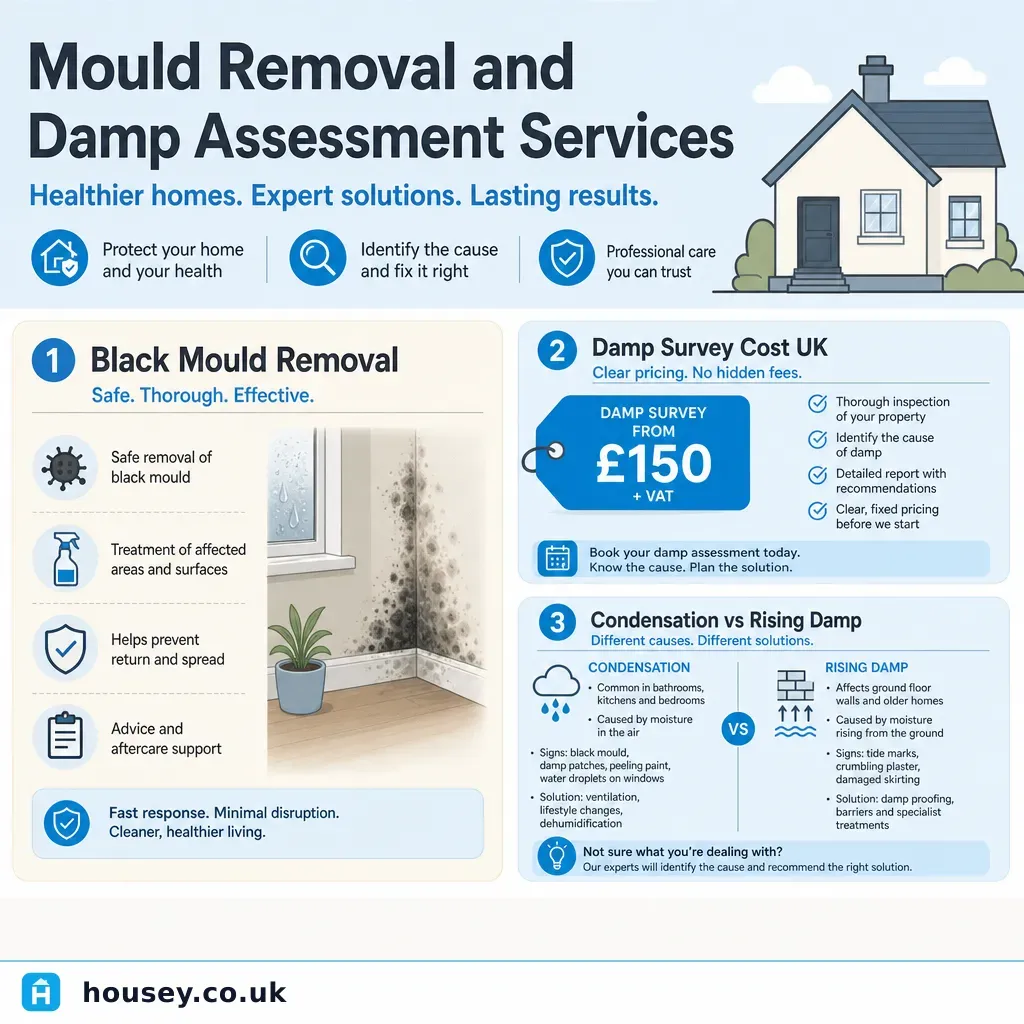 Surveys & Inspections
Mould Removal and Damp Assessment Services
Professional mould removal and damp assessment starts with identifying the moisture source—condensation, rising damp, or penetrating damp—before any treatment begins.
 Surveys & Inspections
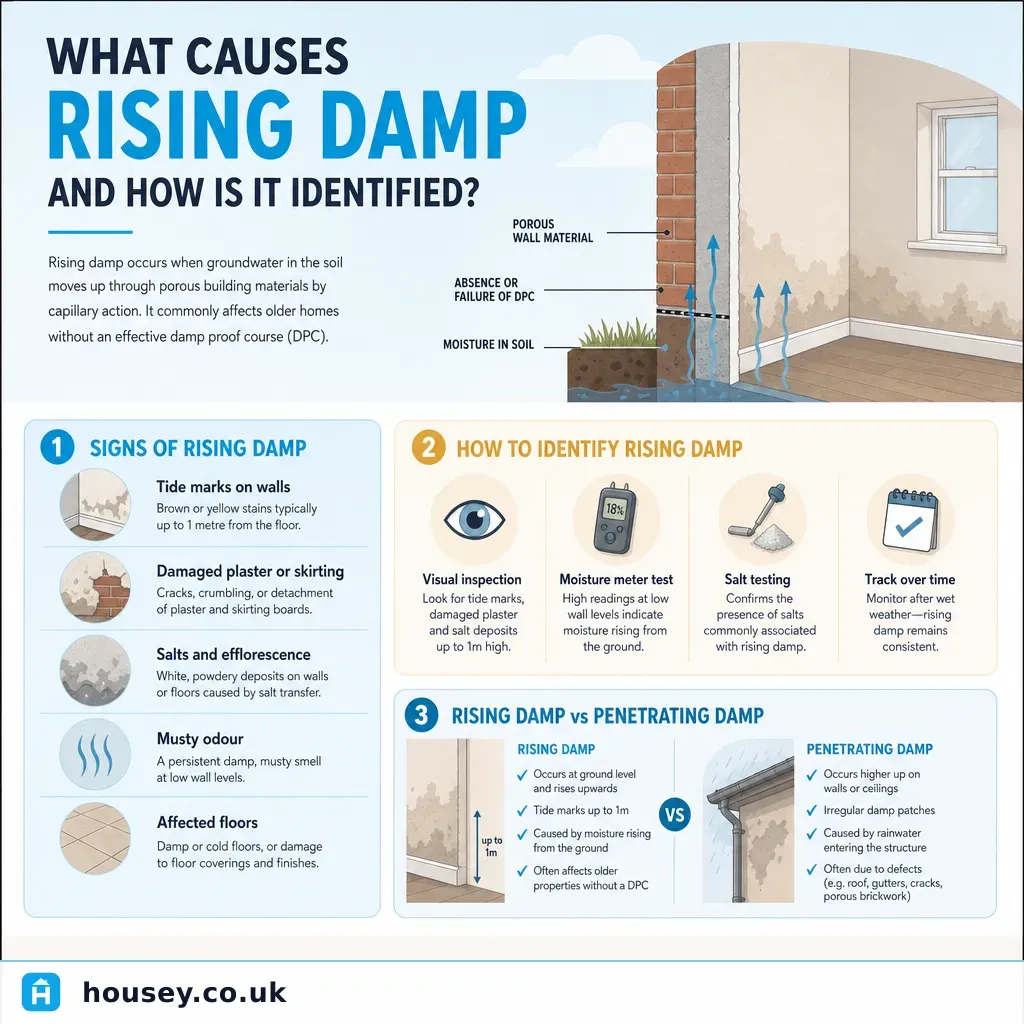
What Causes Rising Damp and How Is It Identified?
Rising damp occurs when groundwater travels upward through masonry via capillary action, usually because the damp-proof course (DPC) has failed, is absent, or has been bridged.
 Surveys & Inspections
Structural Building Survey Costs
A RICS Level 3 Building Survey typically costs £500–£1,500 in the UK, depending on property size, age, and location.