Assessing and Repairing External Wall Damage: When to Call a Specialist
By Housey · Last reviewed 18th of May 2026
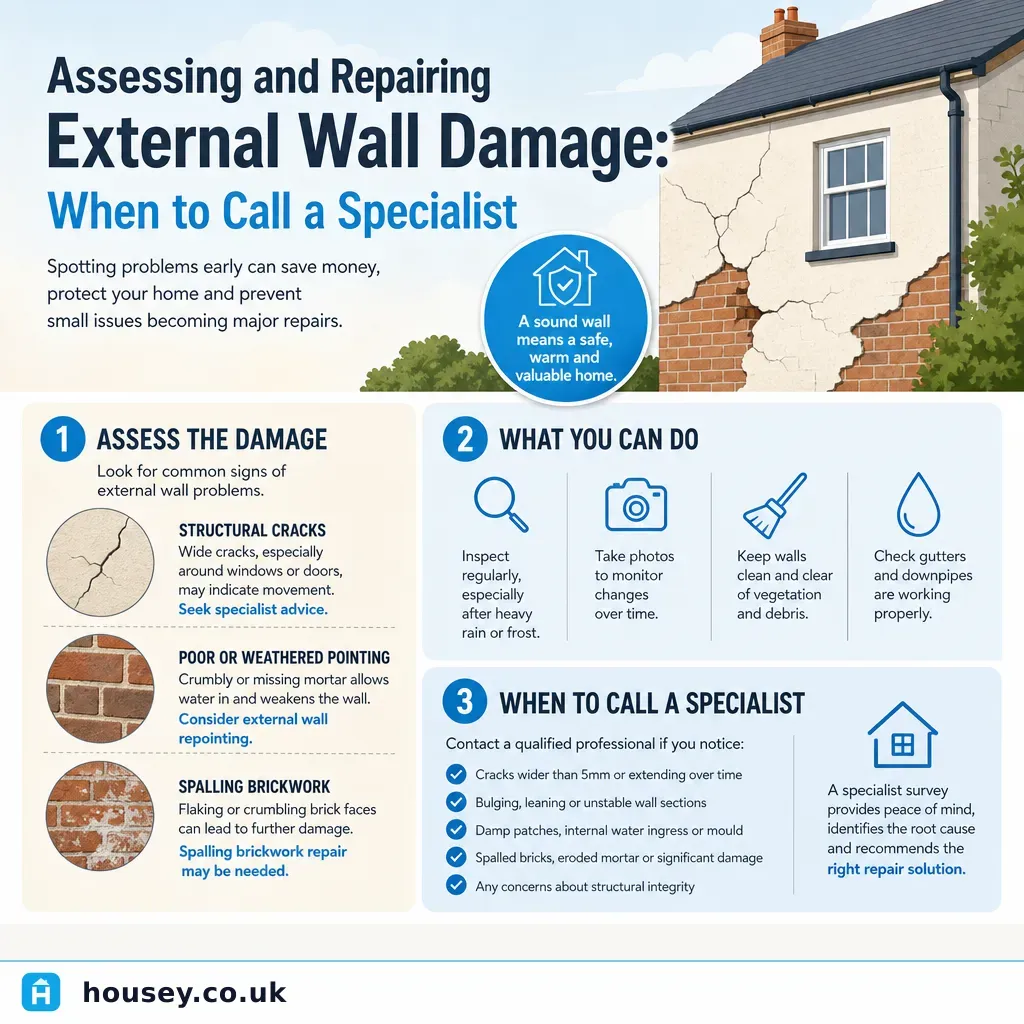
Assessing and Repairing External Wall Damage: When to Call a Specialist
External walls do more than define a property's appearance — they resist wind-driven rain, support upper floors and roof loads, and maintain thermal performance. For UK homeowners, whether the property is a pre-1919 Victorian terrace built with lime mortar or a 1980s cavity-wall semi, understanding why damage has appeared — and how serious it is — determines whether a competent builder or a chartered structural engineer is needed. Getting that assessment wrong is costly in both directions: ignoring serious movement, or commissioning unnecessary structural reports.
Key points
- Cracks are classified by width: the BRE Good Repair Guide 2 system runs from Category 0 (hairline, <0.1 mm) to Category 5 (very severe, >25 mm); structural concern rises sharply above 5 mm.
- The Party Wall etc. Act 1996 may require a formal party wall notice if repair works affect a shared wall or are close to a boundary.
- Structural engineers in the UK hold chartered membership through the Institution of Structural Engineers (IStructE) or the Institution of Civil Engineers (ICE).
- Solid 225 mm brick walls — typical of Victorian and Edwardian terraces — have a U-value of approximately 2.0 W/m²K, making intact weatherproofing critical to thermal performance.
- Building Regulations Part A (Structure) applies to repairs that alter structural elements; permitted development rights do not remove the need for building control notification on structural work.
What types of external wall damage require professional assessment?
Not every crack or surface stain signals a structural problem. Understanding common damage patterns helps you set the right priority and choose the right professional.
Damage type | Appearance | Possible cause | Professional needed |
|---|---|---|---|
Hairline render cracks | <0.1 mm, often widespread | Thermal movement, render shrinkage | Builder or plasterer (cosmetic) |
Step cracking in mortar | Diagonal through brick courses | Differential settlement or subsidence | Chartered surveyor or structural engineer |
Horizontal cracking | Running along mortar joints | Lateral pressure from soil, roots, or water | Structural engineer |
Vertical cracking at corners | Straight down reveals or junctions | Lintel failure or wall tie corrosion | Structural engineer |
Spalling brickwork | Face of brick flaking | Freeze-thaw, sulphate attack, hard cement repointing | Builder with masonry experience |
Efflorescence (white salts) | White crystalline deposits on face | Salt migration driven by moisture | Builder; investigate moisture source first |
Bulging or bowing | Wall face projecting outward | Wall tie failure or cavity fill movement | Structural engineer — urgent |
When cracks are likely to be structural
The BRE classification in Good Repair Guide 2 is widely used by RICS-registered surveyors. Categories 3 to 5 (medium: 5–15 mm, severe: 15–25 mm, very severe: >25 mm) normally require investigation by a structural engineer, particularly where:
- Cracking is diagonal, stepped, or tapered — wider at one end.
- Cracks have appeared suddenly or are visibly widening.
- Doors or windows have begun sticking or distorting.
- Cracking appears to run through the full thickness of the wall.
Weatherproofing failures and water ingress
Water is the most persistent source of external wall damage in the UK climate. Wind-driven rain penetrates through cracked render, failed pointing, spalled brickwork, and deteriorated sealant around frames. Persistent moisture leads to frost damage in porous brickwork, corrosion of steel lintels and cavity wall ties, and damp internally.
Repointing is the most common weatherproofing repair for older masonry. Matching the mortar specification to the original construction is critical. Using hard OPC cement mortars on soft traditional brick or lime-built walls drives moisture back into the brick face, worsening spalling. The correct mix should be confirmed by a competent mason or surveyor familiar with the property's construction period.
External render and coating systems can address water ingress but must be specified carefully. Breathable coatings are essential for solid-wall or lime-built properties to avoid trapping moisture behind the surface.
DIY versus professional repair: a decision guide
- Choose a competent local builder if damage is confined to cosmetic render cracks, surface efflorescence, or localised repointing on a straightforward modern brick wall.
- Choose a specialist masonry contractor if the property is listed, pre-1919, or uses lime mortar — incorrect materials can cause structural and heritage damage.
- Choose a chartered structural engineer if cracks are wider than 5 mm, diagonal or stepped, appearing rapidly, or accompanied by door or window distortion.
- Contact your insurer before starting work if you suspect subsidence or settlement — repairs made before an insurance assessment can complicate or invalidate a claim.
- Check with your local planning authority before altering the external appearance of a listed building or a property in a conservation area — even like-for-like repairs may need consent.
Important limitations
This article provides general information only. The cause and severity of external wall damage varies significantly with property age, construction type, ground conditions, local environment, and alteration history. A written assessment from a RICS-registered surveyor or a chartered structural engineer (IStructE or ICE) is the only reliable way to establish whether damage is structural. Nothing in this article constitutes a structural or legal opinion.
When this becomes urgent
Stop relying on a guide and seek professional help immediately if:
- A wall is visibly bulging, leaning, or separating from the rest of the structure.
- Cracks have appeared suddenly following nearby excavation, demolition, or tree removal.
- A crack is more than 15 mm wide or has opened noticeably within days or weeks.
- Structural timbers — joists, lintels, wall plates — are exposed and visibly damp or distorted.
- You can see daylight through a crack in an external wall.
In an emergency where structural collapse is a concern, contact your local authority building control immediately.
What to ask a qualified professional
Before instructing a structural engineer or chartered surveyor to assess external wall damage, ask:
- What is your chartered membership (IStructE, ICE, or RICS) and do you carry professional indemnity insurance?
- Will your report identify the cause of damage, or only describe it? A cause-based report is more useful for insurance, planning, and repair specification.
- Do you have experience with properties of this age and construction type?
- Will you recommend a specific repair specification, or only flag the problem?
- Is a further structural calculation needed before repair work begins?
- Will the repair require building control notification?
- If party wall issues arise, can you advise on the procedure under the Party Wall etc. Act 1996?
When to get professional help
For anything beyond superficial cosmetic maintenance, a professional assessment is strongly advisable. Specific situations requiring professional involvement include:
- Cracks that have reappeared after a previous repair.
- Damage to a post-tensioned, precast, or non-traditional construction property — common in 1960s and 1970s system-built housing — where standard crack assessment guidance may not apply.
- Damage following a flood, fire, or nearby excavation.
- Any damage to a listed building, where unauthorised repairs can constitute a criminal offence under the Planning (Listed Buildings and Conservation Areas) Act 1990.
How Housey can help
If you need a specialist to assess or repair external wall damage, Housey can connect you with qualified structural engineering professionals who assess crack patterns, movement, and weatherproofing failures. Once a structural assessment has been completed, Housey can also introduce you to experienced extension builders for masonry repair and weatherproofing work.
Frequently asked questions
How do I know if a crack in my external wall is structural?
Cracks are more likely to be structural if they are diagonal or stepped through brick courses, wider than 5 mm, tapering wider at one end, or have appeared suddenly. Sticking doors and windows are a further warning sign. A crack that runs through the full wall thickness or appears to be widening warrants assessment by a RICS-registered surveyor or chartered structural engineer.
Can I repoint my own brickwork?
Minor repointing on a straightforward modern brick wall is within the capability of a competent DIYer if the correct mortar mix is used. For pre-1919 properties built with lime mortar, or for listed buildings, using the wrong mortar specification can cause lasting damage by trapping moisture. In those cases, use a specialist masonry contractor able to match the original specification.
Do I need planning permission to repair my external walls?
Most like-for-like repairs do not require planning permission under the Town and Country Planning Act 1990. Listed buildings require Listed Building Consent for any works affecting the building's character, including repairs. Conservation area properties may need consent for certain external alterations, particularly if an Article 4 Direction is in place. Always check with your local planning authority first.
Will my buildings insurance cover external wall repairs?
Standard buildings insurance typically covers sudden, unexpected damage such as storm damage, but usually does not cover gradual deterioration or maintenance failures. If you suspect subsidence is involved, notify your insurer before carrying out any repair work — premature repairs can complicate or invalidate a subsidence claim.
Sources and further reading
- Building Regulations Approved Document A: Structure — GOV.UK
- BRE Good Repair Guide 2: Assessing Cracks in Houses — Building Research Establishment
- RICS guidance on building surveys and defect diagnosis — Royal Institution of Chartered Surveyors
- Party Wall etc. Act 1996: guidance for practitioners — GOV.UK
- Planning (Listed Buildings and Conservation Areas) Act 1990 — legislation.gov.uk
Useful next reads
 Improvement & Build
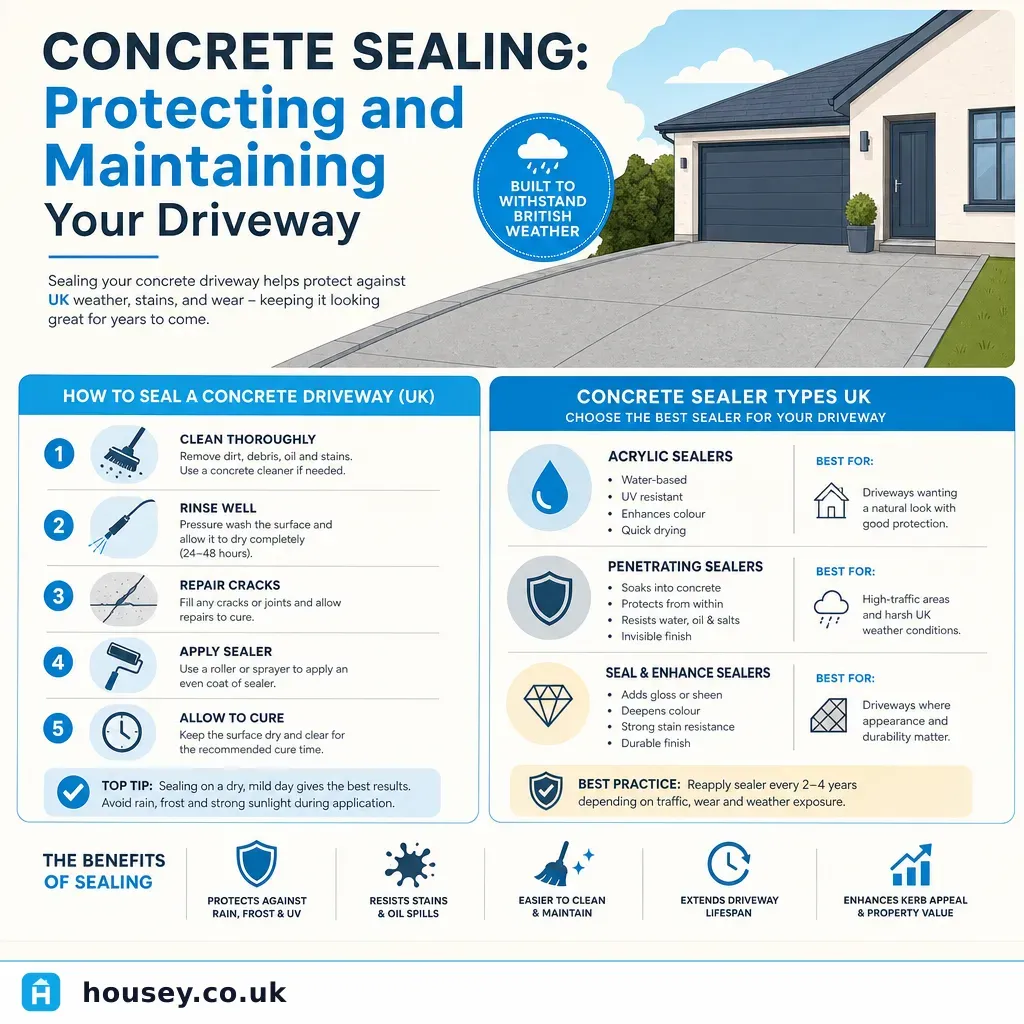
Concrete Sealing: Protecting and Maintaining Your Driveway
Sealing a concrete driveway protects against water ingress, freeze-thaw damage, oil stains, and surface wear.
 Improvement & Build
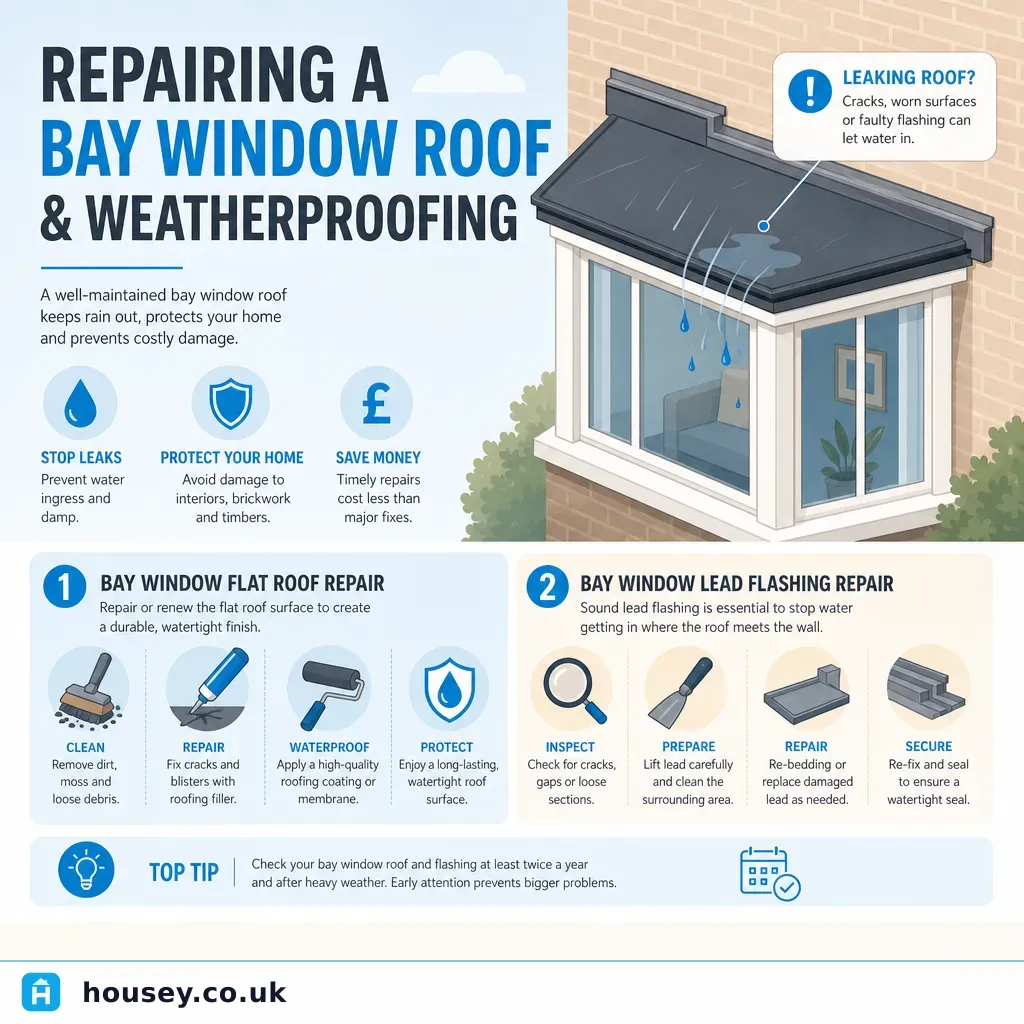
Repairing a Bay Window Roof and Weatherproofing
A bay window roof typically uses felt, lead, or EPDM rubber as its waterproof covering.
 Improvement & Build
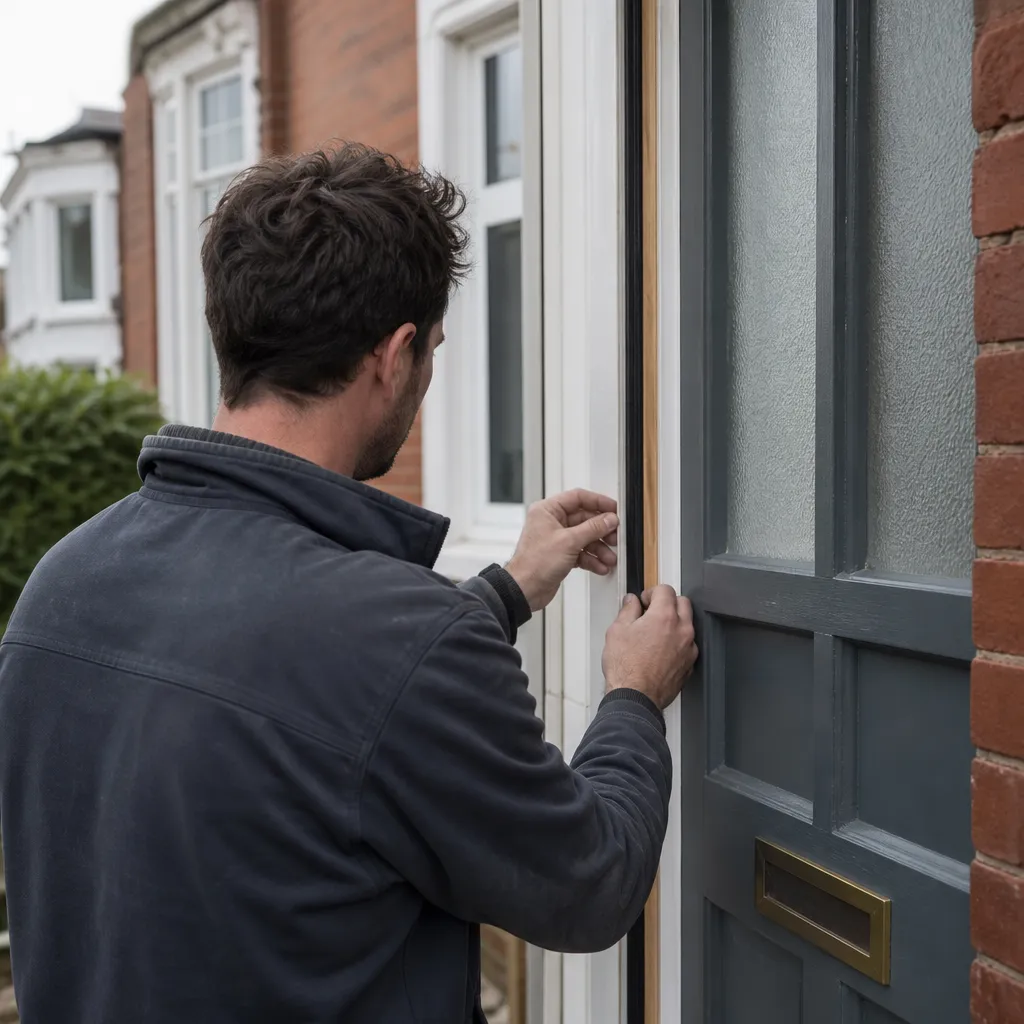
Door Weatherproofing And Sealing: Window And Door Contractors
Door weatherproofing involves fitting draught seals, threshold strips, letterbox brushes, and door sweeps to stop cold air and rain entering around the frame and threshold.
 Improvement & Build
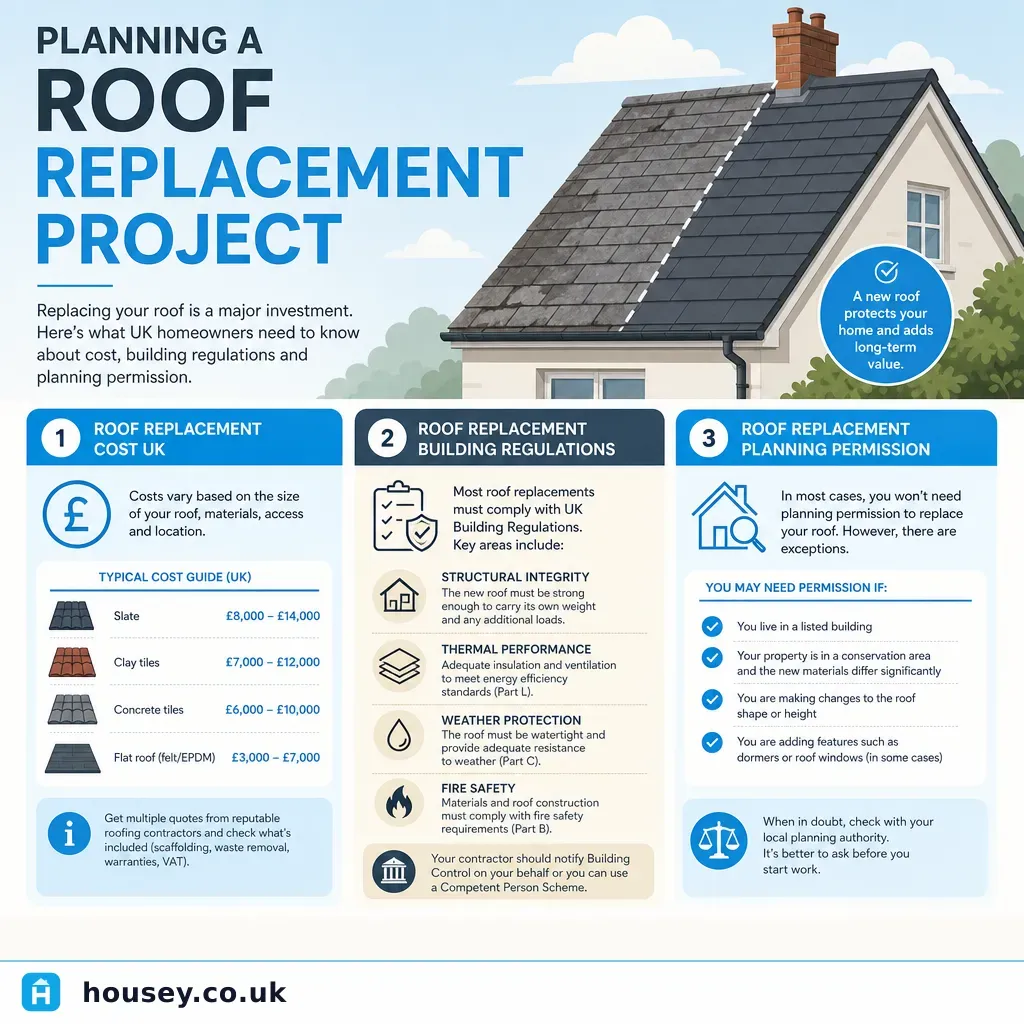
Planning a Roof Replacement Project
A roof replacement project involves stripping the existing covering, renewing the sarking felt and battens, and laying new tiles, slates, or a flat-roof membrane.
 Improvement & Build
How much does window sill replacement cost
Window sill replacement in the UK typically costs £100–£400 per sill for a standard installation, depending on the material — uPVC, timber, stone, or composite — and whether the sill is internal or external.