Assessing Structural Cracks: When to Seek Expert Help
By Housey · Last reviewed 11th of May 2026
Assessing Structural Cracks: When to Seek Expert Help
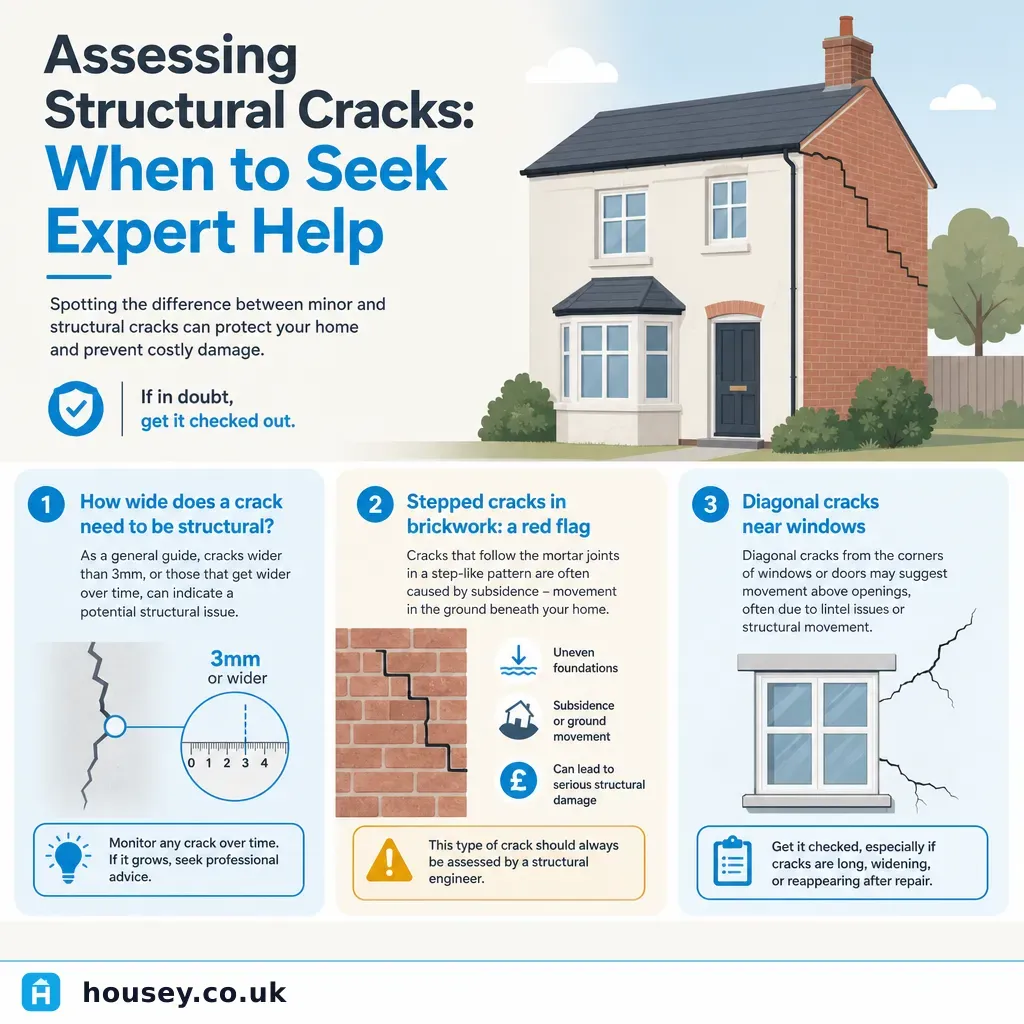
Cracks appear in almost every UK home at some point — from Victorian terraces that have slowly settled over 150 years to new-builds adjusting to ground conditions in their first winter. The challenge for homeowners is that the majority are cosmetic, whilst a minority signal genuine movement requiring professional investigation. Misreading a serious crack as minor, or commissioning expensive structural work for a hairline, are both costly mistakes. Understanding the basics of crack assessment helps you decide whether to monitor, commission a survey, or act urgently.
Key points
- The BRE Digest 251 classification grades crack severity from Category 0 (hairline, below 0.1 mm) to Category 5 (very severe, above 25 mm); Categories 3–5 require structural investigation.
- Stepped cracks following mortar joints in brickwork are often associated with differential settlement or subsidence, particularly in properties built on shrinkable clay soils common across London and the south-east.
- Diagonal cracks radiating from the corners of door and window openings are a common indicator of lintel failure or localised foundation movement.
- Crack monitors (tell-tales) cost approximately £1–2 each from builders' merchants and detect whether a crack is widening or moving sideways over a monitoring period.
- A RICS Level 3 Building Survey will categorise visible cracks but may recommend a specialist structural engineer's report where movement is active or the cause unclear.
What crack patterns tell you
The pattern of a crack — its direction, width, whether it follows mortar or cuts through brick, and where it sits in the building — provides the first diagnostic clue.
Crack type | Typical appearance | Common cause | Urgency |
|---|---|---|---|
Hairline plaster crack | Fine, random, less than 1 mm | Thermal movement, drying shrinkage | Low — monitor |
Stepped crack through mortar | Staircase pattern in brickwork | Differential settlement, subsidence | Medium to high |
Diagonal crack from opening corners | 45° angle from window or door corner | Lintel failure, localised settlement | Medium to high |
Horizontal crack in brickwork | Runs across one or more courses | Wall tie failure, lateral earth pressure | High — seek advice |
Vertical crack at building junction | Straight down, often at extension join | Differential movement between structures | Medium |
Through crack (visible on both faces) | Same crack inside and outside | Significant structural movement | High |
How crack width guides your response
The BRE Digest 251 classification is used widely by surveyors and insurers in the UK:
- Category 0 (below 0.1 mm): Hairlines visible only on very close inspection. No repair needed beyond normal redecoration.
- Category 1 (0.1–1 mm): Fine cracks. Easy to fill. Monitor for any change.
- Category 2 (1–5 mm): Noticeable cracks, possibly several per group. External repointing may be needed. Professional opinion advisable if the crack is new.
- Category 3 (5–15 mm): Cracks a finger fits into easily. Doors and windows may stick. Structural opinion required before attempting repair.
- Category 4 (15–25 mm): Windows and doors distorted. Walls leaning or bowing. Structural repair needed.
- Category 5 (above 25 mm): Severe structural damage. Stability may be compromised. Immediate professional assessment essential.
As a practical rule: below 5 mm and stable, monitoring is usually the first step. At 5 mm and above, commission an assessment rather than wait.
Which professional do you need?
A common question is whether to instruct a chartered building surveyor or a structural engineer. The right choice depends on what you need at each stage.
Situation | Recommended professional | What they provide |
|---|---|---|
Buying a property with visible cracks | RICS Level 3 Building Surveyor | Full condition assessment; crack categorisation; recommendations for further investigation |
Stable cracks found after purchase | Chartered Building Surveyor (specific defect report) | Diagnosis, monitoring advice, remediation options |
Active movement or suspected subsidence | Structural engineer (CEng, MIStructE or MICE) | Engineering analysis, calculations, remediation specification |
Cracking after nearby building works | Structural engineer | Pre- and post-construction surveys; Party Wall Act assessments |
Insurance subsidence claim | Structural engineer (often insurer-appointed) | Technical report meeting insurer requirements |
Which option should you choose?
- Choose monitoring first if the crack is below 5 mm, appears stable, affects only plaster or mortar, and is not accompanied by sticking doors or windows.
- Commission a specific defect survey if the crack is 5–15 mm, has appeared in the last 12 months, runs through brick, or is accompanied by sticking door or window frames.
- Instruct a structural engineer if the crack is above 15 mm, is widening, follows a stepped or horizontal pattern through brickwork, or is accompanied by any wall lean or bulge.
- Seek help urgently if the crack appeared suddenly after heavy rain, nearby excavation, or tree removal, or if there is visible instability in any part of the structure.
- Notify your insurer if you suspect subsidence — most UK buildings insurance policies cover subsidence and require prompt notification; delays can affect your claim.
Red flags that demand professional attention without delay
The following signs warrant calling a professional rather than continuing to monitor:
- A crack that has visibly widened over days or weeks.
- Stepped cracking running through mortar joints in external brickwork, particularly on a property built on clay soil.
- Any horizontal crack in a masonry wall, especially in retaining walls or older cavity walls.
- Doors or windows that have recently started sticking, particularly if accompanied by fresh cracking.
- A crack that is wider at one end than the other, indicating hogging or sagging movement.
- A visible bulge or lean in an external wall or chimney stack.
- Cracking that appeared after nearby excavation, piling, or demolition.
- Any crack accompanied by water ingress or a new damp smell.
Monitoring cracks before commissioning a survey
For cracks in BRE Categories 1–2 that appear stable, monitoring over 4–8 weeks is a reasonable first step before committing to survey costs. Crack monitors cost approximately £1–2 each from builders' merchants. Fix them across the crack in two or more positions and photograph with the date at weekly intervals. Take readings in both summer and winter to account for seasonal thermal movement. Bring monitor records and photographs to any survey appointment — they provide a useful baseline for diagnosis and for any insurance notification.
Important limitations
This article provides general guidance only. Crack assessment in UK residential properties depends heavily on construction type, soil conditions, property age, drainage, nearby vegetation, and building history. The guidance here cannot substitute for a professional on-site inspection of the specific property. Costs, remediation approaches, and professional recommendations will vary. If you are uncertain, seek qualified advice before carrying out any repair work.
When this becomes urgent
Stop monitoring and seek professional help immediately if:
- A crack appears suddenly with no clear cause.
- Any part of a wall, chimney, or gable appears to lean or bulge.
- You hear structural cracking or creaking sounds in the building.
- There has been nearby excavation, heavy construction, or tree felling in the preceding weeks.
- Your insurer has previously identified the property as a subsidence risk and a crack has recently appeared or changed.
What to ask a qualified professional
Before instructing a surveyor or structural engineer, ask:
- Are you a chartered member of RICS, the Institution of Structural Engineers (IStructE), or the Institution of Civil Engineers (ICE)?
- Will the report identify the probable cause of the cracking as well as its extent and category?
- Will you recommend further investigation — such as trial pits, drainage CCTV, or borehole surveys — if the cause is unclear?
- What monitoring period do you recommend before specifying remediation?
- Will your report satisfy my insurer's requirements if I am making a subsidence claim?
- What are your fees, and does the quoted figure include VAT?
When to get professional help
If you are in any doubt about whether a crack is cosmetic or structural, a professional inspection is the only reliable way to find out. Do not rely solely on a general builder to diagnose crack causes — the root cause may require engineering expertise, and an incorrect diagnosis can lead to unnecessary or ineffective repair work.
How Housey can help
Housey connects homeowners across the UK with qualified professionals for structural surveys and structural engineering assessments. Submit a single request and receive quotes from vetted local specialists, helping you understand both the likely cause of the problem and the cost of remediation.
Frequently asked questions
Are diagonal cracks in walls always a serious problem?
Fine diagonal cracks at the corners of window and door openings are common in older UK homes and usually reflect normal thermal or moisture movement. However, diagonal cracks wider than 5 mm, those that are widening, or those accompanied by distorted frames should be assessed by a chartered surveyor or structural engineer to rule out lintel failure or foundation movement.
My house is Victorian — is cracking normal?
Victorian properties often show historic settlement cracking that has been stable for decades. Hairline cracks in plaster and fine mortar cracking are common and usually harmless. The concern is new or widening cracking, particularly stepped cracks in external brickwork, which can indicate ongoing movement. A RICS Level 3 Building Survey before purchasing a Victorian property is advisable and will categorise visible defects.
Does a crack mean my home is subsiding?
Not necessarily. Most cracks in UK homes result from thermal movement, drying shrinkage, or minor historic settlement rather than subsidence. Subsidence is a specific condition involving downward ground movement, commonly linked to shrinkable clay soils, leaking drains, or tree root action. A structural engineer can distinguish active subsidence from historic settlement through on-site monitoring and investigation.
How much does a structural crack assessment cost?
Indicative UK costs, last reviewed 2026-05-11. A specific defect inspection and report from a structural engineer typically costs £300–£800 depending on property size and scope. A RICS Level 3 Building Survey, which includes crack assessment, typically costs £600–£1,500 or more for larger properties. Always request itemised quotes and confirm whether VAT is included before instructing a professional.
Sources and further reading
- BRE Digest 251 — Assessment of Damage in Low-Rise Buildings — BRE Group
- RICS Home Surveys standard — RICS
- Find a structural engineer — Institution of Structural Engineers (IStructE)
- GOV.UK building regulations technical guidance — GOV.UK
Useful next reads
 Surveys & Inspections
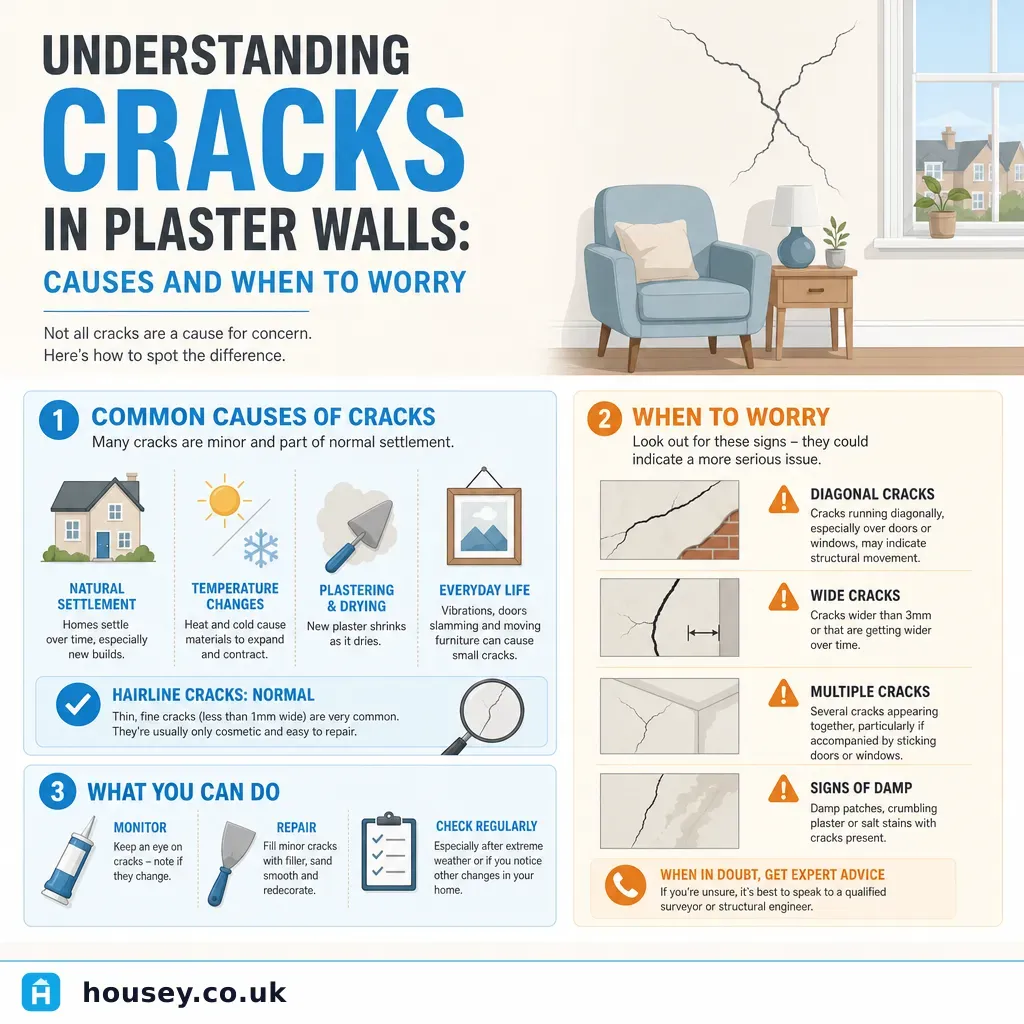
Understanding Cracks in Plaster Walls: Causes and When to Worry
Most hairline plaster cracks are cosmetic, caused by seasonal shrinkage or minor settlement.
 Surveys & Inspections
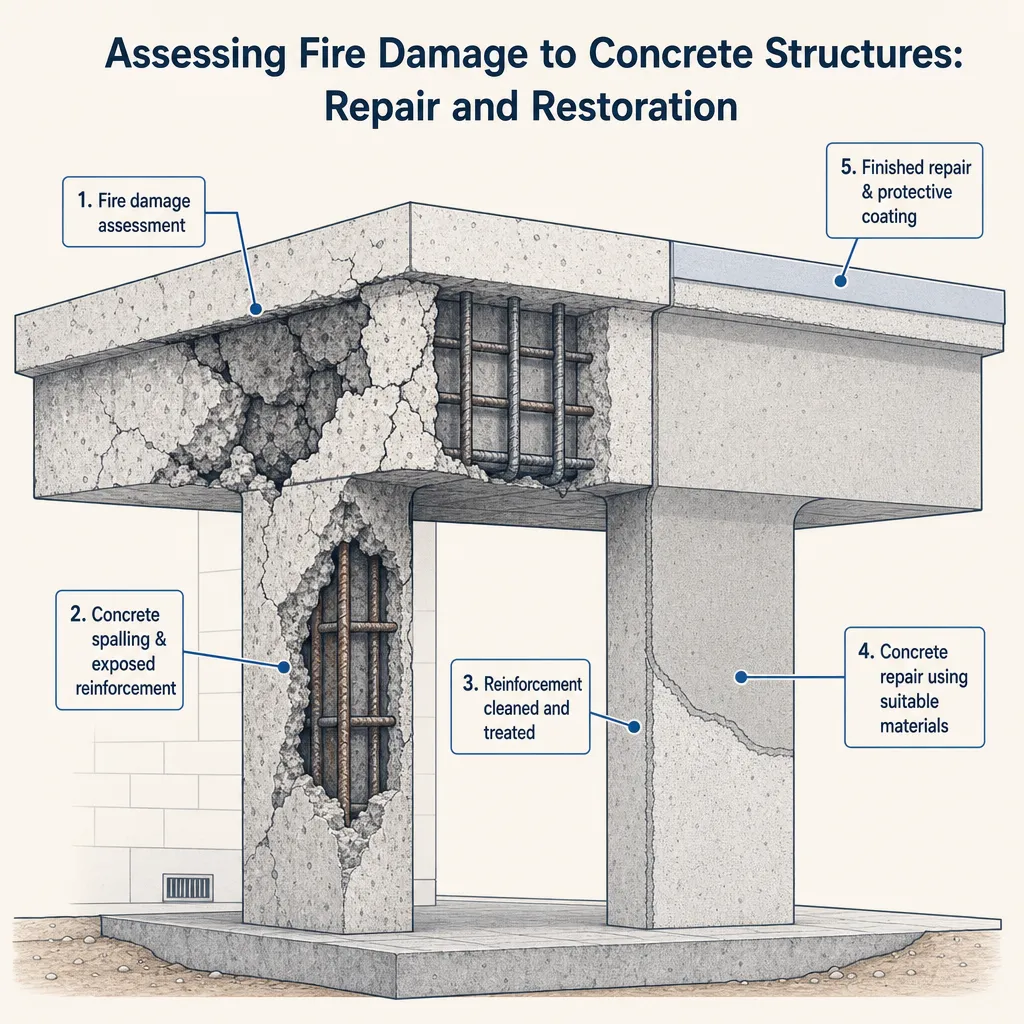
Assessing Fire Damage to Concrete Structures: Repair and Restoration
After a building fire, concrete is assessed by a chartered structural engineer using colour mapping, core sampling, and laboratory strength testing.
 Surveys & Inspections
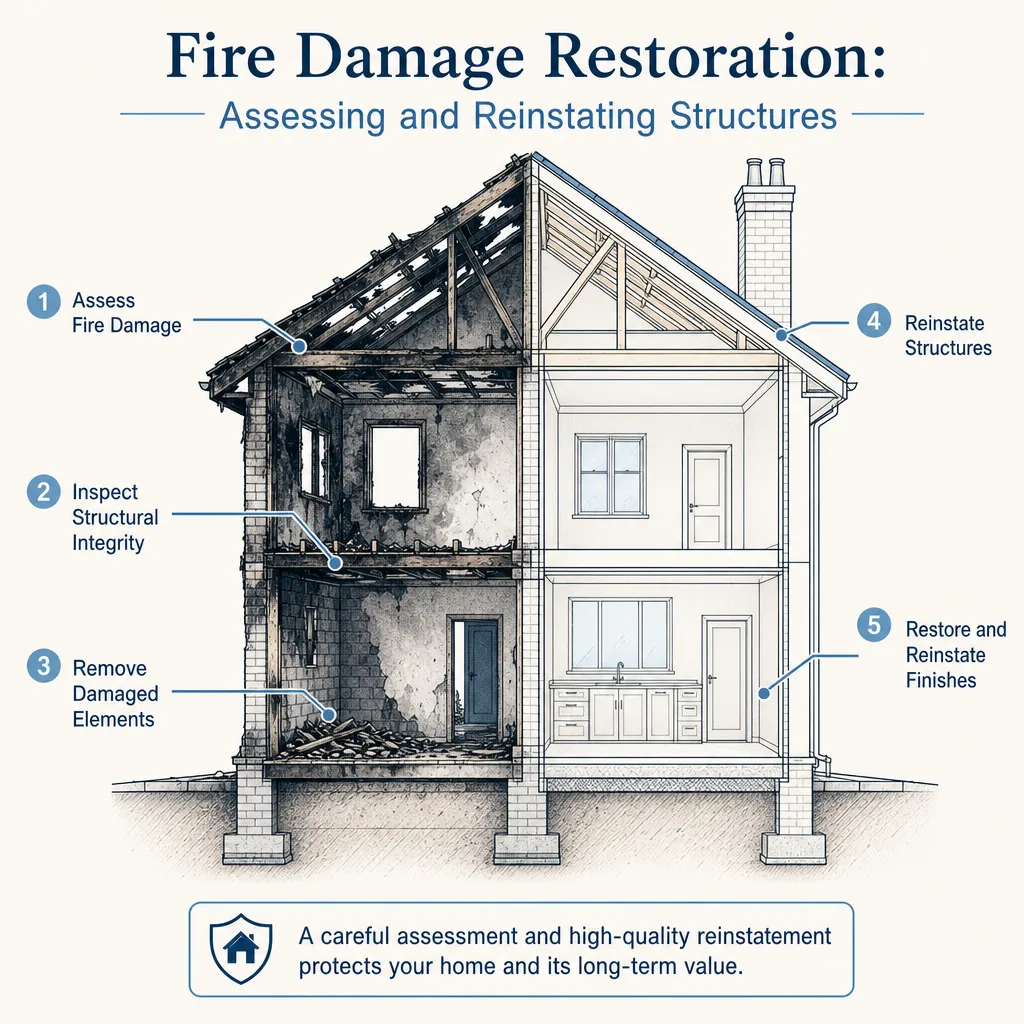
Fire Damage Restoration: Assessing and Reinstating Structures
Fire damage restoration starts with a structural engineer assessing which elements can be repaired and which must be replaced.
 Surveys & Inspections
Water Damage Restoration: Emergency Response and Recovery
After a water event, act within hours: stop the water source, switch off electricity if safe, photograph the damage, and contact your insurer promptly.
 Surveys & Inspections
Identifying Structural Damage from Carpenter Ant Infestations
Carpenter ants excavate galleries in damp or decayed timber, leaving coarse frass and smooth, clean channels distinct from woodworm's fine bore dust and round exit holes.