Water Damage Restoration: Emergency Response and Recovery
By Housey · Last reviewed 10th of May 2026
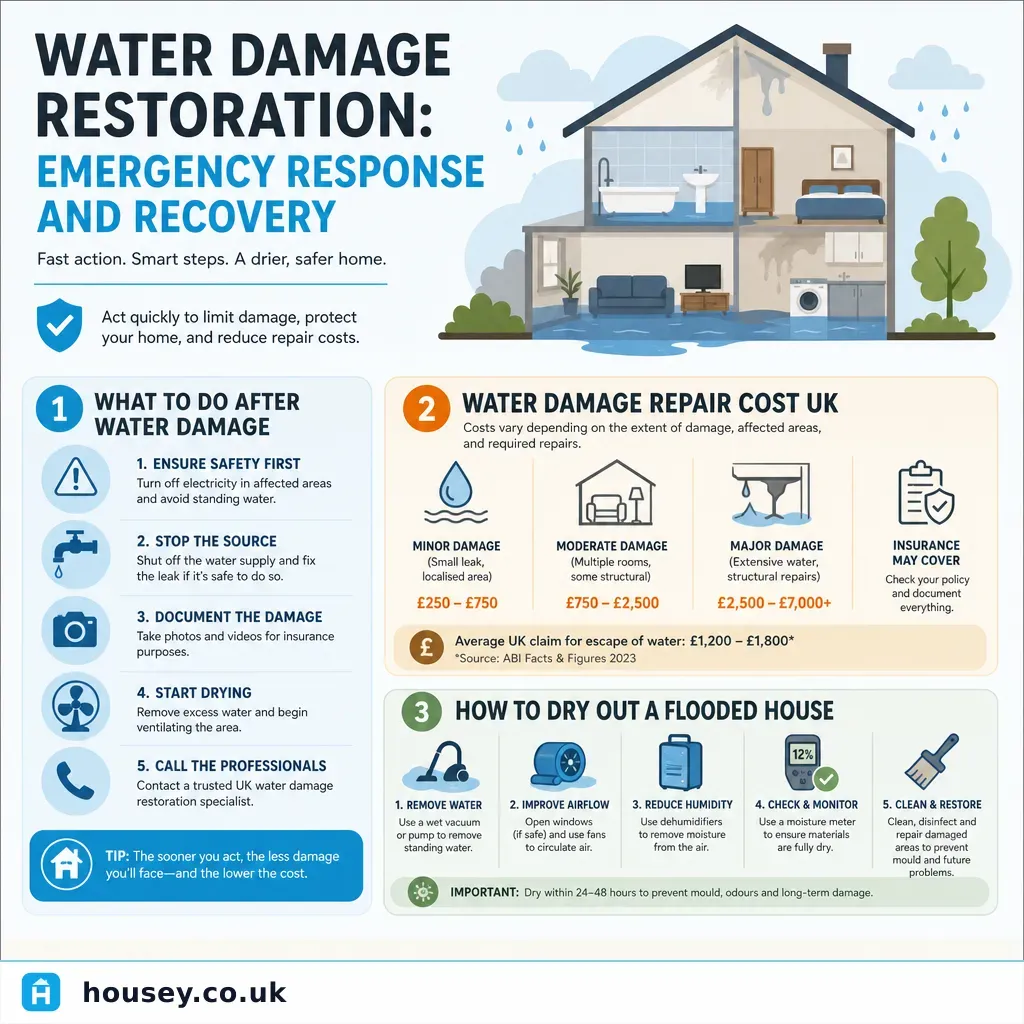
Water Damage Restoration: Emergency Response and Recovery
Water damage can reach a UK property in many ways — a burst supply pipe in a cold spell, a washing machine hose failure, a neighbour's leak through a shared ceiling in a converted Victorian terrace, or surface water finding its way indoors during a storm. The source matters because it determines contamination risk, the restoration approach, and what your insurance policy covers. What rarely varies is the importance of acting quickly: the first 48 hours largely determine how much secondary damage occurs and how long recovery takes.
Key points
- Category 3 water (sewage-contaminated) poses a direct health risk and requires specialist extraction, biocidal treatment, and appropriate PPE — do not attempt clean-up without professional guidance.
- Mould can begin to establish in wet structural materials within 24 to 48 hours; rapid professional extraction and drying is the most effective prevention.
- Structural drying of a flooded property typically takes three to six weeks using professional equipment; domestic dehumidifiers are rarely sufficient for significant water events.
- Most UK home buildings insurance policies cover sudden and accidental water damage from burst pipes; gradual leaks and external flood damage usually require separate or additional cover — check your policy schedule.
- A professional damp and timber survey after a water event can identify hidden moisture in floors, wall cavities, and structural timbers before reinstatement begins, preventing costly failures months later.
Common causes of water damage in UK homes
Understanding the water source matters because it affects the contamination risk, restoration method, and your insurance position.
Cause | Water category | Insurance typically covers? | Key risk |
|---|---|---|---|
Burst or leaking supply pipe | Category 1 (clean) | Usually yes — sudden/accidental | Subfloor and ceiling saturation |
Appliance failure (washing machine, dishwasher) | Category 1 | Usually yes | Subfloor damage, unit below affected |
Overflowing bath or sink | Category 1–2 | Often yes — accidental | Floor and ceiling saturation |
Blocked drain backing up | Category 2–3 | Depends on policy wording | Contamination risk |
Sewage flood | Category 3 (contaminated) | Check policy wording carefully | Health hazard; biocidal treatment essential |
Storm surface water flooding | Category 2–3 | Flood cover needed — often a separate add-on | Widespread structural drying required |
Neighbour's leak through ceiling | Category 1–2 | Own policy or neighbour's liability | Ceiling and structural saturation |
Flood cover for external surface water or river flooding is frequently a separate add-on to a standard UK home insurance policy. Check your policy schedule before assuming cover exists.
Emergency response: the first 48 hours
Acting quickly in the first 48 hours limits secondary damage significantly. Work through this checklist as soon as a water event occurs.
The restoration process: what to expect
Professional water damage restoration in the UK typically follows these stages.
1. Moisture mapping and damage scoping A specialist uses calibrated moisture meters and thermal imaging cameras to map the extent of saturation in floors, walls, and ceilings. This drives the drying programme and identifies moisture that is invisible to the naked eye.
2. Water extraction Industrial wet vacuums and pump extraction equipment remove standing water. Saturated carpets and underlay that cannot be salvaged are removed at this stage.
3. Structural drying High-powered dehumidifiers and air movers draw moisture from structural materials over several weeks. Equipment must remain in place throughout the drying programme; progress is tracked using regular moisture readings against target values for that material and construction type.
4. Antimicrobial treatment Where Category 2 or 3 water was involved, biocidal cleaning agents are applied to affected surfaces and accessible cavities to prevent bacterial and mould growth.
5. Mould assessment and treatment If drying was delayed or mould is already visible, specialist assessment and treatment is required before reinstatement proceeds. Surface wiping is not sufficient for mould established within wall cavities or under flooring.
6. Reinstatement Replastering, floor replacement, redecoration, and fixture reinstatement follow once structural drying is confirmed complete. This phase is typically arranged separately and often co-ordinated through the insurer or loss adjuster.
7. Post-drying verification Final moisture readings confirm the structure has returned to acceptable levels. This documentation is important for the insurance settlement, for any future property survey, and as evidence of completed remediation if the property is sold.
Damp and structural assessment: why it matters after a water event
A significant water event saturates materials that are not visible to the eye — wall cavities, subfloor voids, structural timbers, and insulation. Without a professional damp and timber survey to verify that drying is complete, trapped moisture can cause:
- Dry rot or wet rot in floor joists and structural timbers, which can develop within weeks in persistently damp conditions in older properties.
- Mould growth within wall cavities, affecting indoor air quality for occupants over months.
- Plaster blowing and surface finishes failing shortly after reinstatement — a common and costly consequence of incomplete drying.
- Long-term structural degradation if saturated timbers are sealed behind new finishes before reaching safe moisture levels.
A qualified surveyor using calibrated moisture meters can confirm when drying targets have been met and whether structural timbers show early signs of rot initiation.
Drainage failures and recurring water events
If water entered via a drainage failure — a blocked drain, a collapsed pipe, or inadequate drainage around the building's perimeter — professional drainage contractors should carry out a CCTV drain survey to identify the root cause before reinstatement begins. Redecorating without resolving the drainage issue is likely to result in recurrence.
Signs that drainage may be involved include:
- Water appearing at ground level near gully covers or inspection chambers.
- Damp rising from subfloor areas without a clear supply pipe leak source.
- Foul odour accompanying water ingress.
- Recurring damp in the same location across different weather conditions or seasons.
Costs and what affects them
Indicative UK costs, last reviewed 2026-05-10. Costs vary significantly by property size, water category, speed of response, and contractor rates. Always obtain at least two or three itemised quotes.
Scope | Indicative cost range | Key cost driver |
|---|---|---|
Single room, Category 1, prompt response | £800–£3,500 | Drying equipment hire and monitoring visits |
Multiple rooms, Category 1 | £3,500–£15,000 | Programme duration, subfloor and ceiling removal |
Contaminated water event (Category 3) | £5,000–£30,000+ | Biocidal treatment, specialist disposal, PPE |
Drying equipment hire (per week) | £200–£600 | Equipment count and room volume |
Post-event damp and timber survey | £300–£700 | Surveyor scope and travel |
CCTV drain survey | £150–£400 | Drain length and access |
These figures are indicative only. VAT is typically charged at 20%. Reinstatement costs — replastering, flooring, redecoration — are additional and vary considerably by scope and finish.
When to get professional help
Contact a professional immediately if:
- There is standing water near electrical fittings — do not restore power until a registered electrician has confirmed it is safe.
- The water source is sewage-contaminated — Category 3 water poses direct health risks; do not attempt clean-up without appropriate PPE and specialist guidance.
- A ceiling in a flat or maisonette is bowing or sagging following a leak from above — evacuate the room and arrange structural assessment before re-entering.
- Mould appears within 48 hours of the event — mould in wall cavities requires specialist treatment, not surface cleaning.
- You have unresolved existing damp problems — a new water event on top of pre-existing moisture damage requires professional assessment rather than drying equipment alone.
- You are a landlord: you have legal obligations under the Landlord and Tenant Act 1985 and the Homes (Fitness for Human Habitation) Act 2018 to maintain habitable conditions, and a water event that renders the property unfit must be addressed promptly.
How Housey can help
A professional damp and timber survey confirms that moisture in structural materials has been fully resolved after a water event — essential before reinstatement begins and important for ongoing insurance and any future property survey. If drainage failure contributed to the problem, drainage contractors can carry out a CCTV drain survey to identify and fix the root cause. Housey can help you request quotes from qualified professionals across the UK.
Frequently asked questions
How long does water damage restoration take?
It depends on severity and the materials affected. Structural drying alone typically takes three to six weeks for a significant water event. Reinstatement — replastering, flooring, redecoration — adds further time. A contained appliance leak in a single room may be resolved in two to three weeks; a multi-floor flood can take several months in total.
Does home insurance cover a burst pipe?
Most standard UK home buildings insurance policies cover sudden and accidental water damage from burst pipes. Gradual leaks — where damage built up over time without the homeowner's knowledge — are commonly excluded. Flood damage from external surface water usually requires separate flood cover. Check your policy schedule and notify your insurer promptly after any water event.
Can I use my own dehumidifier to dry out a flooded room?
Domestic dehumidifiers can assist in very minor cases but are rarely powerful enough for significant water events. They also lack the airflow management and moisture monitoring needed to dry structural materials safely and evenly. Inadequate drying risks leaving hidden moisture that causes mould growth or structural damage in the months following remediation.
Who pays for water damage caused by the flat above?
You would typically claim on your own buildings insurance — which may then recover costs from the neighbour's insurer via subrogation — or claim directly against the neighbour's liability cover. The process depends on each party's policy terms. Citizens Advice or a loss assessor can help navigate disputed or complex inter-party claims.
Is a damp survey really necessary after water damage is dried out?
A professional damp and timber survey is strongly recommended after any significant water event. Moisture meters and thermal imaging can confirm that structural timbers, wall cavities, and subfloor voids have reached target moisture levels — impossible to assess reliably by eye. This documentation is also useful for insurance records and any future property survey or sale.
Sources and further reading
- Home insurance: what is and isn't covered — Citizens Advice
- Prepare for flooding: what to do during and after — GOV.UK
- Homes (Fitness for Human Habitation) Act 2018 — GOV.UK
- Landlord and Tenant Act 1985: repairing obligations — legislation.gov.uk
- TrustMark: find a registered contractor — TrustMark
Useful next reads
 Surveys & Inspections
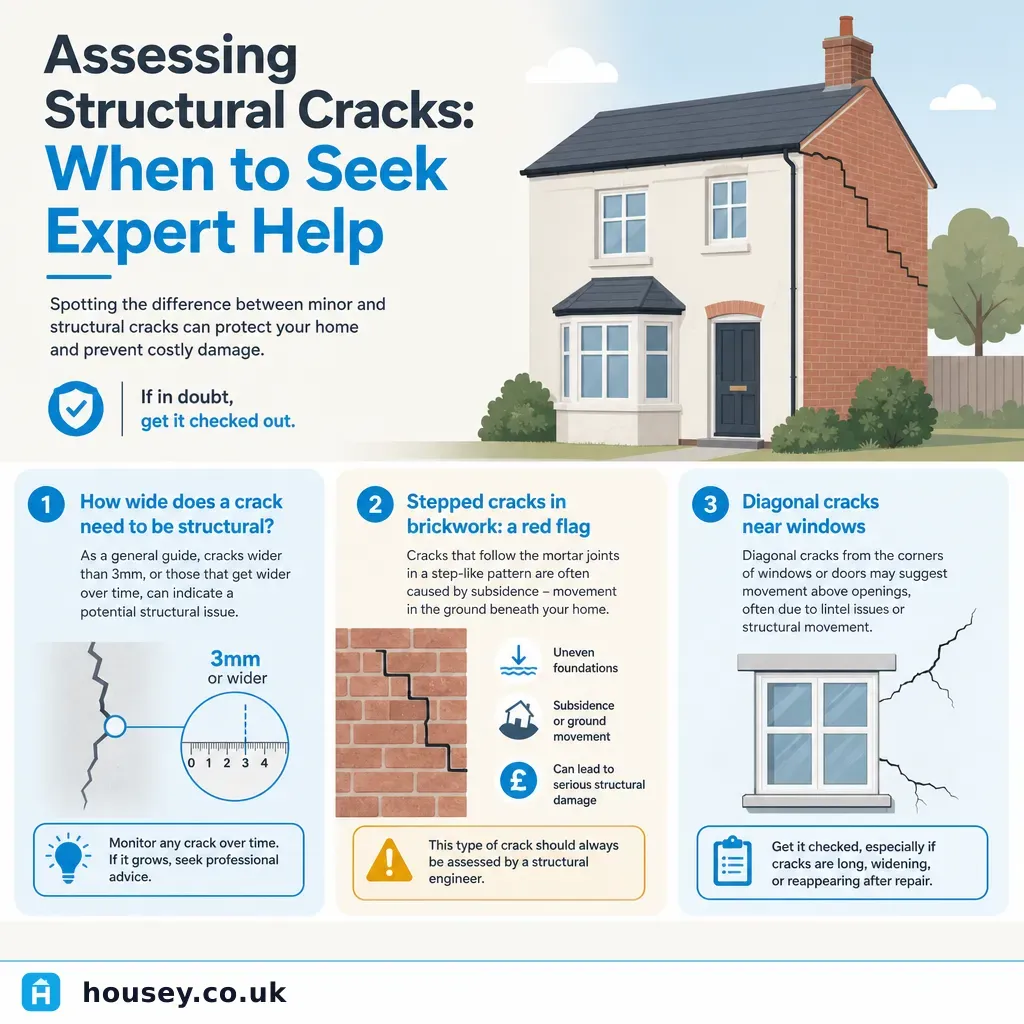
Assessing Structural Cracks: When to Seek Expert Help
Structural cracks range from harmless shrinkage hairlines to signs of subsidence or foundation movement.
 Surveys & Inspections
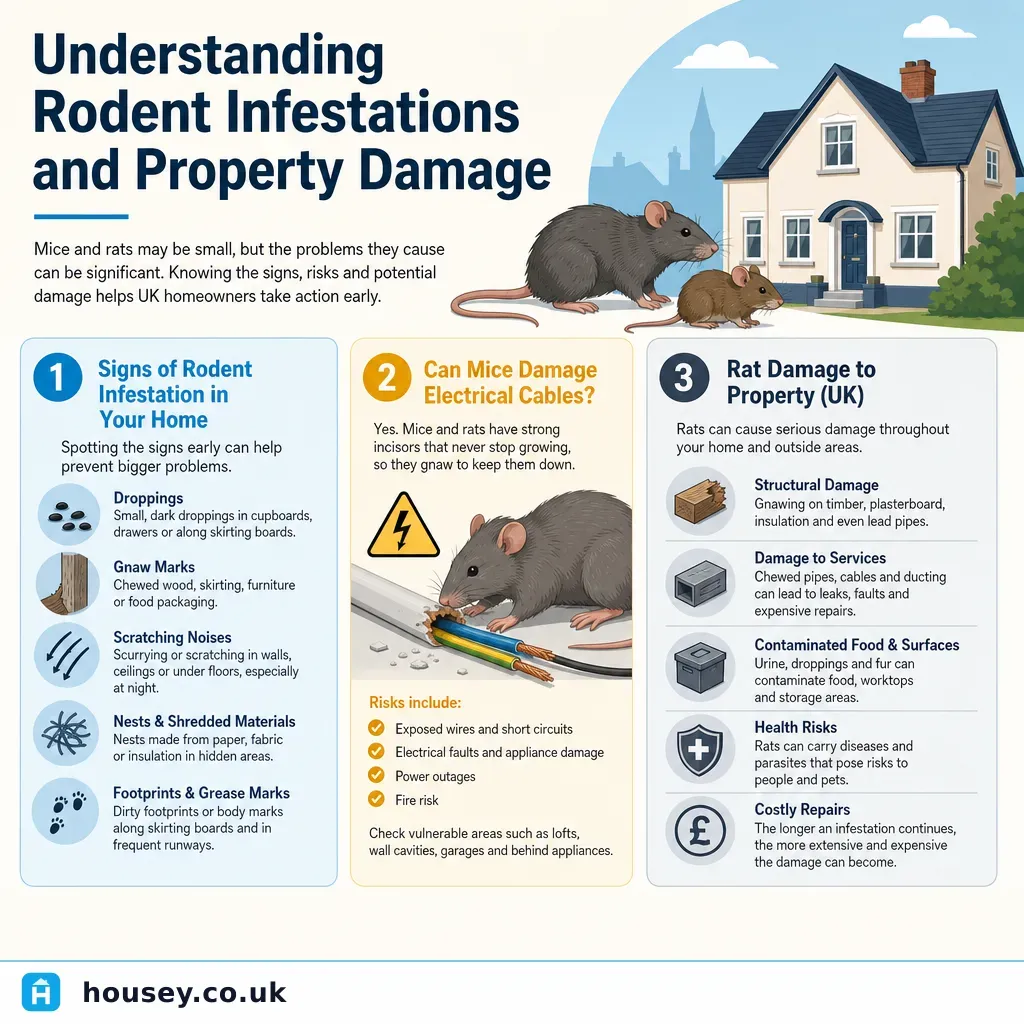
Understanding Rodent Infestations and Property Damage
Rats and mice can cause significant property damage in UK homes, including gnawed electrical cables that create fire risk, damaged pipework causing hidden leaks, and burrowing near foundations in older properties.
 Surveys & Inspections
Managing Property and Contents After Damp Treatment
After damp treatment in a UK home, allow walls to dry fully before re-plastering or decorating — this typically takes six months to two years depending on construction and damp severity.
 Surveys & Inspections
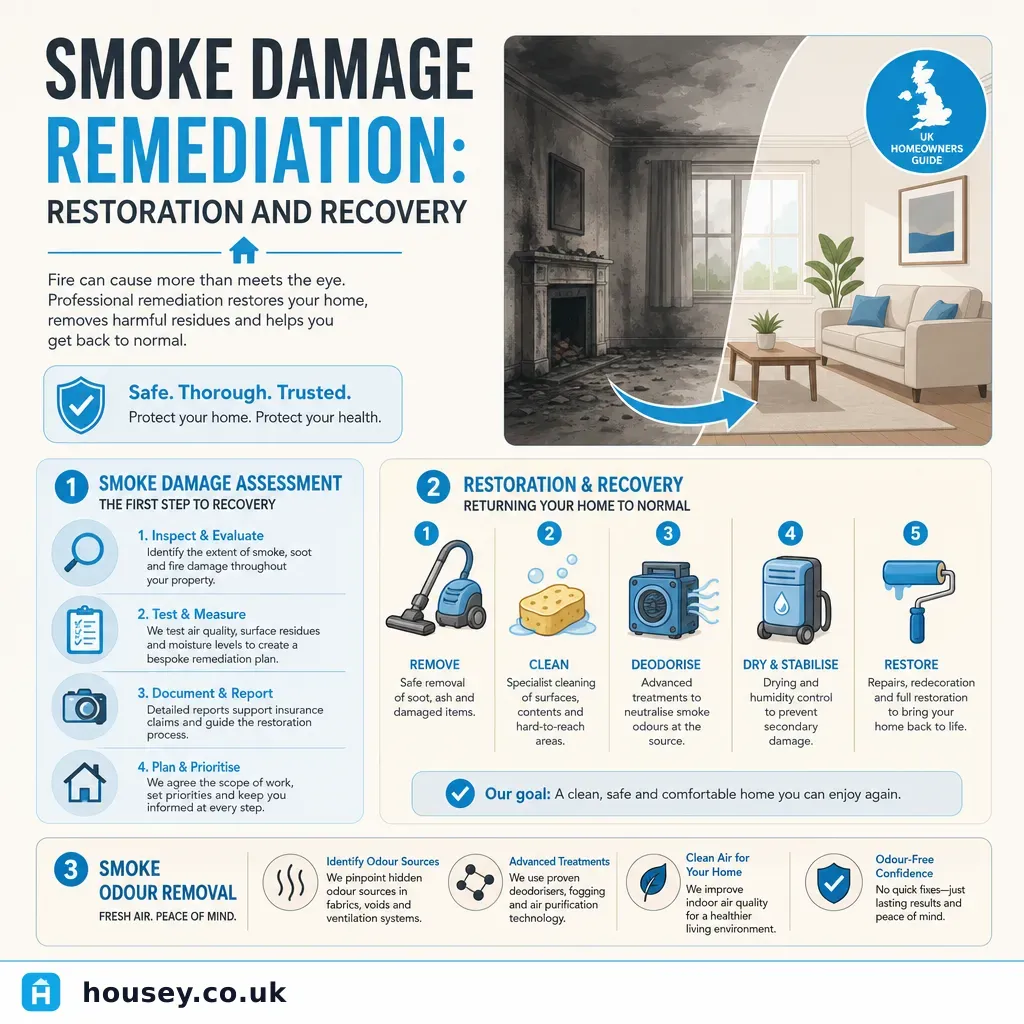
Smoke Damage Remediation: Restoration and Recovery
After a fire or smoke event, professional remediation involves safety assessment, dry cleaning to remove soot, chemical treatment, structural drying, and odour treatment.
 Surveys & Inspections
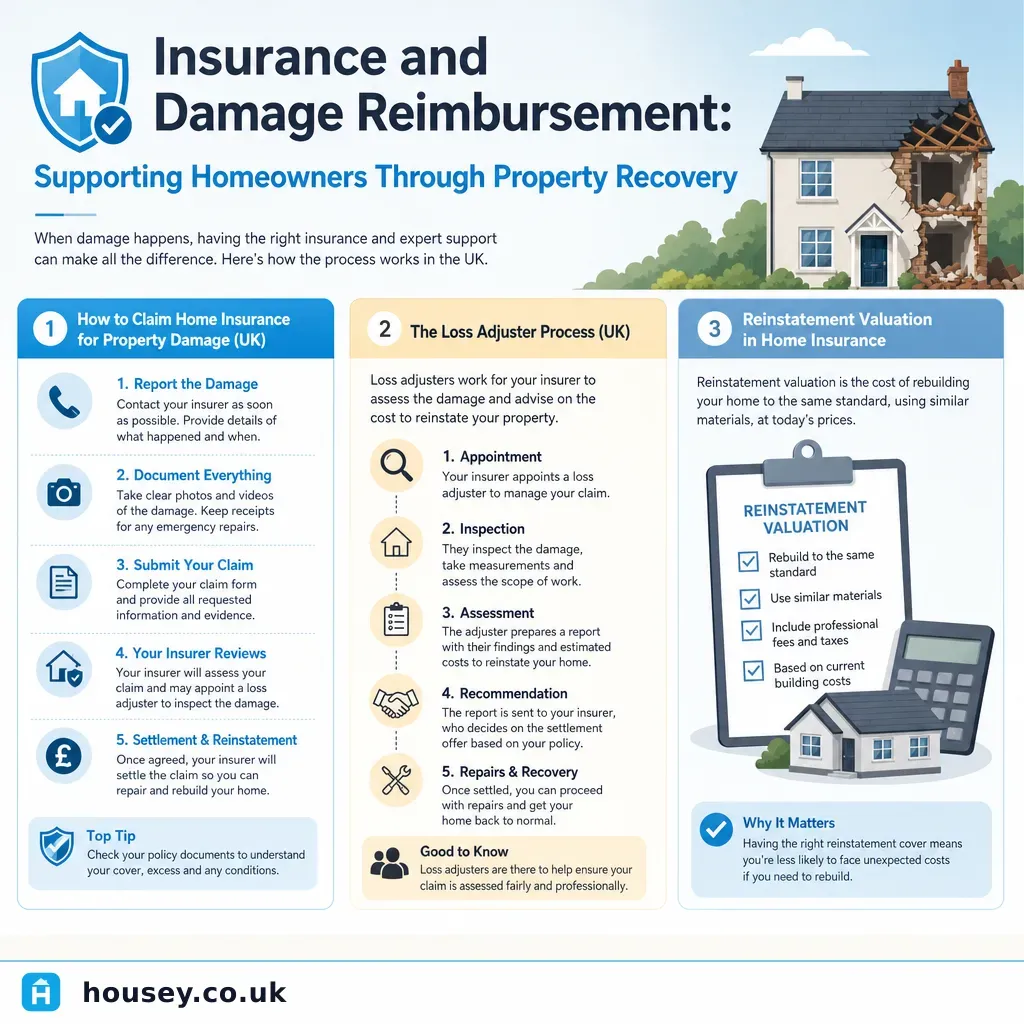
Insurance and Damage Reimbursement: Supporting Homeowners Through Property Recovery
After property damage, your insurer will typically appoint a loss adjuster to assess the claim.