Fire Damage Restoration: Assessing and Reinstating Structures
By Housey · Last reviewed 24th of May 2026
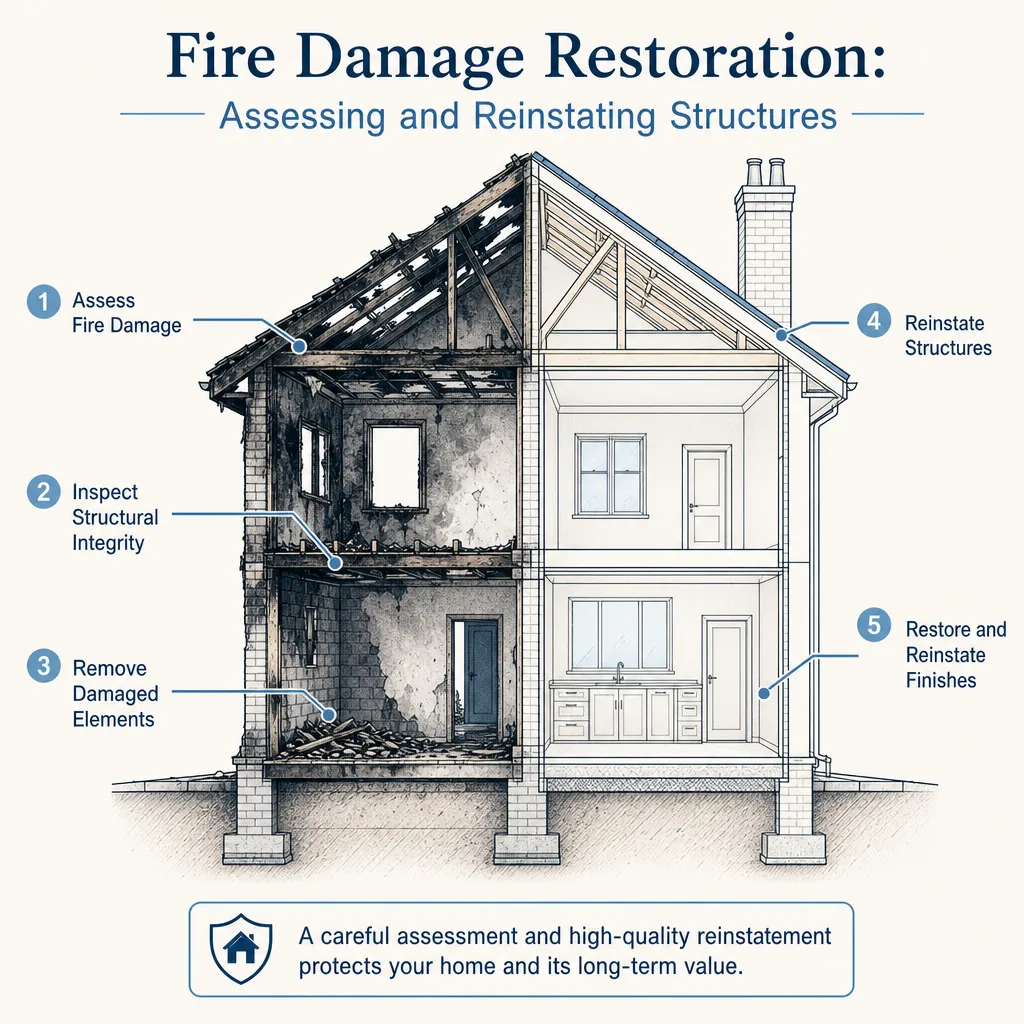
Fire Damage Restoration: Assessing and Reinstating Structures
A structural fire — whether in a Victorian terrace, a 1930s semi, or a leasehold flat — triggers a complex chain of decisions that begins the moment the fire service leaves the scene. Building owners face immediate pressures around safety, habitability, insurance coverage, and whether to restore or demolish. Getting the assessment sequence right determines whether reinstatement is safe, cost-effective, and compliant with current UK Building Regulations — and getting it wrong can mean hidden defects enclosed behind new finishes.
Key points
- Building control must be notified when structural elements are affected by fire — reinstatement work that changes structural performance requires a building control application under the Building Act 1984 and Building Regulations 2010.
- Timber, steel, masonry, and concrete each respond differently to fire and require material-specific assessment methods; a single visual inspection rarely suffices for a complex or multi-element structure.
- Asbestos surveys must be completed before demolition or significant opening-up of any building constructed or substantially altered before the year 2000 — fire may have disturbed asbestos-containing materials, and proceeding without a survey breaches the Control of Asbestos Regulations 2012.
- The Institution of Structural Engineers (IStructE) and RICS publish guidance on post-fire structural assessment; some insurers require a report conforming to one of these frameworks before approving reinstatement costs.
- Reinstatement must meet current Building Regulations, not just the pre-fire standard — this can affect insulation (Part L), fire separation (Part B), and structural performance (Part A), potentially increasing the scope and cost beyond like-for-like replacement.
How fire damages different structural materials
The materials present in a fire-damaged building determine how the structural engineer approaches the assessment and what repair options are available.
Material | Key fire effects | Assessment method | Repair options |
|---|---|---|---|
Timber | Charring at approximately 3 mm per minute; inner core often retains strength | Residual section measurement; charring depth probe | Char removal; replacement of severely affected members |
Structural steel | Softens above ~550 °C; may buckle or twist | Visual inspection and straightness checks; hardness testing for critical members | Flame-straightening if minor distortion; full replacement if buckled |
Reinforced concrete | Spalling; rebar strength loss above 600 °C | Core sampling; phenolphthalein testing; laboratory strength tests | Patch repair, sprayed concrete, jacketing, or demolition |
Brick and block masonry | Mortar degrades; bricks may fracture from thermal shock | Tapping tests; crack mapping; load-bearing assessment | Repointing; partial rebuild; or full demolition |
Cavity and solid walls | Risk of delamination between wall leaves | Borescope inspection; wall-tie assessment | Wall-tie replacement; partial or full rebuild |
Indicative guidance only. A structural engineer must assess each element on site.
The reinstatement assessment sequence
An efficient reinstatement project follows a defined sequence. Skipping steps — often under insurance-claim pressure — increases the risk of hidden defects being enclosed by new finishes.
Step 1 — Immediate site safety
Fire service sign-off is required before re-entry. For severe fires affecting load-bearing elements, building control may attend to assess stability. If the structure is at risk of partial collapse, temporary propping should be arranged by a structural engineer before any investigation or demolition work begins.
Step 2 — Structural engineer appointment
Appoint a chartered structural engineer (MIStructE or CEng-registered) as early as possible. Their role is to produce an assessment report, specify reinstatement works, and liaise with building control. This is distinct from — and more detailed than — a loss adjuster's visit on behalf of the insurer.
Step 3 — Investigation and testing
Depending on the structure, investigation may include opening up wall cavities and floor voids, taking material samples for laboratory analysis, checking roof structures for rafter or truss damage, and surveying for secondary damage such as water ingress from firefighting operations.
Step 4 — Demolition of irreparable elements
Elements confirmed as beyond repair are carefully demolished — usually in a controlled sequence to avoid overloading adjacent structure. Waste from fire-damaged materials should be managed in line with Environment Agency guidance. An asbestos refurbishment survey must be completed before demolition of any pre-2000 structure.
Step 5 — Reinstatement specification
The structural engineer issues a Schedule of Works and, where required, structural drawings for building control approval. Works must comply with current Building Regulations, which may require improvements beyond like-for-like reinstatement.
Step 6 — Construction and sign-off
Work is carried out by a suitably qualified contractor. Building control inspections at key stages are required. A completion certificate is issued on satisfactory final inspection.
Which professional do I need?
Decision tree for fire-damaged property
- Choose a chartered structural engineer if any load-bearing wall, column, beam, floor, or roof structure was directly exposed to flames or intense heat — even if it appears outwardly intact.
- Choose a fire risk assessor if the building contains multiple dwellings or is a commercial property, where a fire risk assessment is required before reoccupation under the Regulatory Reform (Fire Safety) Order 2005.
- Choose an independent loss adjuster (not the insurer's own appointee) if the claim is significant and you want independent representation throughout the reinstatement process.
- Call an asbestos surveyor if the building was constructed or substantially altered before 2000 — fire may have disturbed asbestos-containing materials, and demolition without a refurbishment asbestos survey is unlawful under the Control of Asbestos Regulations 2012.
- Notify building control if any structural element is to be replaced or altered, or if fire separation, means of escape, or energy performance has been affected.
- Appoint a principal designer under CDM Regulations 2015 if the reinstatement project involves more than one contractor working simultaneously or sequentially on the site.
Homeowner reinstatement checklist
Before reinstatement begins, confirm that you have:
Important limitations
This guide describes general reinstatement principles used in UK practice. Every fire and every building is different: fire duration, materials affected, building age, tenure (leasehold or freehold), listed building status, and conservation area designation all affect what is required and what is permitted. Nothing in this article constitutes professional structural, legal, or insurance advice. A qualified structural engineer and, where applicable, a solicitor or specialist insurance adviser should be engaged for your specific situation.
When to get professional help
Structural reinstatement after fire is not a DIY project. Engage a chartered structural engineer before any structural work begins. Seek immediate professional advice if:
- Any wall, column, or beam shows visible lean, distortion, or cracking following the fire
- The building is multi-storey and a floor structure or staircase was affected
- Firefighting water has saturated floor voids or cavity walls, creating risk of hidden decay in structural timbers or weakened masonry
- The insurer's loss adjuster has proposed a reinstatement scope that differs significantly from your own understanding of the damage
- The property is listed (Grade I, II*, or II) — Historic England involvement and listed building consent may be required for reinstatement works
What to ask a qualified professional
- Are you a chartered member of IStructE or RICS with experience in post-fire structural assessments?
- Will you produce a written report covering all structural elements, not just those visibly affected?
- Will you specify the reinstatement works in sufficient detail for a building control application and contractor tendering?
- Can you advise on whether current Building Regulations require improvements beyond like-for-like reinstatement?
- Will you attend site during key stages of reconstruction to verify compliance with your specification?
- Do I need to appoint a principal designer under CDM Regulations 2015 for this project?
How Housey can help
Housey makes it straightforward to find and compare structural engineers and fire risk assessors qualified for post-fire reinstatement work. Use our structural surveys service to get quotes from vetted local structural engineers, or our fire risk assessments service for properties where a formal fire risk assessment is required before reoccupation.
Frequently asked questions
Do I need building control approval to reinstate a fire-damaged building?
In most cases, yes — where load-bearing elements have been damaged and replaced, or where fire separation, means of escape, or energy performance is affected. Under the Building Act 1984 and Building Regulations 2010, material alterations require building control approval. Contact your local authority building control department or an Approved Inspector for pre-application advice specific to your building.
Can I use the original structural drawings from before the fire?
Original drawings are useful as a reference, but reinstatement must comply with current Building Regulations, which may require improvements beyond the pre-fire standard — particularly for energy efficiency (Part L), fire safety (Part B), and structural performance (Part A). A structural engineer can advise on what changes are required for your specific building and situation.
How long does fire damage reinstatement typically take?
This varies enormously with extent of damage. Minor fire damage in a single room may take weeks; a major structural fire affecting multiple floors of a Victorian terrace could take 12–24 months. Assessment, specification, building control approval, contractor procurement, and construction each add time. Insurance claim resolution often runs in parallel and can cause delays if disputes arise.
Is reinstatement work after a fire subject to VAT?
Reinstatement of a fire-damaged residential property may attract reduced VAT at 5% in some circumstances, though 20% can apply depending on the works and building status. VAT treatment is complex. Seek advice from an accountant or HMRC for your situation, and check your insurance policy wording regarding how VAT is handled within the settlement.
Sources and further reading
- Building Regulations Approved Documents — GOV.UK
- Guidance on structural fire assessment — Institution of Structural Engineers
- Regulatory Reform (Fire Safety) Order 2005 — legislation.gov.uk
- Construction Design and Management Regulations 2015 — Health and Safety Executive
- Control of Asbestos Regulations 2012 — Health and Safety Executive
Useful next reads
 Surveys & Inspections
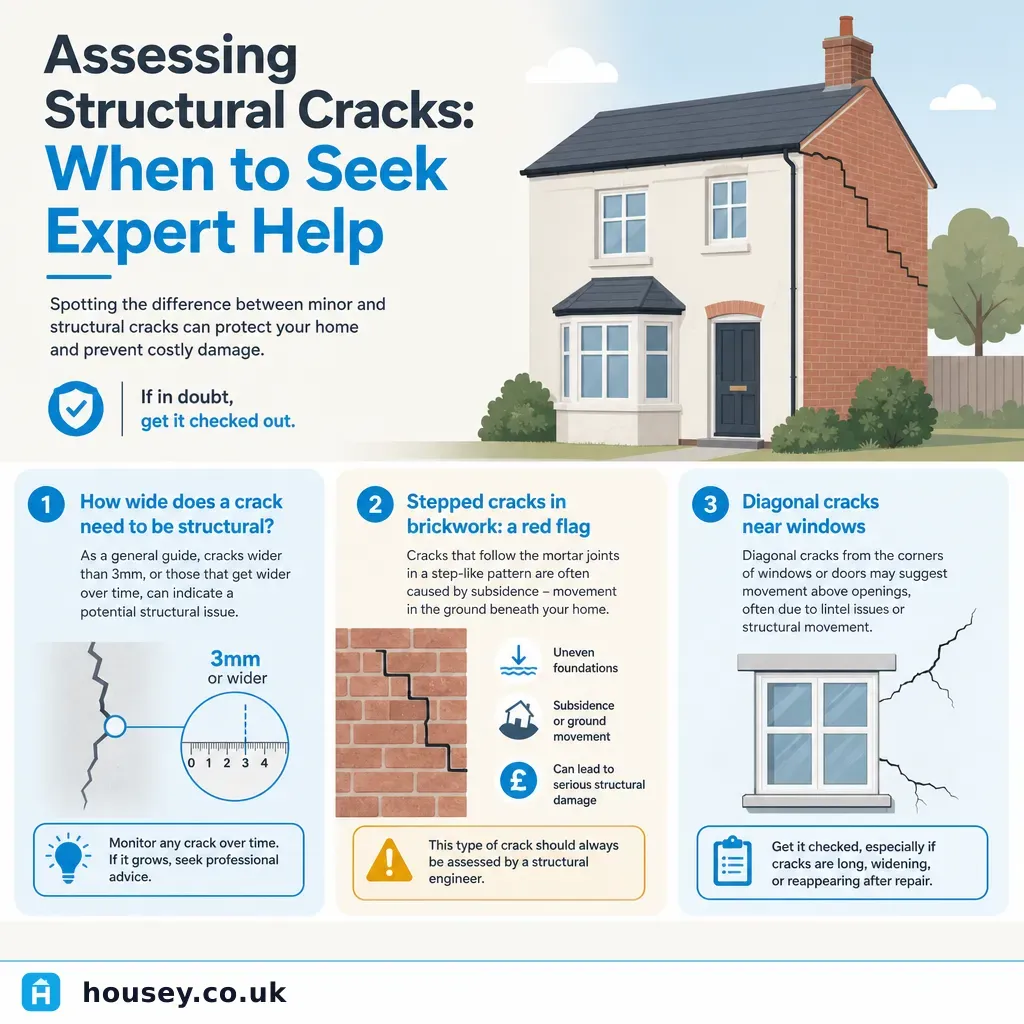
Assessing Structural Cracks: When to Seek Expert Help
Structural cracks range from harmless shrinkage hairlines to signs of subsidence or foundation movement.
 Surveys & Inspections
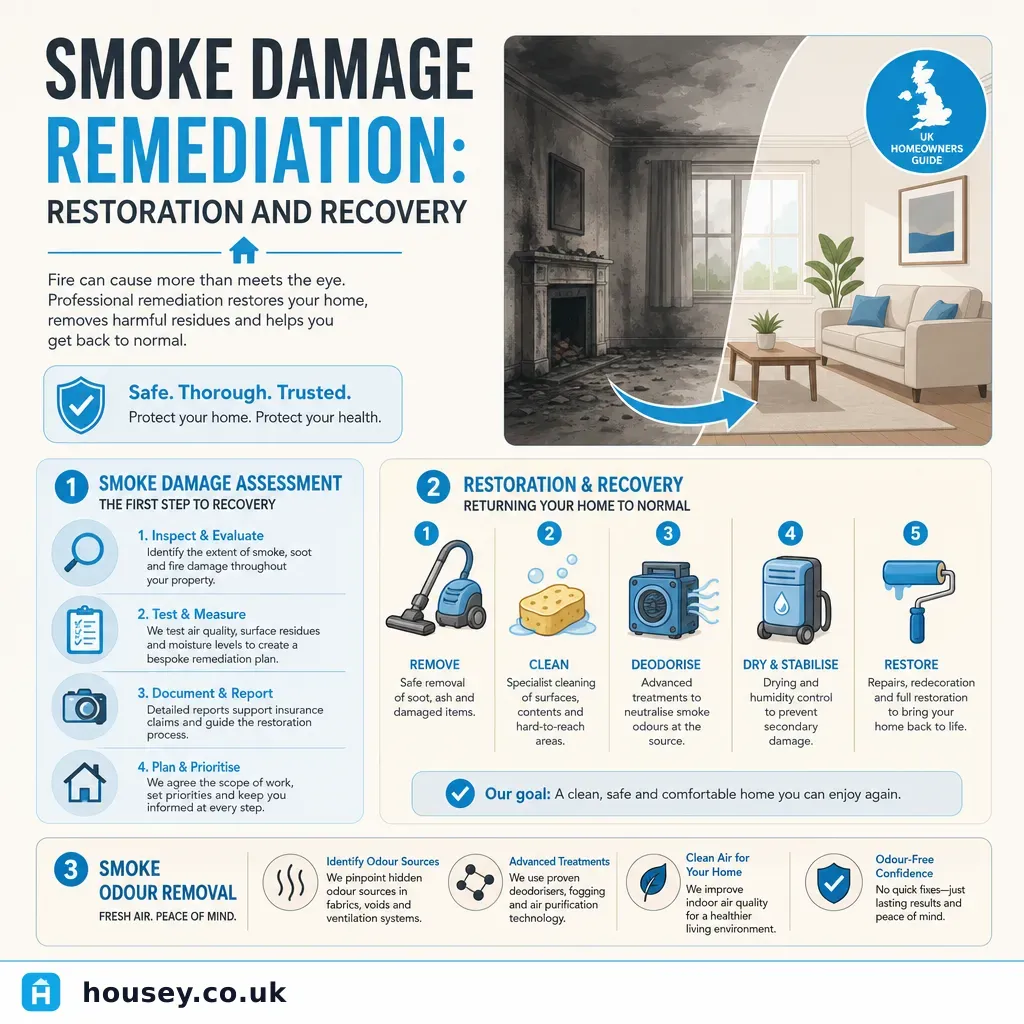
Smoke Damage Remediation: Restoration and Recovery
After a fire or smoke event, professional remediation involves safety assessment, dry cleaning to remove soot, chemical treatment, structural drying, and odour treatment.
 Surveys & Inspections
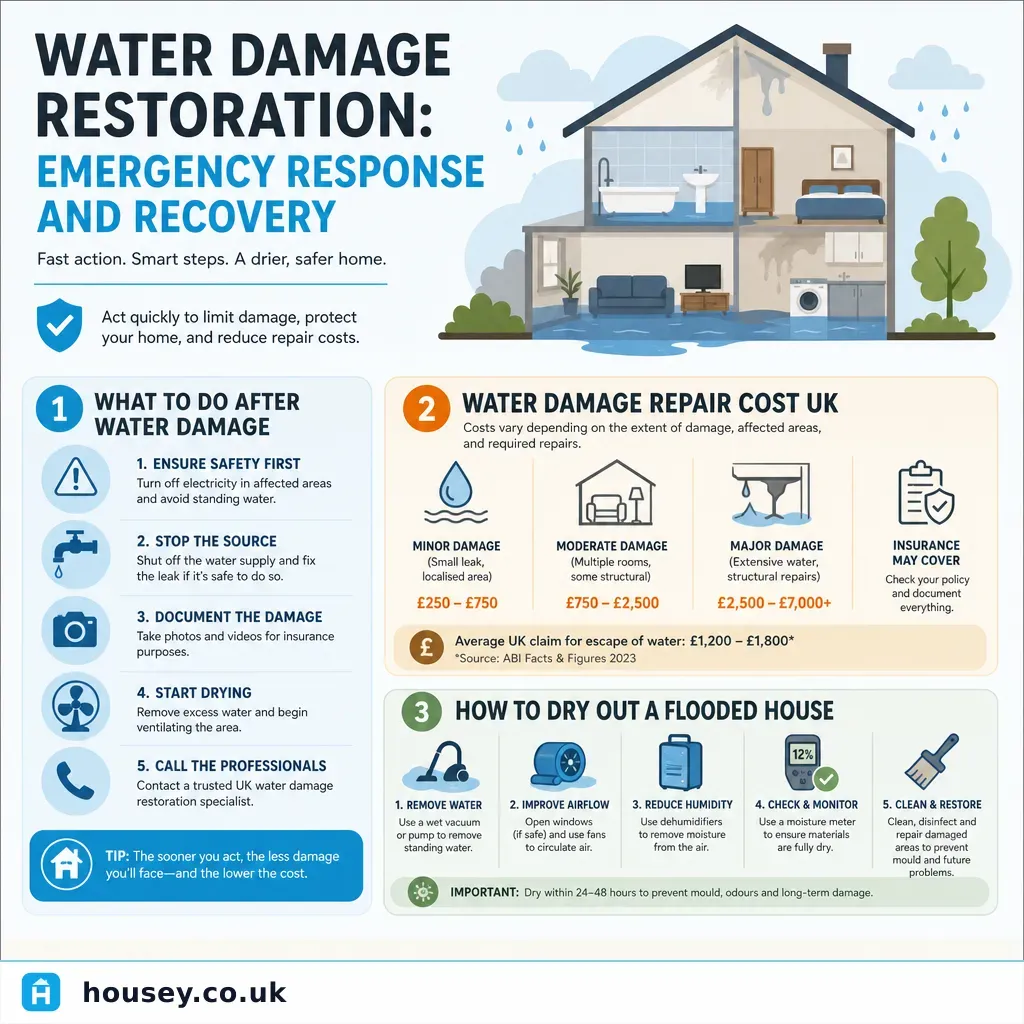
Water Damage Restoration: Emergency Response and Recovery
After a water event, act within hours: stop the water source, switch off electricity if safe, photograph the damage, and contact your insurer promptly.
 Surveys & Inspections
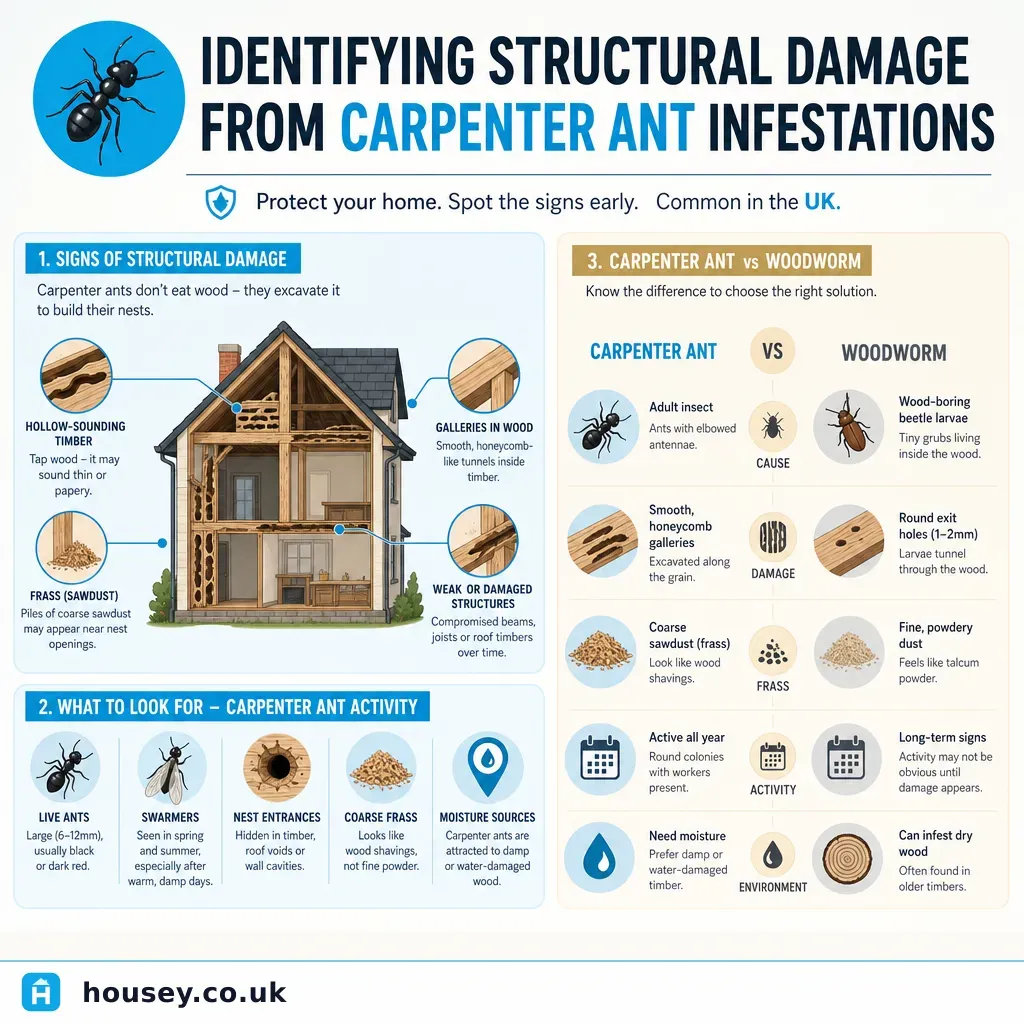
Identifying Structural Damage from Carpenter Ant Infestations
Carpenter ants excavate galleries in damp or decayed timber, leaving coarse frass and smooth, clean channels distinct from woodworm's fine bore dust and round exit holes.
 Surveys & Inspections
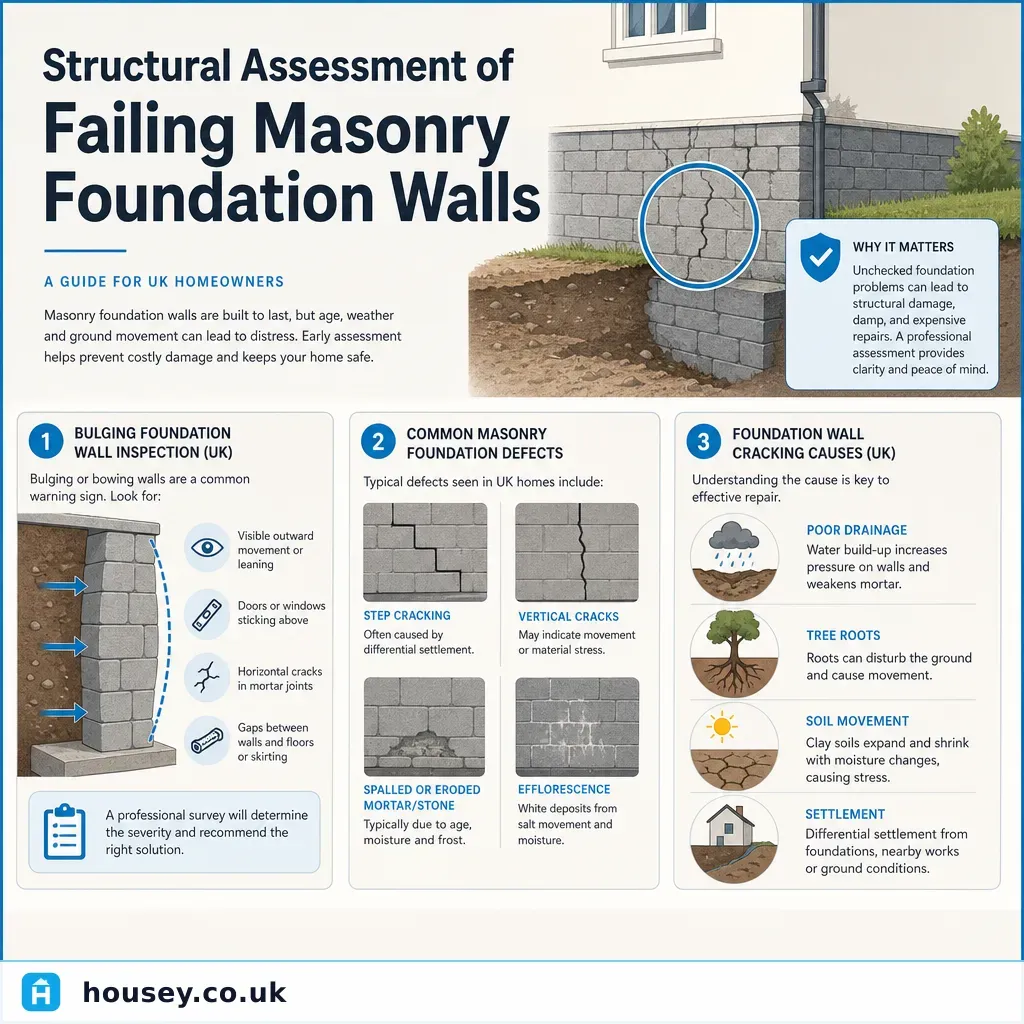
Structural Assessment of Failing Masonry Foundation Walls
Failing masonry foundation walls — showing bulging, progressive cracking, or outward movement — require assessment by a chartered structural engineer or RICS Level 3 surveyor.