Understanding Cracks in Plaster Walls: Causes and When to Worry
By Housey · Last reviewed 19th of May 2026
Understanding Cracks in Plaster Walls: Causes and When to Worry
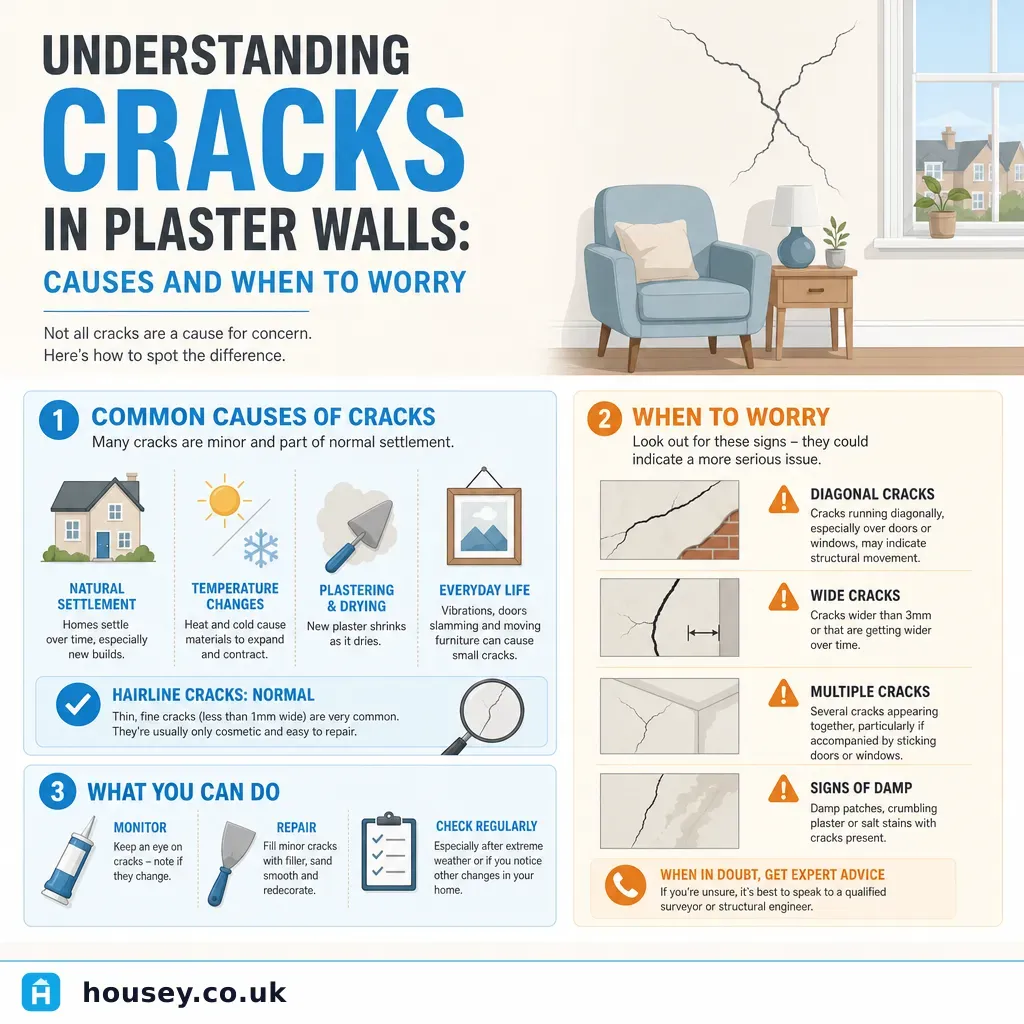
Cracks in plaster walls are one of the most common — and commonly misread — features in UK homes. The overwhelming majority are cosmetic, caused by seasonal shrinkage or minor settlement that occurs over decades in virtually every property. But a small proportion signal active movement that, left unassessed, can escalate into significant structural repair. Distinguishing between the two, and knowing when to call a professional, is one of the most practically valuable things a homeowner or buyer can understand about their property.
Key points
- BRE Digest 251 classifies crack severity in buildings on a 0–5 scale; categories 0–2 (hairline to around 5 mm) are generally cosmetic or minor, while categories 3–5 (5 mm and above) indicate increasing structural concern.
- Diagonal cracks running from the corners of door or window openings are one of the most reliable early indicators of differential settlement in a building.
- Stepped cracks tracking through brick mortar joints — rather than through the bricks or blocks themselves — typically indicate wall movement rather than thermal expansion.
- Tapered cracks that are noticeably wider at one end, particularly when combined with sticking doors or windows, suggest active ongoing movement rather than historic, stable settlement.
- A RICS Level 3 Building Survey or a specific defect survey by a chartered surveyor is the appropriate professional response when the cause or progression of a crack is uncertain.
What type of crack is it? A classification guide
Not all cracks carry the same significance. Width, orientation, location, and pattern each tell a different story.
Hairline cracks (under 0.2 mm)
Almost always cosmetic. Common causes include drying shrinkage in new plaster or render, seasonal thermal expansion and contraction of plaster and its substrate, and very minor settlement in the early years after construction. These appear on most UK homes, particularly at ceiling-to-wall junctions, internal corners, and around window reveals. No remedial action beyond routine redecoration is usually required.
Fine to moderate cracks (0.2 mm–5 mm) — BRE categories 1–2
Generally cosmetic but worth monitoring. May indicate ongoing thermal movement, slight differential settlement that has stabilised, or inadequate plaster bond in a localised area. The critical question is whether the crack is historic and stable, or active and still growing. Marking the crack ends with pencil and the date, then re-checking monthly, is a simple way to establish this before commissioning a survey.
Larger cracks (5 mm+) — BRE categories 3–5
These require professional assessment without delay. At 5 mm and above, cracks may indicate structural failure in a wall, lintel, or foundation; significant subsidence or heave on clay soils; or failure of cavity wall ties in post-1930s brick construction. Do not fill and redecorate large cracks before establishing the cause — masking active movement prolongs the underlying problem and may complicate insurance claims.
Common causes of cracks in plaster walls
Cause | Typical crack pattern | Usually found in | Risk level |
|---|---|---|---|
Thermal movement (seasonal) | Fine horizontal or vertical lines near ceiling | All property types | Low — cosmetic |
Drying shrinkage (new plaster or new build) | Random fine lines or map cracking | New builds, recently replastered walls | Low — cosmetic |
Minor settlement (historic, stable) | Diagonal from window or door corners | Victorian and Edwardian terraces | Low if stable |
Differential settlement (active) | Diagonal, tapered, widening | Properties on clay soil, near large trees | Heightened |
Subsidence (foundation movement) | Large diagonal or stepped; door and window binding | Clay soils near large trees | High |
Heave (soil expansion after drought) | Horizontal near floor level; floors lifting | Clay soils in drought recovery areas | High |
Cavity wall tie failure | Horizontal cracks at regular 450 mm intervals | 1930–1990s cavity brick homes | Moderate to high |
Lintel failure above an opening | Downward diagonal from window or door corners | Any age; corroded steel lintels | Moderate to high |
Damp-related plaster failure | Powdery, flaking, bulging plaster | Solid-wall homes, basement walls | Low structurally but indicates damp |
Decision tree: do I need a professional assessment?
- Crack is under 1 mm, stable, and not growing? Monitor for 3–6 months; redecorate if it remains stable.
- Crack is 1–5 mm and diagonal from a window or door corner? Mark the ends with pencil and date; re-check monthly. If it grows, instruct a RICS-qualified surveyor.
- Crack is 5 mm or wider? Instruct a chartered surveyor or structural engineer promptly.
- Crack is accompanied by sticking doors or windows? Seek professional assessment — this combination suggests active structural movement.
- Buying a property with visible cracks? Commission a RICS Level 3 Building Survey; raise any concerns at survey stage, not after exchange.
- Horizontal cracks at regular intervals on an external wall? Cavity wall tie failure is possible; commission a specific defect survey or RICS inspection.
- Bulging, powdery, or detaching plaster? Likely damp-related plaster failure; commission a damp and timber survey.
Important limitations
This article is general information only. Crack assessment requires direct inspection of the property, its construction type, age, soil conditions, and surrounding context. Causes and significance vary considerably between a 1900s solid-brick terrace, a 1960s cavity-construction semi, and a modern lightweight-frame new build. Nothing in this guide constitutes structural, surveying, or legal advice. A qualified professional should assess any crack that concerns you.
When this becomes urgent
Stop deferring and instruct a professional immediately if:
- A crack has visibly widened over days or weeks.
- Doors or windows have recently started sticking or binding with no obvious explanation.
- You can see daylight or feel a draught through a crack in an external wall.
- Plaster is detaching in large sections or a wall sounds hollow when tapped across a wide area.
- You notice new floor slopes or level changes that were not present before.
- The property is near large trees on clay soil and has never had a structural survey.
What to ask a qualified professional
Before instructing a chartered surveyor, structural engineer, or specific defect inspector:
- Are you a Chartered Surveyor (MRICS or FRICS) or a chartered structural engineer (MIStructE)?
- What type of survey or inspection do you recommend for the symptoms I have described?
- Will your report identify the likely cause of the cracking, or will it only describe what is visible?
- If movement appears active, what monitoring period would you recommend?
- Will the report include recommendations for remedial work and an indication of likely cost?
- Is there anything about this property's age, construction, or soil type that affects your assessment approach?
When to get professional help
Commission a structural survey or specific defect survey for any crack that is 5 mm or wider, accompanied by sticking doors or windows, or that appears to be growing over weeks or months. For cracks associated with damp, salt staining, or detaching plaster, a damp and timber survey can establish whether moisture is contributing to plaster failure.
Red flags that require immediate professional attention:
- Stepped cracks tracking through mortar joints on an external wall.
- Tapered diagonal cracks noticeably wider at one end.
- Horizontal cracks at regular 450 mm intervals on a cavity-construction wall (possible cavity wall tie failure).
- Any crack in a retaining wall, basement wall, or load-bearing chimney breast.
How Housey can help
Housey connects UK homeowners and buyers with qualified professionals for structural surveys, specific defect surveys, and damp and timber surveys. Whether you have spotted a crack before exchange or noticed new movement in a property you have owned for years, the right survey replaces guesswork with an evidence-based assessment.
Frequently asked questions
Are cracks in a new-build normal?
Minor hairline cracks in new-build plaster are common in the first one to two years, usually caused by drying shrinkage as the structure settles. They should be fine rather than tapered and should not recur after redecoration. NHBC Buildmark warranty coverage includes cosmetic defects in the first two years; report any recurring or widening cracks to the developer formally during this period.
What is the BRE Digest 251 crack classification system?
BRE Digest 251 classifies cracking in buildings on a 0–5 scale: category 0 (hairline, under 0.1 mm) through to category 5 (very severe, over 25 mm — structural instability likely). The system was designed to assess damage from ground movement and is now widely used by surveyors and structural engineers to communicate crack severity in a consistent, standardised way.
Can I simply fill and paint over a crack?
For stable hairline or fine cracks up to 1 mm, filling and redecorating is entirely reasonable. For larger or active cracks, filling before understanding the cause masks worsening movement, delays diagnosis, and may create difficulties with home insurance claims if the underlying cause was present and discoverable. Always confirm a crack is stable before decorating over it.
How do I monitor a crack at home without professional equipment?
Mark the ends of the crack with pencil and note the date. Record the width at the widest point. Re-check every four to six weeks over a full year — seasonal movement can cause apparent changes in winter and summer. If the crack grows beyond your original marks, or the width increases materially, instruct a professional. Proprietary tell-tales (plastic gauge slips adhered across the crack) give more precise monitoring.
Sources and further reading
- BRE Digest 251: Assessment of damage in low-rise buildings — BRE Group
- RICS Home Survey Level 3 — RICS
- Subsidence: guidance for homeowners — Association of British Insurers
- Structural integrity in construction — HSE
- Cavity wall tie failure: guidance for homeowners — Property Care Association
Useful next reads
 Surveys & Inspections
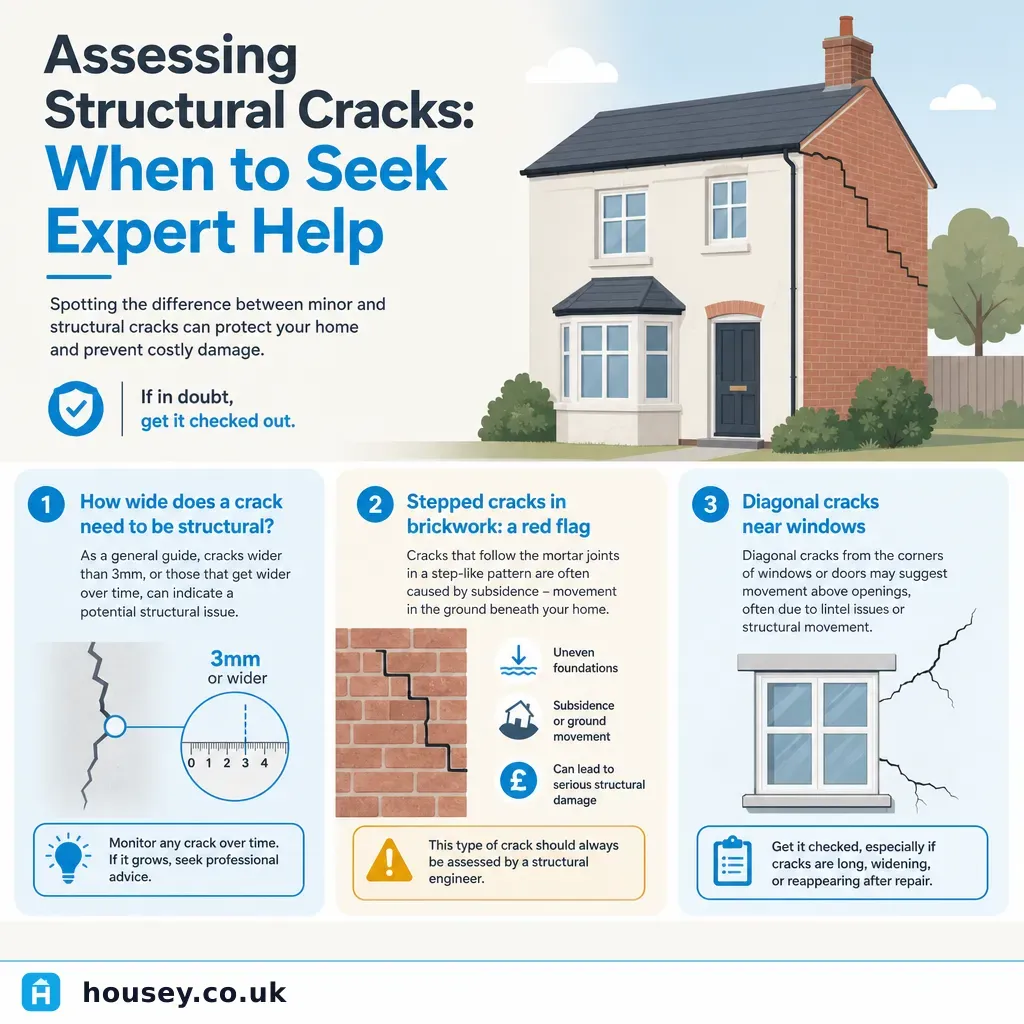
Assessing Structural Cracks: When to Seek Expert Help
Structural cracks range from harmless shrinkage hairlines to signs of subsidence or foundation movement.
 Surveys & Inspections
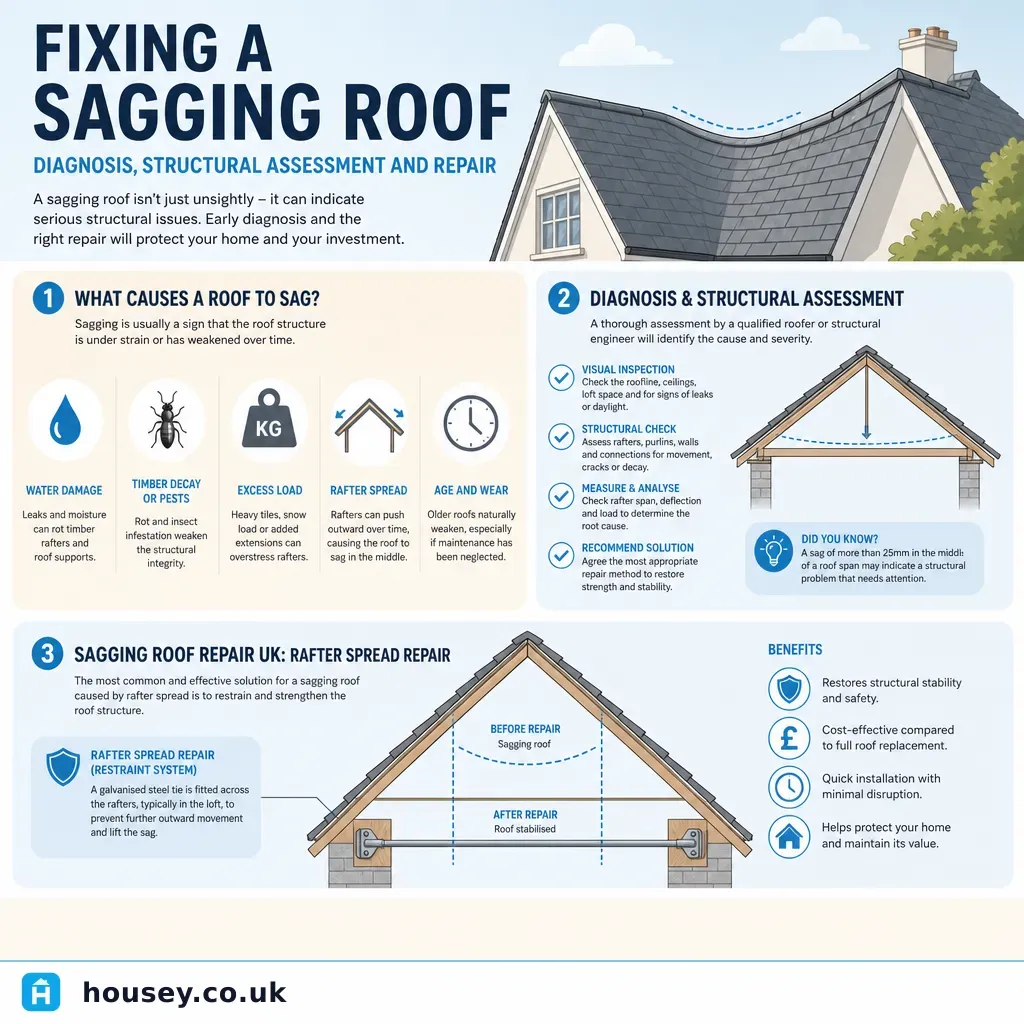
Fixing a Sagging Roof: Diagnosis, Structural Assessment and Repair
A sagging roof usually points to failed or overloaded roof timbers, rafter spread, or a compromised ridge board.
 Surveys & Inspections
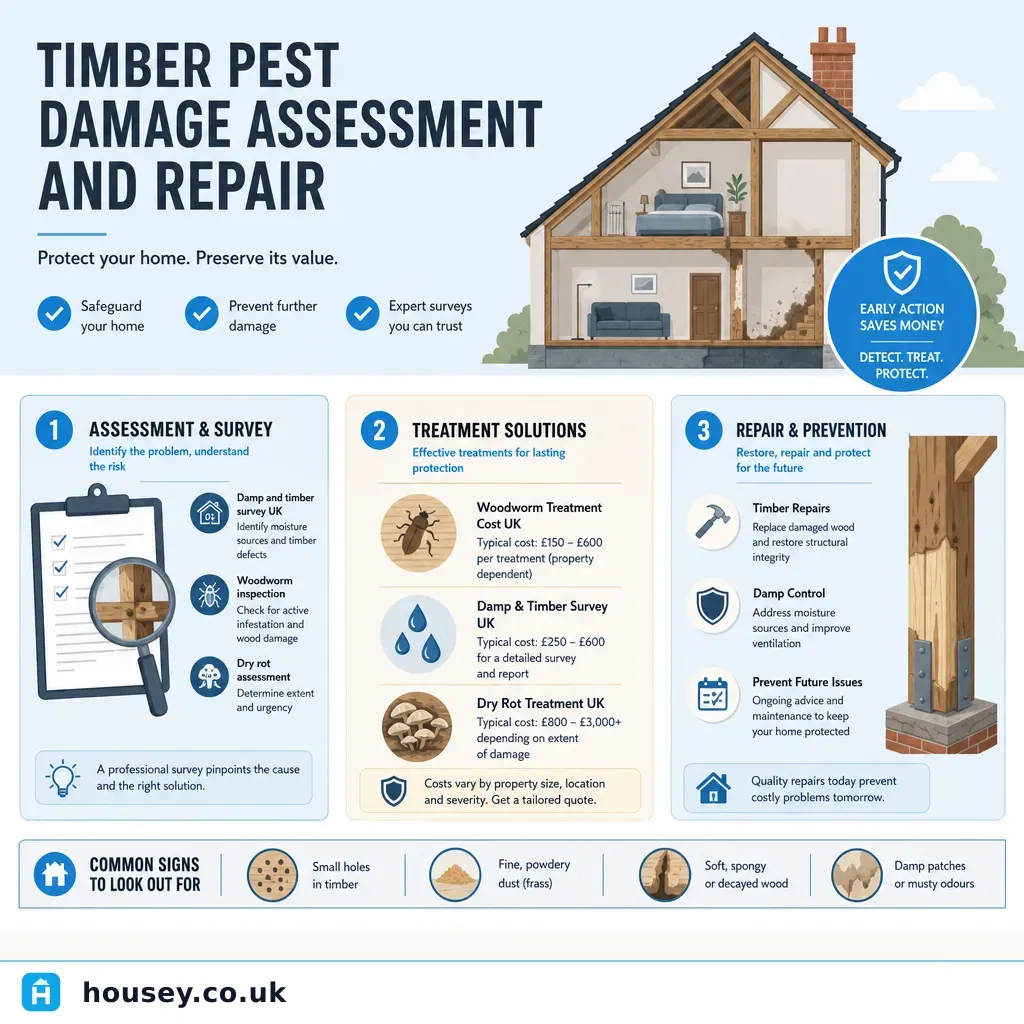
Timber Pest Damage Assessment and Repair
Timber pest damage in UK homes is most commonly caused by Common Furniture Beetle (woodworm), Death Watch Beetle, or fungal decay such as dry rot.
 Surveys & Inspections
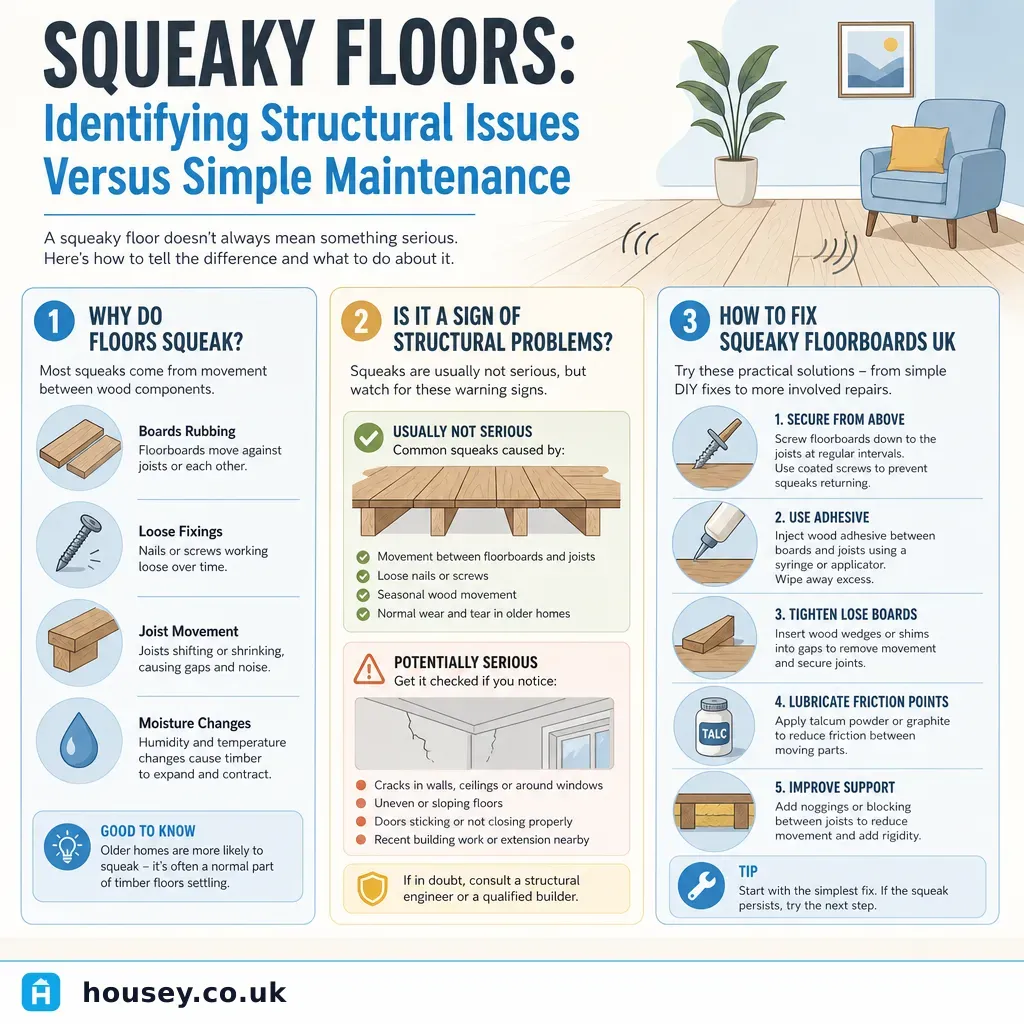
Squeaky Floors: Identifying Structural Issues Versus Simple Maintenance
Most squeaky floors in UK homes are caused by floorboards rubbing against each other or against fixings as they expand and contract — a maintenance issue rather than a structural one.
 Surveys & Inspections
Understanding Property Surveys: Types and When You Need Them
The three main RICS survey types are the Level 1 Condition Report (for standard properties in good condition), the Level 2 Home Survey (conventional homes in reasonable condition), and the Level 3 Building Survey (older, unusual, or defective properties).