Assessing Suitability for Loft Conversion
By Housey · Last reviewed 11th of May 2026
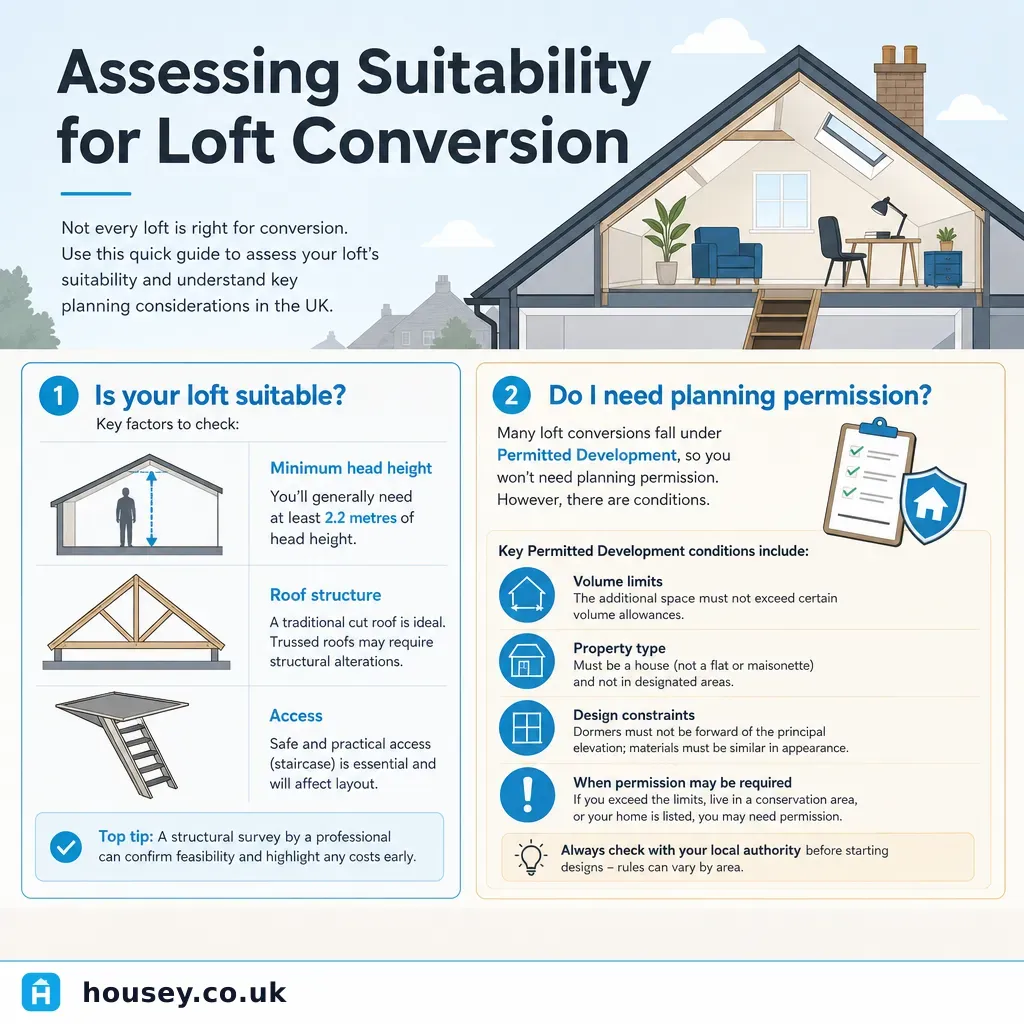
Assessing Suitability for Loft Conversion
Adding a loft conversion is one of the most popular ways UK homeowners gain space without relocating, but not every roof space is straightforwardly convertible. The combination of head height, roof construction type, planning context, and building regulations requirements means that what looks promising from the hatch can still require significant engineering — or turn out to be unworkable without a substantial structural intervention. Understanding these factors before commissioning drawings can save considerable abortive professional cost.
Key points
- The widely used head height benchmark for a loft conversion is 2.2 metres measured from the existing floor joists to the underside of the ridge board — conversions may be achievable with less using a dormer or raised ridge, but the structural and cost profile changes.
- Most loft conversions in England fall within permitted development rights under the Town and Country Planning (General Permitted Development) (England) Order 2015, subject to volume limits: 40 cubic metres of additional roof space for terraced houses and 50 cubic metres for detached and semi-detached.
- Building Regulations approval is mandatory for every loft conversion, covering structural integrity, fire safety and means of escape, thermal performance (Part L), and minimum stair dimensions.
- Homes built after approximately 1965 are more likely to have prefabricated trussed-rafter roofs — these require complete structural replacement, which is more complex and expensive than converting a traditional cut-timber roof.
- A party wall notice must be served on adjoining owners before any work on or near the separating wall in a terraced or semi-detached property under the Party Wall etc. Act 1996.
Is my loft tall enough?
The 2.2 m ridge-to-floor benchmark is a practical guideline rather than a statutory minimum, but conversions below this level become harder to use habitually and more expensive to make workable. Measure from the top surface of the existing loft floor joists — not the ceiling of the room below — to the underside of the ridge board.
Ridge height is not the only dimension that matters:
- Usable floor area is determined by where the roof slope reduces headroom below approximately 1.5 m — the area within that envelope is the practical floor plan.
- Pitch angle affects how quickly the slope drops: a 40° pitch gives more usable area than a 30° pitch at the same ridge height.
- Floor joist capacity matters independently of headroom: most loft floor joists are sized for storage loads only and will need upgrading to carry habitable room loads (typically 1.5 kN/m² as a minimum under BS 6399) regardless of head height.
Roof construction: cut timber versus trussed rafter
The construction type of your roof significantly affects the conversion route, programme, and cost.
Roof type | How to identify | Conversion approach | Relative complexity |
|---|---|---|---|
Cut-timber (traditional) | Individual rafters, purlins, and ridge board — open centre with visible timber framing | Remove or modify internal timbers; introduce structural steelwork designed by an engineer | Generally more straightforward and lower cost |
Trussed rafter (prefabricated) | W-shaped or Fink trusses at regular centres — no usable central void | Trusses must be replaced entirely with a structural steel or engineered timber frame | Higher cost; structural engineer essential |
Flat roof section | Horizontal or near-horizontal covering over part of property | Standard loft conversion not applicable; separate dormer or roof terrace design needed | Case by case |
If in doubt about which type you have, access the hatch and look at the roof structure. A structural engineer or experienced loft conversion specialist can confirm the construction and advise on the most appropriate approach.
Which conversion type suits my roof?
Decision framework
- Choose a Velux or roof-light conversion if: ridge height is 2.2 m or above, the roof is cut-timber construction with a suitable pitch, and you want the most cost-effective route with the lowest planning risk — no external structure is added and the roof silhouette is unchanged.
- Choose a rear dormer if: head height is marginal (1.9–2.2 m) or you need additional floor area beyond what the existing pitch allows; rear dormers are generally within permitted development limits for most house types.
- Choose a hip-to-gable conversion if: your property has a hipped end (common in 1930s–1950s semi-detached and detached houses) and you want to maximise internal volume; usually permitted development on semi-detached and detached houses but not normally on terraces.
- Choose a mansard conversion if: maximum floor area is the priority and you are prepared to apply for planning permission; a mansard has a near-vertical rear slope and shallow-pitched top and typically provides the greatest increase in habitable space.
- Consult your local planning authority first if: the property is listed, in a conservation area, or any prior extensions may have used some of the permitted development volume allowance.
Permitted development rules and planning permission
Most standard loft conversions in England are permitted development under the Town and Country Planning (General Permitted Development) (England) Order 2015, provided they comply with the following conditions:
- Additional roof space does not exceed 40 m³ (terraced) or 50 m³ (detached or semi-detached) beyond the original roof volume.
- No part of the converted roof is higher than the existing highest point of the roof.
- Materials are similar in appearance to the existing house.
- No verandas, balconies, or raised platforms are added.
- Rear and side roof extensions are set back at least 20 cm from the eaves and not forward of the principal elevation.
These rights do not apply to listed buildings, flats, or properties where an Article 4 Direction has removed them, which can include some conservation areas. If a prior extension has already used part of the permitted development volume allowance, there may be little or nothing remaining.
Even when planning permission is not required, applying for a Certificate of Lawful Development is strongly advisable — it provides formal confirmation that the work was lawful and protects you when selling.
What not to assume
- Do not assume head height alone confirms suitability. Floor joist sizes in most lofts are not designed for habitable use and will need structural upgrading regardless of headroom.
- Do not assume permitted development rights apply to your property. Article 4 Directions, conservation area status, listed building designation, and prior works can all reduce or remove these rights.
- Do not assume a trussed-rafter roof cannot be converted. It can, but the structural approach is entirely different and the cost profile is higher. Get specialist advice before ruling it out.
- Do not assume fire safety is straightforward. Building Regulations require a protected means of escape from the new habitable room, typically including a fire-rated stair enclosure and self-closing FD30 fire doors on rooms opening onto the escape route throughout the house.
- Do not assume the work will be exempt from VAT. Most loft conversion work is subject to standard-rate VAT at 20%. Reduced or zero rating applies only in specific qualifying circumstances, such as dwellings empty for two or more years.
Loft conversion suitability checklist
Use this checklist to organise your initial assessment before instructing an architect or contractor.
Geometry and structure
Planning and legal
Party wall and building control
Access and fire
When to get professional help
Arrange a professional site assessment before proceeding with design if:
- Your measured ridge height is below 2.2 m and you are uncertain whether a conversion is viable
- The roof appears to be of trussed-rafter construction
- The property is in a conservation area or is listed
- You are unsure of the party wall position in a terraced or semi-detached property
- There are visible signs of roof movement, damp, sagging rafters, or rot in the existing structure
How Housey can help
Housey can connect you with specialist loft conversion companies who offer on-site feasibility assessments and full design-and-build services, and with building control consultants who can advise on the appropriate approvals route and manage building regulations compliance throughout the project.
Frequently asked questions
How much does a loft conversion cost in the UK?
Indicative UK costs, last reviewed 2026-05-11: a Velux conversion typically ranges from £15,000–£25,000; a rear dormer from £25,000–£45,000; a hip-to-gable from £35,000–£60,000; and a full mansard from £45,000–£80,000 or more. Costs vary significantly by location, specification, access difficulty, and roof type. Always obtain at least three detailed quotes. Figures are indicative; quotes vary considerably.
Does a loft conversion need an architect?
An architect is not legally required, but detailed drawings are needed for both any planning application and the building regulations submission. An architectural technician or specialist loft conversion designer can prepare these drawings. For straightforward Velux or dormer conversions, many specialist loft companies include design drawings as part of their build service.
How long does a loft conversion take?
A straightforward conversion typically takes 3–5 months from initial assessment to completion: 4–8 weeks for design and approvals, and 6–10 weeks on site. Conversions requiring a planning application, trussed-rafter replacement, or a mansard design will take longer — allow 6–12 months from inception to completion for more complex schemes.
Will a loft conversion add value to my home?
Loft conversions are widely regarded as one of the higher-value home improvements in the UK, particularly where the additional space creates a new bedroom or bathroom. The precise uplift depends on location, quality of finish, and the local market. A RICS valuer can provide a more specific assessment if you are planning works with a view to a near-term sale.
Sources and further reading
- Town and Country Planning (General Permitted Development) (England) Order 2015 — legislation.gov.uk
- Planning Portal — loft conversions — Planning Portal
- GOV.UK — Building regulations: loft conversions — GOV.UK
- Party Wall etc. Act 1996 — explanatory booklet — GOV.UK
- RICS — home improvements and adding value — RICS
Useful next reads
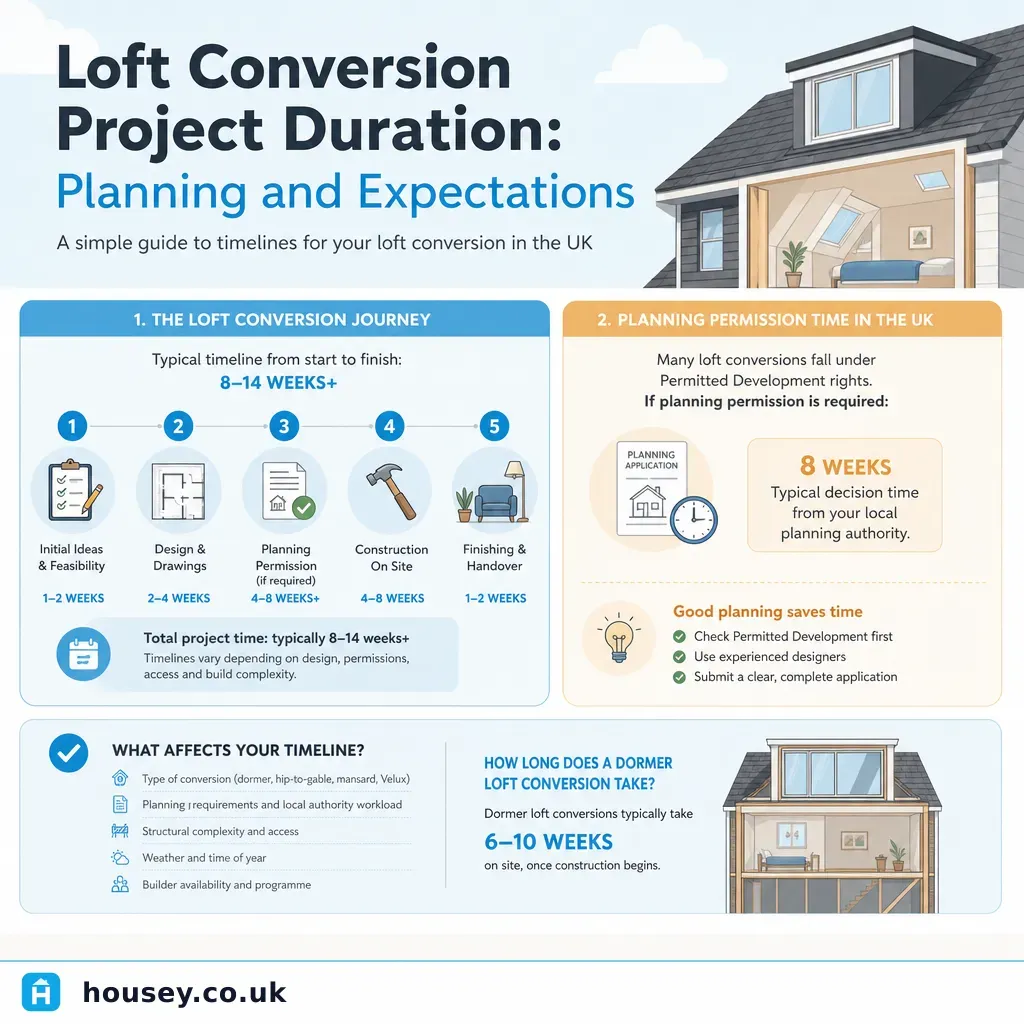 Improvement & Build
Loft Conversion Project Duration: Planning and Expectations
A loft conversion in the UK typically takes 4 to 16 weeks of on-site construction depending on the type.
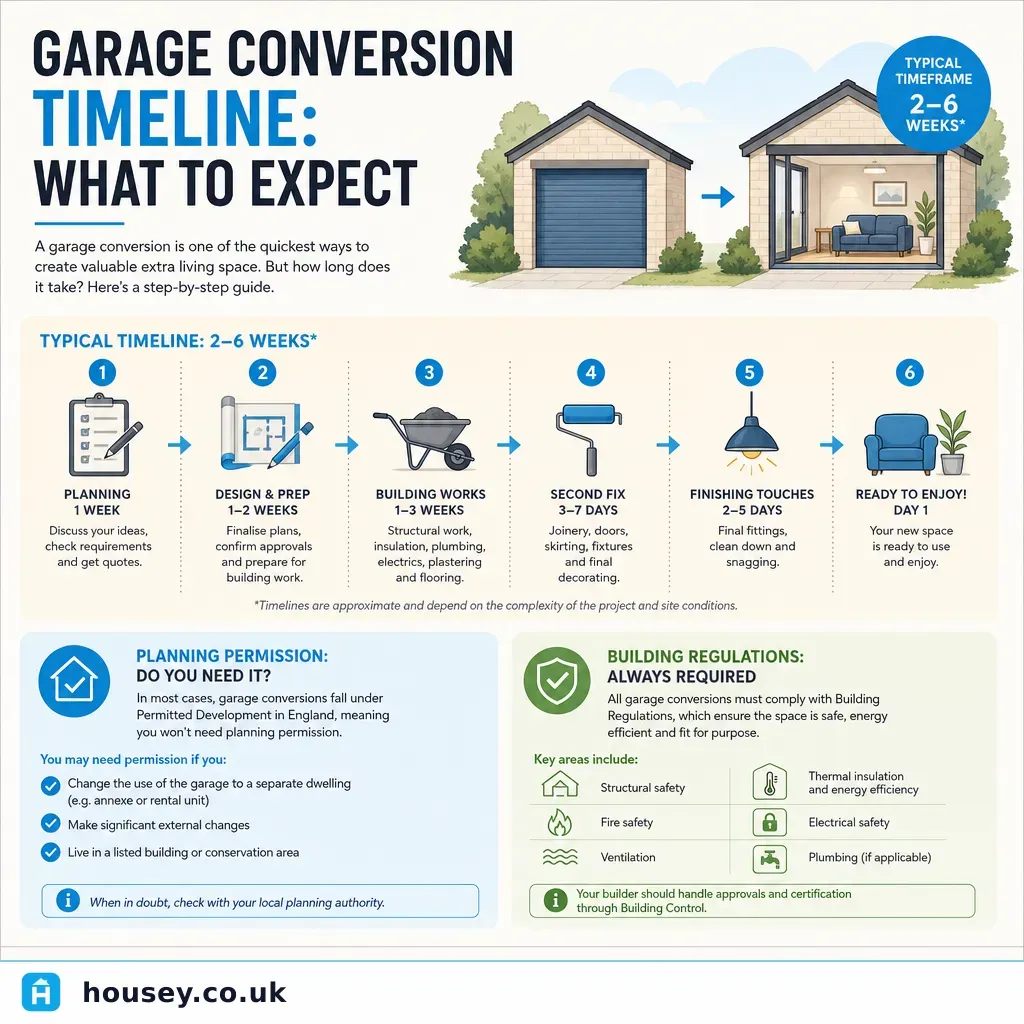 Improvement & Build
Garage Conversion Timeline: What to Expect
A straightforward attached garage conversion in England usually takes 4–8 weeks of construction, plus pre-start time for building control approval (5 working days for Full Plans).
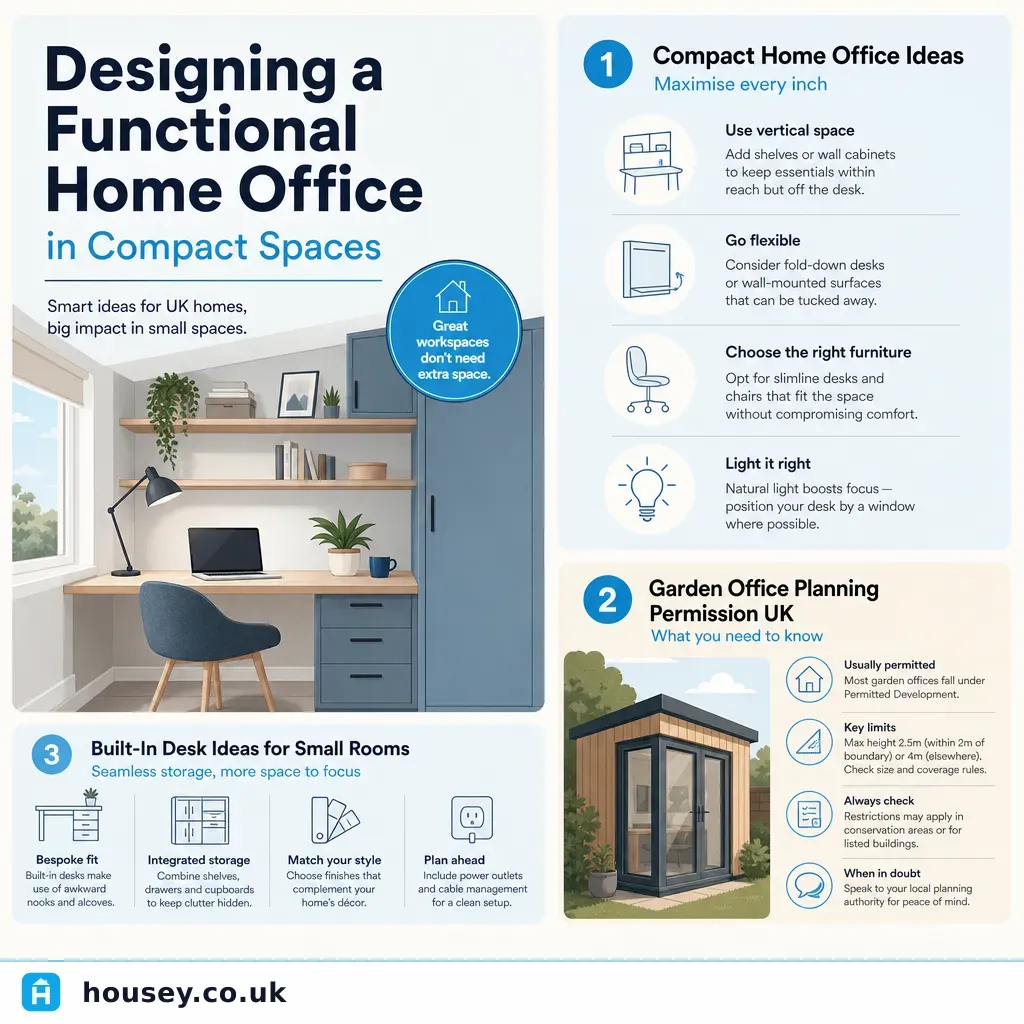 Improvement & Build
Designing a Functional Home Office in Compact Spaces
A functional compact home office needs a clearly defined workspace, ergonomic seating, and good lighting — even in a small footprint.
 Improvement & Build
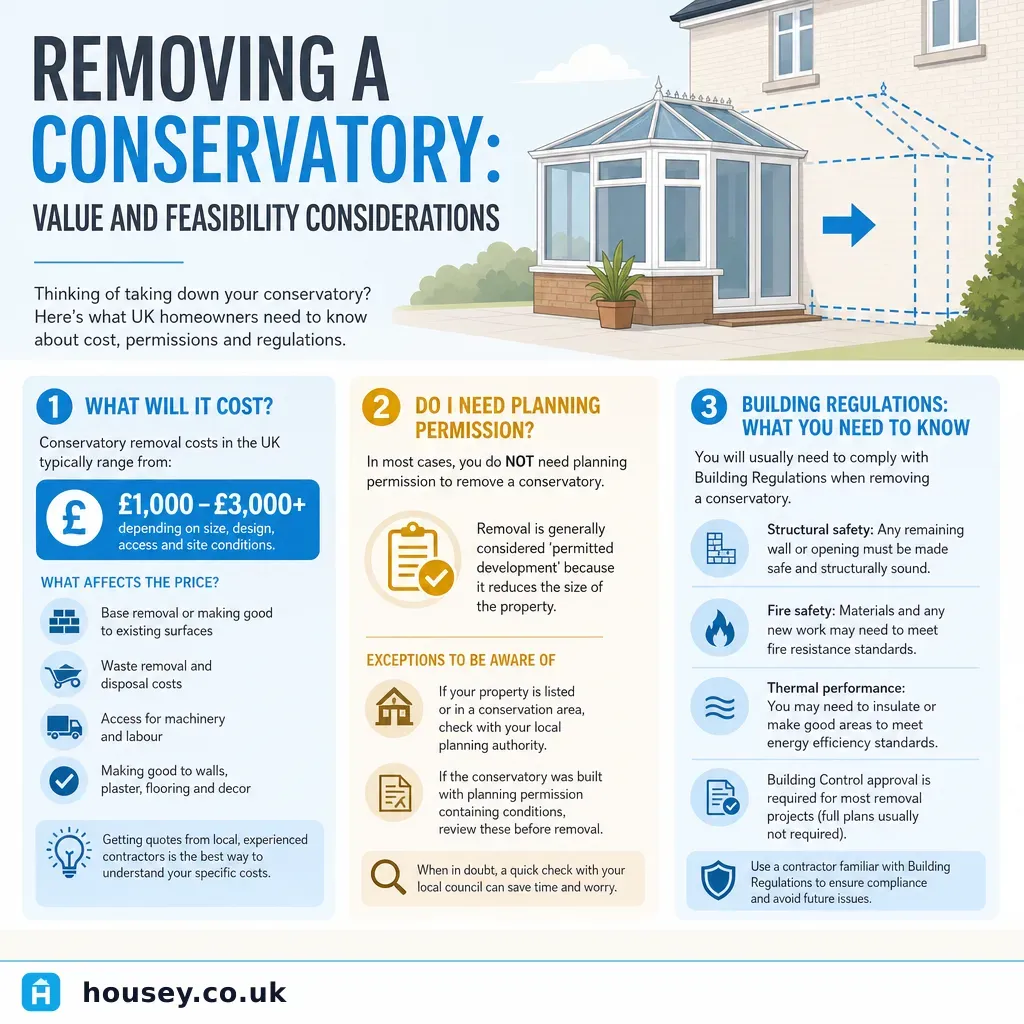
Removing a Conservatory: Value and Feasibility Considerations
Removing a conservatory in England usually does not need planning permission if the original structure was permitted development, but reinstating the original wall almost always requires a building regulations application covering structural, thermal, and moisture elements.
 Improvement & Build
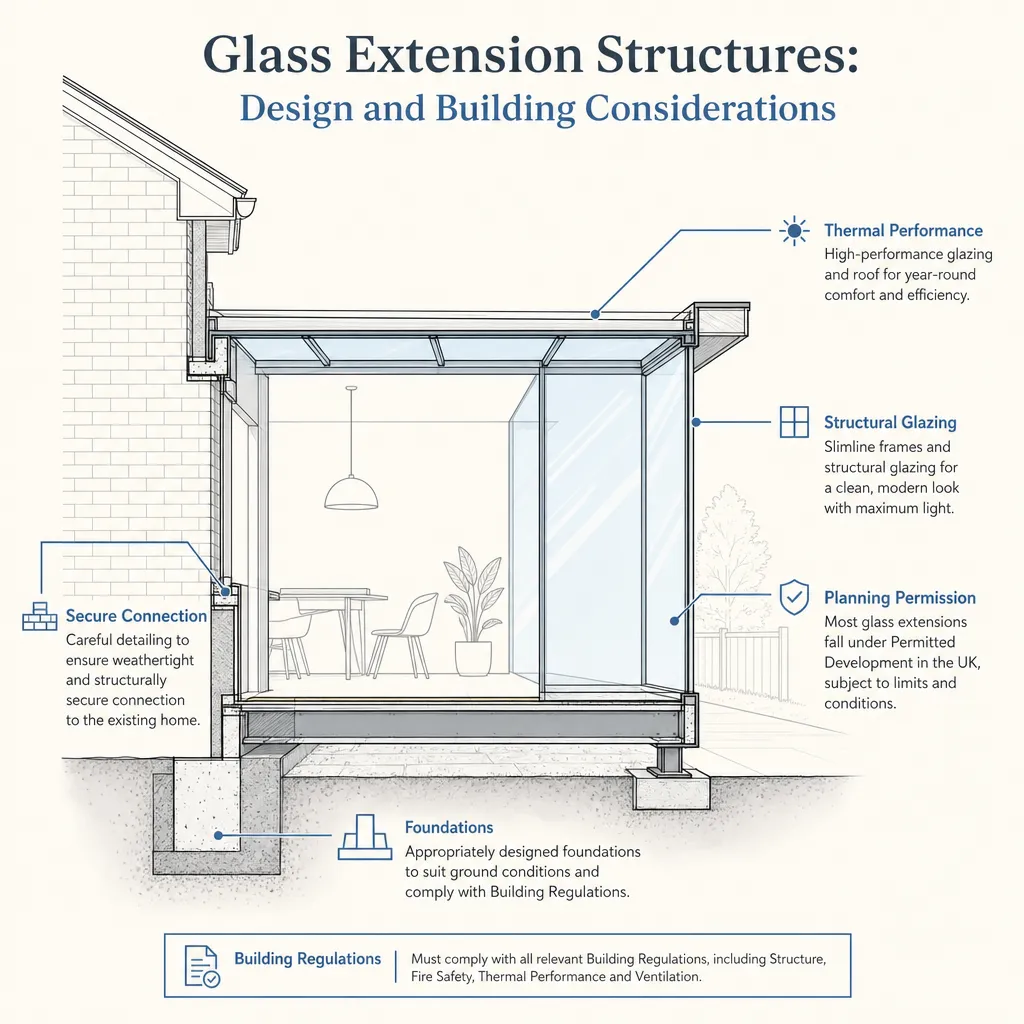
Glass Extension Structures: Design and Building Considerations
A glass extension uses structural glazing for walls, roof, or both to create a light-filled space connected to the garden.