Loft Conversion Project Duration: Planning and Expectations
By Housey · Last reviewed 11th of May 2026
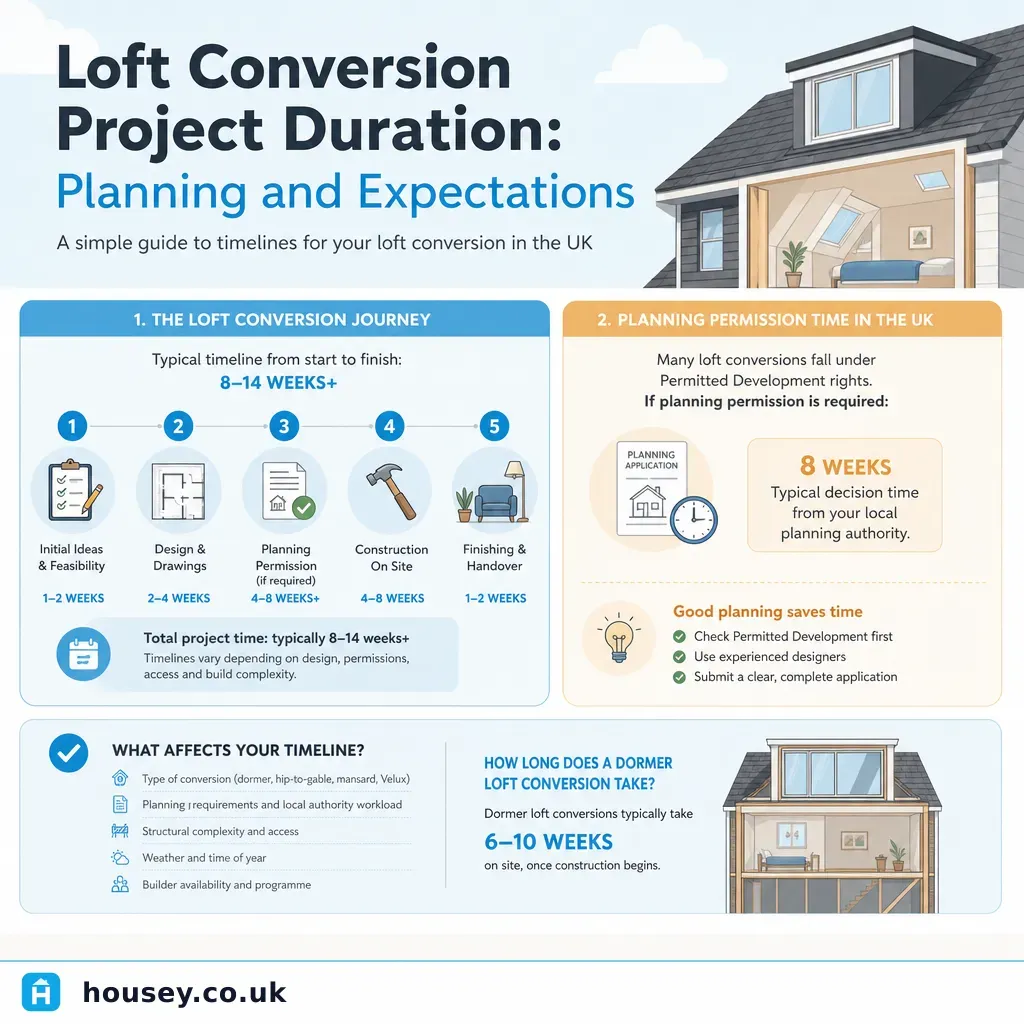
Loft Conversion Project Duration: Planning and Expectations
A loft conversion is one of the most popular ways to add usable space to a UK home without extending the ground-floor footprint — and one of the first questions homeowners ask before committing is how long the whole process will actually take. The answer spans everything from the initial design appointment to the day building control signs off your new room, and getting a realistic picture upfront helps you plan around the disruption, coordinate tradespeople, and budget for any temporary inconvenience.
Key points
- A Velux (rooflight) loft conversion — the simplest form — typically requires 4 to 6 weeks of on-site construction.
- A dormer conversion usually takes 8 to 12 weeks on site; a hip-to-gable or mansard can extend to 12–16 weeks.
- Building Regulations approval is required for all loft conversions in England and Wales, regardless of whether planning permission is also needed.
- If full planning permission is required — for instance, the property is in a conservation area or exceeds permitted development volume limits — allow a further 8–13 weeks for the local planning authority's statutory determination period.
- The pre-construction phase (design, structural calculations, building control submission, contractor procurement) typically adds 4–12 weeks before on-site work can begin.
From first call to completion: the typical programme
Stage | Typical duration | Notes |
|---|---|---|
Initial design and feasibility | 1–3 weeks | Architect or architectural technician surveys and prepares drawings |
Structural engineer calculations | 1–3 weeks | Often runs in parallel with design |
Building Regulations application (full plans) | 4–8 weeks | Approval provides certainty before work starts |
Planning permission (if required) | 8–13 weeks | Not always needed — see below |
Contractor quotes and procurement | 1–4 weeks | Allow time to compare at least three written quotes |
On-site construction | 4–16 weeks | Depends on conversion type |
Snagging and building control final inspection | 1–2 weeks | Completion certificate issued after sign-off |
Indicative UK timescales, last reviewed 2026-05-11. Actual timelines vary by property, location, and contractor availability.
End-to-end, a straightforward Velux conversion on a post-war detached house under permitted development might complete in 3 to 5 months from first enquiry to sign-off. A mansard conversion on a London Victorian terrace requiring full planning permission could take 12 to 18 months from start to finish.
Which type of loft conversion — and how does that affect the timeline?
Conversion type | Typical on-site duration | Planning permission likely? | Best for |
|---|---|---|---|
Velux (rooflight) | 4–6 weeks | Usually no | Properties with adequate head height (2.2 m+); quickest route to a usable room |
Rear dormer | 8–12 weeks | Usually no | Most common type; adds floor area and head height |
Hip-to-gable | 10–14 weeks | Usually no for detached or end-terrace | Hipped-roof homes needing maximum loft volume |
Mansard | 12–16 weeks | Usually yes | Maximum space gain; common in London terraces |
L-shaped dormer | 10–14 weeks | Usually no for rear; check for side | End-of-terrace or detached with a back addition |
Do you need planning permission?
Most loft conversions in England fall within permitted development rights under the Town and Country Planning (General Permitted Development) (England) Order 2015, meaning planning permission is not required — provided the works stay within specific conditions on volume, height, and materials.
Full planning permission is likely to be needed if:
- The property is in a conservation area, National Park, or Area of Outstanding Natural Beauty.
- The property is a listed building (listed building consent will also be required).
- The proposed conversion exceeds the permitted development volume allowance: 40 m³ for terraced houses, 50 m³ for detached and semi-detached properties.
- Permitted development rights have been removed by an Article 4 Direction — check with your local planning authority before assuming they apply.
- A mansard roof is proposed on a terrace or semi-detached property.
If you are uncertain, a Certificate of Lawful Development from the local planning authority provides written confirmation that permitted development applies — and is useful evidence when you come to sell the property.
Which professionals do you need?
Professional | When you need them |
|---|---|
Architect or architectural technician | Design drawings, planning applications, building control submission |
Structural engineer | Calculations for steel beams, purlins, trimmer joists, and new floor structure |
Building control officer (local authority or approved inspector) | Mandatory for all loft conversions in England and Wales |
Party wall surveyor | If structural works affect or are close to a shared wall — the Party Wall etc. Act 1996 may apply |
Loft conversion specialist contractor | On-site construction, typically coordinating all trades |
Project manager | Useful for complex projects or homeowners who cannot manage multiple trades directly |
Decision tree: which approach should you take?
- Choose a Velux conversion if head height is at least 2.2 m and you want the quickest, least disruptive route to a new bedroom or home office.
- Choose a dormer if you need more usable floor area or the existing head height is marginal.
- Choose a hip-to-gable if you have a hipped roof on a detached or end-of-terrace home and want to maximise the loft volume.
- Choose a mansard if you need maximum space and are comfortable with a longer programme and the likelihood of a planning application.
- Ask a structural engineer before proceeding if there are signs of roof spread — bowing walls, cracking at ceiling junctions, or rafters visibly separating from the ridge.
- Check with your local planning authority before starting if the property is in a conservation area or if a previous extension may have used up your permitted development allowance.
What can cause delays?
Understanding common causes of delay helps you build sensible contingency into the programme:
- Late structural calculations — if the engineer is delayed, building control cannot grant full plans approval and the contractor cannot start on site.
- Party wall disputes — an adjoining owner can formally dissent, triggering a surveyor appointment process that can take several months.
- Unforeseen structural issues — rotten purlins, inadequate existing floor joists, or a pre-existing roof defect discovered mid-project that must be remedied before conversion works proceed.
- Material supply delays — structural steel, specific roof window sizes, or specialist insulation products can carry multi-week lead times.
- Bad weather — roof-opening works are weather-dependent; a wet autumn can push programmes by weeks.
- Trade availability — established loft conversion contractors in busy areas are often booked 2–4 months in advance.
Homeowner checklist: before work starts
- Confirm whether permitted development applies — check directly with the local planning authority or obtain a Certificate of Lawful Development; do not rely solely on the contractor's opinion.
- Appoint a structural engineer independently if the contractor has not done so, and ask for a copy of the structural calculations.
- Check whether the Party Wall etc. Act 1996 applies and serve formal notices on adjoining owners at least two months before structural works begin.
- Agree a written programme with the contractor, including key milestone dates and a mechanism for notifying delays.
- Confirm building control has acknowledged your application before work commences on site.
- Arrange for loft contents and any cold water tank to be relocated before the roof-opening phase.
- Clarify what temporary weatherproofing will be in place during the most exposed stages of the conversion.
When to get professional help
Seek professional advice before proceeding if:
- There are signs of existing roof spread — this must be assessed and, where necessary, remedied before conversion work begins.
- The neighbouring property is leasehold, or there are shared roof elements — ownership and consent requirements can be complex and should be confirmed with a solicitor.
- Your contractor proposes to start before building control has acknowledged the application.
- You are uncertain whether party wall procedures apply to the structural works proposed.
How Housey can help
Housey can connect you with experienced loft conversion companies who can assess your loft's potential and produce a realistic programme, as well as independent project managers who can oversee design, regulatory, and construction stages on your behalf.
Frequently asked questions
Can I live in the house during a loft conversion?
Yes, in most cases. The most disruptive period is when the roof is opened — typically 1 to 3 days — during which the upper floor may be briefly exposed. Reputable contractors use scaffolding, temporary weatherproofing, and dust sheets to manage disruption. The remainder of the programme is largely contained to the loft space and upper landing.
Does a loft conversion add value?
A well-executed loft conversion is widely cited as one of the higher-value home improvements in the UK. Indicative uplifts of 10 to 20% are commonly referenced, though actual value depends on location, quality of finish, and local market conditions. A professional valuation before and after is advisable if the financial case is central to your decision.
How important is the building regulations completion certificate?
The completion certificate is important: without it, you may encounter difficulties when selling the property, as conveyancers routinely require evidence of compliance for notifiable works. If a certificate cannot be obtained because inspections were not arranged at the correct stages, you may need to apply for a regularisation certificate — which is more costly and not guaranteed.
How far in advance should I book a loft conversion company?
Established loft conversion contractors in most UK regions are typically booked 2 to 4 months in advance, and longer in high-demand urban areas. Factor this into your overall programme, particularly if you want work to start in spring or summer, when contractor availability is tighter and demand from other homeowners peaks.
Sources and further reading
- Planning Portal: Loft Conversions — Permitted development guidance and planning rules for loft conversions in England.
- GOV.UK: Building Regulations approval — When building regulations approval is required for home improvements.
- Town and Country Planning (GPDO) Order 2015 — legislation.gov.uk — Statutory basis for permitted development rights.
- Party Wall etc. Act 1996 — legislation.gov.uk — The Act governing party wall procedures in England and Wales.
- RICS: Party wall legislation overview — Professional body guidance on party wall procedures for homeowners.
Useful next reads
 Improvement & Build
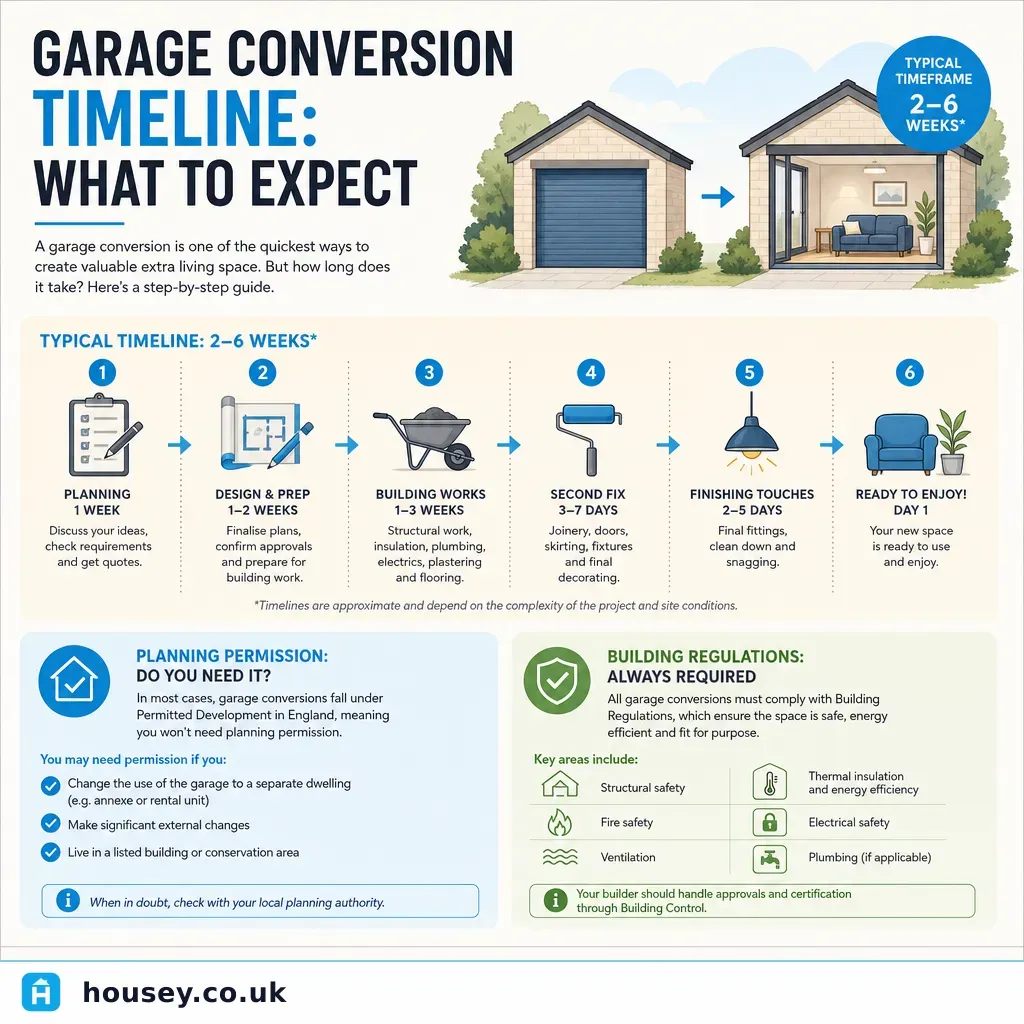
Garage Conversion Timeline: What to Expect
A straightforward attached garage conversion in England usually takes 4–8 weeks of construction, plus pre-start time for building control approval (5 working days for Full Plans).
 Improvement & Build
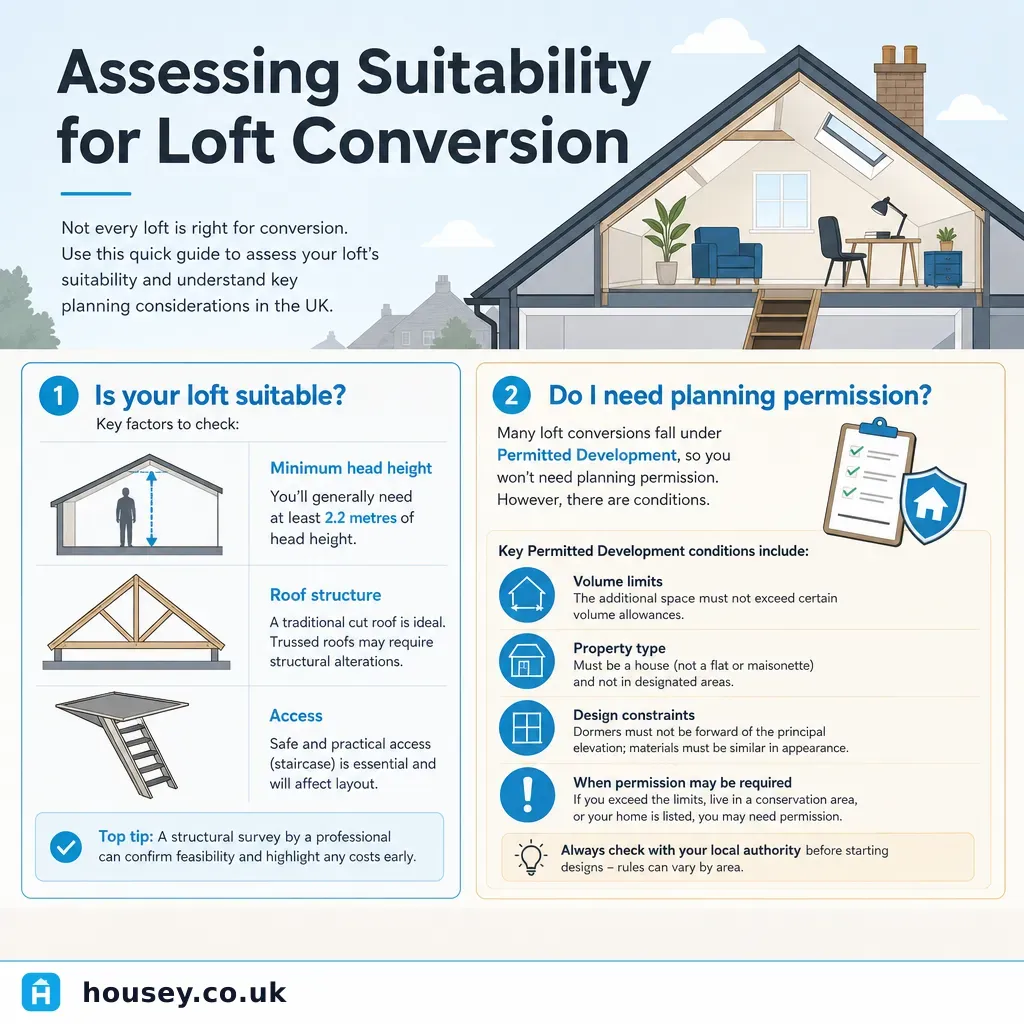
Assessing Suitability for Loft Conversion
Most loft conversions need a minimum ridge height of around 2.
 Improvement & Build
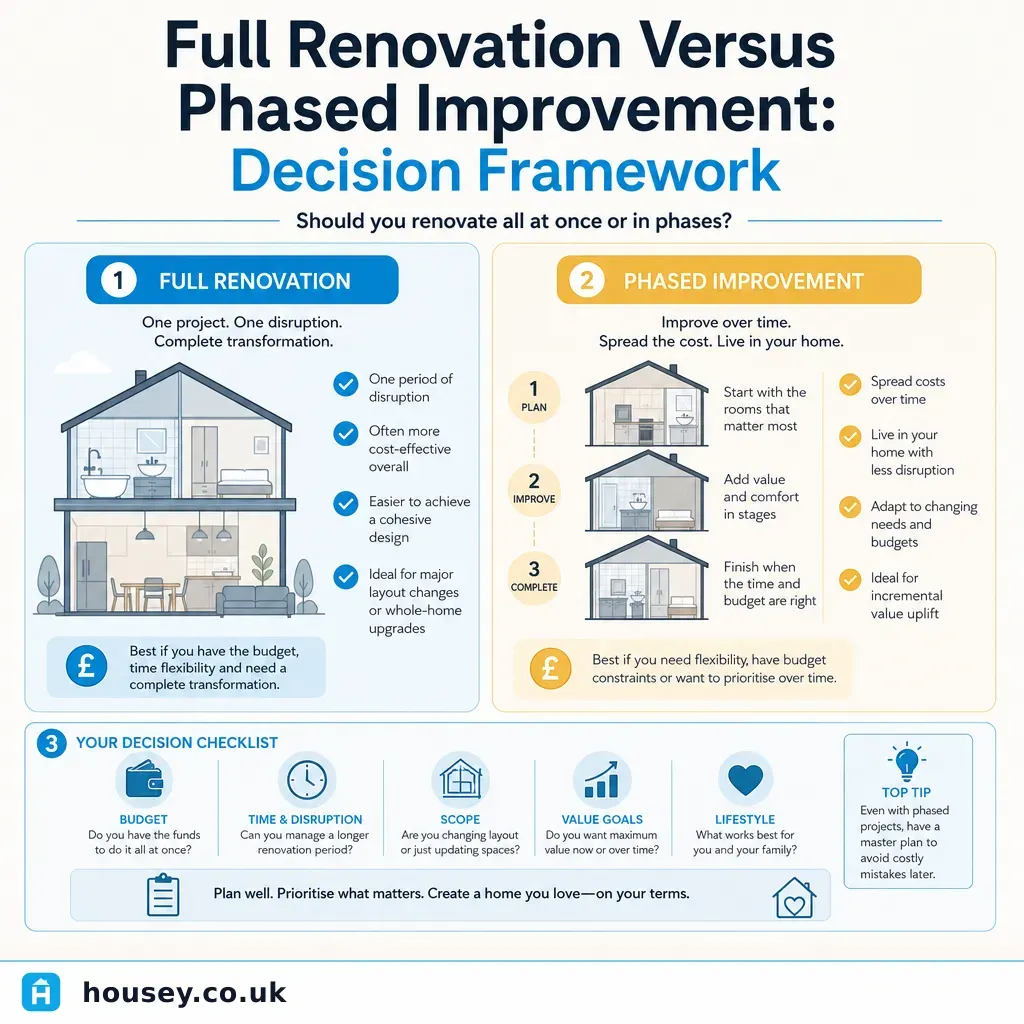
Full Renovation Versus Phased Improvement: Decision Framework
A full renovation suits properties needing comprehensive structural, thermal, or layout changes where repeated disruption would cost more than doing everything once.
 Improvement & Build
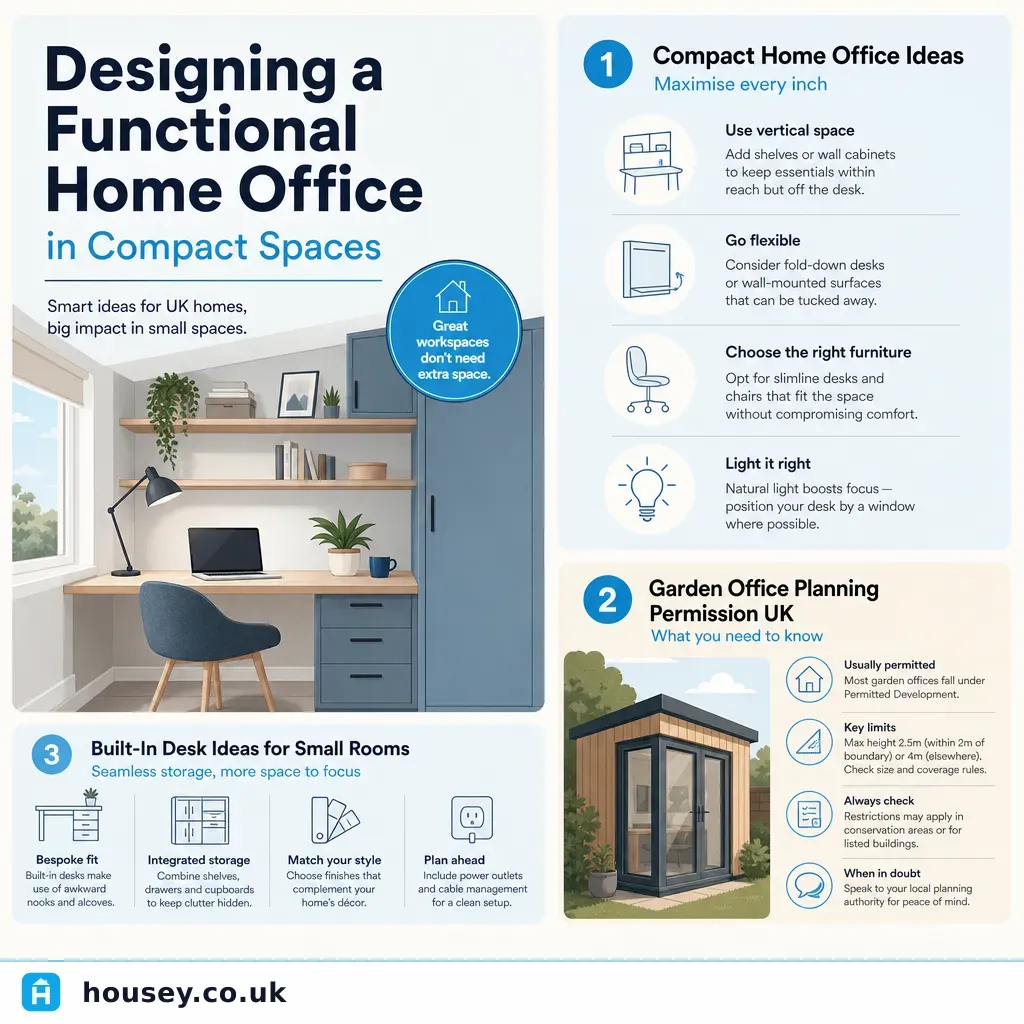
Designing a Functional Home Office in Compact Spaces
A functional compact home office needs a clearly defined workspace, ergonomic seating, and good lighting — even in a small footprint.
 Improvement & Build
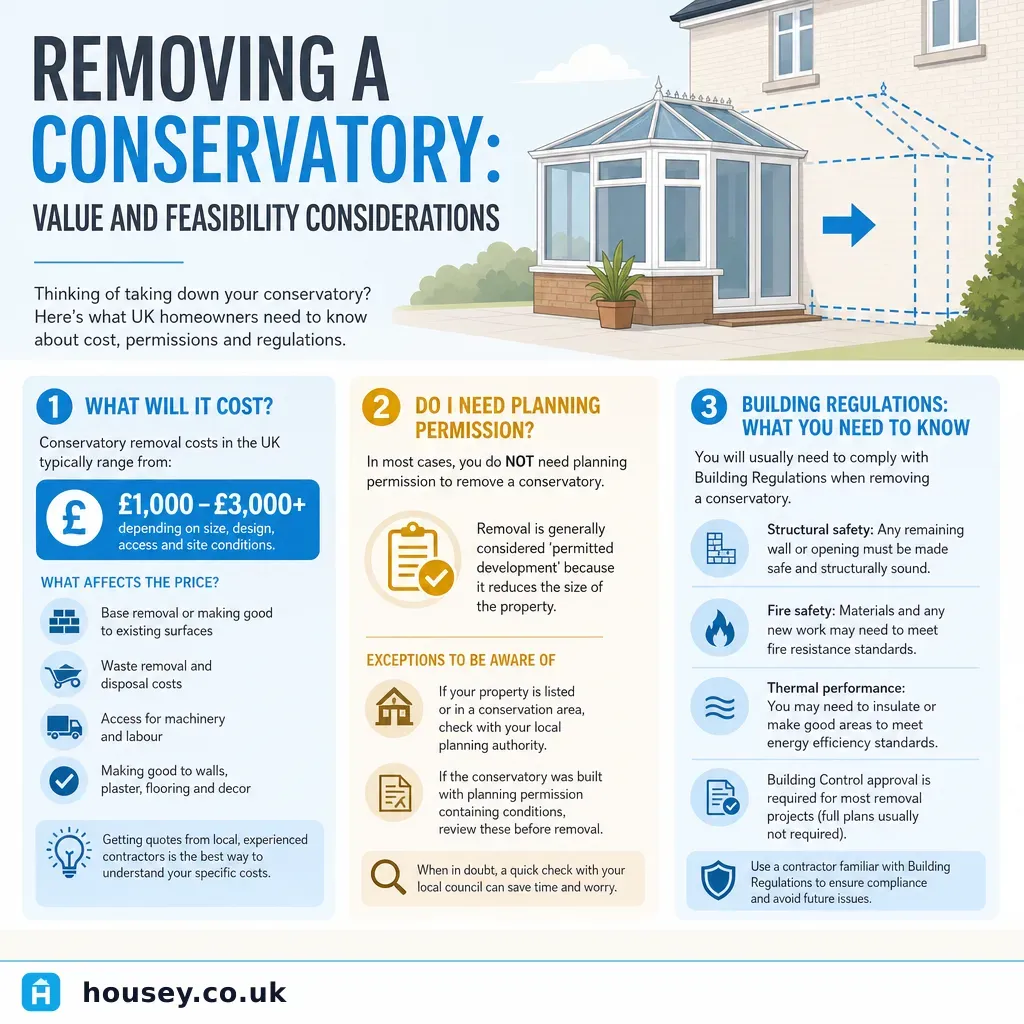
Removing a Conservatory: Value and Feasibility Considerations
Removing a conservatory in England usually does not need planning permission if the original structure was permitted development, but reinstating the original wall almost always requires a building regulations application covering structural, thermal, and moisture elements.