Removing a Conservatory: Value and Feasibility Considerations
By Housey · Last reviewed 11th of May 2026
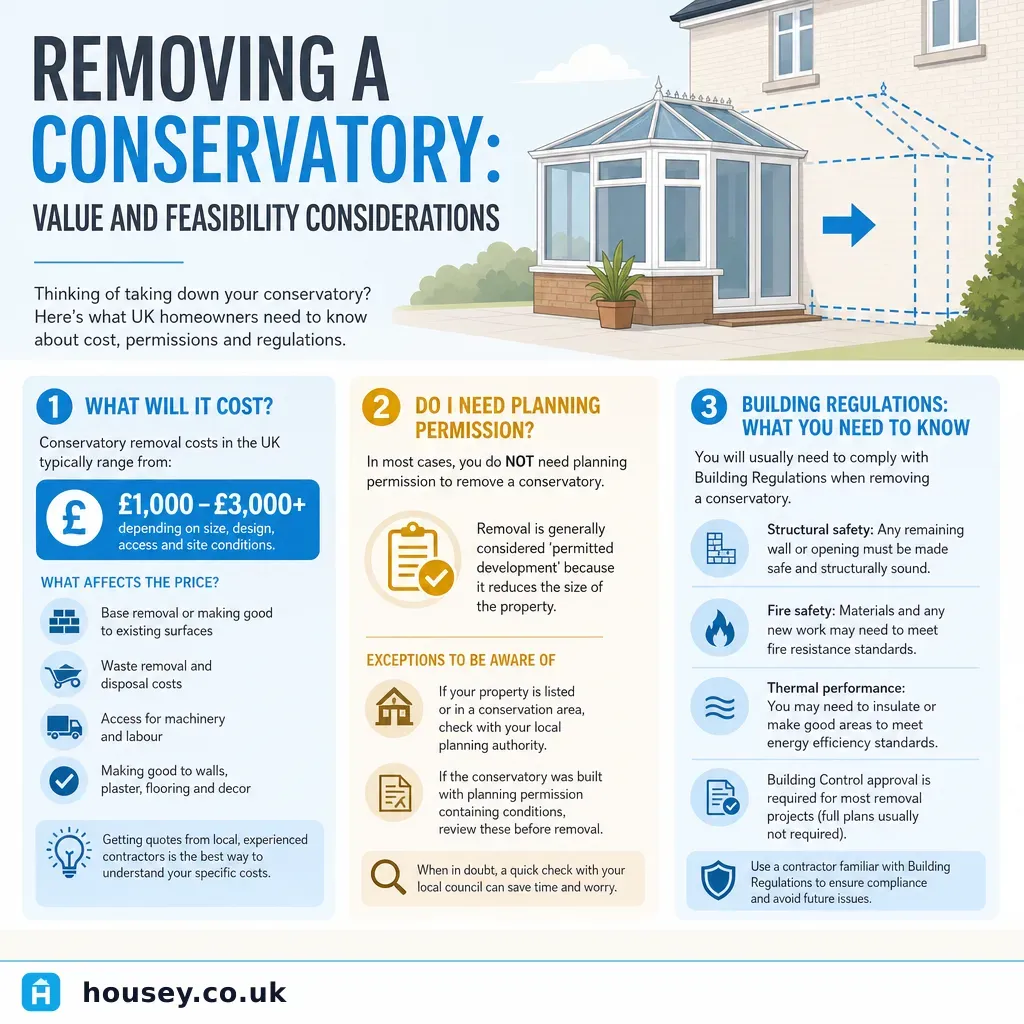
Removing a Conservatory: Value and Feasibility Considerations
A conservatory that no longer suits a property — whether structurally deteriorated, poorly insulated, visually incongruous, or simply unwanted by prospective buyers — is a candidate for removal. The decision involves considerably more than arranging a demolition crew: it affects the thermal envelope of the house, triggers building regulations obligations in almost all cases, and can influence market value in ways that are not always obvious from the outside. Understanding what is involved before instructing works protects both your budget and your sale prospects.
Key points
- Reinstating the original external wall after conservatory removal almost always requires a building regulations application under Approved Document A (Structure) and Approved Document L (thermal performance) as a minimum.
- Demolition of a structure exceeding 50 m³ in England requires prior notification to the local planning authority (LPA) under the Town and Country Planning (Demolition — Description of Buildings) Direction 2021, even if no planning permission is required.
- Properties in conservation areas require Conservation Area Consent for demolition of structures — this applies even to conservatories originally built under permitted development.
- Structures built before 2000 may contain asbestos-containing materials in roofing, soffits, or insulating board — these must be surveyed and removed by a licensed contractor before any demolition begins.
- The value impact of removal depends on the condition of the existing structure and the quality of the reinstatement; a well-reinstated rear wall can leave a property more marketable than a deteriorating glazed extension.
Does conservatory removal add or reduce property value?
The answer depends heavily on the quality of the existing structure, local buyer expectations, and how the original wall is reinstated after demolition.
Scenario | Likely value effect | Key consideration |
|---|---|---|
Old, cold, poorly maintained conservatory removed and wall reinstated well | Neutral to slight positive | Buyers see a clean rear elevation rather than a liability; removes survey risk |
Modern, well-insulated conservatory in good condition removed | Neutral to slight negative | Loss of usable square footage; value depends on how buyers weigh space against quality |
Damaged or structurally compromised conservatory removed before sale | Positive (removes buyer objection) | Reduces scope for downward negotiation and survey-driven price reductions |
Conservatory on a family home in a suburban market | Potentially negative | Families often value flexible additional space; removal may narrow buyer appeal |
Conservatory on a period property where it appears incongruous | Neutral to positive | Buyers concerned with period character or kerb appeal may respond well to sympathetic removal |
In many cases, a well-executed removal with matching brickwork, restored windows, good insulation, and careful detailing of the reinstated wall leaves a property more marketable than a poorly maintained glazed addition that generates survey concerns and negotiating leverage for buyers.
Planning and building regulations: what applies?
Planning permission
Most conservatories attached to dwellings were built under permitted development rights and have no formal planning permission history. Removing a structure that was itself permitted development does not usually require a planning application. Exceptions include:
- Conservation areas: Demolition of any building in a conservation area requires Conservation Area Consent — this applies regardless of how the conservatory was originally built. Confirm with your LPA before proceeding.
- Listed buildings: Listed building consent is required for any external alteration or demolition of an attached structure. Contact your LPA's conservation officer before instructing works.
- Large structures: Prior notification to the LPA is required before demolishing any structure with a volume exceeding 50 m³ under the Town and Country Planning (Demolition — Description of Buildings) Direction 2021. Most domestic conservatories fall below this threshold, but check if yours is substantial.
- Properties with planning conditions: Review the original planning history of the dwelling — some permissions contain conditions relating to outbuildings or rear extensions.
Building regulations
Opening up the original external wall and reinstating it almost always triggers a Building Regulations application. The key elements covered include:
- Part A (Structure): The lintel or structural element above the original opening must be assessed and confirmed adequate for the reinstated wall loading.
- Part L (Conservation of fuel and power): Any new wall, window, or door element must meet current thermal performance standards set in Approved Document L 2021 — walls to 0.18 W/m²K or better, windows to 1.4 W/m²K or better.
- Part C (Site preparation and resistance to contaminants and moisture): Reinstated floor and wall elements must provide adequate damp-proofing, particularly where the original damp-proof course may have been bridged by the conservatory construction.
- Thermal bridging: The junction between the reinstated wall and adjacent structure must be properly detailed to avoid cold bridging and the condensation risk that accompanies it.
Submit a building regulations application to your local building control body or a private approved inspector before works begin. Do not cover up reinstated structural or thermal elements before inspection.
Homeowner checklist before removing a conservatory
Red flags to watch for
- The conservatory's roof or frame connects directly to the main roof structure rather than sitting below it — removal may involve structural intervention in the main building's weathering envelope.
- The original external wall behind the conservatory has been entirely removed, integrating the conservatory structurally with the house — this requires a careful engineering assessment before any demolition begins.
- The structure predates 2000 and has corrugated or flat cement roof panels, insulating board, or textured coatings — these are potentially asbestos-containing materials. Arrange a survey with a competent asbestos professional before any disturbance. Do not break up or drill suspect materials.
- Drainage from the house discharges through or under the conservatory slab — a drainage survey before demolition is advisable to avoid unexpected costs.
- The property is leasehold — landlord consent may be required for external structural changes, and failure to obtain it can affect a future sale or lease extension.
Important limitations
This article provides general information about conservatory removal in England. Planning and building regulations requirements, and structural considerations, vary by property, local authority, and the specific construction of the conservatory. Rules for Wales, Scotland, and Northern Ireland differ. Nothing in this article constitutes structural, legal, planning, or asbestos-related advice. A qualified professional should assess your specific property before any works are instructed.
What to ask a qualified professional
Before instructing demolition works, ask:
- Is any part of the conservatory load-bearing, or has the original external wall behind it been removed entirely?
- What building regulations applications are required, and who will submit and manage them?
- Are there any planning conditions, conservation area requirements, or listed building designations that affect this removal?
- Are there asbestos-containing materials present that require a survey and licensed removal contractor before works begin?
- What is the reinstatement specification for the wall, windows, floor, and thermal detailing to comply with current building regulations?
- When will I receive a building regulations completion certificate, and what happens if the work fails inspection?
When to get professional help
Seek professional input before proceeding if any of the following apply:
- The conservatory has a structural connection to the main roof or upper walls beyond a simple lean-to junction.
- The original wall behind the conservatory has been partially or wholly removed.
- The structure predates 2000 and may contain asbestos-containing materials.
- The property is listed, in a conservation area, or subject to any planning conditions.
- Services including electricity, gas, or drainage run through the structure and need diverting.
How Housey can help
Housey can connect you with experienced demolition contractors for domestic conservatory removal, and with professionals who can produce building regulations drawings to support your application and ensure the reinstatement meets current structural and thermal standards.
Frequently asked questions
Do I need planning permission to remove a conservatory in England?
In most cases, no. Removing a conservatory that was originally built under permitted development does not require a planning application in England. However, prior notification to the local planning authority may be needed if the structure exceeds 50 m³. Listed buildings and conservation areas have additional requirements. Always confirm with your local planning authority if the property has any designations or if planning conditions were attached to the original build.
How much does conservatory removal typically cost in the UK?
Indicative UK costs, last reviewed 2026-05-11. A straightforward domestic conservatory demolition typically costs between £1,500 and £5,000 depending on size, materials, and access. Reinstating the original external wall — including brickwork, insulation, windows, and a door — often adds £3,000–£10,000 to that figure. Structural complications, service diversions, and asbestos surveys can increase costs further. Obtain at least three quotes from accredited contractors before committing.
Will removing a conservatory improve my energy efficiency?
Potentially, yes — particularly with older structures. Pre-2010 conservatories built under the building regulations exemption for conservatories often had poor thermal performance. Removing the structure and reinstating the external wall to current Approved Document L 2021 standards, with appropriate insulation, windows meeting the required U-values, and proper detailing of thermal bridges, can improve the rear elevation's thermal performance compared to the existing glazed addition.
Do I need building regulations approval to remove a conservatory?
Almost certainly yes, if you are reopening and reinstating the original external wall. Any new structural element, thermal component such as walls, windows, or doors, and floor connections will require building regulations approval. Submit a building regulations application to your local building control body or an approved inspector before works begin. Obtain a completion certificate once works are signed off — this document is important for future sales and remortgages.
Sources and further reading
- Building Regulations Approved Document L: Conservation of fuel and power (2021) — GOV.UK
- Building Regulations Approved Document A: Structure — GOV.UK
- When is permission required? (demolition guidance) — GOV.UK Planning Practice Guidance
- Conservation areas: permitted development rights — Historic England
- Control of Asbestos Regulations 2012 — HSE
Useful next reads
 Improvement & Build
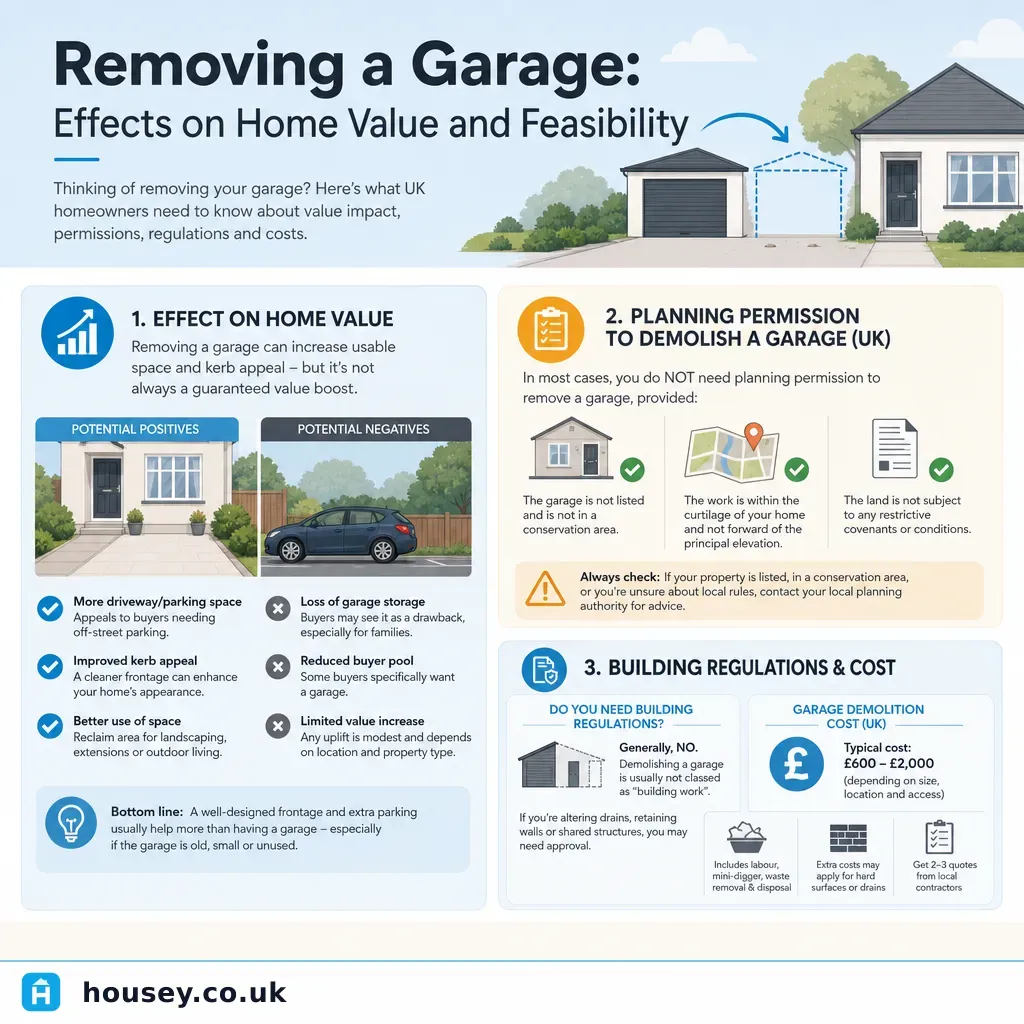
Removing a Garage: Effects on Home Value and Feasibility
Demolishing a garage in England may require prior notification to the local planning authority, and structural or building regulations assessments are often needed if the garage is attached to or integral with the house.
 Improvement & Build
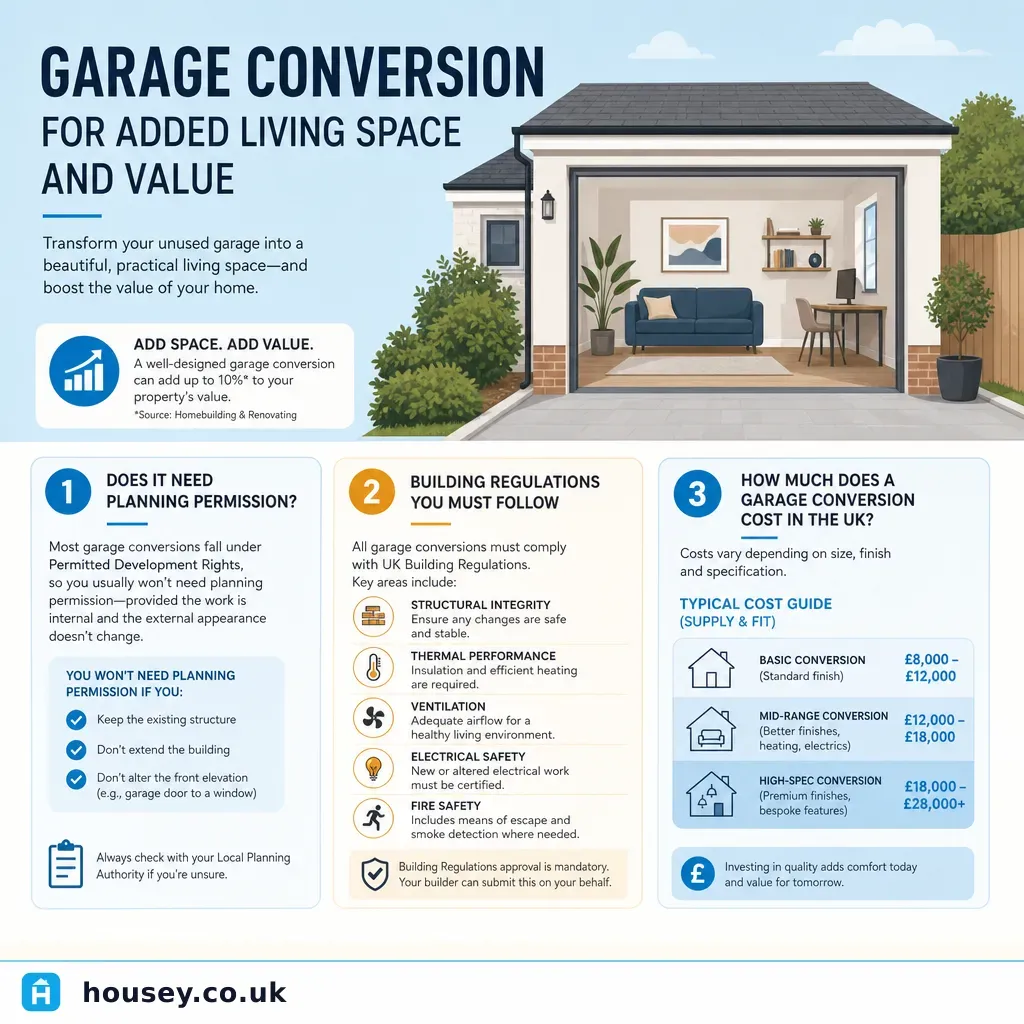
Garage Conversion for Added Living Space and Value
A garage conversion in England typically falls within permitted development and does not need a planning application, provided the property is a standard dwellinghouse with no restricting planning conditions.
 Improvement & Build
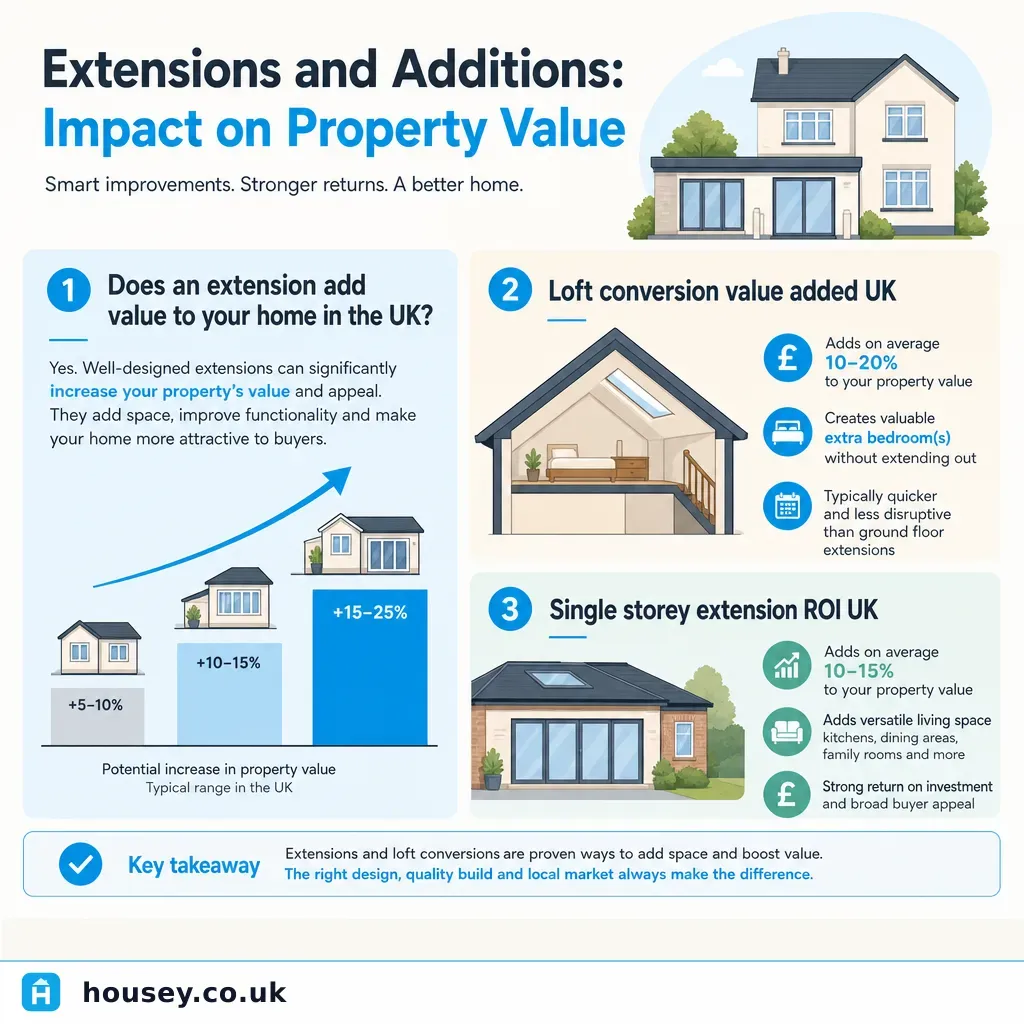
Extensions and Additions: Impact on Property Value
Extensions typically add 5–20% to UK property values depending on type, quality, and local market conditions.
 Improvement & Build
Who Provides House Demolition Services
House demolition in the UK is carried out by specialist demolition contractors, often members of the National Federation of Demolition Contractors (NFDC).
 Improvement & Build
Leaded Window Repair and Restoration Costs
Leaded window repair in the UK typically costs £150–£600 for minor re-soldering or resealing, rising to £800–£2,500+ for full panel removal and restoration.