How to Remove Tree Stumps Safely from Your Garden
By Housey · Last reviewed 25th of May 2026
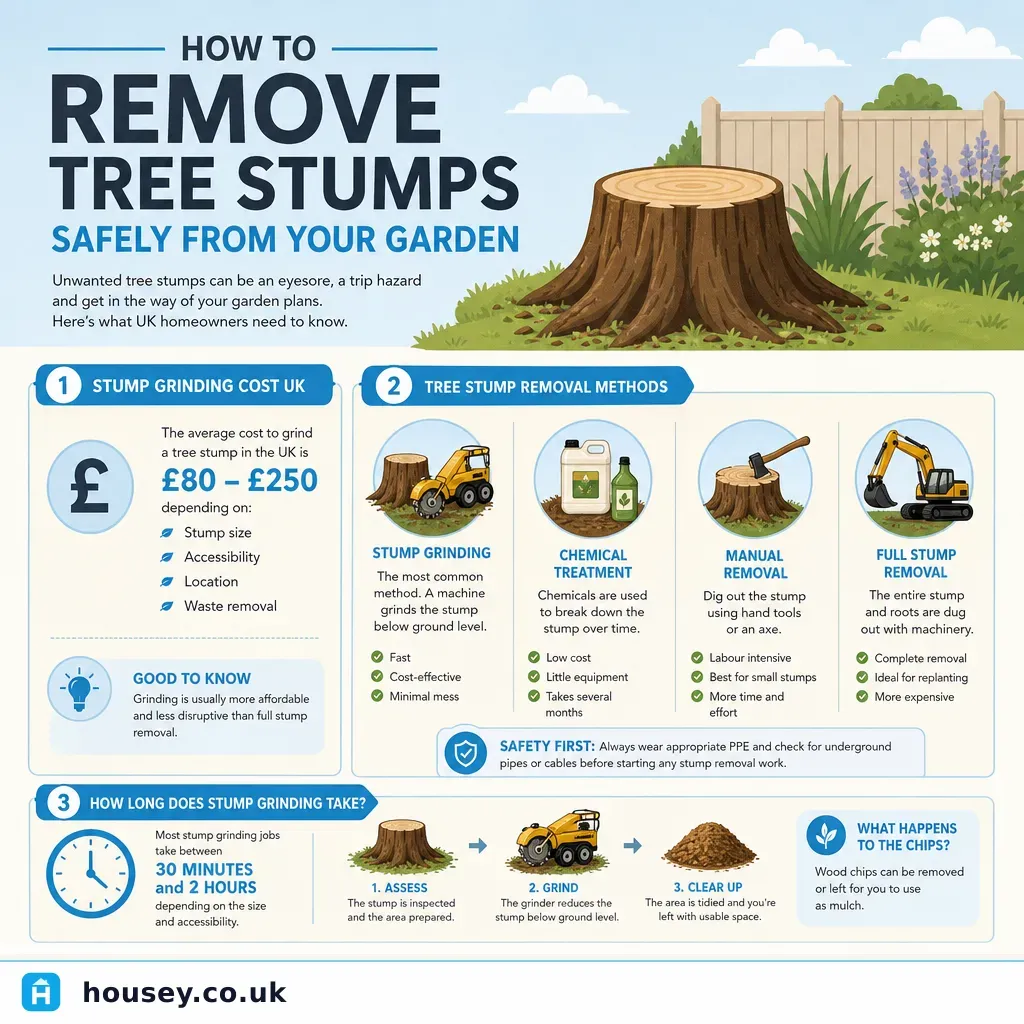
How to Remove Tree Stumps Safely from Your Garden
A felled tree often leaves behind a stump that can become a trip hazard, harbour disease, attract pests such as honey fungus (Armillaria spp.), and make mowing or replanting the area difficult. Whether you have recently had a tree removed or inherited an old stump from a previous owner, the method you choose — and whether you use a professional — will depend on the stump's size, location, species, and root system.
Key points
- Stump grinding is the most common professional removal method; a grinder reduces the stump to wood chip 150–300 mm below ground level in a single session.
- Chemical stump killers (typically potassium nitrate-based) require 4–12 months to fully soften wood before the stump can be broken up and disposed of.
- Any stump from a tree subject to a Tree Preservation Order (TPO) may require consent from your local planning authority before removal — check before starting work.
- Stumps within approximately 3 metres of a building foundation carry a risk of soil shrinkage or subsidence as the root system decays; a structural assessment may be advisable.
- Indicative UK costs for professional stump grinding range from around £60–£200 for a single average-sized stump (last reviewed 2026-05-25; quotes vary by stump diameter, access, and location).
Which stump removal method is right for you?
The right approach depends on how urgently you need the stump removed, its diameter, its proximity to structures or underground services, and your budget. Use the comparison below as a starting point, then discuss specifics with a qualified arborist.
Method | Best for | Not ideal for | Typical outcome | Main risk if wrong choice |
|---|---|---|---|---|
Stump grinding | Most garden stumps; quick results required | Very restricted access; stumps immediately adjacent to walls or utilities | Stump reduced below ground; area filled with wood chip | Damage to nearby roots or underground services if the ground is not surveyed first |
Chemical treatment | Isolated stumps; limited budget; no machinery access | Large stumps; stumps close to edible planting; time-sensitive projects | Stump gradually softens over several months | Slow breakdown; potential runoff near water features if misapplied |
Manual excavation | Small stumps under approximately 150 mm diameter | Large or deep root systems | Complete stump and root removal | Back injury; very time-intensive; rarely practical for large stumps |
Winching / full extraction | Replanting required over the same spot | Urban or restricted-access gardens | Total removal including root ball | Substantial ground disturbance; requires significant access space |
Does the tree have a preservation order?
Before removing any stump, check whether the original tree was subject to a Tree Preservation Order (TPO) or stood within a Conservation Area. Local planning authorities can place TPOs on individual trees, groups, or woodlands. Removal of a stump constitutes further interference with a protected tree, and some authorities take the view that protection extends to the root system. Check with your local planning authority (LPA) before proceeding — you can search for TPOs through your council's planning portal or via GOV.UK guidance on Tree Preservation Orders.
Preparing your garden for stump grinding
Before the contractor arrives, a few straightforward steps can reduce session time and cost.
Homeowner checklist before stump grinding:
How deep does stump grinding need to go?
For most domestic gardens, stumps are ground to 150–300 mm below the original ground level. This is generally sufficient for re-turfing or replanting over the area. If you plan to lay hard landscaping — paving slabs, decking, or a shed base — over the stump site, discuss the required depth with your contractor; 200 mm or more is often advisable. Harder timber species such as oak or sweet chestnut may require additional passes of the grinder.
Root depth and lateral spread varies considerably by species. Oak and beech can have roots extending several metres from the trunk; birch and cherry tend towards shallower, more manageable systems.
Chemical and DIY approaches: what to expect
Potassium nitrate-based stump killers (widely available from UK garden centres) accelerate natural wood decomposition by supporting microbial activity. The standard method involves drilling holes into the stump, packing them with granules, and keeping the stump moist over several months. Results depend on species, stump size, moisture levels, and season.
What to be realistic about:
- Chemical treatments do not remove the stump — they speed decomposition, after which you still need to physically break it up and dispose of it, which can be substantial work on a large stump.
- These products are generally not suited to stumps from species known to sucker aggressively — cherry, poplar, and robinia can produce new growth from treated stumps.
- Treated stump waste should not be composted.
- The process can take 6–12 months or more on larger, denser stumps.
When to get professional help
Hire a qualified arborist or tree surgeon if any of the following apply:
- The stump diameter exceeds 300 mm
- The stump is within 3 metres of a building, wall, or boundary structure
- You suspect underground services are present in the vicinity
- The original tree was subject to a TPO or stood in a Conservation Area
- The stump is producing new growth from the root system (suckering)
- The stump is associated with honey fungus — professional treatment or complete root extraction may be required to protect surrounding planting
How Housey can help
Housey connects you with vetted tree surgeons who can assess your stump, advise on the most appropriate removal method for your garden and soil conditions, and carry out the work safely. Submit a job request to receive quotes from qualified local professionals.
Frequently asked questions
Will stump grinding kill regrowth from the roots?
Grinding removes the stump and the uppermost root section, but large lateral roots remain and may produce new shoots — particularly from cherry, sycamore, and poplar. If suckering is a concern, ask your arborist about targeted herbicide treatment to the ground roots at the time of grinding to suppress regrowth.
How long does stump grinding take?
Most domestic stumps are ground within 30–90 minutes by a professional. Larger stumps, restricted access, or very hard timber such as oak or sweet chestnut can extend the time. The resulting wood chip is typically left on site unless you request removal, which may attract an additional charge.
Do I need planning permission to remove a stump?
Removing a stump does not usually require separate planning permission. However, if the tree was protected by a Tree Preservation Order or stood in a Conservation Area, confirm with your local planning authority before proceeding — protection can extend to the root system and stump.
Can I use the wood chip from stump grinding in my garden?
Yes — wood chip from stump grinding can be used as path mulch or composted over 12–18 months. Avoid using it directly around edible crops until fully composted, and do not mulch with chip from diseased trees, as this may spread pathogens through the surrounding soil.
Sources and further reading
- Tree Preservation Orders and protected trees — GOV.UK
- BS 3998:2010 Tree work recommendations — BSI
- Find an Arborist — Arboricultural Association
- Line Search Before U Dig — LSBUD
Useful next reads
 Improvement & Build
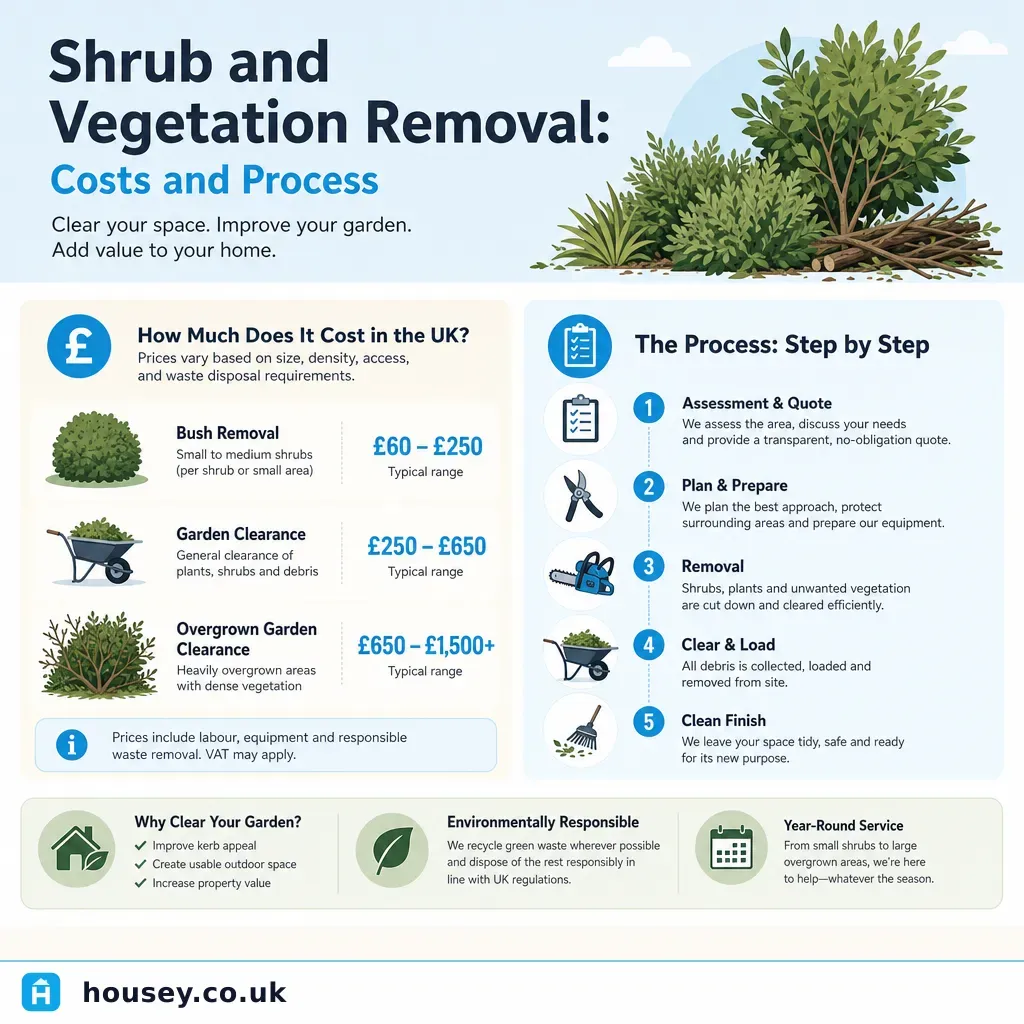
Shrub and Vegetation Removal: Costs and Process
Shrub and vegetation removal costs £50–£2,500 or more depending on area size, species involved, and whether stumps need grinding.
 Improvement & Build
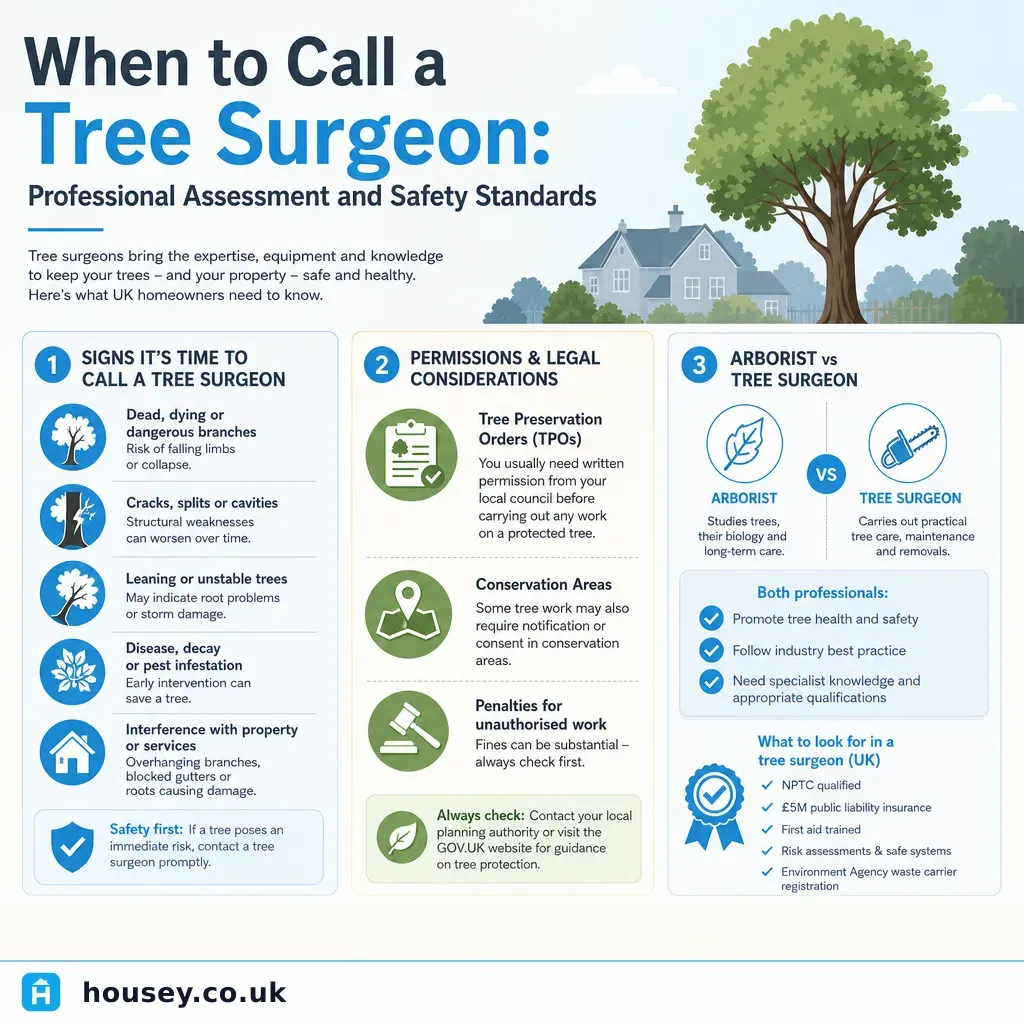
When to Call a Tree Surgeon: Professional Assessment and Safety Standards
Call a tree surgeon when a tree shows signs of disease, structural failure, or poses a risk to people or property.
 Improvement & Build
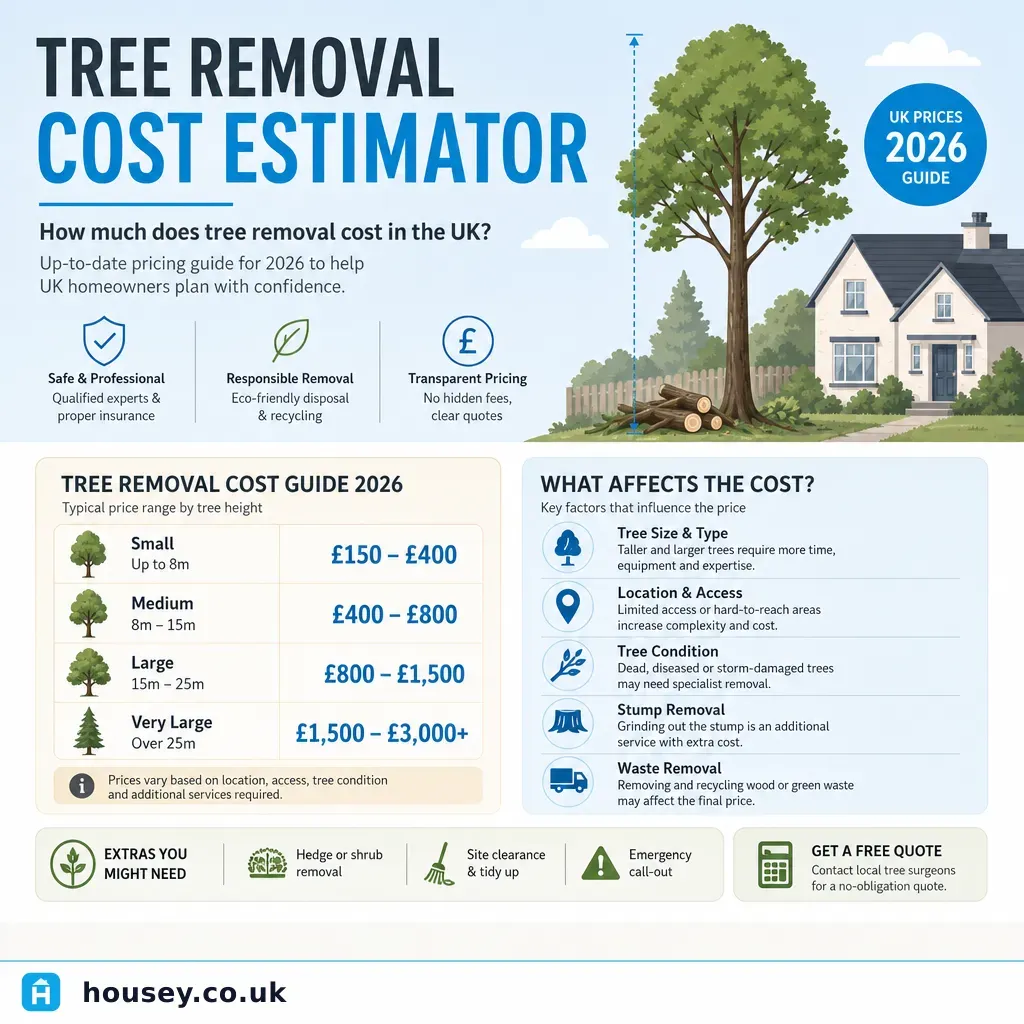
Tree Removal Cost Estimator
Tree removal in the UK costs roughly £150 to £5,000 or more, depending on the tree's height, species, access conditions, and whether stump removal is needed.
 Improvement & Build
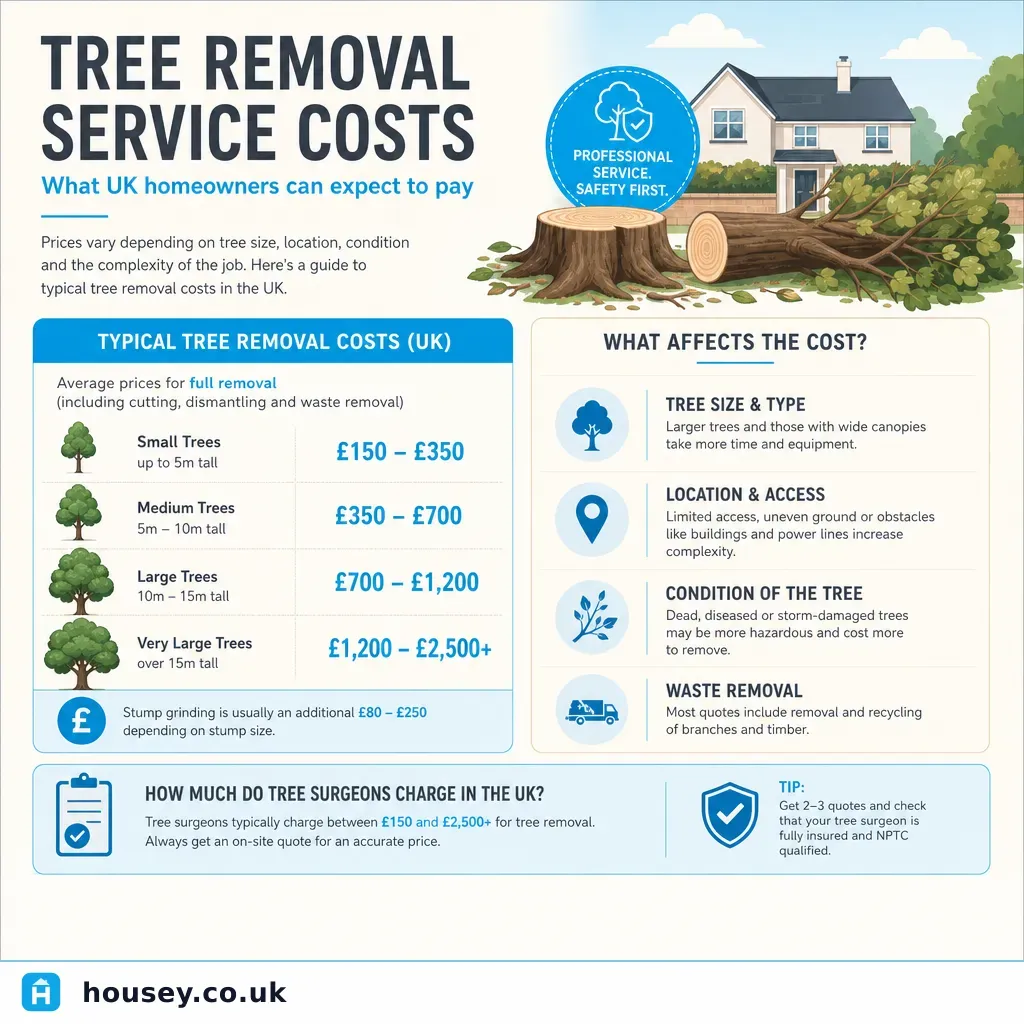
Tree Removal Service Costs
Professional tree removal costs in the UK depend on tree height, access, species, and the scope of work included.
 Improvement & Build
Land Clearance: Site Preparation Costs
Land clearance and site preparation costs in the UK vary widely depending on site size, vegetation density, access, and whether structures need demolishing.