Tree Removal Cost Estimator
By Housey · Last reviewed 11th of May 2026
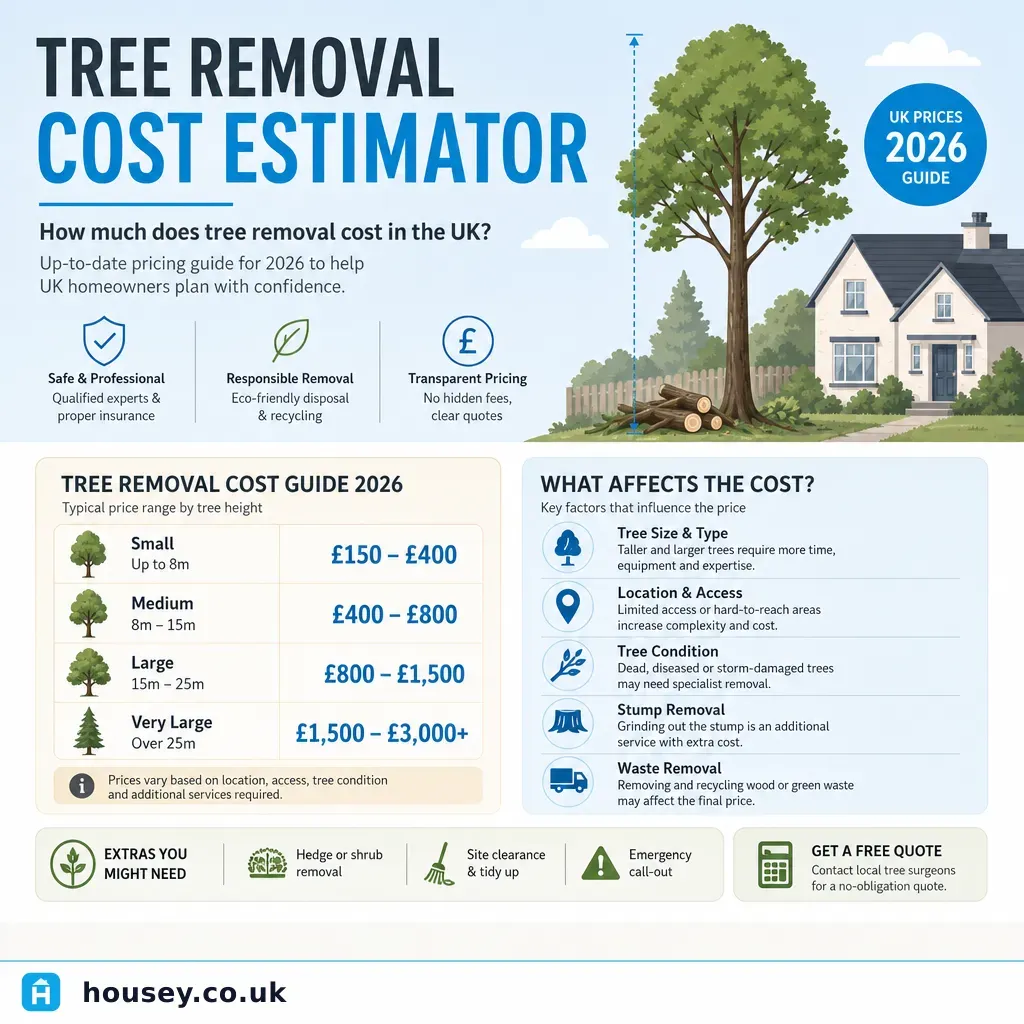
Tree Removal Cost Estimator
Tree removal becomes a practical concern in a wide range of situations: a diseased or storm-damaged tree posing a safety risk, roots threatening a drainage run or foundation, or a clearance needed ahead of an extension or garden redesign. The cost varies considerably depending on factors you can assess before contacting a tree surgeon, and building a realistic estimate in advance puts you in a stronger position when comparing quotes.
Key points
- Tree height is the single biggest cost driver: expect £150–£400 for trees under 5 m, £400–£800 for 5–10 m, and £800–£2,000+ for trees between 10 and 20 m (indicative UK costs, last reviewed 2026-05-11).
- Stump grinding or removal is almost always priced separately — add £60–£200 per stump, depending on diameter.
- Trees subject to a Tree Preservation Order (TPO) or in a conservation area require Local Planning Authority (LPA) written consent before any work; felling without consent is a criminal offence under Sections 210 and 211 of the Town and Country Planning Act 1990.
- Access difficulties — confined gardens, overhead cables, or proximity to structures — can add 25–50% to a standard quote.
- Disposal of green waste is often included in quotes but worth confirming in writing; log splitting or chipping to order may carry a small additional charge.
What factors affect the estimate?
Size and height
Height is the most reliable starting point for a rough working estimate before requesting formal quotes. Tree surgeons typically price in height bands:
Tree height | Indicative cost (removal only) | Typical scope |
|---|---|---|
Up to 5 m (small) | £150–£400 | Half-day, 1–2 crew |
5–10 m (medium) | £400–£800 | Full day, often 2 crew |
10–20 m (large) | £800–£2,000+ | Specialist rigging required |
Over 20 m (very large) | £2,000–£5,000+ | Crane may be needed |
Indicative UK costs, last reviewed 2026-05-11. Prices vary by region, species, condition, and contractor.
Species and condition
Dense hardwoods such as oak and beech take longer to section than softer species such as willow or birch. A diseased or structurally compromised tree may need more careful dismantling — though if the site allows whole-tree felling to open ground, the job may be quicker and cheaper than its height alone suggests.
Access and site conditions
A tree in an open rear garden with good vehicle access for a chipper is quicker and cheaper to remove than one in a confined side passage, close to an outbuilding, or beneath overhead cables. Restricted access that prevents use of a cherry picker or large chipper increases labour time and cost accordingly.
Stump removal
Leaving a stump creates long-term problems: regrowth from many species, trip hazards, and continued fungal activity. The main options are:
- Stump grinding: a mechanical grinder removes the stump below ground level — typically £60–£200 per stump.
- Chemical treatment: a contractor drills the stump and applies an approved herbicide — typically £40–£100 per stump, but slower to take effect.
- Full root extraction: rarely practical except in open ground; cost varies widely.
Emergency and hazard work
If a tree has fallen or presents an immediate risk, expect a premium of 50–100% above routine removal rates. Emergency contractors must prioritise callouts and may work outside normal hours.
Decision framework: estimating your cost
Use these benchmarks to arrive at a working figure before requesting formal quotes:
- Choose a budget of £150–£400 if the tree is under 5 m in an open garden with good access.
- Choose a budget of £400–£900 if the tree is 5–10 m with moderate access.
- Budget £800–£3,000+ and obtain at least three quotes if the tree is over 10 m, near buildings, or has restricted access.
- Ask for a per-tree rate if removing multiple trees in one visit — many contractors discount accordingly.
- Add £60–£200 per stump for grinding.
- Add approximately 20–30% for LPA consent and potential delays if the tree has a TPO or is in a conservation area.
TPO and conservation area rules
Before commissioning any tree work, check whether the tree is protected. A Tree Preservation Order (TPO) is attached to individual trees and makes it a criminal offence under Section 210 of the Town and Country Planning Act 1990 to remove, lop, or carry out work without prior written LPA consent.
Trees in conservation areas receive automatic protection once their trunk diameter exceeds 75 mm, measured at 1.5 m above ground level. The landowner must give the LPA six weeks' written notice before any work under Section 211 of the same Act.
Your LPA's website or planning portal usually publishes a TPO map. Reputable tree surgeons will check protection status before quoting, but the legal responsibility sits with the landowner.
Checklist: what to confirm before accepting a quote
When to get professional help
Tree removal should always be carried out by a qualified professional. Chainsaws at height are among the leading causes of serious workplace injuries in the UK, and the Health and Safety Executive (HSE) identifies working above 2 m with cutting equipment as a high-risk activity. Seek professional help if:
- The tree is taller than approximately 3 m
- It is close to buildings, fences, utilities, or boundaries
- The tree appears diseased, structurally weakened, or is leaning noticeably
- You are unsure whether a TPO applies
- A storm or partial failure has created urgent hazard conditions
Look for members of the Arboricultural Association approved contractor scheme or contractors holding NPTC/Lantra qualifications.
How Housey can help
Housey connects you with vetted tree surgeons who can confirm TPO status, assess the tree on site, and provide itemised written quotes. Compare up to four local contractors through your Housey dashboard before committing to any work.
Frequently asked questions
Does tree removal require planning permission in the UK?
You do not need planning permission to remove most trees on your own property. However, if a Tree Preservation Order applies or the tree is in a conservation area, you must obtain written consent from your Local Planning Authority before work begins. Felling a protected tree without consent is a criminal offence under the Town and Country Planning Act 1990.
Is stump removal included in a tree removal quote?
Stump removal is almost always priced separately. Most contractors quote for tree removal and stump grinding or treatment as distinct line items. A stump grind typically costs £60–£200 depending on diameter. Always confirm what is and is not included before accepting a quote.
How long does tree removal take?
A small to medium tree typically takes half a day to a full day. Larger or more complex removals — particularly sectional dismantling close to buildings — may take two or more days. Crane-assisted work adds further time for rigging, coordination, and site clearance.
Can I keep the timber after the tree is removed?
Yes, in most cases. Ask your contractor to leave usable timber sections on site. Some will split or stack logs as part of the job or for a small additional charge. Specify this when requesting quotes so it is captured in the written scope of work.
Do I need to notify my neighbours before removing a tree?
There is no legal requirement to notify neighbours before removing a tree on your own land, provided no TPO applies and the property is not in a conservation area. It is good practice to do so, particularly where branches overhang the boundary or the work will create significant noise or disruption.
Sources and further reading
- Tree Preservation Orders and trees in conservation areas — GOV.UK
- Town and Country Planning Act 1990, Sections 210–211 — legislation.gov.uk
- Arboricultural Association approved contractor scheme — Arboricultural Association
Useful next reads
 Improvement & Build
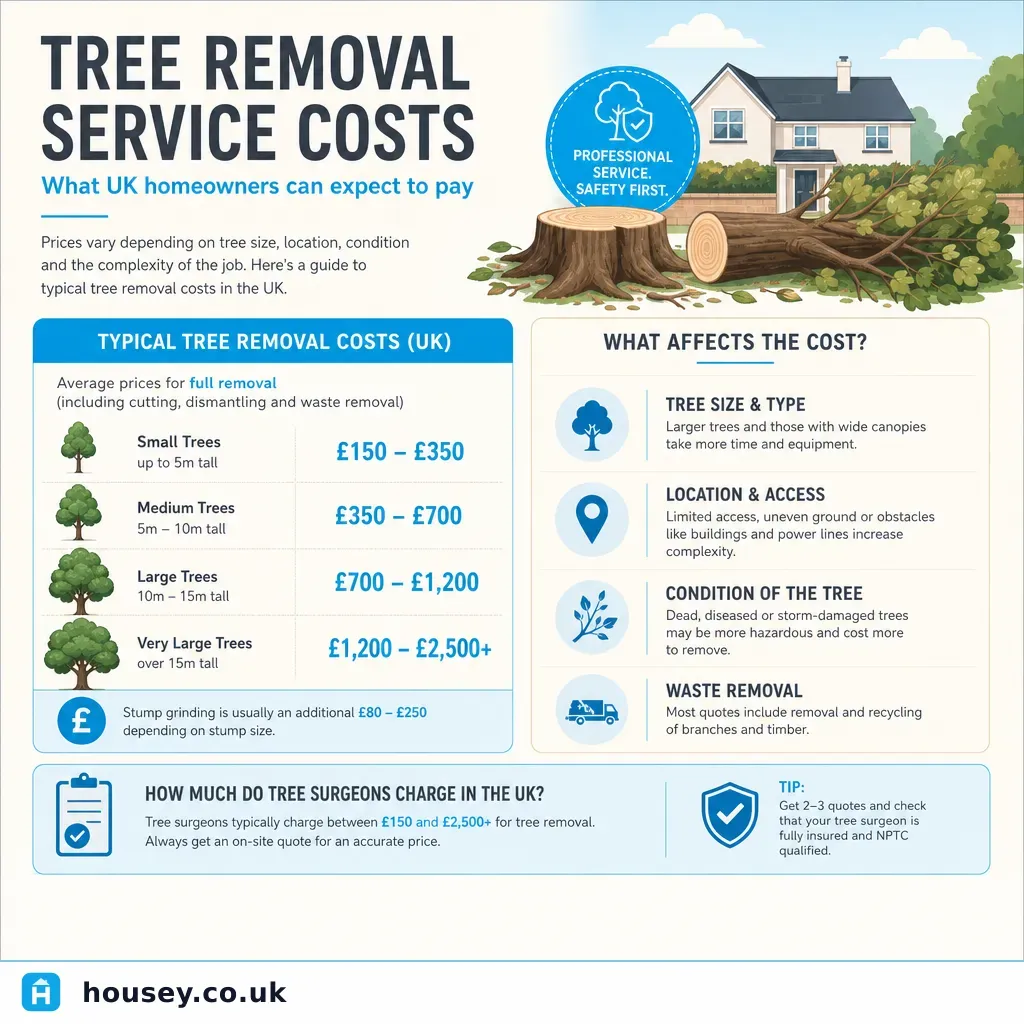
Tree Removal Service Costs
Professional tree removal costs in the UK depend on tree height, access, species, and the scope of work included.
 Improvement & Build
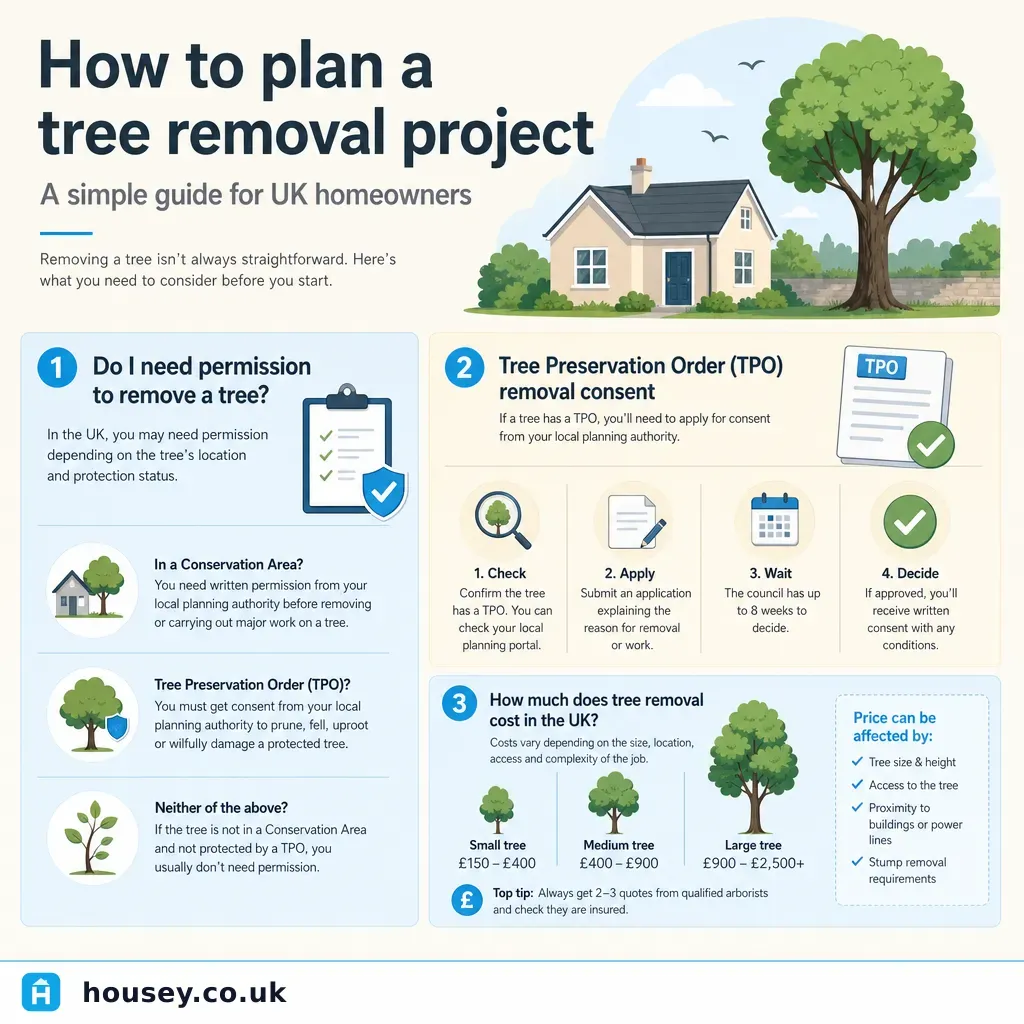
How to plan a tree removal project
Planning a tree removal project starts with checking whether the tree is protected by a Tree Preservation Order or sits in a conservation area, as both require council consent before any work begins.
 Improvement & Build
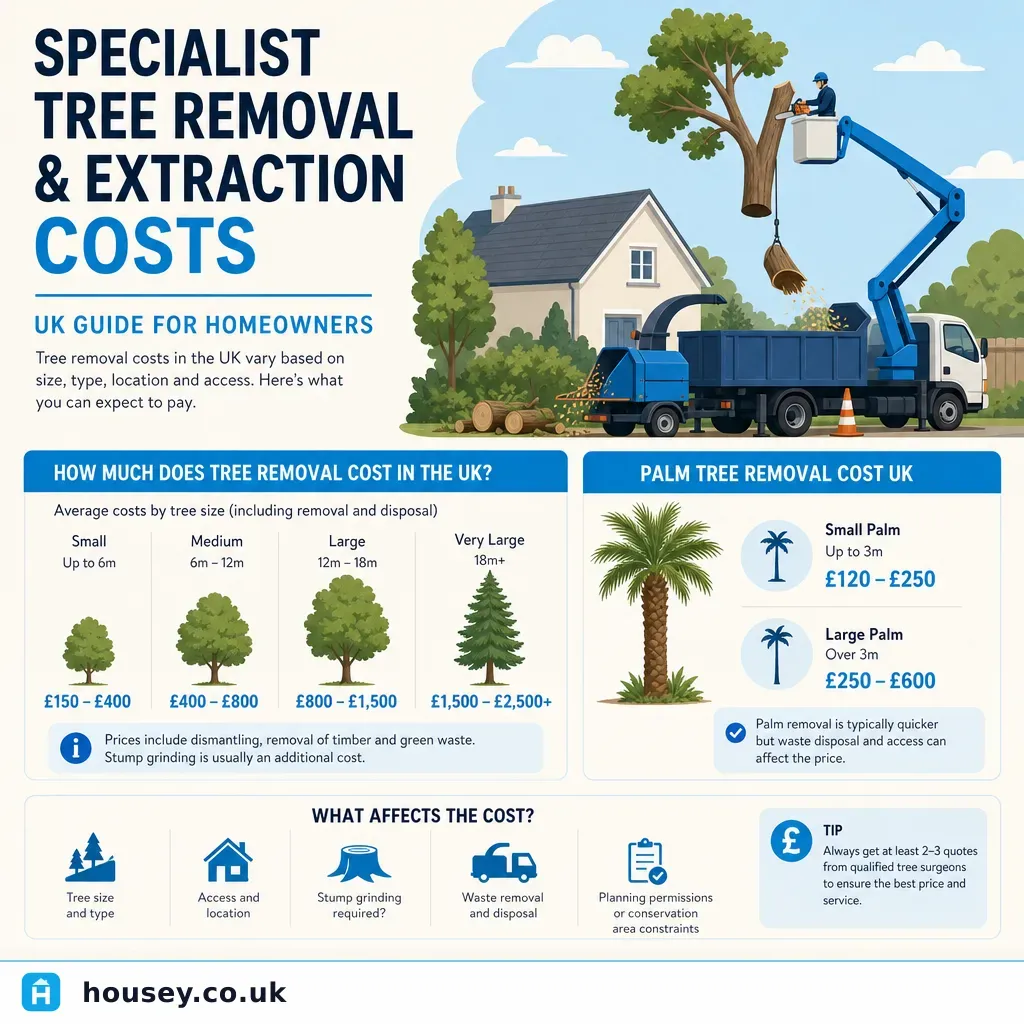
Specialist Tree Removal and Extraction Costs
Specialist tree removal costs in the UK range from around £150 for small trees to £3,000 or more for large mature specimens, with palm trees typically costing more due to specialist technique.
 Improvement & Build
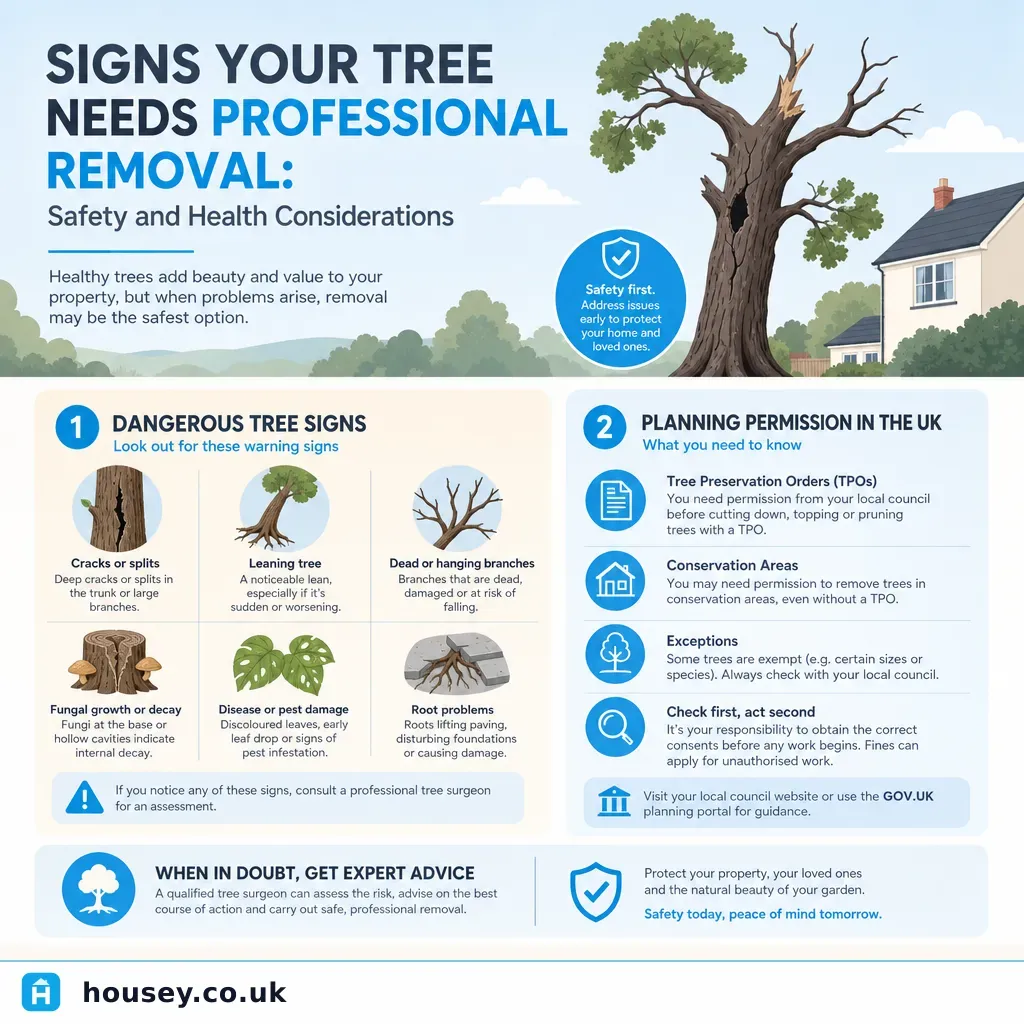
Signs Your Tree Needs Professional Removal: Safety and Health Considerations
Key signs that a tree may need professional removal include a significant recent lean, large dead or hanging branches, fungal growth at the base, hollow or cracked trunk, and visible root plate lifting.
 Improvement & Build
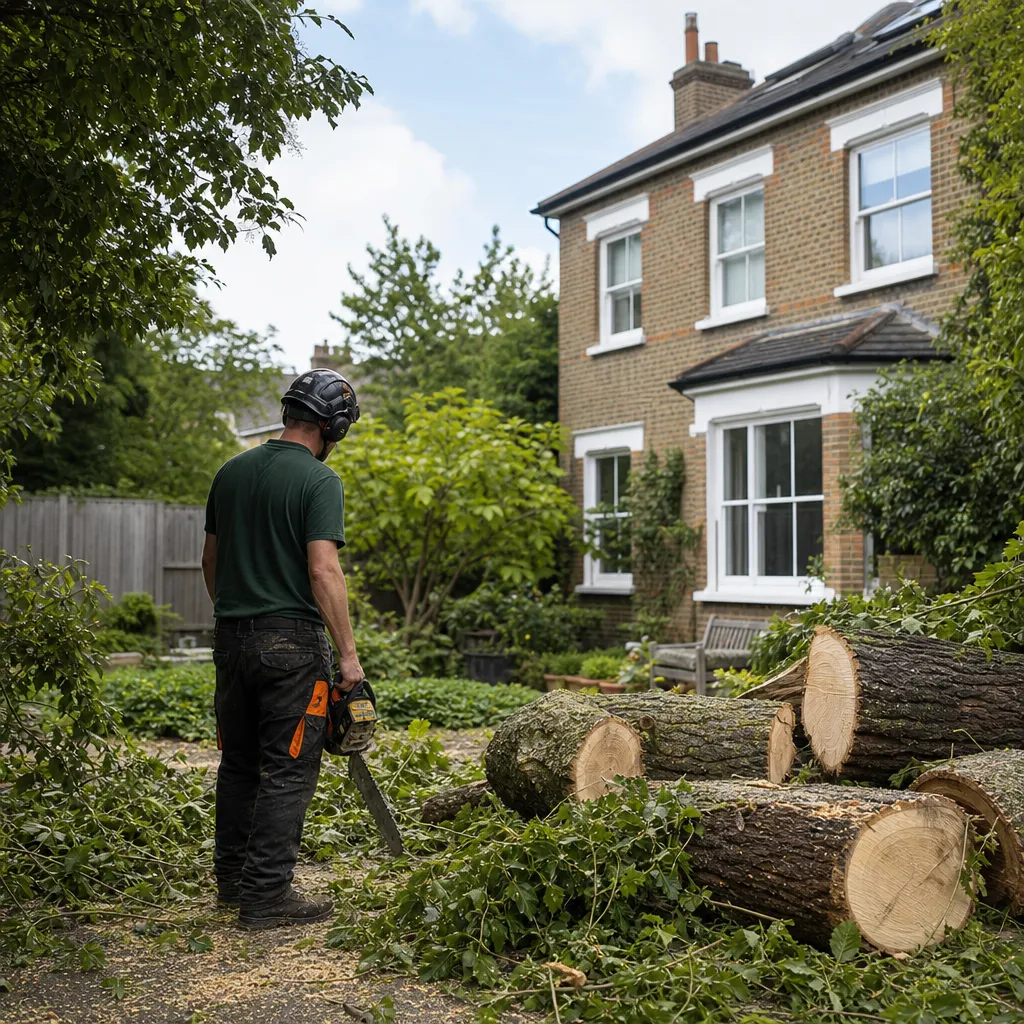
Tree Removal and Sustainable Uses for Timber
When a tree is felled, the timber can be reused as firewood (after 12–24 months' seasoning), woodchip mulch, or sawn planks.