How to budget for removing overgrown trees and shrubs
By Housey · Last reviewed 7th of May 2026
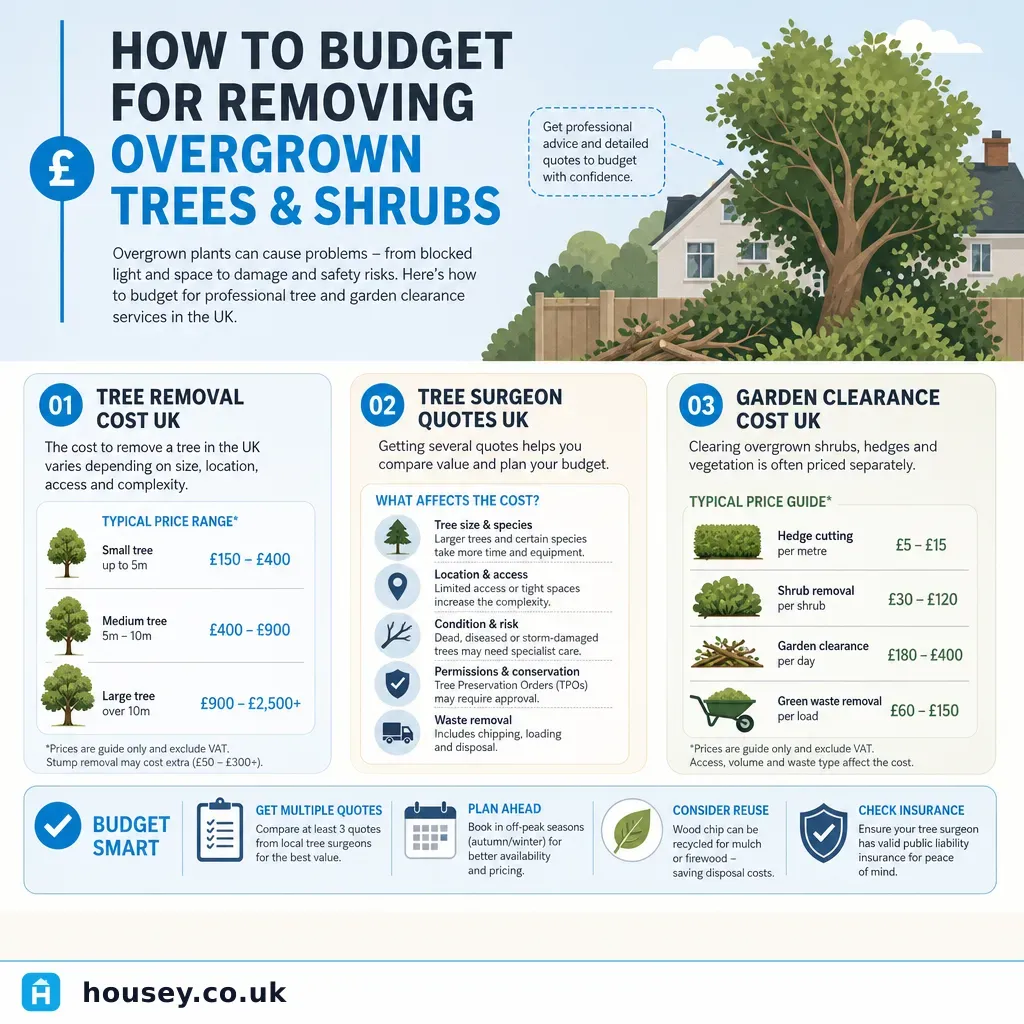
How to budget for removing overgrown trees and shrubs
Overgrown trees and shrubs are among the most commonly underestimated line items in a garden renovation or site-clearance budget. Whether you are preparing a plot for an extension, reclaiming a neglected garden, or dealing with specimens that have simply outgrown their space, costs vary widely depending on size, access, species, and what needs to happen to the waste afterwards. Getting the budget wrong at this stage can delay the rest of a project significantly.
Key points
- Tree removal in the UK typically costs between around £200 for a small tree and over £2,500 for a large specimen — most domestic jobs fall between £400 and £1,200 (indicative UK costs, last reviewed 2026-05-07).
- Trees covered by a Tree Preservation Order (TPO) or in a Conservation Area cannot be felled or significantly pruned without prior written consent from your local planning authority — check before instructing any contractor.
- Waste disposal and chipping fees are often excluded from headline quotes; always ask whether skip hire, green waste removal, or on-site chipping is included.
- Arboricultural Association-registered tree surgeons should carry public liability insurance of at least £5 million — ask to see the certificate before work begins.
- A full garden clearance involving multiple trees, heavy shrub growth, and ground preparation may require both a tree surgeon and a landscaper, working in sequence.
What affects the cost of tree and shrub removal
Several factors push costs up or down significantly:
Size and species: A 3-metre ornamental cherry is a very different undertaking from a 15-metre mature oak. Hardwoods such as oak and beech are denser and slower to process than softwoods. Dense species such as bamboo and leylandii hedging are particularly labour-intensive to remove in full.
Access: Can a chipper van reach the garden? Is the tree close to a boundary wall, a building, or overhead power lines? Poor access often means hand-carrying sections, which significantly increases labour hours.
Number of operatives: Felling a large tree safely usually requires at least two operatives and, for larger specimens, an aerial climber. More operatives mean higher day rates.
Stump removal: Felling is separate from stump grinding. If you want the stump removed — often necessary before laying a lawn or patio — expect to add approximately £60–£250 per stump, depending on diameter.
Disposal method: On-site chipping, loading into a skip, or removal in the contractor's vehicle each carry different cost implications. Chipping reduces volume but leaves a pile of woodchip on site to manage.
Location: Rates in London and the South East tend to run 20–40% higher than in the Midlands or North.
Indicative cost ranges by job type
Job | Typical UK range | Notes |
|---|---|---|
Small shrub or hedge removal (up to 1.5m) | £80–£250 | Often included in a landscaper day rate |
Large shrub or dense hedge (1.5–3m) | £150–£450 | Disposal may be extra |
Small tree felling (up to 5m) | £200–£500 | Including basic clearance |
Medium tree felling (5–10m) | £400–£900 | Climber may be needed |
Large tree felling (10m+) | £800–£2,500+ | Complex access, multiple operatives |
Stump grinding (per stump) | £60–£250 | Depends on diameter |
Full garden clearance (average plot) | £300–£1,500+ | Highly variable by volume and condition |
Skip hire (small, 4–6 yd³) | £200–£400 | Regional variation; road permit may be required |
Indicative UK costs, last reviewed 2026-05-07. Prices vary by region, contractor, and site conditions. Obtain at least three quotes.
Do you need a tree surgeon or a landscaper?
The right professional depends on the work involved:
- Choose a tree surgeon if the work involves trees over around 4–5 metres, any climbing or aerial work, trees near structures or power lines, trees with suspected disease or instability, or any tree covered by a TPO.
- Choose a landscaper for shrub clearance, hedge removal up to around 2–3 metres, ground-level removal of small specimens, and post-clearance tidying and replanting.
- Use both in sequence for full garden overhauls — tree surgeons first for the canopy and large specimens, landscapers next for ground clearance, levelling, and new planting.
- Ask a qualified professional if you are unsure whether a tree is protected, diseased, or structurally unstable before commissioning any work.
Tree Preservation Orders and Conservation Areas
Before any tree work begins, check whether the trees are subject to a Tree Preservation Order (TPO) or are in a Conservation Area. Both impose legal restrictions under the Town and Country Planning Act 1990 and the Town and Country Planning (Tree Preservation) (England) Regulations 2012.
- TPO trees: You must apply to your local planning authority (LPA) and receive written consent before felling or carrying out substantial pruning. Applications are free. Processing typically takes up to eight weeks. Carrying out work without consent is a criminal offence carrying an unlimited fine.
- Conservation Area trees: You must give six weeks' written notice to your LPA before starting work on any tree with a trunk diameter over 75mm measured at 1.5 metres from ground level. The authority may choose to impose a TPO during this period.
- Exemptions include trees that are dead, dying, or present an immediate danger to the public — but retain documentary evidence of any emergency works carried out.
Your local planning portal or council's TPO register will show protected trees. Your tree surgeon should flag any protections, but the legal duty to comply rests with the landowner.
What to include in your quote request
Homeowner checklist: what to ask before accepting a quote
- How many operatives will be on site, and what qualifications or accreditations do they hold?
- Is the contractor a member of the Arboricultural Association, or do they hold an NPTC/Lantra qualification?
- Does the quote include waste removal and disposal, or is that charged separately?
- Will a skip be required, and who arranges and pays for it?
- Is stump grinding included? If not, what is the additional cost per stump?
- Does the contractor carry public liability insurance of at least £5 million — can I see the certificate?
- Have you checked whether any trees are subject to a TPO or are in a Conservation Area?
- What will be left on site at the end of the job?
- Is VAT included in the quoted price?
- What is the payment schedule, and is a deposit required?
Red flags to watch for
- A contractor who cannot provide proof of public liability insurance.
- No mention of checking for TPOs before starting work.
- A quote delivered verbally only, with no written breakdown.
- A very low headline price with disposal, stump grinding, and waste removal excluded in the small print.
- Pressure to make a same-day decision without time to compare quotes.
- No fixed business address, no company registration number, and cash-only payment demanded upfront.
When to get professional help
Tree work always carries risk. Instruct a qualified tree surgeon for any tree over roughly four metres, any tree showing visible signs of disease or structural failure — cracks in the trunk, deadwood in the crown, or leaning with exposed root plates — and any tree within falling distance of a building, vehicle, or public area.
Do not attempt to fell even a small tree yourself if it is close to a fence, wall, or building, if you are unsure of the direction of fall, or if there are overhead cables nearby.
For suspected disease — particularly ash dieback (Hymenoscyphus fraxineus) — check the Forestry Commission guidance and consider notifying your local authority where appropriate.
How Housey can help
Housey can help you find and compare quotes from qualified tree surgeons and experienced landscapers in your area. Request quotes from multiple contractors, compare what is included, and start your project on a sound footing.
Frequently asked questions
Do I need planning permission to remove a tree in my garden?
You do not need planning permission to remove a tree unless it is protected by a Tree Preservation Order (TPO) or located in a Conservation Area. For TPO trees, you must apply to your local planning authority and receive written consent before work starts. For Conservation Area trees, you must give six weeks' written notice. Check your council's TPO register before instructing any contractor.
Is tree removal covered by home insurance?
Standard buildings and contents insurance typically does not cover the cost of removing healthy trees, even where they pose a risk. Some policies may cover emergency removal of a fallen tree that has caused damage to a structure. Check your policy wording carefully and speak to your insurer before booking work if you are unsure.
How long does it take to remove a large tree?
A small tree can usually be felled and cleared in two to four hours. A large or complex specimen near a building may take a full day or more for a crew of two or three. Access constraints, the disposal method, and stump grinding will all add to the overall time on site.
Can I leave the stump in the ground?
You can leave a stump in place if you are not replanting or laying hard landscaping over it. However, some species such as cherry can regrow from the stump, and stumps can attract honey fungus (Armillaria spp.), which may spread to nearby healthy trees and shrubs. Grinding or chemical treatment is advisable where other planting is close by.
How many quotes should I get for tree work?
Aim for at least three written quotes from contractors who have visited the site in person. Each quote should itemise labour, waste disposal, stump removal if applicable, and VAT separately so you can compare on a like-for-like basis and avoid unexpected costs once work begins.
Sources and further reading
- Tree Preservation Orders and trees in conservation areas — GOV.UK
- Find a tree surgeon — Arboricultural Association
- Ash dieback (Hymenoscyphus fraxineus) — Forest Research
- Garden waste disposal — GOV.UK
Useful next reads
 Improvement & Build
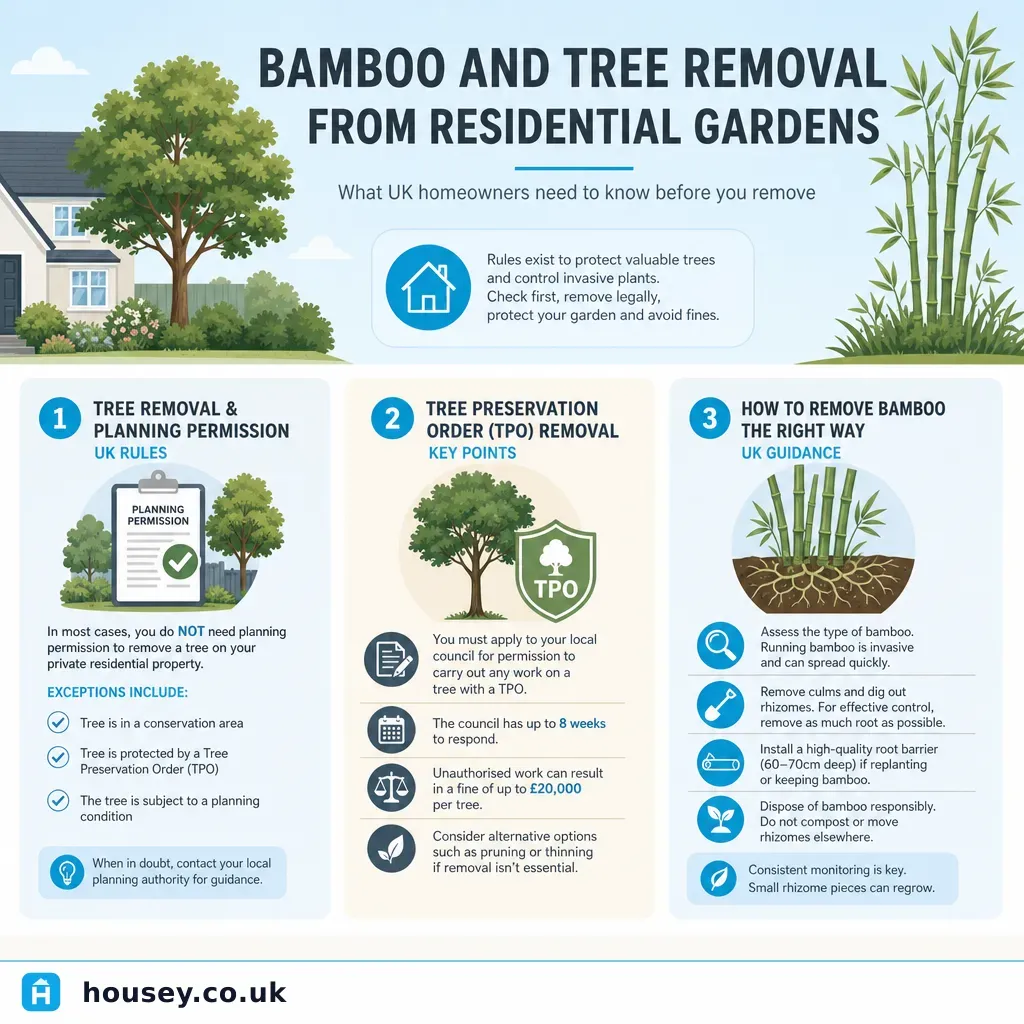
Bamboo and Tree Removal from Residential Gardens
Tree removal in UK gardens may need local authority approval if the tree has a Tree Preservation Order or sits in a conservation area.
 Improvement & Build
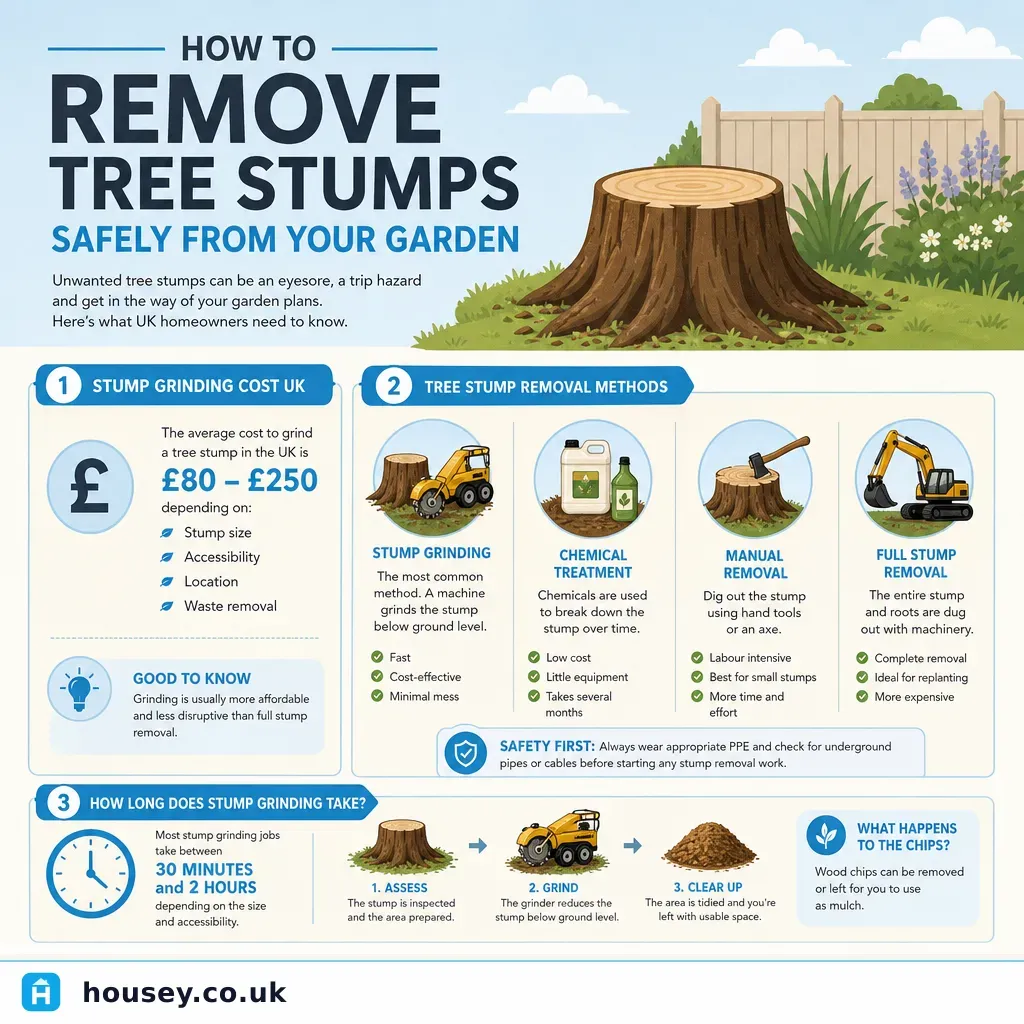
How to Remove Tree Stumps Safely from Your Garden
Tree stump removal in the UK typically involves stump grinding, chemical treatment, or manual excavation.
 Improvement & Build
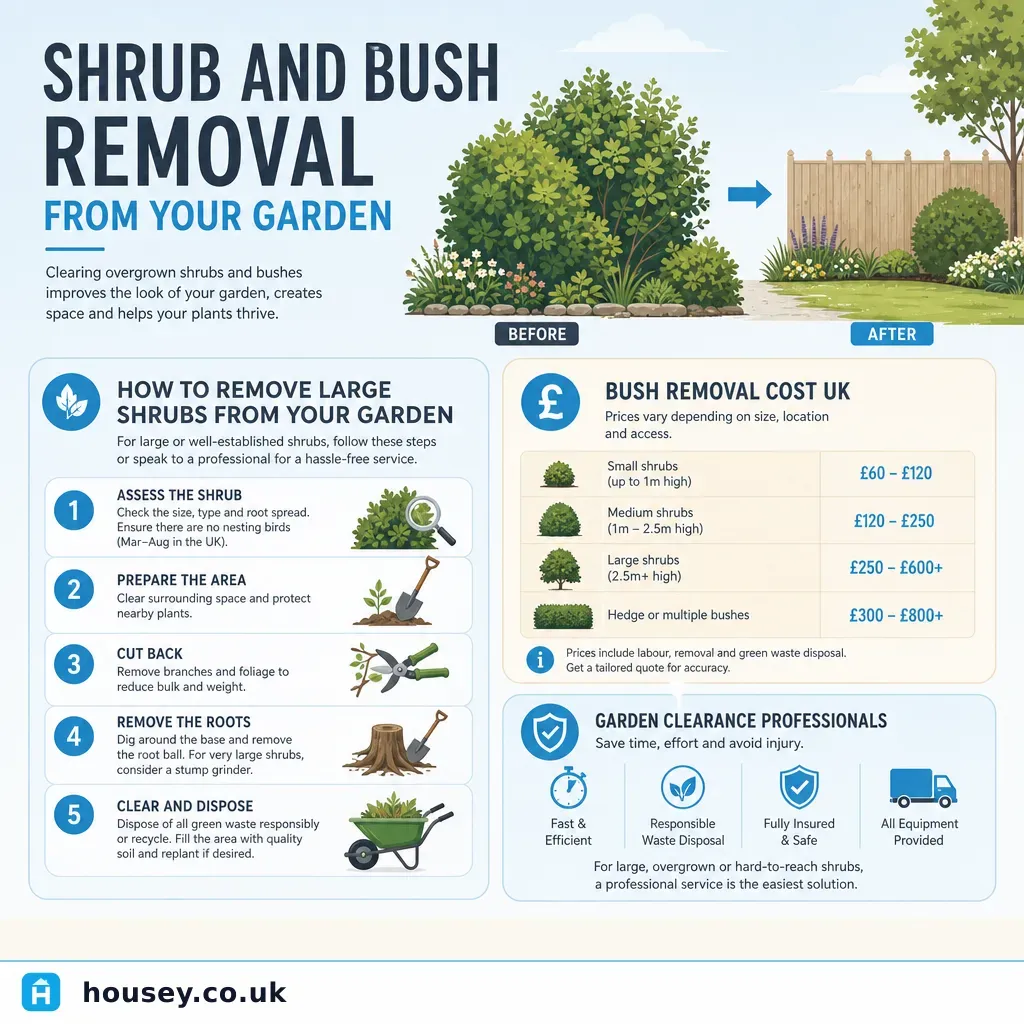
Shrub And Bush Removal From Your Garden
Shrub and bush removal ranges from a DIY afternoon's work to a professional job needing a mini-digger or stump grinder.
 Improvement & Build
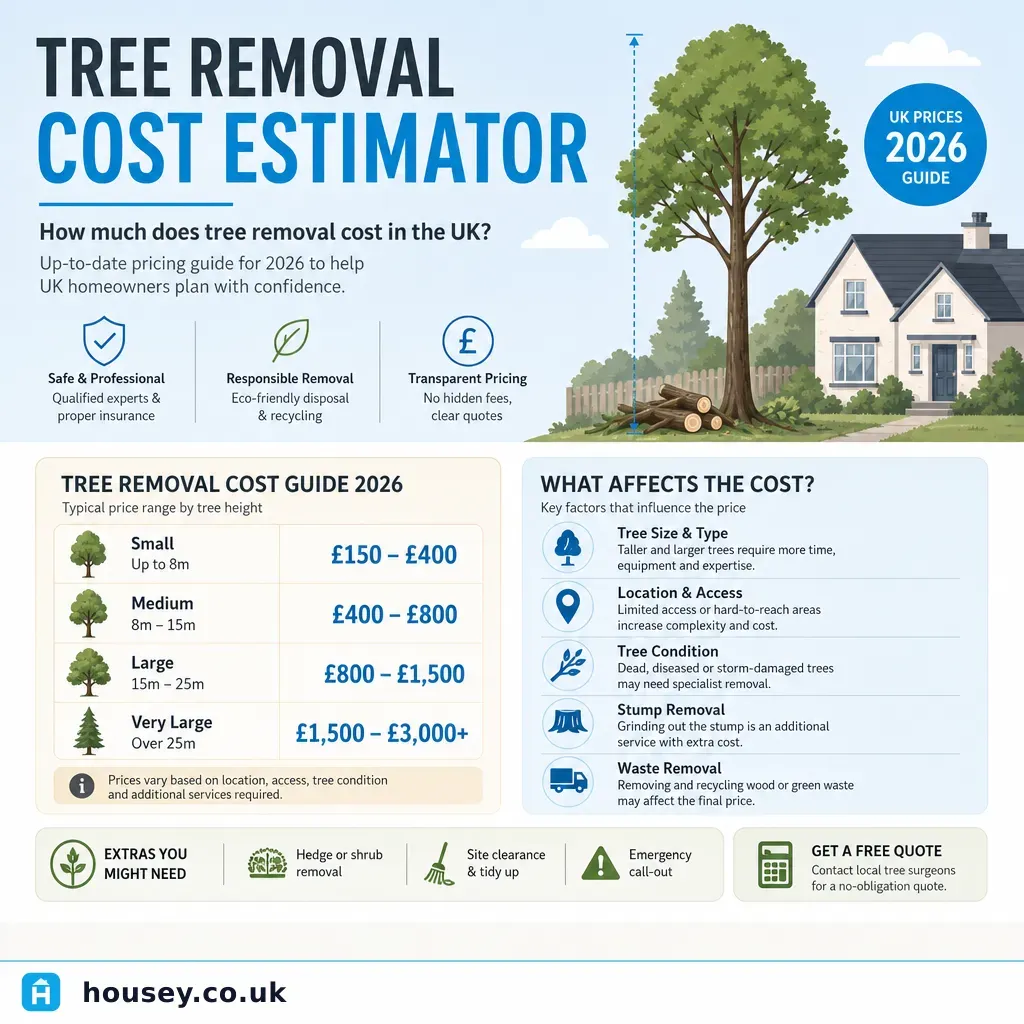
Tree Removal Cost Estimator
Tree removal in the UK costs roughly £150 to £5,000 or more, depending on the tree's height, species, access conditions, and whether stump removal is needed.
 Improvement & Build
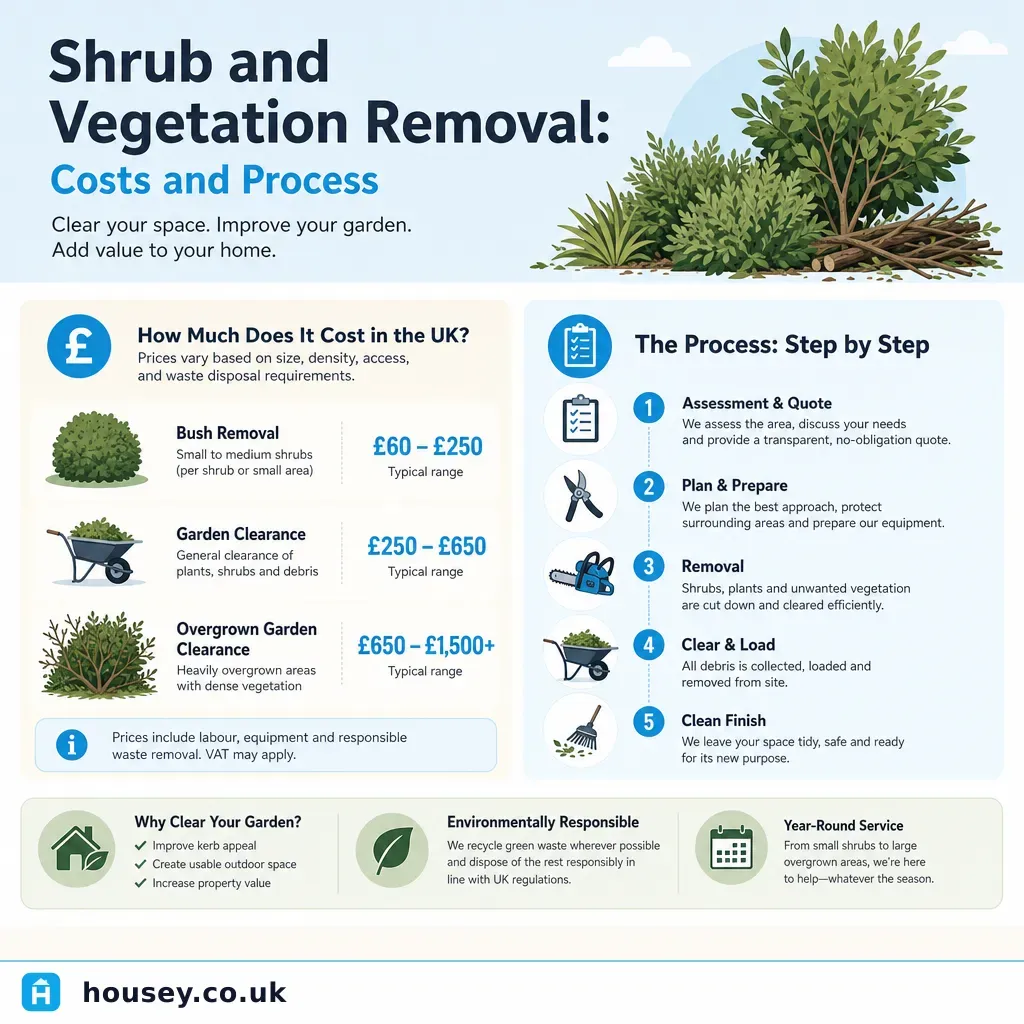
Shrub and Vegetation Removal: Costs and Process
Shrub and vegetation removal costs £50–£2,500 or more depending on area size, species involved, and whether stumps need grinding.