How to plan a tree removal project
By Housey · Last reviewed 19th of May 2026
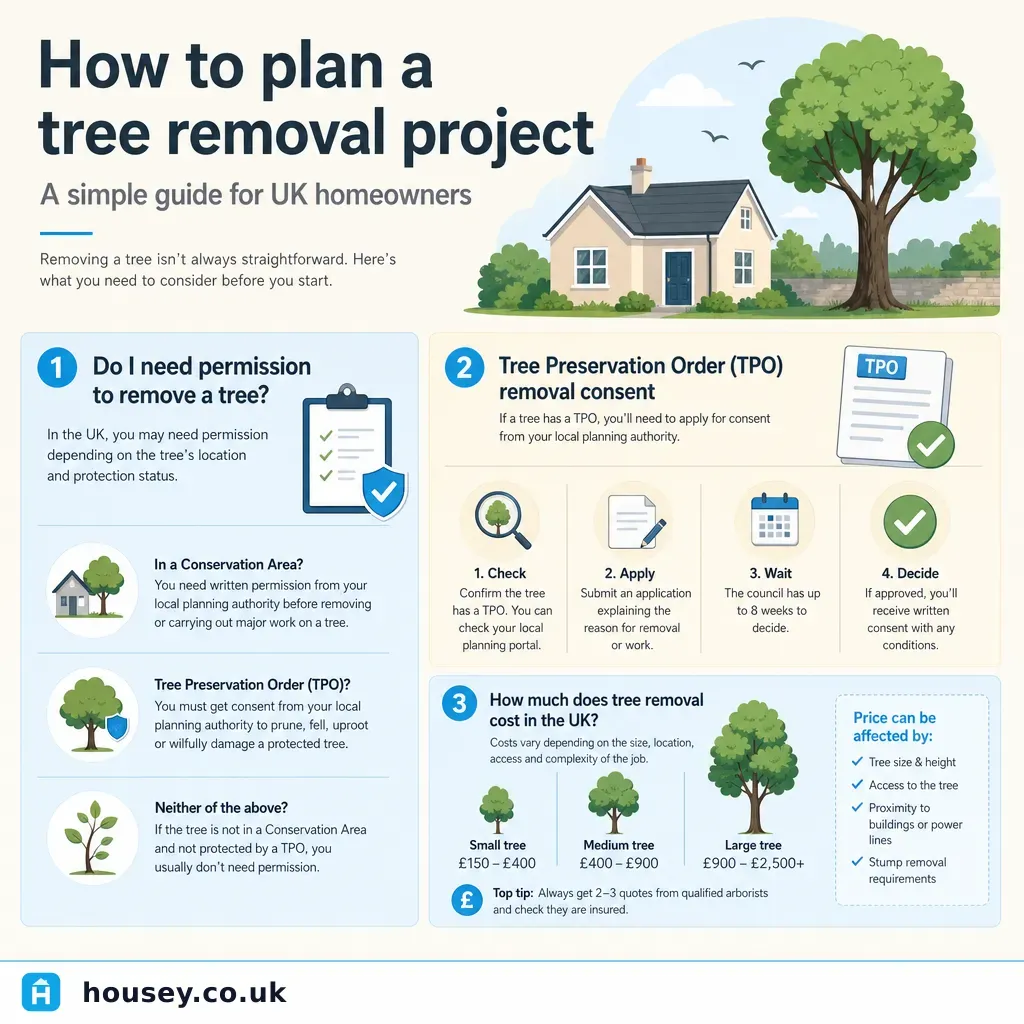
How to plan a tree removal project
Whether you are clearing a storm-damaged tree, making room for an extension, or removing an overgrown specimen that has outgrown its space, tree removal requires considerably more preparation than it might first appear. Legal protections on certain trees, safety requirements for chainsaw and aerial work, and waste disposal obligations all need thinking through before any cutting begins — getting this wrong can result in criminal prosecution, civil liability, or serious injury.
Key points
- Removing a tree subject to a Tree Preservation Order (TPO) without prior consent from your local planning authority (LPA) is a criminal offence under sections 210–211 of the Town and Country Planning Act 1990, with unlimited fines on conviction.
- Trees in conservation areas are automatically protected: you must give your LPA at least six weeks' written notice before carrying out any works, allowing time for them to consider making a TPO.
- A qualified arborist should hold relevant NPTC/Lantra certificates of competence — such as CS30 (ground-level chainsaw use and felling), CS31 (aerial chainsaw work), and CS38 (climbing and rescue) — and hold current public liability insurance; ask for evidence of both before instructing any contractor.
- Ground clearance, stump grinding, and waste disposal are separate activities from felling; clarify what is included in any written quotation before accepting it.
- Large stumps left in situ can regenerate (particularly ash, cherry, and sycamore) or attract honey fungus (Armillaria spp.), which spreads to other garden plants through root systems.
Is your tree protected? Check before you do anything
Before commissioning any tree work, establish whether the tree is legally protected. There are two main protection mechanisms in England and Wales.
Tree Preservation Orders (TPOs)
A TPO is made by a local planning authority and can protect individual trees, groups, or woodlands. To check:
- Search your council's website for their TPO register — most English LPAs publish an interactive map.
- Contact your LPA in writing if you are uncertain; ask for written confirmation of the position.
- Review the property's title register via HM Land Registry, which sometimes records TPO restrictions.
If a TPO applies, you must apply for consent to carry out works or to fell the tree before any work begins. Applications to LPAs are generally free and the LPA typically decides within eight weeks.
Trees in conservation areas
If your property is within a designated conservation area, all trees with a trunk diameter of 75 mm or more (measured at 1.5 m above ground level) are automatically protected. You must give your LPA six weeks' written notice using the GOV.UK tree works notification service before starting any work.
Carrying out works to a protected tree without the required consent or notice is a criminal offence, with unlimited fines under sections 210–211 of the Town and Country Planning Act 1990.
Decision tree: do you need council consent?
- Is the tree covered by a TPO? Apply for consent from your LPA before any work begins. If unsure, check the council's TPO register first.
- Is the property in a conservation area and is the trunk 75 mm or more in diameter at 1.5 m? Submit a six-week written notice to your LPA before any work.
- Is the tree in a private garden with no TPO and not in a conservation area? No formal consent is needed, but check with your LPA in writing if you have any doubt about the tree's status.
- Is the tree dead, dying, or an immediate danger to people or property? Emergency works are permitted even on protected trees to remove an immediate risk, but notify your LPA as soon as practicable and retain the timber as evidence.
- Does the tree overhang a boundary, or could it fall onto a neighbour's property? Works affecting neighbouring land require their consent; falling branches can give rise to civil liability claims.
Hiring a qualified tree surgeon
Tree surgery — particularly felling large trees, working in confined gardens, or dismantling trees in sections near structures — is among the most physically hazardous work carried out in domestic settings. The right contractor matters for both safety and legal compliance.
What to check before instructing any contractor:
- NPTC/Lantra certificates of competence for the specific operations proposed: CS30 for ground-level chainsaw use and basic felling; CS31 for aerial chainsaw work; CS38 for climbing and rescue techniques.
- Public liability insurance: a minimum of £2 million cover is typical for domestic work; ask to see the current certificate before work begins.
- Arboricultural Association Approved Contractor status: this scheme independently assesses contractors for safety practices, competence, and insurance. It is not a legal requirement but is a strong indicator of quality.
- A written quotation specifying exactly what is included: felling, removal of timber and brash, stump grinding or removal, and site clearance.
Avoid contractors who quote without visiting the site, cannot produce an insurance certificate, or pressure you to agree immediately.
Planning the project: a homeowner checklist
What to ask before accepting a quote
- What is included and excluded from the quoted price?
- Who will carry out the work, and what NPTC/Lantra qualification units do they hold?
- Can you provide a current public liability insurance certificate?
- Are you an Arboricultural Association Approved Contractor?
- What is the proposed method — sectional dismantling or straight fell? (Especially relevant in confined gardens or near structures.)
- Is stump grinding included? If not, what is the additional cost?
- How will timber and green waste be disposed of, and can I retain any timber for firewood?
- What happens if the tree is found to be more complex or larger than initially assessed?
- Is VAT included in the quoted price?
Stump removal: your options
Option | Description | Indicative cost range | Best for |
|---|---|---|---|
Stump grinding | Machine grinds the stump to below ground level; chippings left on site | £80–£400 per stump | Most domestic gardens |
Chemical treatment | Herbicide applied to the cut surface; effective over 1–3 years | Low cost | Non-urgent stumps where budget is limited |
Manual excavation | Digging out by hand or mini-digger | £200–£800+ | Where the area is to be built on or heavily replanted |
Indicative UK costs, last reviewed 2026-05-19. Costs vary by stump size, species, root spread, and site access.
Waste disposal and timber
Tree surgery generates significant volumes of green waste and timber. Options include:
- Timber retained for firewood: agree this at quote stage; timber will need seasoning before use in a wood-burning appliance.
- Green waste chipped on site: many contractors include chipping in their price — confirm this in writing.
- Waste removed by the contractor: confirm the destination is a licensed waste facility; for significant volumes, ask for a waste transfer note.
Do not allow open burning of green waste on your property without checking local bylaws; this is subject to restrictions and can result in nuisance complaints or council enforcement action.
Important limitations
This article provides general information about tree removal planning in England. Rules differ in Wales, Scotland, and Northern Ireland. Whether a tree is protected by a TPO or falls within conservation area legislation depends on your specific property and location — always verify in writing with your LPA before commissioning any work. This article does not constitute legal advice. If you have already carried out works to a protected tree without consent, seek advice from a planning solicitor promptly.
What to ask a qualified professional
Before instructing a tree surgeon:
- Have you confirmed the TPO register and conservation area status for this specific tree?
- What NPTC/Lantra qualification units do you hold for the operations proposed?
- Can you provide a current public liability insurance certificate?
- Are you an Arboricultural Association Approved Contractor?
- What method will you use — sectional dismantling or straight fell — and why is that appropriate for this site?
- Is stump grinding included in the quote? If not, what does it cost?
- How will timber and green waste be disposed of legally?
- Is VAT included in the quoted price?
When to get professional help
All chainsaw use, aerial tree work, and felling of any tree more than knee height must be carried out by a trained and qualified arborist. Do not attempt to fell or significantly prune a tree yourself unless it is very small and entirely clear of structures, overhead cables, and boundaries.
Seek professional help immediately if:
- You have already disturbed a tree that may be subject to a TPO.
- The tree is leaning towards a structure, overhead power lines, or a neighbouring property.
- You notice bracket fungi at the base of the tree, which may indicate internal structural decay.
- Roots are affecting building foundations, drainage runs, or neighbouring land.
- The tree requires sectional dismantling in a confined space near structures or boundaries.
How Housey can help
Housey connects you with vetted tree surgeons who hold the relevant qualifications and insurance for safe, lawful tree removal, and with landscapers who can help restore, replant, and redesign your garden once the tree has been removed.
Frequently asked questions
Do I need permission to remove a tree in my garden?
It depends on the tree. If it is covered by a Tree Preservation Order, you need consent from your local planning authority before any work begins. In a conservation area, trees with a trunk 75 mm or more in diameter require six weeks' written notice to the LPA. Neither rule applies to most trees in unprotected private gardens, but verify with your LPA if unsure.
How much does tree removal cost in the UK?
Costs vary considerably by tree size, species, access, and whether stump removal is included. Small trees may cost from £150 to £400; larger or complex trees can exceed £1,000 to £3,000 or more. Always obtain at least three written, itemised quotes. Indicative UK costs, last reviewed 2026-05-19.
What qualifications should a tree surgeon have?
Look for NPTC/Lantra certificates of competence for the specific operations proposed: CS30 for ground-level chainsaw use and felling, CS31 for aerial chainsaw work. The contractor should hold current public liability insurance and, ideally, Arboricultural Association Approved Contractor status, which confirms independent assessment of their safety standards and competence.
What happens to the stump after felling?
The stump can be left in situ, chemically treated with herbicide, ground down below ground level using a stump grinder, or excavated manually. Stump grinding is the most practical solution for most domestic gardens. Confirm at quotation stage whether stump removal is included in the price, as it is often quoted separately from the felling work.
Can I burn the timber from a felled tree?
Open burning of green garden waste is subject to restrictions in most areas and can cause nuisance. Seasoned timber can be used in a wood-burning appliance if it meets moisture content requirements under current Clean Air Act regulations. For green waste and brash, the most practical option is usually to have the contractor chip it on site or remove it to a licensed facility.
Sources and further reading
- Tree Preservation Orders and trees in conservation areas — GOV.UK
- Apply to carry out works on a protected tree — GOV.UK
- Arboricultural Association Approved Contractors — Arboricultural Association
- Town and Country Planning Act 1990, sections 210–211 — legislation.gov.uk
- Lantra Awards: NPTC chainsaw and arboriculture qualifications — Lantra Awards
Useful next reads
 Improvement & Build
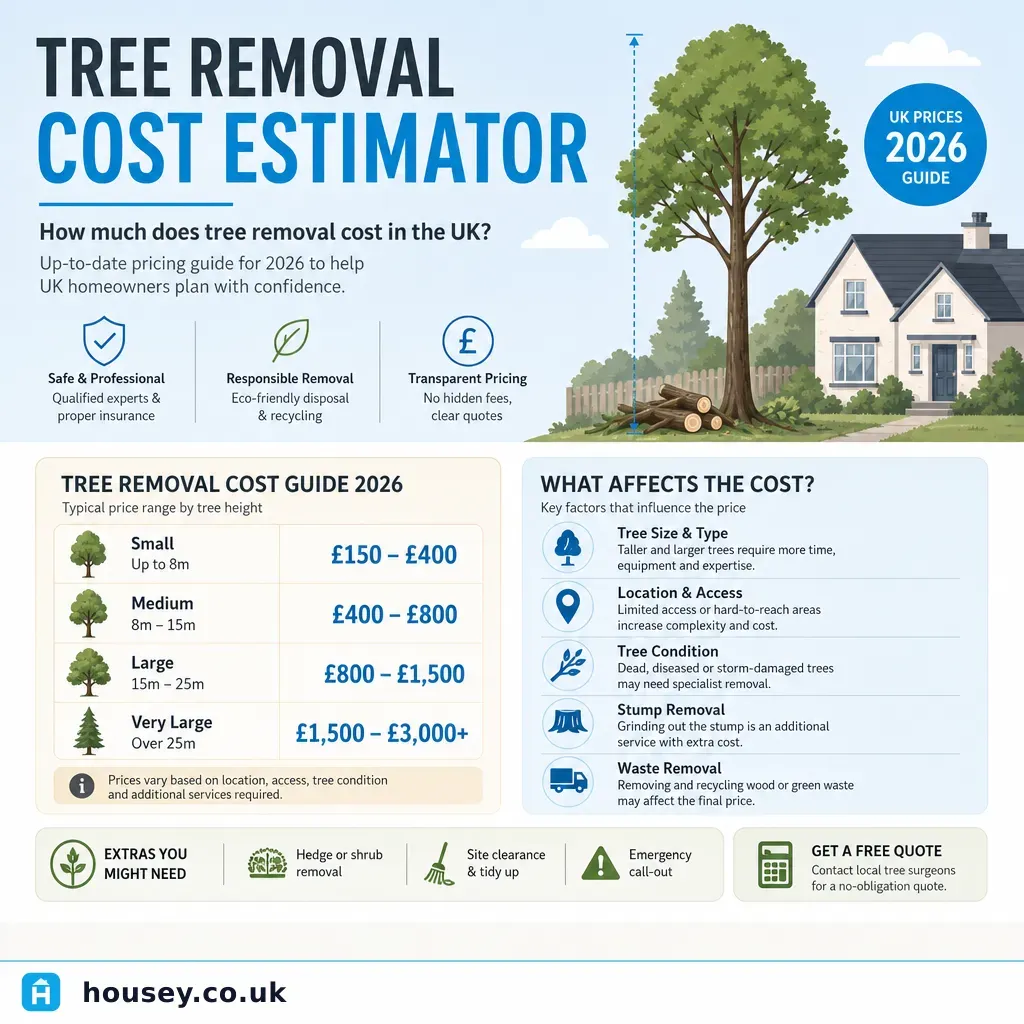
Tree Removal Cost Estimator
Tree removal in the UK costs roughly £150 to £5,000 or more, depending on the tree's height, species, access conditions, and whether stump removal is needed.
 Improvement & Build
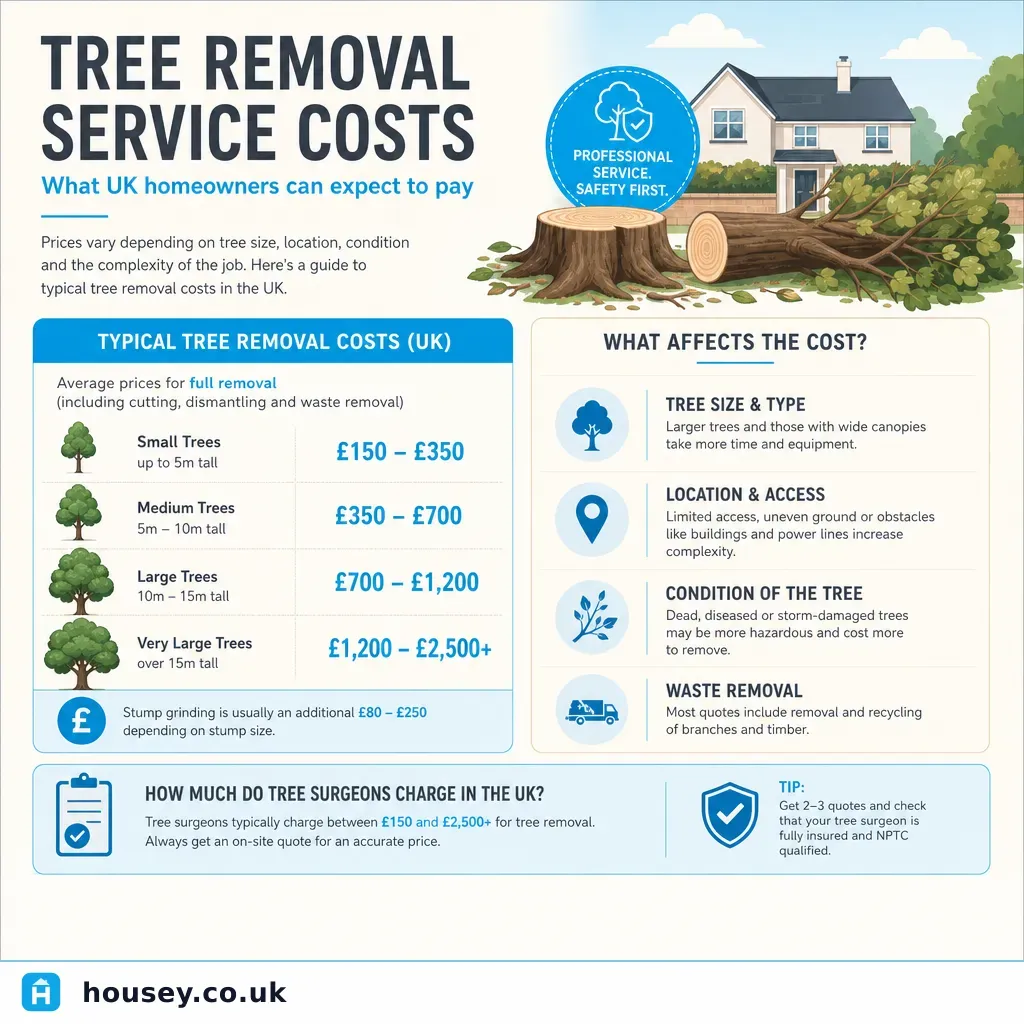
Tree Removal Service Costs
Professional tree removal costs in the UK depend on tree height, access, species, and the scope of work included.
 Improvement & Build
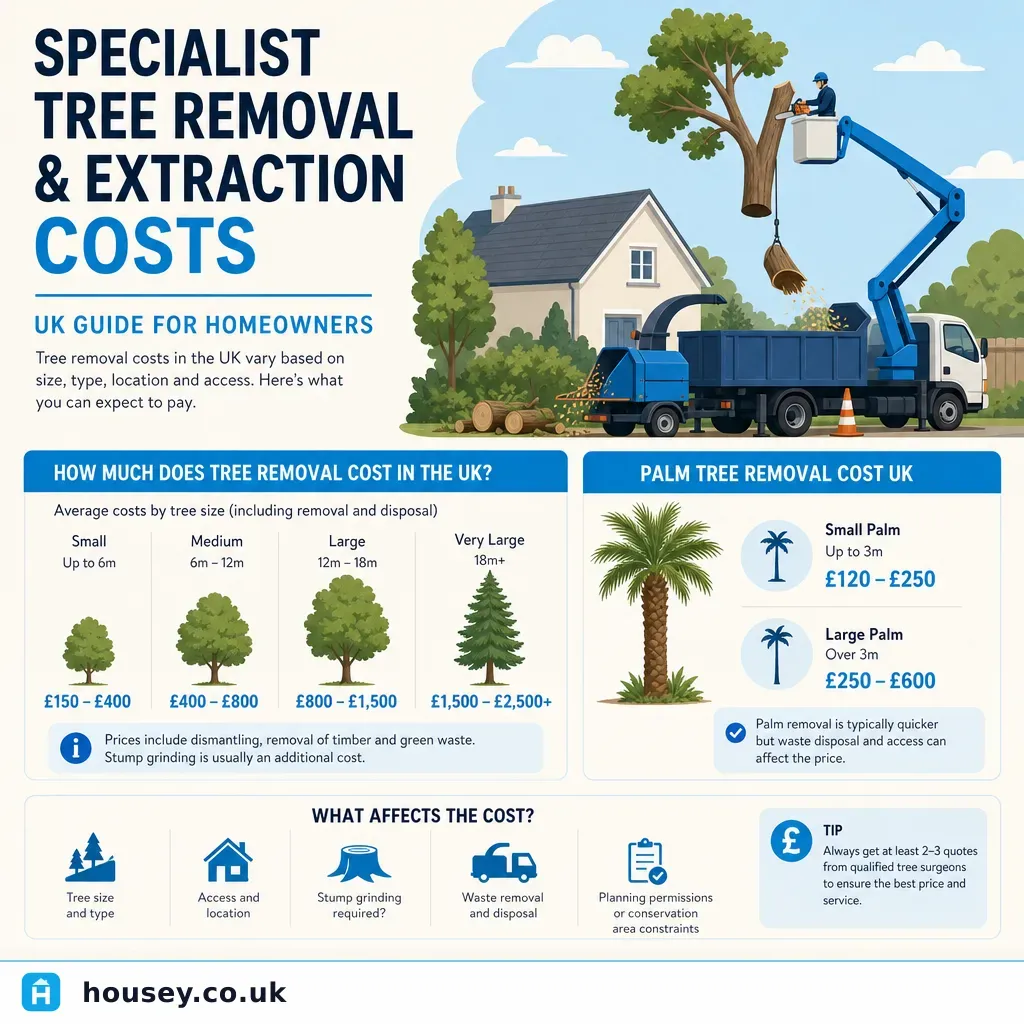
Specialist Tree Removal and Extraction Costs
Specialist tree removal costs in the UK range from around £150 for small trees to £3,000 or more for large mature specimens, with palm trees typically costing more due to specialist technique.
 Improvement & Build
Tree Removal and Sustainable Uses for Timber
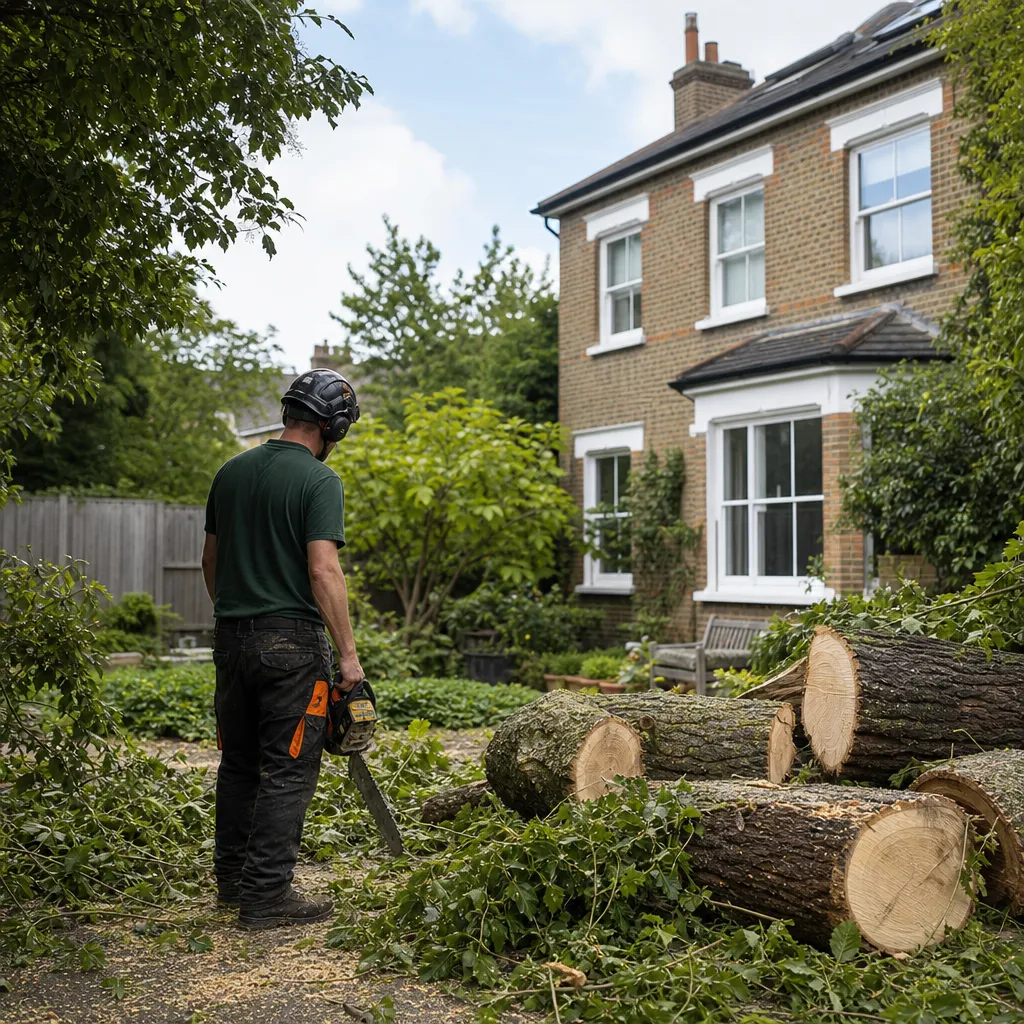
When a tree is felled, the timber can be reused as firewood (after 12–24 months' seasoning), woodchip mulch, or sawn planks.
 Improvement & Build
Tree Crown Reduction and Management Costs
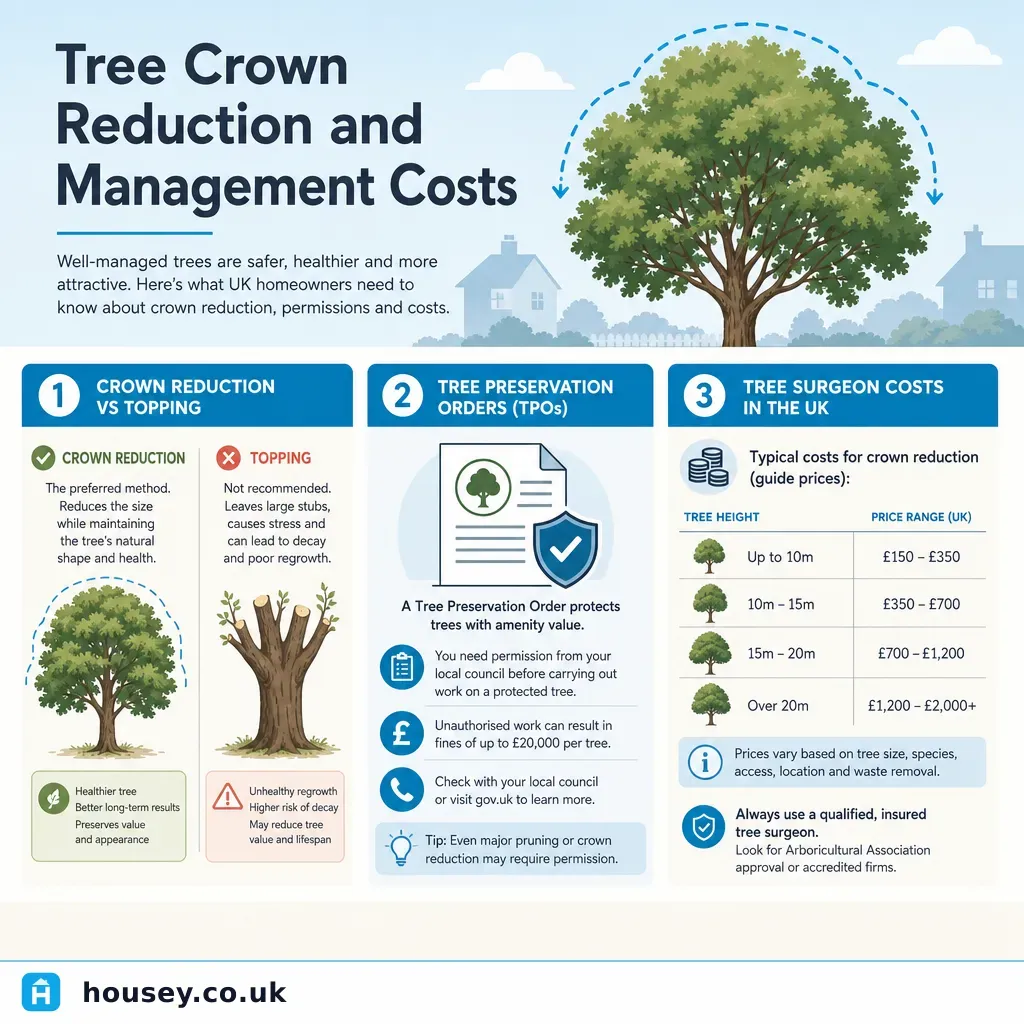
Crown reduction reduces a tree's overall size by 15–30% while preserving its natural shape, and must follow BS 3998:2010.