Basement Development: Space, Planning, and Investment
By Housey · Last reviewed 5th of May 2026
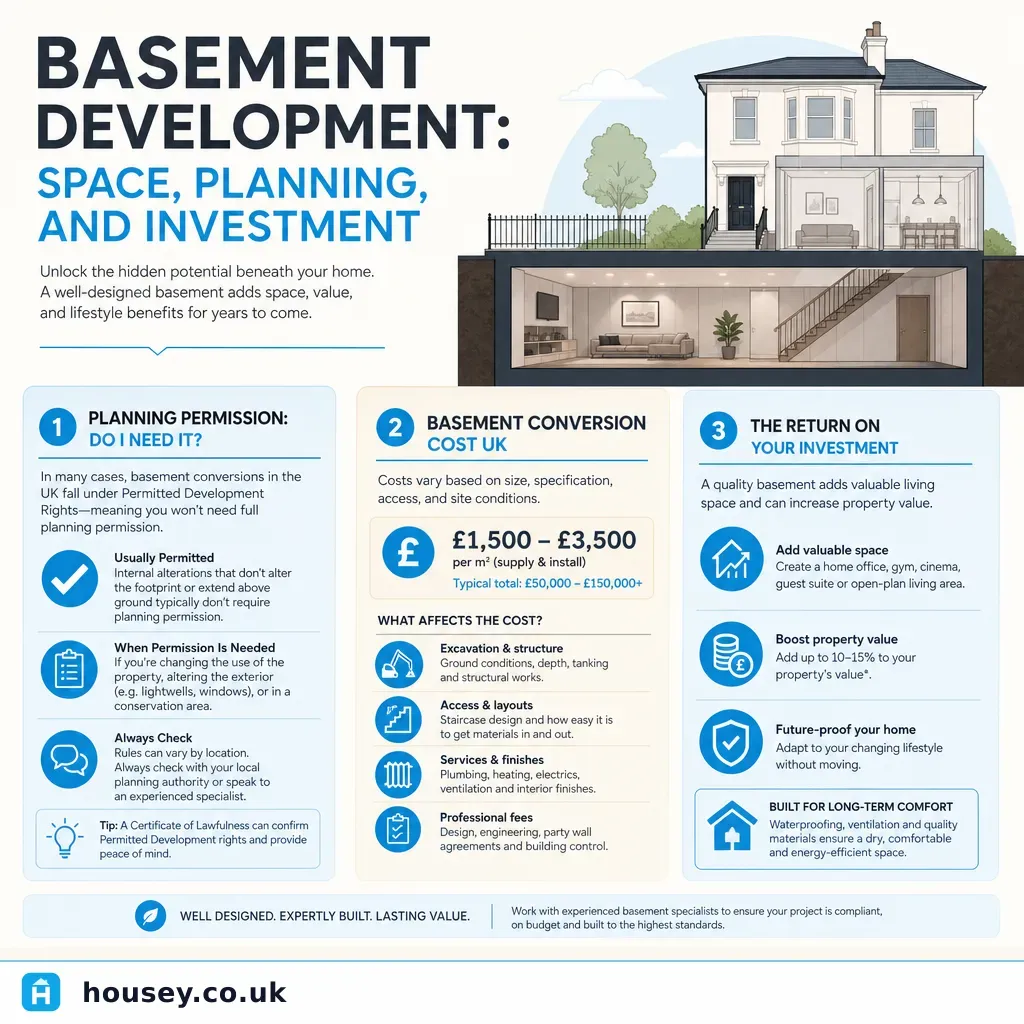
Basement Development: Space, Planning, and Investment
Basement development has become one of the more ambitious home improvement routes in the UK — particularly in urban areas where extending upward or outward is constrained by neighbours, planning policy, or limited plot size. For many homeowners, a basement offers genuine additional usable space without altering the property's external envelope. But the process involves significant structural intervention, complex Building Regulations compliance, and planning considerations that vary considerably by location, property type, and ground conditions.
Key points
- Full basement excavations and conversions require Building Regulations approval under Parts A, C, F, L, and B; many also require planning permission if the external footprint or appearance of the property changes.
- The Party Wall etc. Act 1996 applies to excavation within 3 metres of an adjoining property's foundations — notice must be served on adjoining owners before work begins.
- Indicative UK costs for basement development range from £1,500–£3,500 per square metre, with a typical single-storey residential basement often costing £150,000–£350,000 or more for a full dig and fit-out (Indicative UK costs, last reviewed 2026-05-05).
- A structural engineer must be appointed for any basement project — foundation underpinning, retaining wall design, and waterproofing specification all require professional structural input.
- Groundwater level, soil type, and proximity to existing drainage infrastructure are the primary risk factors that determine project feasibility and cost.
Does basement development need planning permission?
The answer depends on what is being built and where. Three common scenarios apply in England:
Permitted development (no planning permission required): Converting an existing basement or cellar into habitable space — without altering the external appearance of the property — is generally permitted development for a house. No new footprint is being created and no external change is visible.
Planning permission required: Any extension of the basement footprint beyond the existing building envelope, new or enlarged external light wells projecting beyond the front boundary, and any development on a listed building or in a conservation area will typically require full planning permission. The same applies where permitted development rights have been removed by an Article 4 Direction.
Local variation: Some London boroughs have adopted supplementary planning documents with additional restrictions on basement depth, size, and proximity to trees. Rules in Wales and Scotland also differ from those in England. Always check with the local planning authority (LPA) before assuming permitted development applies.
Decision guide: do you need planning permission for your basement?
- Use the permitted development route if: you are converting an existing cellar with no external changes, the property is not listed or in a conservation area, and no Article 4 Direction applies.
- Apply for planning permission if: you are extending the basement footprint beyond the existing structure, creating new or enlarged external light wells at the front, or the property is listed or in a conservation area.
- Seek pre-application advice from the LPA if: you are unsure whether your proposal crosses the permitted development threshold, or you are in a borough with a supplementary basement policy.
- Instruct a planning consultant if: the project is complex, the LPA has raised concerns, or the property has heritage or neighbour-sensitivity constraints that require careful management.
Building regulations for basement development
All basement development — including cellar conversions — requires Building Regulations approval regardless of whether planning permission is needed. The key parts of the Building Regulations that apply are:
Building Regs Part | What it covers | Typical basement requirement |
|---|---|---|
Part A (Structure) | Structural stability | Underpinning design, retaining walls, ground floor retention |
Part C (Resistance to moisture) | Waterproofing and dampness | Tanking or cavity drain membrane system to BS 8102:2022 |
Part F (Ventilation) | Fresh air provision | Mechanical ventilation or equivalent adequate system |
Part L (Energy efficiency) | Thermal performance | Insulation to meet minimum U-values for habitable space |
Part B (Fire safety) | Means of escape | Habitable basements require a compliant means of escape |
BS 8102:2022 (Protection of below-ground structures against water from the ground) is the key British Standard for basement waterproofing design. It categorises below-ground spaces by Grade (1–4) depending on intended use, and the waterproofing specification must match the Grade. A structural engineer or specialist waterproofing designer should specify the system.
Building control approval can be sought from your local authority building control (LABC) or a registered building control approver. A building control consultant can help manage the process and liaise with the building control body throughout the project.
What does basement development cost in the UK?
Indicative UK costs, last reviewed 2026-05-05. Costs are subject to wide regional variation and site-specific factors.
Project type | Indicative cost range | Key cost drivers |
|---|---|---|
Existing cellar conversion (no excavation) | £20,000–£60,000 | Waterproofing, electrics, headroom, ventilation |
Single-storey basement extension (new dig) | £150,000–£350,000+ | Depth, soil type, access, underpinning complexity |
Double-storey basement | £300,000–£600,000+ | Significantly more complex; rare outside central London |
Structural engineer fees | £3,000–£10,000+ | Varies by project scope and number of site visits |
Planning application fee (householder, England) | £258 | Current rate; check GOV.UK for latest fees |
Party wall surveyor | £700–£2,000+ per adjoining owner | Depends on number of adjoining owners |
The principal cost drivers are soil type and groundwater level (clay and high water tables increase complexity significantly), access for excavation machinery, number of structural bays requiring underpinning, proximity to neighbours' foundations, and the fit-out specification chosen.
The Party Wall etc. Act 1996: what basement developers must know
The Party Wall etc. Act 1996 requires you to serve formal notice on all adjoining owners before carrying out any excavation within 3 metres of a neighbouring building if the excavation is deeper than their foundations, or within 6 metres if the excavation follows the relevant angle rule. Basement development almost always triggers this requirement.
Adjoining owners have the right to appoint their own party wall surveyor (at your cost) or agree to use a single agreed surveyor. A party wall award sets out how the work must proceed and protects both parties.
Failure to serve notice before excavation does not automatically halt work, but it removes your legal protections and could result in injunctions or liability for neighbour damage claims. A party wall surveyor should be instructed early in the project programme.
Important limitations
This article is general information about the basement development process in the UK. Planning rules, Building Regulations requirements, structural risks, and costs vary considerably by property, location, ground conditions, and local planning authority policy. Nothing in this article constitutes structural, planning, legal, or financial advice.
Do not commence any excavation, underpinning, or below-ground structural work without: a full structural engineer's assessment and design; Building Regulations approval obtained before work starts; party wall notices served and awards agreed where required; planning permission obtained where applicable; and a qualified and insured contractor appointed.
When this becomes urgent
Seek immediate professional advice if:
- You have already started work and discover unexpected groundwater, unstable soil, or signs of movement in adjacent structures
- A neighbour has served a counter-notice or raised a dispute under the Party Wall etc. Act 1996
- Work has commenced without party wall notice or Building Regulations approval
- You have received a planning enforcement notice from the local authority
What to ask a qualified professional
Before instructing any groundworks contractor, raise the following questions with a structural engineering professional and your planning consultant:
- What geotechnical investigation (trial pits or boreholes) is needed before structural design can begin?
- What underpinning method is appropriate for my soil type and existing foundation depth — traditional mass concrete, mini-piled, or another approach?
- How will groundwater be managed during and after excavation?
- What BS 8102 Grade applies to my intended use, and what waterproofing system do you recommend?
- Will tree root protection zones be affected, and has an arboricultural assessment been commissioned?
- What monitoring will be required during construction to protect adjacent structures?
- Does this project require planning permission, or does permitted development apply in this location?
- Are there any local supplementary planning documents or LPA policies that restrict basement development here?
When to get professional help
Basement development is not a project where professional appointments are optional. At minimum, you will need a structural engineer, a building control body, and in most cases a party wall surveyor. Where planning permission is required or uncertain, a planning consultant is strongly advisable — particularly on listed buildings, in conservation areas, or in boroughs with supplementary basement policies.
If you are in the early stages of considering a basement project, begin with a feasibility assessment from a structural engineering professional before committing to any design costs or contractor conversations.
How Housey can help
Housey connects homeowners with qualified structural engineers, planning consultants, and building control specialists across the UK. Whether you need a preliminary feasibility assessment or full professional support for your basement project, you can request quotes through our structural engineering, planning consultancy, and building control consultants service pages.
Frequently asked questions
Does converting an existing cellar always avoid the need for planning permission?
Generally, converting an existing cellar into habitable space without any external changes is permitted development for a house. However, if the property is listed, in a conservation area, or subject to an Article 4 Direction, planning permission will be required. Always verify with your local planning authority before starting work, as individual circumstances vary.
How long does a basement development project typically take in the UK?
From initial feasibility to practical completion, a full basement excavation often takes 12–24 months. This includes time for geotechnical surveys, structural design, planning (if required), party wall process, contractor procurement, and construction. Cellar conversions without excavation are typically shorter — often 3–6 months from start to completion depending on fit-out complexity.
Is basement development permitted development in a conservation area?
Not usually. In a conservation area, permitted development rights are restricted, and any basement development involving external changes — including new or enlarged light wells — is likely to require planning permission. Some conservation area policies also restrict external vents and grilles. Always check with your local planning authority before proceeding.
What is BS 8102 and why does it matter for basement waterproofing?
BS 8102:2022 is the British Standard specifying how below-ground structures should be protected against water ingress. It grades basements from Grade 1 (basic utility) to Grade 4 (special use) and requires a waterproofing system matched to the intended use and ground conditions. Building control bodies expect compliance with this standard in any basement project.
Sources and further reading
Useful next reads
 Planning & Pre-Build
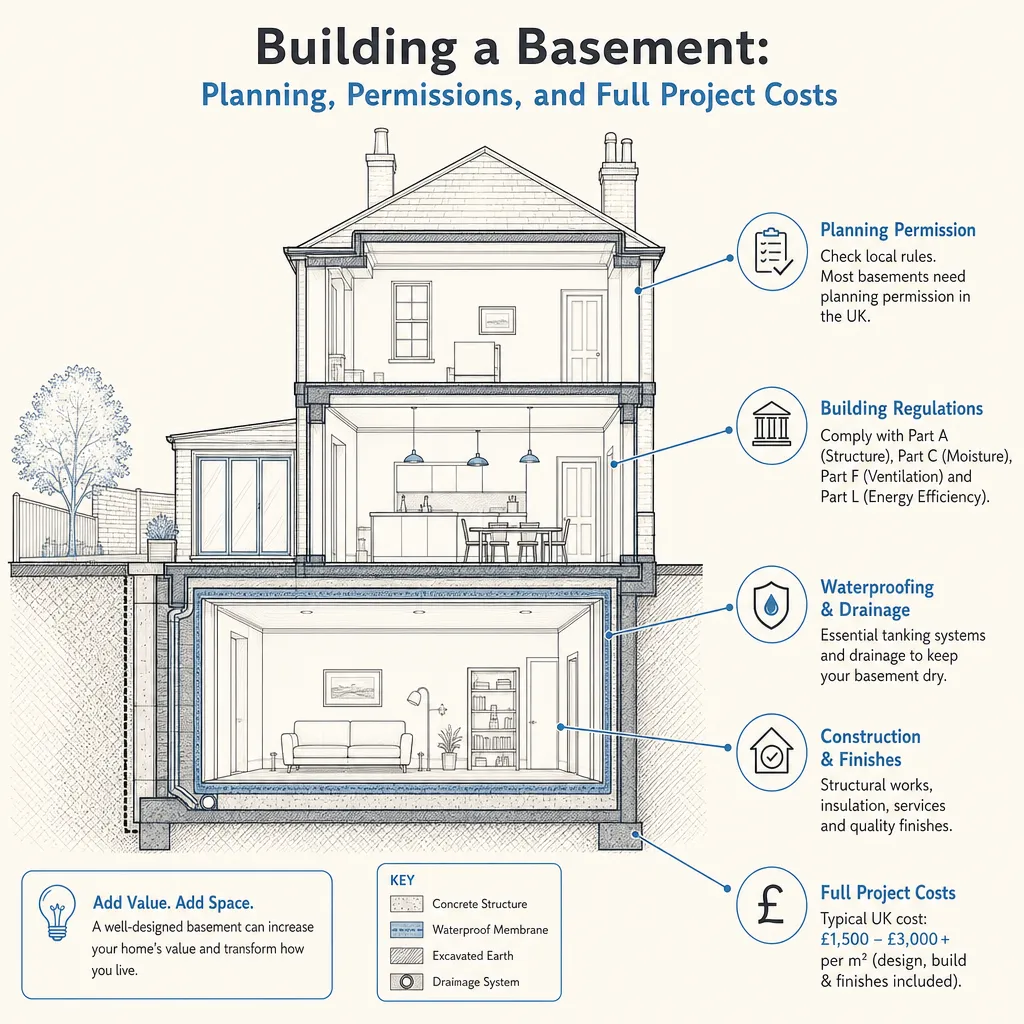
Building a Basement: Planning, Permissions, and Full Project Costs
Building a basement in the UK usually requires full planning permission where new excavation or external changes are involved.
 Planning & Pre-Build
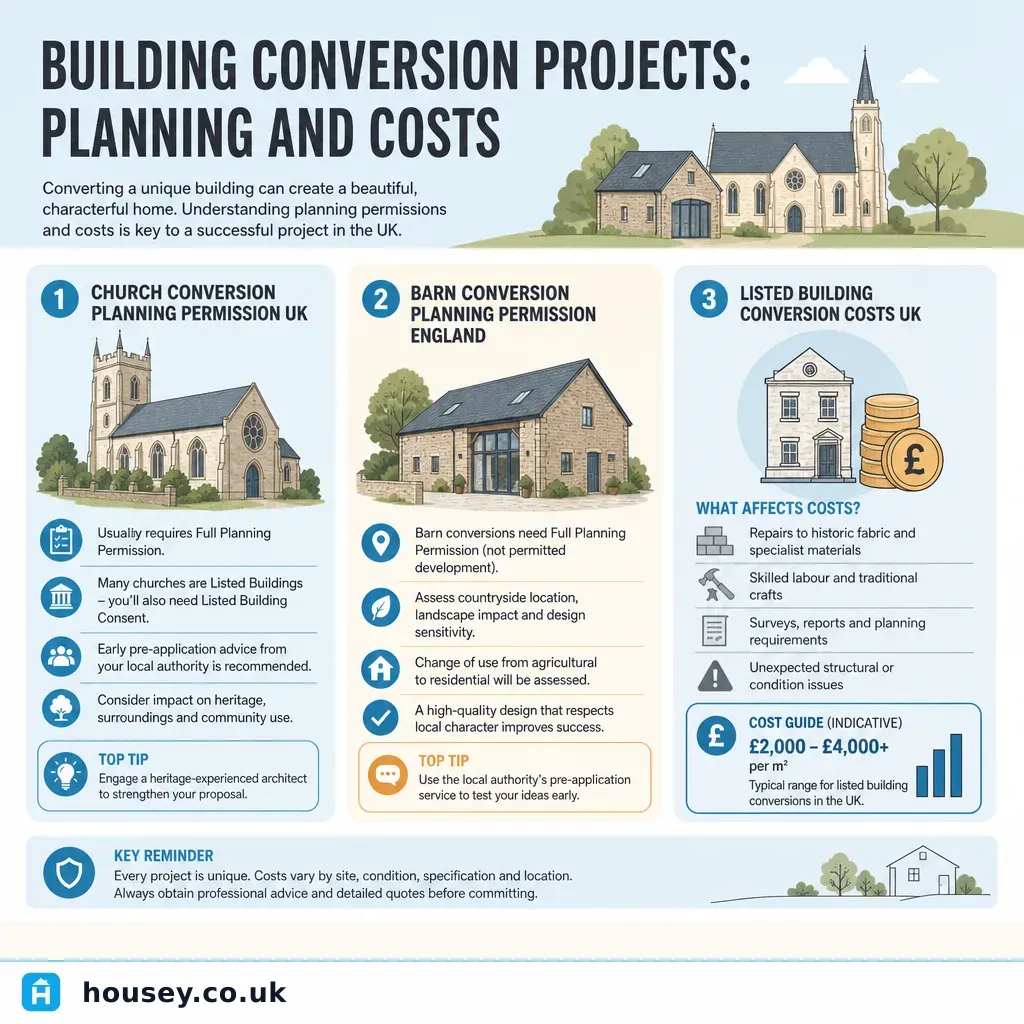
Building Conversion Projects: Planning and Costs
Converting a non-residential building in the UK — such as a barn, church, or commercial property — typically requires full planning permission and often Listed Building Consent.
 Planning & Pre-Build
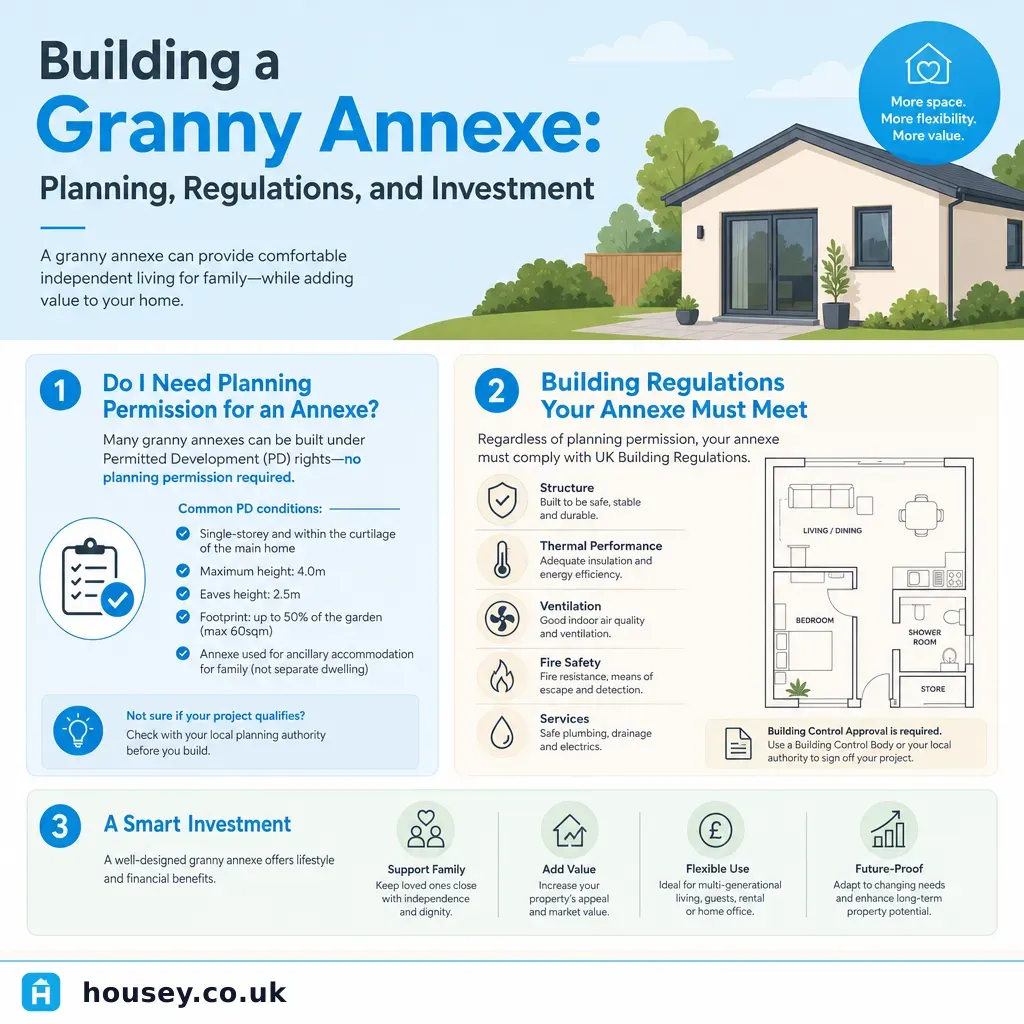
Building a Granny Annexe: Planning, Regulations, and Investment
A granny annexe in the UK may or may not need planning permission depending on whether it is classed as incidental to the main house or as a separate dwelling.
 Planning & Pre-Build
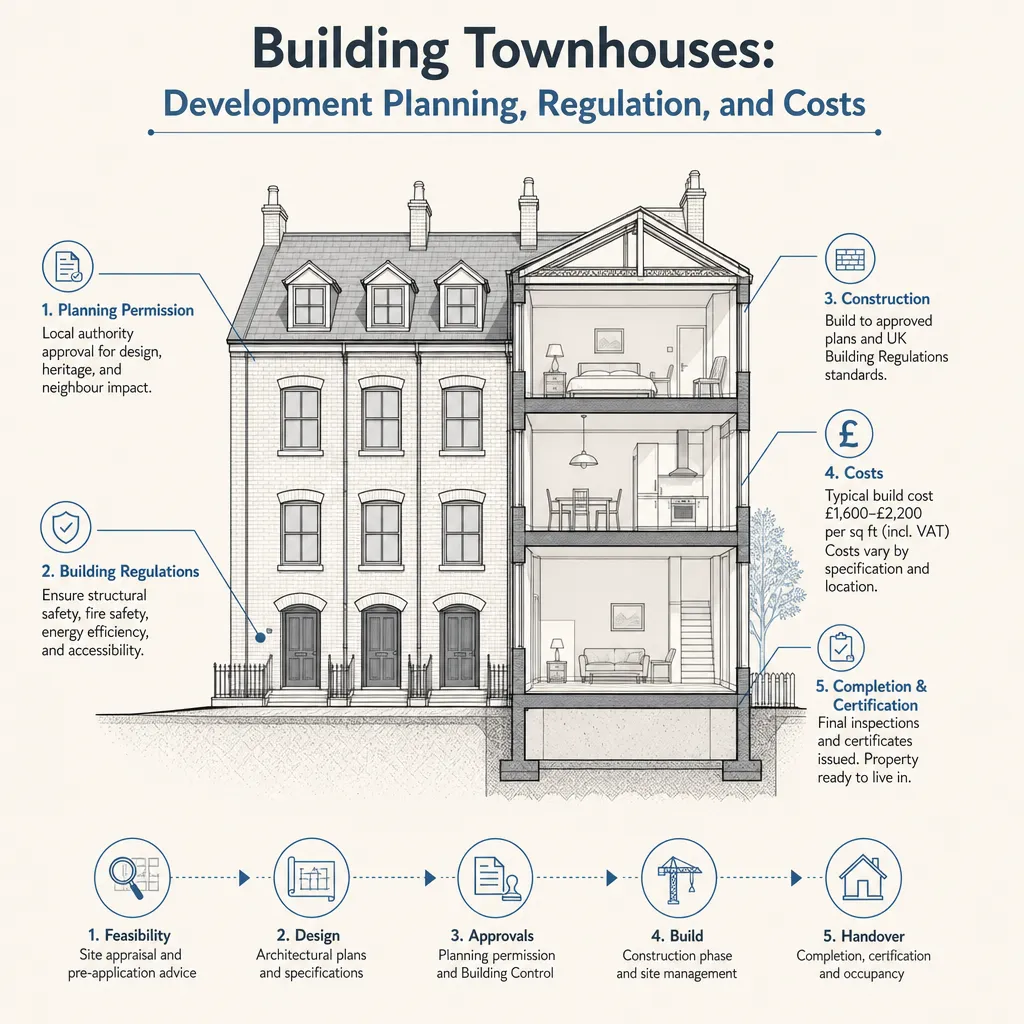
Building Townhouses: Development Planning, Regulation, and Costs
Building townhouses in the UK requires full planning permission for all new dwellings — permitted development rights do not apply to new residential construction.
 Planning & Pre-Build
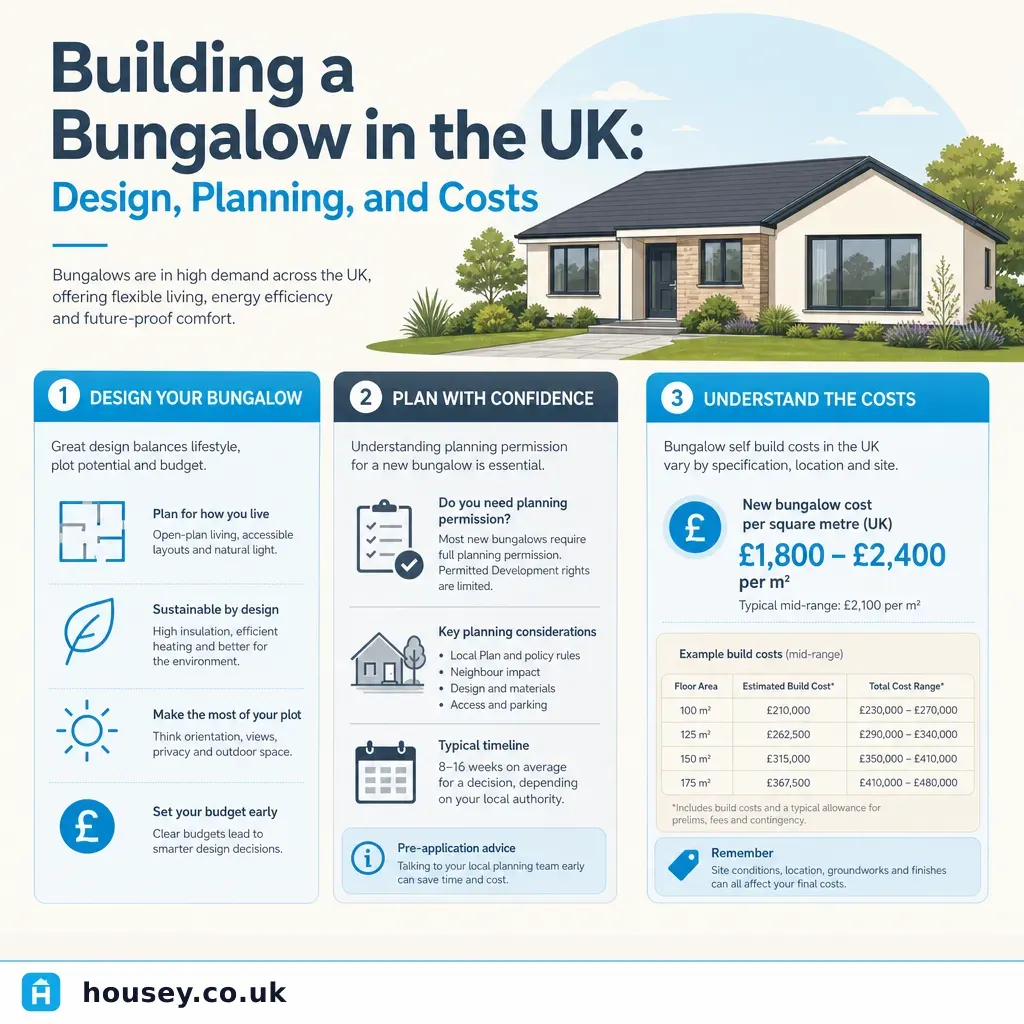
Building a Bungalow in the UK: Design, Planning, and Costs
Building a bungalow in the UK typically costs £1,500–£3,000 per square metre, putting a 100m² bungalow at roughly £150,000–£300,000 in build costs before land, professional fees, and VAT.