Building a Bungalow in the UK: Design, Planning, and Costs
By Housey · Last reviewed 5th of May 2026
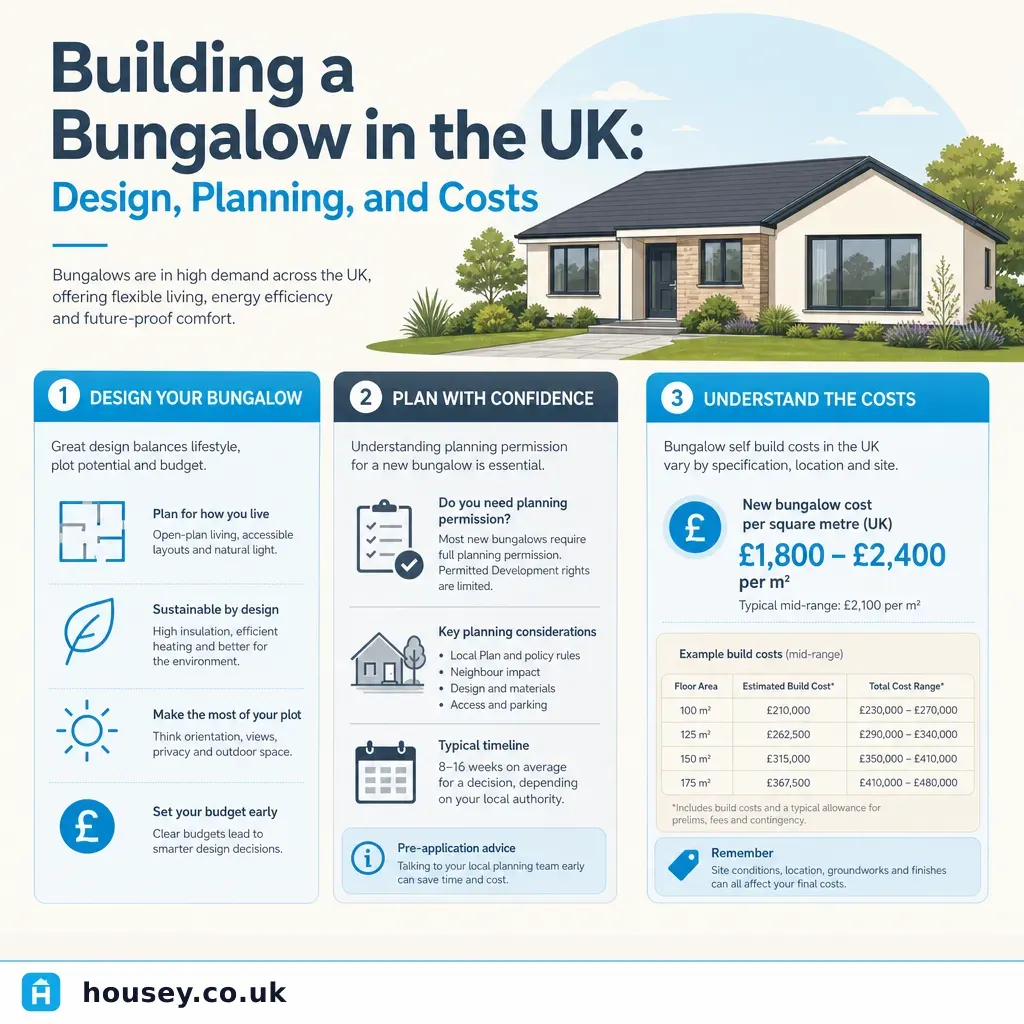
Building a Bungalow in the UK: Design, Planning, and Costs
The number of new bungalows built in the UK has fallen sharply since the 1970s, yet demand from downsizers, accessibility-conscious buyers, and rural self-builders remains strong. Building a bungalow from scratch is a multi-stage project spanning land acquisition, planning permission, professional appointments, building regulations compliance, and a contractor programme that typically runs well over a year. Understanding the cost structure and planning process before committing to a plot can prevent expensive surprises.
Key points
- Build costs for a new bungalow in the UK typically range from £1,500 to £3,000 per square metre depending on specification and region — Indicative UK costs, last reviewed 2026-05-05.
- Planning permission is always required to build a new bungalow; permitted development rights do not apply to new dwellings.
- Building Regulations approval under the Building Act 1984 is mandatory for all new dwellings, covering structure, fire safety, energy efficiency, ventilation, drainage, and accessibility.
- VAT is generally zero-rated for new residential construction; self-builders may reclaim VAT on eligible materials through HMRC's DIY Housebuilder Scheme (form VAT431NB), subject to conditions.
- A typical single-plot bungalow build takes 12–24 months from planning application to practical completion, depending on complexity and contractor programme.
How much does it cost to build a bungalow in the UK?
The table below shows indicative build cost ranges by specification level. These figures cover construction only and exclude land, professional fees, and infrastructure connections.
Specification level | Build cost per m² | 100m² bungalow build cost | Typical characteristics |
|---|---|---|---|
Basic | £1,500–£1,900 | £150,000–£190,000 | Standard brick/block, developer-grade fittings |
Mid-range | £1,900–£2,400 | £190,000–£240,000 | Good-quality fittings, higher insulation specification |
High specification | £2,400–£3,000+ | £240,000–£300,000+ | Architect-designed, bespoke detailing, premium materials |
Indicative UK costs, last reviewed 2026-05-05. Costs are broadly representative for England; Northern Ireland, Scotland, and parts of Wales may differ.
Additional costs to budget for
- Land purchase — the largest single variable; prices vary enormously by location and whether the plot already has planning permission
- Planning application fee — currently £578 for a new dwelling in England (GOV.UK planning fees guidance, 2026)
- Architect and design fees — typically 5–12% of construction cost for a full service
- Structural engineering fees — usually £2,000–£6,000+ depending on site complexity
- Building control fees — typically £1,500–£4,000 for a new single dwelling
- Infrastructure connections — mains water, electricity, gas, and foul drainage can cost £5,000–£20,000+ on a greenfield site
- Ground investigation (SI report) — typically £1,500–£4,000 for a single plot
- Contingency — allow at least 10–15% across all estimated costs
Planning permission for a new bungalow
Full planning permission is always required to build a new bungalow. Permitted development rights apply only to alterations and extensions to an existing dwelling, not to any new residential building.
Key considerations when assessing a plot:
- Local Plan allocation — the land must be allocated for residential use, or you must make a planning case under the National Planning Policy Framework (NPPF) for that specific location
- Design and character — local planning authorities typically require new buildings to respect surrounding character; single-storey designs are sometimes viewed more sympathetically in sensitive settings
- Flood risk — sites in Flood Zone 2 or 3 require a Flood Risk Assessment and sequential test
- Ecology — protected species surveys (bats, great crested newts) may be required; Tree Preservation Orders can restrict site clearance
- Highway access — new vehicular access onto classified roads usually requires separate Highways consent
A planning consultant can assess the likelihood of consent before you commit to purchasing land and can manage the application through determination.
Which construction approach suits your bungalow project?
- Choose traditional brick-and-block construction if you need a proven, low-maintenance structure that most local contractors can build — well suited to standard suburban or rural plots with straightforward ground conditions.
- Choose timber frame if speed of on-site construction matters — frames are typically erected in 1–2 weeks once the ground floor slab is complete, and airtightness performance is often easier to achieve than with masonry.
- Choose structural insulated panels (SIPs) if you want high thermal performance and a fast build programme — SIPs can support ambitious Part L energy efficiency targets.
- Ask a structural engineer to review the structural approach regardless of build system, particularly on sloped sites, shrinkable clay soils, or where ground conditions are uncertain.
- Check with your local planning authority before committing to a design if the site is in a conservation area, Area of Outstanding Natural Beauty, or Green Belt.
A worked example: 3-bedroom bungalow in the East Midlands
Consider a couple building a 120m² three-bedroom bungalow on a serviced plot in a Nottinghamshire village using traditional brick-and-block construction at a mid-range specification.
Cost item | Indicative amount |
|---|---|
Plot purchase | £120,000 |
Architect and planning fees (full service) | £18,000 |
Structural engineering | £4,000 |
Ground investigation | £2,500 |
Building control fees | £2,000 |
Build cost (120m² × £1,900/m²) | £228,000 |
Infrastructure connections | £8,000 |
Contingency (10%) | £26,250 |
Estimated total (inc. land) | approx. £408,750 |
Indicative only. Actual costs depend on market conditions, site-specific factors, contractor availability, and specification choices. Last reviewed 2026-05-05.
Building regulations for a new bungalow
All new dwellings must comply with the Building Regulations 2010 (as amended). Key Approved Documents relevant to a new bungalow include:
- Part A (Structure) — foundation and structural design
- Part B (Fire safety) — smoke alarms, heat detection, means of escape
- Part F (Ventilation) — background ventilation or mechanical ventilation with heat recovery (MVHR)
- Part L (Conservation of fuel and power) — energy efficiency standards and SAP assessment
- Part M (Accessibility) — minimum accessibility requirements for new homes
- Part P (Electrical safety) — notifiable electrical installations
A building control consultant (approved inspector or local authority building control) manages compliance from plans check through to the completion certificate. A completion certificate is essential for future sales and mortgage purposes.
Important limitations
This article provides general information about building a bungalow in the UK and should not be treated as planning, legal, structural, or financial advice. Planning permission outcomes depend on local policy, site-specific constraints, and national guidance that is subject to change. Build costs are indicative and based on publicly available information reviewed in 2026; actual costs depend on market conditions, contractor pricing, and specification. Always consult a qualified planning consultant, architect, structural engineer, and building control body before committing to any project.
What to ask a qualified professional
Planning consultant:
- Is this plot allocated for residential development in the Local Plan, or would this require a departure from policy?
- What are the realistic prospects for planning permission given the site's location and surrounding character?
- Are there designated area restrictions — Green Belt, AONB, Conservation Area, or Flood Zone — that apply?
- Is pre-application advice from the local planning authority available and advisable before submitting?
Architect or architectural technologist:
- What design options are achievable within the planning constraints and budget?
- Can the design meet Part L energy efficiency requirements cost-effectively?
- What is your fee structure and what is included at each RIBA work stage?
Structural engineer:
- What ground investigation is needed before foundation design can be confirmed?
- Are there soil conditions, drainage issues, or load constraints specific to this site?
Building control consultant:
- At which stages will inspections be required during the build?
- What documentation is needed to obtain a completion certificate at the end of the project?
When to get professional help
A new bungalow always requires a team of qualified professionals. Do not proceed without an architect or architectural technologist for design and planning drawings, a planning consultant for complex or uncertain planning situations, a structural engineer for foundation and structural design, and a building control consultant for regulatory compliance and sign-off.
Additionally, seek specialist advice if the site is in a flood risk area, Green Belt, AONB, or Conservation Area; if ground investigations reveal poor bearing capacity or contamination; or if protected species, trees with a TPO, or heritage assets are present on or near the site.
How Housey can help
Housey connects self-builders with vetted local professionals. Whether you need a planning consultant to assess your plot's prospects before purchase, a structural engineer to advise on foundation options and build system, or a building control consultant to manage compliance from drawings to completion certificate, you can request quotes through Housey.
Frequently asked questions
Do you always need planning permission to build a bungalow?
Yes. Planning permission is always required to build a new dwelling in the UK. Permitted development rights do not extend to new-build residential properties. You must submit a full planning application to your local planning authority, who will assess it against the Development Plan, the National Planning Policy Framework, and any site-specific constraints.
How long does it take to build a bungalow in the UK?
A typical self-build bungalow takes 12–24 months from planning application submission to practical completion. Standard applications are determined within 8–13 weeks. The build programme itself often takes 4–9 months for a traditional masonry bungalow, though timber frame builds can be faster once groundworks are complete. Unexpected ground conditions or material delays can extend this.
Can a bungalow be built on Green Belt land?
Very rarely. National planning policy treats Green Belt as highly protected, and new residential development there is considered inappropriate unless very special circumstances can be demonstrated. A planning consultant should assess the site and review local Green Belt policy before any land is purchased for development purposes.
What is the VAT position for a self-build bungalow?
New residential construction is generally zero-rated for VAT. Self-builders can reclaim VAT paid on eligible materials through HMRC's DIY Housebuilder Scheme using form VAT431NB. The scheme has specific eligibility conditions, including that the completed dwelling must be your main residence. Take advice from an accountant experienced in self-build projects before proceeding.
What ground investigation is needed before building a bungalow?
A ground investigation (site investigation or SI report) assesses soil bearing capacity, groundwater levels, contamination risk, and geological hazards. It is normally required by your structural engineer before foundation design can be confirmed and by building control. Indicative costs are £1,500–£4,000 for a single dwelling plot — Indicative UK costs, last reviewed 2026-05-05.
Sources and further reading
- Planning Portal: New dwellings — do I need permission? — Planning Portal (GOV.UK)
- National Planning Policy Framework (NPPF) — Ministry of Housing, Communities and Local Government
- Building Regulations 2010: Approved Documents — GOV.UK
- HMRC: VAT refunds for DIY housebuilders (VAT431NB) — HMRC
- Planning application fees in England — GOV.UK
- Energy Saving Trust: Building a new home — Energy Saving Trust
Useful next reads
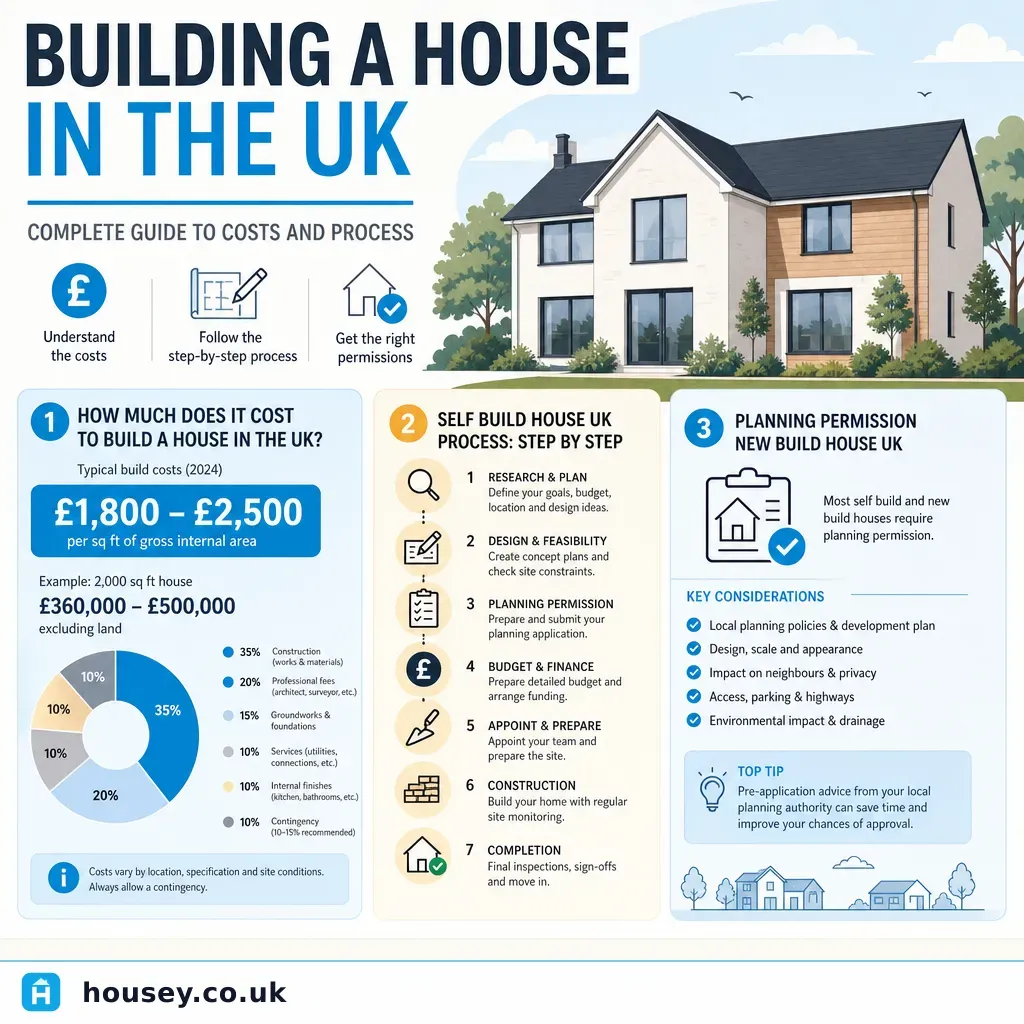 Planning & Pre-Build
Building a House in the UK: Complete Guide to Costs and Process
Building a house in the UK typically costs £1,500–£3,000 per sq m for construction (excluding land) and takes two to four years from land search to completion.
 Planning & Pre-Build
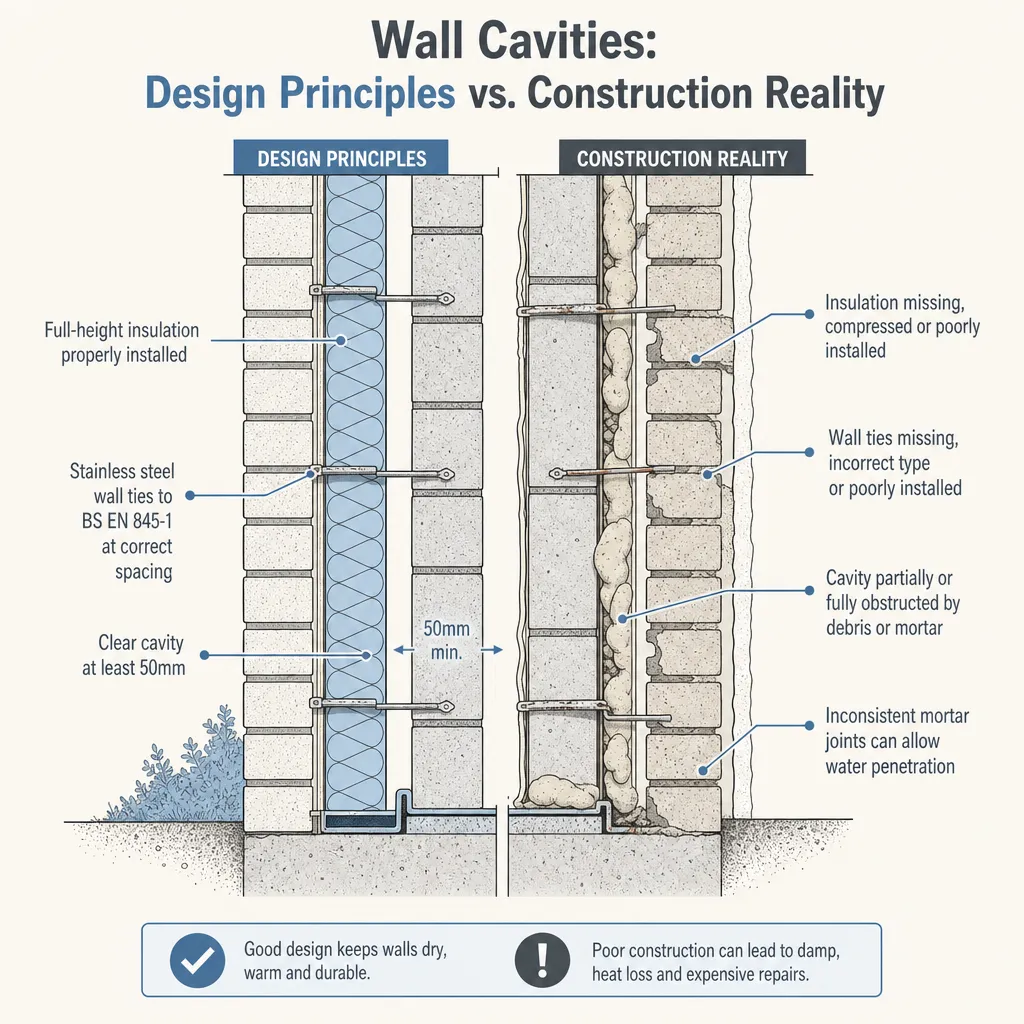
Wall Cavities: Design Principles vs. Construction Reality
A UK cavity wall is designed to resist weather, control heat loss, and structurally link two masonry leaves.
 Planning & Pre-Build
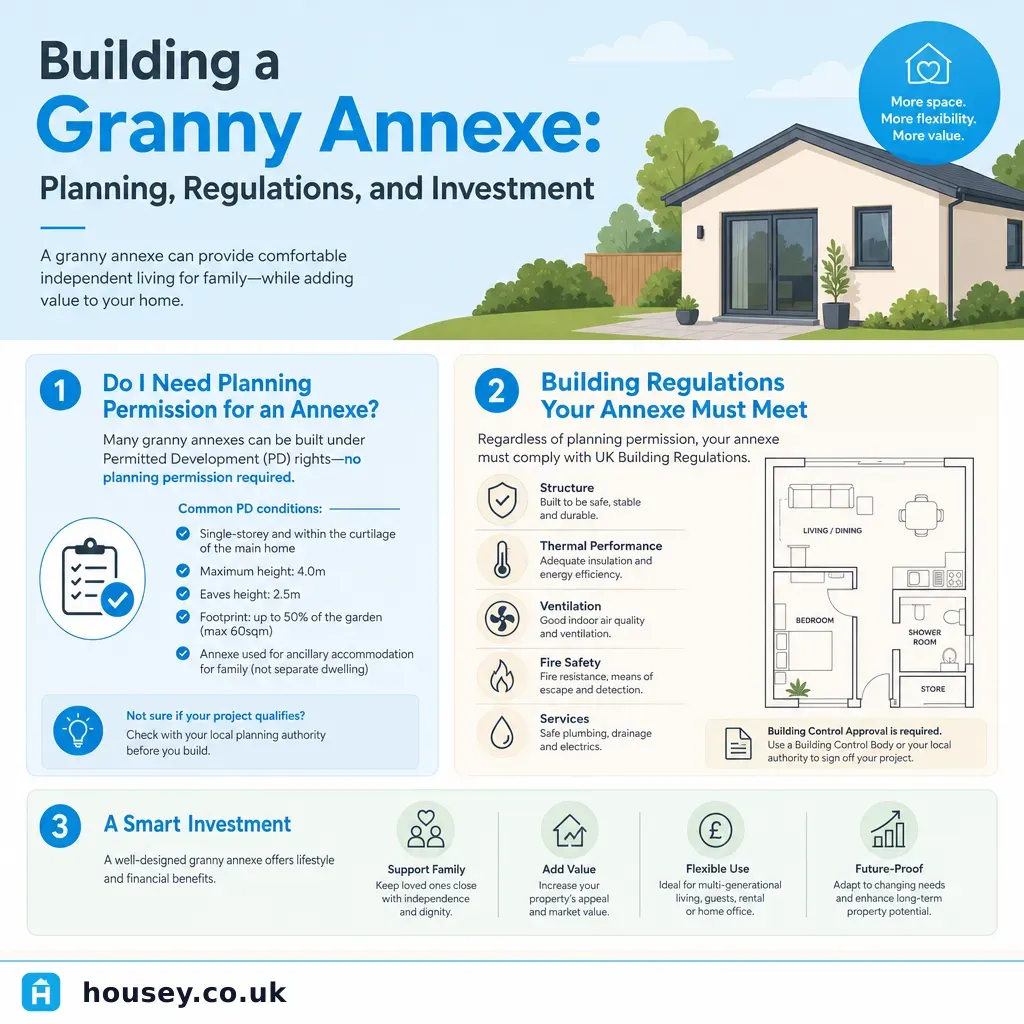
Building a Granny Annexe: Planning, Regulations, and Investment
A granny annexe in the UK may or may not need planning permission depending on whether it is classed as incidental to the main house or as a separate dwelling.
 Planning & Pre-Build
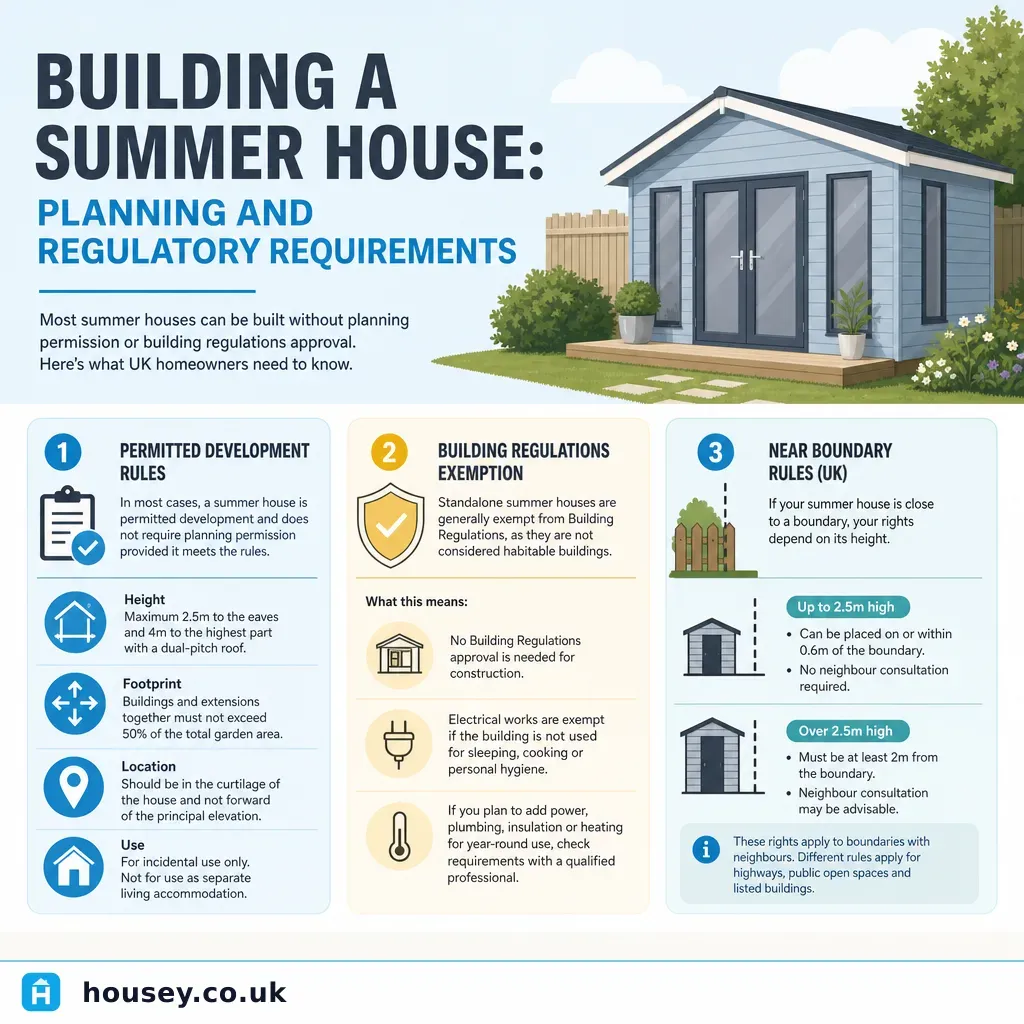
Building a Summer House: Planning and Regulatory Requirements
Most garden summer houses in England fall under Class E permitted development and need no planning permission, provided they are single-storey, within height limits, and not used for sleeping.
 Planning & Pre-Build
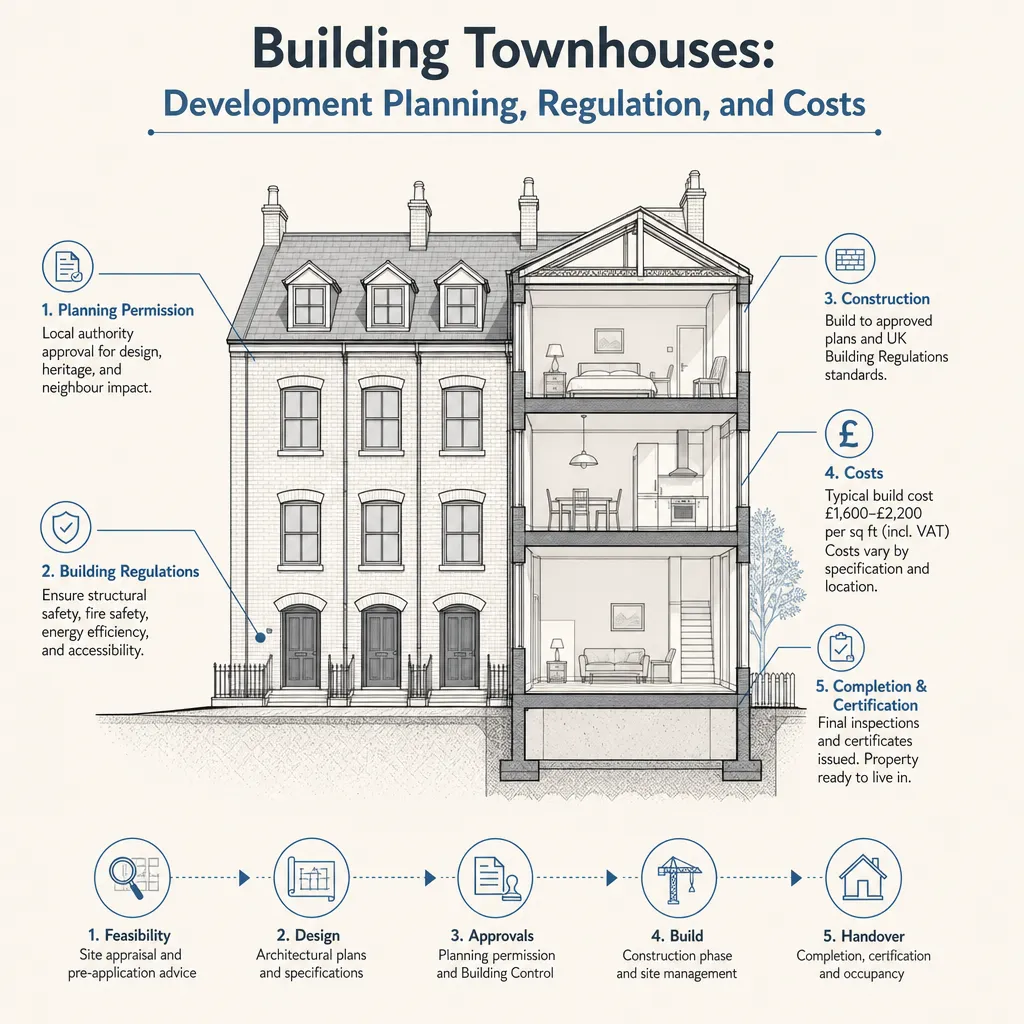
Building Townhouses: Development Planning, Regulation, and Costs
Building townhouses in the UK requires full planning permission for all new dwellings — permitted development rights do not apply to new residential construction.