Building a Basement: Planning, Permissions, and Full Project Costs
By Housey · Last reviewed 6th of May 2026
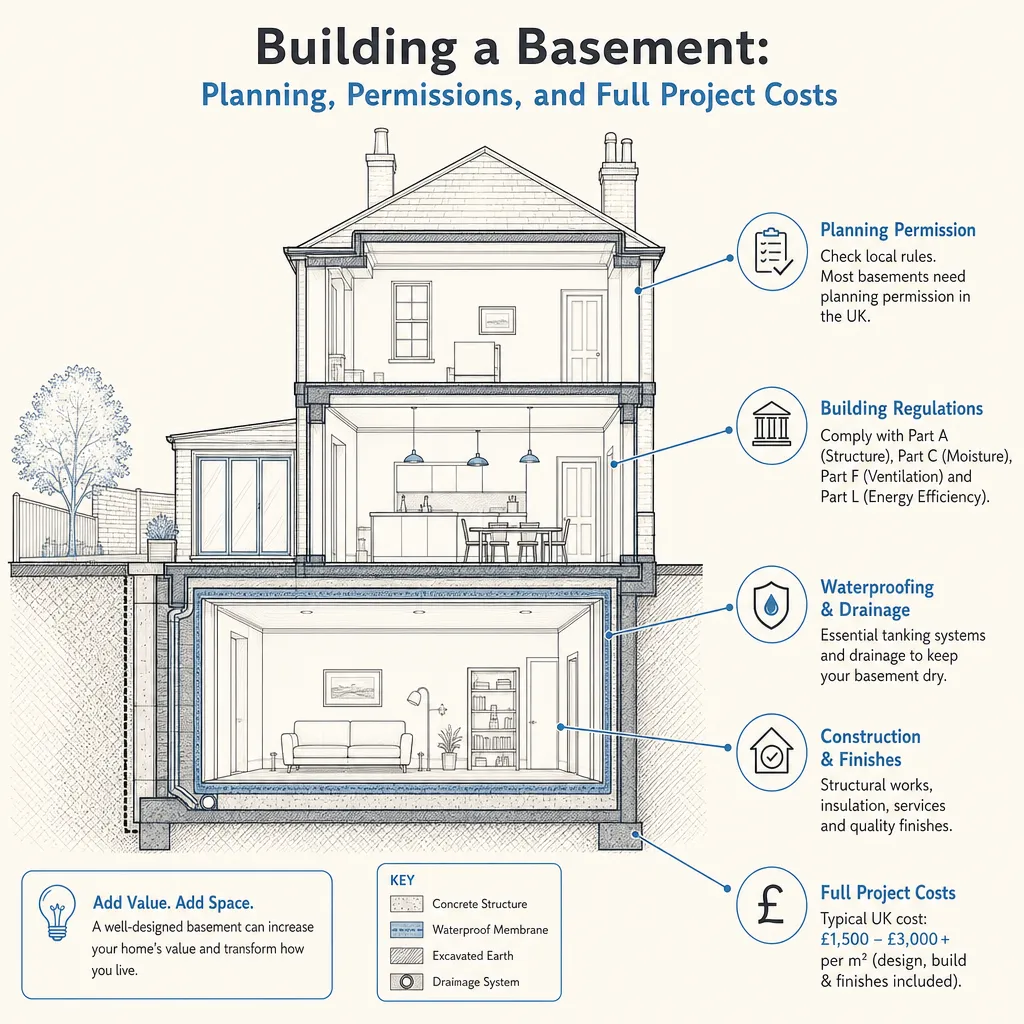
Building a Basement: Planning, Permissions, and Full Project Costs
Basement construction has become an attractive option for UK homeowners in cities where above-ground extensions are constrained by conservation area rules, permitted development limits, or simple lack of garden space. Below-ground construction is, however, among the most technically demanding residential projects you can undertake — combining structural engineering, planning law, building regulations, party wall obligations, and ground investigation, often simultaneously. Understanding the framework before instructing professionals can save significant time and cost.
Key points
- Most basement construction in England requires full planning permission — particularly where new excavation is involved or any external alteration (such as a light well) is proposed; converting an existing cellar without external changes may fall within permitted development, but this is subject to local conditions and Article 4 Directions.
- Building Regulations Approved Documents A (Structure), C (Site preparation), F (Ventilation), and H (Drainage) all apply to basement work — approval is mandatory regardless of planning status.
- A structural engineer is essential: basement projects require ground investigation, underpinning or retention wall design, and a waterproofing specification conforming to BS 8102:2022.
- If your property shares a party wall, the Party Wall etc. Act 1996 is very likely triggered — excavation within 3 metres of a neighbour's structure where work goes deeper than their foundations requires written notice before starting.
- Indicative costs range from £1,000–£2,000/m² for a cellar conversion to £1,500–£3,500+/m² for a new-build basement, with ground conditions, depth, and access being the main drivers. Indicative UK costs, last reviewed 2026-05-06. Obtain independent quotes.
Do you need planning permission for a basement?
The answer depends on whether a basement already exists and what the proposed works involve.
When full planning permission is usually required
- Creating a new basement beneath a house where no basement currently exists.
- Any works involving external alterations — light wells, access staircases, pavement vaults, or an extended footprint.
- Works in a conservation area or to a listed building — Listed Building Consent is required regardless of whether planning permission is also needed.
- Converting a basement for rental use or as a separate dwelling unit.
When permitted development may apply (England only)
In England, converting an existing cellar into a habitable room may fall within Class C of the General Permitted Development Order (GPDO) if there are no external alterations and the property is not in a restricted zone. Key conditions:
- Many councils have Article 4 Directions removing PD rights for basement works — check with your Local Planning Authority (LPA) before proceeding.
- If any excavation is needed to achieve habitable head height, the space is unlikely to qualify as an existing cellar under PD rules.
- Wales, Scotland, and Northern Ireland operate different planning frameworks; always verify locally.
Building regulations approval is mandatory for all basement construction regardless of planning status.
New-build basement vs cellar conversion: comparison
Aspect | New-build basement | Cellar conversion |
|---|---|---|
Starting condition | Excavation beneath existing footprint | Existing below-ground void |
Planning permission | Almost always required | May fall within PD if no external changes |
Structural complexity | Very high — piled walls or underpinning from scratch | Moderate to high — tanking or underpinning likely |
Waterproofing (BS 8102:2022) | Type C cavity drain typical; full specification required | Type A, B, or C depending on water table and construction |
Indicative cost/m² | £1,500–£3,500+ | £1,000–£2,000 |
Typical programme | 6–18 months | 3–9 months |
Party Wall Act | Almost certainly triggered | Likely triggered near a party wall |
Building regulations | Mandatory | Mandatory |
Indicative UK costs, last reviewed 2026-05-06. Costs vary significantly by location, ground conditions, and specification.
Structural engineering: what is involved
A structural engineer is not optional for basement work. Their scope typically includes:
- Ground investigation — desk study and possibly trial pits or borehole survey to establish soil type, groundwater level, and contamination risk.
- Retention design — mass concrete underpinning is traditional; contiguous bored pile walls or king post walls suit deeper excavations or tighter urban sites.
- Waterproofing specification — prepared in accordance with BS 8102:2022, which defines three protection types: Type A (surface barrier), Type B (structurally integral), and Type C (drained cavity). A Type C cavity drain system with sump and pump is common in UK residential projects.
- Structural calculations — load paths, beam and column sizing, and temporary works requirements.
- Monitoring plan — particularly important in terraced or semi-detached properties where neighbouring foundations are close.
Worked UK property scenario
Scenario: A homeowner in a 1930s semi-detached house in a London suburb wants to create a habitable basement playroom beneath the rear reception room. The property is not listed, not in a conservation area, and has no existing cellar.
- Planning: New excavation plus a proposed rear light well means full planning permission is required. The LPA may require a basement impact assessment given the urban context.
- Party wall: Works within 3 metres of the left-hand shared wall trigger the Party Wall etc. Act 1996. Notice is served; the neighbour appoints their own surveyor, and an award is agreed before excavation starts.
- Structural: The engineer designs contiguous pile walls to the sides and rear, mass concrete underpinning beneath the shared flank wall, and a BS 8102 Grade 3 waterproofing specification for habitable use.
- Building regulations: A full plans application covers structure, waterproofing, drainage (sump pump), mechanical extract ventilation, and means of escape.
- Indicative cost: Approximately 25 m² at £2,200/m² for structural and fit-out works = £55,000, plus £8,000–£15,000 in professional fees (structural engineer, planning consultant, party wall surveyor, architect). Indicative figures only — obtain independent quotes.
What drives basement project costs?
- Ground conditions — high water tables and poor bearing soils increase waterproofing and retention costs significantly; ground investigation costs typically £1,500–£5,000 before design begins.
- Access — tight urban plots without side access require smaller plant, raising labour costs and programme duration.
- Depth — achieving 2.5 m finished ceiling height requires more excavation than 2.2 m, affecting structure, cost, and programme.
- Waterproofing grade — BS 8102 Grade 3 (habitable) is more involved and costly than Grade 1 (utility storage).
- Existing services — gas, water, and drainage runs beneath the footprint may need diverting before excavation begins, adding cost and requiring Gas Safe or approved contractors.
Important limitations
This article provides general information about basement construction in the UK. Planning rules, permitted development rights, and building regulations requirements vary significantly by property type, local authority policy, ground conditions, and project scope. Nothing in this article constitutes structural, planning, or legal advice.
Ground conditions, water table depth, neighbouring foundations, and existing services can fundamentally change what is feasible, safe, and cost-effective on any specific site. A structural engineer, planning consultant, and building control body should all be engaged before design decisions are made.
What to ask a qualified professional
Planning consultant:
- Does my specific site require full planning permission, or could permitted development rights apply?
- Has the council issued any Article 4 Directions affecting basement works in this area?
- Will the LPA require a basement impact assessment?
- Are there flood risk zones, groundwater policies, or local plan restrictions that could affect approval?
Structural engineer:
- What ground investigation do you recommend before design begins?
- Which retention method suits my site, soil conditions, and depth of excavation?
- What waterproofing grade and type does this project need under BS 8102:2022?
- Will temporary works be required, and who designs and supervises them?
Building control consultant:
- What documentation is needed for a full plans application for this scope of work?
- How will inspections be sequenced for waterproofing and structural elements before they are covered over?
- Are there any local interpretations of the Approved Documents I should be aware of?
When to get professional help
Basement construction requires professional input before any design decisions are made — not after. Engage a structural engineer and planning consultant at the outset. If you are in a conservation area or near a listed building, involve a heritage consultant or architect early. Party wall matters must be resolved before excavation starts.
Never begin excavation on the basis of verbal planning advice, informal cost estimates, or assumptions about ground conditions. Getting it wrong risks enforcement notices, costly remediation, and subsidence affecting your own and neighbouring properties.
How Housey can help
Housey connects homeowners with qualified professionals across every stage of a basement project. Find a planning consultancy to advise on permissions before you commit to a design; engage a structural engineering practice to lead the technical design and ground investigation; and appoint building control consultants to manage regulatory approval throughout the build.
Frequently asked questions
Does building a basement add value to a house?
A well-built, compliant basement can add meaningful value — particularly in London and other high-density areas where above-ground space is limited. However, a basement with waterproofing failures, structural defects, or absent planning consent can affect saleability. Value uplift depends on ceiling height, natural light, finish quality, and full building regulations compliance. Independent valuations vary significantly by location and specification.
How long does it take to build a basement in the UK?
A new-build basement typically takes 6–18 months from initial surveys to completion, including planning determination (8–13 weeks for a standard decision), structural design, and physical works. Cellar conversions are usually faster at 3–9 months. Both timescales assume straightforward planning and no significant ground condition surprises — delays are common on complex urban sites.
Do I need a party wall agreement for basement excavation?
In most cases, yes. The Party Wall etc. Act 1996 covers excavation within 3 metres of a neighbour's building where work goes deeper than their foundations, and within 6 metres where excavation cuts a 45-degree line from the base of their foundations. Basement works commonly trigger both thresholds. Written notice must be served; if the neighbour dissents, a party wall surveyor is appointed.
Can a basement conversion fall within permitted development in England?
Converting an existing cellar into habitable space may fall within permitted development in England if no external changes are made and no Article 4 Direction applies locally. Creating a new basement by excavation almost never qualifies under PD. Rules differ in Wales, Scotland, and Northern Ireland. Always verify with your local planning authority before assuming permitted development rights apply to your specific property.
Which building regulations apply to a basement project?
The main Approved Documents for a UK basement are: Part A (structure), Part C (site preparation and moisture), Part F (ventilation), Part H (drainage), Part L (energy efficiency, if adding a new habitable room), and potentially Part M (access). Your building control body will confirm the complete list based on your project scope and how the work is classified.
Sources and further reading
- When is planning permission required? — GOV.UK
- The Party Wall etc. Act 1996 — explanatory booklet — GOV.UK
- Building Regulations Approved Documents — GOV.UK
- BS 8102:2022 Protection of below-ground structures from water — BSI Group
- RICS guidance on residential construction — Royal Institution of Chartered Surveyors
Useful next reads
 Planning & Pre-Build
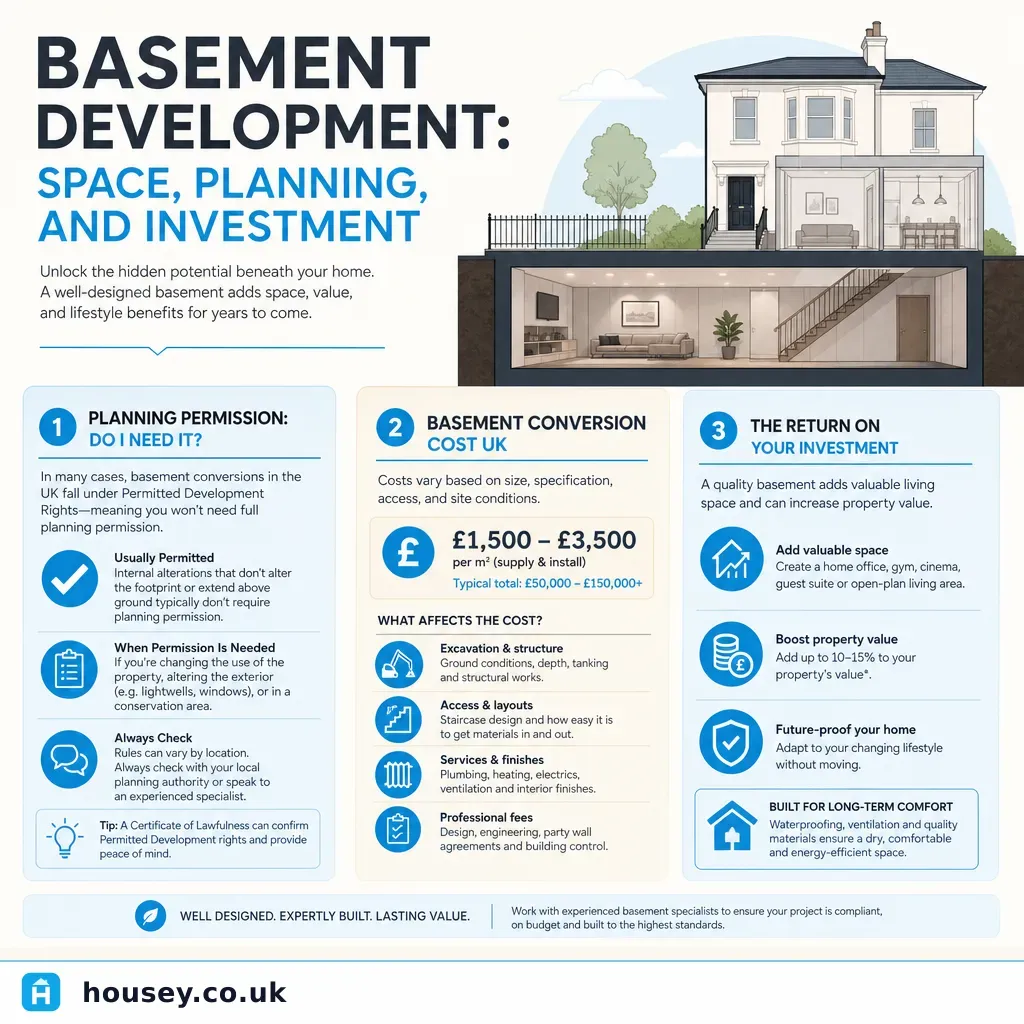
Basement Development: Space, Planning, and Investment
Basement development in the UK almost always requires Building Regulations approval and may need planning permission depending on whether the footprint or external appearance changes.
 Planning & Pre-Build
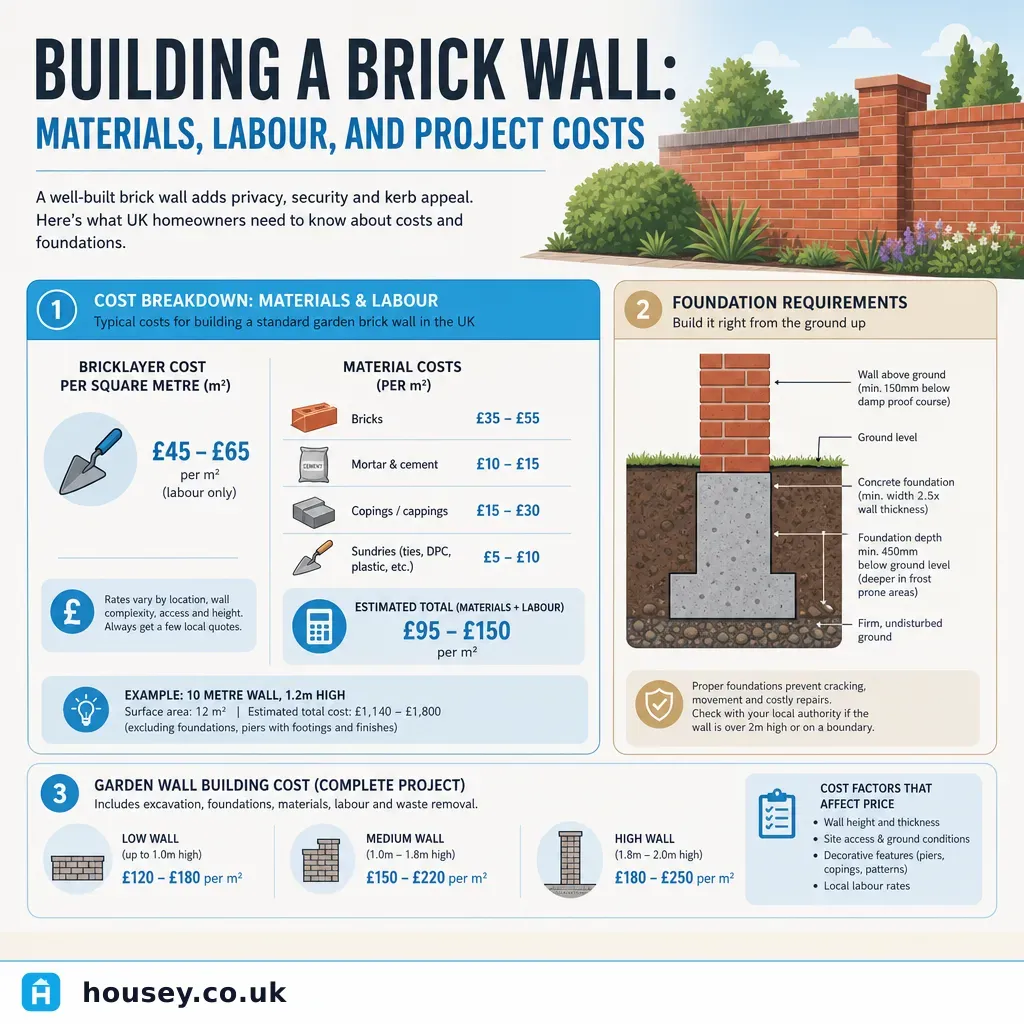
Building a Brick Wall: Materials, Labour, and Project Costs
Building a brick wall in the UK typically costs £50–£120 per square metre for labour, plus £30–£70 per square metre for materials.
 Planning & Pre-Build
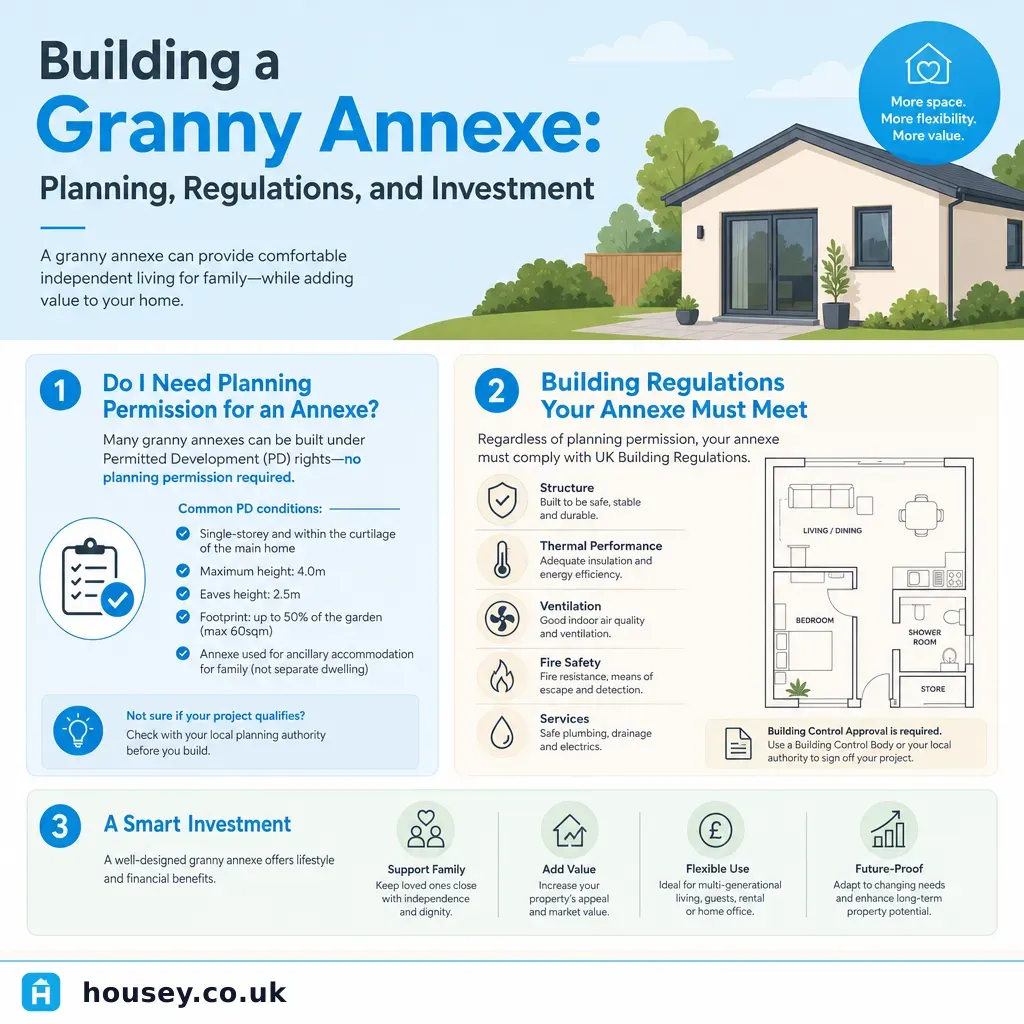
Building a Granny Annexe: Planning, Regulations, and Investment
A granny annexe in the UK may or may not need planning permission depending on whether it is classed as incidental to the main house or as a separate dwelling.
 Planning & Pre-Build
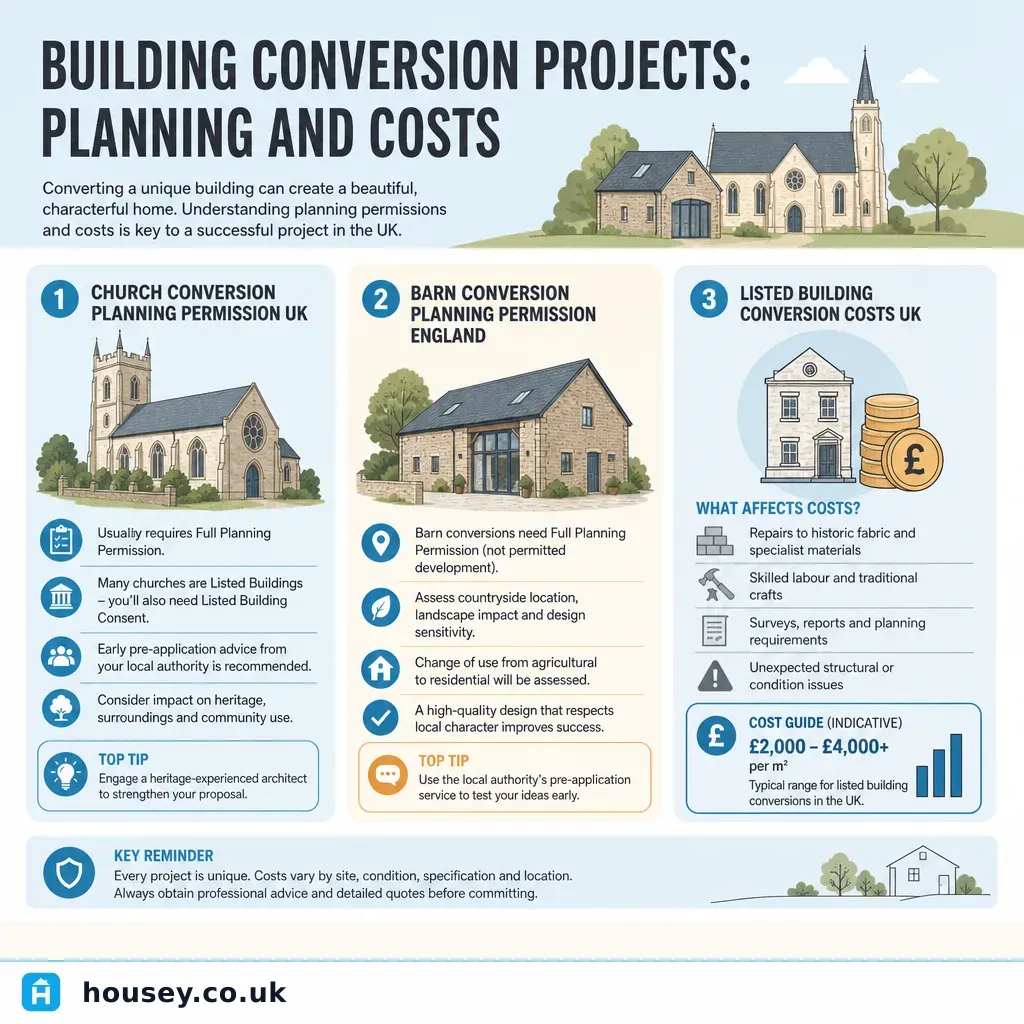
Building Conversion Projects: Planning and Costs
Converting a non-residential building in the UK — such as a barn, church, or commercial property — typically requires full planning permission and often Listed Building Consent.
 Planning & Pre-Build
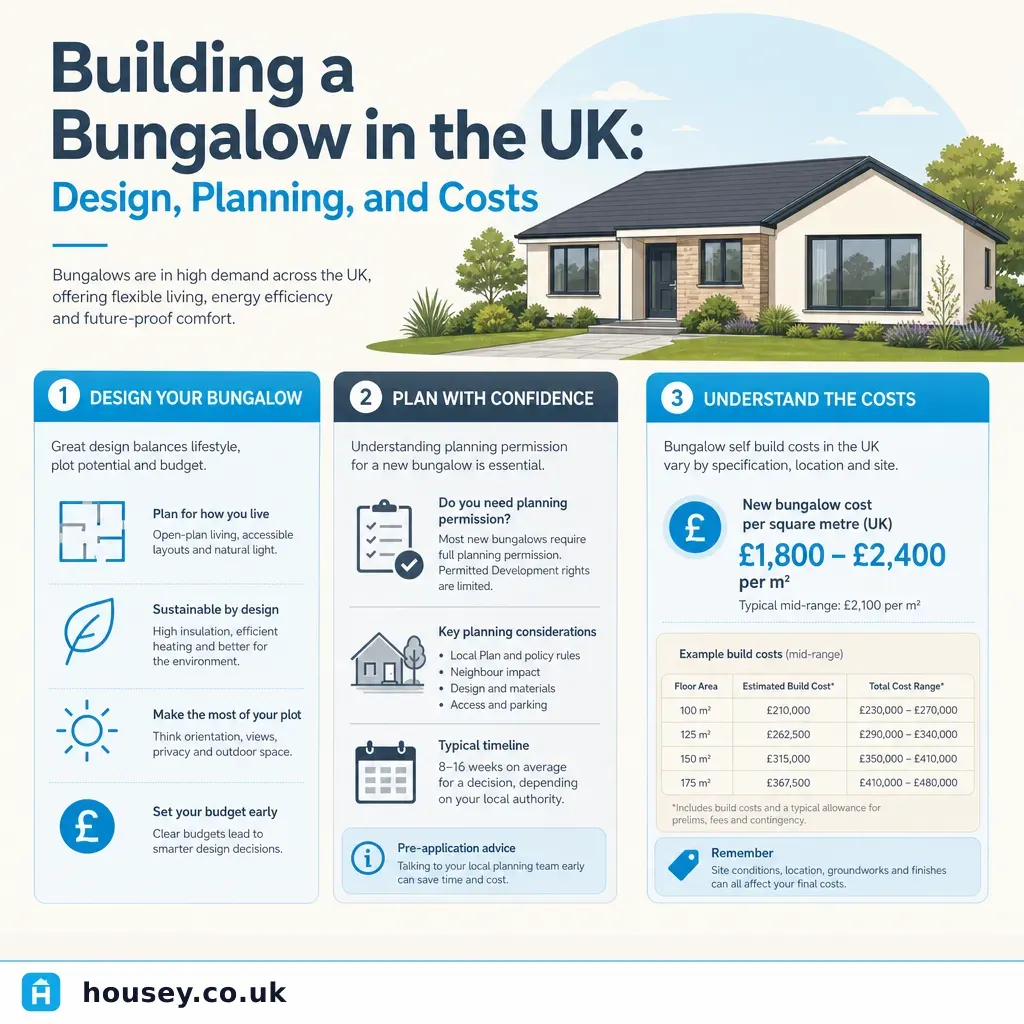
Building a Bungalow in the UK: Design, Planning, and Costs
Building a bungalow in the UK typically costs £1,500–£3,000 per square metre, putting a 100m² bungalow at roughly £150,000–£300,000 in build costs before land, professional fees, and VAT.