Building Conversion Projects: Planning and Costs
By Housey · Last reviewed 5th of May 2026
Building Conversion Projects: Planning and Costs
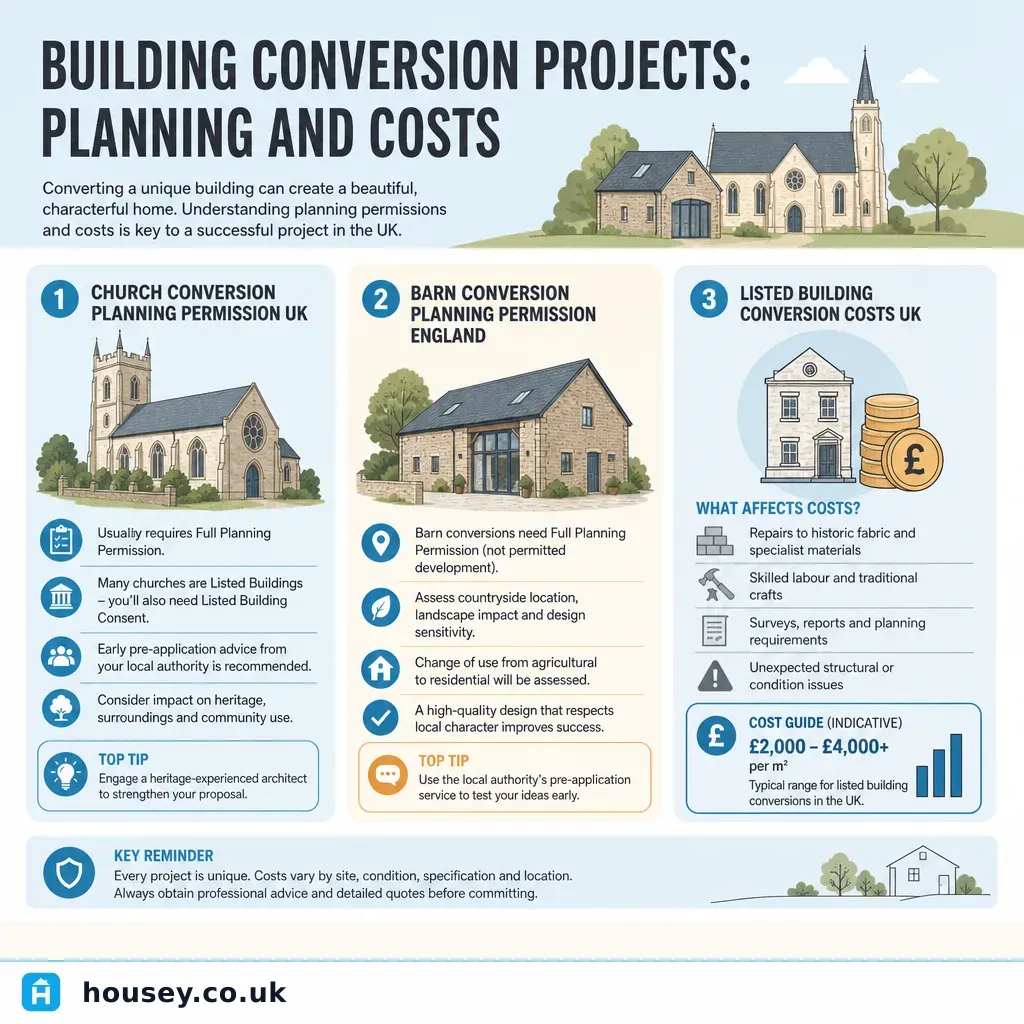
Converting an existing non-residential building — whether a former church, agricultural barn, commercial unit, or industrial warehouse — into a home is one of the most complex residential projects a UK property owner can undertake. The appeal is clear: unique spaces, high ceilings, original fabric, and often attractive or rural locations. But the planning, structural, and heritage considerations involved are substantially more demanding than a conventional extension or new build, and the costs reflect this complexity.
Key points
- Most building conversions require full planning permission through a change-of-use application; some agricultural-to-residential conversions may use Permitted Development Class Q (England only), but this has strict eligibility conditions and prior approval is still required.
- Listed Building Consent (LBC) is required for any works to a listed building's fabric, interior, or exterior — including conversion works — in addition to any planning permission, under the Planning (Listed Buildings and Conservation Areas) Act 1990. Unauthorised works are a criminal offence.
- A structural survey is not optional: conversion projects regularly uncover hidden structural problems, contaminated ground, and inadequate foundations that materially affect both cost and programme.
- Building Regulations approval is required for all conversion works; a change of use to a dwelling triggers requirements under Parts A (structure), B (fire), C (moisture), E (sound), F (ventilation), L (energy efficiency), and P (electrical).
- Indicative conversion costs range from approximately £1,200 to £4,000+ per square metre depending on building type, condition, heritage status, and specification — indicative UK costs, last reviewed 2026-05-05.
Types of building conversion in the UK
The planning and cost landscape varies significantly by building type. The table below summarises the key factors for the most common conversion types.
Building type | Typical planning route | Heritage risk | Structural complexity | Approx. cost range per m² |
|---|---|---|---|---|
Agricultural barn (England) | Class Q permitted development (if eligible) or full planning | Low to medium | Medium — limited insulation and services | £1,200–£2,500 |
Church or chapel | Full planning + LBC if listed | High — often Grade II or II* | Medium to high — large spans, fragile fabric | £2,000–£4,000+ |
Industrial or warehouse | Full planning or prior approval (Class PA) | Low to medium | Medium — structural frame often retained | £1,500–£3,000 |
Commercial (office or retail) | Full planning or prior approval (Class MA in England) | Low to medium | Low to medium | £1,200–£2,500 |
Water tower, oasthouse, pub | Full planning + LBC if listed | High | High — bespoke structural solutions often needed | £2,500–£5,000+ |
All cost ranges are indicative UK figures, last reviewed 2026-05-05. Costs vary substantially by condition, location, specification, and professional fees. Always obtain detailed quotes from contractors experienced in conversion work.
Planning permission for building conversions
Change of use and the use classes
In England, planning use classes are set out in the Town and Country Planning (Use Classes) Order 1987 (as amended). Converting a building to a dwelling (Use Class C3) from most other uses requires a formal change-of-use planning application unless a specific permitted development right applies. Wales, Scotland, and Northern Ireland each have their own use classes and PD rights — always check with the relevant authority.
Key permitted development routes in England — note that these rights have changed frequently and current eligibility should be confirmed with your LPA:
- Class Q (agricultural to residential): Allows conversion of certain agricultural buildings to up to five dwellings without full planning permission. The building must have been in lawful agricultural use; the footprint cannot be materially extended; and prior approval is required for transport, flooding, noise, contamination, and design matters.
- Class MA (commercial, business and service to residential): Permits conversion of certain Class E buildings — offices, retail, light industrial — to residential use, subject to prior approval on specific matters.
- Class PA (light industrial to residential): Allows conversion of light industrial buildings under specified conditions.
For each of these routes, prior approval from the LPA is still required — it is not automatic consent. Prior approval assesses defined matters and the LPA can refuse. For listed buildings, buildings in conservation areas where Article 4 directions have removed PD rights, and most complex heritage buildings, full planning permission will be required regardless of use class.
Listed Building Consent
If the building is listed (Grade I, II*, or II in England), you need Listed Building Consent for any works that affect its character as a building of special interest. This applies to internal works as well as external changes — inserting floor levels, forming new openings, concealing cables, or repairing with different materials can all require LBC. Both LBC and planning permission may be required simultaneously and are processed as separate applications.
Unauthorised works to a listed building carry unlimited fines and potential imprisonment under the Planning (Listed Buildings and Conservation Areas) Act 1990. If in doubt about whether a specific element requires LBC, seek pre-application advice from the LPA's conservation officer.
Structural and technical requirements
Converting a non-residential building to a dwelling brings it under the full scope of Building Regulations. Key areas where conversions frequently require significant investment:
- Structure (Part A): The existing structure must be assessed by a structural engineer to confirm it can safely support new residential loading and occupancy. Agricultural and ecclesiastical buildings are often not designed for the live loads associated with domestic use.
- Fire safety (Part B): Escape routes, compartmentation, and fire detection must meet residential standards. Large open-plan barn or warehouse conversions often require bespoke fire engineering solutions.
- Moisture and weatherproofing (Part C): Many agricultural and industrial buildings were not designed to be weathertight to domestic standards. Damp-proofing, insulation, and vapour control are commonly significant cost items.
- Energy efficiency (Part L): Converting to a dwelling triggers energy performance requirements. Solid stone or brick walls, single-glazed windows, and uninsulated roofs — common in heritage buildings — all present challenges. Balancing conservation obligations against energy efficiency requirements is often the most technically demanding aspect of a heritage conversion.
- Sound insulation (Part E): Where more than one dwelling is created, separating elements must meet minimum sound transmission standards.
- Electrical safety (Part P): A full rewire is usually required; in listed buildings, concealing cables requires careful negotiation with the conservation officer.
An asbestos refurbishment survey by a UKAS-accredited provider is legally required before any intrusive investigation or works in buildings where asbestos-containing materials (ACMs) may be present — typically any building constructed or refurbished before 2000. This is a legal duty under the Control of Asbestos Regulations 2012.
The professional team you will need
A conversion project at medium to high complexity typically requires:
- Planning consultant — to navigate change-of-use applications, listed building consent, and negotiations with the LPA and Historic England for significant listed buildings.
- Structural engineer — to assess the existing structure and design any new structural elements, load transfer systems, or inserted floor levels.
- Architect or architectural technologist — for design development, planning drawings, and Building Regulations drawings.
- Building control body (approved inspector or LPA building control) — to oversee and certify compliance throughout the project.
- Asbestos surveyor — before any intrusive investigation or works begin.
- Main contractor experienced in heritage or conversion projects — contractors unfamiliar with listed building constraints regularly cause costly and legally problematic damage.
For listed buildings, a heritage consultant or historic buildings architect holding AABC accreditation (Architects Accredited in Building Conservation) is advisable.
Which planning route applies? A decision tree
- Is the building listed (any grade)? → Always need LBC. Full planning permission is also likely required. Engage a planning consultant and conservation architect before purchase.
- Is it an agricultural building in England not covered by any Article 4 direction? → Class Q prior approval may apply. Check eligibility against current rules carefully — the building must have been in lawful agricultural use and the conversion must not extend the external footprint materially.
- Is it a commercial or office building (Class E) in England? → Class MA prior approval may apply. Check for Article 4 directions removing this right in the area.
- Is it in a conservation area with an Article 4 direction? → Permitted development rights may be removed. Full planning permission is likely required.
- None of the above, or any doubt about the position? → Full planning permission is required. Seek pre-application advice from the LPA and engage a planning consultant early — before committing financially to the project.
Important limitations
The planning and heritage framework for building conversions is highly specific to each individual building, its listing status, its planning history, and the policies of the relevant local planning authority. This article provides general information only and should not be relied upon as planning or legal advice.
Class Q, Class MA, and other permitted development rights have changed frequently and may change again. Cost estimates in this article are indicative ranges only — actual costs depend heavily on the building's specific condition, structural complexity, services requirements, specification, location, and professional fees. Rules differ between England, Wales, Scotland, and Northern Ireland.
A qualified planning consultant should assess the planning position for any specific building before financial commitments are made.
What to ask a qualified professional
Planning consultant
- Does this building sit within a conservation area, and are there Article 4 directions removing any permitted development rights?
- Is a Class Q, Class MA, or other prior approval route realistically available for this building based on its use history?
- What is this LPA's general attitude to residential conversions of this building type and in this location?
- How long does a typical full planning or prior approval application take at this LPA?
- Is pre-application advice recommended before submitting?
Structural engineer
- What level of survey do you recommend before we commit to the design — desk study, non-intrusive, or intrusive investigation?
- Are the existing foundations adequate for residential loading?
- Are there any signs of significant movement, subsidence, or deterioration in the structure?
- What are the structural implications of any new openings or inserted floor levels we are proposing?
Building control consultant
- At what stage should we engage you on this project?
- Are there particular compliance challenges for this building type that we should design for from the outset — particularly around fire, sound, or energy?
When to get professional help
Engage qualified professionals before making any financial commitment to a building conversion project. In particular:
- If the building is listed or in a conservation area, speak to a planning consultant and ideally a conservation architect before exchanging contracts.
- If there are any signs of structural movement, subsidence, or serious deterioration, commission a structural survey before proceeding.
- If any asbestos-containing materials may be present, commission a refurbishment asbestos survey before any intrusive investigation or works begin — this is a legal requirement.
- If there is any uncertainty about the planning position — particularly regarding permitted development eligibility — obtain formal pre-application advice from the LPA and instruct a planning consultant.
How Housey can help
Housey can connect you with specialists at every stage of a conversion project. Start with planning consultancy to clarify what permissions you will need, then engage structural engineering to assess the building's condition and structural requirements. Once your design is developed, building control consultants can guide the project through the compliance process from initial design to completion certificate.
Frequently asked questions
Do I always need planning permission to convert a building?
Not always. Certain conversions benefit from permitted development rights — for example, Class Q (agricultural to residential in England) or Class MA (commercial to residential in England). However, these routes have strict eligibility criteria, prior approval requirements, and can be limited by Article 4 directions. Listed buildings and conservation areas face additional restrictions. Always check with your LPA or a planning consultant before assuming any permitted development route applies.
How much does it cost to convert a barn or church in the UK?
Costs vary widely depending on building condition, heritage status, and specification. As a rough guide, barn conversions typically cost £1,200–£2,500 per square metre; church or chapel conversions often cost £2,000–£4,000+ per square metre due to structural complexity and heritage constraints. These are indicative UK figures, last reviewed 2026-05-05. Actual costs depend on the building's condition, professional fees, and any heritage or structural remediation required. Always obtain detailed quotes from experienced conversion contractors.
What is Listed Building Consent and when do I need it?
Listed Building Consent (LBC) is required for any works to a listed building that would affect its character as a building of special interest. This includes internal works such as inserting new floor levels, forming openings, and installing services. You need LBC in addition to any planning permission — not instead of it. Carrying out works without LBC is a criminal offence under the Planning (Listed Buildings and Conservation Areas) Act 1990, with unlimited fines and potential imprisonment.
How long does a building conversion project take from start to finish?
Timelines vary significantly by complexity. A straightforward Class Q barn conversion may take 18–30 months from prior approval application to completion. A complex listed building conversion — involving full planning, listed building consent, detailed design, and construction — often takes three to five years. Planning alone can take 6–12 months for complex applications, and Historic England consultation adds further time for Grade I or II* listed buildings.
Do I need an asbestos survey before converting a building?
Yes — if the building was constructed or refurbished before 2000, or if you cannot confirm asbestos-containing materials (ACMs) are absent, you must commission a refurbishment asbestos survey before any intrusive works. This is a legal requirement under the Control of Asbestos Regulations 2012. ACMs are commonly found in agricultural, industrial, and ecclesiastical buildings from the 1950s through to the 1980s. Do not disturb suspected materials before surveying.
Sources and further reading
- Permitted development rights: technical guidance — GOV.UK
- Planning (Listed Buildings and Conservation Areas) Act 1990 — legislation.gov.uk
- Historic England: development in historic areas — Historic England
- Building Regulations Approved Documents — GOV.UK
- Control of Asbestos Regulations 2012 — legislation.gov.uk
- Planning Portal: change of use — Planning Portal
Useful next reads
 Planning & Pre-Build
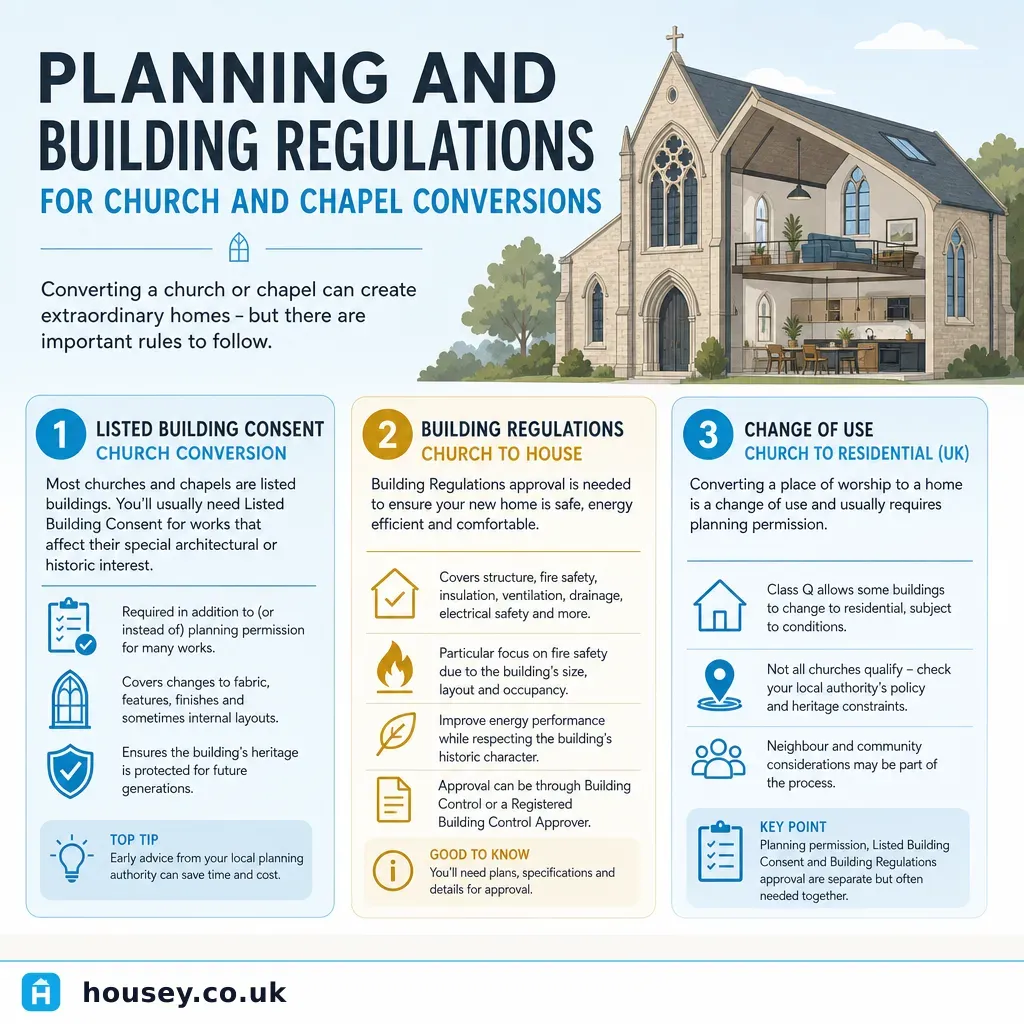
Planning and Building Regulations for Church and Chapel Conversions
Converting a church or chapel to residential use requires planning permission for change of use from Class F1 to Class C3, and listed building consent if the building is listed.
 Planning & Pre-Build
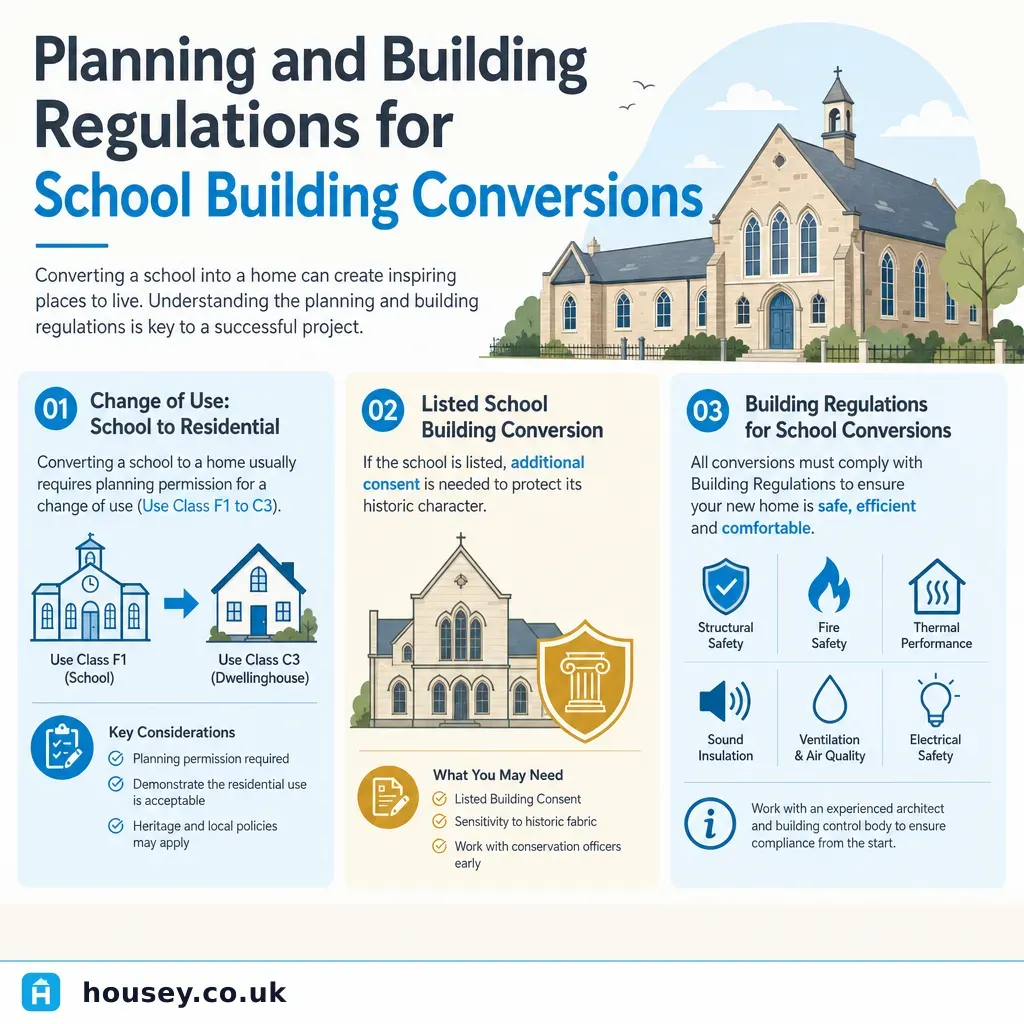
Planning and Building Regulations for School Building Conversions
Converting a school to residential use in England requires full planning permission — there is no permitted development right for this change of use.
 Planning & Pre-Build
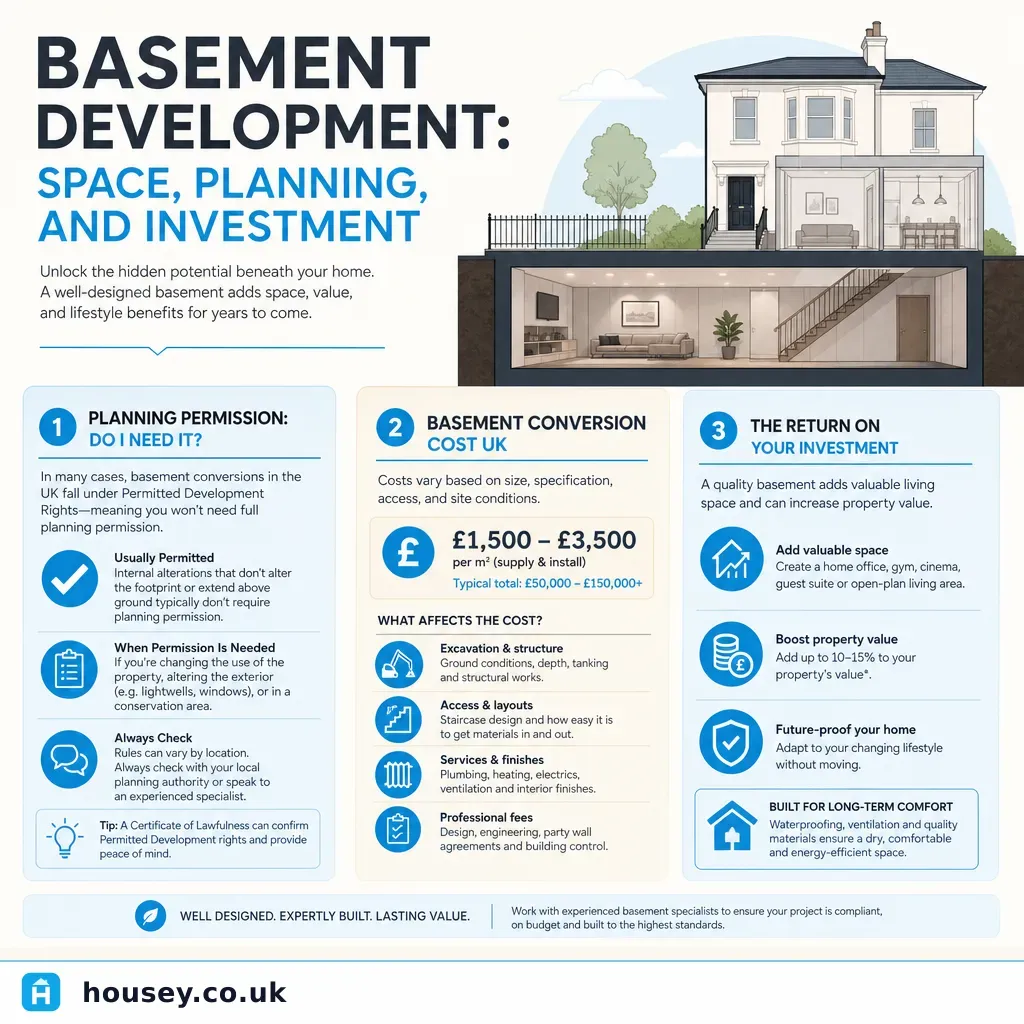
Basement Development: Space, Planning, and Investment
Basement development in the UK almost always requires Building Regulations approval and may need planning permission depending on whether the footprint or external appearance changes.
 Planning & Pre-Build
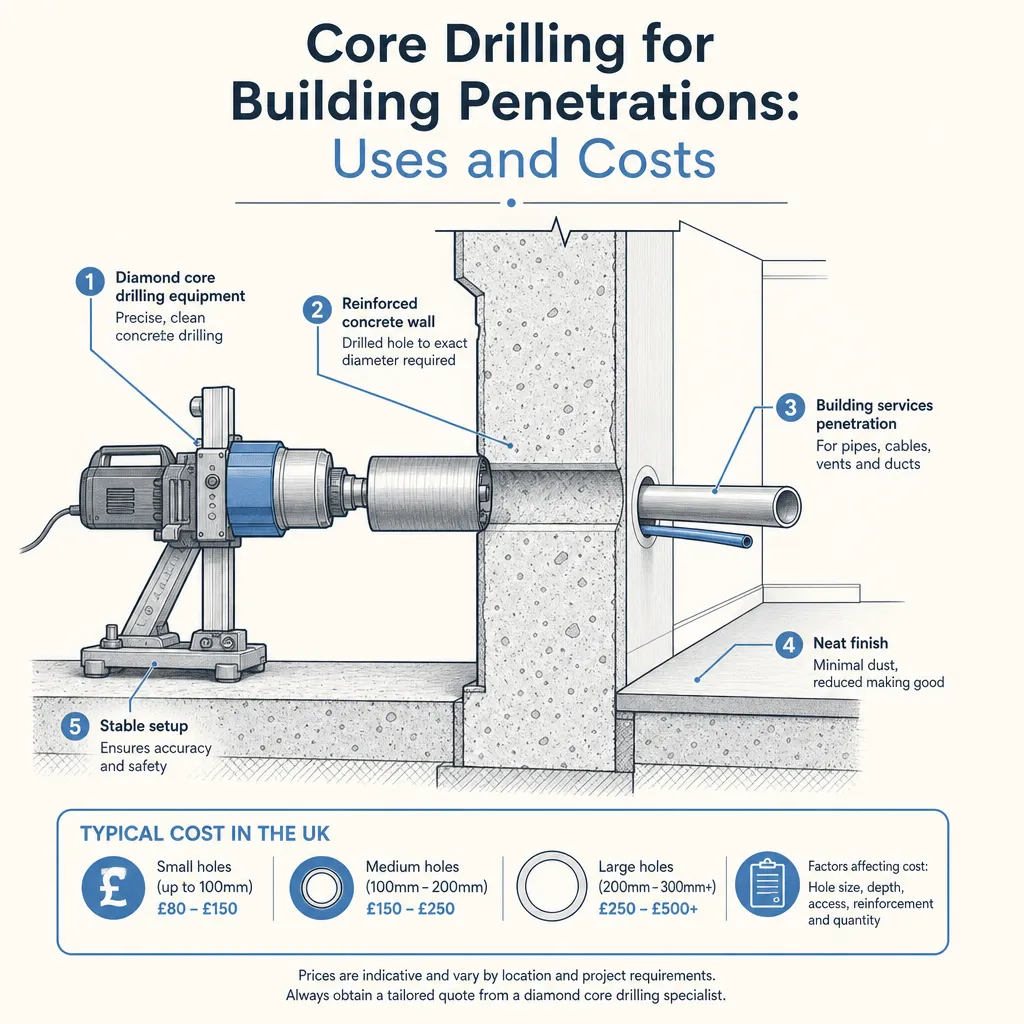
Core Drilling for Building Penetrations: Uses and Costs
Core drilling uses diamond-tipped equipment to cut clean holes through concrete, masonry, or block for pipes, ducts, cables, and building services.
 Planning & Pre-Build
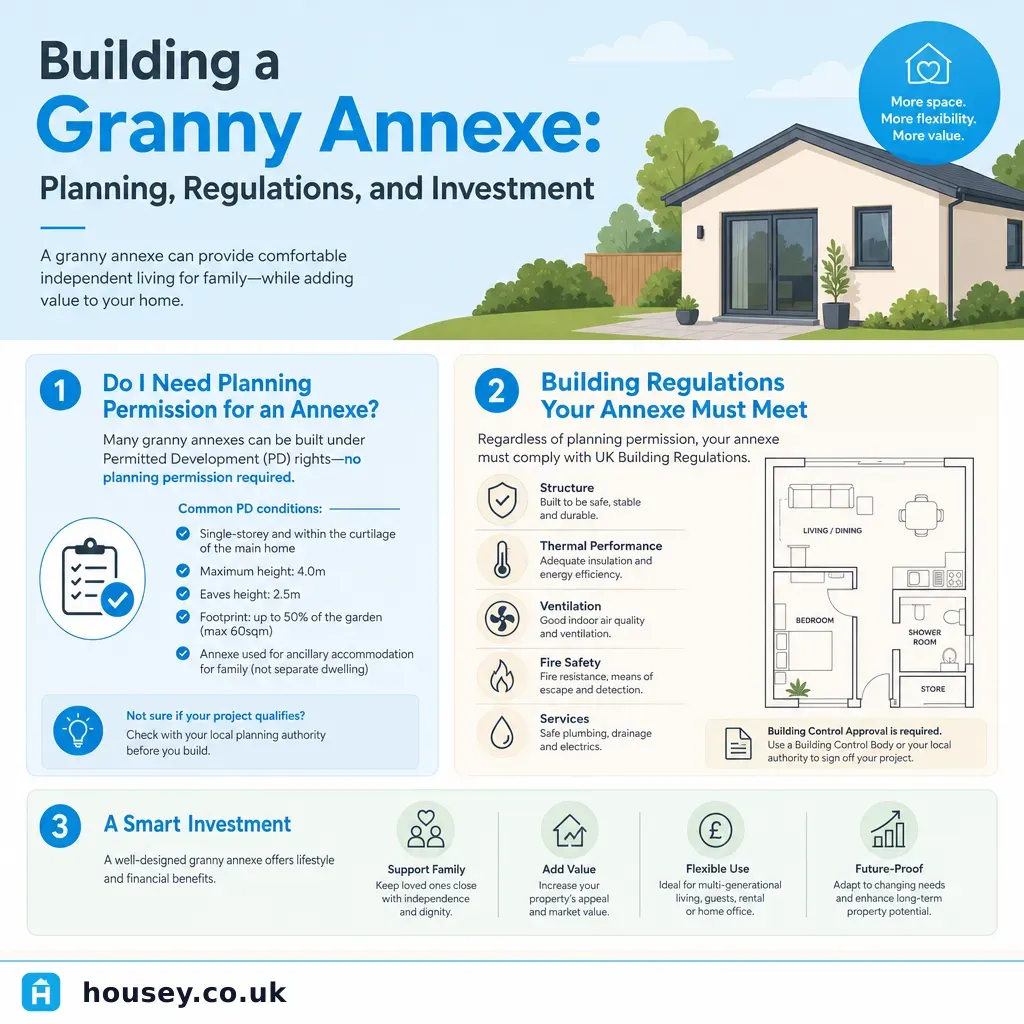
Building a Granny Annexe: Planning, Regulations, and Investment
A granny annexe in the UK may or may not need planning permission depending on whether it is classed as incidental to the main house or as a separate dwelling.