Building a Granny Annexe: Planning, Regulations, and Investment
By Housey · Last reviewed 5th of May 2026
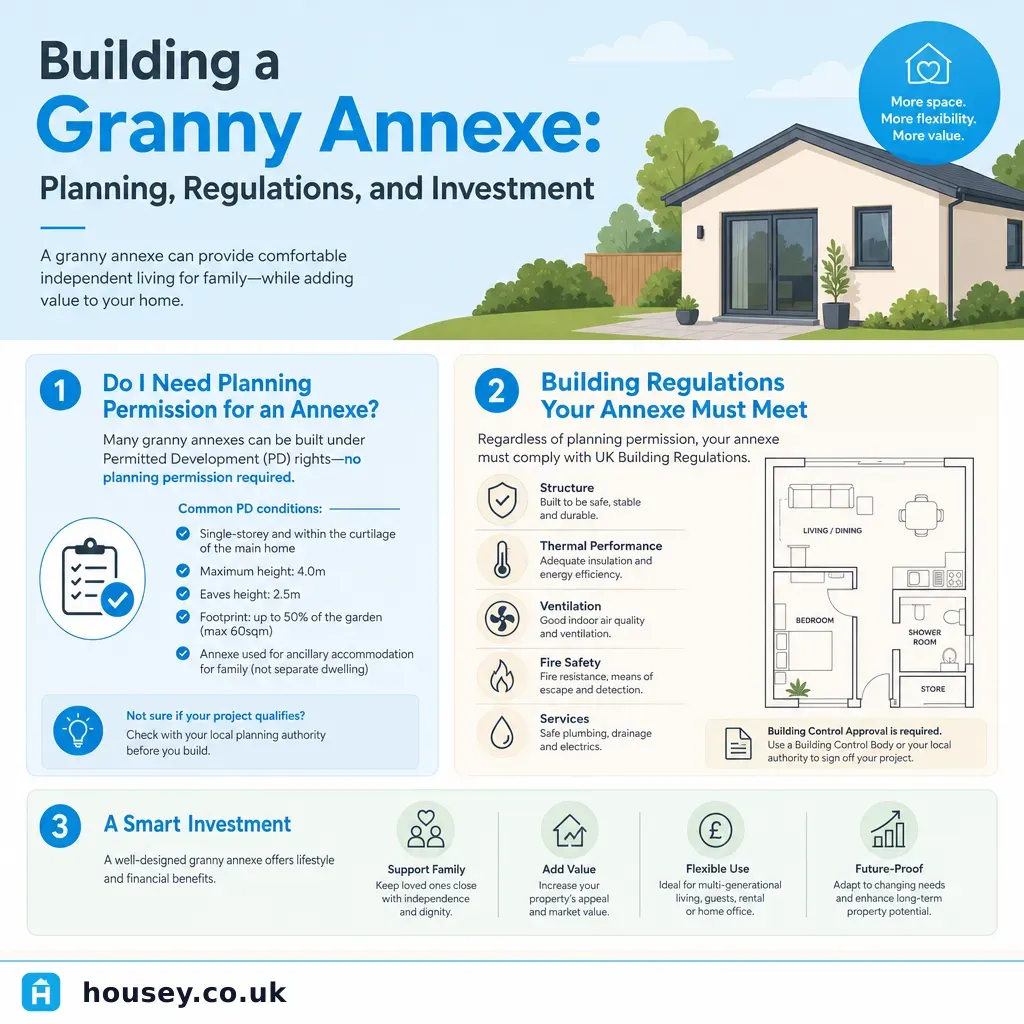
Building a Granny Annexe: Planning, Regulations, and Investment
A granny annexe — sometimes called a garden annexe, ancillary dwelling, or self-contained garden room — has become one of the more practical responses to the UK's intergenerational housing pressures. The decision to build one typically arises when a family member needs more independence, better accessibility, or proximity to relatives, while remaining connected to the household. Getting the planning position, Building Regulations compliance, and financial implications right from the outset avoids costly and sometimes irreversible mistakes later.
Key points
- Whether a granny annexe needs full planning permission depends on whether it is classified as an outbuilding incidental to the main house or as a separate residential dwelling — a distinction that depends on its facilities, layout, and your LPA's interpretation.
- Under Schedule 2, Part 1, Class E of the GPDO 2015, outbuildings within a dwellinghouse curtilage may be erected without planning permission only if they are incidental to the enjoyment of the house — a fully self-contained annexe with a kitchen, bathroom, and independent entrance almost never qualifies.
- Building Regulations always apply to any new annexe structure, regardless of permitted development status — a completion certificate is required before occupation.
- A self-contained annexe occupied by a relative of the main dwelling's occupier may qualify for a 50% council tax discount in England under the Local Government Finance Act 1992.
- Indicative costs range from £25,000–£70,000 for a garage conversion to £80,000–£160,000+ for a purpose-built brick-and-block annexe (last reviewed 2026-05-05; costs vary by region and specification).
Planning permission: when is it needed?
This is the question most homeowners get wrong. The common assumption — that a granny annexe automatically qualifies under permitted development — is not reliably accurate, and proceeding without confirming the planning position can result in enforcement action and costly retrospective applications.
The 'incidental use' test
Under Schedule 2, Part 1, Class E of the Town and Country Planning (General Permitted Development) (England) Order 2015 (GPDO 2015), outbuildings within the curtilage of a dwellinghouse may be erected without planning permission provided they are incidental to the enjoyment of the dwellinghouse. This covers home offices, hobby rooms, gyms, and pool houses.
A fully self-contained annexe with sleeping accommodation, a kitchen, a bathroom, and its own entrance functions as a separate residential unit. Planning authorities consistently treat this as a new dwelling requiring full planning permission, not an incidental outbuilding. Planning officers assess:
- Whether the annexe has its own separate entrance and independent access
- Whether it contains complete independent facilities (kitchen, bathroom, sleeping space)
- Whether it is genuinely subordinate to and functionally linked with the main house
- Whether the design allows it to be used entirely independently of the main property
The fact that a dependent relative will occupy the annexe can support the planning case but does not automatically grant permission, and does not remove the need to apply.
Decision tree: do I need planning permission for my annexe?
- Proposed use is storage, gym, or hobby room only — no sleeping, kitchen, or bathroom? → May fall under Class E permitted development. Check size and height limits still apply (maximum 4m ridge height with a dual-pitched roof; 2.5m where within 2m of a boundary; total outbuilding footprint must not exceed 50% of the original curtilage).
- Proposed annexe is self-contained with sleeping, kitchen, and bathroom? → Full planning permission is likely required. Speak to a planning consultant before commissioning drawings.
- Property is a listed building? → Permitted development rights do not apply; listed building consent and full planning permission are required.
- Property is in a conservation area, AONB, or National Park? → Permitted development rights for outbuildings are more restricted; check with the LPA before proceeding.
- An Article 4 direction is in place for your area? → Permitted development rights may have been removed — check with the LPA.
- Annexe would be a detached new-build structure in a standard residential garden? → Size and height limits under Class E still apply even if the use is incidental; a self-contained annexe almost always requires planning permission regardless.
Pre-application advice
Before investing in detailed drawings, many LPAs offer a pre-application advice service (typically £50–£300 for householder enquiries). A written pre-application response confirms whether planning permission is required and what conditions may apply — a worthwhile cost before committing to design fees.
Building Regulations: what applies to a granny annexe?
Regardless of whether planning permission is required, Building Regulations under the Building Act 1984 apply to any new annexe building. You must notify Building Control before work starts and obtain a completion certificate before the annexe is occupied.
Part | What it covers | Typical requirement for annexes |
|---|---|---|
Part A — Structure | Structural stability | Foundation design, wall construction, roof loading — structural calculations required |
Part B — Fire safety | Escape routes, fire detection | Escape window where above ground floor; smoke alarms to BS 5839-6 |
Part C — Site preparation | Ground contamination, damp resistance | DPC and DPM required; ground conditions assessed before foundation design |
Part F — Ventilation | Adequate fresh air, moisture extraction | Background ventilation required; extract ventilation in kitchen and bathroom |
Part L — Energy efficiency | Insulation, U-values, air tightness | New annexes must meet current fabric standards broadly comparable to new dwellings |
Part M — Accessibility | Access to the annexe | Level or ramped threshold access; minimum door widths to Category 1 standard |
Part P — Electrical safety | Fixed electrical installation | Must be carried out by a competent person and notified to Building Control |
Many modular or kit-build annexe suppliers offer a Building Regulations package as part of their service. Confirm this includes actual approval and a completion certificate — not only design drawings.
Comparison: types of granny annexe
Type | Indicative cost | Approximate build time | Planning notes | Best suited to |
|---|---|---|---|---|
Converted garage or outbuilding | £25,000–£70,000 | 8–20 weeks | Planning permission likely required if change of use creates a dwelling | Existing structure in reasonable condition |
Modular or timber-frame garden annexe | £50,000–£120,000 | 4–16 weeks on site | Planning permission usually required for self-contained unit | Quicker delivery; can achieve good insulation standards |
Purpose-built brick-and-block annexe | £80,000–£160,000+ | 16–30 weeks | Full planning permission; Building Regulations apply | Long-term, permanent solution integrated with the garden |
First-floor addition over existing garage | £40,000–£90,000 | 12–24 weeks | Planning and party wall considerations; structural assessment of existing garage required | Maximising floor area without losing garden space |
Indicative UK costs, last reviewed 2026-05-05. Costs vary by region, specification, contractor, and site conditions. Obtain multiple quotes before committing.
Council tax and financial considerations
Council tax
A self-contained annexe occupied by a relative of the main dwelling's occupier may qualify for a 50% council tax discount in England under the Local Government Finance Act 1992. However, if the annexe is let to an unrelated tenant or is unoccupied, it will typically be valued and banded separately by the Valuation Office Agency. Contact your local council's revenues department to confirm the applicable rules — interpretation and administration can vary between authorities.
VAT
Construction of a new residential annexe may attract 5% reduced-rate VAT rather than the standard 20% in certain circumstances — for example, where the annexe constitutes a new dwelling with its own separate use and disposal, or where it is designed for use by a disabled person. Standard-rate VAT applies to most general building works on existing dwellings. Discuss the VAT treatment with your contractor and accountant before work starts, as this can make a material difference to budget.
Planning conditions and resale
Some LPAs grant planning permission for an annexe subject to a condition that it cannot be occupied separately from the main dwelling or let as an independent unit. This can restrict future letting income and may affect how lenders and buyers view the property on resale. Check any planning conditions carefully before proceeding and take advice from a planning consultant if you want to use the annexe flexibly in the future.
Document preparation checklist
Before applying for planning permission or serving a Building Regulations notice, prepare:
Important limitations
This article provides general information about planning and Building Regulations for granny annexes in England. Rules in Wales, Scotland, and Northern Ireland differ in important respects. Planning policy, permitted development limits, and council tax rules are subject to change. Your specific property, site history, location, and local authority's adopted policies will determine what applies to your scheme. Nothing in this article is a substitute for advice from a qualified planning consultant, architect, or structural engineer.
What to ask a qualified professional
Before appointing professionals for an annexe project, ask:
- Do you consider this annexe to be permitted development, or will a full planning application be required? On what basis do you reach that conclusion?
- Has the LPA's pre-application advice service been consulted, and if not, would you recommend it before submitting an application?
- Will any planning conditions restrict future occupation, letting, or sale of the annexe?
- What Building Regulations approval route do you recommend — full plans or building notice — and why?
- What foundation type is recommended given the ground conditions, and is a site investigation needed?
- Is the proposed specification designed to meet current Part L U-value requirements?
- Will a completion certificate be issued at the end, and what documentation will I receive?
When to get professional help
Seek professional advice before starting any annexe project if:
- You are unsure whether your proposed annexe needs planning permission — incorrect assumptions can result in enforcement notices and costly retrospective applications.
- The main house is a listed building or is in a conservation area.
- Ground conditions on the proposed site are unknown or the site has a history of previous development or fill.
- You are converting an existing outbuilding and are unsure whether a material change of use applies.
- A neighbour is likely to object to the development, or a party wall issue may arise.
- You plan to let the annexe or use it for purposes other than housing a dependent family member.
How Housey can help
Housey can connect you with qualified professionals for your granny annexe project. Request quotes from planning consultants to confirm whether planning permission is needed and to guide your application, structural engineers for foundation design and structural calculations, and building control consultants to manage compliance from Building Regulations approval through to your completion certificate.
Frequently asked questions
Does a granny annexe always need planning permission?
Not always, but it usually does if it is fully self-contained. An outbuilding genuinely incidental to the main house — such as a gym or hobby room — may fall under permitted development. A self-contained annexe with its own kitchen, bathroom, sleeping space, and entrance is likely to be treated as a separate dwelling by the LPA, requiring full planning permission. Always check with your local planning authority before proceeding.
Can I rent out my granny annexe?
If planning permission was granted subject to a condition restricting occupation to a dependent relative of the main household, renting to an unrelated tenant would breach that condition and could result in enforcement action. Check any planning conditions carefully before making letting arrangements. If you want flexible future use, raise this with a planning consultant at the application stage — some conditions can be negotiated.
Does a granny annexe affect council tax?
A self-contained annexe occupied by a relative of the main dwelling's occupier may qualify for a 50% council tax discount in England under the Local Government Finance Act 1992. If the annexe is let separately or unoccupied, it will typically be valued and banded as an independent dwelling. Contact your local council's revenues team to confirm the applicable rules for your specific situation.
How long does it take to build a granny annexe?
Timescales vary by type. A modular or timber-frame annexe can typically be installed on site in 4–16 weeks once planning and Building Regulations approval are in place. A traditional brick-and-block annexe usually takes 16–30 weeks on site. Allow additional time for planning determination (8 weeks for a standard householder application), Building Regulations approval, and any site preparation works.
Do I need a structural engineer for a granny annexe?
Most annexes require some structural input — foundation design and calculations at a minimum. If you are converting an existing outbuilding, a structural assessment of the existing structure is advisable before committing to a design. Building Control will require evidence of structural compliance before issuing a completion certificate. Involve a structural engineer from the early design stage for anything other than a very lightweight modular structure on an established, well-drained site.
Sources and further reading
- GPDO 2015 — Schedule 2, Part 1 (permitted development for outbuildings) — legislation.gov.uk
- Planning Portal — permitted development: outbuildings — Planning Portal
- Building Regulations Approved Documents — GOV.UK
- Council tax: who has to pay — GOV.UK
- Community Infrastructure Levy guidance — GOV.UK
Useful next reads
 Planning & Pre-Build
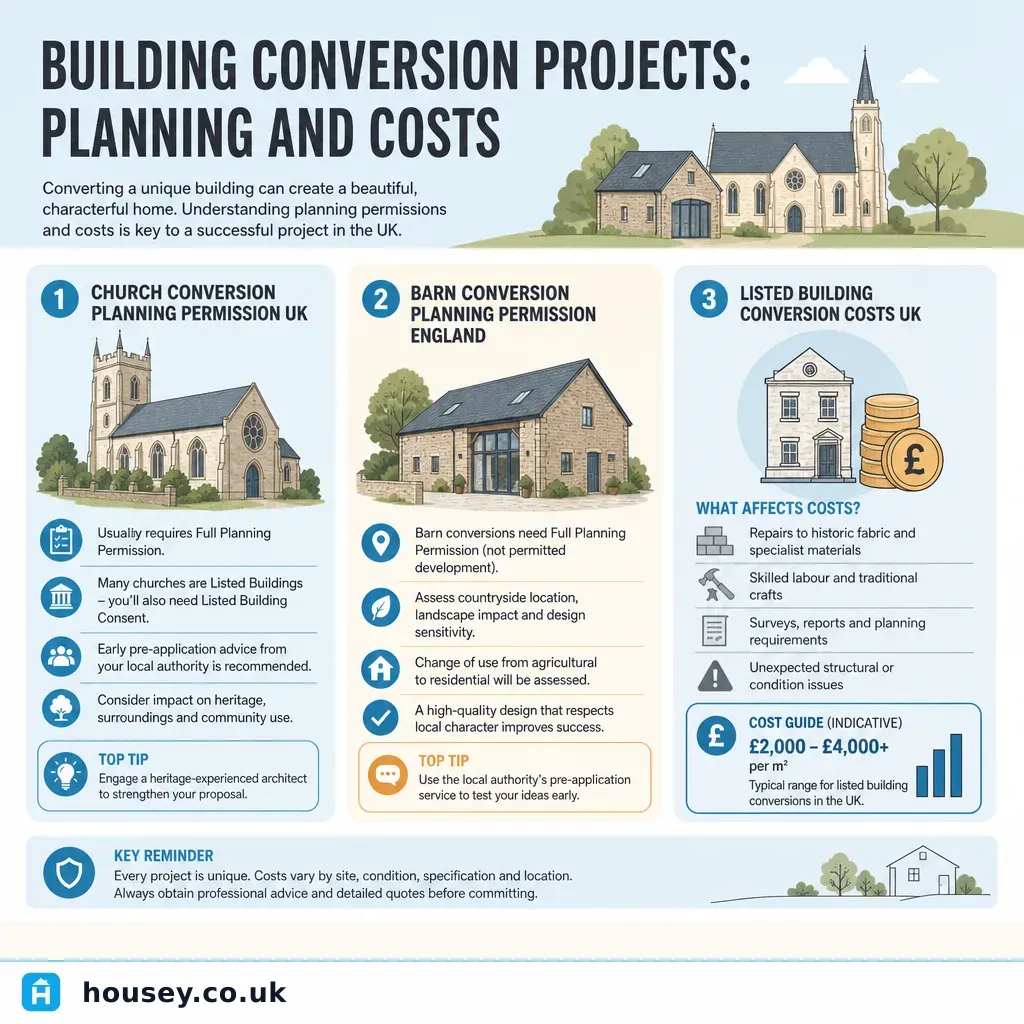
Building Conversion Projects: Planning and Costs
Converting a non-residential building in the UK — such as a barn, church, or commercial property — typically requires full planning permission and often Listed Building Consent.
 Planning & Pre-Build
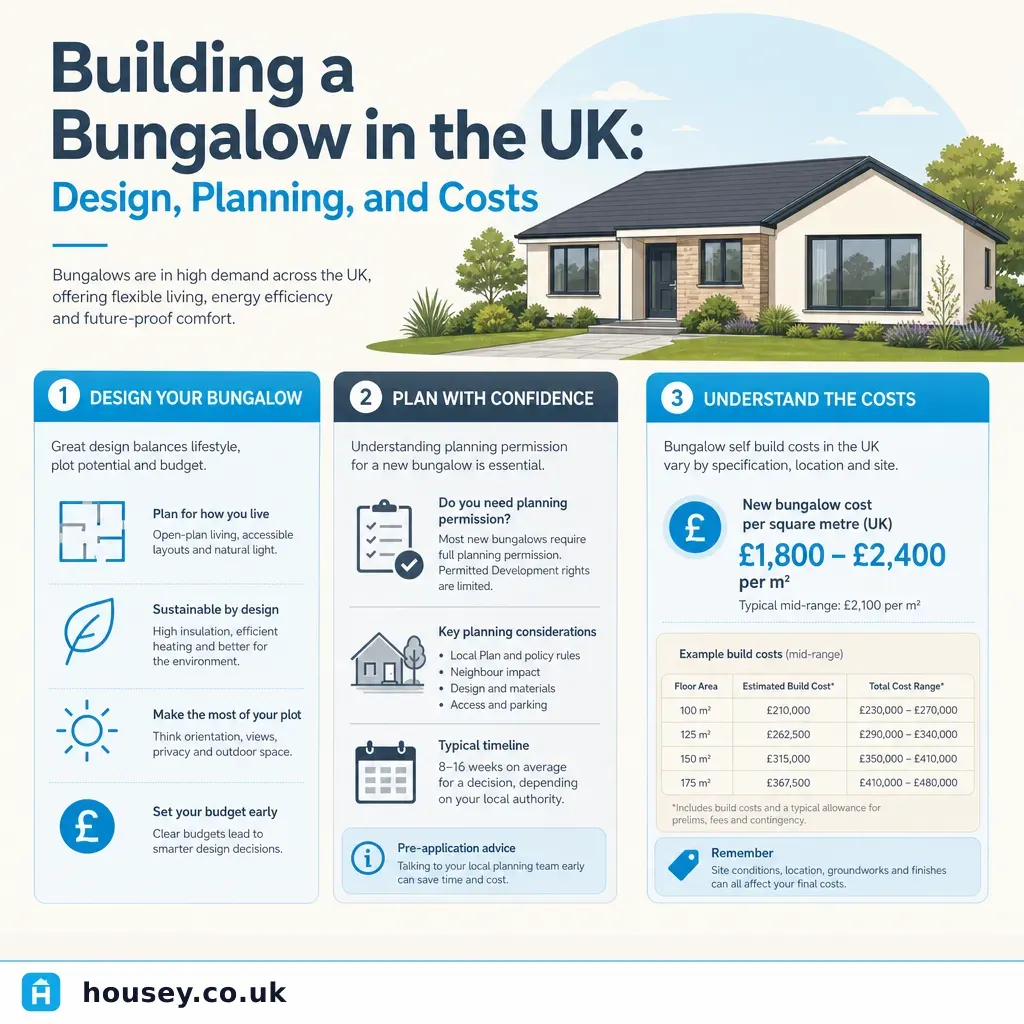
Building a Bungalow in the UK: Design, Planning, and Costs
Building a bungalow in the UK typically costs £1,500–£3,000 per square metre, putting a 100m² bungalow at roughly £150,000–£300,000 in build costs before land, professional fees, and VAT.
 Planning & Pre-Build
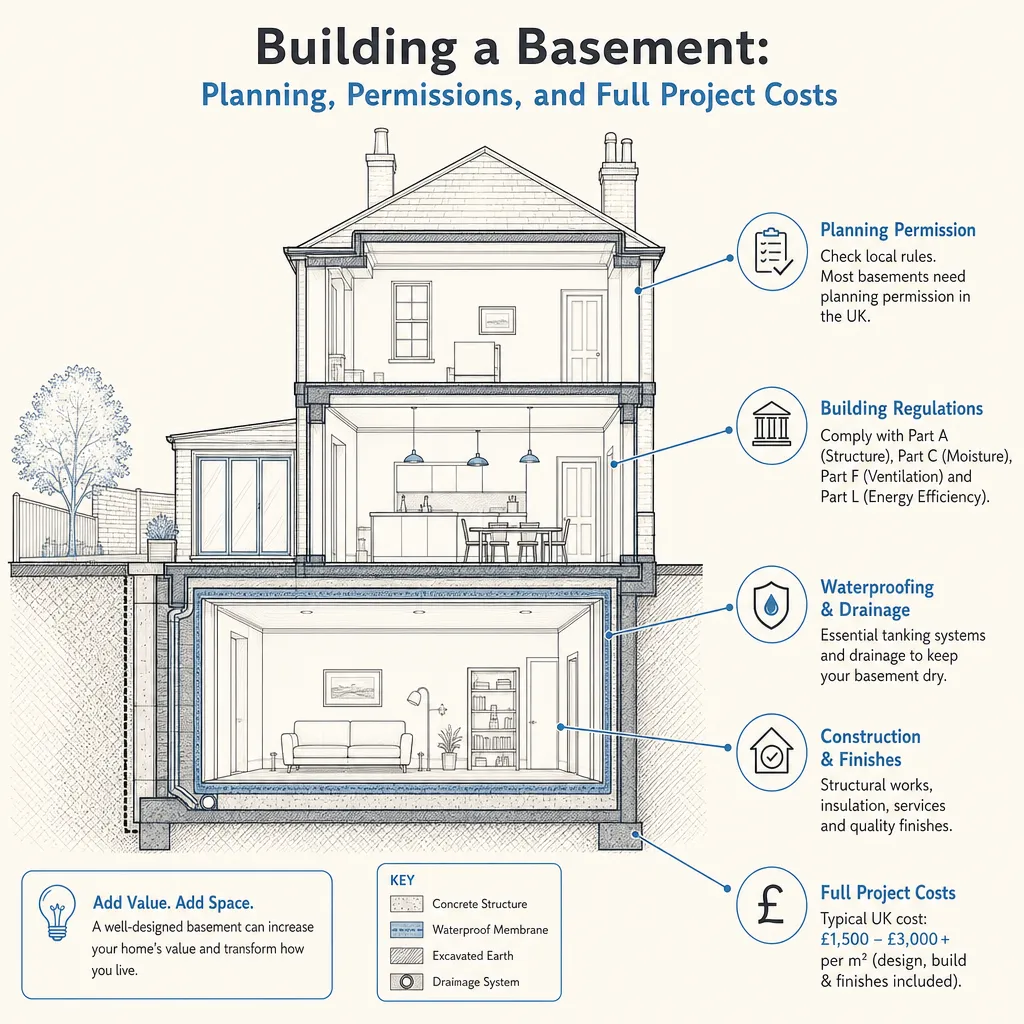
Building a Basement: Planning, Permissions, and Full Project Costs
Building a basement in the UK usually requires full planning permission where new excavation or external changes are involved.
 Planning & Pre-Build
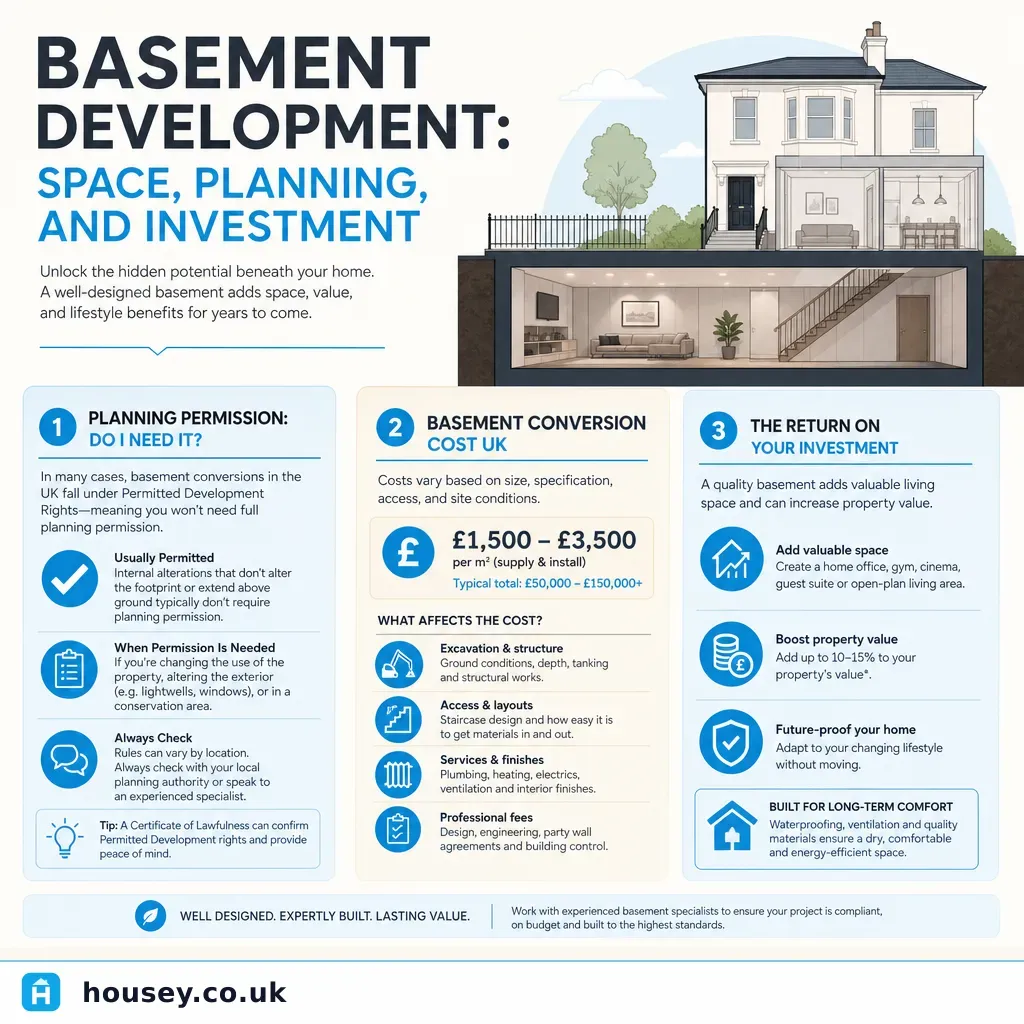
Basement Development: Space, Planning, and Investment
Basement development in the UK almost always requires Building Regulations approval and may need planning permission depending on whether the footprint or external appearance changes.
 Planning & Pre-Build
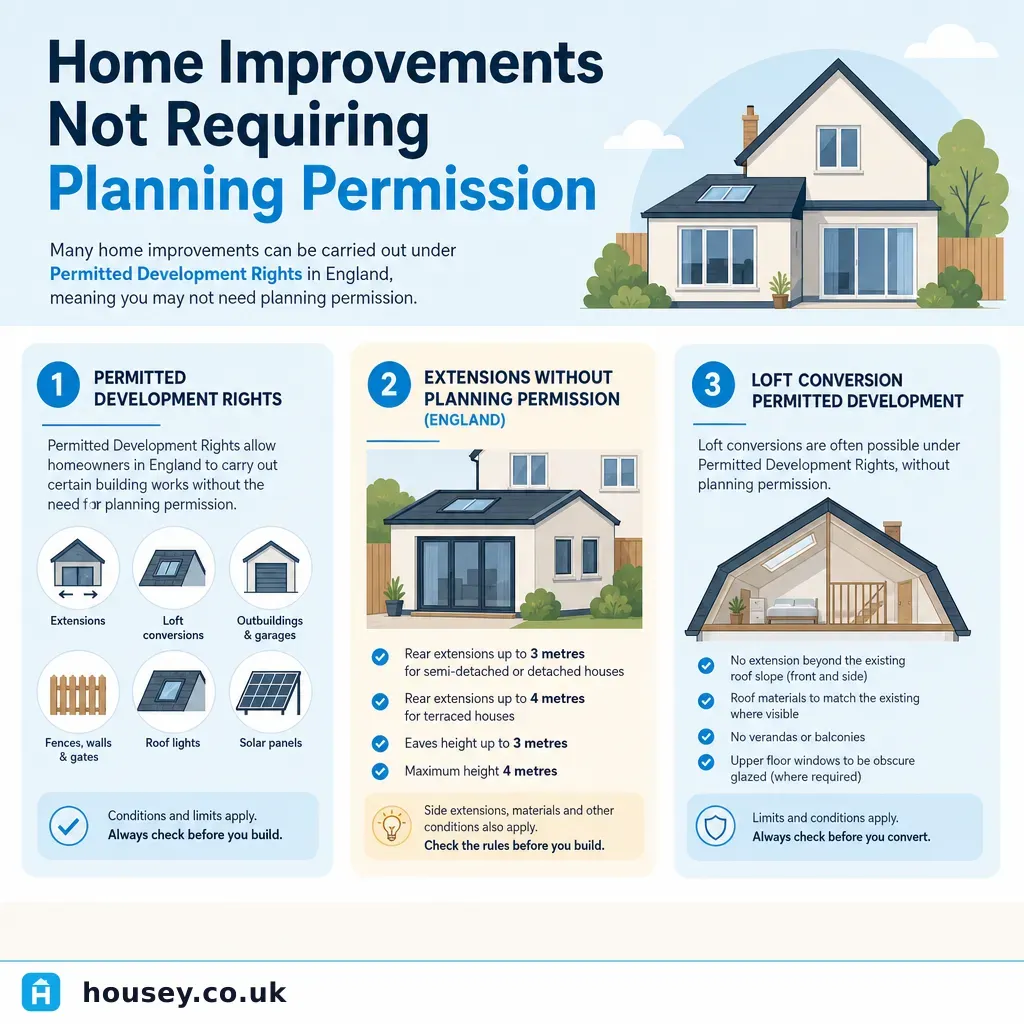
Home Improvements Not Requiring Planning Permission
Many common home improvements in England fall under Permitted Development Rights and do not require a planning application.