Building Townhouses: Development Planning, Regulation, and Costs
By Housey · Last reviewed 5th of May 2026
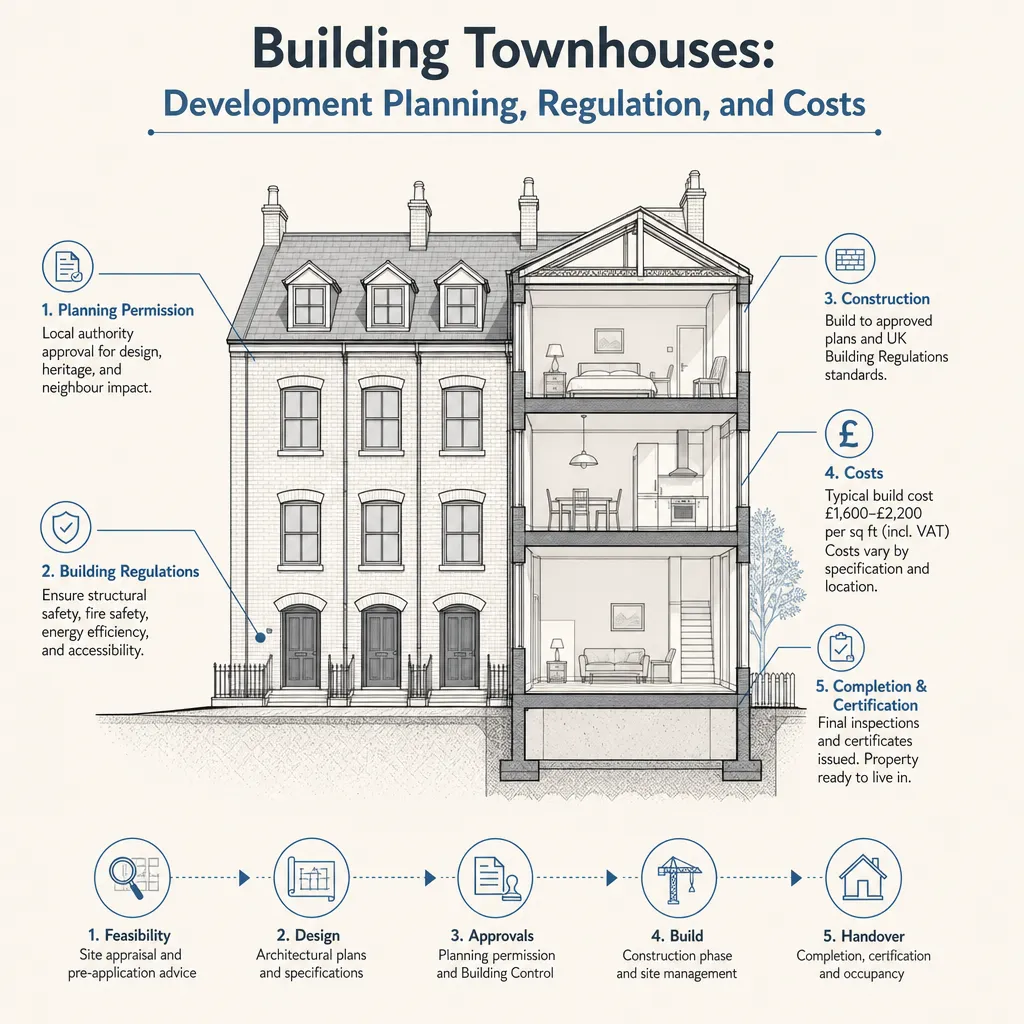
Building Townhouses: Development Planning, Regulation, and Costs
Townhouse development sits at the intersection of residential planning policy, Building Regulations compliance, and multi-phase construction management. Whether you own an infill plot in a city centre, a brownfield site on the edge of a market town, or are weighing up a small terrace scheme on land with outline permission, the planning, regulatory, and financial demands of multi-unit residential development are considerably more complex than a single dwelling extension. Understanding these requirements before acquiring land or committing to design fees is essential to a viable scheme.
Key points
- All new townhouse construction requires full planning permission — permitted development rights do not apply to new residential dwellings, regardless of the number of units.
- As of December 2023, planning application fees in England are £578 per dwelling for new residential schemes (up to 50 units), following revisions under the Levelling-up and Regeneration Act 2023 framework.
- Building Regulations Parts A (structure), B (fire), E (sound between dwellings), F (ventilation), L (energy efficiency), and M (accessibility) all apply to new townhouses.
- Schemes of 10 or more dwellings (or sites over 0.5 hectares) trigger major development thresholds, typically attracting affordable housing obligations and a 13-week determination period.
- The Party Wall etc. Act 1996 applies where excavation or foundation work is within 3 metres of a neighbouring structure — formal notices must be served before work can start.
What counts as a townhouse development?
In UK planning terms, a townhouse is typically a multi-storey terraced or semi-detached dwelling on a narrower plot — usually 2–4 storeys with 2–4 bedrooms per unit. A townhouse development refers to building two or more of these as a co-ordinated scheme: a terrace, a pair of semis, or a small cluster on a shared site.
Scale matters significantly from a planning perspective:
- 1–9 new dwellings: minor residential application; 8-week statutory determination target.
- 10 or more dwellings (or 0.5 hectares or more): major development threshold; 13-week target; affordable housing obligations usually triggered; extended consultation required.
Knowing which threshold your scheme falls into shapes programme, cost planning, and the level of planning expertise you will need from the outset.
Planning permission: requirements and decision points
There is no permitted development route for new residential dwellings. Every townhouse development requires a full planning application, assessed by the local planning authority (LPA) against the adopted Local Plan.
Key planning considerations
Local Plan policy: Policies on density, height, parking, and design standards vary between LPAs. Some authorities have residential design guides or design codes with minimum room sizes, daylight standards, and street-frontage rules. Reviewing these before commissioning design work avoids abortive fees.
Design and Access Statement: Most applications for two or more dwellings require a Design and Access Statement explaining how the scheme responds to local character and provides accessible entrances.
Affordable housing: Many LPAs require affordable housing contributions on schemes of 10 or more dwellings — typically 10–40% of units depending on the authority's viability evidence and adopted policy. Some authorities apply lower thresholds in high-demand areas. Confirm the applicable policy before land acquisition.
Community Infrastructure Levy (CIL): Where an LPA operates a CIL charging schedule, new residential floor space attracts a levy calculated per square metre. Rates range from nil to over £400/m² in parts of London and the South East. Check your LPA's published charging schedule via the Planning Portal before committing to a financial appraisal.
Decision tree: what planning route applies?
- New townhouses on a vacant or previously undeveloped plot → Full planning permission required in all cases.
- Converting a commercial building to residential townhouses → Full planning permission required. Class MA permitted development (commercial-to-residential change of use) may apply in limited circumstances, subject to prior approval conditions — check with a planning consultant.
- Proposed site is in a conservation area, AONB, or near a listed building → Additional heritage and design constraints apply; pre-application advice from the LPA is strongly recommended before progressing design.
- Extending an existing townhouse rather than building new → May fall under permitted development for extensions, subject to volume and height limits; check whether an Article 4 direction has removed those rights in your area.
Building Regulations for townhouse construction
Building Regulations apply independently of planning permission and must be complied with throughout construction. A Building Control body — either the LPA's own department or a private approved inspector — oversees compliance from commencement through to the issue of a completion certificate.
Regulation | What it covers | Key implication for townhouses |
|---|---|---|
Part A — Structure | Structural stability of walls, floors, roof | Structural engineer's calculations required; party wall and shared foundation design is critical on tight urban plots |
Part B — Fire safety | Escape routes, compartmentation, detection | 3–4 storey townhouses require protected staircase enclosures; mains-wired interlinked smoke and heat alarms |
Part E — Sound | Airborne and impact sound between dwellings | Party walls and floors must meet minimum performance standards via Robust Standard Details or pre-completion testing |
Part F — Ventilation | Fresh air provision, moisture extraction | Mechanical extract or whole-house ventilation strategy required; acoustic attenuation where MVHR is used |
Part L — Energy efficiency | Fabric standards, SAP calculations | New dwellings must achieve ≥31% carbon reduction vs 2013 baseline under Part L 2021; SAP/EPC assessment required |
Part M — Accessibility | Access to and within dwellings | Category 1 (visitable) as a minimum; some LPAs require Category 2 as a planning condition |
Party wall and neighbouring properties
Where townhouses are built adjacent to existing homes or structures, the Party Wall etc. Act 1996 applies. Notices must be served on all affected neighbouring owners if:
- Foundations are proposed within 3 metres of a neighbouring structure and at a depth that could undermine it.
- Excavation is within 6 metres of a neighbouring structure where depth would intersect a 45-degree plane from the base of the neighbour's foundations.
- Work is proposed directly to an existing shared party wall.
Allow at least 2 months between serving notices and planned start on site. If a neighbour dissents, they can appoint their own surveyor at your expense. Factor party wall timescales and potential surveyor costs into your programme and budget from the outset.
Indicative costs for townhouse development
Indicative UK costs, last reviewed 2026-05-05. Significant regional variation exists. Always obtain multiple professional quotes and carry out your own financial appraisal.
Cost element | Indicative range | Notes |
|---|---|---|
Planning application fee (England) | £578 per dwelling | Set by central government; verify current fee with Planning Portal before submission |
Architectural and design fees | £5,000–£20,000+ per scheme | Depends on complexity, RIBA stages commissioned, and number of units |
Structural engineering | £3,000–£10,000+ per scheme | Higher for complex foundations, contaminated land, or poor ground conditions |
Construction cost | £1,800–£3,500/m² GIA | Significant regional variation; London and the South East typically at the upper end |
CIL contribution | Nil to £400+/m² | Highly variable; nil in some LPAs; check your authority's charging schedule |
Section 106 obligations | Highly variable | May include off-site affordable housing, transport, education, or open space contributions |
NHBC Buildmark or equivalent warranty | £500–£2,000+ per unit | Required by most mortgage lenders for new-build sales |
Building Control fees | £1,000–£5,000+ per scheme | Varies by LPA or approved inspector and number of units |
Source: BCIS (Building Cost Information Service); GOV.UK planning fee schedule.
Developer and landowner checklist
Before committing to a townhouse development scheme:
Red flags to watch for
- A site described as having 'planning potential' without a formal pre-application response — always verify independently before acquisition.
- CIL or Section 106 obligations not included in the financial appraisal at land acquisition stage — a common cause of unviable schemes.
- Ground conditions worse than anticipated (contamination, made ground, high groundwater) discovered only after planning is secured.
- Party Wall Act obligations identified late in the programme, causing delays and unplanned surveyor costs.
- Part L SAP calculations prepared early, then specification changed after submission — changes to glazing ratios, insulation, or heating system often require full reassessment.
- Affordable housing obligations triggered unexpectedly by amendments that push the unit count over the LPA threshold.
Important limitations
This article provides general information about the UK planning and Building Regulations framework for townhouse development. It does not constitute planning advice, structural advice, or legal advice. Planning policy, application fees, CIL rates, and building standards vary by local authority and are subject to change. Individual schemes have requirements determined by site history, location, design, and the adopted policies of the relevant LPA. Always instruct a qualified planning consultant, architect, and structural engineer before committing resources to any development scheme.
What to ask a qualified professional
Before instructing professionals for a townhouse development, ask:
- What does the adopted Local Plan say about residential development on this site — are there allocations, constraints, or protected designations that apply?
- Is affordable housing likely to be required at this scheme's scale, and at what percentage?
- What is the CIL rate for this LPA and does this scheme qualify for any exemptions or reliefs?
- What ground investigation is recommended before design is progressed, and what risks does the site present?
- How will Part L 2021 compliance be achieved — fabric-first, or with supplementary renewable technology?
- What programme impact should I allow for Party Wall Act obligations with adjacent owners?
- Is LPA building control or an approved inspector recommended for this scheme, and why?
When to get professional help
Townhouse development involves planning, legal, structural, and construction expertise that should be engaged at the earliest possible stage. Seek professional advice if:
- You are considering acquiring land for development — a planning consultant can advise on policy compliance and financial viability before purchase.
- You have a site but are unsure how many dwellings it can accommodate within policy constraints.
- A planning application has been refused and you are considering an appeal.
- The scheme involves heritage assets, contaminated land, or complex ground conditions.
- A neighbour has raised a Party Wall dispute or is formally objecting to the proposed development.
How Housey can help
Housey connects developers and landowners with qualified professionals for townhouse and multi-unit schemes. You can request quotes from planning consultants to assess viability and manage your application, structural engineers for foundation design and party wall matters, building control consultants to oversee compliance from commencement to completion certificate, and project managers to co-ordinate the build programme across trades and stages.
Frequently asked questions
Do I need planning permission to build a row of townhouses?
Yes. All new residential dwellings require full planning permission. There is no permitted development right that allows new homes to be built on vacant or previously developed land without planning consent. Applications are assessed against the local planning authority's adopted Local Plan, covering density, design standards, parking, and infrastructure requirements.
How long does planning permission take for a townhouse development?
Minor residential applications (under 10 dwellings) carry an 8-week statutory determination target from validation. Major applications (10 or more dwellings) have a 13-week target. Schemes involving Section 106 negotiations, heritage considerations, or significant public objection regularly exceed these targets. Pre-application advice from the LPA can reduce avoidable delays once the formal application is submitted.
Do new-build townhouses need a structural warranty?
Most mainstream mortgage lenders require a structural warranty for new-build properties before they will lend to buyers. The NHBC Buildmark warranty is most widely recognised, though providers such as Premier Guarantee and LABC Warranty are accepted by many lenders. Arrange warranty enrolment before construction begins — retrospective enrolment is complicated and sometimes not possible.
What is Part L 2021 and how does it affect townhouse construction?
Part L 2021 (in force in England from June 2022) requires new dwellings to achieve at least a 31% reduction in carbon emissions compared to the 2013 baseline, using improved fabric standards and SAP energy calculations. The Future Homes Standard, expected from 2025, will raise this target further and is likely to effectively end gas boiler installation in new-build homes.
What is a Section 106 agreement and does it apply to my scheme?
A Section 106 agreement is a legal obligation attached to a planning permission, typically requiring contributions to affordable housing, transport, education, or other infrastructure. Many LPAs trigger Section 106 at 10 or more dwellings, though some apply obligations at lower thresholds. CIL contributions may also apply in parallel. Confirm obligations with a planning consultant before land acquisition.
Sources and further reading
- Planning application fees — Planning Portal
- Building Regulations Approved Documents — GOV.UK
- Party Wall etc. Act 1996 — guidance on the Act — GOV.UK
- Community Infrastructure Levy guidance — GOV.UK
- The Future Homes and Buildings Standards: 2023 consultation — GOV.UK / MHCLG
Useful next reads
 Planning & Pre-Build
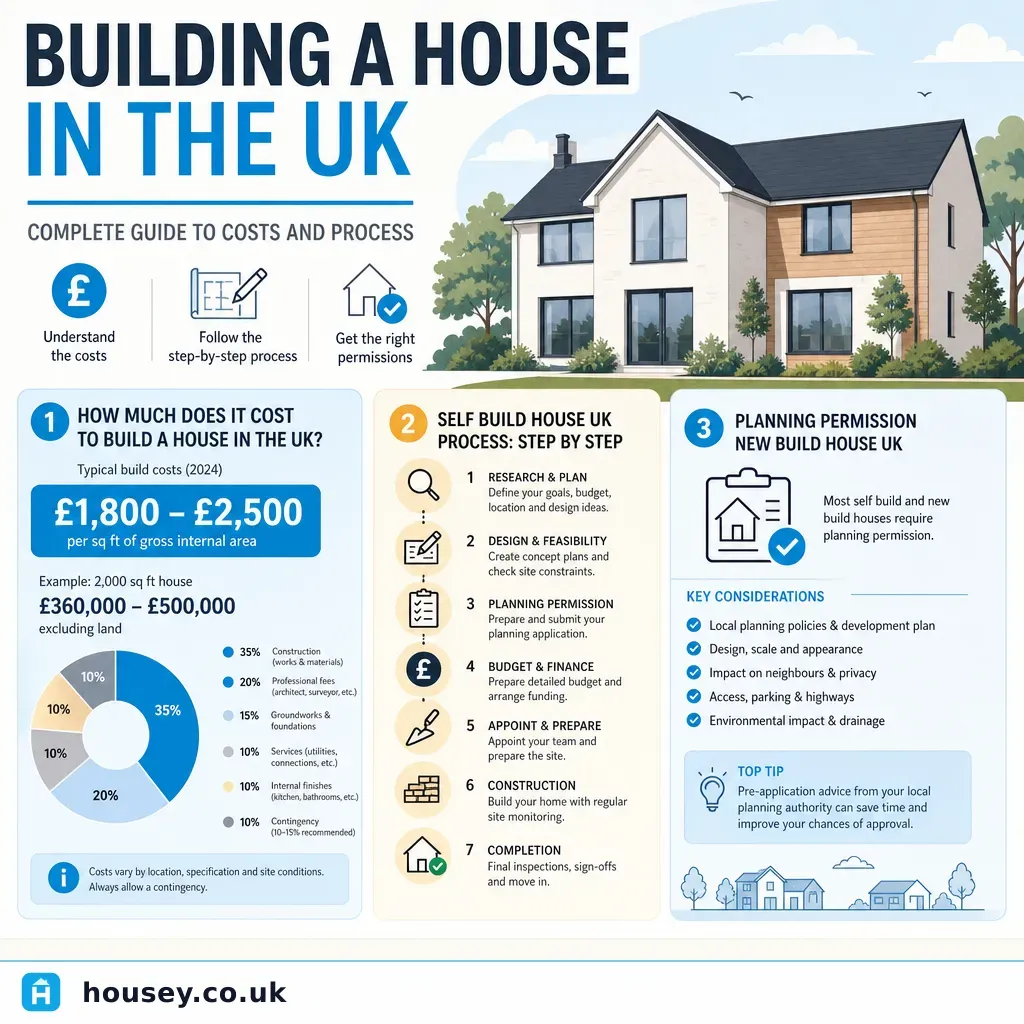
Building a House in the UK: Complete Guide to Costs and Process
Building a house in the UK typically costs £1,500–£3,000 per sq m for construction (excluding land) and takes two to four years from land search to completion.
 Planning & Pre-Build
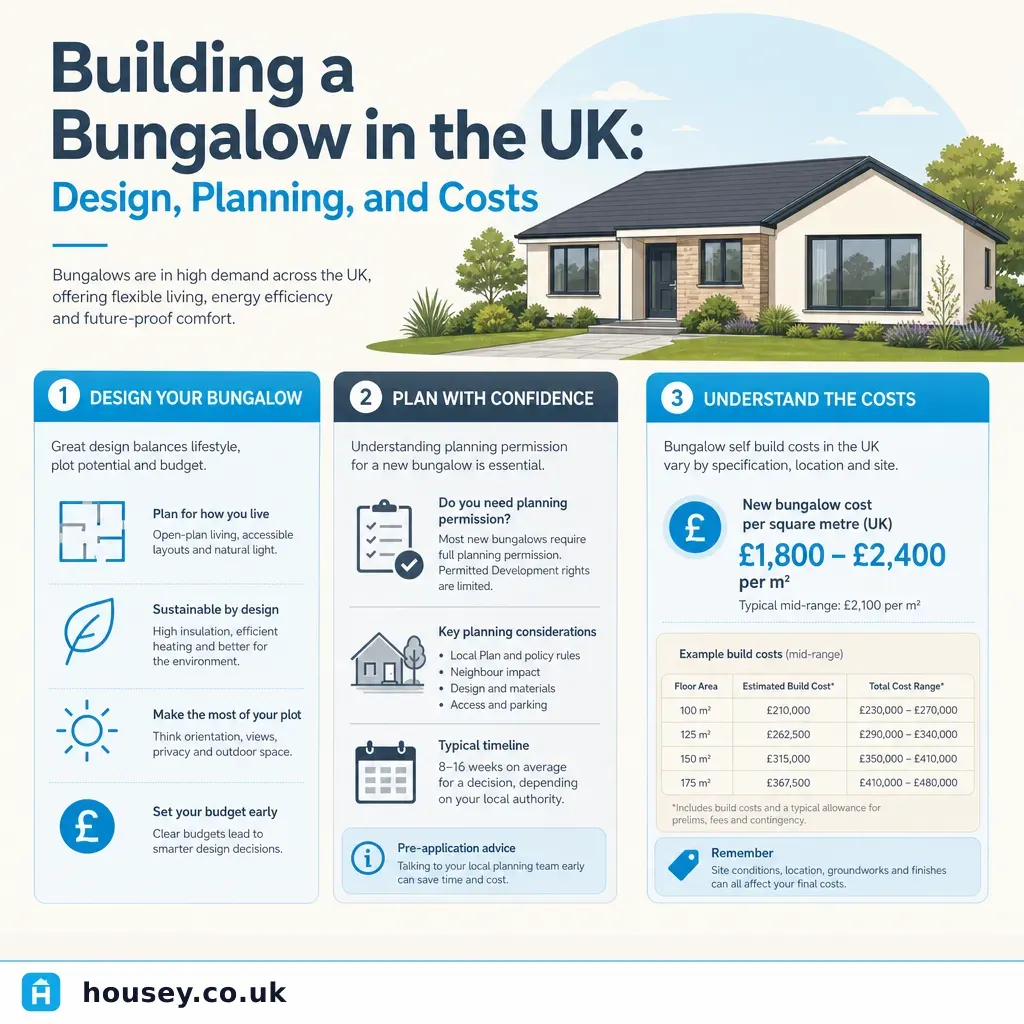
Building a Bungalow in the UK: Design, Planning, and Costs
Building a bungalow in the UK typically costs £1,500–£3,000 per square metre, putting a 100m² bungalow at roughly £150,000–£300,000 in build costs before land, professional fees, and VAT.
 Planning & Pre-Build
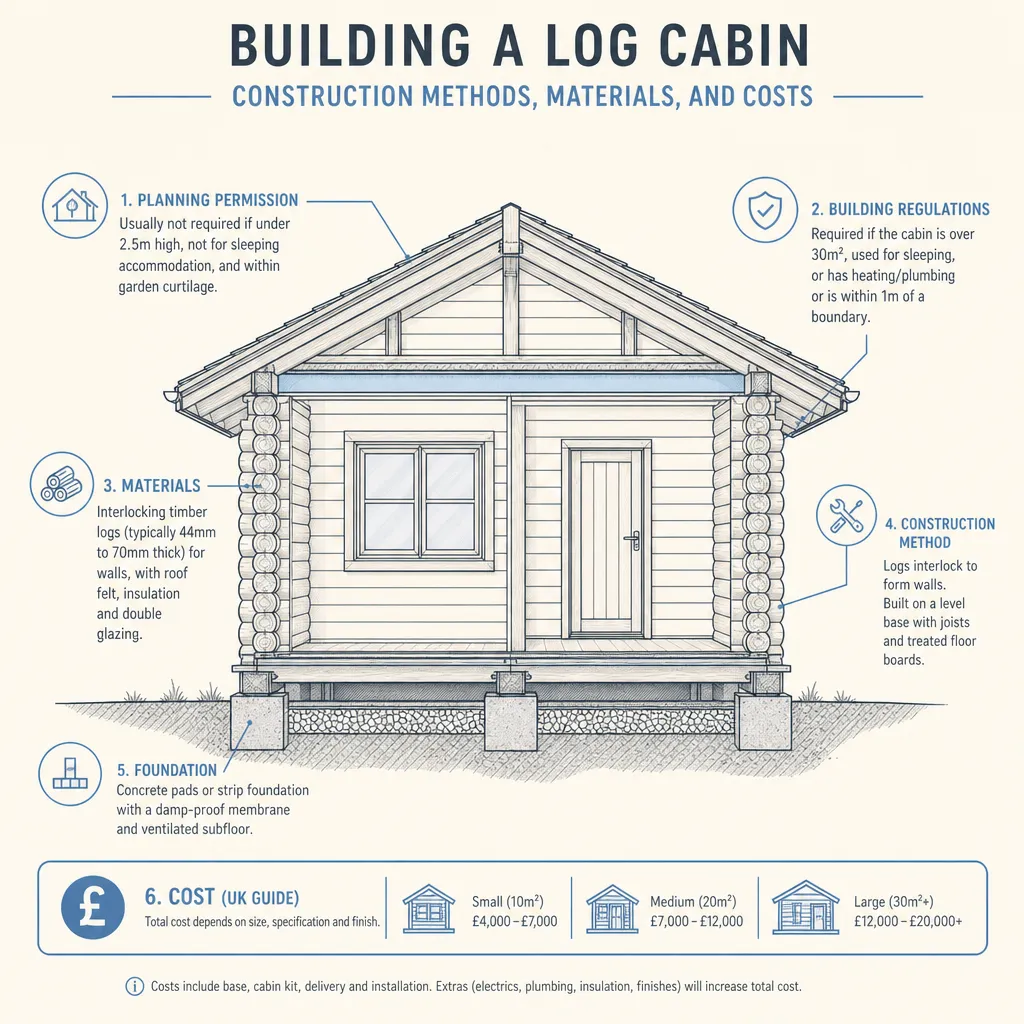
Building a Log Cabin: Construction Methods, Materials, and Costs
Building a habitable log cabin in the UK requires full planning permission and Building Regulations approval, the same as any new house.
 Planning & Pre-Build
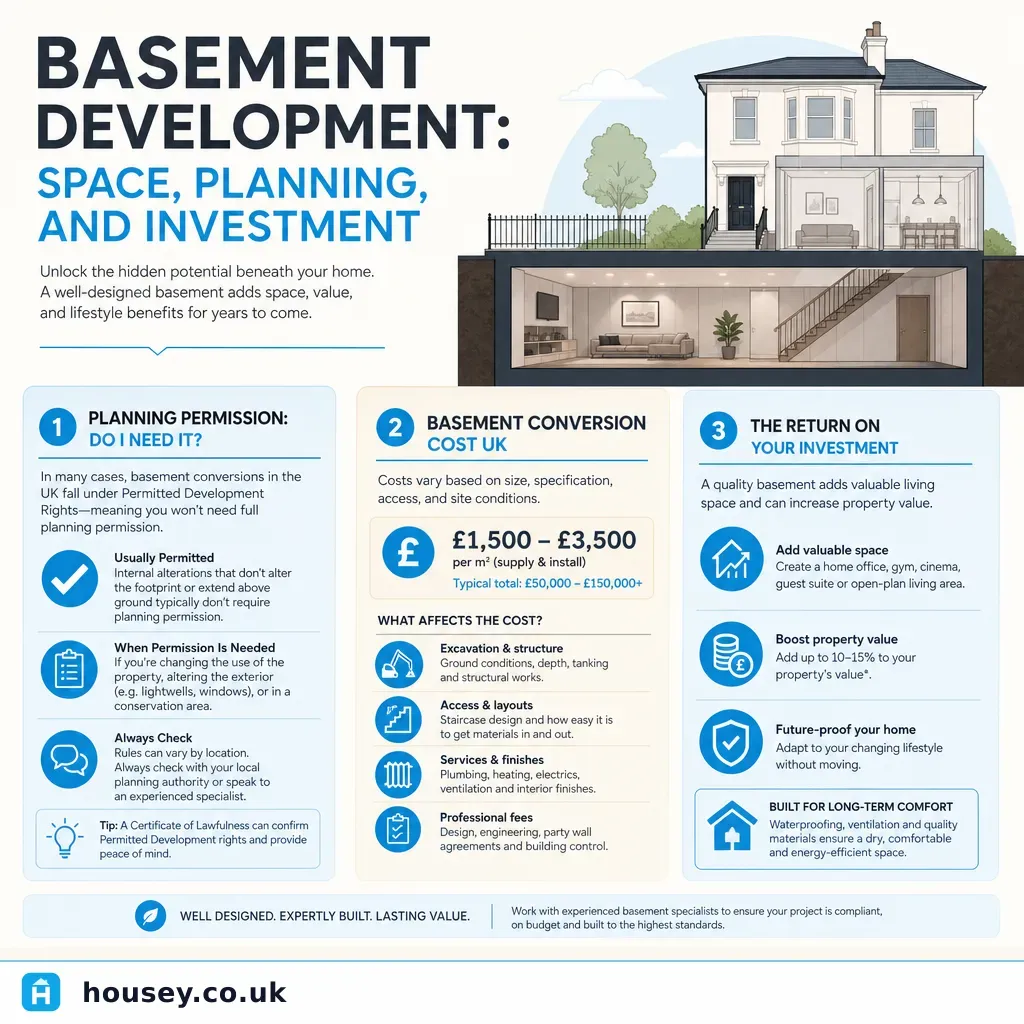
Basement Development: Space, Planning, and Investment
Basement development in the UK almost always requires Building Regulations approval and may need planning permission depending on whether the footprint or external appearance changes.
 Planning & Pre-Build
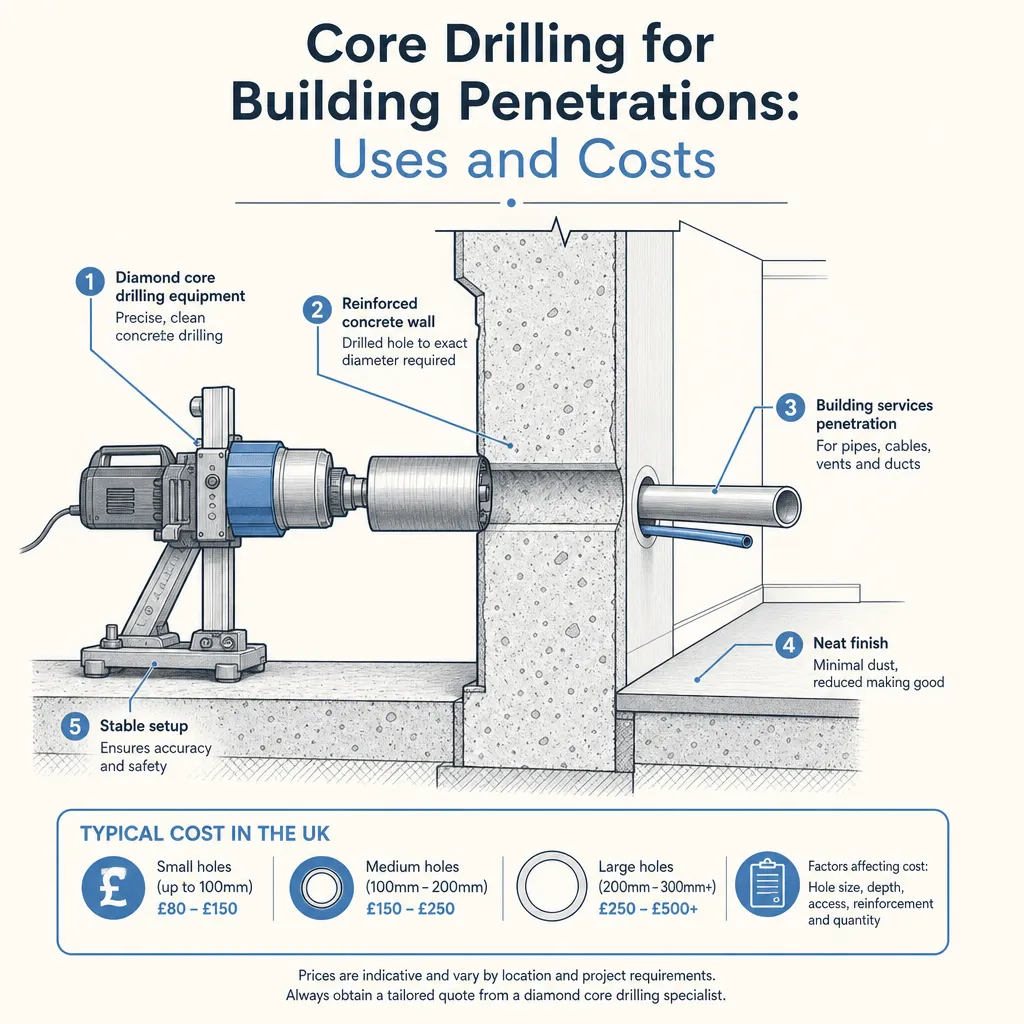
Core Drilling for Building Penetrations: Uses and Costs
Core drilling uses diamond-tipped equipment to cut clean holes through concrete, masonry, or block for pipes, ducts, cables, and building services.