Basement Excavation and Floor Lowering Costs
By Housey · Last reviewed 8th of May 2026
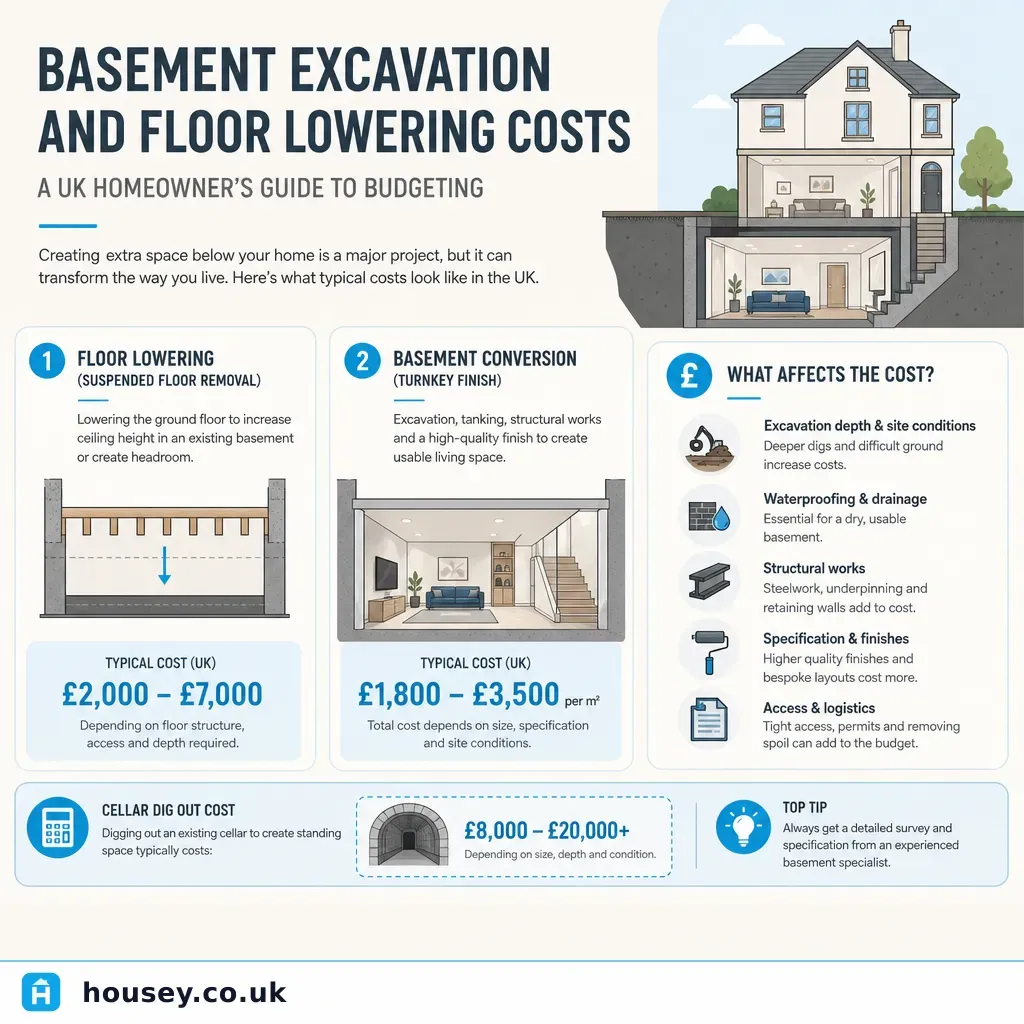
Basement Excavation and Floor Lowering Costs
Homeowners in Victorian and Edwardian terraces — and increasingly in post-war semi-detached houses — are turning to below-ground space as an alternative to loft conversions or rear extensions. Basement excavation and floor lowering unlock significant usable floor area, but they are among the most technically demanding residential construction projects available, involving geotechnical risk, structural engineering, waterproofing design, and — in most cases — both planning and building regulations approval. Understanding realistic costs and the process before engaging contractors is essential to avoid costly surprises.
Key points
- Lowering an existing cellar floor to habitable headroom typically costs £10,000–£30,000 for structural and waterproofing works before fit-out. (Indicative UK costs, last reviewed 2026-05-08.)
- A new basement excavation under an existing house — where no cellar currently exists — typically costs £30,000–£80,000+ before internal fit-out, depending on footprint, depth, and soil conditions.
- Underpinning of existing foundations is commonly required in pre-1919 properties and can add £15,000–£40,000+ to the project total.
- Building Regulations approval under Part A (structure), Part C (moisture resistance), and Part F (ventilation) is required for all habitable basement conversions in England and Wales.
- Party Wall etc. Act 1996 notices must usually be served on affected adjoining owners before excavation begins in terraced or semi-detached properties.
Excavation versus floor lowering: what is the difference?
These are related but distinct operations with different cost profiles and planning implications.
Operation | What it involves | Typical scenario | Indicative cost range |
|---|---|---|---|
New basement excavation | Digging out ground beneath an existing footprint to create a basement where none exists | Property with no cellar, often 1930s or newer construction | £30,000–£80,000+ |
Floor lowering (cellar dig-out) | Lowering an existing cellar floor to increase headroom to 2.2–2.4m | Victorian or Edwardian property with an existing cellar at 1.5–1.8m headroom | £10,000–£30,000 |
Basement extension | Extending the footprint of an existing basement outward or beneath the garden | Adding floor area to an already-converted basement | £20,000–£60,000+ per phase |
Indicative UK costs, last reviewed 2026-05-08. London projects typically run 30–50% higher. All figures exclude internal fit-out.
Key cost drivers
A single national average is rarely meaningful for basement projects. The main variables are:
- Soil and geology: London clay, sandy gravel, chalk, and made ground each present different engineering challenges. Rock and contaminated ground can increase costs sharply and require additional investigation.
- Foundation depth and type: pre-1919 properties typically have shallow rubble-strip foundations that require underpinning before excavation can safely proceed. Underpinning alone can cost £15,000–£40,000+ on a standard terrace.
- Drainage: lowering the floor often puts drainage below the existing sewer level, requiring a pump station or sewage ejector — typically £2,000–£5,000 additional, plus ongoing maintenance and power costs.
- Waterproofing: habitable basements require a structural waterproofing system compliant with BS 8102:2022. A cavity drain membrane system on a typical project adds £5,000–£15,000; the appropriate type depends on ground conditions, water table, and use.
- Party wall and neighbours: Party Wall etc. Act 1996 notices must be served where excavation is within 3 metres of an adjoining structure. Surveyor fees and agreed party wall awards typically add £1,500–£5,000 to project costs.
- Structural engineering fees: £2,000–£8,000 for full design, structural calculations, and site inspections is typical at residential scale.
- Ground investigation: trial pits or boreholes to establish soil type before design — usually £800–£2,500 at residential scale — are necessary before a structural engineer can complete their design.
- Internal fit-out: excavation costs do not include walls, flooring, electrics, heating, and a new staircase. Allow an additional £20,000–£60,000+ depending on specification and room use.
Planning permission and permitted development rights
Whether your project requires planning permission depends on several factors:
- New basement excavation: almost always requires householder planning permission in England. Some London boroughs and other local authorities have supplementary planning documents or Article 4 directions imposing additional restrictions on basement works.
- Floor lowering in an existing cellar: may fall within permitted development rights under Class A, Schedule 2 of the Town and Country Planning (General Permitted Development) (England) Order 2015 if the external appearance of the house is unchanged and the property is not subject to PD restrictions.
- Conservation areas and listed buildings: permitted development rights are either restricted or removed. Listed building consent is required for any works affecting a listed building, in addition to any planning permission.
- Scotland, Wales, and Northern Ireland: planning rules differ from England. Check with the relevant authority — Planning Portal Scotland, Planning Portal Wales, or the Planning Appeals Commission (Northern Ireland).
A lawful development certificate can be applied for to formally confirm permitted development status before work begins — recommended wherever any uncertainty exists.
The structural engineering requirement
No basement project should proceed without a qualified structural engineer involved from the outset. The typical engineering process for a residential basement project involves:
- Initial assessment: review of available drawings and a visual inspection, followed by a recommendation for ground investigation scope.
- Ground investigation: trial pits or boreholes to establish soil type, water table depth, and the level and condition of existing foundations.
- Structural design: specification of temporary works such as propping and shoring, underpinning method, new slab design, and retaining wall details.
- Building regulations submission: structural calculations and drawings submitted to a building control body — local authority building control or an approved inspector.
- Staged site inspections: inspections at key construction stages — underpinning, waterproofing membrane installation, structural slab pour, and practical completion.
The choice of underpinning method — mass concrete, mini-piled, beam-and-base, or screw-pile systems — is an engineering decision based on soil conditions, existing load, access constraints, and proximity to neighbouring foundations.
Worked UK scenario: lowering a cellar in a Victorian terrace
A homeowner in an 1890s mid-terrace in Leeds has an existing cellar with 1.65m head height. They want to lower the floor to 2.3m to create a habitable utility room and study.
- Ground investigation (2 trial pits): £1,200
- Structural engineer — design, calculations, 3 site inspections: £3,500
- Floor lowering with mini-pile underpinning to existing foundations: £22,000
- Type C cavity drain waterproofing system: £7,500
- New sub-floor drainage pump station: £3,200
- Building regulations application and fees: £1,100
- Party wall surveys and awards for 2 adjoining neighbours: £3,800
- Total before internal fit-out: approximately £42,300
This scenario is illustrative. Actual costs will vary by ground conditions, specification, contractor, and region. Internal fit-out — plastering, flooring, electrics, heating, and a new staircase — would be additional.
Decision guide: which approach is right for your project?
- Choose floor lowering if an existing cellar already has 1.5m or more of headroom and you want the most cost-effective route to habitable below-ground space.
- Consider new basement excavation if no cellar exists and you need substantial additional accommodation, and alternatives such as a loft conversion or rear extension are not viable or have already been used.
- Always consult a structural engineer before committing if the property is pre-1919, terraced, or semi-detached, or shows any existing cracking, settlement, or signs of previous movement.
- Check with your local planning authority before starting if the property is listed, in a conservation area, or in an area with Article 4 directions limiting permitted development.
- Pause and seek independent advice if a contractor proposes proceeding without a structural engineer, ground investigation, or building regulations approval — this represents a serious red flag for any basement project.
Important limitations
This article provides general cost and process information for basement excavation and floor lowering in the UK. Costs, structural requirements, planning rules, and waterproofing specifications vary significantly by property, location, soil conditions, and scope of work. Nothing in this article constitutes structural engineering, planning, or legal advice. A qualified structural engineer and, where required, a planning consultant, building control body, and party wall surveyor should be engaged before any work proceeds on site.
What to ask a qualified professional
Before instructing a structural engineer or specialist basement contractor, ask:
- Have you completed basement projects in properties of this age, construction type, and soil conditions?
- What ground investigation do you recommend before structural design can begin?
- Is underpinning likely to be required, and what method are you proposing to specify?
- What waterproofing system are you specifying, and is it compliant with BS 8102:2022?
- Who will be the principal contractor under the Construction (Design and Management) Regulations 2015, and have CDM duties been considered?
- How will Party Wall Act notices and any potential neighbour disputes be managed?
- Which building control body will be used, and are their fees included in your quote?
- What happens if ground conditions encountered on site differ from those identified during investigation?
When to get professional help
Basement and excavation projects should always involve a qualified structural engineer from the outset. Seek professional input immediately if:
- There is existing cracking, settlement, or signs of previous movement in walls, floors, or the roof structure.
- The property is terraced or semi-detached, where excavation poses a direct risk to neighbouring foundations.
- The property is listed, in a conservation area, or subject to an Article 4 direction.
- Any contractor suggests starting excavation work without a structural engineer, ground investigation, or building regulations submission.
- There is any indication of contaminated ground — former industrial sites, made ground, or brownfield land — which requires specialist assessment before excavation.
How Housey can help
Basement projects typically require a multidisciplinary team. Housey can help you find a qualified structural engineer for design and building regulations work, experienced groundworkers for the excavation and underpinning, and — for complex drainage or geotechnical challenges — civil engineers who specialise in residential below-ground construction.
Frequently asked questions
Do I need planning permission for a basement conversion in the UK?
It depends on the scope of work and the property. Lowering an existing cellar floor may fall within permitted development rights if the external appearance is unchanged and no PD restrictions apply. Creating a new basement where none exists almost always requires householder planning permission. Listed buildings, conservation areas, and Article 4 direction areas have additional restrictions. Always confirm with your local planning authority before starting.
How long does basement excavation take from start to finish?
Floor lowering in a standard terraced house typically takes 8–16 weeks on site. A new basement excavation under an existing house can take 4–9 months depending on ground conditions, underpinning method, and fit-out scope. Allow additional time before works start for ground investigation, structural design, planning (if required), party wall notices — a minimum of two months where neighbours dissent — and building regulations approval.
What is BS 8102:2022 and why does it matter for basement waterproofing?
BS 8102:2022 is the British Standard for protecting below-ground structures against water. It defines three types of waterproofing — Type A barrier, Type B integral, and Type C drained cavity — and sets out risk-grading guidance. Building control will expect your waterproofing design to demonstrate compliance. A structural engineer or specialist waterproofing contractor should specify the appropriate system based on your ground conditions, water table, and intended basement use.
Will excavating my basement affect my neighbours' foundations?
Possibly — and this is a key reason the Party Wall etc. Act 1996 includes adjacent excavation provisions. If you excavate within 3 metres of a neighbouring structure and go deeper than their foundations, a section 6 notice must be served. In a terraced or semi-detached house, works to the party wall itself may also trigger a notice. Neighbours can appoint their own surveyor at your cost. A party wall surveyor should advise on which notices apply.
Can I convert a basement without underpinning?
In some cases, yes — particularly where floor lowering is modest and existing foundations are deep enough to accommodate the new level without affecting bearing capacity. However, in most pre-1919 terraced and semi-detached houses, existing rubble-strip foundations are shallow, and underpinning is required before excavation proceeds. A structural engineer must assess the existing foundations before any decision is made; do not rely on a contractor's verbal assurance.
Sources and further reading
- When is permission required — GOV.UK planning guidance — guidance on planning permission requirements for basement and below-ground works
- Party Wall etc. Act 1996 — legislation.gov.uk — primary legislation for party wall and adjacent excavation notices
- Approved Document A: Structure — GOV.UK — Building Regulations structural requirements relevant to basement construction
- Approved Document C: Site Preparation and Resistance to Contaminants and Moisture — GOV.UK — moisture resistance requirements relevant to basement waterproofing design
- Construction (Design and Management) Regulations 2015 — HSE — CDM duties including for domestic construction projects
- BS 8102:2022 Code of practice for below-ground waterproofing — BSI — the waterproofing standard referenced by building control for habitable basements
Useful next reads
 Improvement & Build
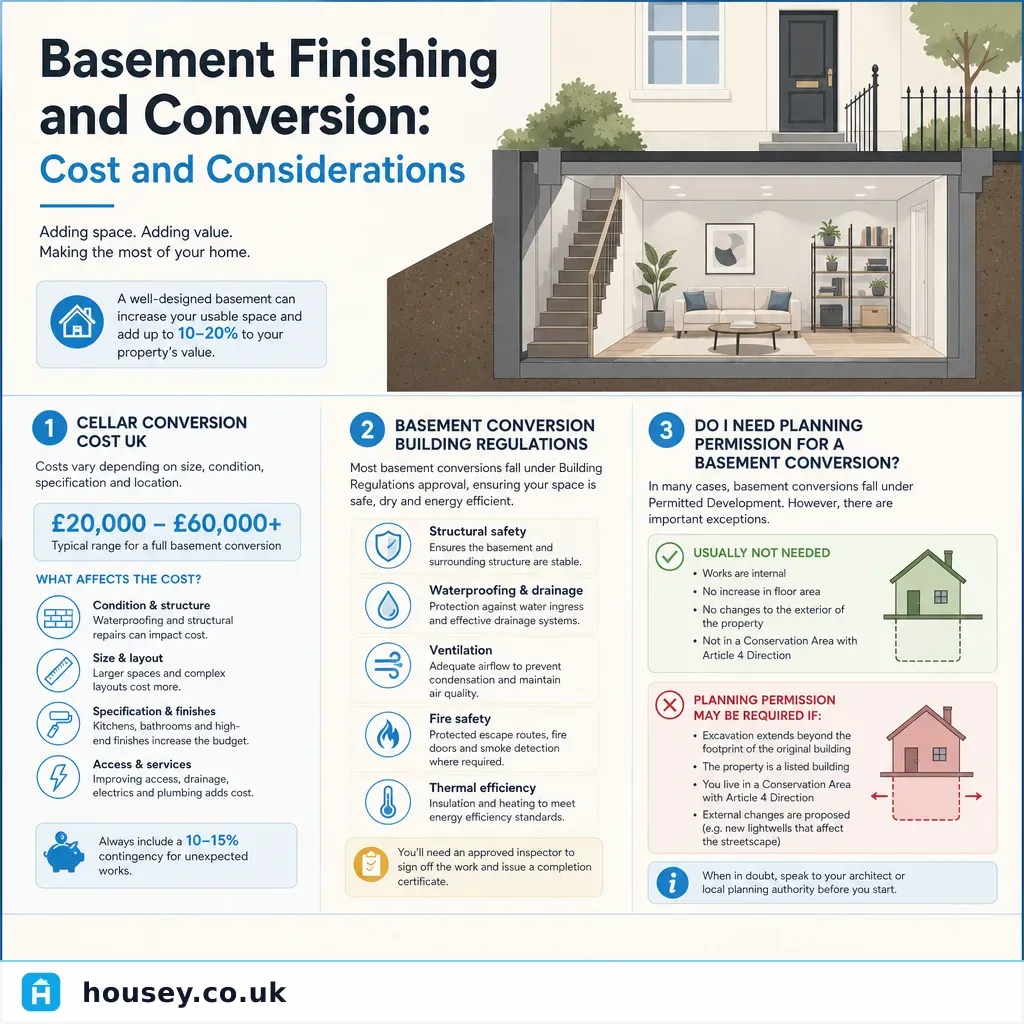
Basement Finishing and Conversion: Cost and Considerations
Converting an existing basement or cellar into a habitable room in the UK typically costs £1,500–£3,000 per square metre, depending on the condition, waterproofing method, and fit-out specification.
 Improvement & Build
Cost of converting a window to a door
Converting a window to a door in the UK typically costs £1,500–£5,000 or more, depending on wall construction (cavity, solid, or timber frame), the type of door fitted, and whether a new or enlarged lintel is required.
 Improvement & Build
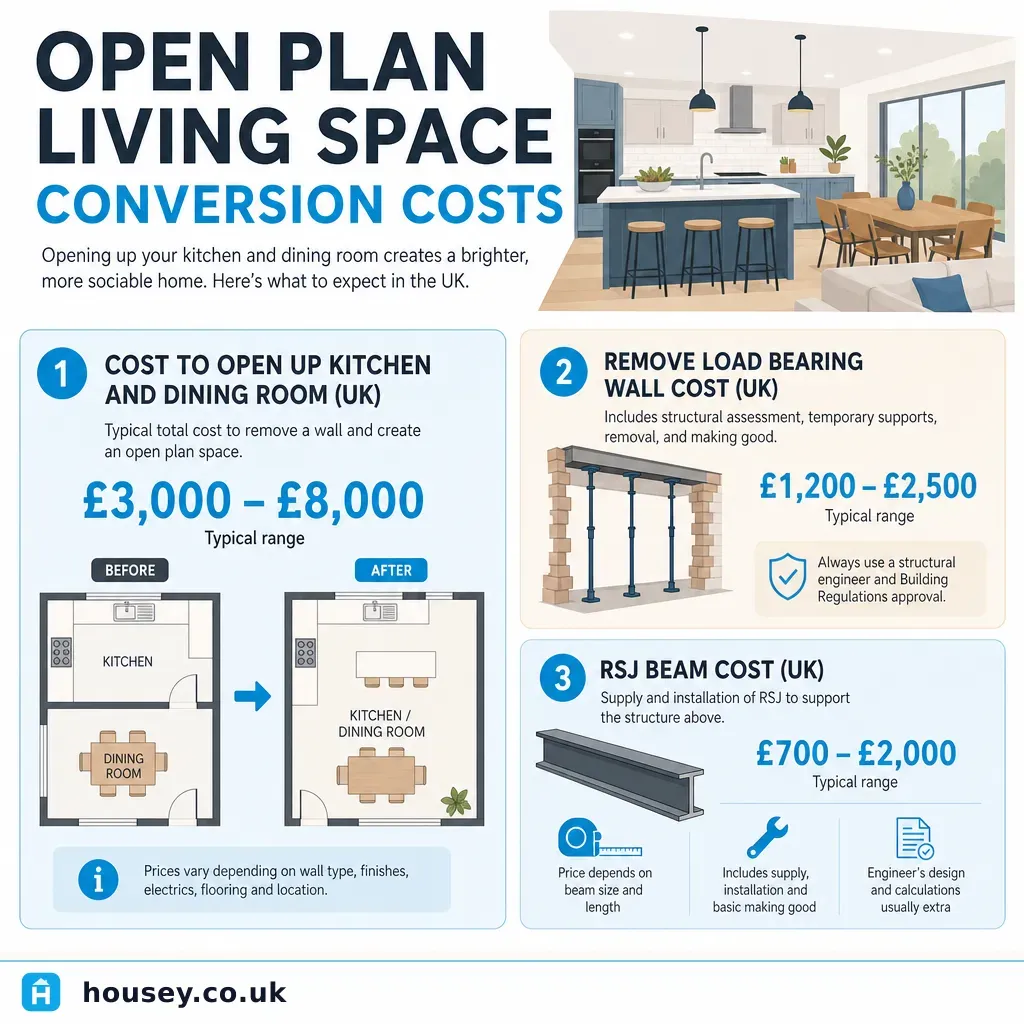
Open Plan Living Space Conversion Costs
Opening up a living space in the UK typically costs £3,000–£15,000+ depending on whether walls are load-bearing, the beam specification required, and the extent of remodelling.
 Improvement & Build
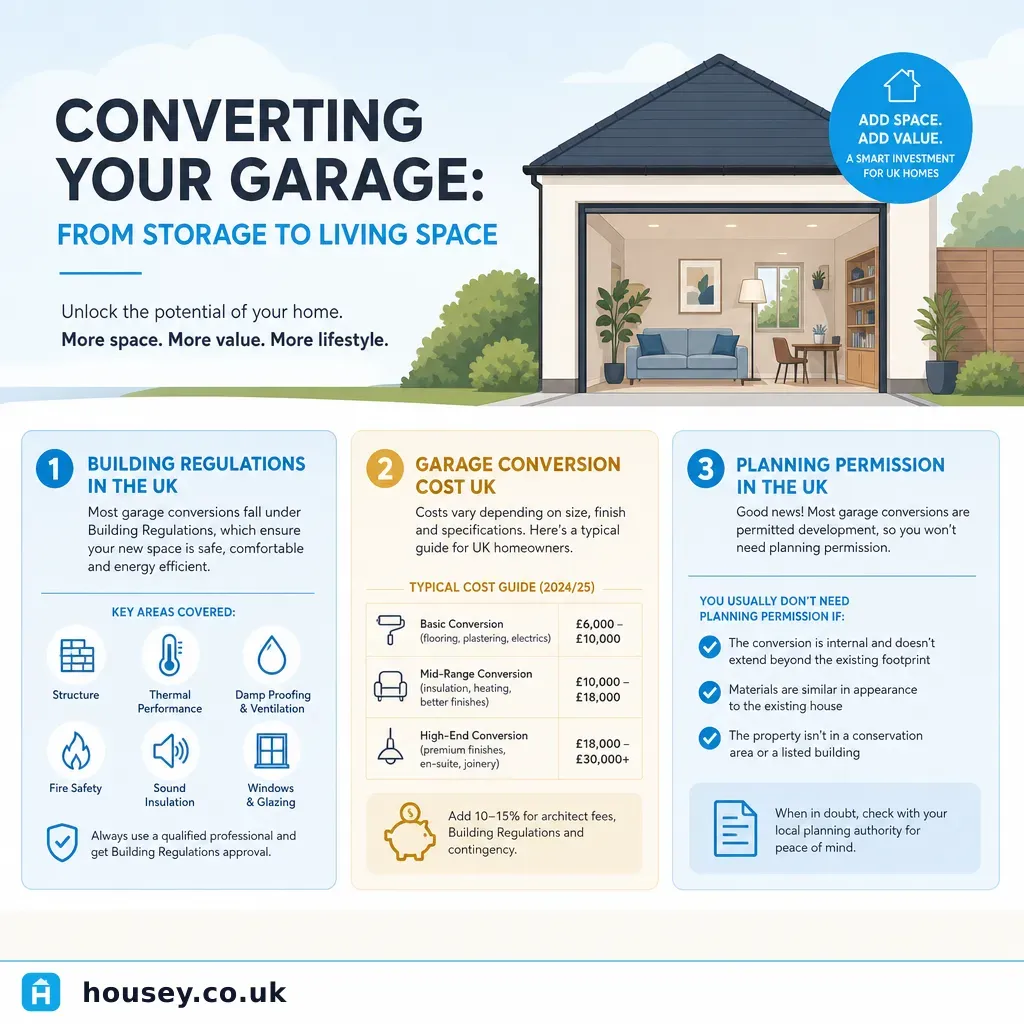
Converting Your Garage: From Storage to Living Space
Converting a garage to habitable space in the UK almost always requires Building Regulations approval, covering structure, insulation, ventilation, and fire safety.
 Improvement & Build
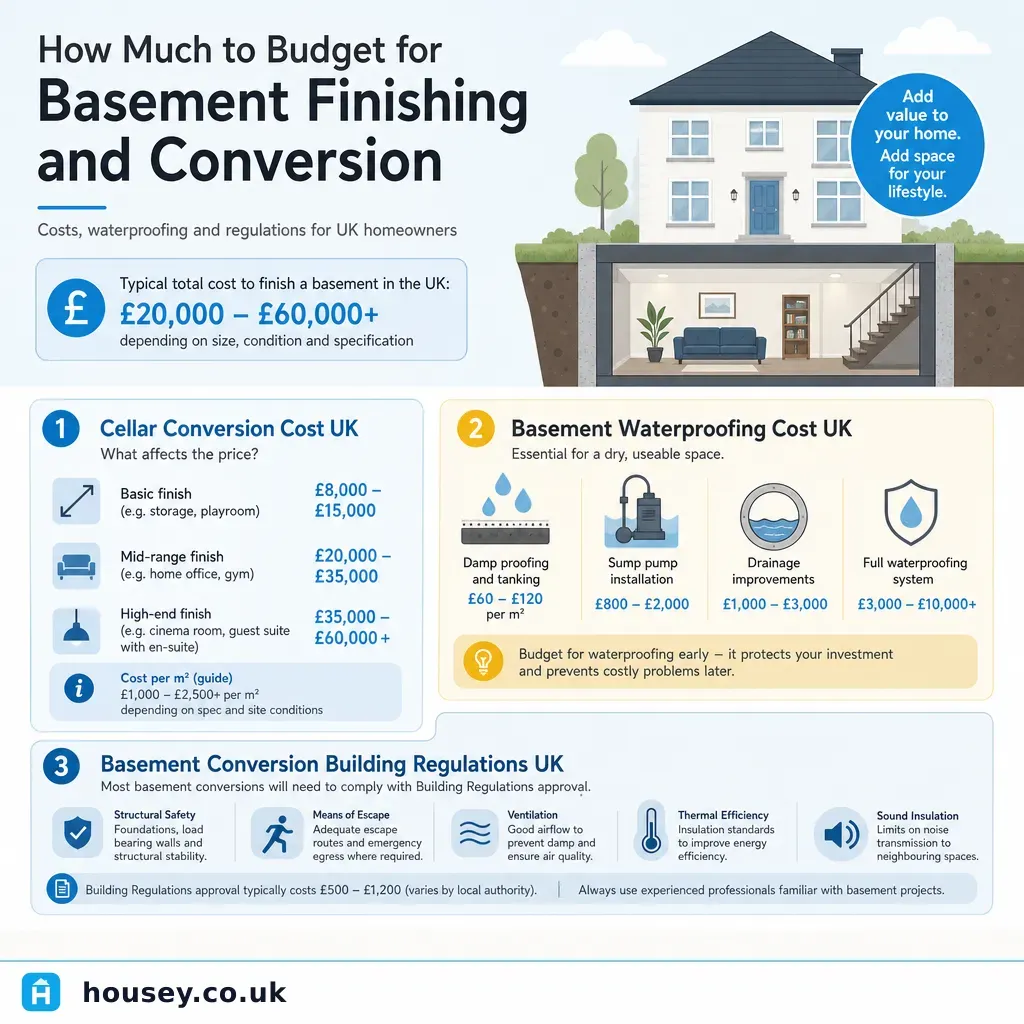
How Much to Budget for Basement Finishing and Conversion
Basement conversions in the UK typically cost £700–£1,500 per square metre for a simple cellar finish with existing headroom, rising to £1,500–£3,500 per square metre for a full conversion with underpinning.