Basement Finishing and Conversion: Cost and Considerations
By Housey · Last reviewed 30th of May 2026
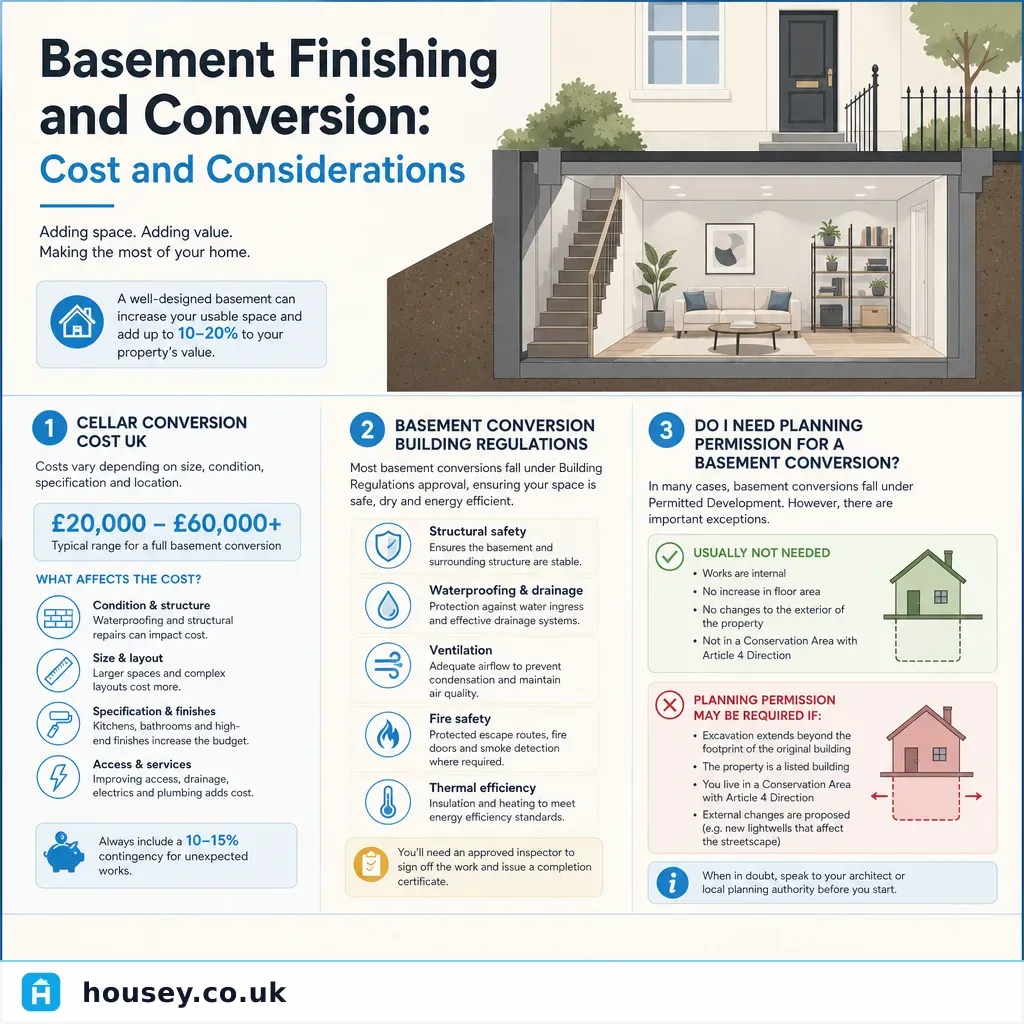
Basement Finishing and Conversion: Cost and Considerations
A basement or cellar that currently serves as storage represents some of the most affordable additional floor space a UK homeowner can unlock — but converting it into a habitable room is considerably more complex than most people initially expect. Whether you are planning a home office beneath a Victorian terrace or a guest bedroom under a 1930s semi, the structural, waterproofing, and regulatory requirements vary significantly depending on what you are starting with. Understanding the key considerations before commissioning any work protects both your budget and your building.
Key points
- Most basement conversions require Building Regulations approval under Approved Documents A (structure), C (moisture resistance), F (ventilation), L (energy efficiency), and B (fire safety) — but planning permission is usually not required for converting an existing cellar.
- Waterproofing systems are classified under BS 8102:2022; a Type C cavity drain membrane is the most widely used retrofit approach for UK cellars with existing masonry walls.
- A structural engineer is typically required to assess and certify any underpinning, load-bearing changes, or new openings before work begins and before building control approval is granted.
- Indicative UK costs range from approximately £1,200/m² for a basic fit-out of a dry cellar to £4,000+/m² where underpinning or comprehensive waterproofing is needed (Indicative UK costs, last reviewed 2026-05-30).
- A Party Wall etc. Act 1996 notice may be required if underpinning or excavation works extend within 3 metres of a neighbouring property's foundations.
Does a basement conversion need planning permission?
Converting an existing cellar or basement into a habitable room falls within permitted development for most houses — planning permission is not usually required. The main exceptions are:
- If you are excavating to create a new basement where none previously existed, or significantly enlarging an existing one.
- If works alter the external appearance of the property — for example, by adding a lightwell with a pavement grille.
- If the property is listed or within a conservation area, where additional consent is likely to be required.
- If the property is a flat or maisonette, where permitted development rights may not apply.
Always check with your local planning authority before starting work. Enforcement notices can require works to be reversed entirely at your own cost.
Building regulations: what applies to a basement conversion?
Building regulations approval is almost always required. The relevant Approved Documents include:
- Part A – Structure: Changes to load-bearing walls, beams, or foundations must be assessed and certified by a chartered structural engineer.
- Part C – Site preparation and moisture resistance: Waterproofing must be designed to BS 8102:2022 standards, with the chosen system documented and signed off by building control.
- Part F – Ventilation: Habitable rooms require adequate ventilation. Mechanical ventilation with heat recovery (MVHR) is commonly specified in basement conversions where natural ventilation is limited.
- Part L – Conservation of fuel and power: Insulation requirements apply to the floors, walls, and ceilings of the new habitable space.
- Part B – Fire safety: Means of escape, fire-resistant doors, and interlinked smoke alarms must comply — particularly where the basement includes sleeping accommodation.
You must appoint a building control body — either your local authority building control (LABC) or a registered building control approver — before work starts.
Waterproofing methods compared
The waterproofing system is usually the most critical technical decision in a basement conversion. Three principal approaches are recognised under BS 8102:2022:
Waterproofing type | How it works | Best for | Main limitation |
|---|---|---|---|
Type A – Barrier (tanking) | Waterproof membrane applied to internal or external masonry | Dry or slightly damp cellars with low water-table risk | Vulnerable to hydrostatic pressure; a membrane breach can allow water ingress |
Type B – Structural waterproofing | Reinforced concrete construction forms the barrier | New-build basements; rarely used for UK cellar retrofits | Requires new concrete construction; not practical for existing cellars |
Type C – Cavity drain membrane | Internal membrane creates a drained cavity; water is channelled to a sump pump | Most UK retrofit cellar conversions; moderately or heavily damp spaces | Sump pump requires ongoing maintenance; slightly reduces usable floor area |
Combined (A + C or similar) | Two or more types used together | High water-table sites; older properties with complex masonry | Higher cost; requires specialist design input |
A waterproofing specialist who is a member of the Property Care Association (PCA) can survey the space and recommend the appropriate type for your specific conditions.
How much does a basement conversion cost?
Cost depends on the existing condition of the space, the waterproofing specification, ceiling height, and fit-out scope.
Conversion scenario | Indicative cost per m² | What's typically included |
|---|---|---|
Basic fit-out (dry cellar, good ceiling height) | £1,200–£1,800/m² | Tanking or membrane, insulation, electrics, plastering, floor finish |
Standard conversion (some damp, modest structural works) | £1,800–£2,500/m² | Type C membrane, sump pump, structural beam, full fit-out |
Complex conversion (low ceiling, underpinning required) | £2,500–£4,000+/m² | Underpinning, slab lowering, waterproofing, full mechanical and electrical works |
Indicative UK costs, last reviewed 2026-05-30. Costs vary significantly by region, contractor, and property condition — obtain at least three quotes.
Additional costs to budget for separately:
- Structural engineer fee: approximately £500–£1,500 depending on scope
- Building regulations application fee: approximately £150–£600 depending on local authority
- Party wall surveyor (if required): approximately £700–£1,200 per property owner
- Architectural or design fees: typically 5–15% of build cost if a designer is appointed
Is your basement a good candidate for conversion?
- Choose a straightforward fit-out if the cellar is structurally sound, has usable ceiling height above 2.2m, shows no active water ingress, and requires only modest drainage works.
- Expect significant waterproofing works if the walls show efflorescence (white salt deposits), tide marks, or moss growth — these indicate water ingress that must be resolved before habitable fit-out can begin.
- Instruct a structural engineer first if ceiling height is below 2.1m and you are considering underpinning or slab lowering, if there are cracks in structural walls, or if a new opening into the basement is planned.
- Check your Party Wall Act obligations if your property is terraced or semi-detached and any excavation will extend within 3m of a shared or neighbouring boundary.
- Consult your local planning authority if the property is in a conservation area, is listed, or is a flat or maisonette.
Worked UK property scenario
A homeowner with a 1930s semi-detached in Leeds has a cellar of approximately 22m² with 2.1m ceiling height. The space was used for storage, had damp patches on the lower courses of brickwork, and connected to the hallway via a steep timber stair.
After a structural survey confirmed the walls and concrete floor slab were sound, the homeowner appointed a PCA-registered waterproofing specialist who recommended a Type C cavity drain membrane with a sump and pump. Building regulations approval was obtained from the local authority. The contractor installed a new insulated floor screed, plasterboard wall lining, MVHR unit, and a fire-rated door at the stairwell.
The total project cost came to approximately £38,000 — around £1,730/m² — for a finished home office and occasional guest room. The homeowner noted that annual sump pump servicing was required and budgeted approximately £100–£150 per year for this.
Pre-conversion checklist
Before instructing any contractor, work through these checks:
Important limitations
This article provides general guidance only. Basement and cellar conversions involve structural, waterproofing, and regulatory factors that vary significantly by property type, age, ground conditions, local water table, and the requirements of your local building control body. Nothing in this guide constitutes structural, legal, or building control advice. A qualified structural engineer, a PCA-accredited waterproofing specialist, and a building control body should each assess your specific property and proposed works before construction begins.
What to ask a qualified professional
Before instructing a contractor, ask:
- What waterproofing type and specification do you recommend for this property, and why?
- Are you a member of the Property Care Association or another recognised accreditation scheme for waterproofing work?
- Who will certify the structural elements — will I need to appoint a separate structural engineer?
- Will you manage the building regulations application, or should I appoint a building control consultant separately?
- What guarantees or warranties come with the waterproofing system, and are they backed by an insurance-backed guarantee?
- Have you carried out conversions on properties of this type, age, and construction before?
- What is included in and excluded from your quote, and what circumstances could change the final price?
- Is VAT included?
When to get professional help
Basement conversions carry structural and moisture risks that can cause long-term damage if addressed incorrectly. Seek professional advice before proceeding if:
- You find structural cracks, signs of movement, or settlement in the basement walls or floor slab
- There is evidence of historic flooding or an active seasonal water table issue
- Ceiling height is below 2.0m and you are considering underpinning or slab excavation
- The property is listed or within a conservation area
- Any shared wall or neighbouring foundation is within 3m of planned works
- You intend to create a self-contained flat or rental accommodation within the basement
How Housey can help
Housey connects you with vetted design-and-build firms and building control consultants experienced in basement and cellar conversion projects. Before committing to a contractor, you can also use Housey's build cost estimating service to get an independent view of what your project should reasonably cost.
Frequently asked questions
Does a basement conversion add value to my home?
A well-executed basement conversion can add an estimated 10–15% to a property's value in areas where floor space is at a premium. The return on investment depends on local market conditions, the quality of finish, and the intended use — a bedroom with an en-suite typically adds more value than a utility room or storage area.
Do I need a structural engineer for a basement conversion?
In most cases, yes. Any changes to load-bearing walls, installation of new beams, or underpinning works require structural engineer assessment and certification before building control will approve the works. Your building control body will usually require structural calculations to be submitted at the application stage.
Can I convert a basement into a rental flat?
Possibly, but this typically requires planning permission for change of use, full compliance with habitable room standards for light, ventilation, ceiling height, and means of escape, plus compliance with any relevant licensing rules. Consult your local planning authority and a solicitor before proceeding, as requirements vary by council.
How long does a basement conversion take?
A straightforward cellar fit-out with no major structural works typically takes 8–16 weeks on site. Complex projects involving underpinning, slab lowering, or new lightwells can take 6–12 months in total, including design, building regulations approval, and construction stages.
Sources and further reading
- Building Regulations Approved Documents — GOV.UK
- BS 8102:2022 – Protection of below ground structures against water from the ground — BSI Group
- Basement waterproofing consumer guidance — Property Care Association
- Basements – planning guidance — Planning Portal
- Party Wall etc. Act 1996 guidance — GOV.UK
Useful next reads
 Improvement & Build
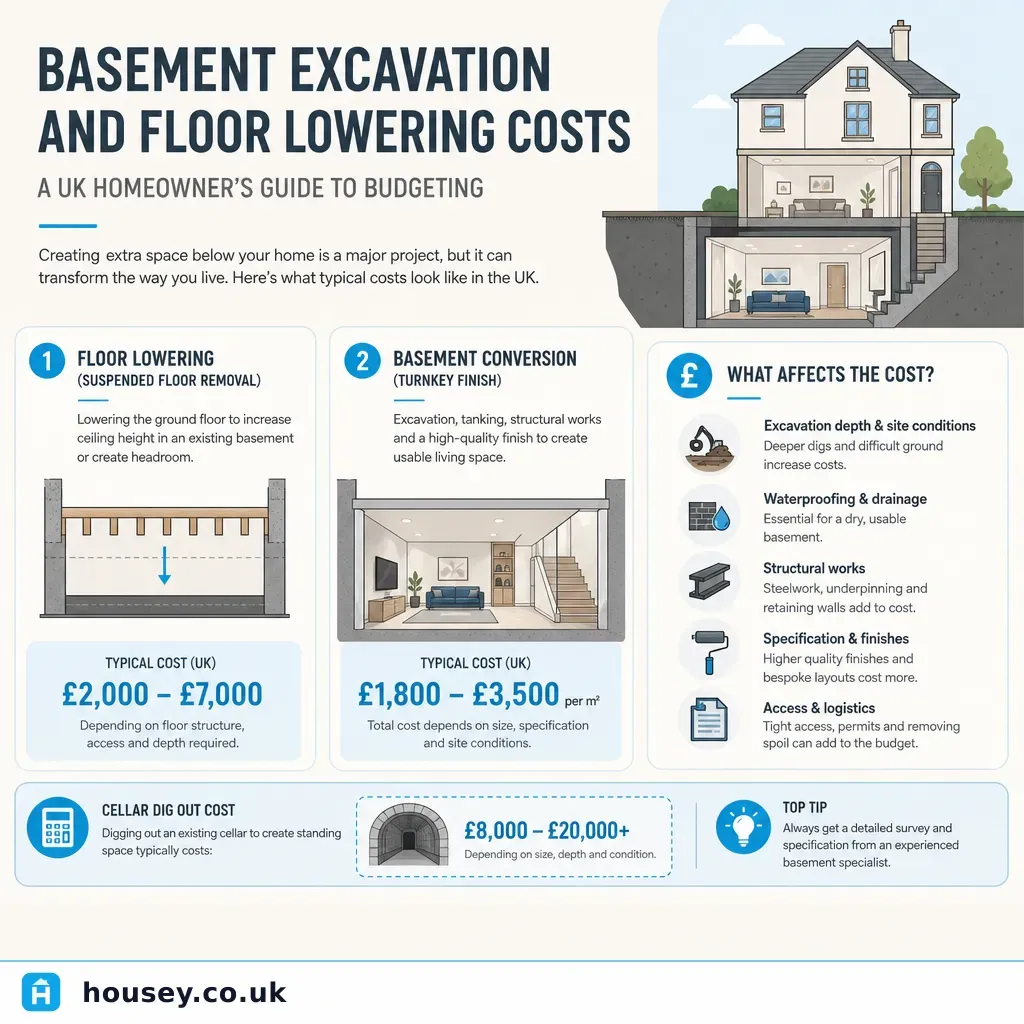
Basement Excavation and Floor Lowering Costs
Basement excavation and floor lowering are complex structural operations.
 Improvement & Build
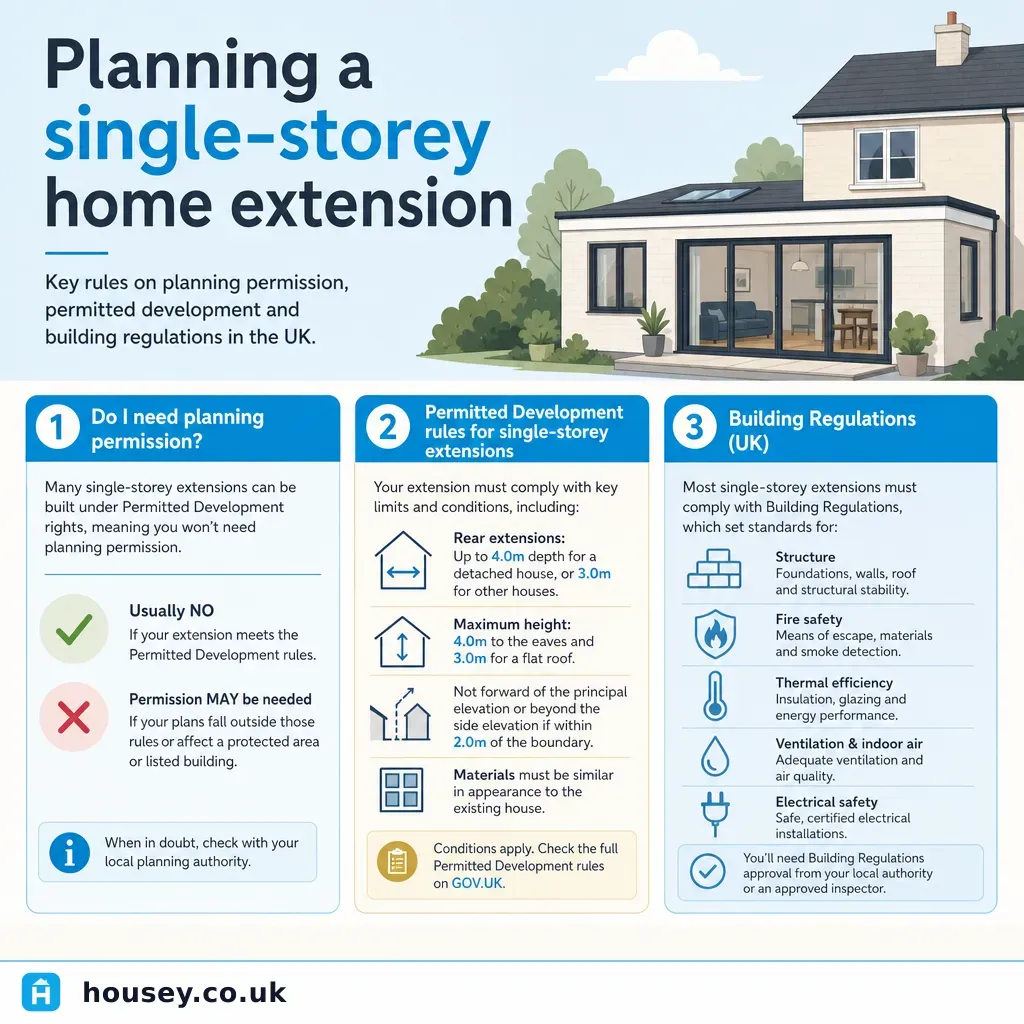
Planning a single-storey home extension
A single-storey extension may fall under permitted development rights, avoiding full planning permission, but only if it meets size, height, and boundary conditions simultaneously.
 Improvement & Build
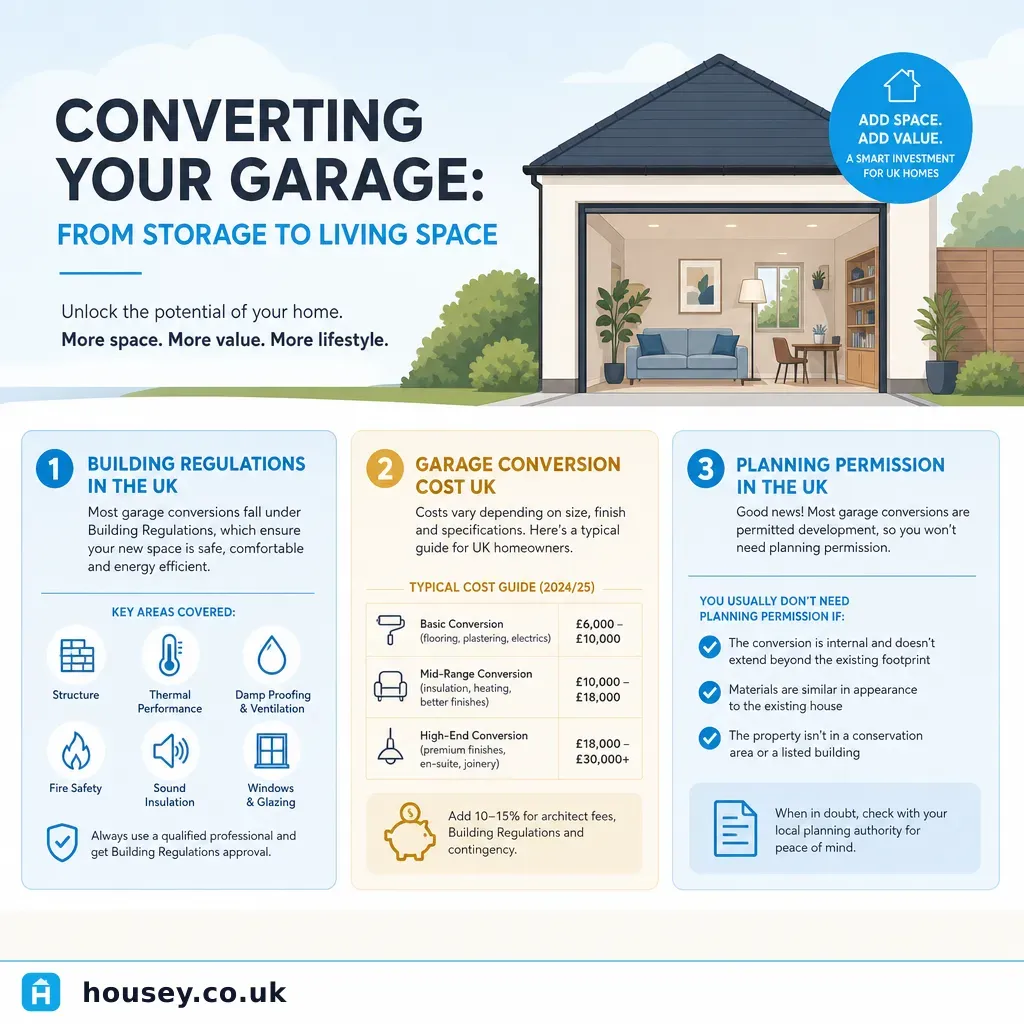
Converting Your Garage: From Storage to Living Space
Converting a garage to habitable space in the UK almost always requires Building Regulations approval, covering structure, insulation, ventilation, and fire safety.
 Improvement & Build
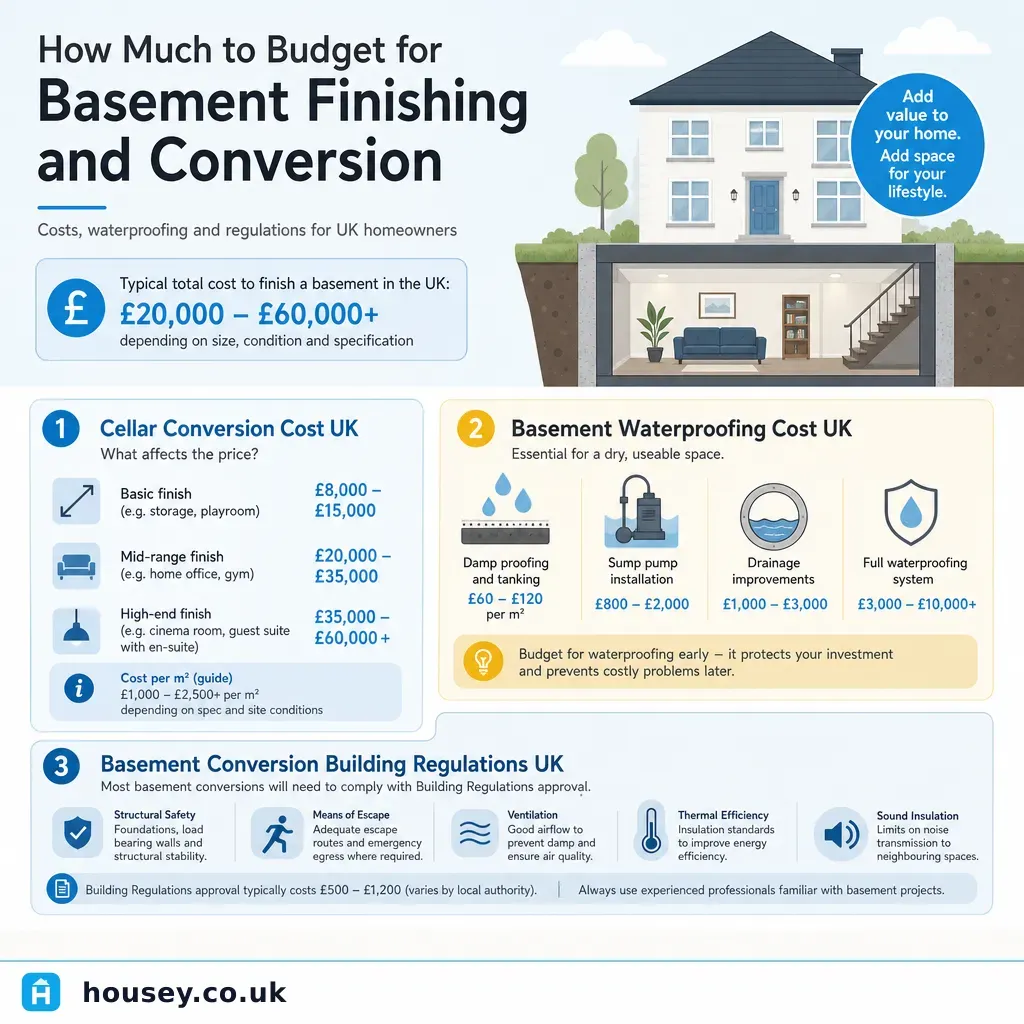
How Much to Budget for Basement Finishing and Conversion
Basement conversions in the UK typically cost £700–£1,500 per square metre for a simple cellar finish with existing headroom, rising to £1,500–£3,500 per square metre for a full conversion with underpinning.
 Improvement & Build
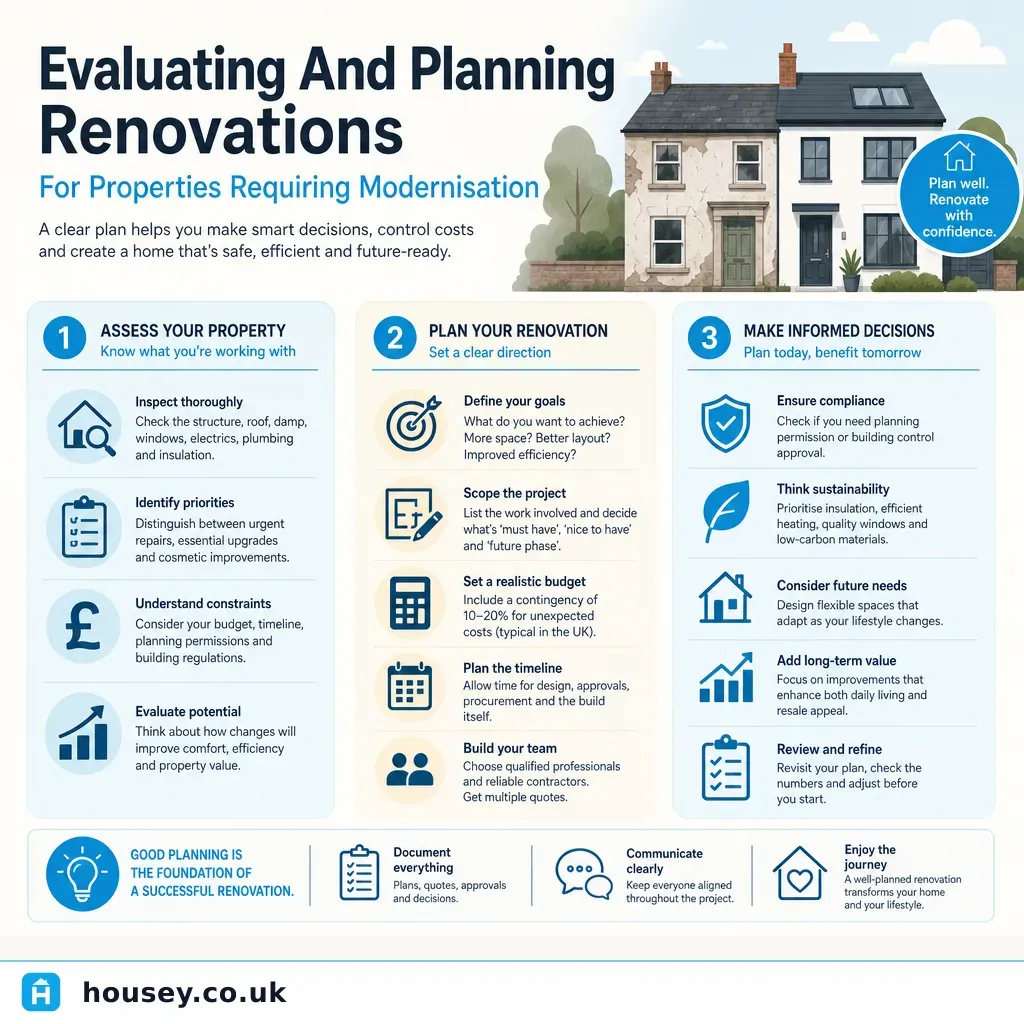
Evaluating And Planning Renovations For Properties Requiring Modernisation
Start by commissioning a condition survey — RICS Level 3 for pre-1919 properties — to identify structural defects, damp, and services issues before finalising a budget.