Converting Your Garage: From Storage to Living Space
By Housey · Last reviewed 7th of May 2026
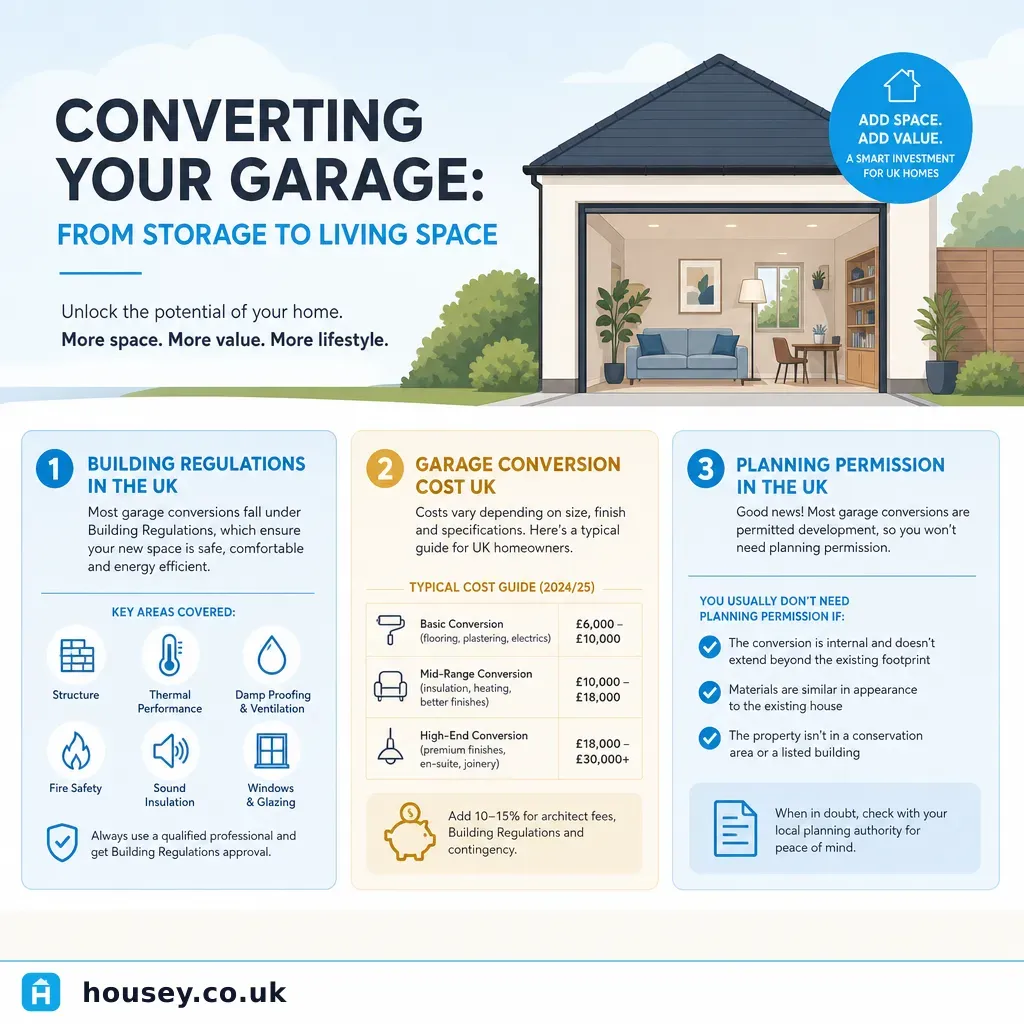
Converting Your Garage: From Storage to Living Space
Turning a garage into habitable space is one of the most cost-effective ways to gain an extra room without building a new extension — but the regulatory requirements are more demanding than many homeowners expect. A conversion that bypasses Building Regulations, or one that reaches completion without a formal sign-off, can become a serious liability when you come to sell, remortgage, or insure the property. Knowing what the rules require, what the structural checks involve, and how to manage the process makes the difference between a straightforward project and an expensive problem.
Key points
- Building Regulations approval is required for virtually all garage conversions in England and Wales under the Building Act 1984, regardless of whether planning permission is also needed.
- Most integral and attached garage conversions fall under permitted development rights and do not require planning permission; detached garages and conservation areas are common exceptions.
- The conversion must meet Part L (thermal performance) minimum U-values: walls ≤0.28 W/m²K, floors ≤0.22 W/m²K, roofs ≤0.16 W/m²K, windows ≤1.6 W/m²K.
- A completion certificate from Building Control is legally distinct from Building Regulations application approval — you need both, and the certificate is essential for conveyancing.
- Indicative costs for a standard integral garage conversion range from £8,000 to £20,000 depending on structural works required, finish level, and whether a WC is included.
Do you need planning permission?
For most homeowners converting an integral or attached garage, the answer is no — but the exceptions are significant.
Permitted development (planning permission not usually needed):
- Integral garage (within the main house footprint) converted to habitable use.
- Attached single-storey garage converted to habitable use with no material change to the external roofline.
- Works that replace the garage door with a window and matching masonry infill without significantly altering the external appearance.
Planning permission likely required:
- Detached garages — the change of use from ancillary storage to habitable use may require full consent.
- Properties in conservation areas, Areas of Outstanding Natural Beauty, or National Parks.
- Properties subject to an Article 4 Direction removing permitted development rights.
- Listed buildings (listed building consent is also required separately).
- Conversions where the original planning consent for the house required the garage to be retained as a garage — common on some residential estates.
- Works involving significant external alterations such as a new roofline, dormer, or substantial extension of the footprint.
Always verify your position with your local planning authority before starting work. Permitted development rights can be removed by local authorities and rules vary by property history and location.
Building Regulations: what every conversion must cover
Building Regulations approval under the Building Act 1984 is legally required regardless of whether planning permission is needed. Submit either a Full Plans application (recommended) or a Building Notice to your local authority Building Control body or an Approved Inspector.
Approved Document | What it requires |
|---|---|
Part A — Structure | Floor, walls, and roof must be structurally adequate for habitable use. Garage floor slabs are often thin and uninsulated and may need structural assessment. |
Part B — Fire safety | Habitable rooms must have adequate means of escape. Internal doors between the converted space and the rest of the house must typically be FD30 fire-rated with intumescent seals. |
Part C — Moisture | Walls and floor must resist damp ingress. Cavity walls may need a damp-proof course; floors need a DPC membrane or tanking layer. |
Part F — Ventilation | Habitable rooms need background and purge ventilation. Extract ventilation is required if a WC or kitchen is included. |
Part L — Thermal performance | Walls, floors, roof, and windows must meet the minimum U-values listed in the Key points section above. |
Part P — Electrics | All new electrical installation must comply with BS 7671 and be certified by a competent person registered with NICEIC, NAPIT, or a similar scheme. |
A structural engineer's assessment of the floor slab and any load-bearing elements is strongly recommended, especially in older garages where the slab may be thinner than modern standards require.
Decision tree: which route applies to your conversion?
- Choose a Full Plans Building Regulations application if you want pre-approval of the design and a clear sign-off at each inspection stage — the safest route for most conversions.
- Use a Building Notice only for very straightforward conversions where your contractor has strong experience managing stage inspections without pre-approved drawings.
- Contact your local planning authority first if your property is in a conservation area, is listed, has an Article 4 Direction, or if you are uncertain about original planning conditions.
- Instruct a planning consultant if the LPA indicates planning permission may be needed — they can assess your permitted development position and advise on the application.
- Instruct a structural engineer before finalising any design if the floor slab, party wall, or roof structure is involved — do not assume the existing garage structure is adequate for habitable use.
- Ask a solicitor to check your title deeds if you are on an estate or hold a leasehold interest, where restrictive covenants or planning conditions may affect the conversion.
What does the conversion process involve?
Stage 1 — Feasibility: assess floor slab thickness, cavity wall construction, ceiling height (2.1m minimum for habitable use; 2.4m preferable), and existing utilities. A structural engineer or experienced conversion contractor can advise at this stage.
Stage 2 — Drawings: Building Regulations drawings are required for a Full Plans application. An architect, architectural technologist, or building regulations drawings specialist produces these, showing structural details, insulation specification, ventilation strategy, and fire-door positions.
Stage 3 — Application: submit Full Plans to your Building Control body or Approved Inspector. Approval typically takes up to five weeks. The Building Control Officer (BCO) will inspect at key stages: slab/DPC, insulation before it is covered, and completion.
Stage 4 — Structural and fabric works: insulate the floor (typically 70–100mm rigid insulation board over the slab), insulate and internally line the walls, treat the ceiling, and address the garage door opening — which usually involves a lintel assessment and masonry infill.
Stage 5 — Services: first-fix electrics by an NICEIC or NAPIT registered electrician, heating connections or underfloor heating circuits, and ventilation ducting.
Stage 6 — Completion: plastering, flooring, decoration, and second-fix electrics. The BCO inspects the completed works and issues a completion certificate — keep this safely with your property title deeds.
What does a garage conversion cost?
Indicative UK costs, last reviewed 2026-05-07. Figures are market ranges only; always obtain at least three itemised quotes.
Conversion type | Indicative cost range |
|---|---|
Basic integral garage, single, no WC | £8,000–£14,000 |
Integral garage with WC or utility area | £12,000–£20,000 |
Attached single-storey garage, standard finish | £10,000–£18,000 |
Detached garage with new utilities | £15,000–£30,000+ |
Key cost drivers:
- Floor slab condition and insulation method (floating floor versus bonded screed).
- Whether the garage door opening requires lintel replacement or structural reinforcement.
- Heating: extending the existing central heating circuit versus installing electric underfloor heating.
- Level of finish and any bespoke joinery or tiling.
- VAT at 20% applies to most conversion work; certain residential conversion works may qualify for the reduced 5% rate — take advice from your contractor before agreeing a final price.
Important limitations
This article is general guidance only. Building Regulations requirements, planning rules, and structural standards vary significantly between properties, construction types, local authorities, and planning histories. Nothing in this article constitutes professional structural, legal, or planning advice. Permitted development rights may not apply to your property and can be withdrawn by local authorities. Always verify your planning position with your local planning authority and instruct qualified professionals — including a structural engineer and a Building Control body — before starting any work.
What to ask a qualified professional
Before instructing a contractor, ask:
- Has a structural engineer assessed the floor slab, party wall (if relevant), and any load-bearing elements?
- Will you submit a Full Plans application or a Building Notice, and what is the reason for that choice?
- Are you or your subcontractors registered with a competent persons scheme for electrical and gas works?
- Which Building Control body will you use, and how will the inspection stages be managed?
- Will I receive a completion certificate on completion, and what is the process if an inspection identifies a problem?
- How will you treat the garage door opening — what lintel assessment or replacement is required?
- Does your quote include VAT, and at what rate — have you considered whether any reduced-rate relief could apply?
When to get professional help
A garage conversion is not a project to undertake without qualified professionals. The following are non-negotiable:
- A structural engineer to assess the floor slab, walls, and structural elements before the design is finalised — a structural engineering assessment at feasibility stage prevents expensive surprises later.
- A building regulations drawings specialist to produce Full Plans drawings for submission to Building Control.
- A registered electrician (NICEIC or NAPIT) to certify all new electrical installation.
- A Gas Safe registered engineer to connect any new gas heating.
- Building Control (local authority or Approved Inspector) to inspect and issue the completion certificate.
Red flags:
- A contractor who claims Building Regulations approval is not needed for a garage conversion.
- Anyone proposing to avoid or bypass the completion certificate process.
- A quote with no structural assessment of the floor slab or load-bearing elements.
- Electricians who cannot confirm registration with a competent persons scheme.
- No mention of FD30 fire-rated doors between the converted space and the main house.
How Housey can help
Housey makes it straightforward to find and compare vetted professionals for every stage of a garage conversion. Whether you need building regulations drawings prepared for your Full Plans application, a structural engineering assessment of your floor slab and walls, or experienced garage conversion specialists to manage and complete the build, Housey can connect you with qualified local providers. You can also request quotes from building control consultants to manage your compliance process, and project managers to keep the conversion on schedule and on budget.
Frequently asked questions
Does a garage conversion add value to a home?
A well-executed, fully compliant garage conversion typically adds value — particularly where an additional bedroom or home office is created in an area where living space commands a premium. An unconverted garage can also be valued as storage or parking. The net impact depends on your local market and the room's intended use. A local estate agent or RICS-registered valuer can advise on comparable evidence.
Can I convert a garage without planning permission?
In many cases, yes. Most integral and attached garage conversions in England fall under permitted development rights and do not require planning permission. You will still need Building Regulations approval regardless. Properties in conservation areas, listed buildings, or those with an Article 4 Direction may require planning permission. Always check with your local planning authority before starting work.
How long does a garage conversion take?
A straightforward integral garage conversion typically takes four to eight weeks from commencement of work, assuming materials are available and Building Control inspections are booked at each stage. Conversions involving structural works, new drainage, or a WC may take eight to twelve weeks. The Full Plans Building Regulations application, submitted before work starts, can take up to five weeks for approval.
What happens if I sell a house with a garage conversion but no completion certificate?
Your buyer's solicitor will flag the missing certificate and is likely to require a retrospective Building Control inspection, an indemnity insurance policy, or a price reduction. Retrospective inspections can require opening up finished work to verify compliance — a potentially costly exercise. This is why obtaining the completion certificate during the original project is essential, not optional.
Is a garage conversion subject to VAT?
Most garage conversion work is standard-rated at 20% VAT. Where a garage is being converted into a separate self-contained dwelling, certain works may qualify for the reduced 5% rate under HMRC VAT Notice 708. The rules are specific and depend on the nature and extent of the works. Take advice from your contractor and, for complex projects, a construction VAT specialist.
Sources and further reading
- Garage conversions — Planning Portal — Planning Portal
- Building Regulations Approved Documents — GOV.UK
- Permitted development rights for householders: technical guidance — GOV.UK
- VAT Notice 708: buildings and construction — HM Revenue & Customs
- Find a structural engineer — Institution of Structural Engineers
Useful next reads
 Improvement & Build
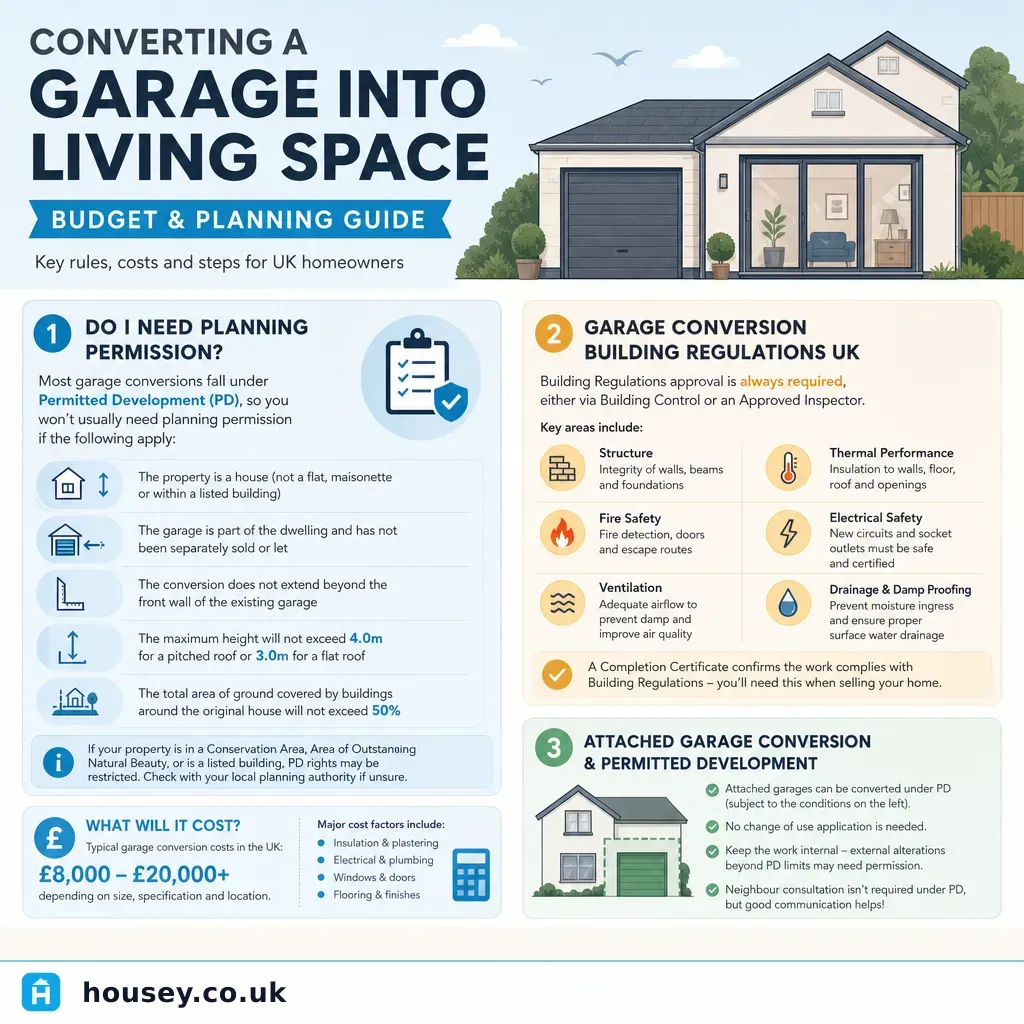
Converting a Garage into Living Space: Budget and Planning Guide
A single-garage conversion typically costs £8,000–£20,000 in the UK.
 Improvement & Build
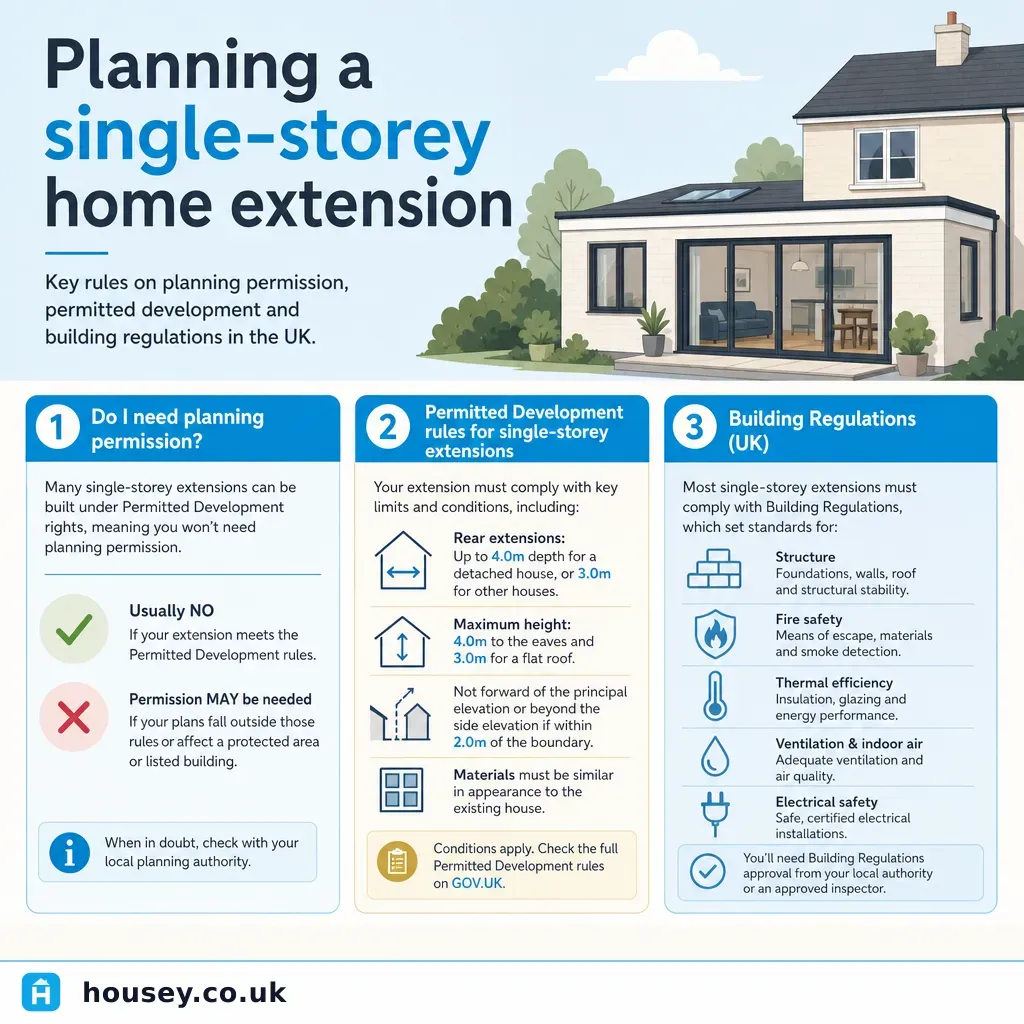
Planning a single-storey home extension
A single-storey extension may fall under permitted development rights, avoiding full planning permission, but only if it meets size, height, and boundary conditions simultaneously.
 Improvement & Build
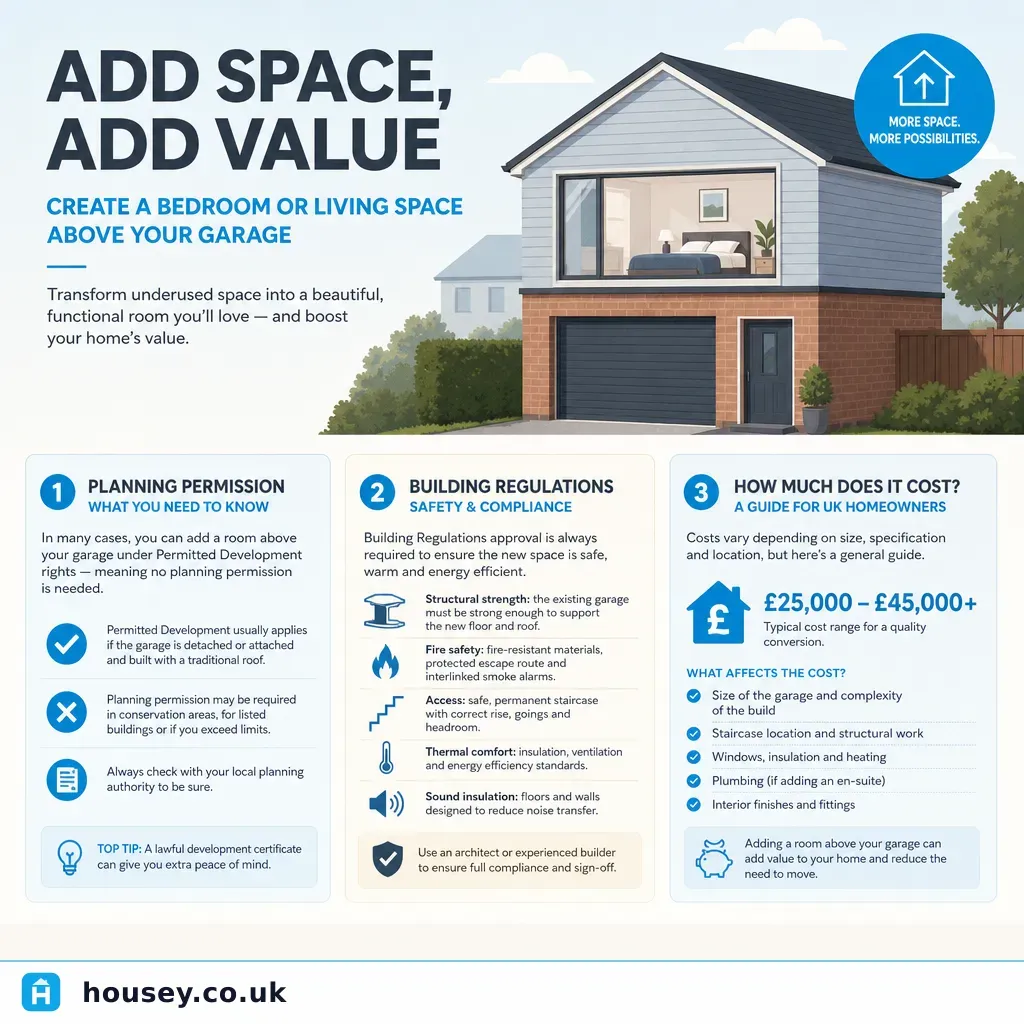
Adding a bedroom or living space above an existing garage
Adding habitable space above an existing garage almost always requires planning permission and Building Regulations approval in the UK.
 Improvement & Build
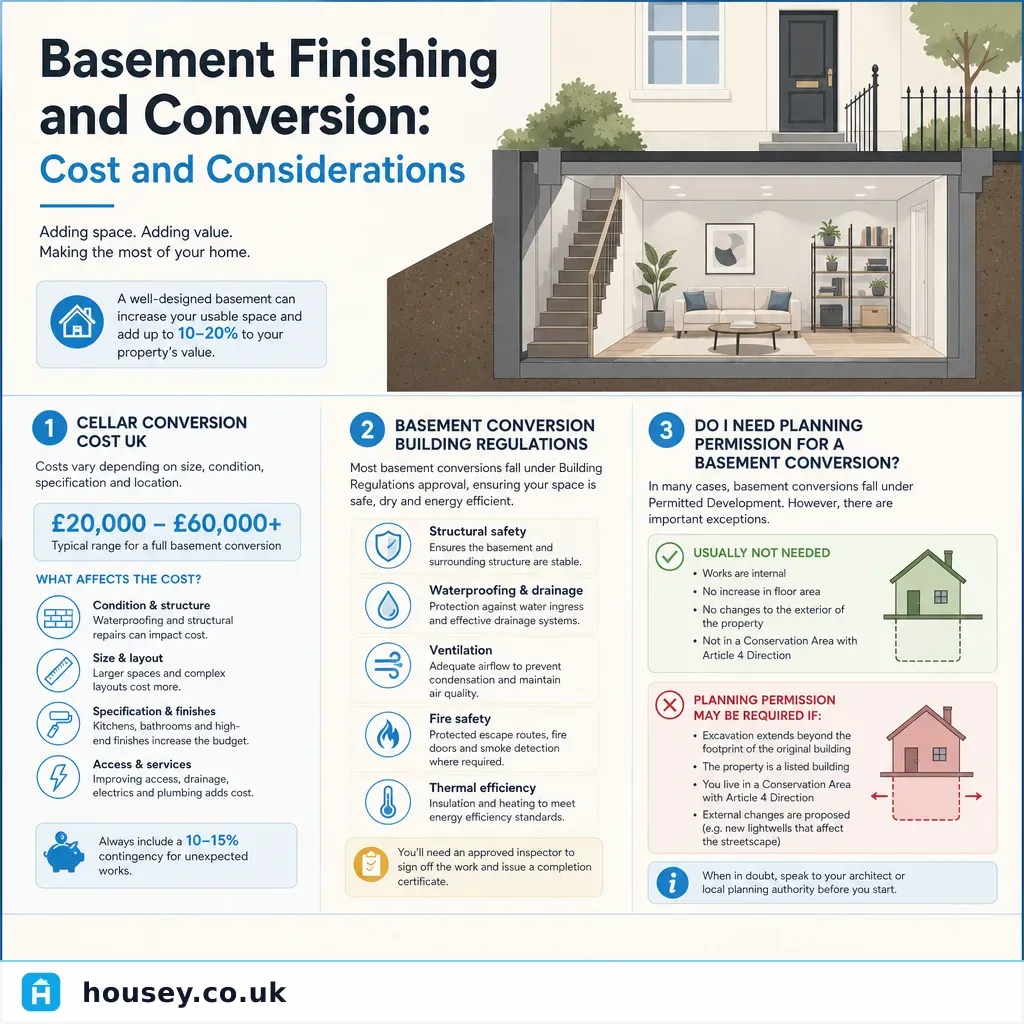
Basement Finishing and Conversion: Cost and Considerations
Converting an existing basement or cellar into a habitable room in the UK typically costs £1,500–£3,000 per square metre, depending on the condition, waterproofing method, and fit-out specification.
 Improvement & Build
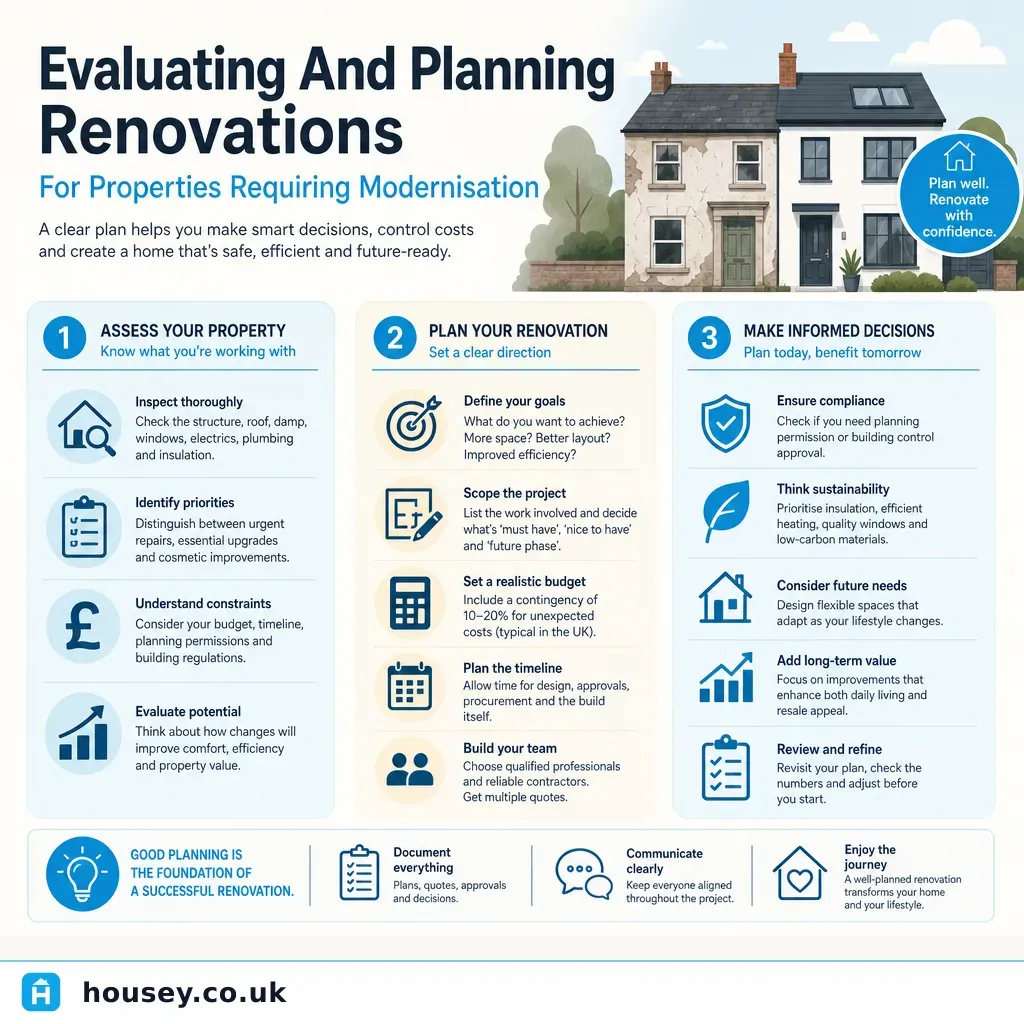
Evaluating And Planning Renovations For Properties Requiring Modernisation
Start by commissioning a condition survey — RICS Level 3 for pre-1919 properties — to identify structural defects, damp, and services issues before finalising a budget.