How Much to Budget for Basement Finishing and Conversion
By Housey · Last reviewed 6th of May 2026
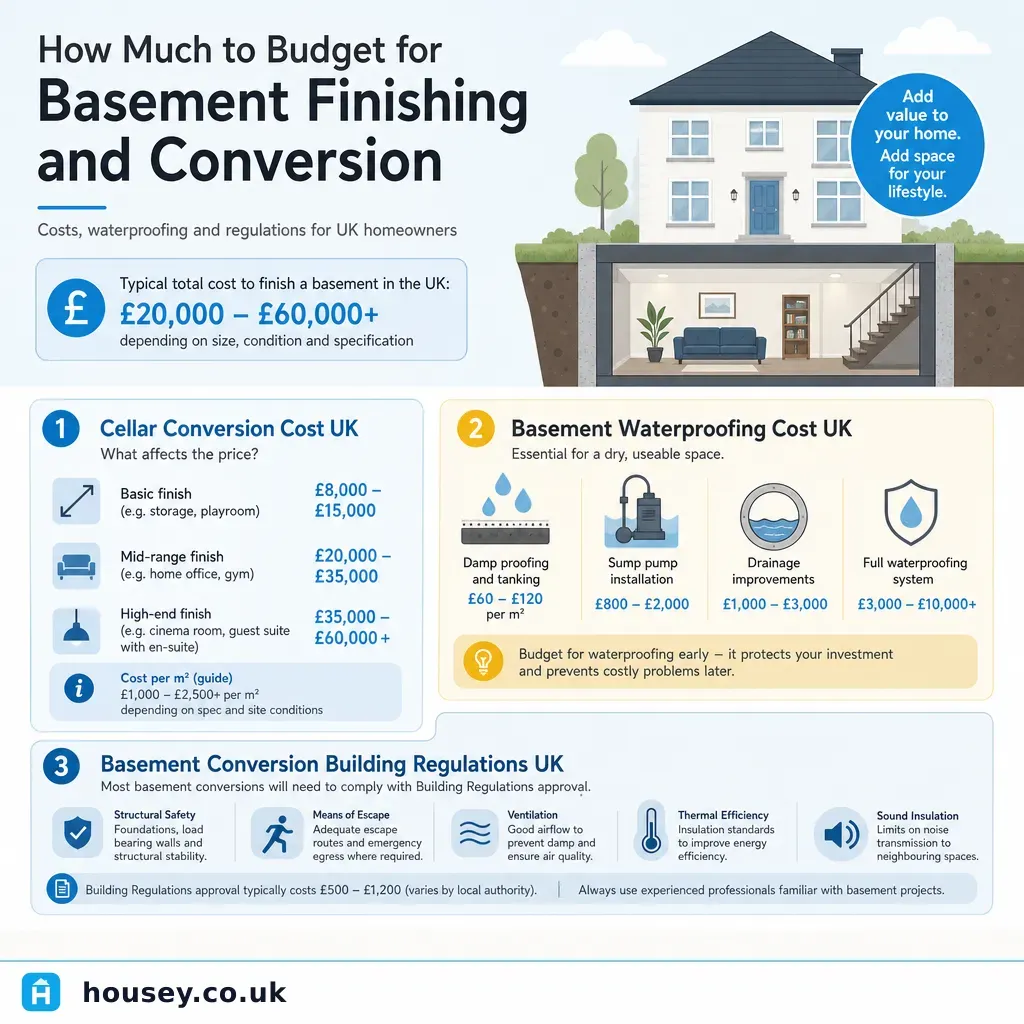
How Much to Budget for Basement Finishing and Conversion
Basement conversions are among the most complex and expensive home improvements a UK homeowner can undertake, yet they can substantially increase usable floor area and resale value in the right property and market. The question of cost most commonly arises when a Victorian or Edwardian terrace has a damp, underused cellar, or when a homeowner wants to create a self-contained annexe, home office, or cinema room beneath an existing property. Getting the budget wrong at the outset — particularly on waterproofing and structural work — can leave a project stalled, a property unmortgageable, or a homeowner facing costs far beyond their original estimate.
Key points
- Basement conversions in England and Wales almost always require Building Regulations approval, even where planning permission is not needed; the primary Approved Documents are A (Structure), C (Moisture), F (Ventilation), and L (Conservation of Fuel and Power).
- BS 8102:2022 is the current standard for below-ground waterproofing in the UK; the Property Care Association (PCA) recommends a Type A, B, or C system based on site conditions and intended use.
- Structural underpinning — required when lowering a floor slab below existing foundation level — can add £20,000–£40,000 or more to a project; a structural engineer's assessment is essential before finalising any budget.
- A full basement conversion including excavation, waterproofing, fit-out, and building control fees typically costs £1,500–£3,500 per square metre; a simple cellar conversion with adequate existing headroom is usually £700–£1,500/m².
- Mechanical ventilation compliant with Approved Document F (2021) is required for habitable basement rooms; natural ventilation alone is rarely sufficient below ground.
Indicative UK costs, last reviewed 2026-05-06. Costs vary significantly by location, soil conditions, access, contractor, and specification. Always obtain multiple quotes.
What drives the cost of a basement conversion?
Existing headroom. If a cellar already has 2.1–2.4 m of clear height, conversion may be possible without excavation. Where headroom is insufficient, lowering the floor requires underpinning or a new structural slab, substantially increasing cost.
Waterproofing requirement. Below-ground structures face risk from groundwater, lateral ingress, and condensation. The correct BS 8102:2022 system depends on soil permeability, water table depth, and intended use. Incorrectly specified waterproofing is the most common cause of failed basement conversions.
Structural condition. Victorian and Edwardian properties commonly have shallow rubble-fill foundations. A structural engineer must assess foundations before any underpinning or wall modification is priced.
Fit-out specification. A raw waterproofed shell costs far less than a finished bedroom with en suite or a home cinema with acoustic treatment. Mechanical and electrical installation, plastering, flooring, and bathroom fit-out all add significantly.
Site access. A basement accessible only through the house interior is harder and more expensive to work on than one with external stair access. Spoil removal and concrete deliveries may need pavement licences in terraced streets.
Location. London and south-east England contractor rates are typically 20–40% higher than equivalent work in the Midlands or North.
Types of basement conversion and typical costs
The table below shows indicative cost ranges for common conversion approaches in England and Wales. Costs exclude VAT; confirm the applicable rate (standard 20% or potentially reduced 5% for qualifying conversion works) with your contractor.
Conversion type | Suitable when | Typical cost range (per m²) | Key notes |
|---|---|---|---|
Cellar finishing (existing headroom) | Cellar ≥2.1 m clearance; manageable damp | £700–£1,500/m² | Waterproofing, insulation, fit-out; no excavation |
Cellar conversion with floor lowering | Headroom inadequate; no full underpinning required | £1,200–£2,000/m² | New structural slab; soil conditions drive cost |
Full underpinning and conversion | Structural modification required for headroom | £1,500–£3,500/m² | Structural engineer essential; high cost variability |
Basement extension (new excavation) | No existing basement; significant new dig | £2,500–£5,000/m² | Planning permission often required; highest risk |
Indicative UK costs, last reviewed 2026-05-06. Source: RICS Building Cost Information Service (BCIS) published ranges and contractor market data. Obtain a minimum of three written quotes.
Waterproofing: the critical cost variable
Inadequate waterproofing is the single most common cause of failed basement conversions. BS 8102:2022 defines three primary protection types:
- Type A (barrier protection): Tanking membranes or renders applied directly to the structure. Suitable for low-risk sites; vulnerable to sustained hydrostatic pressure.
- Type B (structurally integral protection): Waterproof concrete used during construction. Most effective for new-build basements.
- Type C (drained protection): Cavity drain membranes (CDMs) channelling water to a sump and pump. The most resilient retrofit solution for existing UK cellars and the industry standard approach.
For most existing UK properties, a Type C system with a sump and pump is recommended. Use a contractor trained to the CSSW (Certificate in Structural Waterproofing) standard, available through PCA-registered firms. Typical supply-and-install costs for a Type C system on a 50 m² cellar range from £8,000–£15,000, with sump and pump installation adding £1,500–£3,000. Annual pump maintenance should be factored into running costs.
Building regulations and planning requirements
Building Regulations approval is required for conversions involving a change of use to a habitable room, structural alterations (underpinning, new openings, beams), or new drainage, electrical, or ventilation installations.
Key Approved Documents:
- Approved Document A: Governs underpinning, loadbearing walls, and floor slab design
- Approved Document C: Covers the waterproofing specification
- Approved Document F (2021): Requires mechanical ventilation for habitable below-ground rooms
- Approved Document L: Sets insulation standards
Planning permission is not usually required for a basement conversion within the existing footprint of a house in England under permitted development rights. However, conservation area properties, listed buildings, properties with Article 4 directions, and London borough basements may need consent. Many London boroughs have specific basement development policies requiring neighbourhood impact assessments. Always check with your local planning authority before committing to a scope of works.
Homeowner checklist: preparing your basement conversion budget
Before approaching contractors, complete the following steps to obtain meaningful, comparable quotes:
Red flags that will push costs higher
- High water table confirmed by trial pit or borehole: Increases pump capacity, drainage complexity, and Type C specification requirements.
- Rubble-fill or shallow foundations: Common in Victorian and Edwardian terraces; may need specialist temporary propping before underpinning can proceed.
- Party wall proximity: Works within 3–6 metres of a neighbour's foundation require a Party Wall Award under the Party Wall etc. Act 1996; fees of £700–£2,000 per award are typical.
- Services crossing the works zone: Buried gas mains, drain runs, and electrical ducts may require utility surveys and diversions.
- Listed building designation: Requires listed building consent; constrains specification choices and increases professional fees and timescales.
- Made ground or contaminated land: Former industrial sites may require ground investigation, contamination testing, and remediation before construction.
Important limitations
This article provides general guidance on typical basement conversion costs in the UK. All cost ranges are indicative, based on published industry data and contractor market surveys as at May 2026; actual costs will vary materially based on site-specific conditions, local authority requirements, specification, and contractor selection. This article is not a substitute for a site-specific structural engineer's assessment, a waterproofing survey, or professional Building Regulations drawings. Permitted development rights and planning policies vary by property, location, and local authority; always verify with a qualified professional before committing to expenditure.
What to ask a qualified professional
Before instructing a contractor, structural engineer, or waterproofing specialist:
- What waterproofing system is appropriate for this site, and which BS 8102:2022 type do you recommend — and why?
- Will the existing foundations support the proposed works without underpinning?
- What Building Regulations applications are required, and are drawings included in your fee?
- Is planning permission required for this property and scope?
- Do any works fall within 3–6 m of a neighbouring foundation, triggering the Party Wall etc. Act 1996?
- What contingency is included in your quote, and what specific conditions would trigger additional costs?
- Are you a PCA member holding the CSSW qualification?
- What warranty does the waterproofing system carry, and is it backed by an independent insurer?
When to get professional help
Appoint structural engineers before finalising the scope of any project involving underpinning, floor lowering, or modification of loadbearing walls. Do not rely on a builder's assessment alone for structural decisions.
If exploratory works reveal suspected subsidence, significant cracking, an unexpectedly high water table, or potential contamination, pause and commission specialist advice before proceeding. Continuing without specialist input in these circumstances risks both safety and significant unplanned cost.
For waterproofing, instruct a PCA-registered CSSW contractor. Incorrectly specified or installed waterproofing may not be covered by building warranties or home insurance, and remediation after fit-out is disproportionately expensive.
How Housey can help
Housey connects UK homeowners with qualified professionals for basement and cellar conversion projects. Request quotes from structural engineers for foundation assessments and underpinning design, architectural technologists for Building Regulations drawings, and building control consultants to manage the approvals process. If your project includes a broader build element, extension builders with basement conversion experience are also available through the platform.
Frequently asked questions
Do basement conversions always need planning permission in the UK?
Not always. Converting an existing cellar within the original footprint of a house often falls within permitted development in England, so planning permission is not required. Properties in conservation areas, listed buildings, and London boroughs with specific basement policies may need consent, as may any excavation that extends the footprint. Always check with your local planning authority before starting work.
How long does a basement conversion typically take?
A straightforward cellar finishing project with adequate existing headroom typically takes 8–14 weeks from contractor appointment to practical completion, assuming Building Regulations drawings are already in place. A full underpinning and conversion project can take 4–9 months, depending on structural complexity, contractor programme, and building control inspection timescales. Allow additional time for pre-construction surveys and drawings beforehand.
What is a Type C cavity drain membrane, and is it reliable?
A Type C drained protection system uses a dimple-profile membrane fixed to internal walls and floors. Water that penetrates the structure is channelled to a sump and pump, which discharges to a drain or soakaway. When installed by a PCA-trained CSSW contractor and maintained with annual inspection, Type C systems are considered the most reliable retrofit waterproofing method for UK cellars. The sump pump requires electricity and ongoing maintenance.
Can a basement room be used as a bedroom?
Yes, but it must meet Building Regulations requirements for habitable rooms: at least 2.1 m headroom, compliant mechanical ventilation under Approved Document F, insulation to Part L standards, an adequate means of escape from fire, and natural light provision. A building control officer inspects and certifies the works before the room is approved for habitable use. A non-compliant basement bedroom may affect mortgage eligibility and insurance.
Does a basement conversion add value to a UK property?
Property market evidence suggests basement conversions can add 10–15% to a property's value in the right market, particularly in London where space commands a premium. The return depends on specification, the local market ceiling, and whether the extra floor area addresses a genuine buyer need. In some markets the conversion cost may exceed any value uplift; an independent valuation provides the most reliable pre-project assessment.
Sources and further reading
- Building Regulations: Approved Documents — GOV.UK
- BS 8102:2022 Code of Practice for Protection of Below Ground Structures Against Water — BSI
- Structural Waterproofing Guidance for Homeowners — Property Care Association
- Party Wall etc. Act 1996: Explanatory Booklet — GOV.UK
- Permitted Development Rights for Householders: Technical Guidance — GOV.UK
Useful next reads
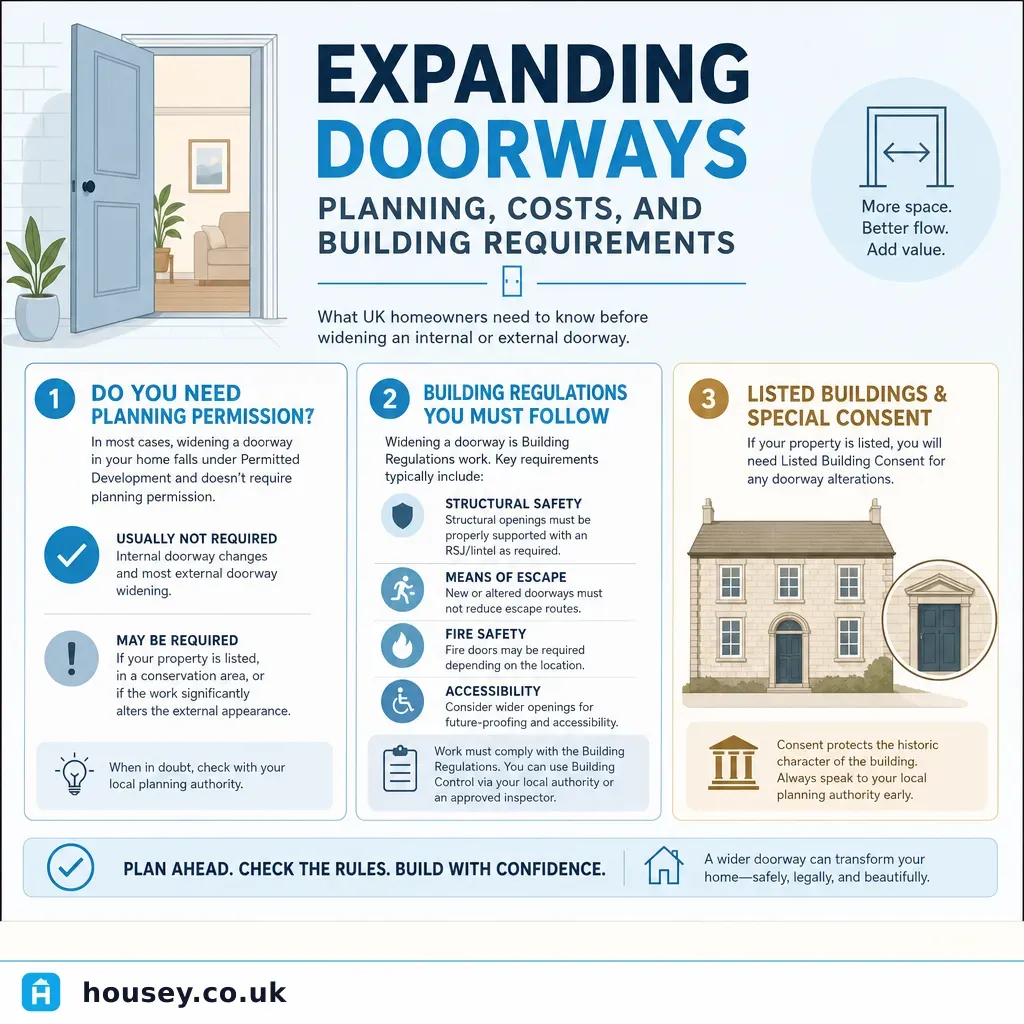 Improvement & Build
Expanding Doorways: Planning, Costs, and Building Requirements
Expanding a doorway in a load-bearing wall requires Building Regulations Part A approval and a structural engineer's lintel design.
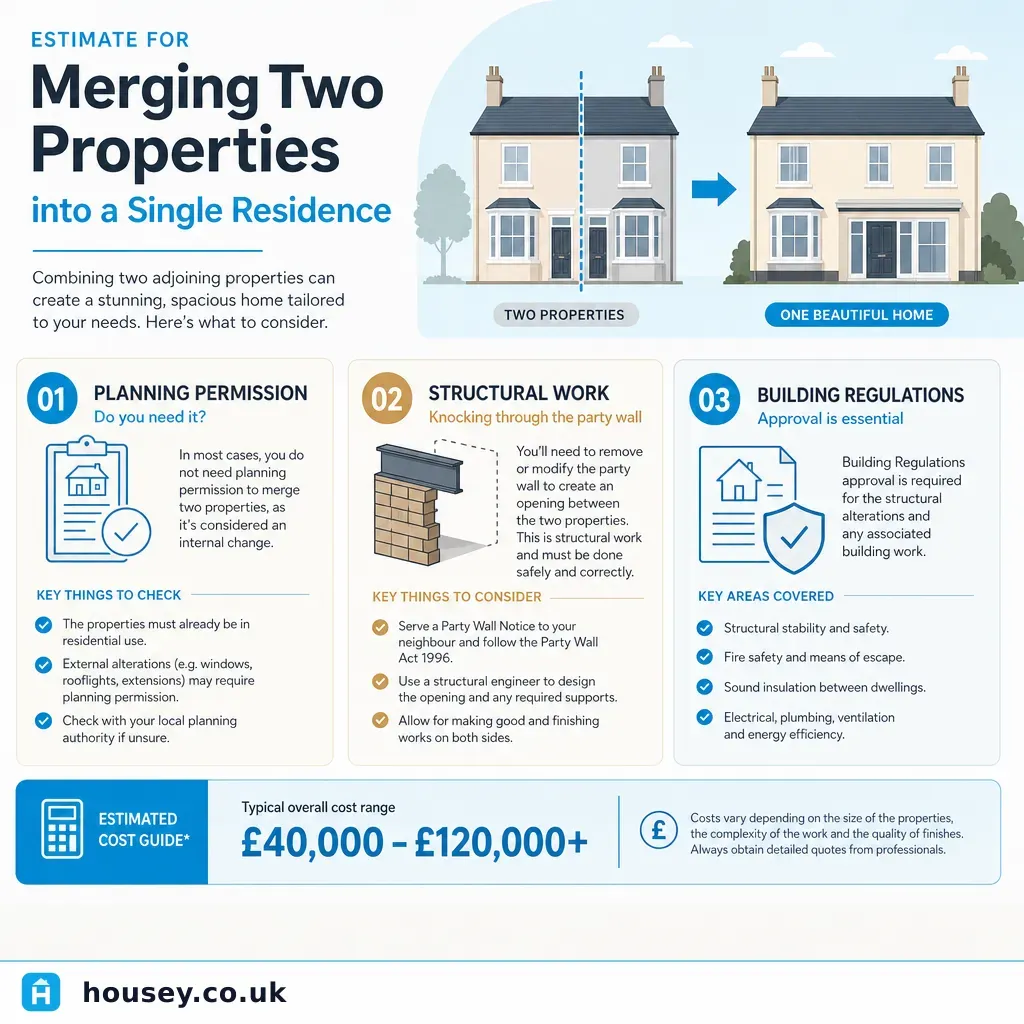 Improvement & Build
Estimate for Merging Two Properties into a Single Residence
Merging two properties into one typically costs £30,000–£120,000 or more, depending on property type, structural complexity, and professional fees.
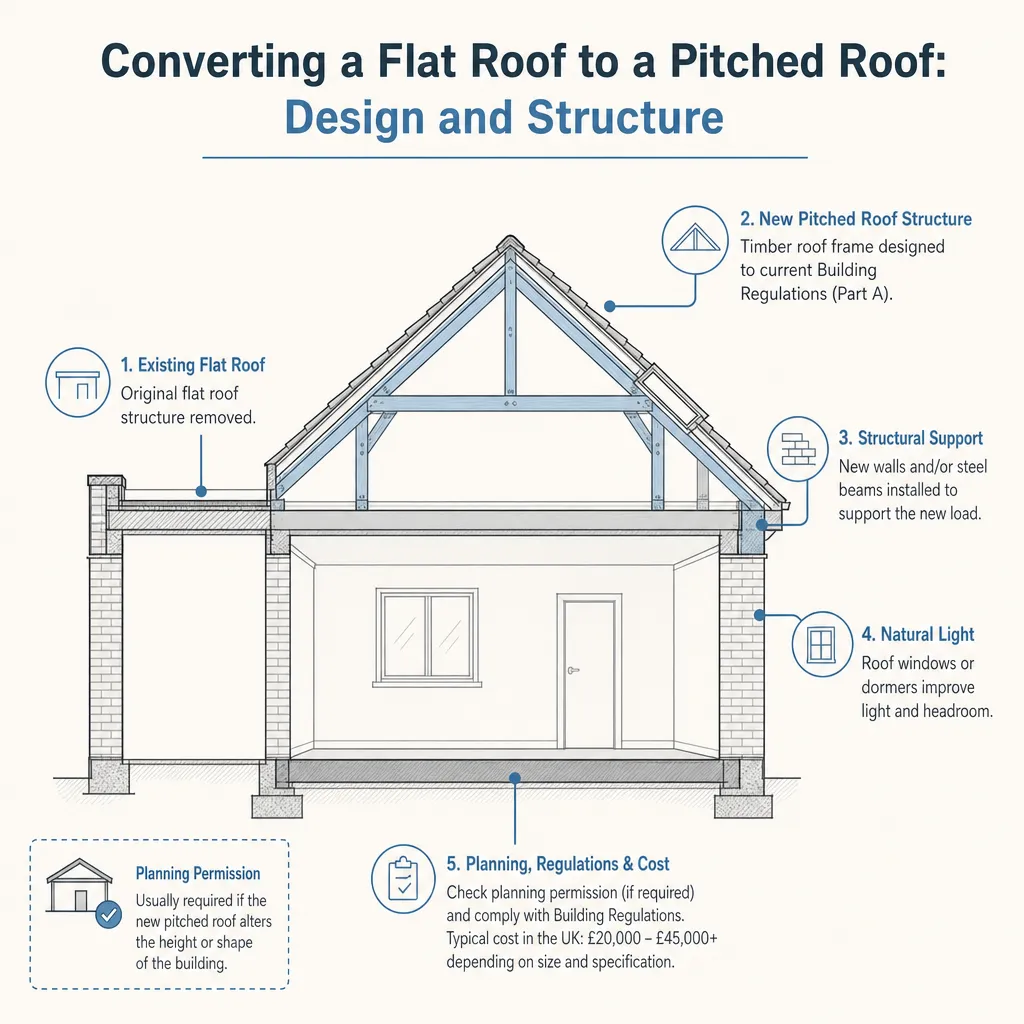 Improvement & Build
Converting a Flat Roof to a Pitched Roof: Design and Structure
Converting a flat roof to a pitched roof almost always requires Building Regulations approval and a structural engineer's design.
 Improvement & Build
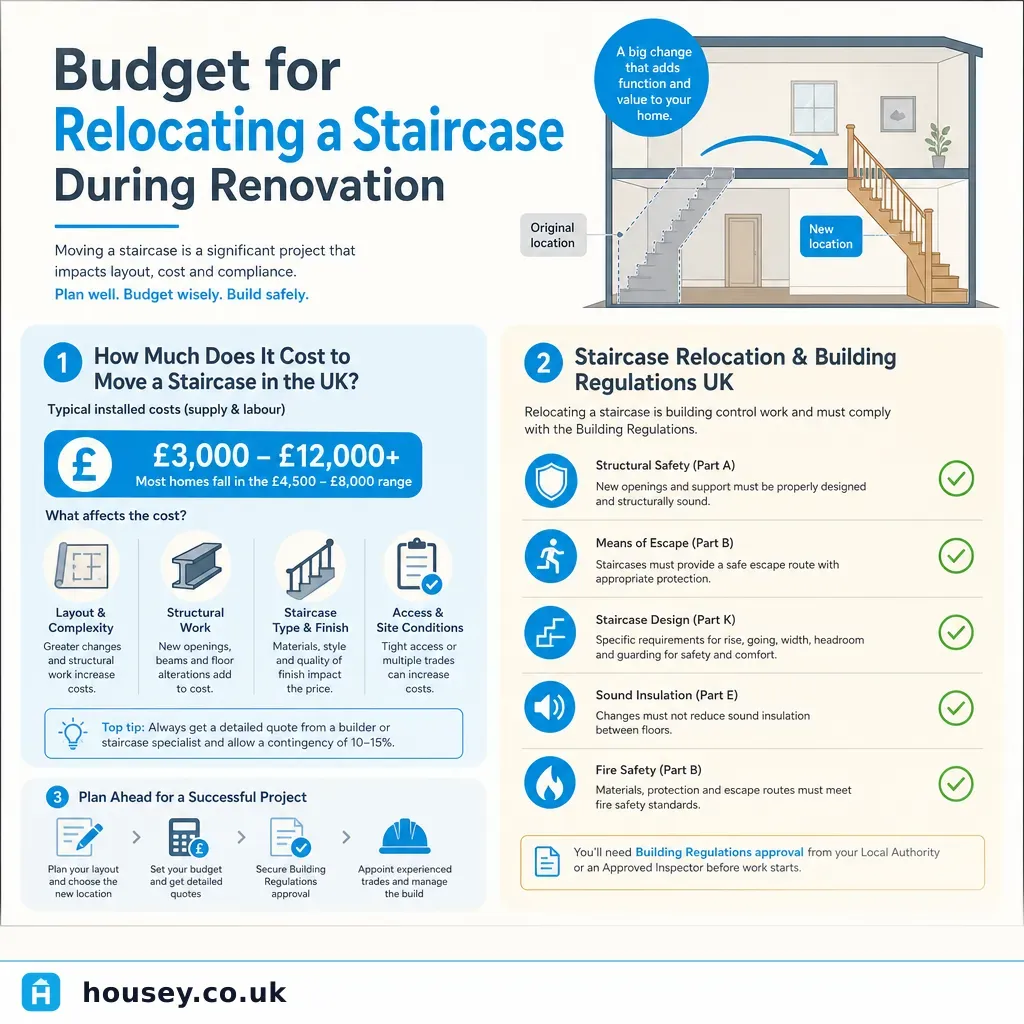
Budget for Relocating a Staircase During Renovation
Relocating a staircase in a UK home typically costs £6,000 to £20,000 or more, depending on structural complexity and staircase design.
 Improvement & Build
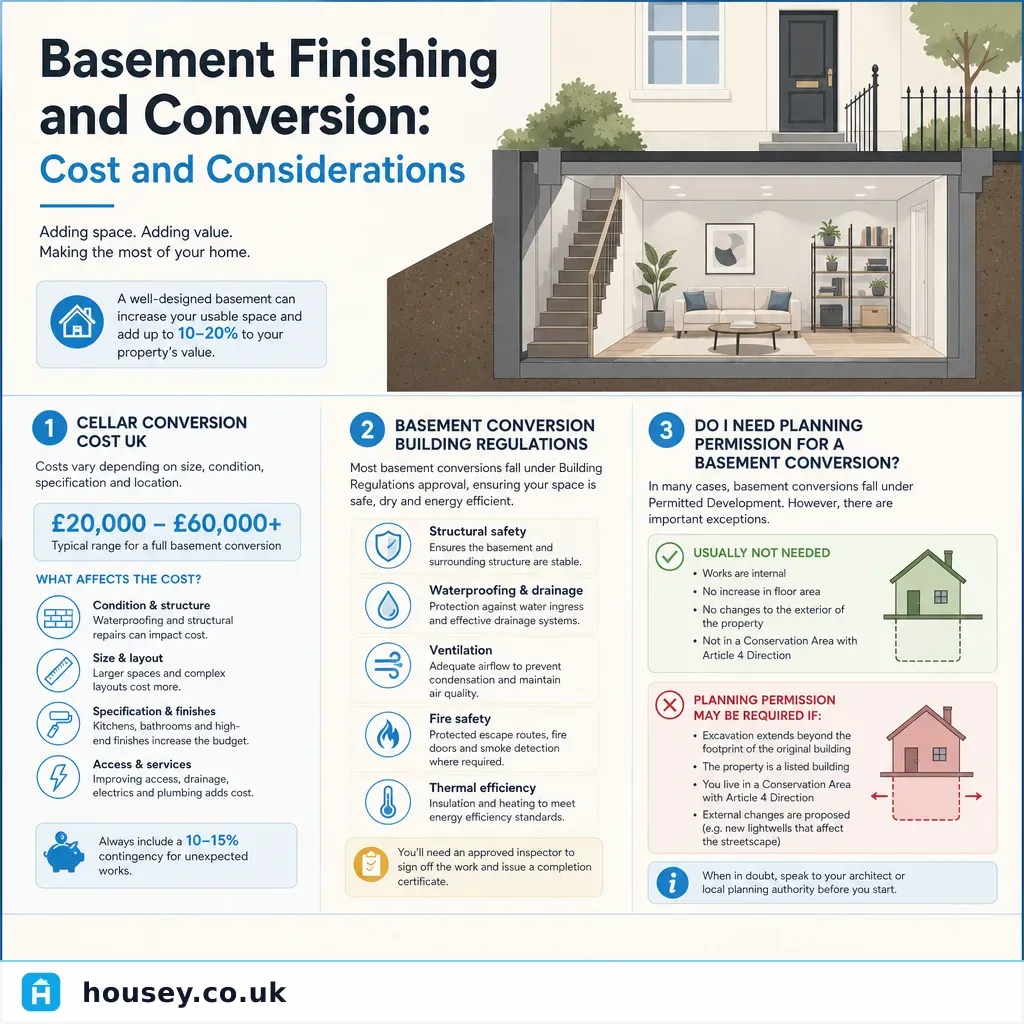
Basement Finishing and Conversion: Cost and Considerations
Converting an existing basement or cellar into a habitable room in the UK typically costs £1,500–£3,000 per square metre, depending on the condition, waterproofing method, and fit-out specification.