Basement Extensions: What UK Homeowners Need to Know
By Housey · Last reviewed 8th of May 2026
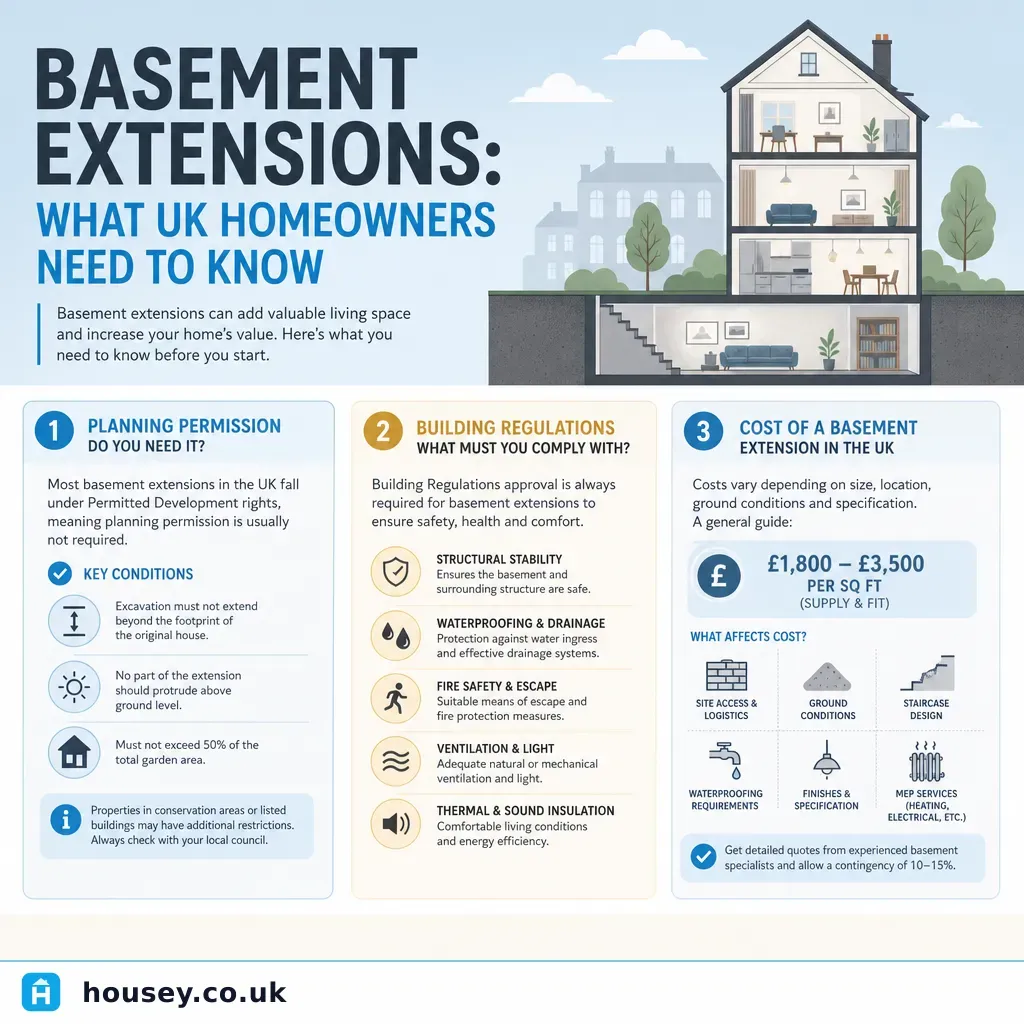
Basement Extensions: What UK Homeowners Need to Know
Basement extensions have become an increasingly popular way for London and city-centre homeowners to add significant floor space without extending outwards or upwards. Whether you are digging out beneath an existing Victorian terrace or creating a new subterranean level beneath a garage, the decision involves substantial engineering, regulatory, and financial complexity. Understanding what is involved before committing to a contractor can save considerable time, money, and disruption.
Key points
- Most basement extensions require full planning permission — permitted development rights do not generally cover new subterranean space, though some conversions of existing cellars may have a lower regulatory threshold.
- Building Regulations approval under Parts A (structural), C (moisture), F (ventilation), H (drainage), and L (energy) is always required for habitable basement space.
- Party Wall etc. Act 1996 notices must be served on adjoining owners if excavation is within 3m or 6m of their foundations, depending on depth and method.
- A structural engineer must be involved; basement construction affects the foundations of the existing building and, in terraced or semi-detached properties, neighbouring foundations too.
- Indicative UK construction costs range from £2,000–£3,500 per square metre for a basement extension (Indicative UK costs, last reviewed 2026-05-08), though London and complex sites can be considerably higher.
Does a basement extension need planning permission?
In most cases, yes. Creating new habitable underground space typically falls outside the scope of permitted development in England and requires a full planning application. The key considerations are:
- New-build basements: Virtually always require full planning permission.
- Converting an existing cellar to habitable use: May or may not require planning permission, depending on whether the works constitute a material change of use and the extent of structural works involved. Check with your local planning authority (LPA) before assuming it is exempt.
- Conservation areas and listed buildings: Additional consents are required in all cases.
- London-specific policies: Several London boroughs have adopted specific policies on basement development due to concerns about flooding, ground stability, and neighbourhood disruption. Notable examples include the Royal Borough of Kensington and Chelsea, Camden, and Westminster.
Always check your LPA's local plan policies and any Article 4 Directions that may remove permitted development rights in your area.
Building Regulations: what applies to basement extensions
Regardless of planning permission, basement extensions in England must comply with Building Regulations. The main Approved Documents relevant to basement work are:
Approved Document | What it covers | Why it matters for basements |
|---|---|---|
Part A — Structure | Structural stability | Underpinning, retaining walls, and temporary propping |
Part C — Site preparation and resistance to moisture | Damp-proofing and waterproofing | Basement waterproofing systems (tanking or cavity drain) |
Part F — Ventilation | Fresh air supply | Habitable rooms must have adequate ventilation |
Part H — Drainage | Surface and foul drainage | Sump pumps and drainage to prevent flooding |
Part L — Conservation of fuel and power | Thermal performance | U-values for floors, walls, and ceilings of new habitable space |
A Building Control application — full plans application rather than a building notice — is strongly recommended for basement works given the structural complexity involved.
The Party Wall Act and basement excavations
The Party Wall etc. Act 1996 is particularly relevant to basement extensions in terraced, semi-detached, or other adjoining properties. You must serve written notice on adjoining owners if:
- You intend to excavate within 3 metres of a neighbouring building or structure and the excavation will be deeper than the neighbour's foundations.
- You intend to excavate within 6 metres of a neighbouring building where the excavation depth would intersect a 45-degree line drawn from the bottom of the neighbour's foundations.
Failure to serve the correct notices can result in injunctions and court costs. Appoint a party wall surveyor to advise on notices and produce the required award before works start.
Structural and waterproofing considerations
Basement construction is complex engineering. The typical construction sequence for a new basement beneath an existing house involves:
- Initial structural survey — assessing existing foundations, soil type, and neighbouring structures.
- Underpinning or secant piling — to support the existing building while excavation takes place.
- Excavation — removing material from beneath the existing footprint.
- Waterproofing — either tanking (Type A), cavity drain membrane (Type C), or structural waterproof concrete (Type B), or a combination. BS 8102:2022 covers protection of below-ground structures against water.
- Drainage — sump and pump systems to manage any water ingress.
- Internal fit-out — to Building Regulations standards for habitable space.
A drainage contractor should assess the impact of your basement on local surface water drainage and confirm arrangements for any new sump pump discharge.
Decision tree: is a basement extension right for your property?
- Choose a basement extension if you have a terraced or semi-detached property in a high-value urban area where extending outwards or upwards is restricted or not possible, and the cost per square metre is offset by a significant uplift in property value.
- Consider alternatives if your property sits on clay-heavy or waterlogged ground, or if neighbouring owners are likely to object — negotiations under the Party Wall Act can delay a project significantly.
- Get a structural engineer's assessment first if your property shows any signs of existing movement, cracking, or settlement.
- Check with your LPA first if you are in a conservation area, have an Article 4 Direction, or live in a London borough with specific basement development policies.
- Ask a party wall surveyor first if you share any wall or boundary with a neighbour whose foundations might be affected by your proposed excavation.
What not to assume
Several common misconceptions lead homeowners to underestimate the complexity of basement projects:
- Assumption: converting an existing cellar is always straightforward. Cellars are often poorly waterproofed, may have inadequate ceiling height, and frequently have drainage issues that require extensive remediation before habitable use is possible.
- Assumption: permitted development covers basement work. In most cases it does not — always confirm with your LPA before starting any works.
- Assumption: any builder can do this work. Basement construction requires specialist contractors with experience in underpinning and waterproofing systems. Always verify contractor qualifications, professional indemnity insurance, and previous project references.
- Assumption: the project will not affect neighbours. Vibration, settlement risk, and access requirements during construction can significantly affect adjoining properties.
Important limitations
This article provides general information for UK homeowners. Basement extension projects are complex engineering and planning undertakings. Rules vary by local authority, property type, tenure, and site conditions. Nothing in this article constitutes structural, legal, or planning advice. Always engage qualified professionals — including a structural engineer, party wall surveyor, and planning consultant — before committing to a basement project.
What to ask a qualified professional
Before appointing any contractor or consultant for a basement extension, ask:
- What is the soil type and groundwater level at my property, and how will this affect the design and waterproofing specification?
- Does my property require underpinning, and if so, what method is most appropriate?
- Which neighbouring properties are likely to be affected, and what Party Wall Act notices will be required?
- What planning application is required, and are there any local authority policies that could restrict or refuse the proposal?
- What Building Regulations applications are needed, and will a full plans application be submitted?
- What warranties are available for the waterproofing system, and for how long?
- What is the programme of works, and how will access to my property be managed during excavation?
When to get professional help
Engage qualified professionals before starting any basement work if:
- You share a wall, foundation, or close boundary with a neighbour.
- Your property shows any signs of subsidence, settlement, or structural cracking.
- You are in a conservation area, Article 4 area, or your property is listed.
- Your property is on clay, made ground, or in a flood risk zone.
- You have any doubt about the drainage arrangements or groundwater levels on site.
How Housey can help
Housey connects you with vetted UK professionals for basement extension projects. Whether you need extension builders experienced in basement construction, specialist drainage contractors for sump and waterproofing design, or building control consultants to manage your compliance application, Housey can help you request and compare quotes from local providers.
Frequently asked questions
Do I need planning permission for a basement extension in the UK?
Most new basement extensions require full planning permission in England. Converting an existing cellar to habitable use may also require planning permission depending on the extent of works and whether it constitutes a material change of use. Permitted development rights do not generally cover new subterranean accommodation. Always check with your local planning authority before starting work.
How much does a basement extension cost in the UK?
Indicative UK construction costs for a basement extension typically range from £2,000 to £3,500 per square metre (last reviewed 2026-05-08), though costs in London and on complex or restricted sites can be considerably higher. Professional fees — for a structural engineer, party wall surveyor, architect, and planning consultant — add significantly to the total. Always obtain at least three itemised quotes from specialist contractors.
Does the Party Wall Act apply to basement extensions?
Yes. If your excavation will be within 3 metres of a neighbouring structure — or 6 metres where the depth intersects a 45-degree line from the neighbour's foundations — you must serve written notice under the Party Wall etc. Act 1996 before works begin. Appoint a party wall surveyor to draft and serve the correct notices and, if necessary, prepare the required party wall award.
How long does a basement extension take?
Timescales vary significantly by project complexity. A straightforward cellar conversion might take 8–12 weeks on site, while a new-build basement beneath an existing house typically takes 4–9 months including planning, design, and construction. Party wall procedures can add a further 1–2 months to the programme if neighbours require formal awards.
Sources and further reading
- Party Wall etc. Act 1996: guidance for those involved in construction works — GOV.UK
- Building Regulations Approved Documents — GOV.UK
- Planning Portal: basement extensions and planning permission — Planning Portal
- LABC: basement conversions and extensions — Local Authority Building Control (LABC)
- Historic England: basement development in historic areas — Historic England
Useful next reads
 Improvement & Build
Conservatories and Garden Extensions: Design and Building Guide
Most conservatories qualify as permitted development in England if they are single-storey, within 50% of original curtilage, and meet dimensional limits.
 Improvement & Build
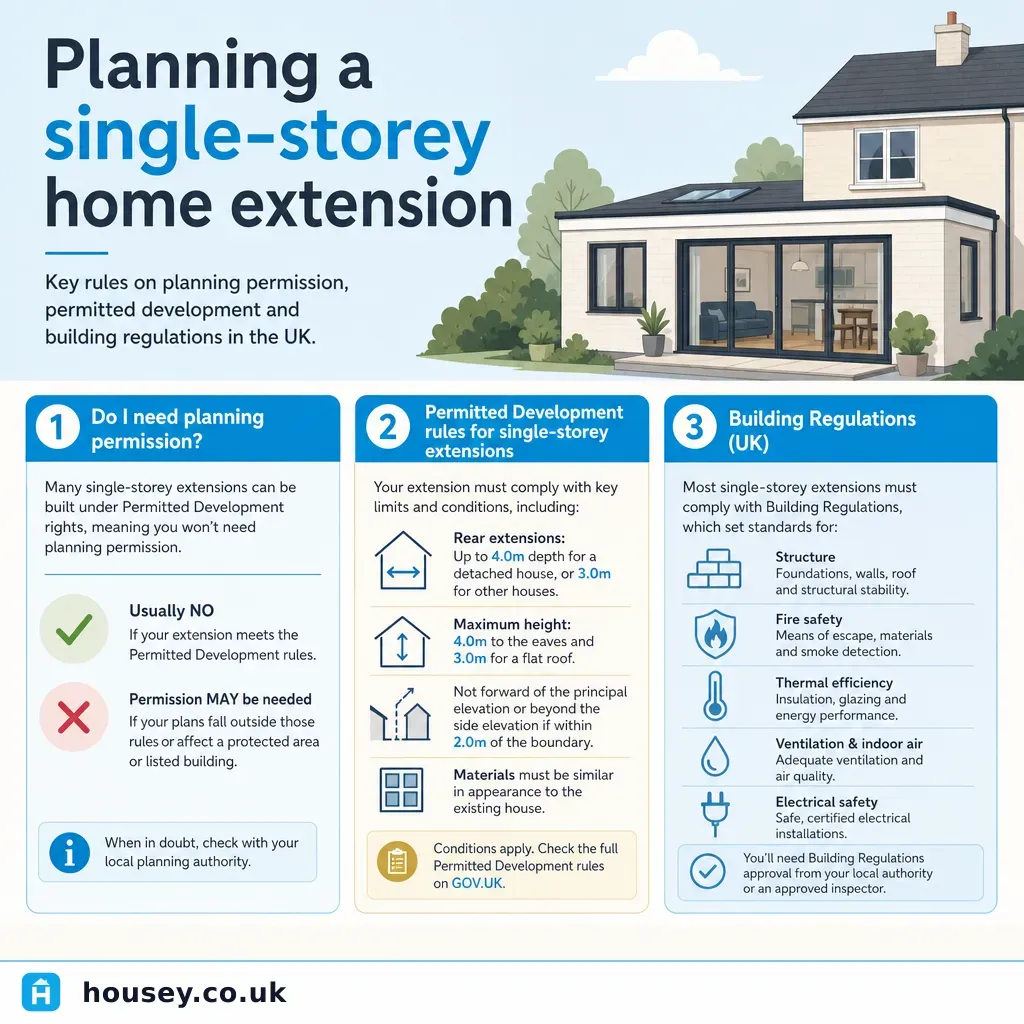
Planning a single-storey home extension
A single-storey extension may fall under permitted development rights, avoiding full planning permission, but only if it meets size, height, and boundary conditions simultaneously.
 Improvement & Build
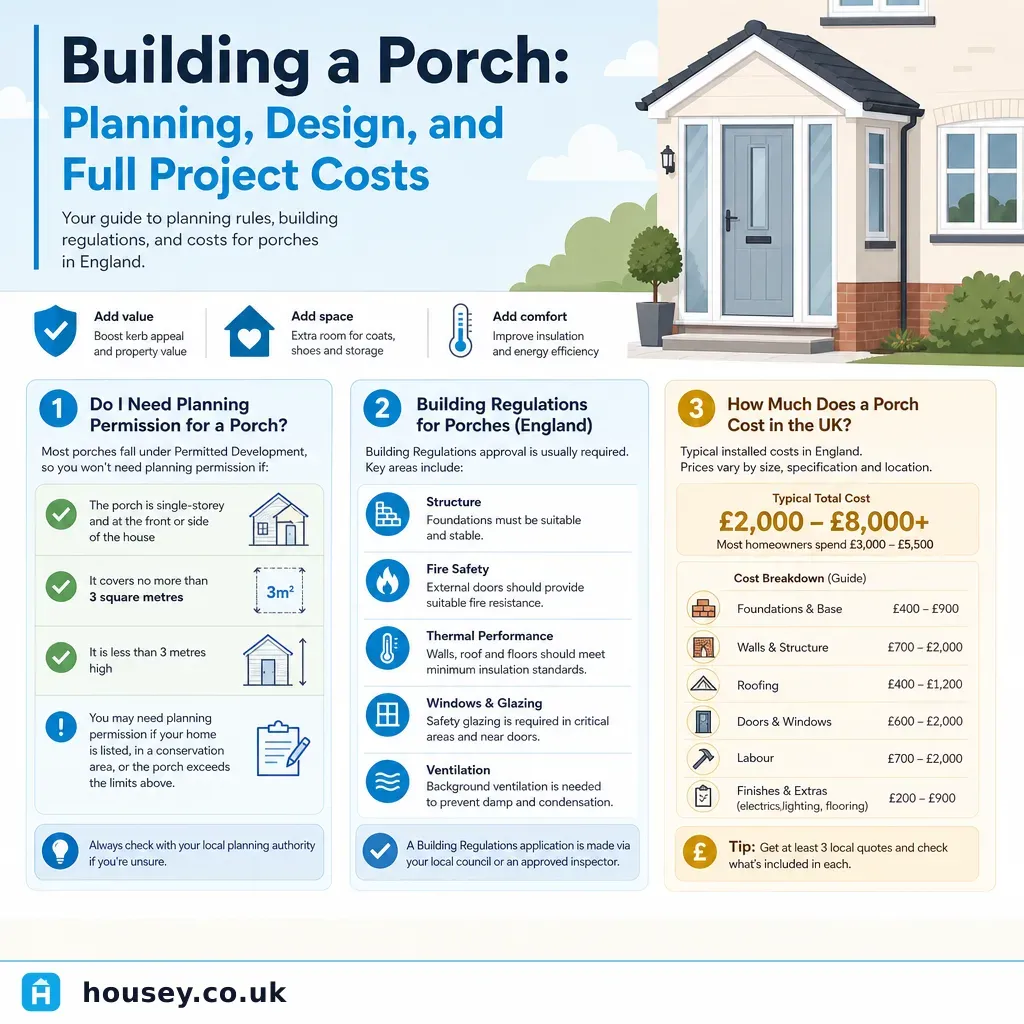
Building a Porch: Planning, Design, and Full Project Costs
Most porches with an external floor area of 3m² or less can be built without planning permission in England under permitted development rights, but building regulations approval is almost always required.
 Improvement & Build
Window Replacement Fundamentals: Standards and Best Practice for UK Properties
Replacement windows in England must achieve a whole-window U-value of 1.
 Improvement & Build
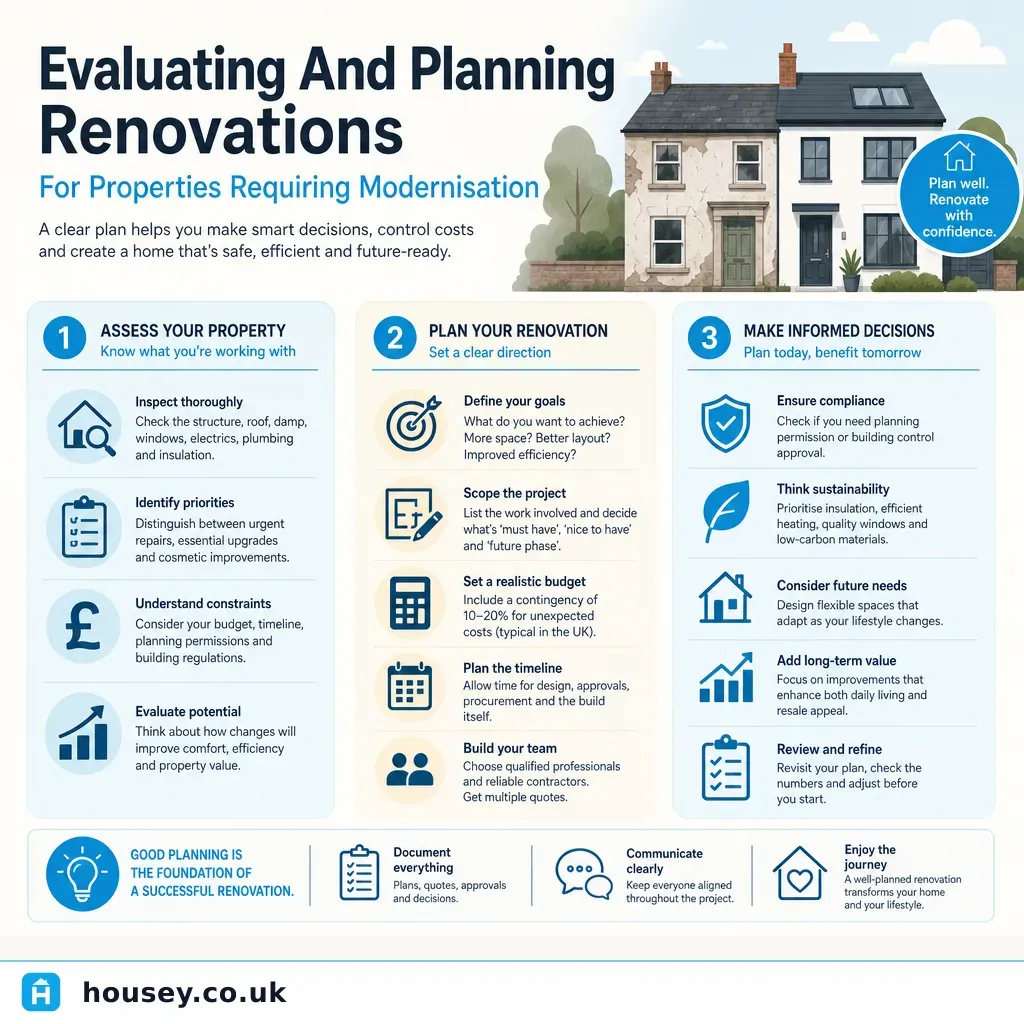
Evaluating And Planning Renovations For Properties Requiring Modernisation
Start by commissioning a condition survey — RICS Level 3 for pre-1919 properties — to identify structural defects, damp, and services issues before finalising a budget.