Planning a single-storey home extension
By Housey · Last reviewed 19th of May 2026
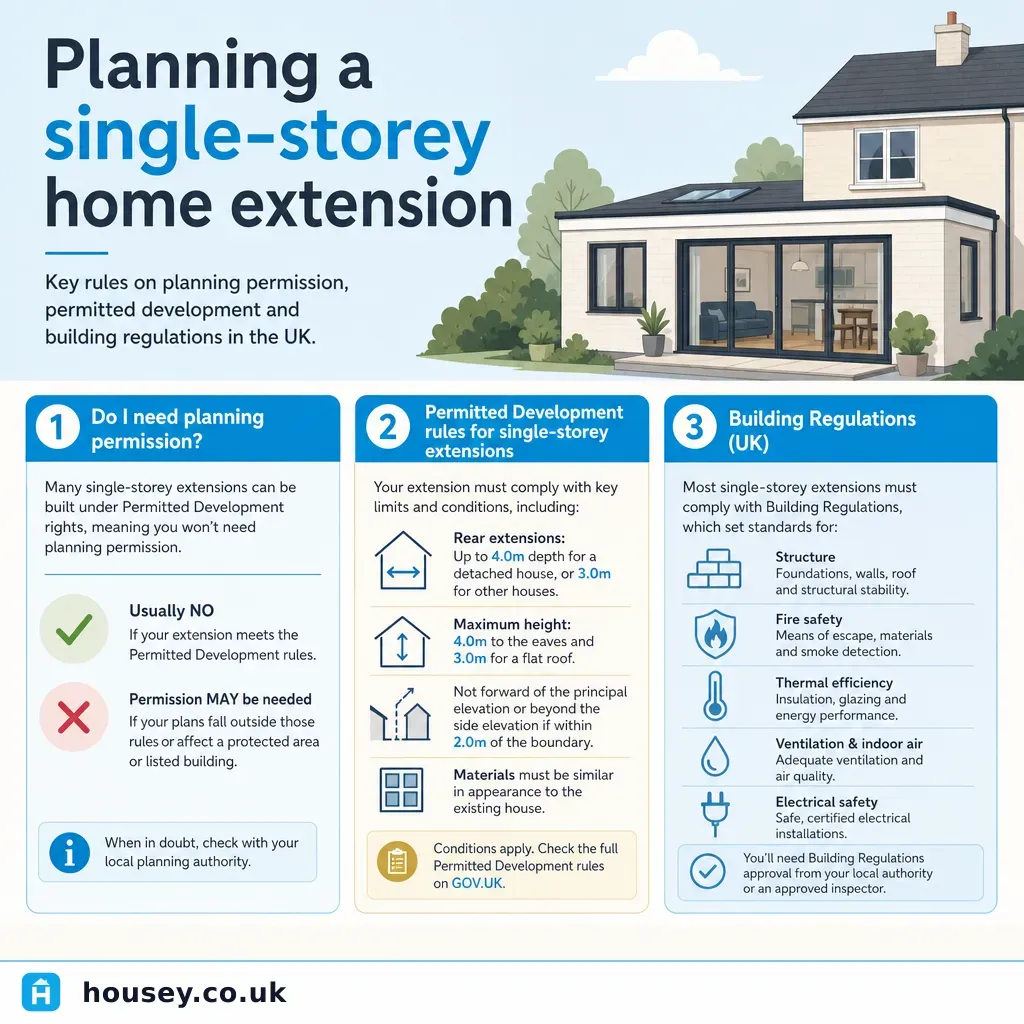
Planning a single-storey home extension
Adding a single-storey extension is one of the most common ways UK homeowners create extra living space — whether that is a larger kitchen-diner, a utility room, or a ground-floor bedroom. Getting the planning and building regulations process right from the start determines whether your project runs smoothly or encounters costly delays, and the rules vary considerably depending on your property type, location, and the size and design of the extension.
Key points
- Permitted development rights allow most single-storey rear extensions up to 3 m deep for terraced and semi-detached homes, and up to 4 m for detached houses, without a full planning application — provided all conditions are met simultaneously.
- The Neighbour Consultation Scheme (prior approval) extends those thresholds to 6 m and 8 m respectively if no neighbour raises a valid objection within 42 days of notification.
- Building regulations approval is always required for any extension, regardless of permitted development status — covering structure (Part A), energy efficiency (Part L), fire safety (Part B), and drainage (Part H).
- A Certificate of Lawful Development (CLD) from your local planning authority creates a legal record that works were lawful under permitted development; solicitors will typically request this on a future sale.
- Conservation area properties, listed buildings, and flats are generally excluded from standard permitted development rights and require a full planning application.
Do you need planning permission?
Permitted development (PD) rights remove the need for a full planning application for many single-storey extensions, but all relevant conditions must be met at the same time.
Standard permitted development conditions for a single-storey rear extension
- Maximum depth: 3 m for a terraced or semi-detached house; 4 m for a detached house.
- Maximum eaves height: 3 m where the extension falls within 2 m of a boundary.
- Overall maximum height: 4 m.
- The extension must not project forward of the principal elevation (the front of the house).
- Materials must be similar in appearance to the existing dwelling.
- No verandas, raised platforms, or balconies are permitted under PD.
The Neighbour Consultation Scheme (prior approval)
Under this route, extensions up to 6 m deep (semi-detached and terraced) or 8 m (detached) may proceed without a full planning application, provided:
- You notify your local planning authority (LPA) and directly adjoining neighbours.
- No neighbour raises a valid objection within 42 days.
- The LPA confirms prior approval is not required, or grants prior approval.
If your property is in a conservation area, an Article 4 direction area, or is listed, permitted development rights are usually removed or significantly restricted. Always check with your LPA before starting any design work.
Choosing between routes
Route | Best for | Not ideal for | Typical timeframe | Main risk if wrong |
|---|---|---|---|---|
Permitted development (standard) | Extensions within depth thresholds on conventional sites | Conservation areas, listed buildings, flats | No formal wait; CLD recommended | Enforcement notice; costly retrospective application |
Prior approval (Neighbour Consultation Scheme) | Extensions 3–6 m (semi/terraced) or 4–8 m (detached) | Sites with objecting neighbours or sensitive settings | 42-day consultation period | Refusal if valid objection upheld; must reduce size or reapply |
Full planning permission | Unusual designs, side extensions, listed buildings, conservation areas | Time-sensitive projects | 8 weeks (standard); 13 weeks (major) | Refusal; design or materials conditions imposed |
Even if you are confident the works fall within permitted development, applying for a Certificate of Lawful Development creates a legal record your solicitor will need when you sell.
Building regulations: always required
Planning permission and building regulations are entirely separate processes. Building regulations approval is needed for any extension, covering:
- Structure (Part A): foundations, walls, beams, and lintels — a structural engineer's calculations are typically required.
- Fire safety (Part B): escape routes and fire-stopping where the extension affects the existing layout.
- Energy efficiency (Part L): new walls, roofs, floors, and windows must meet current Approved Document L standards. New external walls should typically achieve a U-value of no worse than 0.18 W/m²K (check the current Approved Document L for the figures applicable to your project).
- Drainage (Part H): connection to existing drainage where applicable.
- Ventilation (Part F) and electrical work (Part P): where the extension includes these elements.
You can use a local authority building control service or a Registered Building Control Approver (updated terminology under the Building Safety Act 2022). Either way, submit a full plans application before construction starts and arrange site inspections at key stages.
What does a single-storey extension cost?
Indicative UK costs, last reviewed 2026-05-19. Quotes vary by region, specification, and site conditions.
Element | Indicative range |
|---|---|
Architect or architectural designer fees | £2,000–£8,000+ |
Householder planning application fee (England, 2026) | £258 |
Certificate of Lawful Development fee | Varies by LPA; typically £103–£206 |
Structural engineer | £500–£2,000 |
Building control fee | £500–£1,500 |
Build cost per m² (labour and materials) | £1,800–£3,500+ (higher in London and the South East) |
Party wall surveyor (if required) | £700–£2,500 per surveyor |
Always request at least three itemised written quotes from builders, confirm whether VAT is included, and ask what is excluded from the groundworks allowance.
Decision tree: which route is right for you?
- Is your property a flat? Permitted development does not apply to flats; full planning permission is required.
- Is your property listed? Listed building consent is required in addition to planning permission; contact your LPA before any design work begins.
- Is your property in a conservation area or Article 4 direction area? Check with your LPA — permitted development rights may be removed or restricted.
- Is the proposed extension at the rear and within the standard depth threshold (3 m for semi/terraced; 4 m for detached)? The extension is likely within permitted development; apply for a CLD to confirm this legally.
- Is the extension 3–6 m deep (semi/terraced) or 4–8 m (detached)? Consider the Neighbour Consultation Scheme and notify your LPA.
- Does the extension exceed 8 m in depth, extend to the side, affect the front elevation, or involve an unusual design? Full planning permission is required.
- Does the work affect or fall within 3 m of a shared wall, boundary wall, or neighbouring foundation? A party wall agreement under the Party Wall etc. Act 1996 is required, regardless of the planning route.
What to expect: project timeline
- Design and feasibility (weeks 1–8): Appoint an architect or architectural designer; agree the brief; produce planning drawings.
- Pre-application advice (optional, 2–4 weeks): Submit a pre-app enquiry to your LPA for early guidance on complex or boundary-sensitive schemes.
- Planning or prior approval (0–13 weeks): Submit your application; await the decision.
- Building regulations (ongoing from before start): Submit full plans; receive approval before construction begins.
- Party wall process (2–8 weeks): Serve notice on neighbours and allow time for agreement or a party wall award.
- Tender and contractor appointment (4–6 weeks): Obtain quotes; sign a written contract — a JCT Minor Works contract is recommended for extensions over £20,000.
- Construction (8–20 weeks typically): Varies by size, specification, and site conditions.
- Completion: Obtain the building regulations completion certificate before the extension is occupied.
Important limitations
This article provides general information about planning and building regulations for single-storey extensions in England. Rules differ in Wales, Scotland, and Northern Ireland. Permitted development thresholds, local Article 4 directions, and building regulations details can vary by property type and local planning authority. Confirm the position with your LPA and consult qualified professionals before committing to a design or starting any work. This article does not constitute planning or legal advice.
What to ask a qualified professional
Before appointing an architect, planning consultant, or builder:
- Does this extension fall within permitted development, and do you recommend applying for a Certificate of Lawful Development?
- Are there any Article 4 directions, conservation area restrictions, or listed building constraints that affect my property?
- Will a party wall notice need to be served? Can you advise on the process and the likely timeline?
- What building regulations will apply, and who will act as the Registered Building Control Approver?
- What structural engineer input is needed, and can you coordinate that appointment?
- What professional qualifications and indemnity insurance do you hold?
- Can you provide references from similar extension projects completed in the past two years?
When to get professional help
Appoint an architect or architectural designer before approaching builders — not after you have received a sketch from a contractor. Seek specialist professional advice if:
- Your property is listed, in a conservation area, or subject to an Article 4 direction.
- The extension is close to a boundary, a shared wall, or existing drainage runs.
- You are planning to remove or open up a load-bearing wall as part of the works.
- You receive a planning objection or a neighbour declines to engage with the party wall process.
- Building control raises concerns about structural calculations or energy performance values.
How Housey can help
Housey connects you with vetted extension builders, architects and architectural designers, planning consultants, and building control consultants who can guide you from initial feasibility through to your building regulations completion certificate.
Frequently asked questions
Do I need planning permission for a single-storey rear extension?
Not always. Many single-storey rear extensions fall under permitted development rights, meaning no planning application is needed, provided the extension meets all relevant size, height, and boundary conditions. Applying for a Certificate of Lawful Development is strongly recommended to confirm this legally, and building regulations approval is always required separately regardless of planning status.
What is the maximum size for a permitted development extension?
Under standard permitted development, the maximum depth is 3 m for terraced and semi-detached houses, or 4 m for detached houses. Under the Neighbour Consultation Scheme (prior approval), these limits extend to 6 m and 8 m respectively, subject to no valid neighbour objection being raised within the 42-day consultation period.
How long does a single-storey extension take from start to finish?
Typically 6 to 18 months from appointing an architect to receiving the building regulations completion certificate, depending on the planning route, design complexity, contractor availability, and site conditions. More straightforward schemes within permitted development limits, without party wall complications, will usually sit at the lower end of this range.
Do I need a structural engineer for an extension?
In most cases, yes. Building control will require structural calculations to demonstrate that foundations, walls, beams, and lintels are adequate for the proposed extension. Your architect or building control officer can advise on the level of structural input needed. A structural engineer typically prepares these calculations before building regulations approval is granted.
Can I build an extension without an architect?
You can appoint an architectural designer or architectural technician rather than a chartered architect, and some builders offer design-and-build packages. However, professional design input is strongly recommended to navigate planning rules, optimise the layout, and ensure building regulations compliance. Check the designer's qualifications and professional indemnity insurance before appointing them.
Sources and further reading
Useful next reads
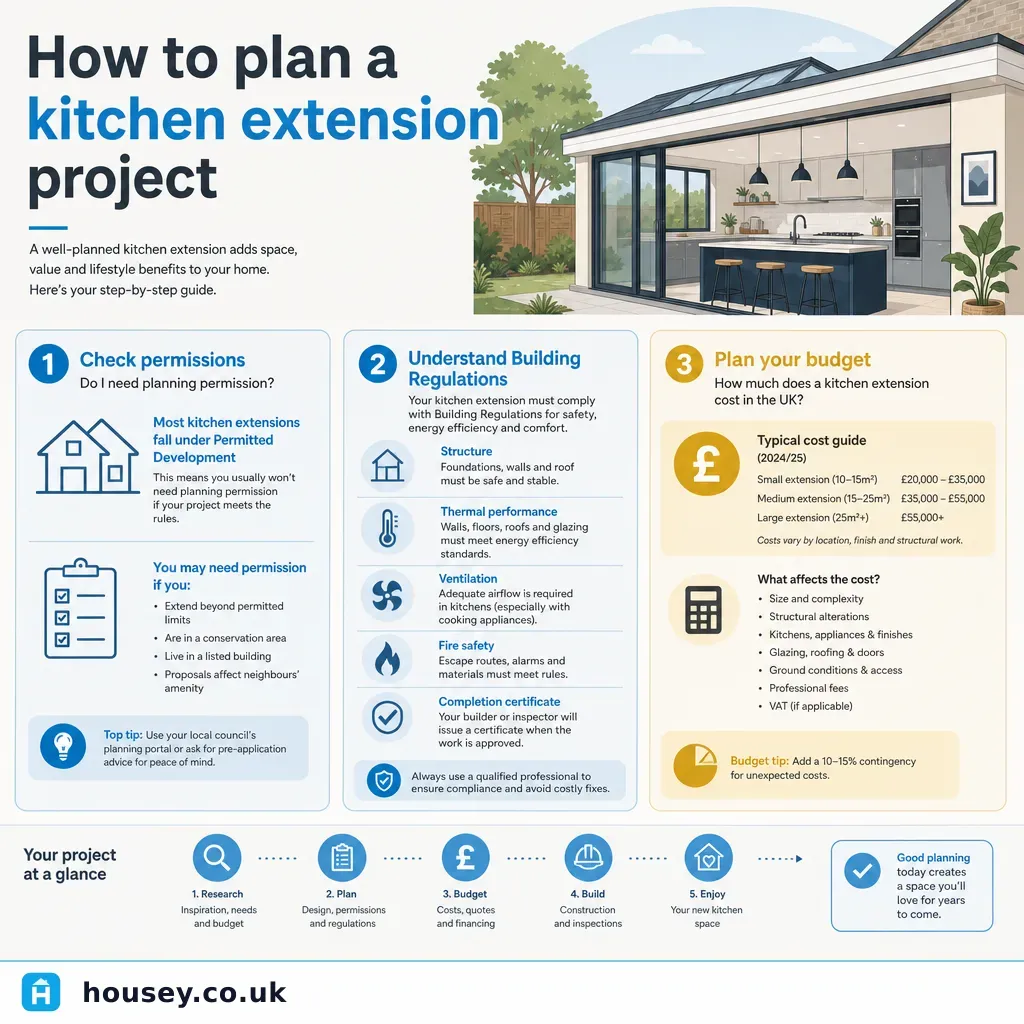 Improvement & Build
How to plan a kitchen extension project
Planning a kitchen extension means checking whether permitted development or planning permission applies, appointing an architect for drawings, obtaining Building Regulations approval, and commissioning a structural engineer for any wall removals.
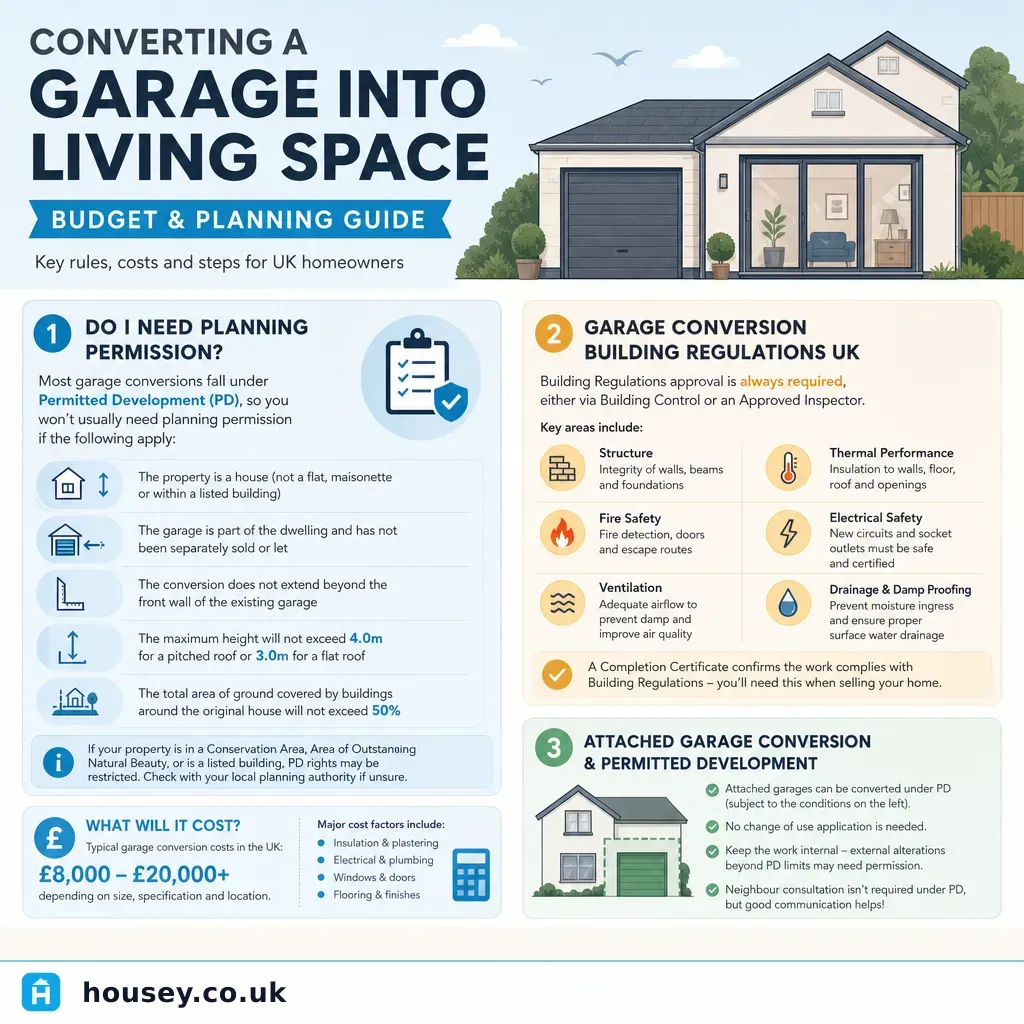 Improvement & Build
Converting a Garage into Living Space: Budget and Planning Guide
A single-garage conversion typically costs £8,000–£20,000 in the UK.
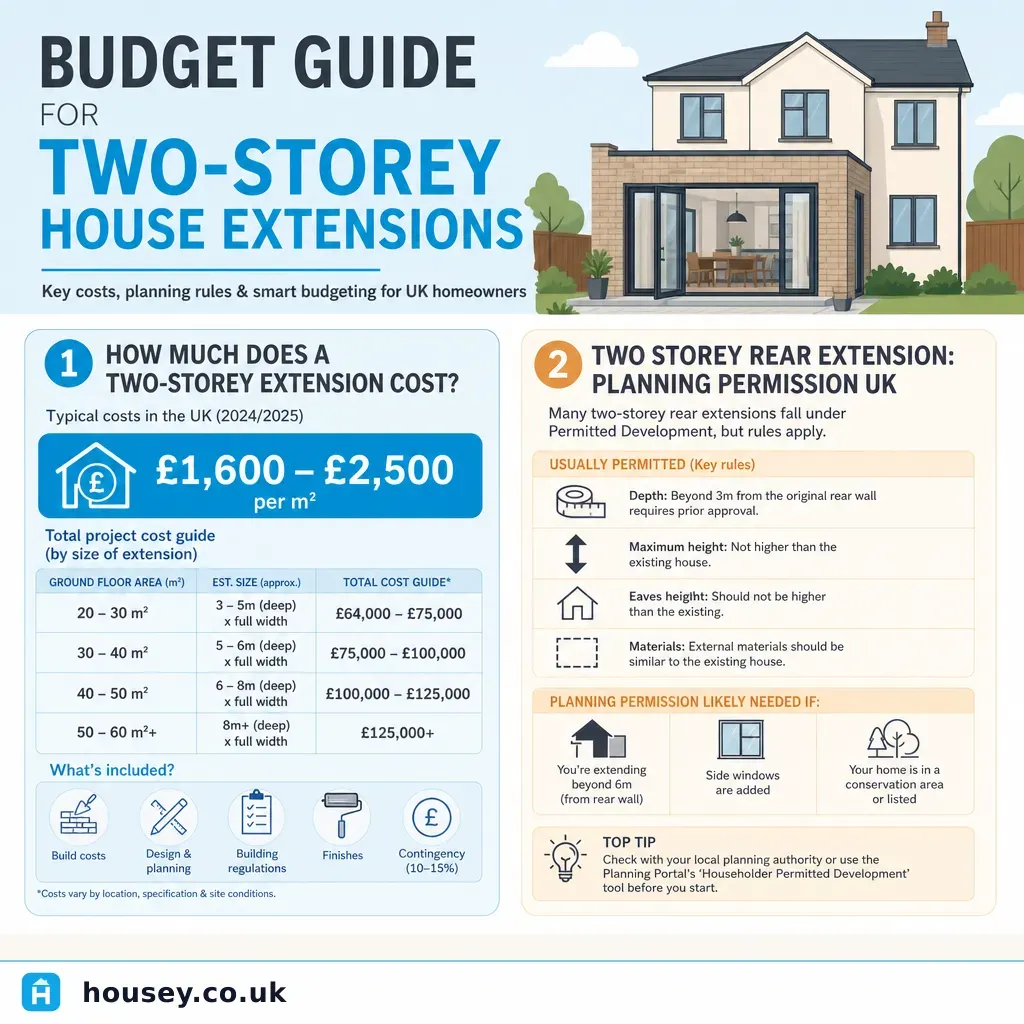 Improvement & Build
Budget Guide for Two-Storey House Extensions
A two-storey house extension in the UK typically costs £1,800–£3,000+ per square metre for the build alone.
 Improvement & Build
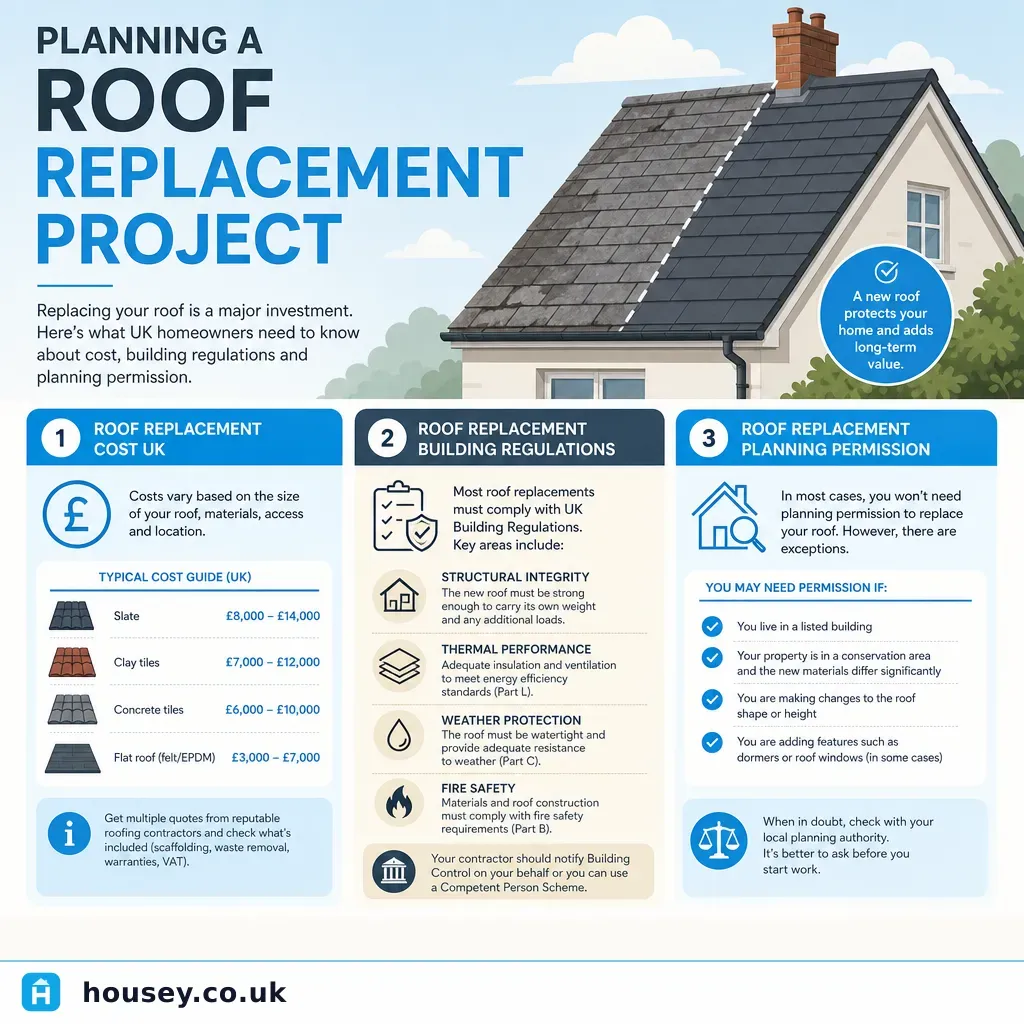
Planning a Roof Replacement Project
A roof replacement project involves stripping the existing covering, renewing the sarking felt and battens, and laying new tiles, slates, or a flat-roof membrane.
 Improvement & Build
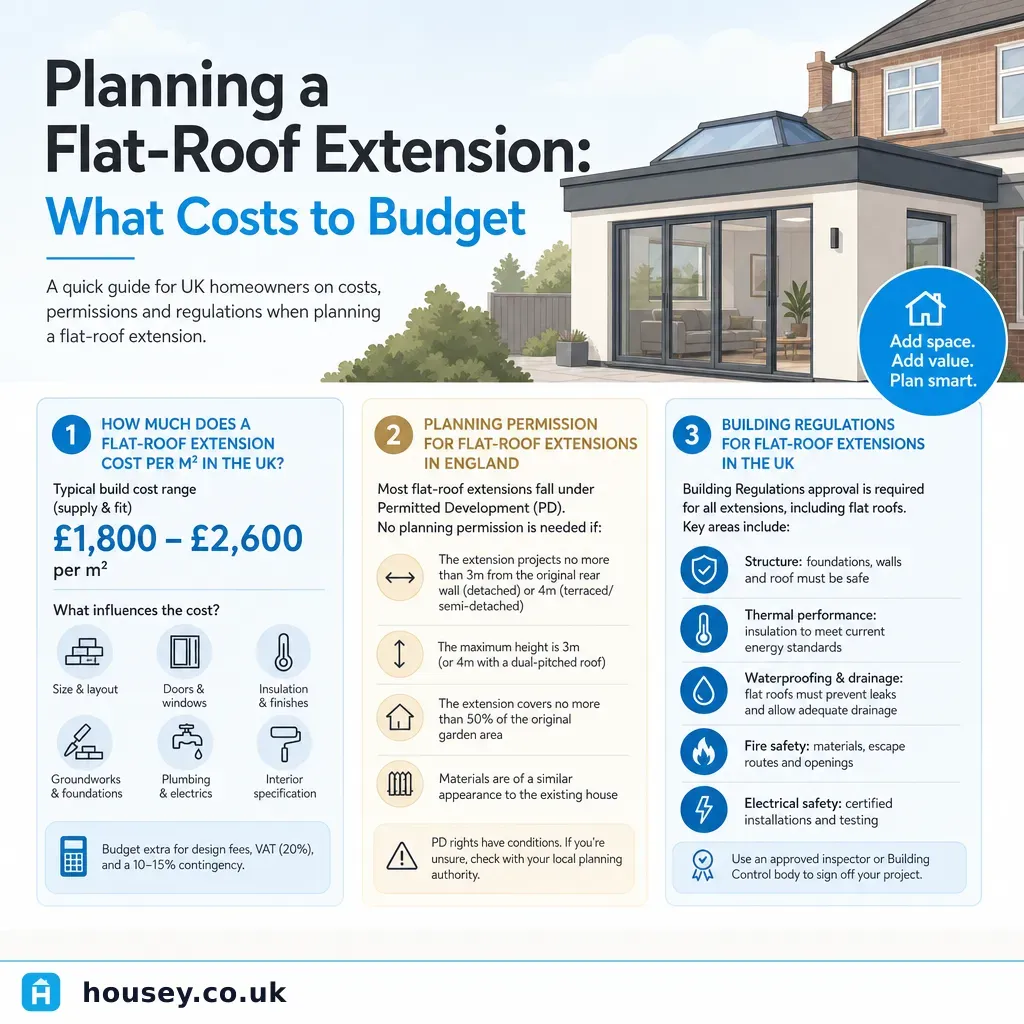
Planning a Flat-Roof Extension: What Costs to Budget
A flat-roof single-storey extension typically costs £1,500–£3,000 per m² in the UK, depending on size, specification, location, and roof membrane choice.