Window Replacement Fundamentals: Standards and Best Practice for UK Properties
By Housey · Last reviewed 1st of June 2026

Window Replacement Fundamentals: Standards and Best Practice for UK Properties
Replacing windows is one of the most common home improvement projects across the UK, yet it sits at an intersection of building regulations, planning law, and consumer protection. Whether you are swapping draughty single-glazed sashes in a Victorian terrace or upgrading failed double-glazed units in a 1990s semi, understanding the compliance requirements before work begins can prevent costly problems — and potential delays — when you come to sell.
Key points
- In England, replacement windows must achieve a whole-window U-value of no more than 1.4 W/m²K under the 2021 edition of Approved Document L (Conservation of Fuel and Power).
- Work must be either self-certified by a FENSA- or CERTASS-registered installer, or formally notified to and signed off by local authority building control — there is no third option.
- Properties in conservation areas, Article 4 Direction zones, or World Heritage Sites may require planning permission even for like-for-like window replacements.
- Listed buildings require Listed Building Consent for any window changes; different thermal performance exemptions may be agreed with the local planning authority.
- You should receive a compliance certificate (commonly called a FENSA certificate) within 30 days of completion — without it, you may face difficulties at the point of sale.
What building regulations apply to window replacement?
Replacing a window in a domestic property in England is classified as a "controlled fitting" under the Building Regulations 2010. This means the replacement unit must comply with Approved Document L — Conservation of Fuel and Power. The current requirement for England (2021 edition) specifies:
- Whole-window U-value: no greater than 1.4 W/m²K (lower values indicate better thermal performance)
- Centre-pane U-value: typically 1.0–1.2 W/m²K depending on glazing specification
- Window Energy Rating (WER): minimum Band C under the British Fenestration Rating Council (BFRC) scheme, as an alternative compliance route
These requirements apply regardless of whether you are replacing like-for-like (swapping a failed double-glazed unit for a new double-glazed unit) or changing style entirely (replacing casements with tilt-and-turn units).
Regional variation: Wales uses its own version of Part L; Scotland applies Section 6 of the Building Standards Technical Handbooks; Northern Ireland uses Technical Booklet F. If you are outside England, check the current thresholds with your local authority or a competent installer in your region, as requirements may differ.
Windows must also carry UKCA marking, confirming they meet EN 14351-1 — the product standard for windows and external pedestrian doors. This is separate from, but complementary to, Building Regulations compliance.
FENSA, CERTASS, and building control: how compliance is certified
Rather than requiring a local authority inspection for every window replacement, the government authorises Competent Person Schemes (CPS) whose registered members can self-certify that their work complies with Building Regulations. The two principal schemes for window installation are:
- FENSA (Fenestration Self-Assessment Scheme): the largest scheme, covering window and door replacement in England and Wales.
- CERTASS: an alternative competent person scheme for the glazing industry.
When a registered installer completes your window replacement, they submit a notification to their scheme, which registers the installation with the local authority and issues a compliance certificate. This should arrive within 30 days of completion.
If your installer is not registered with a competent person scheme, they — or you — must submit a building notice to the local authority building control department before work begins. The local authority will charge a fee and carry out an inspection. This route is sometimes used for unusual window types, heritage repair, or installers who work infrequently on domestic projects.
Always verify your installer's registration before work starts at fensa.org.uk or certass.co.uk.
Do replacement windows need planning permission?
For most homes, replacing windows is permitted development under the Town and Country Planning (General Permitted Development) (England) Order 2015 — you do not need to submit a planning application. However, there are important exceptions depending on your property's designation.
Which compliance route applies to your situation?
- Permitted development (no planning application needed): residential property not in a designated area; replacement windows broadly similar in appearance to originals; no enlargement of openings.
- Planning permission may be required: property in a conservation area, World Heritage Site, or subject to an Article 4 Direction removing permitted development rights for windows or external alterations.
- Listed Building Consent required (in addition to any planning permission): any property listed at Grade I, II*, or II; applies across all four nations and covers both external and internal alterations visible from outside.
- Check with your Local Planning Authority (LPA): if you are unsure of your property's designation, or plan to change the appearance significantly — new materials, enlarged openings, or a change of style in a sensitive area.
Conservation area rules vary considerably between councils. Some permit like-for-like timber replacement in timber; others require slim-profile replacements in specific materials. Contact your LPA before specifying materials if your property is in a designated area.
Homeowner checklist: before and after installation
Use this checklist to ensure your window replacement proceeds compliantly and without surprises.
Before installation
After installation
Trickle vents: an easy compliance detail to miss
Approved Document F (Ventilation) requires that where existing windows included background ventilators (trickle vents), replacement windows must also incorporate them. Installing new windows without trickle vents in this situation is a building regulations non-compliance — even if the glazing specification is otherwise fully correct.
This catches homeowners off guard particularly when upgrading from older double-glazed units (many of which had trickle vents) to new units quoted without them. Always ask your installer explicitly whether the replacement windows include trickle vents, and request written confirmation that the ventilation provision complies with Approved Document F.
Red flags to watch for
The following signs should prompt you to pause and ask questions before proceeding or making any further payment:
- No written quotation specifying product U-values, frame material, glazing specification, and scope of work.
- Pressure to proceed quickly before a full survey has taken place, or requests for a large upfront deposit before work is scheduled.
- Installer claims building regulations do not apply to window replacements — they do in the great majority of domestic situations.
- No mention of a FENSA certificate or how compliance will be certified after completion.
- Significant cracking or movement around existing openings — this may indicate a structural issue (failed lintel, subsidence, thermal movement in masonry) that needs investigation before new windows are fitted.
- Condensation between panes on existing units is a valid reason to replace, but if new units fail quickly after installation, it may indicate a wider moisture or ventilation problem in the property.
When to get professional help
Most window replacements are routine jobs handled competently by registered installers. However, you should involve a specialist — a chartered architect, conservation specialist, or structural engineer — in the following situations:
- Work on a listed building at any grade — even like-for-like replacements usually require Listed Building Consent and may need Historic England guidance.
- Work in a conservation area where material choice or profile style could lead to planning enforcement.
- New or enlarged window openings requiring a new or upgraded lintel, or involving changes to load-bearing walls — structural calculations will be needed.
- Suspected structural movement around existing frames: cracked or sagging lintels, bowing frames, difficulty opening or closing sashes.
- Whole-house refurbishment where window performance must integrate with a PAS 2035 retrofit plan or EPC improvement target — a Retrofit Coordinator can specify windows within the broader energy model.
How Housey can help
Housey connects you with vetted window and door installers who are registered with FENSA or CERTASS and familiar with UK building regulations compliance — including conservation area requirements. Describe your project, receive comparable quotes from local professionals, and compare glazing specifications, certification arrangements, and aftercare terms before making a decision.
Frequently asked questions
Do I need planning permission to replace windows in my home?
In most cases, no. Replacing windows in a standard residential property in England is permitted development under the Town and Country Planning (General Permitted Development) (England) Order 2015. Exceptions apply if your home is in a conservation area, subject to an Article 4 Direction, or is a listed building — in these cases, planning permission or Listed Building Consent may be required. Check with your local planning authority before starting work.
What is a FENSA certificate and why does it matter?
A FENSA certificate confirms that replacement windows have been installed in compliance with Building Regulations and self-certified by a registered installer. When you sell your home, your conveyancer will request certificates for any controlled fitting work carried out since 2002. Without one, you may need to pay for a retrospective building control inspection or purchase an indemnity insurance policy, both of which can delay exchange.
What U-value must replacement windows achieve in England?
Under the 2021 edition of Approved Document L, replacement windows in existing dwellings in England must achieve a whole-window U-value of no more than 1.4 W/m²K. Alternatively, compliance can be demonstrated via a minimum Window Energy Rating of Band C under the BFRC scheme. Higher-performance windows may improve your property's EPC rating. Requirements differ in Wales, Scotland, and Northern Ireland.
Can I replace windows without a FENSA-registered installer?
Yes, but the compliance route changes. If your installer is not registered with a competent person scheme, a building notice must be submitted to your local authority building control department before work starts. They will charge a fee and carry out an inspection. This route is sometimes used for unusual or heritage window types where specialist craftspeople may not hold scheme registration.
Do new replacement windows need trickle vents?
Where your existing windows included trickle vents (background ventilators), Approved Document F requires that replacement windows also incorporate them. Omitting trickle vents in this situation is a building regulations non-compliance and can cause condensation and air quality problems. Confirm explicitly with your installer that the replacement windows meet the ventilation requirements of Approved Document F.
Sources and further reading
- Approved Document L: Conservation of fuel and power — GOV.UK
- Approved Document F: Ventilation — GOV.UK
- FENSA: Fenestration Self-Assessment Scheme — FENSA
- Competent person schemes for building regulations — GOV.UK
- Planning Portal: Windows, doors and glazing — Planning Portal
- Historic England: Guidance on windows in historic buildings — Historic England
Useful next reads
 Improvement & Build
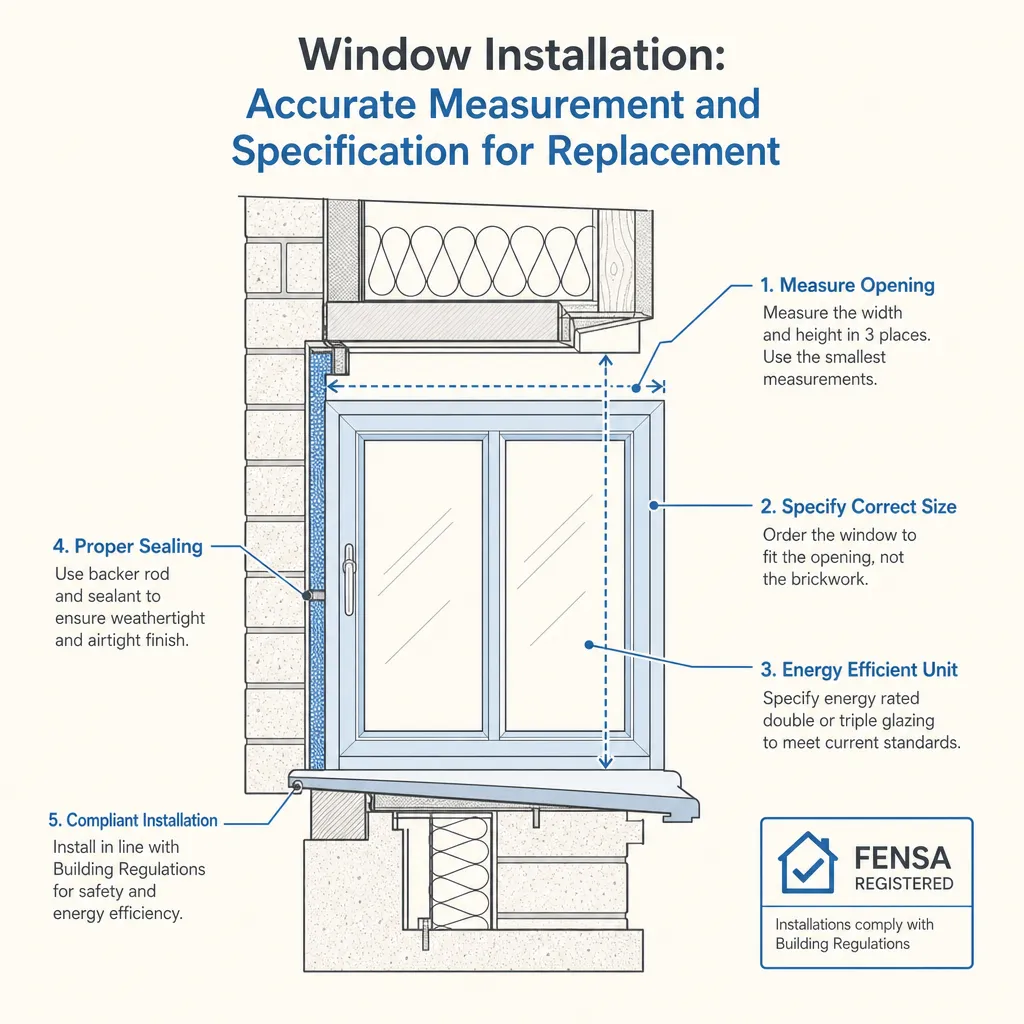
Window Installation: Accurate Measurement and Specification for Replacement
Accurate window measurement for replacement means recording the width and height of the existing frame opening in at least three places, noting the smallest dimension, and providing a full specification to your installer — including frame material, glazing type, opening style, and trickle ventilators.
 Improvement & Build
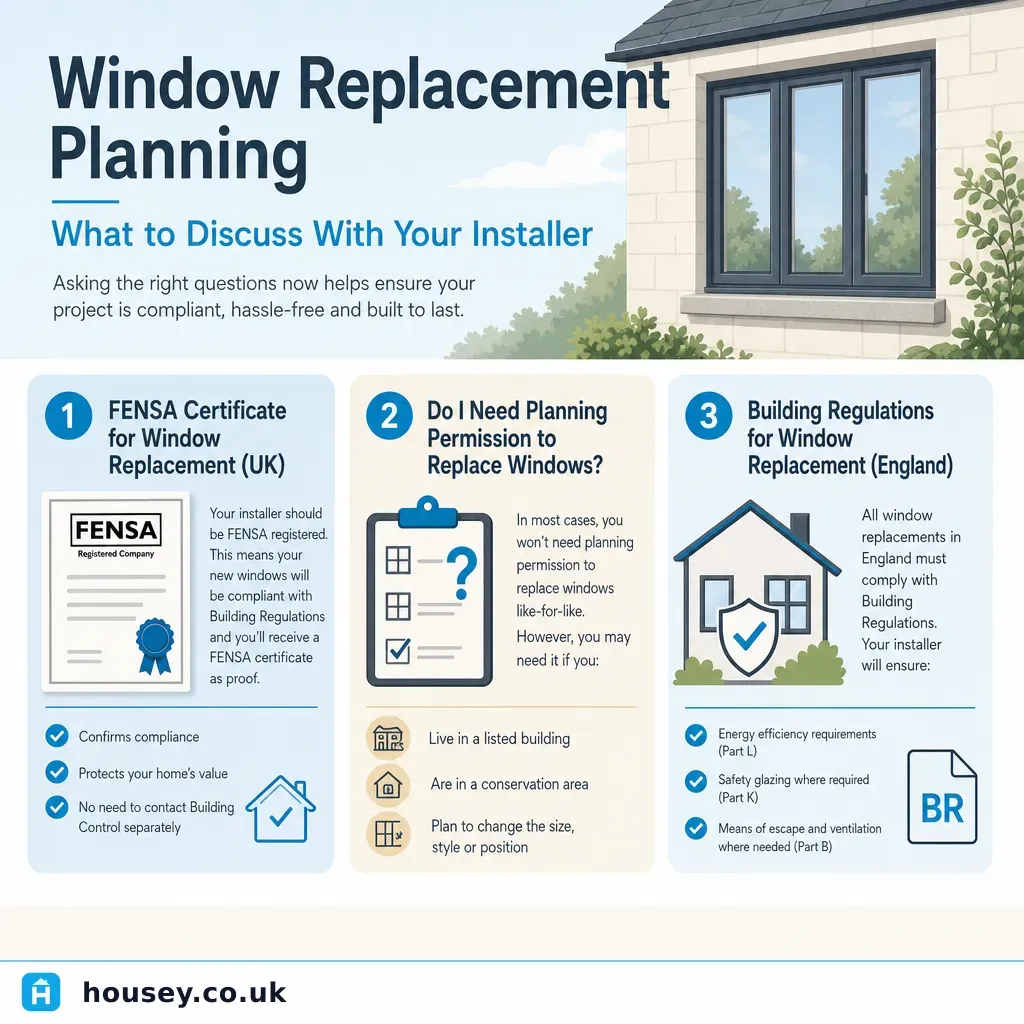
Window Replacement Planning: What to Discuss With Your Installer
Most window replacements in England fall under permitted development rights and do not require planning permission, but they must comply with Building Regulations Part L and Part K.
 Improvement & Build
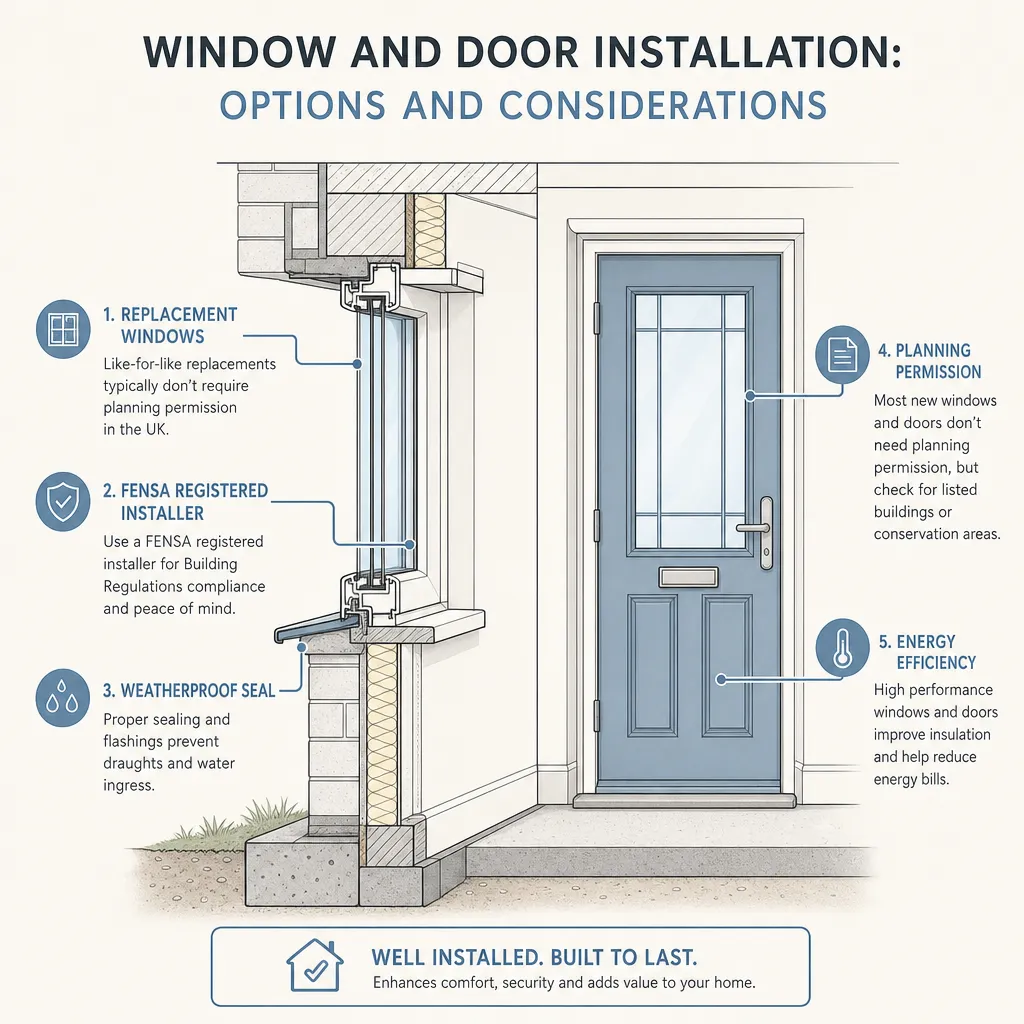
Window and Door Installation: Options and Considerations
Replacing windows and external doors in the UK requires compliance with Building Regulations Part L (thermal performance) and Part K (safety glazing).
 Improvement & Build
Installing Replacement Windows in Your Home
Replacing windows in the UK requires compliance with Building Regulations Part L — a minimum centre-pane U-value of 1.
 Improvement & Build
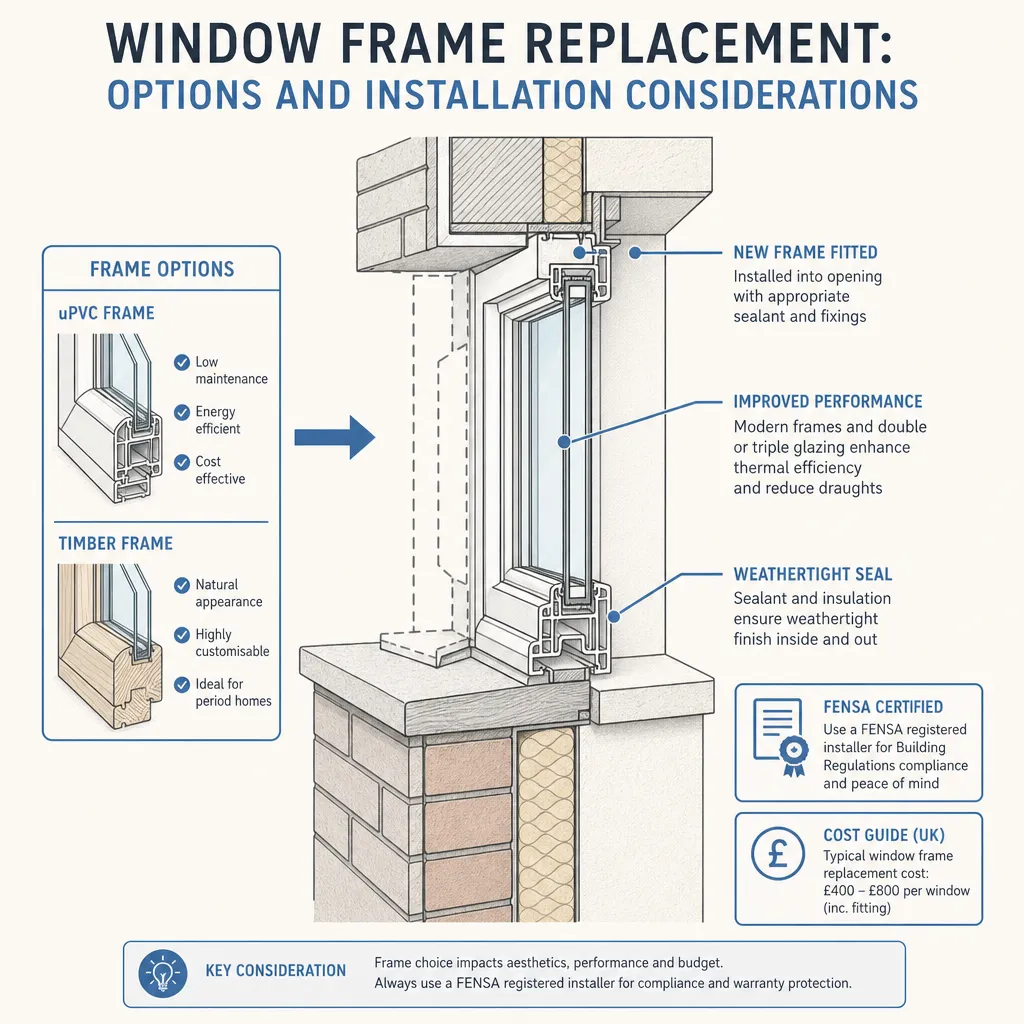
Window Frame Replacement: Options and Installation Considerations
Replacing window frames in the UK requires compliance with Part L of the Building Regulations and, in most cases, a FENSA or Certass certificate.