Converting a Flat Roof to a Pitched Roof: Design and Structure
By Housey · Last reviewed 7th of May 2026
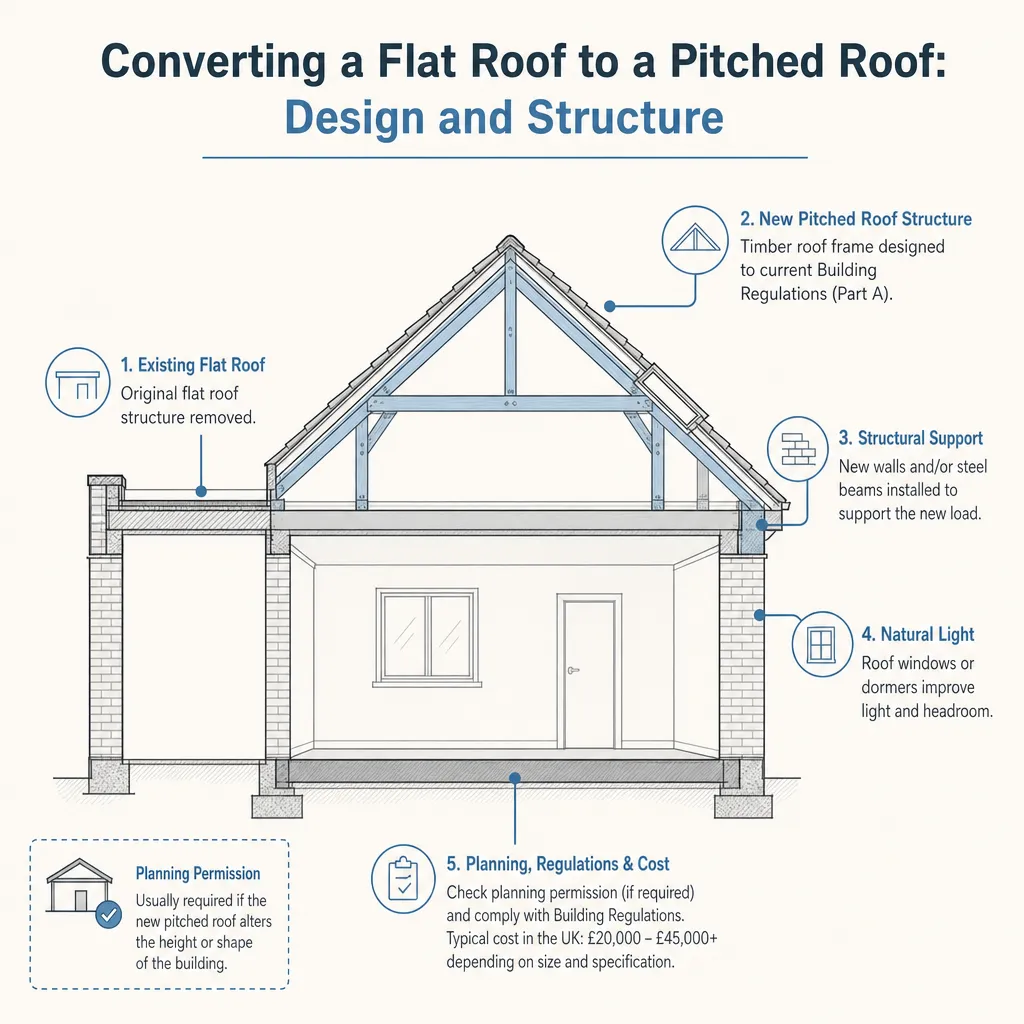
Converting a Flat Roof to a Pitched Roof: Design and Structure
Flat roofs are common on mid-century extensions, post-war houses, and garage roofs across the UK. Most single-ply and felt systems have a design life of 15–25 years, and many are now at or beyond that point. Rather than renewing on a like-for-like basis, some homeowners choose a pitched conversion to improve weathering performance, meet current insulation standards, and bring the building's appearance closer to the main house. This is a significant structural alteration — not a simple re-roofing job — and it involves engineered design, formal Building Regulations approval, and usually planning permission.
Key points
- Building Regulations approval is required under Approved Document A (structure), Part C (moisture), Part L (thermal — target U-value 0.16 W/m²K at ceiling level under the 2021 standard), and Part F (ventilation).
- Planning permission is usually required because converting a flat roof to a pitched roof raises the ridge height — this is not normally permitted development under the Town and Country Planning (General Permitted Development) (England) Order 2015.
- A chartered structural engineer must design the wall plates, rafters, ridge board or beam, and lateral restraint straps at maximum 2m centres to Approved Document A.
- The Party Wall etc. Act 1996 requires written notice to neighbours before starting works affecting a shared wall on semi-detached or terraced properties.
- A building control completion certificate is issued on finishing the works and will be required during future conveyancing.
Why homeowners convert flat roofs to pitched
A flat-to-pitched conversion typically costs more upfront than a like-for-like flat roof replacement, so homeowners usually have clear reasons for proceeding:
- Improved longevity: A well-built tiled or slated pitched roof typically outlasts most flat membrane systems by several decades.
- Lower long-term maintenance: Pitched roofs drain naturally; flat roofs depend on outlets that can block and upstand seals that can fail.
- Better thermal performance: Pitched roofs accommodate insulation to current Part L standards more readily than many flat-roof constructions.
- Aesthetic match: A pitched design often sits more sympathetically alongside the main house, particularly on pre-war properties where a flat-roof extension was added later.
- Potential headroom: A higher pitch can create usable storage or, with additional consents and Part B compliance, habitable space.
Do you need planning permission?
In most cases, yes — or at minimum you should verify carefully before committing to the project.
A flat-to-pitched conversion is not normally covered by permitted development rights because it changes the height and external appearance of the structure. Class A of the Town and Country Planning (General Permitted Development) (England) Order 2015 permits certain roof alterations that do not materially affect the external appearance — but raising the ridge height almost always constitutes a material change.
Decision tree: do you need planning permission?
- The flat roof is on a detached garage or outbuilding → Planning permission is often not required if the structure remains under 2.5m to eaves (or meets the 4m dual-pitch limit for detached outbuildings) and stays within plot permitted development limits. Confirm with your local planning authority first.
- The flat roof is on an extension to the main house → Planning permission is usually required because the ridge height will increase.
- The property is in a conservation area, AONB, or World Heritage Site → Additional restrictions apply. Check with your local planning authority before any works.
- The property is listed → Listed Building Consent is required alongside any planning permission. Do not start work without it.
- The property is a leasehold flat → Freeholder and management company consent is likely needed in addition to planning. Take legal and planning advice before proceeding.
- You are unsure → Apply for a Lawful Development Certificate (LDC) from your local planning authority to obtain written confirmation before spending money on design or contractors.
Do not assume permitted development applies. Enforcement action for unauthorised alterations can require reinstatement at your cost and affect your ability to sell the property.
Building Regulations requirements
Building Regulations approval is required regardless of whether planning permission is also needed. The relevant Approved Documents are:
Approved Document | What it covers for this project |
|---|---|
Part A — Structure | Rafters, ridge board or beam, wall plates, lateral restraint straps |
Part B — Fire Safety | Fire-stopping where new roof meets party walls or fire-resisting elements |
Part C — Moisture Resistance | Sarking membrane, eaves detailing, weatherproofing at abutments |
Part L — Thermal Performance | Insulation U-value: 0.16 W/m²K at ceiling level (2021 standard) |
Part F — Ventilation | Roof void ventilation to prevent condensation in cold-roof construction |
Part H — Drainage | New gutter and downpipe sizing and connection to surface-water drainage |
Appoint a building control body — either local authority building control (LABC) or a Registered Building Control Approver (RBCA) approved by the Building Safety Regulator — before work starts. The completion certificate issued on satisfactory completion is needed for future conveyancing.
Structural design: what is involved
A flat-to-pitched conversion cannot be specified by a roofer alone. The structural elements that must be engineer-designed include:
Wall plates: Treated timber wall plates are fixed to the top of the masonry walls and carry the rafter loads. Depending on the existing construction, the wall may need to be raised or a ring beam installed.
Rafters and ridge: For spans up to around 5m, a ridge board with opposing rafter pairs may suffice. For larger spans or where the geometry creates outward thrust, a structural ridge beam on posts or padstones is required. Sizes are calculated to Approved Document A.
Lateral restraint: Straps tie the rafters back to the masonry at maximum 2m centres, resisting wind uplift. These are mandatory under Approved Document A.
Insulation strategy:
- Cold roof (insulation at ceiling level): simpler to build, but requires a ventilated void above to meet Part F. Target U-value 0.16 W/m²K.
- Warm roof (insulation between and over rafters, no ventilation void): better thermal performance, no condensation risk in the roof void, but higher material cost.
Pitched roof design options
Roof type | Best for | Structural complexity | Common coverings | Key consideration |
|---|---|---|---|---|
Mono-pitch (lean-to) | Single-storey rear extensions | Lower | Tiles, slates, standing-seam metal | Drainage at one eave; often simpler for planning |
Duo-pitch (gable) | Larger extensions, garages | Moderate | Concrete or clay tiles, slates | Structural ridge beam needed for wider spans |
Hipped roof | Matching an existing hipped house | Higher | Tiles, slates | More complex carpentry; hip junctions require careful detailing |
Cat-slide | Where existing roof slopes continue down | Moderate–high | Tiles, slates | Weathering junction with existing roof must be carefully specified |
Drainage changes
A flat roof drains via internal outlets or a parapet gutter. A pitched roof drains via eaves gutters and downpipes, which requires new installation. You will need to:
- Install guttering sized for the catchment area and local rainfall intensity (Approved Document H provides guidance on domestic gutter sizing).
- Route downpipes to a surface-water drain or a soakaway at least 5m from any building foundation.
- Check whether your area uses a combined or separate drainage system — discharging roof water to the foul drain may not be permitted.
Important limitations
This article provides general information about the planning, structural, and Building Regulations considerations involved in converting a flat roof to a pitched roof. It is not a substitute for professional advice specific to your property and local planning authority.
- Planning policy varies between local authorities. An LPA may apply restrictions beyond national permitted development rules.
- Structural requirements depend on the specific building, span, wind exposure zone, and materials. Only a chartered structural engineer can produce a design suitable for Building Regulations submission.
- Party wall matters require formal notice procedures under the Party Wall etc. Act 1996. Consult a party wall surveyor where works affect a shared wall.
- Rules in Scotland, Wales, and Northern Ireland differ from those in England. Seek advice from the relevant devolved authority.
What to ask a qualified professional
Architect or architectural technologist:
- Can you confirm in writing whether planning permission is required for this property and proposed design?
- Will you prepare drawings for both planning submission and Building Regulations?
- What are the implications of the new roof height for neighbouring properties?
Structural engineer:
- What are the correct sizes for rafters, ridge board or beam, and wall plates for this span?
- Will the existing masonry walls support the new structure, or is reinforcement or a ring beam needed?
- What specification will you provide for lateral restraint straps, padstones, and posts?
Building control body:
- Should I use a full plans application or a building notice?
- What staged inspections will be required?
- What documents are needed for the completion certificate?
Roofer:
- Are you a member of the National Federation of Roofing Contractors (NFRC)?
- What roofing system do you recommend, and what is its expected design life?
- What warranty do you provide on the covering and on your installation?
- How will you weatherproof the junction with any existing roof structure?
When to get professional help
A flat-to-pitched roof conversion always requires a team of professionals. Red flags that mean you must pause and seek advice immediately:
- Any contractor who offers to carry out the conversion without structural engineer drawings or Building Regulations approval.
- Signs of existing structural movement in the walls below the flat roof — cracks, leaning, or displaced masonry.
- Discovery that the flat roof serves as a terrace or is load-bearing for another element of the building.
- A neighbour objecting or serving a counter-notice under the Party Wall etc. Act 1996 before an agreed award is in place.
Engage a structural engineer for design calculations, an architect or architectural technologist for planning and building regulations drawings, a qualified roofer (NFRC member preferred) for installation, and a building control body for inspection and certification. Where works affect a party wall, appoint a party wall surveyor before starting.
How Housey can help
Housey connects UK homeowners with qualified professionals for roof conversion projects. Request quotes from experienced roofers for covering and installation, structural engineers for design calculations and Building Regulations specifications, and building control consultants to manage the approvals process from submission through to completion certificate.
Frequently asked questions
Does a flat-to-pitched roof conversion always need planning permission?
Not always, but it usually does when the conversion raises the ridge height or materially changes the building's appearance. On detached outbuildings within permitted development limits, consent may not be required — but rules depend on the plot, local authority, and prior consents. Always verify with your local planning authority or apply for a Lawful Development Certificate before starting work.
How much does it cost to convert a flat roof to a pitched roof in the UK?
Costs vary widely depending on roof size, design, structural requirements, covering choice, and regional labour rates. A simple mono-pitch conversion on a small extension may start from around £8,000–£15,000 including structure, covering, and Building Regulations. Larger or more complex projects could cost £20,000 or more. Indicative UK costs, last reviewed 2026-05-07. Obtain at least three itemised quotes.
How long does a flat-to-pitched roof conversion take from start to finish?
On-site works for a small to medium conversion typically take 2–4 weeks once approvals are in place. Allow additional time for design (2–6 weeks), planning permission if required (8 weeks from validation in England), and Building Regulations full plans approval (5–8 weeks). The full programme from first decision to completion is often 4–6 months.
Will the conversion affect my neighbours under the Party Wall Act?
Potentially. If you share a wall with a neighbour — as in a semi-detached or terraced property — the Party Wall etc. Act 1996 requires written notice before starting work affecting or adjacent to the party wall. Even where the Act does not strictly apply, informing neighbours of the planned change in roof height is good practice and can help avoid disputes.
Can I add roof windows to the new pitched roof?
Yes — a pitched roof makes it straightforward to incorporate roof windows such as VELUX-style units. Any roof window must comply with Approved Document L (thermal performance) and Approved Document B (fire egress in some situations). If planning permission is required for the conversion, roof window positions should be shown on the planning drawings. Conservation areas may restrict windows on front elevations.
Sources and further reading
- Planning permission: when you need it — GOV.UK
- The Town and Country Planning (General Permitted Development) (England) Order 2015 — legislation.gov.uk
- Approved Document A: Structure — MHCLG / GOV.UK
- Approved Document L: Conservation of Fuel and Power (2021) — MHCLG / GOV.UK
- Party Wall etc. Act 1996 — legislation.gov.uk
- National Federation of Roofing Contractors — NFRC
Useful next reads
 Improvement & Build
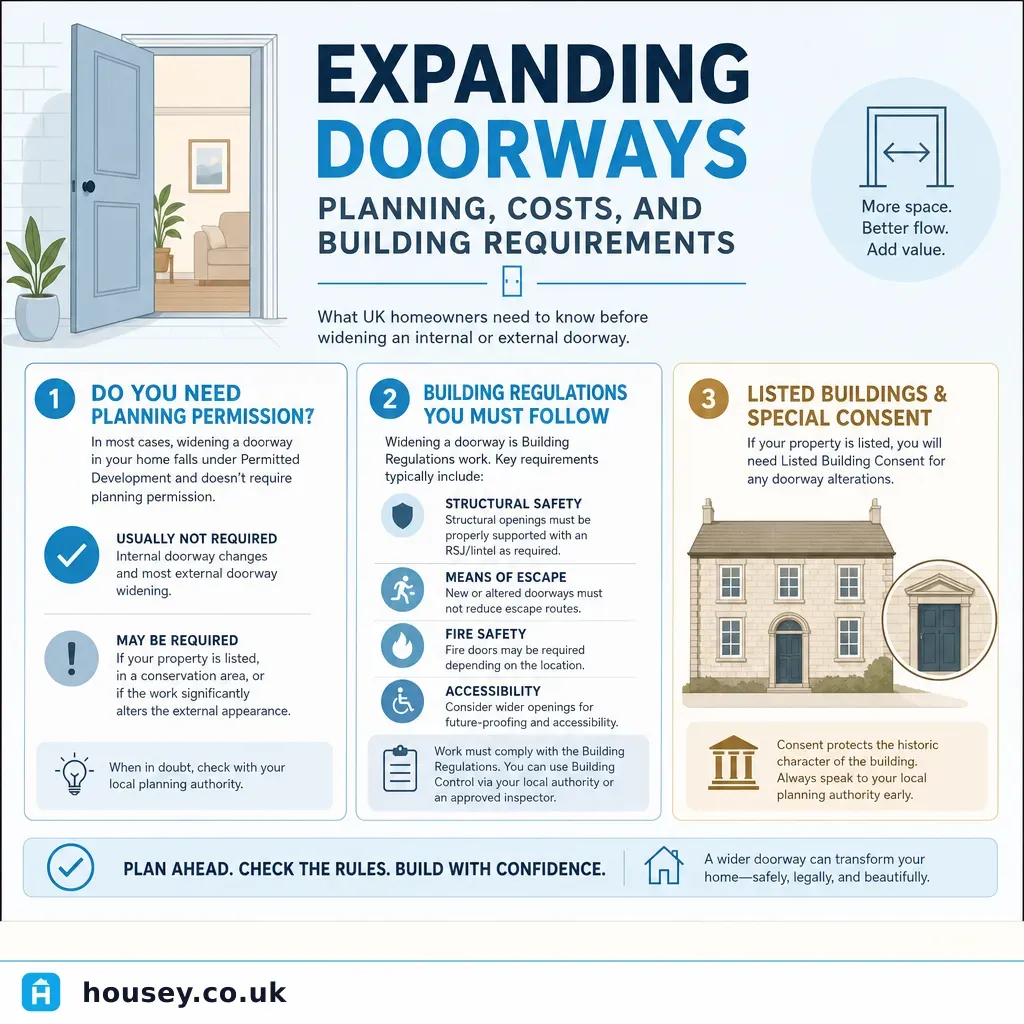
Expanding Doorways: Planning, Costs, and Building Requirements
Expanding a doorway in a load-bearing wall requires Building Regulations Part A approval and a structural engineer's lintel design.
 Improvement & Build
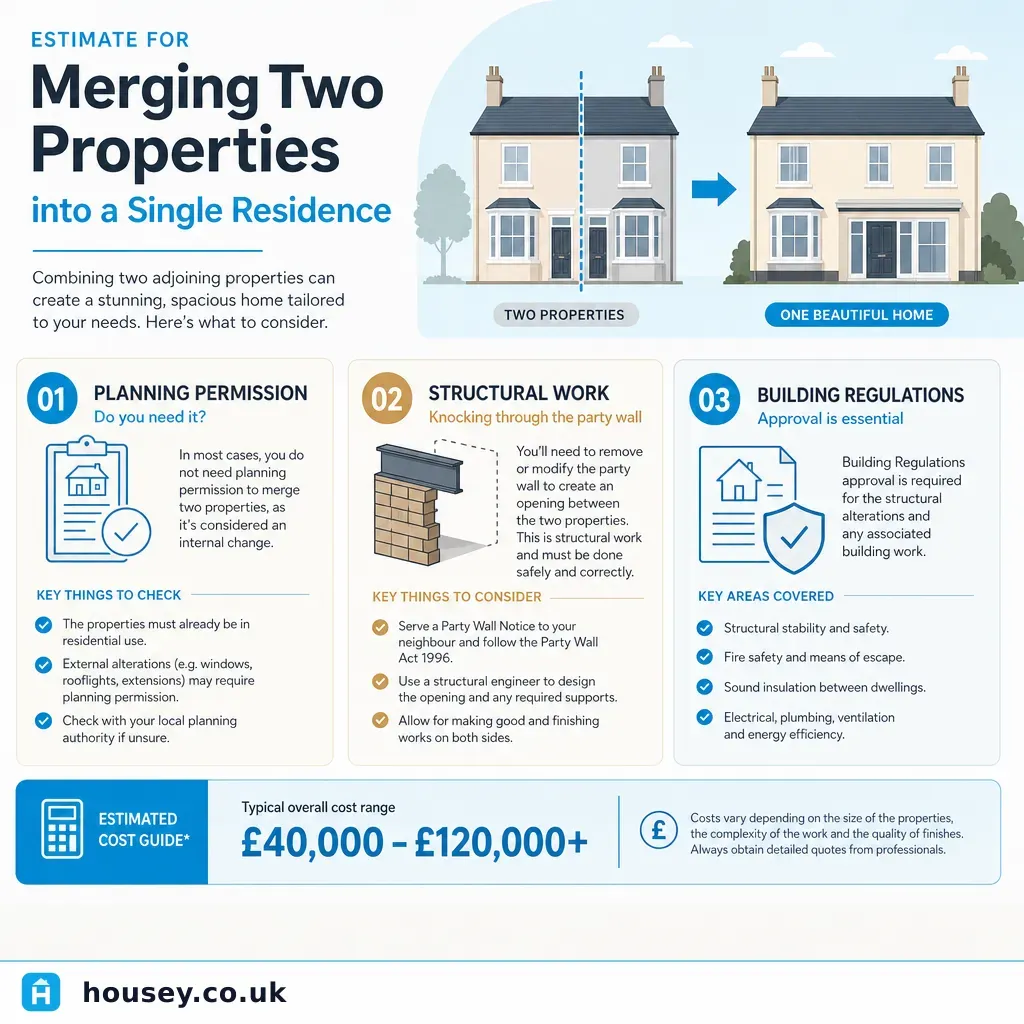
Estimate for Merging Two Properties into a Single Residence
Merging two properties into one typically costs £30,000–£120,000 or more, depending on property type, structural complexity, and professional fees.
 Improvement & Build
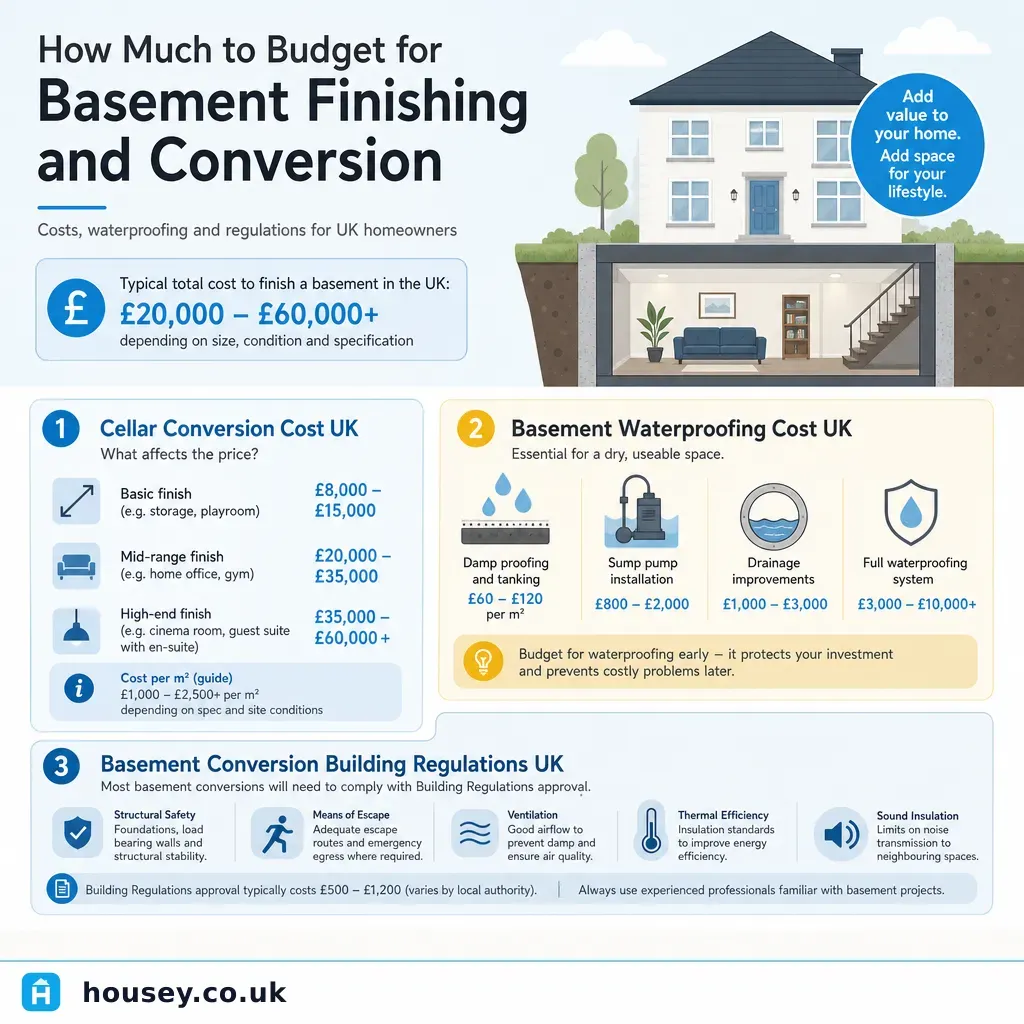
How Much to Budget for Basement Finishing and Conversion
Basement conversions in the UK typically cost £700–£1,500 per square metre for a simple cellar finish with existing headroom, rising to £1,500–£3,500 per square metre for a full conversion with underpinning.
 Improvement & Build
Budget for Relocating a Staircase During Renovation
Relocating a staircase in a UK home typically costs £6,000 to £20,000 or more, depending on structural complexity and staircase design.
 Improvement & Build
Costs Involved in Relocating a Bathroom to an Upper Floor
Moving a bathroom to an upper floor in a UK home typically costs £7,000 to £20,000 or more, depending on drainage method, structural work required, and finishes chosen.