Basement Waterproofing: Solutions for a Dry Property
By Housey · Last reviewed 10th of May 2026
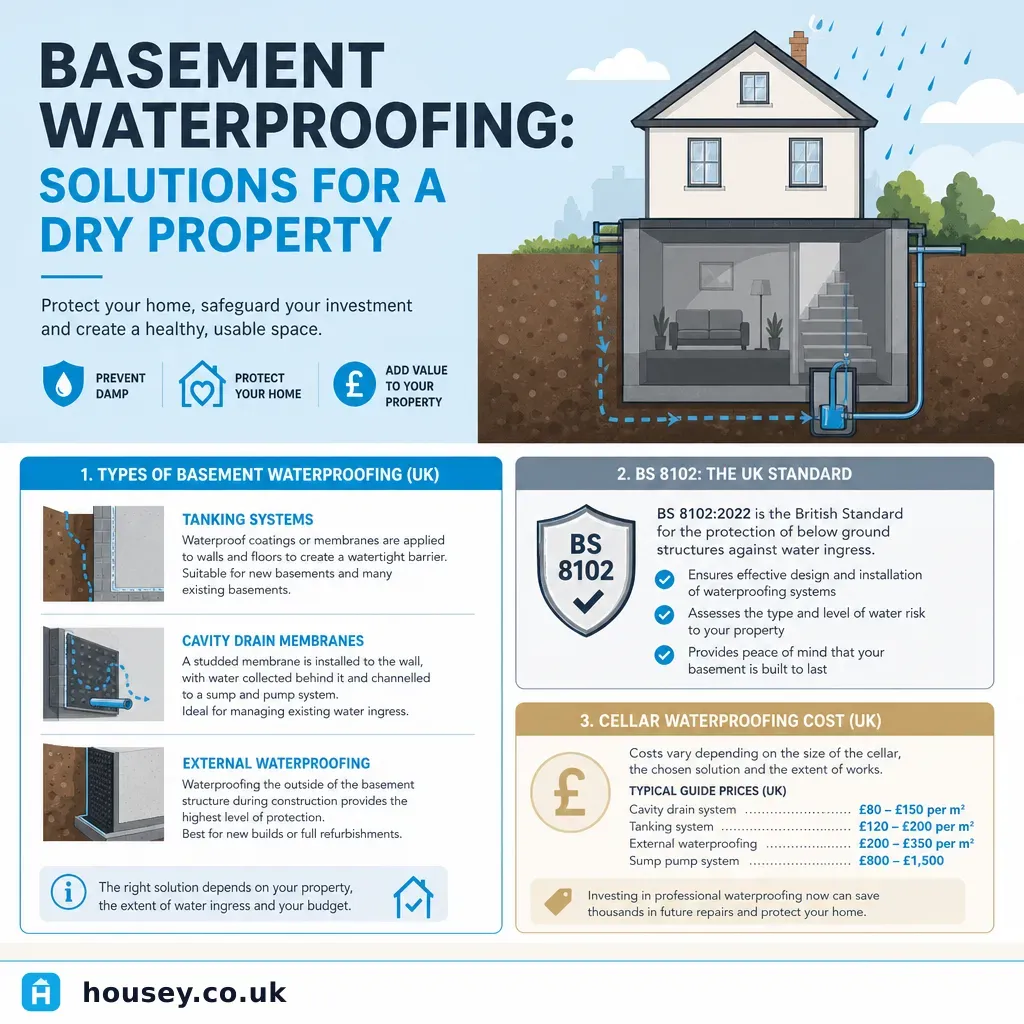
Basement Waterproofing: Solutions for a Dry Property
Water ingress in a basement or cellar is one of the more persistent problems in UK properties, particularly in Victorian and Edwardian terraces where the substructure was never designed to be habitable. Whether you are converting a cellar into usable living space, dealing with an existing damp problem, or preparing a below-ground area for storage, choosing the right waterproofing system matters. Get it wrong and the moisture will return — often more aggressively than before.
Key points
- BS 8102:2022 (Code of Practice for Protection of Below Ground Structures Against Water Ingress) is the primary technical standard governing basement waterproofing design in the UK.
- BS 8102 defines three recognised waterproofing system types: Type A (barrier), Type B (structurally integral), and Type C (drained cavity membrane).
- The Property Care Association (PCA) is the principal trade body for structural waterproofing in the UK — PCA-registered contractors are required to employ a CSSW (Certificated Surveyor in Structural Waterproofing) qualified designer.
- Basement conversions creating habitable space require Building Regulations approval under at minimum Part C (moisture resistance) and Part A (structure).
- Excavation within 3–6 metres of a neighbouring building's foundations triggers the Party Wall etc. Act 1996, requiring a party wall agreement before work starts.
What causes basement damp?
Basement water ingress in UK properties typically has one of three origins, and accurately diagnosing the source is essential before any waterproofing is specified:
- Hydrostatic pressure: Groundwater builds up in saturated soil — particularly in clay-heavy areas — and forces water through cracks, joints, and porous masonry under pressure.
- Water vapour and condensation: Moisture migrates as vapour through walls and floors, condensing on cooler internal surfaces. This is often mistaken for a structural water leak but has a different treatment.
- Surface water run-off: Poor drainage around the property directs rainwater towards the building, which then percolates through the substructure walls and floor.
A qualified surveyor or PCA-registered specialist should identify the moisture type and pathway before any system is designed.
The three BS 8102 waterproofing system types
System Type | How it works | Best for | Key limitation |
|---|---|---|---|
Type A — Barrier | Tanking slurry or sheet membrane applied to the external or internal face of the structure to block water physically | External application during new build or full excavation; internal tanking for low-water-table situations | Relies on adhesion to host structure; can fail at cracks, movement joints, or where structural movement is active |
Type B — Structurally integral | Watertight concrete or reinforced blockwork designed to hold back water as part of the structure itself | New-build basements where the structure can be engineered to resist water ingress | Relies on construction quality; any defect in the concrete or blockwork becomes a potential leak point |
Type C — Drained cavity | A studded cavity drain membrane fixed to the internal wall and floor surface channels water into a perimeter drain and sump pump for controlled removal | Retrofit to existing basements; high hydrostatic pressure situations; combined waterproofing systems | Sump pump must be maintained; backup pump recommended; membrane slightly reduces the usable floor area |
Based on BS 8102:2022 classifications. For habitable basement rooms (Grade 3 environment under BS 8102), a combined Type A and Type C system is typically recommended.
Which waterproofing solution should you choose?
Use this as a starting point — always confirm the approach with a CSSW-qualified specialist after a site survey:
- Choose Type C (cavity drain) if you are retrofitting an existing Victorian or Edwardian cellar, especially where the water table or drainage conditions are uncertain.
- Choose Type A (internal tanking) if damp is primarily from condensation or very low-level moisture permeation with no active seepage.
- Specify a combined Type A + Type C system if you plan to use the space as a habitable room requiring Grade 3 dryness under BS 8102.
- Consult a structural engineer before specifying anything if you suspect structural movement, foundation cracking, or if the work involves underpinning.
- Check with your LPA if the conversion involves any extension below ground level or changes to the external appearance of the building.
- Check the Environment Agency flood risk map and confirm whether the property is in Flood Zone 2 or 3 — additional flood resilience measures may be required or recommended by your insurer.
Red flags that warrant specialist assessment
The following signs indicate a more serious situation and should prompt specialist assessment before any waterproofing work begins:
- Active water ingress: water flowing into the space or pooling on the floor during or after heavy rain.
- Efflorescence with crumbling mortar: white salt deposits combined with deteriorating masonry point to sustained water pressure over time.
- Cracks in the floor slab or wall junctions: may indicate structural movement rather than simple moisture ingress.
- Debonded previous tanking: bubbling, hollow, or delaminating plasterwork suggests a previous treatment has failed under pressure.
- Sticking doors or sloping floors: potential signs of broader structural movement that must be investigated before waterproofing proceeds.
- Proximity to a watercourse or flood zone: properties near rivers or in designated flood zones face higher hydrostatic risk and may need specific flood resilience measures.
If any of these are present, a structural engineer should be consulted alongside the waterproofing specialist.
Planning permission and Building Regulations
Basement conversions that create new living space are not always permitted development. You will usually need:
- Building Regulations approval under Parts A and C (and potentially Parts B, E, F, and L depending on the scope of the works) — mandatory for any conversion creating habitable space.
- Planning permission if the conversion involves creating a new basement, visible external alterations, or if the property is listed or in a conservation area. In London, the GLA and individual boroughs have additional basement development policies due to structural and flood risk concerns.
- Party wall notice under the Party Wall etc. Act 1996 if excavation work is within 3 metres of a neighbouring building's foundations (or 6 metres where works go deeper than the neighbour's foundations).
- A structural engineer's report if underpinning, reinforcement, or alterations to foundations are part of the scope.
Always check with your local planning authority and building control before work begins.
Important limitations
Basement waterproofing involves structural, drainage, and moisture-management decisions that can affect the long-term integrity of a building. The guidance in this article is general and cannot substitute for a site-specific assessment by a qualified specialist. Rules around planning, Building Regulations, party wall obligations, and flood risk vary by location and property type. Use a suitably qualified specialist, ideally PCA-registered with a CSSW-qualified designer, and ensure any installation comes with an insurance-backed guarantee (IBG).
What to ask a qualified professional
Before instructing a waterproofing contractor, ask:
- Are you PCA-registered, and will a CSSW-qualified surveyor design and sign off the system?
- Will the design comply with BS 8102:2022, and which system type (or combination) do you recommend and why?
- Is a structural engineer's report needed before you can finalise the design?
- Will you identify and address the source of moisture, not just manage the symptom?
- What insurance-backed guarantee (IBG) comes with the work, and who is the underwriter?
- If a sump pump is installed, what provision is there for pump failure or power interruption?
- What ongoing maintenance is required after installation?
When to get professional help
Always use a qualified, PCA-registered specialist. Seek professional assessment urgently if:
- You notice active water ingress during or after heavy rain.
- Cracks in walls or floors appear to be widening or are stepped through brickwork.
- A previous waterproofing treatment has visibly failed.
- You are planning to convert the basement to habitable use.
- The property has a history of structural movement or is near a watercourse.
- Your planned excavation work will come within 3–6 metres of a neighbouring structure.
How Housey can help
Housey connects homeowners with trusted damp proofing specialists who can carry out a thorough moisture assessment, design the right BS 8102-compliant waterproofing system, and provide insurance-backed guarantees on their work.
Frequently asked questions
How long does basement waterproofing last?
A properly installed Type C cavity drain system with a quality sump pump should last 20–30 years with regular maintenance. The pump should be inspected annually and replaced proactively. Type A tanking systems are more dependent on substrate preparation and can fail earlier if the surface was not correctly prepared or if structural movement occurs after installation.
What does basement waterproofing cost in the UK?
Costs vary considerably by system type, basement area, severity of water ingress, and whether structural work is also needed. Indicative UK costs for a basic internal cavity drain system in a small cellar start from around £5,000–£10,000 and rise significantly for larger or more complex projects. Indicative UK costs, last reviewed 2026-05-10. Always obtain at least three quotes from PCA-registered contractors.
Is a sump pump always needed for basement waterproofing?
A sump pump is required with any Type C cavity drain system — the membrane channels water to a sump, and the pump removes it. A battery backup or secondary pump is strongly recommended in case of mains power failure. Without a backup, a power cut during heavy rainfall could result in the sump overflowing.
Can I waterproof a basement myself?
DIY tanking compounds are available for minor situations, but for active water ingress, significant hydrostatic pressure, or conversion to habitable use, professional installation to BS 8102:2022 is strongly advisable. Incorrectly applied systems can trap moisture or fail under pressure. An insurance-backed guarantee (IBG) is only available through registered contractors, not DIY applications.
Do I need building regulations approval for basement waterproofing?
Waterproofing an existing cellar that remains a storage or utility space does not always trigger Building Regulations. However, any conversion to habitable use requires Building Regulations approval under at minimum Part C (moisture resistance) and Part A (structure). Always check with your local building control authority before starting work.
Sources and further reading
- BS 8102:2022 Code of Practice for protection of below ground structures — BSI Group
- Structural waterproofing guidance for homeowners — Property Care Association
- Check flood risk for planning — GOV.UK
- When is planning permission required? — GOV.UK / DLUHC
- Party Wall Act 1996: guidance for homeowners — GOV.UK
Useful next reads
 Improvement & Build
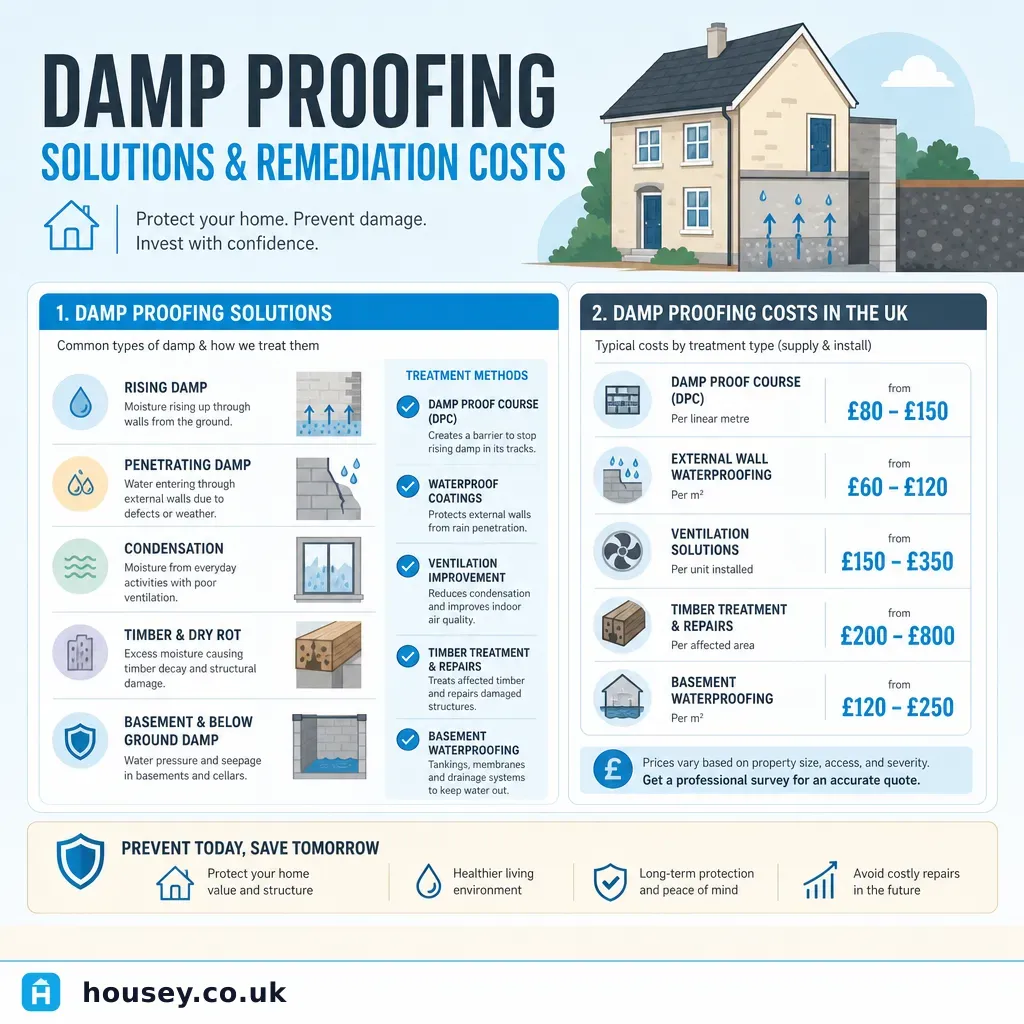
Damp Proofing Solutions and Remediation Costs
Damp proofing costs depend on the type of damp present: ventilation improvements for condensation start at around £300–£700, chemical DPC injection plus replastering typically costs £1,500–£3,500, and full basement waterproofing can reach £7,000–£15,000 or more.
 Improvement & Build
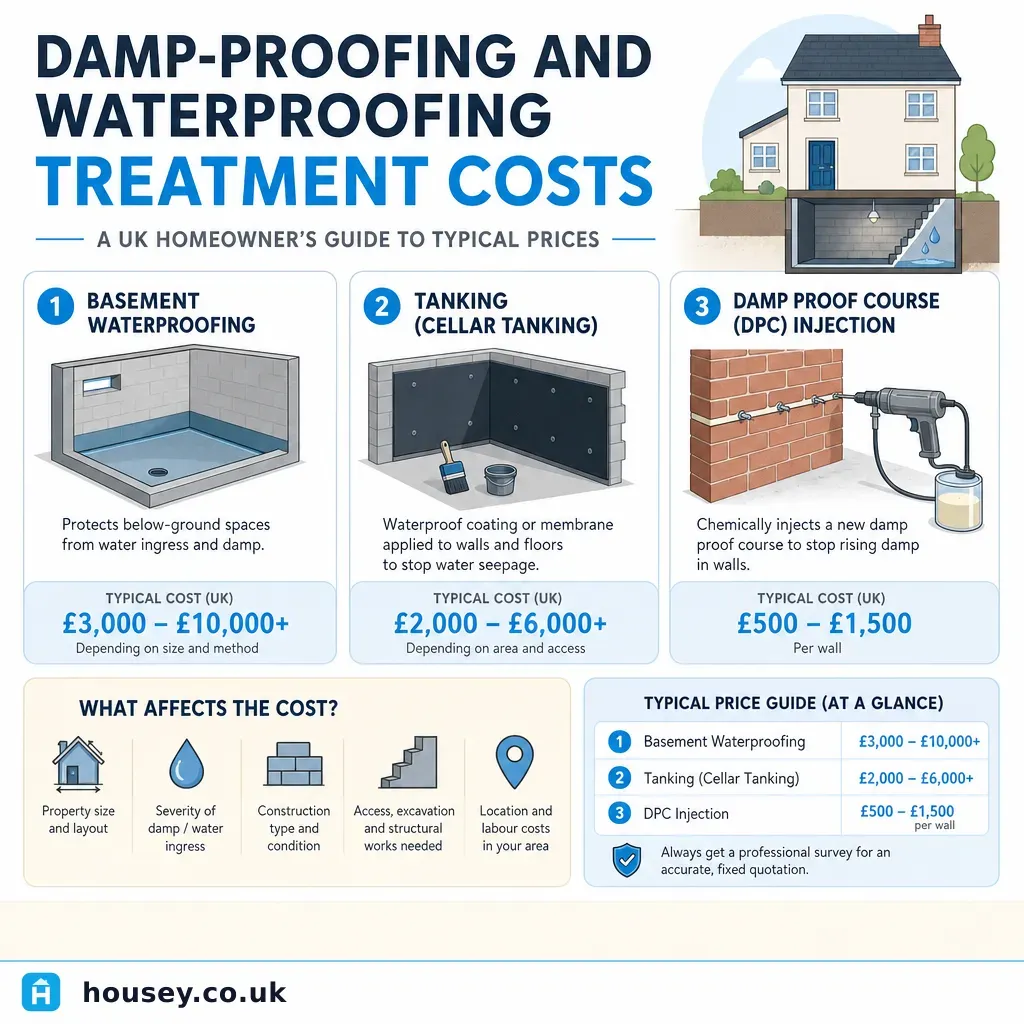
Damp-Proofing and Waterproofing Treatment Costs
Damp-proofing costs in the UK depend on the treatment type and extent of the problem.
 Improvement & Build
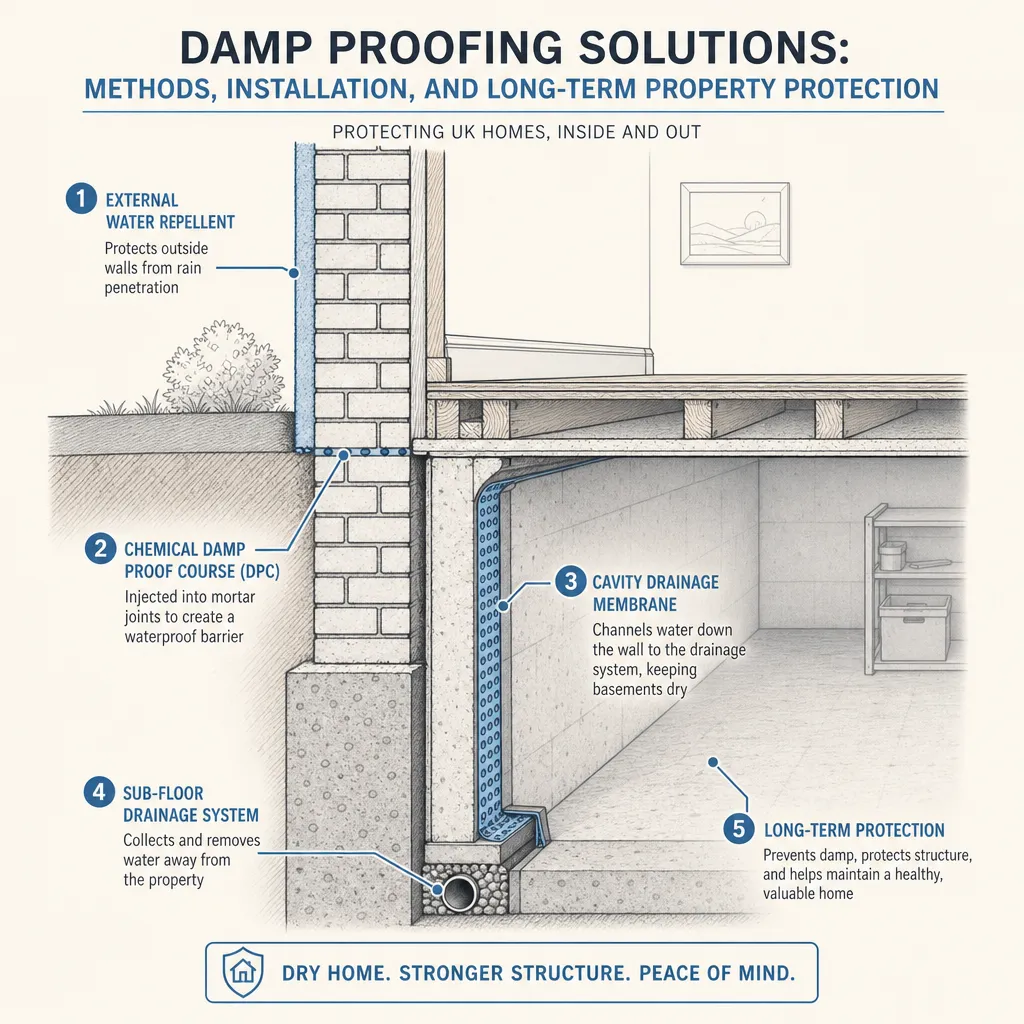
Damp Proofing Solutions: Methods, Installation, and Long-Term Property Protection
Damp proofing in UK homes typically involves chemical damp proof course (DPC) injection for rising damp, cavity drainage membranes for basement or below-ground moisture, and tanking for waterproofing solid walls.
 Improvement & Build
Foundation Waterproofing: Long-Term Protection and Durability
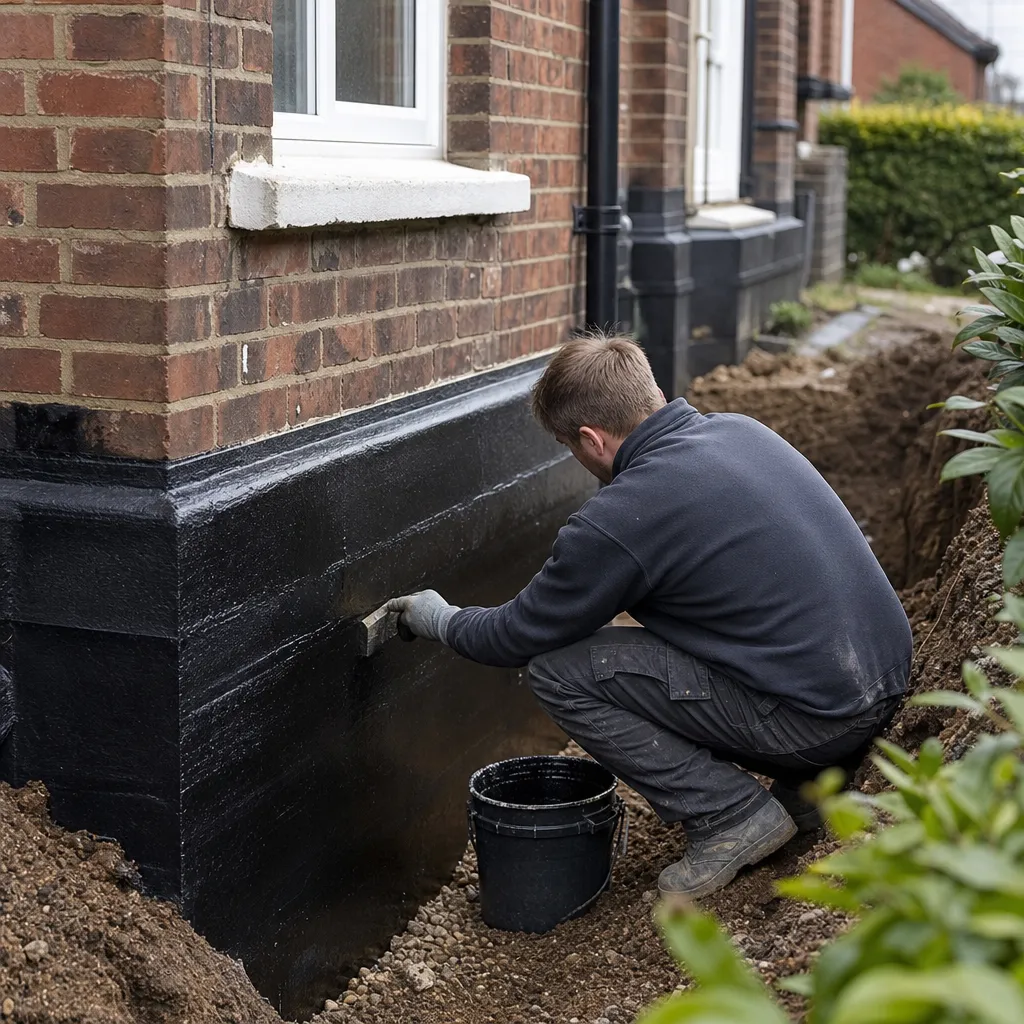
Foundation waterproofing protects below-ground structures from water ingress using systems classified under BS 8102:2022 as Type A barrier membranes, Type B waterproof concrete, or Type C drained cavity arrangements.
 Improvement & Build
Flat Roof Solutions: Installation, Maintenance, and Longevity Considerations
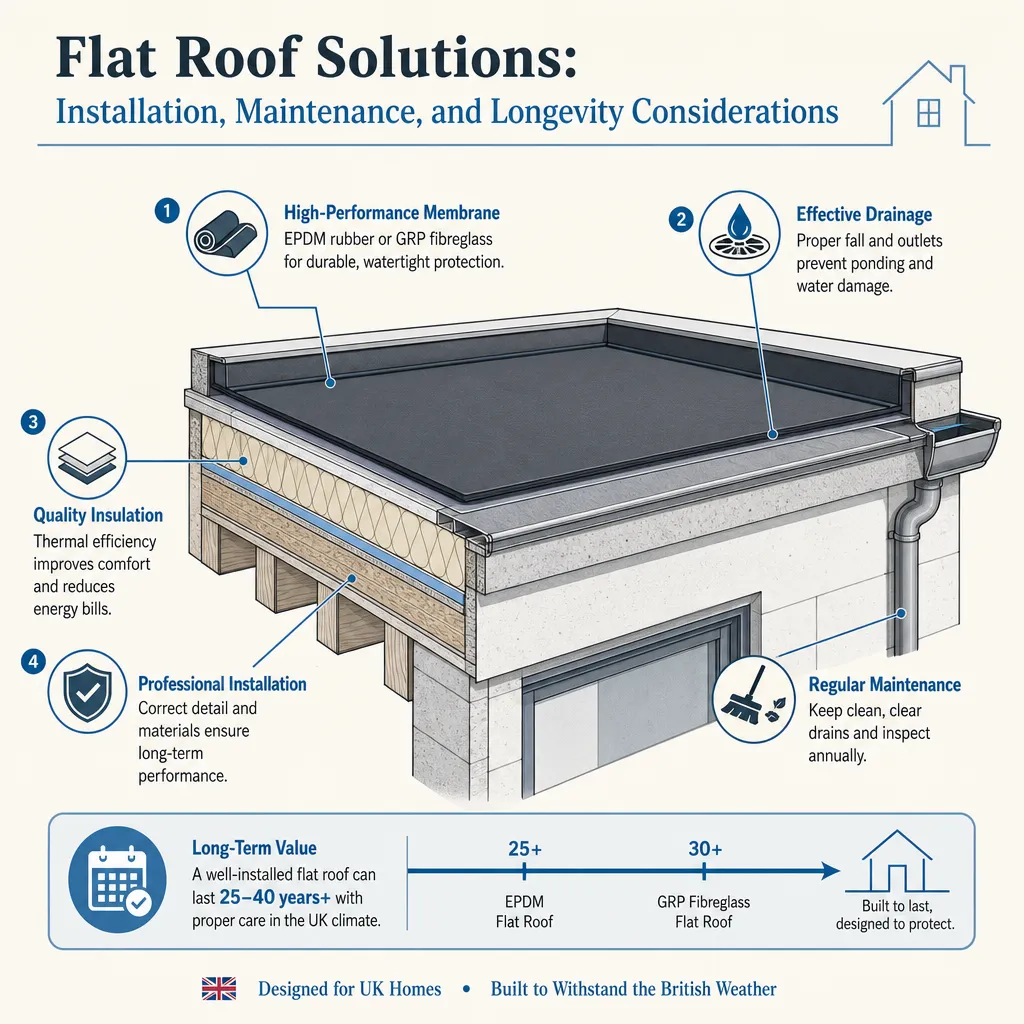
Flat roofs use several waterproofing systems — EPDM rubber, GRP fibreglass, liquid-applied coatings, modified bitumen felt, lead, and zinc — each with different lifespans and installation requirements.