Damp Proofing Solutions: Methods, Installation, and Long-Term Property Protection
By Housey · Last reviewed 19th of May 2026
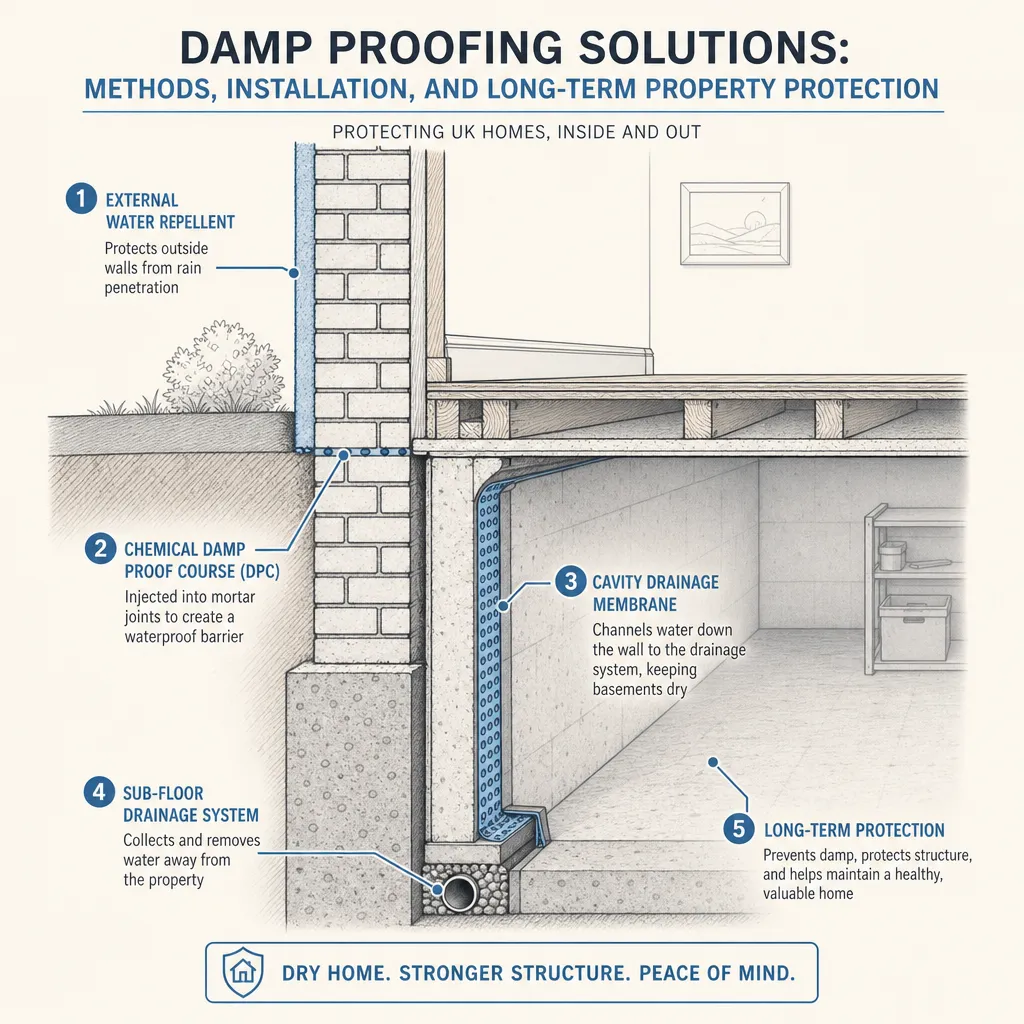
Damp Proofing Solutions: Methods, Installation, and Long-Term Property Protection
Damp is one of the most commonly reported problems in UK housing, affecting properties of every age and construction type. When surface-level remedies — improved ventilation, better heating, or repainting — fail to resolve persistent moisture, structural damp proofing may be required to introduce or restore a physical barrier against moisture migration. Choosing the wrong method can make an underlying problem worse, mask structural damage, or create new moisture pathways. Understanding the range of available approaches helps homeowners engage with specialists from an informed position and avoid unnecessary expenditure.
Key points
- Chemical damp proof course (DPC) injection uses silicone-based compounds injected into the masonry mortar course to create a moisture-repelling zone — used to reinstate or install a DPC where none is effective.
- Cavity drainage membrane systems manage water ingress by channelling moisture to a sump and pump rather than stopping it at source — recommended by BS 8102:2022 for below-ground habitable spaces.
- Tanking (cementitious or crystalline waterproofing) bonds directly to masonry to resist hydrostatic water pressure, typically applied to below-ground walls and floors.
- The Property Care Association (PCA) is the main UK trade body for damp and timber specialists; the CSRT (Certificated Surveyor in Remedial Treatments) and CSSW (Certificated Surveyor in Structural Waterproofing) are the relevant professional qualifications.
- The BRE has noted that rising damp is frequently misidentified in UK properties — condensation or ground-level leaks are often the true cause, making correct diagnosis before treatment critical.
How does moisture enter a building?
Before selecting a damp proofing method, it is important to understand the route through which moisture is entering the property. The three principal forms of dampness in UK buildings are:
- Rising damp: Groundwater drawn upward through porous masonry by capillary action, usually visible as a tide mark up to 1 m from the floor level. Typically caused by a failed, absent, or physically bridged damp proof course.
- Penetrating (lateral) damp: Rainwater entering through walls, roofs, or around openings — often associated with defective pointing, failed render, blocked gutters, or window seal failure.
- Condensation: Moisture in warm air depositing on cool surfaces, producing mould growth — the most common form of dampness in UK homes, frequently confused with rising or penetrating damp.
Each form requires a fundamentally different remedial approach. Applying chemical DPC injection to a wall where the real problem is condensation will have no useful effect and could delay correct diagnosis.
Damp proofing methods compared
Method | How it works | Best for | Not suited to | Typical lifespan |
|---|---|---|---|---|
Chemical DPC injection | Silicone cream or fluid injected into mortar bed to create a water-repelling zone | Reinstating or installing a DPC in existing masonry walls | Penetrating damp; condensation; below-ground hydrostatic pressure | 20–30 years (manufacturer dependent) |
Physical DPC installation | A physical barrier cut or stitched into the mortar course | New builds or major rebuilds | Retrofit into existing walls without significant disruption | Indefinite if undamaged |
Cavity drainage membrane | Studded HDPE sheet creates drainage void; water managed to sump and pump | Below-ground basements, cellars, below-DPC walls with ongoing ingress | Spaces where ongoing pump maintenance is not feasible | 30+ years with maintenance |
Cementitious tanking | Hydraulic cement slurry applied in layers to resist water penetration | Basements, retaining walls, below-ground structures | Above-DPC walls; areas subject to movement or cracking | 20–30 years; retreatment if cracked |
Crystalline waterproofing | Active chemicals penetrate and crystallise within concrete or masonry pores | Concrete basements, water tanks, poured foundations | Older lime-mortar masonry without specialist assessment | Can be permanent within concrete |
External render and coatings | Applied to external face to reduce rain penetration | Solid-wall buildings with penetrating damp through defective render | Solid-wall buildings where breathability must be maintained | 10–20 years typically |
Method selection should always be confirmed by a suitably qualified specialist following physical inspection.
What does installation involve?
Chemical DPC injection
The standard process involves drilling holes at regular intervals (typically every 120 mm) into the mortar course just above floor level. A silicone-based compound is then injected under low pressure or by gravity feed before the holes are plugged. Salt-contaminated plaster must be removed and replaced with a salt-resistant renovating plaster — failure to replaster is one of the most common reasons treatments appear to fail, as old plaster continues to absorb atmospheric moisture regardless of the new DPC.
Cavity drainage membrane installation
Studded HDPE sheeting is mechanically fixed to affected walls, with channel drains at the base directing water to a sump. A submersible pump with battery backup discharges water away from the building. This approach manages water ingress rather than eliminating it — ongoing pump maintenance is essential. Groundwork around the sump and floor-level drainage channels may also be required depending on the extent of the affected area.
Tanking and cementitious waterproofing
Cementitious tanking is applied in multiple layers to dry, structurally sound masonry. Surface preparation is critical: loose material is removed, honeycombed concrete is cut back and filled, and construction joints and pipe penetrations receive additional attention. Tanking is effective against hydrostatic pressure in below-ground walls but relies entirely on the wall fabric being intact and adequately prepared prior to application.
Red flags: when damp proofing may not be the right first step
Watch for these indicators that the underlying cause has not been correctly identified before treatment is proposed:
- Moisture readings taken only with a hand-held pin meter — surface resistance meters can return elevated readings in walls with soluble salts but no active rising damp.
- No laboratory analysis of plaster or masonry samples — proper rising damp diagnosis should include gravimetric (oven-drying) testing, not just electrical readings.
- No discussion of ventilation or condensation as a potential cause — a responsible specialist will rule these out before recommending any structural treatment.
- A remediation proposal issued before any diagnostic report is complete — proposals that arrive before findings have been confirmed warrant scrutiny.
- No mention of insurance-backed guarantees — reputable PCA-accredited contractors provide long-term guarantees (typically 20–30 years) backed by a recognised insurance scheme.
- Replastering proposed without DPC confirmation — renovating plaster alone controls salt migration but does not address an active moisture source.
Important limitations
This article provides general information about damp proofing methods available in the UK. Damp is a complex problem — the most appropriate solution depends on construction type, moisture source, ground conditions, and the extent of damage to the building fabric, all of which require physical inspection and professional assessment.
Incorrectly applied damp proofing can trap moisture within wall construction, damage historic lime plasterwork, void existing guarantees, and mask structural defects requiring separate attention. Historic and listed buildings require conservation-aware approaches; standard chemical injection systems are not appropriate for solid lime-mortar masonry without specialist assessment.
What to ask a qualified professional
- What tests will you carry out to confirm the source of the dampness?
- Will you take physical samples for laboratory analysis, or rely solely on electrical moisture meters?
- Which specific method do you recommend, and why is it appropriate for this property's construction type?
- What will happen to the existing plasterwork — does it need to be stripped and replaced with renovating plaster?
- Is your guarantee insurance-backed, and who is the insurer?
- Are you a member of the Property Care Association (PCA) and do you hold the CSRT or CSSW qualification?
- Is there anything about the property's construction or condition that could affect the outcome of the treatment?
When to get professional help
Any confirmed or suspected rising damp, persistent basement moisture, or recurring penetrating damp warrants a professional inspection. Seek specialist advice if:
- You have a visible tide mark or salt efflorescence on lower walls
- Skirting boards, floor joists, or structural timbers show signs of decay near affected areas
- A RICS survey has flagged damp before exchange of contracts
- A previous damp proofing treatment has failed within its guarantee period
- The property is a basement flat, cellar conversion, or contains below-ground habitable space
How Housey can help
Housey connects UK homeowners with vetted damp proofing specialists who carry out professional diagnosis before recommending any treatment. Submit your details to receive quotes from vetted damp and waterproofing professionals accredited by the Property Care Association.
Frequently asked questions
How long does a chemical DPC injection last?
Most manufacturers quote 20–30 years for silicone-based DPC injection systems, provided the associated plasterwork is replaced with salt-resistant renovating plaster. Guarantees are typically insurance-backed when provided by a PCA-accredited contractor. The longevity of the treatment depends heavily on the correct installation process being followed throughout.
Is damp proofing covered by home insurance?
Standard UK home insurance policies do not usually cover damp proofing or remediation work, as damp is typically treated as a maintenance issue rather than a sudden, accidental event. Some specialist policies or buildings warranties may provide cover for specific scenarios — check your policy wording or speak to your insurer for clarification.
Do I need to leave my home during damp proofing work?
For most above-ground chemical DPC injection and replastering projects, you can remain in the property, though the affected rooms will be out of use. Basement cavity drainage and tanking projects may be more disruptive depending on access requirements. Your contractor should advise on timescales and access needs before works begin.
What is the difference between a damp proof course and a damp proof membrane?
A damp proof course (DPC) is a horizontal barrier built into or injected into the wall fabric to prevent rising damp. A damp proof membrane (DPM) is a sheet material — typically heavy-gauge polyethylene — laid under floor screeds to prevent moisture rising through the floor slab. Both may be needed in a comprehensive moisture management strategy.
Sources and further reading
- BS 8102:2022: Protection of below-ground structures against water from the ground — British Standards Institution
- Property Care Association: guidance for homeowners — Property Care Association
- BRE Good Repair Guide 6: treating rising damp in houses — Building Research Establishment
- Historic England: moisture in historic buildings — Historic England
Useful next reads
 Improvement & Build
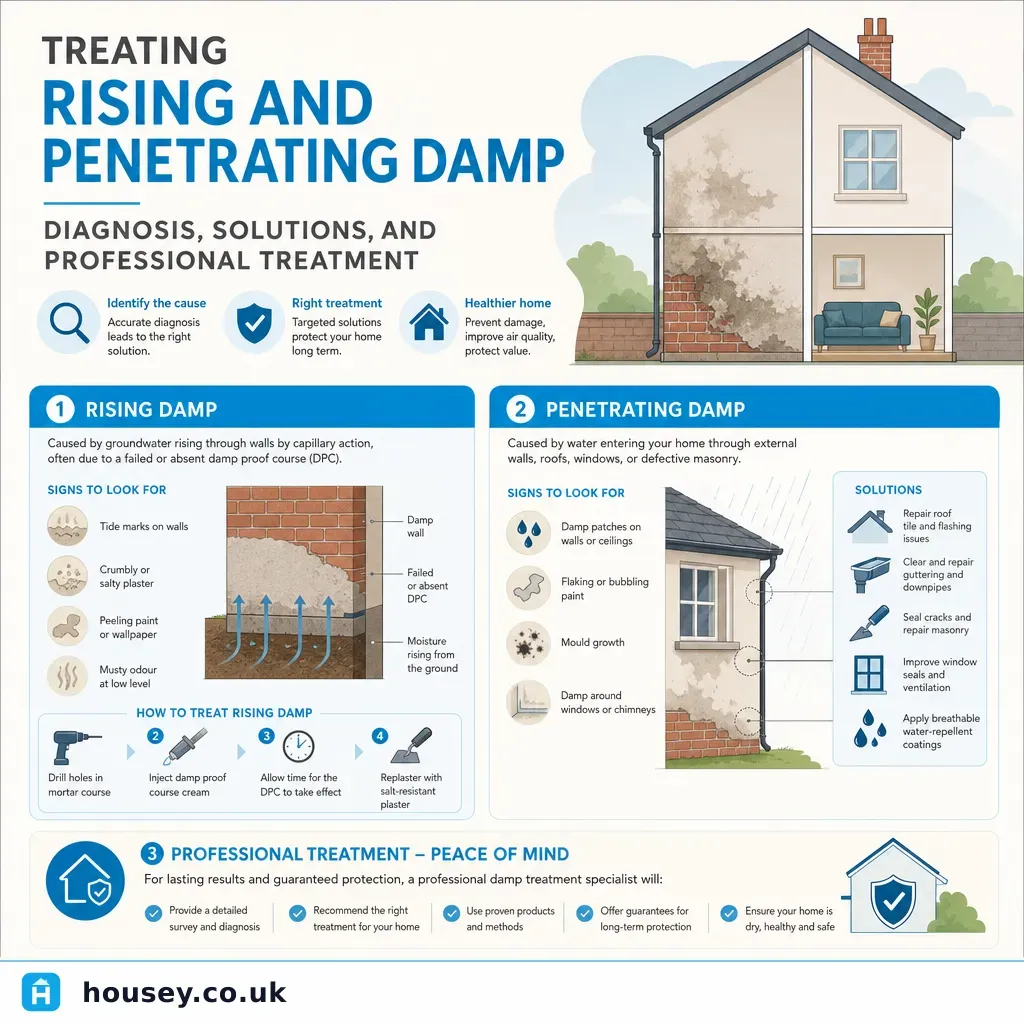
Treating Rising and Penetrating Damp: Diagnosis, Solutions, and Professional Treatment
Rising damp appears as a tide mark at the base of ground-floor walls and is caused by a failed or absent damp-proof course.
 Improvement & Build
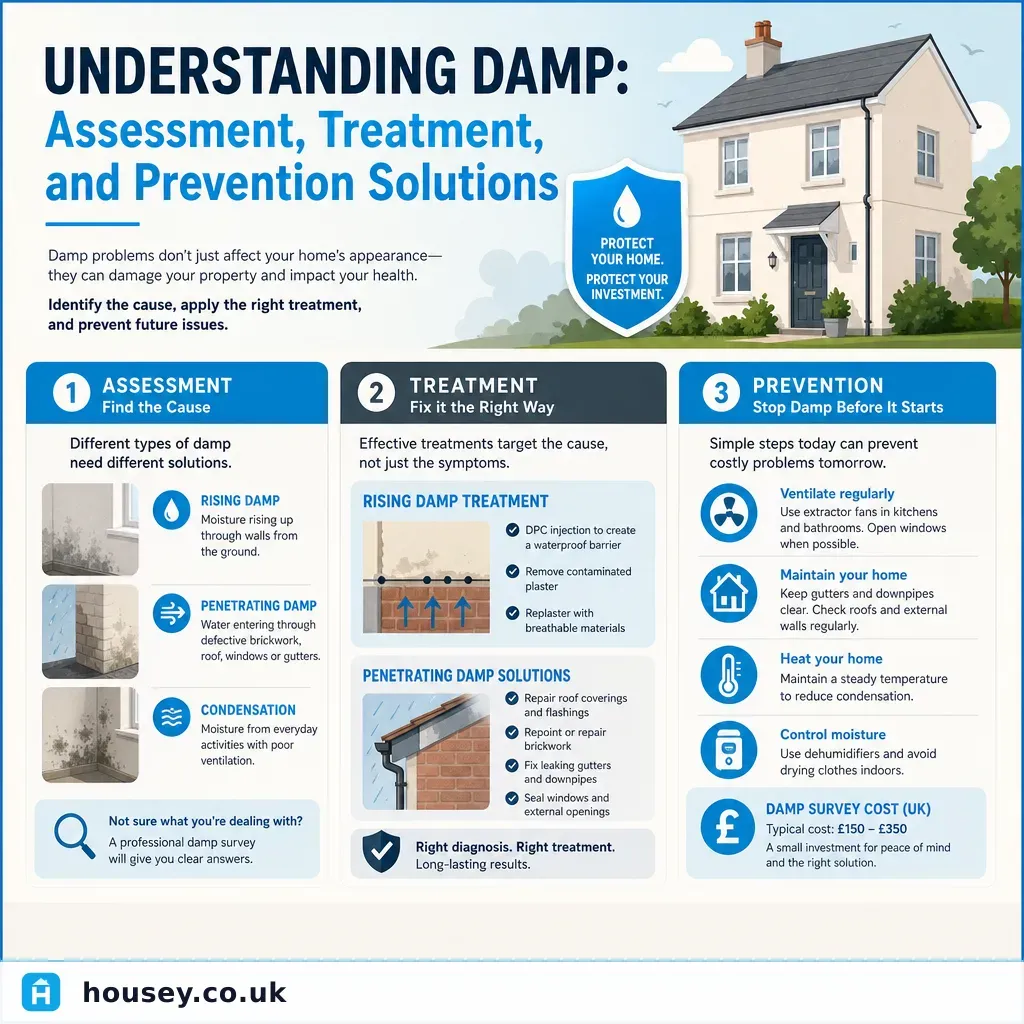
Understanding Damp: Assessment, Treatment, and Prevention Solutions
Damp in UK homes usually falls into three categories — rising damp, penetrating damp, and condensation — each requiring a different remedy.
 Improvement & Build
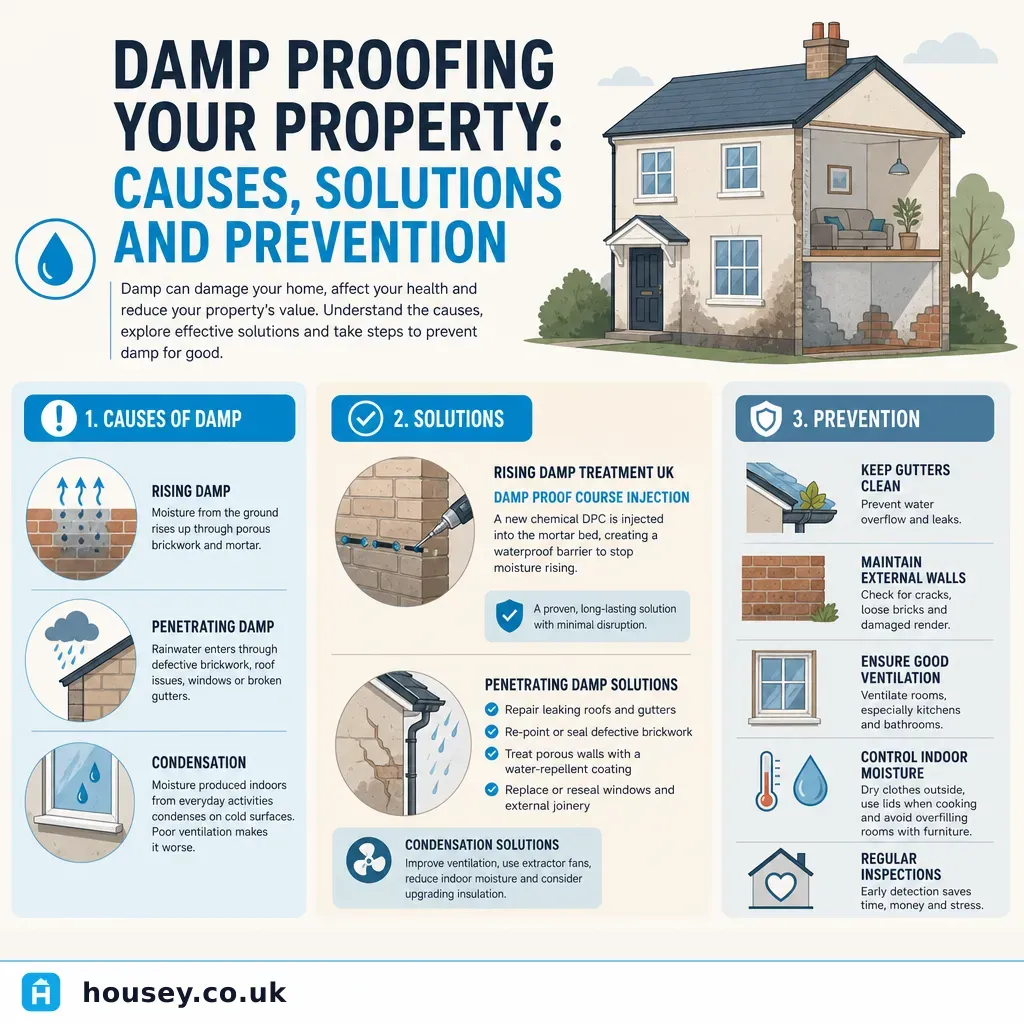
Damp Proofing Your Property: Causes, Solutions and Prevention
Damp in UK properties falls into three main types: rising damp caused by a failed damp proof course, penetrating damp from defects such as failed flashings or cracked render, and condensation from poor ventilation.
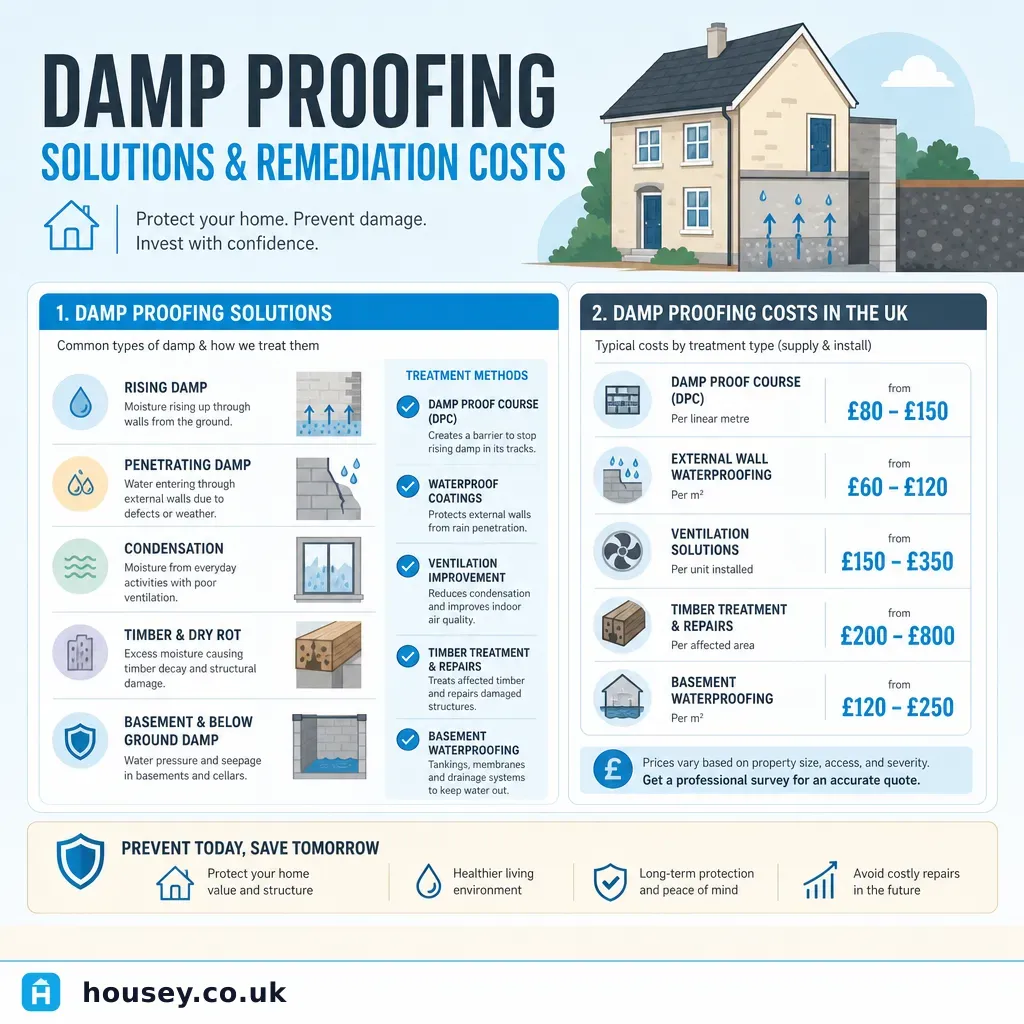 Improvement & Build
Damp Proofing Solutions and Remediation Costs
Damp proofing costs depend on the type of damp present: ventilation improvements for condensation start at around £300–£700, chemical DPC injection plus replastering typically costs £1,500–£3,500, and full basement waterproofing can reach £7,000–£15,000 or more.
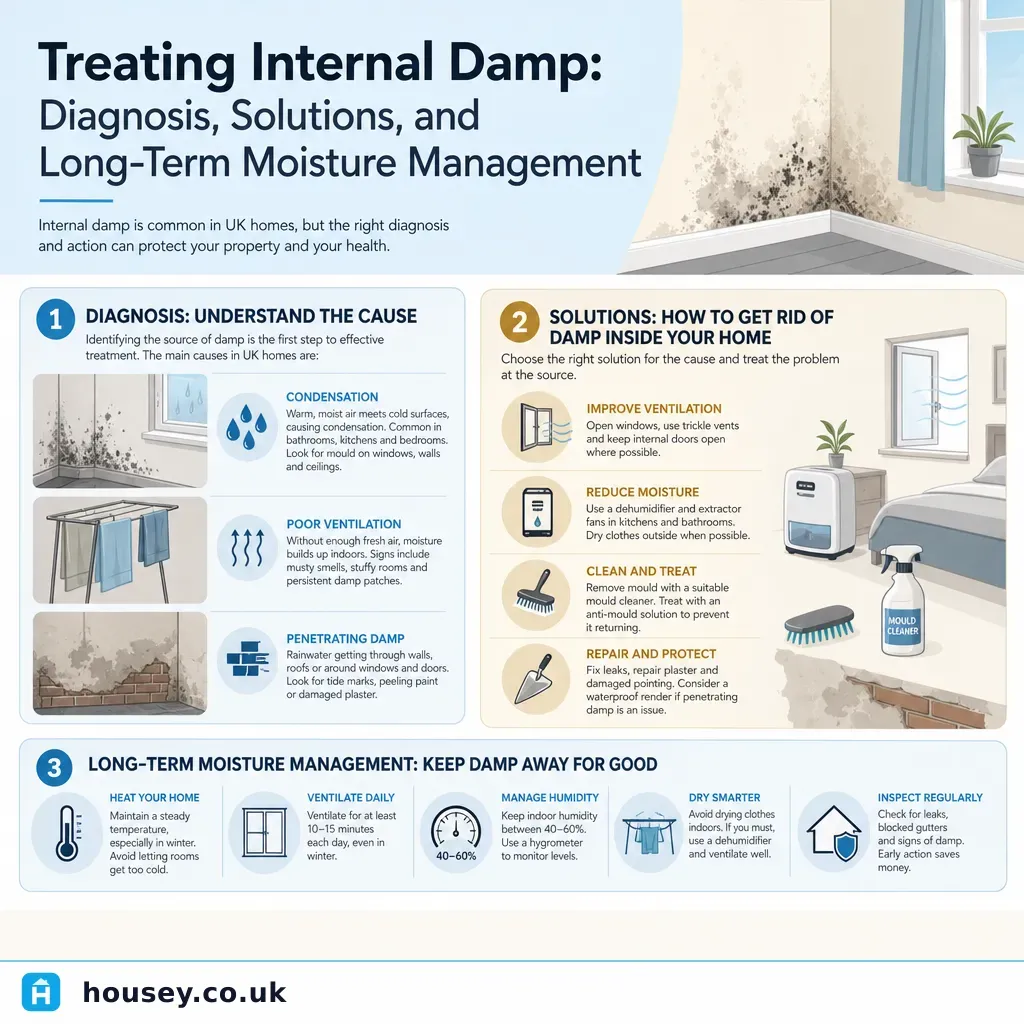 Improvement & Build
Treating Internal Damp: Diagnosis, Solutions, and Long-Term Moisture Management
Treating internal damp successfully requires diagnosing the correct type first.