Foundation Waterproofing: Long-Term Protection and Durability
By Housey · Last reviewed 11th of May 2026
Foundation Waterproofing: Long-Term Protection and Durability
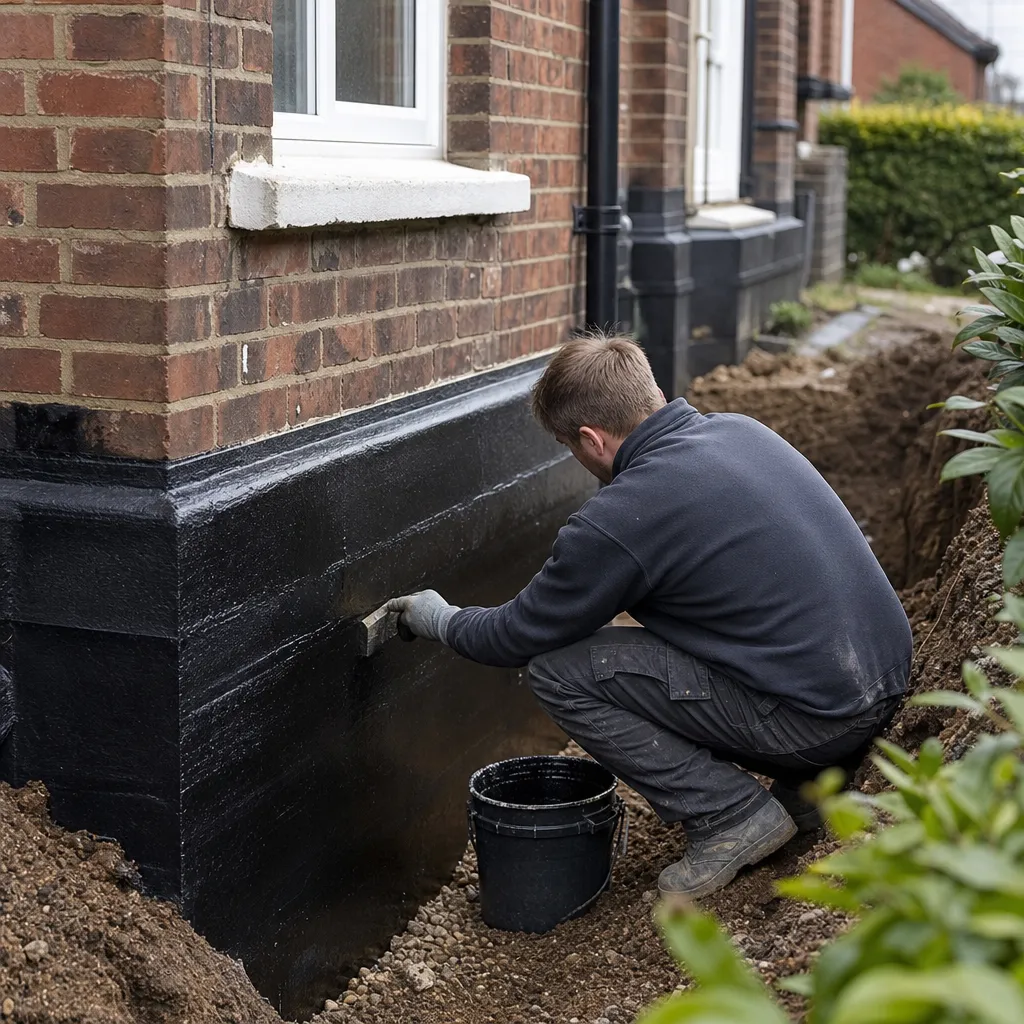
Foundation waterproofing becomes a pressing concern during basement conversions, new-build deep foundations, and subterranean extensions across the UK — wherever a structure meets sustained contact with groundwater or soil moisture. At stake is the long-term structural integrity of the building: water ingress into below-ground concrete can undermine the structure, corrode reinforcement, and create persistent conditions for mould growth and timber decay in adjacent elements. Getting the specification right at the outset is far less costly than remediation after failure.
Key points
- BS 8102:2022 (Code of Practice for Protection of Below Ground Structures Against Water from the Ground) is the primary UK standard governing the design and specification of foundation waterproofing systems.
- Three system types are defined: Type A (barrier protection using membranes or tanking), Type B (integral waterproof concrete), and Type C (drained cavity protection with sump and pump) — they may be used individually or in combination.
- Four grades of protection are specified (Grade 1–4), from basic utility use to fully conditioned habitable space — the target grade must be established before any system is selected.
- NHBC Standards Chapter 5.4 requires a qualified waterproofing specialist to design and inspect below-ground systems in new residential builds covered by NHBC warranties.
- The Property Care Association (PCA) awards the CSSW (Certificated Surveyor in Structural Waterproofing) qualification — a recognised competence benchmark for below-ground waterproofing design and inspection.
Understanding the three waterproofing system types
The correct system depends on site groundwater conditions, the structural form, and the grade of internal environment required. BS 8102:2022 defines three types, which may be used individually or combined for higher-risk situations.
System type | How it works | Best for | Main limitation |
|---|---|---|---|
Type A — Barrier | External or internal membrane (bituminous sheet, cementitious render, or crystalline slurry) forms a continuous barrier against water ingress | New builds where external access is feasible; lower hydrostatic pressure sites | Relies on membrane continuity — joints, penetrations, and cracks are vulnerable; internal remediation after failure can be very disruptive |
Type B — Integral | Waterproof concrete mix (dense aggregate, reduced water-cement ratio, crystalline admixtures) resists water through reduced permeability | New reinforced concrete basements; insulated concrete formwork (ICF) structures | Not sufficient as a standalone solution if significant cracking develops; usually combined with Type A or C in high-risk situations |
Type C — Drained cavity | Studded HDPE cavity drain membrane channels any water that enters to a perimeter drain and sump pump | Retrofit basement conversions; sites with variable or high groundwater | Dependent on pump reliability; requires regular maintenance; manages water ingress rather than preventing it |
BS 8102:2022 recommends combining system types for Grade 3 (habitable) and Grade 4 (fully conditioned) spaces, particularly where groundwater is high or variable. A Type C system alone may achieve Grade 3 when correctly specified and maintained, but combined approaches offer greater long-term resilience.
Grades of protection: matching specification to intended use
The grade of internal environment required is the starting point for any waterproofing specification. Underspecifying — for example, using a Grade 1 system in a space intended as a habitable bedroom — is one of the most common causes of waterproofing failure and subsequent costly remediation.
- Grade 1: Tolerable seepage and some damp patches. Acceptable for car parking, plant rooms, and utility storage with no applied finishes.
- Grade 2: No water penetration; some damp areas tolerable. Suitable for workshops and garages where environmental control is not critical.
- Grade 3: Dry environment with no visible damp. Required for habitable rooms, offices, and any space with floor, wall, or ceiling finishes. This is the minimum standard for a basement bedroom, gym, or study.
- Grade 4: Fully conditioned habitable space with controlled temperature and relative humidity. Required for home cinemas, archives, and areas with sensitive finishes or electronic equipment.
Service life and long-term durability
How long a waterproofing system lasts depends on system type, installation quality, site conditions, and the maintenance regime in place.
- Cementitious tanking (Type A): typically 10–25 years before reapplication may be needed, depending on substrate preparation and extent of crack movement.
- Bituminous sheet membrane (Type A): typically 20–30+ years when correctly installed and protected from puncture during backfill operations.
- Waterproof concrete (Type B): potentially the full design life of the structure, provided no significant cracking develops.
- HDPE cavity drain membrane (Type C): manufacturer-stated membrane life often exceeds 30 years; the associated sump pump has a typical operational life of 3–10 years and requires planned maintenance and replacement.
Always request the BBA (British Board of Agrément) certificate for any proposed product — it states the assessed service life and conditions of use. Products without independent third-party certification carry higher long-term performance risk.
Common causes of waterproofing failure
Understanding where failures typically originate helps homeowners identify red flags when reviewing contractor proposals or interpreting survey findings.
- Inadequate substrate preparation: cementitious tanking fails when applied to friable, dusty, or contaminated substrates — any weakness in the backing causes the tanking to crack and admit water.
- Unsealed penetrations: pipes, cables, and drainage outlets passing through a waterproofed wall are the most common failure points in both Type A and Type C systems.
- Insufficient drainage at foundation level: without adequate perimeter drainage, hydrostatic pressure builds against membranes and eventually overcomes them however well they are applied.
- Poor workmanship at laps and joints: sheet membranes require correctly lapped and bonded joints; inadequate lapping is a primary source of long-term failure.
- Sump pump failure: in Type C systems, a failed pump allows the drainage cavity to fill; early-warning alarms and a secondary pump are best practice for habitable spaces.
The role of ground drainage alongside waterproofing
Foundation waterproofing rarely performs well in isolation. Perimeter drainage — whether French drains, rubble drainage channels, or geocomposite drain composites — reduces the head of water bearing against the structure and extends system life considerably. On sloping sites or those with seasonally high water tables (common in clay-bearing soils across parts of southern and eastern England), drainage design is as important as the waterproofing specification itself. Any contractor who quotes for waterproofing without addressing drainage should be asked to explain why drainage is not required for your specific site conditions.
Important limitations
This article provides general information about foundation waterproofing principles and the BS 8102 framework. It does not constitute structural, engineering, or waterproofing design advice. The correct system type, grade, and product selection for any project depends on site-specific conditions — including groundwater level, soil type, structural form, and intended use — none of which can be reliably assessed from a general guide. An incorrectly specified or poorly installed system can fail silently for months before water ingress becomes visible internally, potentially causing significant and expensive damage. A qualified professional should assess and design the waterproofing system for your project.
When to get professional help
Consult a qualified waterproofing specialist or chartered surveyor immediately if you notice any of the following:
- White crystalline deposits (efflorescence) on basement or foundation walls
- Persistent damp patches or water staining at or below ground level on internal walls
- A sump pump activating frequently, running continuously, or failing entirely
- A smell of mildew in a basement, cellar, or ground-floor void
- Visible cracks in a foundation wall or basement floor slab
- Staining or deterioration of internal finishes applied below ground level
What to ask a qualified professional
Before instructing a waterproofing specialist, ask:
- Which BS 8102 system type(s) are you recommending, and what grade of protection will the completed installation achieve?
- Are you a CSSW-qualified surveyor, or is your specification reviewed by one?
- Do your proposed products hold current BBA certificates, and what are their certified service lives?
- What drainage provision is included in the specification, and how does it interface with the waterproofing membrane at foundation level?
- How will pipe, cable, and drainage penetrations through the waterproofed structure be sealed?
- Is the completed installation backed by a manufacturer guarantee supported by an insurance-backed warranty scheme?
- What maintenance will the system require and at what intervals?
How Housey can help
Housey connects homeowners with vetted damp proofing specialists experienced in below-ground waterproofing across a range of UK property types, and with drainage contractors who can design and install the perimeter drainage that complements long-term waterproofing performance. Submit your project details to receive competitive quotes from local specialists.
Frequently asked questions
Do I need building regulations approval for foundation waterproofing?
Installing a waterproofing system to an existing foundation does not typically require a building regulations application in its own right. However, if the works form part of a basement conversion changing the use of space to habitable accommodation, building regulations approval is required — covering structural integrity, drainage, ventilation, fire safety, and means of escape. Check with your local building control body before committing to a design.
Can foundation waterproofing be applied from inside?
Yes. Internal systems — including Type C cavity drain membranes and Type A cementitious tanking applied to the internal face — are widely used in UK retrofit projects where external excavation is not practicable. Internal systems do not reduce water pressure on the structure, but when correctly specified and installed they can manage ingress and achieve habitable conditions.
What is a CSSW and why does it matter?
CSSW stands for Certificated Surveyor in Structural Waterproofing, a qualification awarded by the Property Care Association. Holders are trained to specify and inspect below-ground waterproofing in accordance with BS 8102. Some product manufacturers require a CSSW-designed specification before issuing a long-term guarantee, making this qualification a useful marker of competence when selecting a contractor.
How much does foundation waterproofing cost in the UK?
Costs vary considerably by system type, basement footprint, site access, and region. Indicative UK costs, last reviewed 2026-05-11: cementitious tanking for a single small room may start from approximately £1,500–£4,000; a full cavity drain system for a typical two-room basement conversion may range from £8,000–£25,000 or more depending on drainage design and complexity. Always obtain at least three itemised quotes from contractors with CSSW-supported specifications.
Sources and further reading
- BS 8102:2022 — Code of practice for protection of below ground structures against water from the ground — BSI British Standards
- NHBC Standards Chapter 5.4 — Waterproofing of basements and below ground structures — NHBC
- British Board of Agrément — product certification database — British Board of Agrément
- Property Care Association — CSSW qualification and structural waterproofing guidance — Property Care Association
- GOV.UK — Building regulations approval — GOV.UK
Useful next reads
 Improvement & Build
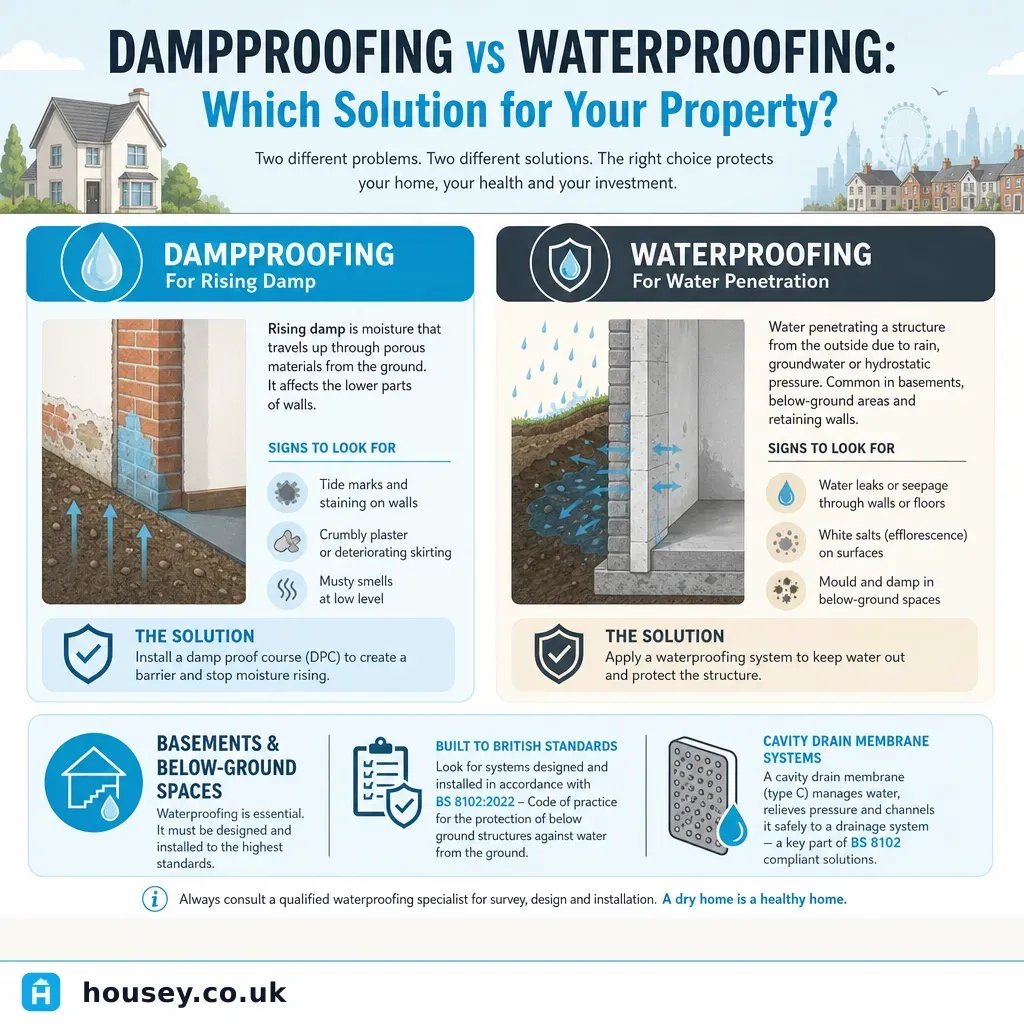
Dampproofing vs Waterproofing: Which Solution for Your Property
Damp proofing resists moisture vapour and capillary movement through masonry and is the correct treatment for rising damp.
 Improvement & Build
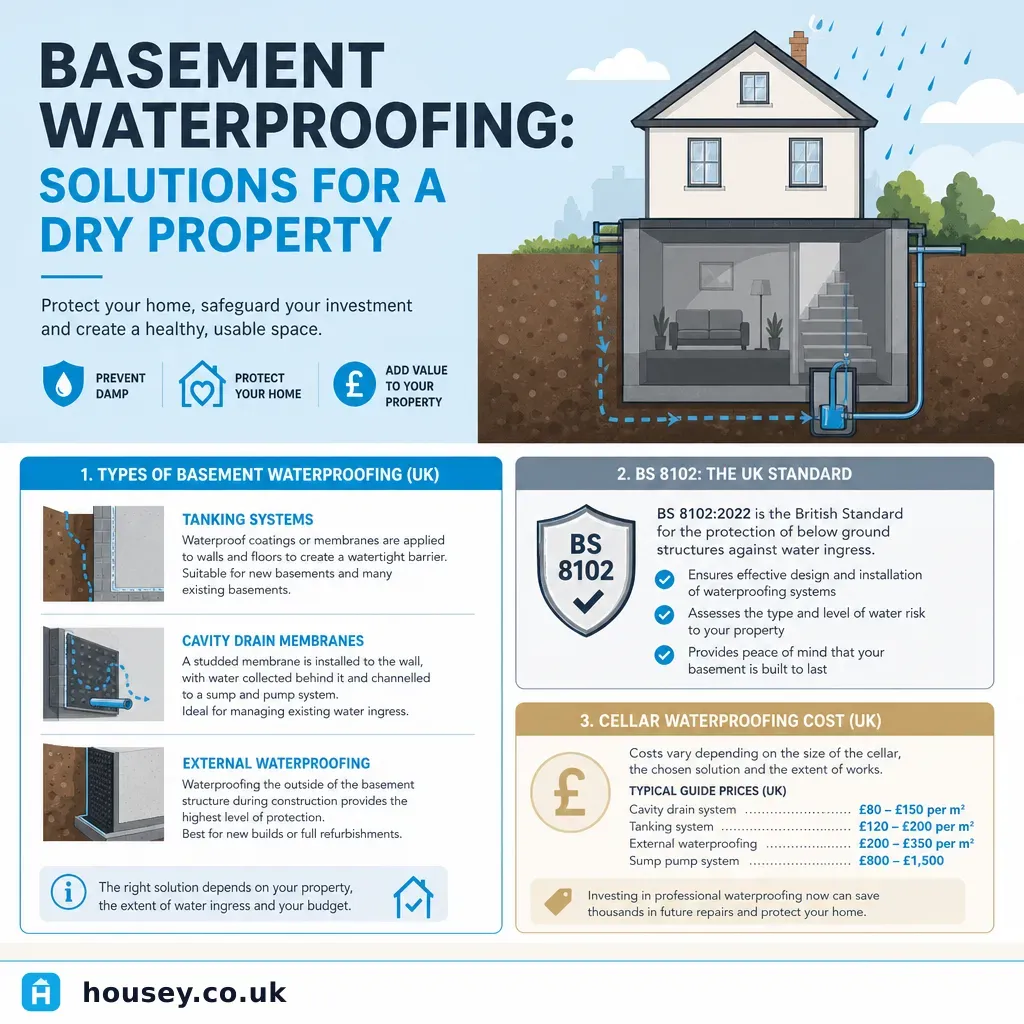
Basement Waterproofing: Solutions for a Dry Property
Basement waterproofing in the UK is governed by BS 8102:2022 and uses three recognised system types: Type A (barrier), Type B (structurally integral), and Type C (drained cavity).
 Improvement & Build
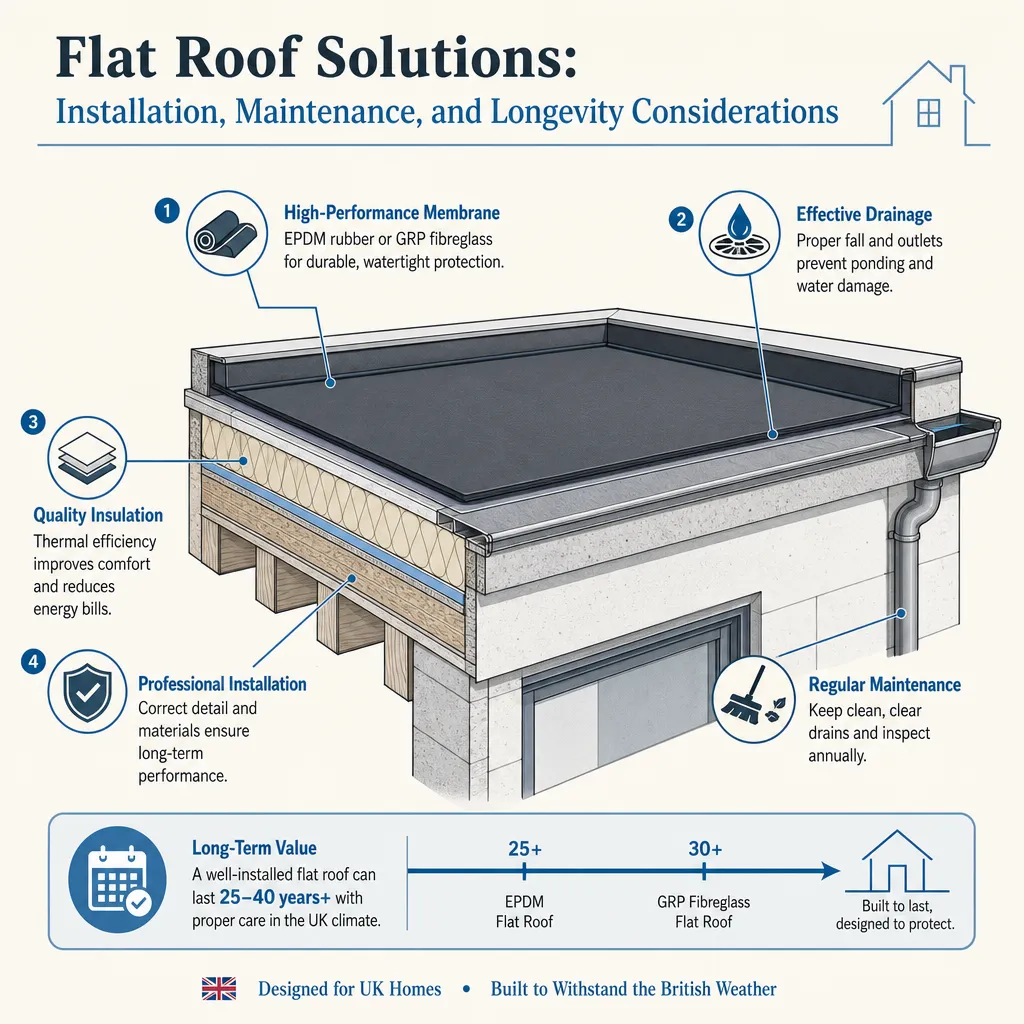
Flat Roof Solutions: Installation, Maintenance, and Longevity Considerations
Flat roofs use several waterproofing systems — EPDM rubber, GRP fibreglass, liquid-applied coatings, modified bitumen felt, lead, and zinc — each with different lifespans and installation requirements.
 Improvement & Build
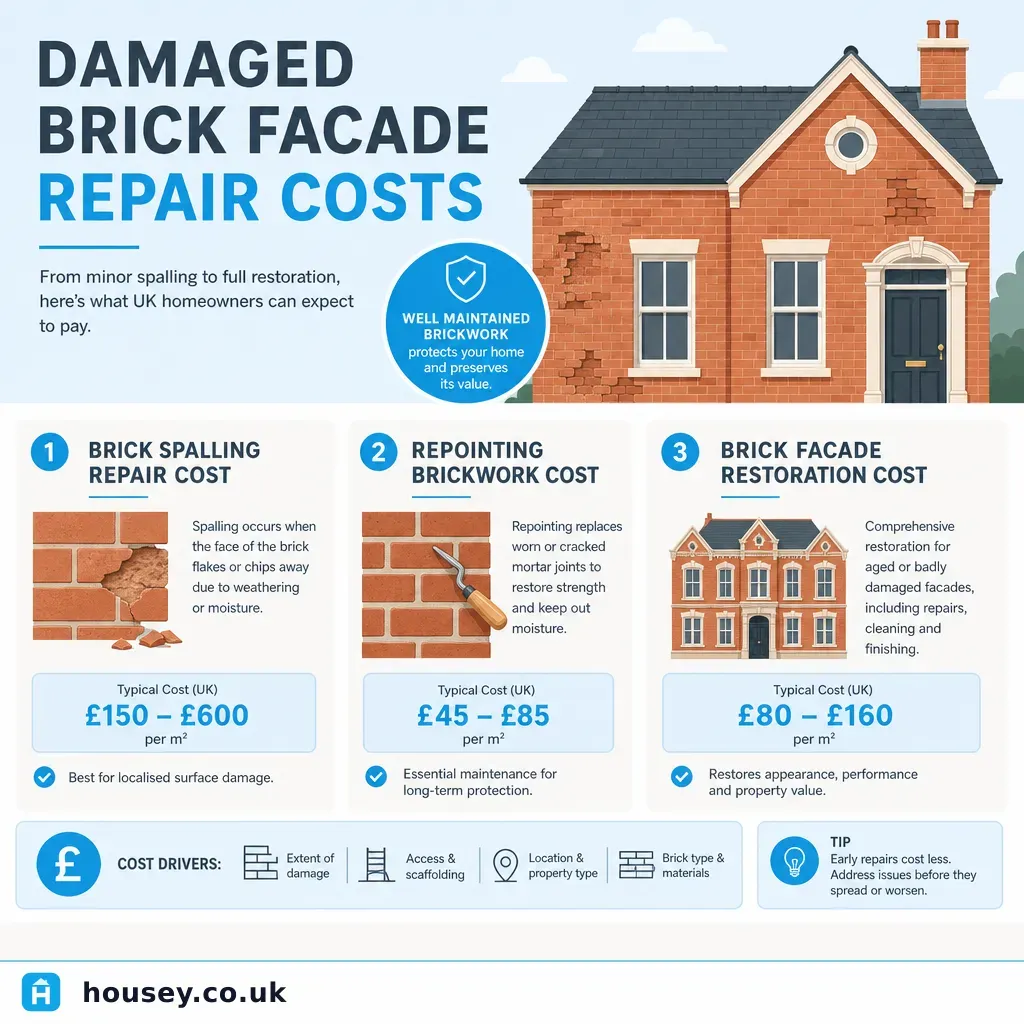
Damaged Brick Facade Repair Costs
Repairing a damaged brick facade in the UK typically involves repointing mortar joints, replacing spalled bricks, or full masonry restoration.
 Improvement & Build
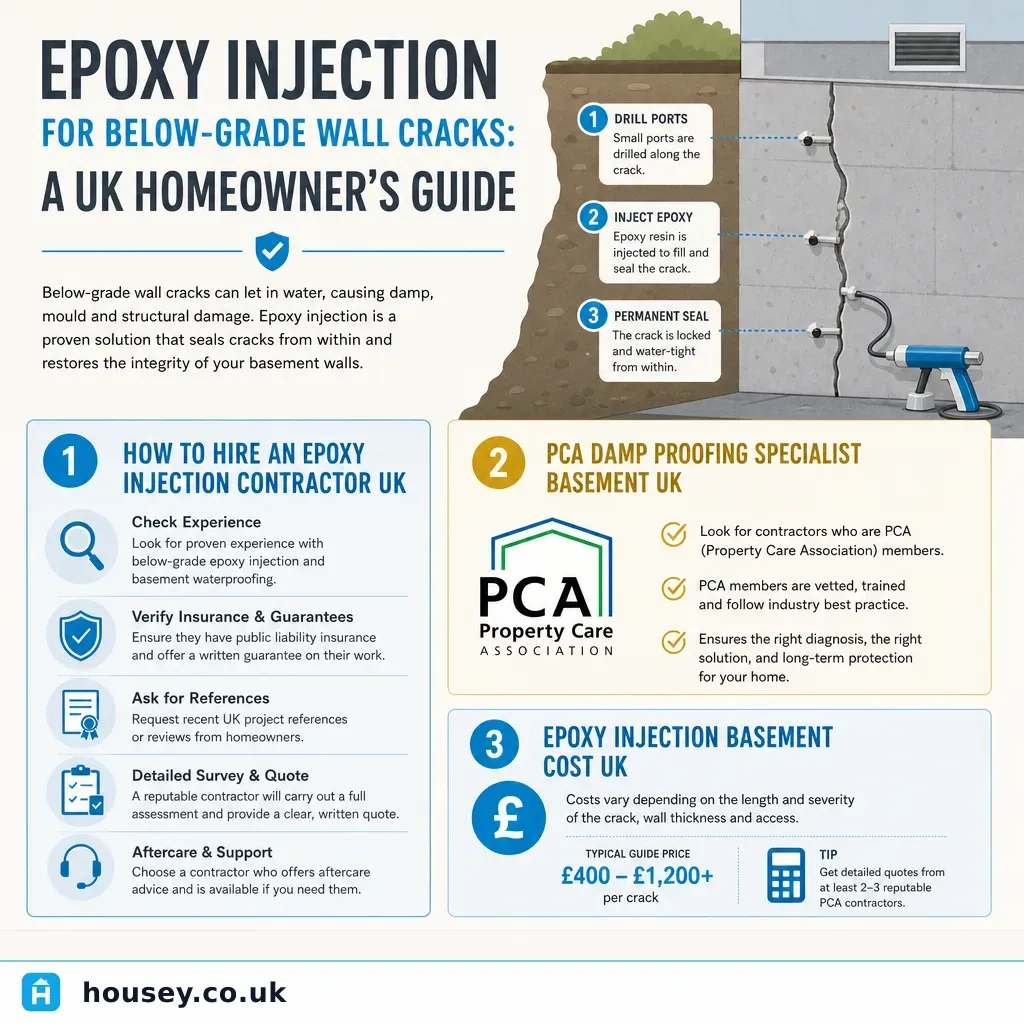
Epoxy Injection for Below-Grade Wall Cracks: A UK Homeowner's Guide
Epoxy injection seals stable, non-moving cracks in below-grade concrete walls but will not work on masonry, actively moving cracks, or as a standalone fix for habitable basement conversions.