Damp Proofing Solutions and Remediation Costs
By Housey · Last reviewed 6th of May 2026
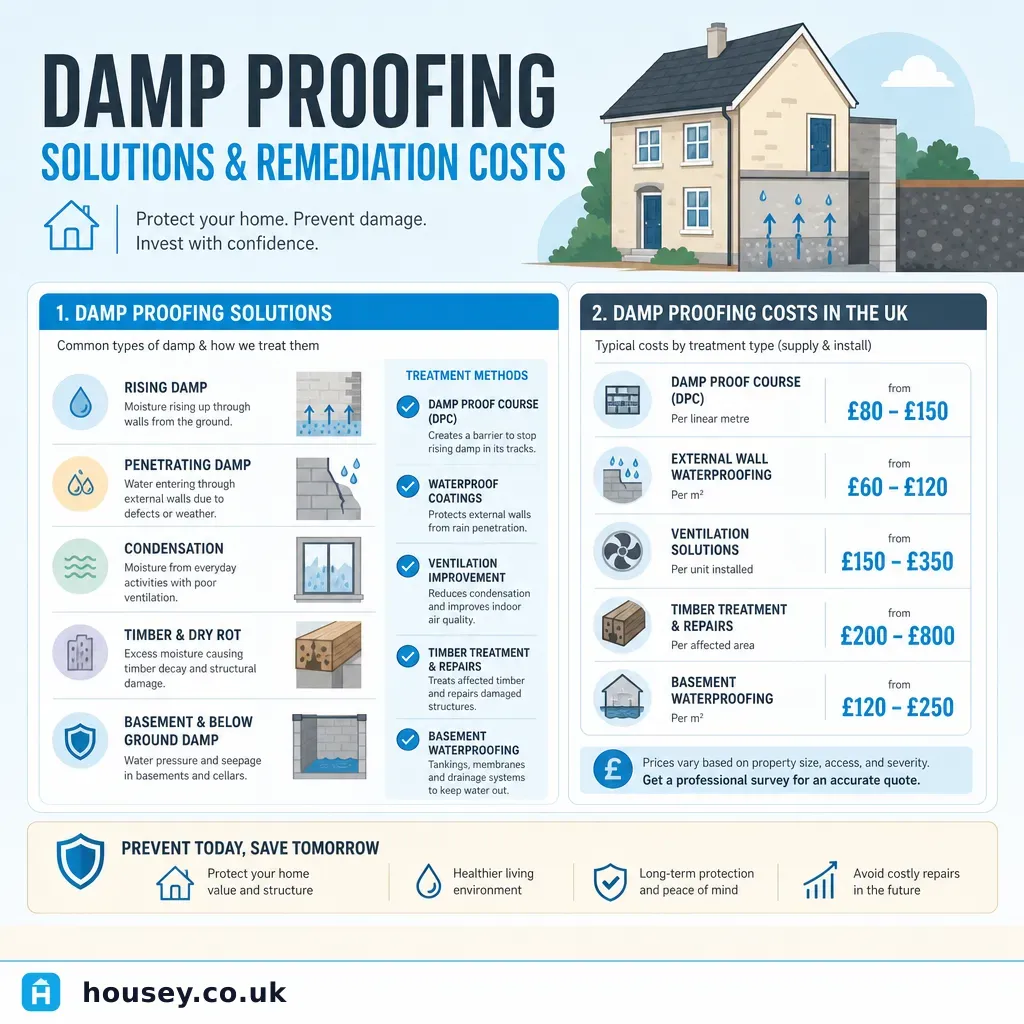
Damp Proofing Solutions and Remediation Costs
Damp in a UK home is rarely a single problem with a single fix. The three main types — rising damp, penetrating damp, and condensation — have different causes, different symptoms, and require different treatments. Commissioning the wrong treatment is a common and costly mistake: chemical DPC injection applied to a property with condensation or a simple bridged DPC achieves little while leaving the root cause unresolved. This article sets out the main damp proofing methods used in UK residential properties, what each typically costs, and how to make sure you commission the right solution for your property.
Key points
- Condensation — not rising damp — is the most prevalent form of damp in UK homes, particularly in well-sealed modern properties and flats; it is usually addressed through improved ventilation rather than chemical treatment.
- The Property Care Association (PCA) is the primary UK trade body for remedial damp-proofing contractors; PCA membership indicates adherence to agreed industry technical standards.
- Chemical DPC injection for rising damp almost always requires replastering with specialist renovation plaster, which typically represents the majority of total remediation costs.
- Basement and below-ground waterproofing is a specialist discipline distinct from above-ground damp proofing; cavity drain membrane systems require ongoing sump pump maintenance to remain effective.
- Indicative costs range from £300–£700 for a positive input ventilation (PIV) unit to £7,000–£15,000 or more for full basement waterproofing. Indicative UK costs, last reviewed 2026-05-06.
Which type of damp do you have?
Accurate diagnosis matters more than any specific treatment method. The three main types present differently and require different responses.
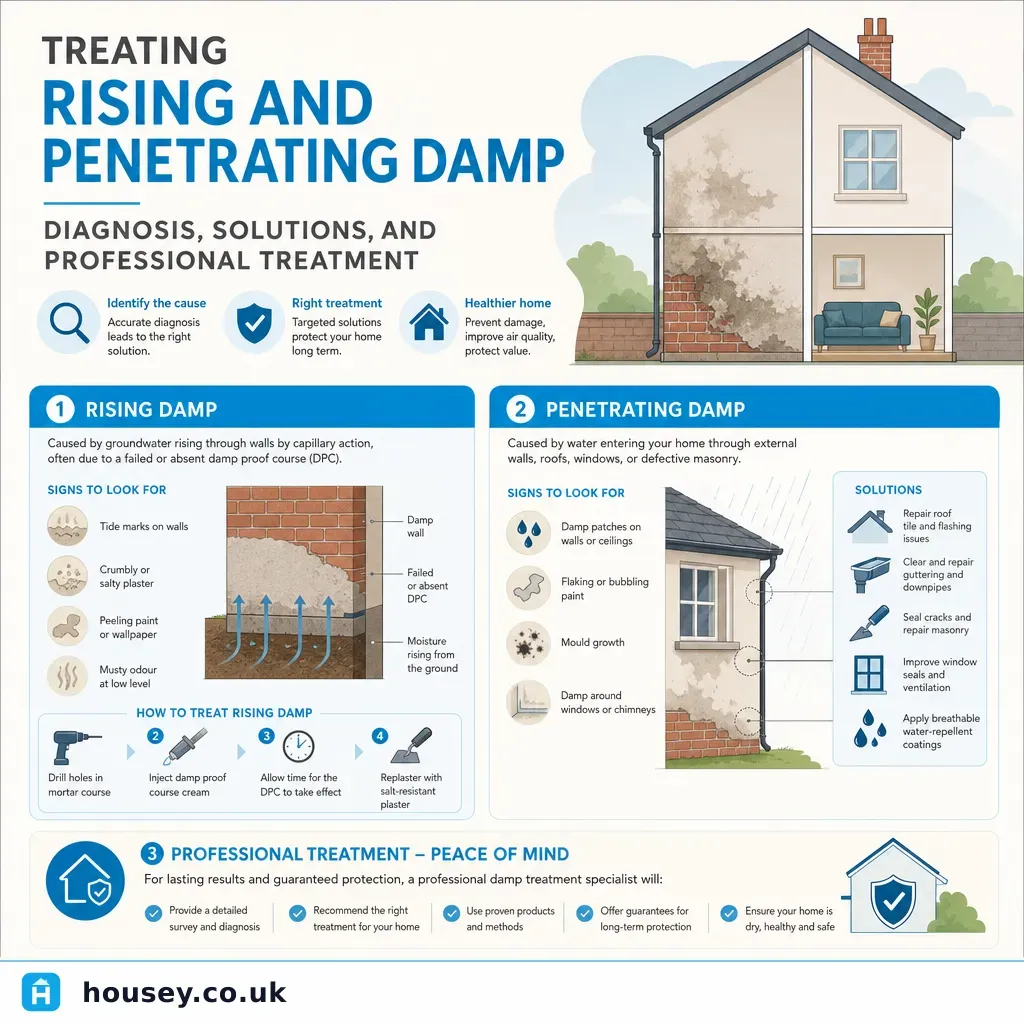
Rising damp occurs when groundwater moves upward through masonry by capillary action. It produces tide marks below 1 metre on ground-floor walls, white salt (efflorescence) deposits, and deteriorating plaster at low level. It is most common in solid-wall pre-1920 homes with a failed, absent, or bridged damp-proof course.
Penetrating damp enters laterally through walls, roofs, or around windows and doors. It can appear at any height, often following rainfall, and is typically associated with defective pointing, failed render, cracked masonry, blocked gutters, or poorly sealed window frames. It is very common in older UK properties and is frequently misdiagnosed as rising damp.
Condensation forms when warm, moist air meets cold surfaces. It is particularly common in kitchens, bathrooms, and poorly ventilated bedrooms, and often manifests as black mould near windows or on cold external walls at mid-height or above. It requires improved ventilation and heating management — not chemical injection or masonry treatment.
Which damp proofing treatment do you need?
Use this decision guide to identify the most likely appropriate approach for your property:
- Choose chemical DPC injection if: rising damp has been confirmed in a solid-wall property by an independent surveyor who has conducted moisture readings and salt analysis.
- Choose pointing, render repair, or masonry sealing if: damp appears at mid-wall or above, worsens during or after rain, and is associated with visibly defective external masonry, failed render, or cracked pointing.
- Choose ventilation improvement (PIV unit or extractor fans) if: you have surface mould, condensation on windows, or damp that worsens in cold weather and improves during summer.
- Choose cavity drain membrane or tanking if: you have a basement, cellar, or below-ground room requiring protection against groundwater entry.
- Commission an independent survey first if: the pattern of damp is unclear, multiple types may be present, or a RICS survey has flagged damp without providing a definitive diagnosis.
Damp proofing methods compared
Method | Best for | Not ideal for | Typical deliverable | Main risk if wrong choice |
|---|---|---|---|---|
Chemical DPC injection | Rising damp in solid-wall properties | Condensation or penetrating damp | Injected mortar course + specialist replastering | Unnecessary spend; root cause unresolved |
Pointing and render repair | Penetrating damp through defective masonry | Rising damp, condensation | Repointed or rerendered external wall | Damp recurs if rising or condensation component missed |
Positive input ventilation (PIV) | Condensation and general indoor humidity | Structural moisture entry | Reduced humidity; mould prevention | No structural damp addressed |
Cavity drain membrane (CDM) | Basement and below-ground waterproofing | Above-ground rising or penetrating damp | Managed drainage system behind membrane | Costly to rectify if installed incorrectly |
Tanking slurry | Basement walls and floors | General rising damp above ground | Waterproof coating bonded to structure | Can fail under high hydrostatic pressure |
Electro-osmotic system | Some listed or historic buildings | Standard modern residential properties | Electronic system managing capillary moisture | Limited independent evidence; specialist evaluation essential |
How much does damp proofing cost?
Costs vary widely depending on the type of treatment, the extent of affected areas, property type, and whether associated works such as replastering or structural repair are included.
Treatment type | Indicative cost range | Notes |
|---|---|---|
PIV unit — supply and installation | £300–£700 | Addresses condensation; no masonry work |
Chemical DPC injection — one wall, no replastering | £300–£700 | Injection only; replastering additional |
Chemical DPC + replastering — 2 ground-floor rooms | £1,500–£3,500 | Typical full remediation package |
Penetrating damp — repointing or render repair | £500–£2,500 | Depends on extent of affected masonry |
Cavity drain membrane — small cellar | £3,000–£7,000 | Membrane, drainage channel, sump pump |
Full basement waterproofing — larger space | £7,000–£15,000+ | Complete system with pump, guarantees, finishes |
Indicative UK costs, last reviewed 2026-05-06. These are broad guides only. Always request at least three itemised written quotes from PCA-registered contractors. Source: Property Care Association guidance and general UK contractor market data.
What to ask before accepting a damp proofing quote
Before instructing any contractor, ask the following:
- What type of damp have you diagnosed, and what testing or evidence — moisture readings, salt analysis, visual inspection — supports that conclusion?
- Are you a Property Care Association (PCA) member, and will the work follow PCA technical standards?
- What exactly is included in the quoted price — injection, plaster removal, replastering, disposal, and making good?
- Is specialist renovation plaster specified for the re-plaster, and what minimum thickness?
- How long is the guarantee, and is it backed by an insurance-backed guarantee (IBG)?
- What could cause the price to increase once work is under way?
- Is VAT clearly included or excluded in the quoted price?
- Do you recommend an independent survey before quoting, or are you diagnosing and pricing on the same visit?
Red flags in damp proofing quotes and contractors
Be cautious if a contractor or quote exhibits the following:
- Diagnosis and a quote are provided on the same visit without recommending an independent assessment first.
- Injection and replastering costs are not separately itemised.
- No PCA membership or equivalent professional accreditation is mentioned.
- A long guarantee (e.g., 30 years) is offered with no reference to insurance backing.
- All dampness is attributed to rising damp without moisture readings, salt tests, or any consideration of condensation or penetrating damp.
- The quoted price appears very low but excludes replastering, which is almost always required for chemical DPC treatment to be effective.
- Urgency is applied — suggestions that the damp is getting rapidly worse and work must begin immediately — to pressure a quick decision.
When to get professional help
Commission a qualified damp specialist or independent surveyor if:
- A RICS survey has flagged damp issues and you need a remediation cost before exchange of contracts.
- You have visible mould, salt staining, or tide marks and are uncertain of the root cause.
- Previous damp-proofing treatment has failed or the property has recurring damp despite earlier work.
- You are planning to convert a basement or cellar and need structural waterproofing advice.
- External render, pointing, or flashings are visibly deteriorating and you suspect lateral moisture entry.
An independent assessment — obtained before agreeing to any remedial work — gives you an unbiased diagnosis and a written specification you can use to obtain genuinely comparable quotes.
How Housey can help
Housey can connect you with vetted damp proofing specialists across the UK. Request itemised quotes, compare contractor accreditations, and make sure the treatment you commission matches the damp problem your property actually has — whether that is condensation control, chemical DPC injection, penetrating damp repair, or basement waterproofing.
Frequently asked questions
How do I know if I have rising damp or condensation?
Rising damp typically presents as horizontal tide marks below 1 metre on solid ground-floor walls, with white salt deposits and deteriorating plaster. Condensation usually appears as black mould near windows, on cold external walls at higher levels, or in kitchens and bathrooms. An independent damp surveyor can carry out moisture readings and salt analysis to distinguish between them accurately.
Do all older UK homes need damp proofing treatment?
Not necessarily. Many pre-1920 homes without a formal DPC have functioned for over a century, particularly solid-wall properties allowed to breathe. Damp problems in older properties are sometimes caused by modern interventions — impermeable render, double glazing without ventilation, or injudicious insulation — rather than a fundamental failure of the original construction.
How long does damp proofing last?
Chemical DPC injection typically carries contractor guarantees of 20–30 years. Penetrating damp repairs are only as durable as the pointing, render, or flashings installed. Ventilation solutions require periodic filter cleaning or replacement. Basement waterproofing systems can last many decades if the sump pump is regularly serviced. Always confirm that long guarantees are backed by an insurance-backed guarantee scheme.
Will damp proofing improve my EPC rating?
Damp proofing alone is unlikely to improve an Energy Performance Certificate rating directly. However, addressing damp may be a prerequisite for other energy-efficiency improvements — particularly internal wall insulation, where damp masonry creates a condensation and mould risk beneath the new lining. A retrofit coordinator or EPC assessor can advise on the correct sequence of works for your property.
Is there a government grant for damp proofing?
There is no dedicated UK government grant for standalone damp proofing. However, if moisture problems are linked to energy-efficiency improvements such as wall insulation, some funding may be available under ECO4 or the Great British Insulation Scheme if you meet the eligibility criteria. Check current GOV.UK guidance for up-to-date details, as scheme eligibility rules change regularly.
Sources and further reading
- Damp in Buildings — Homeowner Guidance — Property Care Association
- Damp in Old Buildings — Historic England
- Damp and condensation — Energy Saving Trust
- ECO4 and Great British Insulation Scheme — GOV.UK
- RICS Home Survey Standard — RICS
Useful next reads
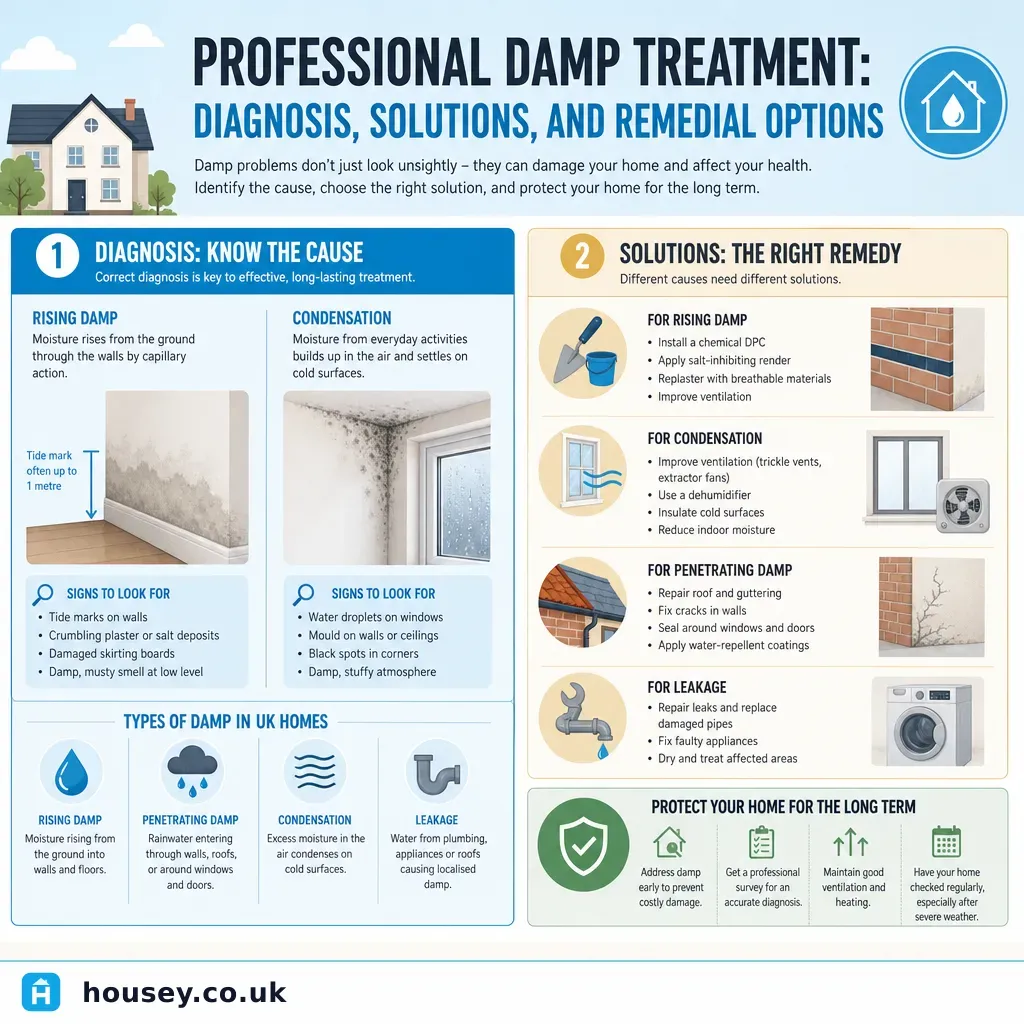 Improvement & Build
Professional Damp Treatment: Diagnosis, Solutions, and Remedial Options
Professional damp treatment begins with correct diagnosis of which type of dampness is present — rising damp, penetrating damp, or condensation — as each requires a different remedial approach.
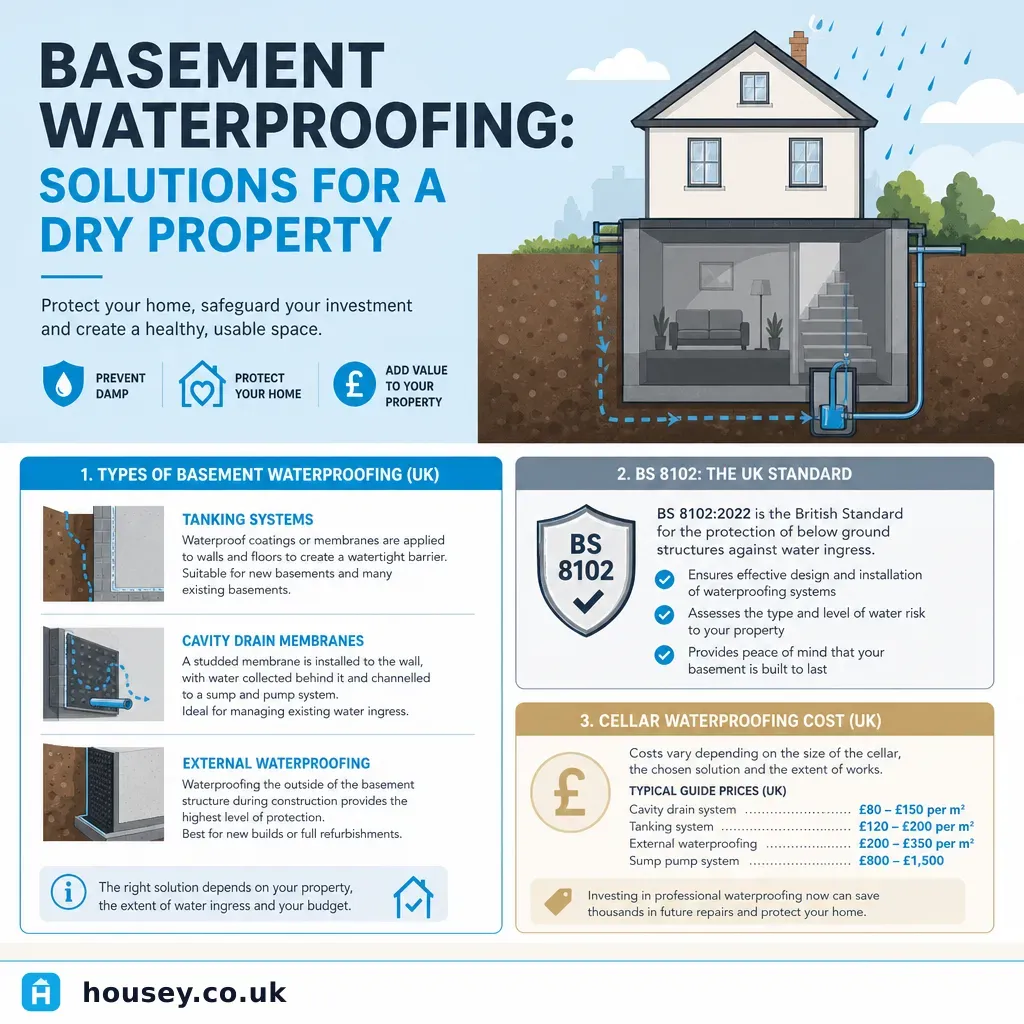 Improvement & Build
Basement Waterproofing: Solutions for a Dry Property
Basement waterproofing in the UK is governed by BS 8102:2022 and uses three recognised system types: Type A (barrier), Type B (structurally integral), and Type C (drained cavity).
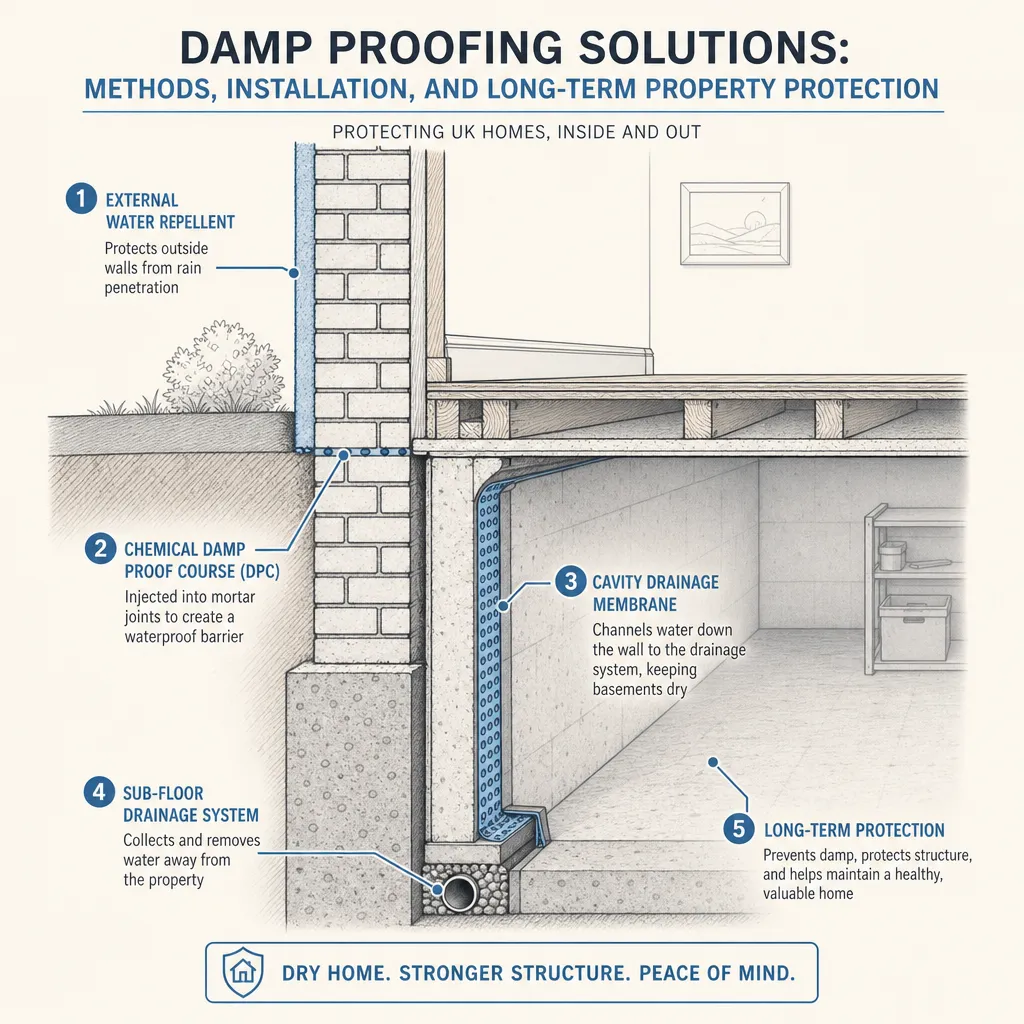 Improvement & Build
Damp Proofing Solutions: Methods, Installation, and Long-Term Property Protection
Damp proofing in UK homes typically involves chemical damp proof course (DPC) injection for rising damp, cavity drainage membranes for basement or below-ground moisture, and tanking for waterproofing solid walls.
 Improvement & Build
Treating Rising and Penetrating Damp: Diagnosis, Solutions, and Professional Treatment
Rising damp appears as a tide mark at the base of ground-floor walls and is caused by a failed or absent damp-proof course.
 Improvement & Build
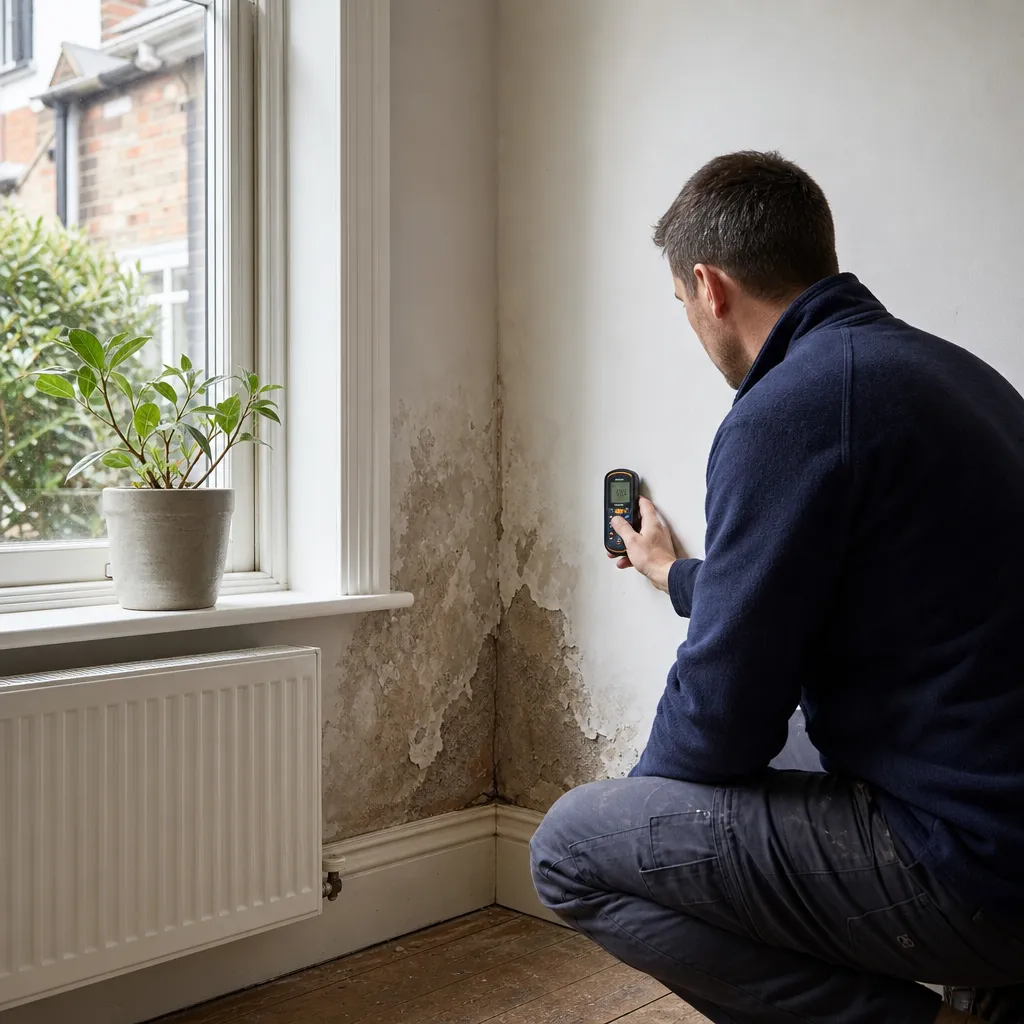
Identifying and Treating Damp Before Interior Decoration: Remediation First
Decorating before treating damp guarantees early failure — paint and wallpaper will bubble, stain, and peel within months.