Damp-Proofing and Waterproofing Treatment Costs
By Housey · Last reviewed 7th of May 2026
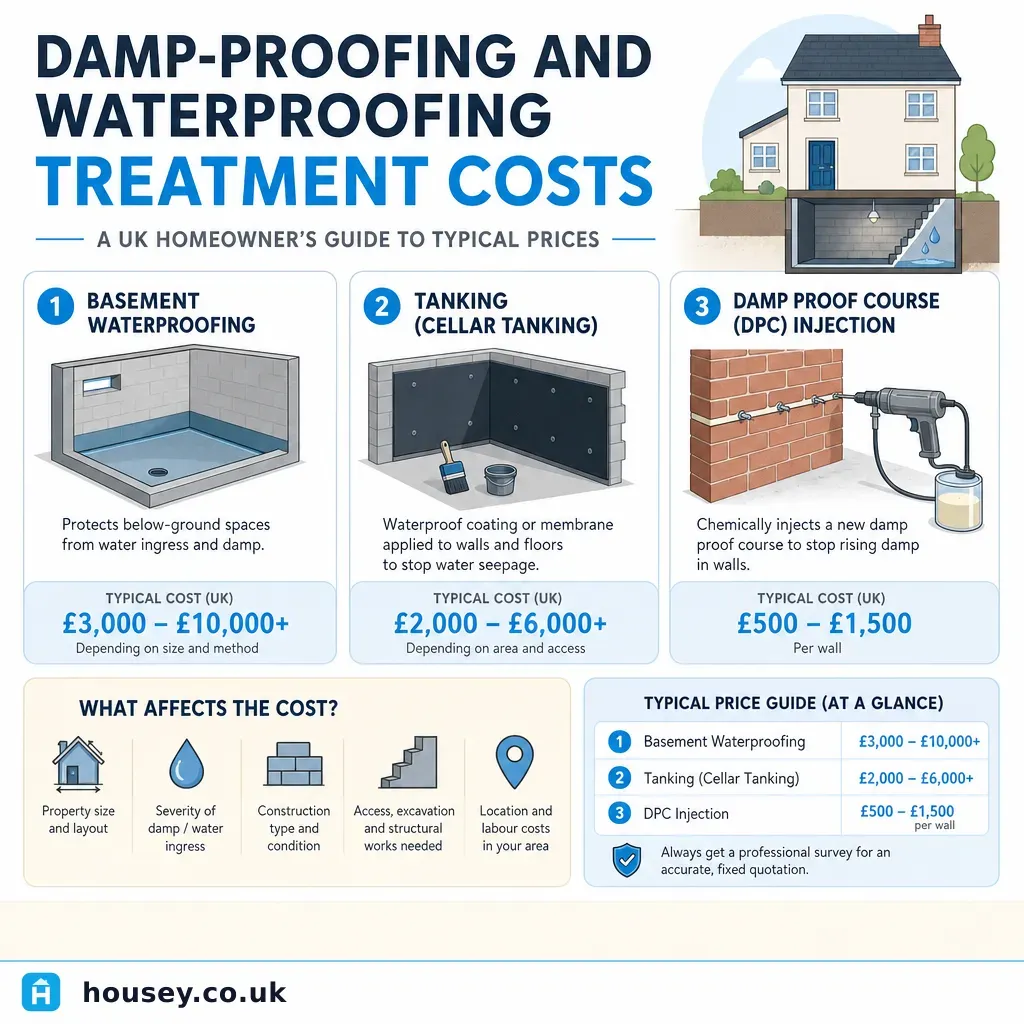
Damp-Proofing and Waterproofing Treatment Costs
Damp problems are among the most commonly reported defects in UK homes, appearing across property types from Victorian terraces to post-war semis and modern new builds. Costs vary significantly depending on the treatment method, the severity and cause of moisture ingress, and whether the work involves above-ground rising damp or a full basement waterproofing system. Getting the diagnosis right before commissioning any work can make the difference between a targeted £500 fix and an unnecessary £3,000 treatment.
Key points
- Chemical damp proof course (DPC) injection for a single room typically costs £300–£800; whole-ground-floor treatment on a three-bedroom semi often ranges from £1,500–£3,500 including replastering (Indicative UK costs, last reviewed 2026-05-07).
- Basement waterproofing using a Type C cavity drain membrane system (as defined in BS 8102:2009) typically costs £80–£150 per m² installed, including a sump pump.
- The Property Care Association (PCA) is the main UK trade body for damp-proofing contractors; member-certified work usually carries a 20–30 year guarantee backed by Guarantee Protection Insurance (GPI).
- An independent damp and timber survey from a RICS-registered or PCA-qualified surveyor — typically £200–£400 — should precede any treatment to confirm the cause, as condensation and penetrating damp are frequently misdiagnosed as rising damp.
- Building Regulations Approved Document C governs site preparation and moisture resistance; basement conversion projects may require building control approval.
What damp-proofing and waterproofing treatments involve
Damp in UK homes falls into three broad categories, each requiring a different treatment approach.
Rising damp occurs when ground moisture travels upward through masonry via capillary action where a damp proof course is absent, failed, or bridged. Treatment usually involves injecting a chemical DPC into mortar courses and replacing salt-damaged plaster.
Penetrating damp enters laterally through walls or around windows due to defective pointing, cracked render, failed flashings, or porous masonry. The fix is usually remedial building work — repointing, render repair, new flashings — rather than a chemical treatment.
Basement and below-ground water ingress occurs where the water table or drainage pressure forces water through the structure. BS 8102:2009 classifies waterproofing systems into three types depending on the protection strategy required.
Getting this distinction right matters because treatment costs vary substantially between categories, and misdiagnosis leads to unnecessary expenditure.
Damp-proofing costs by treatment type
Treatment type | What it addresses | Indicative cost (UK, 2026) | Typical guarantee |
|---|---|---|---|
Chemical DPC injection | Rising damp | £300–£800 per room | 20–30 years (PCA-backed) |
Cementitious tanking slurry | Basement waterproofing (Type A) | £70–£150 per m² | 10–25 years |
Cavity drain membrane (Type C) | Active water ingress, basements | £80–£150 per m² + sump | 10–25 years |
Remedial plaster re-render | Post-DPC salt-damaged plaster | £20–£50 per m² | N/A |
External waterproof coating | Penetrating damp on solid walls | £15–£40 per m² | Varies |
Damp-proof membrane (floor) | Ground moisture under solid floors | £15–£30 per m² | N/A |
Indicative UK costs, last reviewed 2026-05-07. Costs vary by region, property size, and contractor.
Basement waterproofing in detail
BS 8102:2009 — the British Standard for protection of below-ground structures against water — defines three system types:
- Type A (barrier protection): Applied membranes or coatings (cementitious tanking, sheet membranes). Suitable where the water table is low and hydrostatic pressure is limited.
- Type B (structurally integral protection): Waterproof concrete. Used primarily in new-build basement construction.
- Type C (drained cavity protection): Cavity drain membranes channelling water to a sump and pump. Recommended by the PCA for most existing UK basement conversions where active water ingress is present.
For a 30 m² basement using a Type C system including sump pump installation, total costs commonly range from £4,500–£8,000. Cementitious tanking alone for the same area might cost £2,500–£5,000. These are indicative figures; an accurate quote requires a site visit and assessment of ground conditions.
Worked UK property scenario
A homeowner in a 1960s semi-detached in South Yorkshire notices damp patches at low level on the front bay wall and a musty smell in the reception room. Two contractors quote £1,800–£2,200 for DPC injection and replastering, citing rising damp. Before proceeding, the homeowner commissions an independent damp and timber survey from a PCA-member surveyor (cost: £280).
The survey identifies a cavity wall debris bridge — soil raised against the external wall during recent garden work — as the primary cause. The recommendation is to clear the cavity via airbrick renewal and lower the external ground level. Total remedial cost: approximately £350, saving over £1,500 compared with the unnecessary DPC treatment quoted.
This scenario is common. The PCA's own guidance warns that condensation and bridged cavities are frequently misidentified as rising damp by contractors conducting visual-only assessments.
What drives damp-proofing costs
- Wall length — DPC injection is priced per linear metre; longer walls cost proportionally more.
- Plaster condition — Salt-damaged plaster must be removed and replaced after DPC injection, often adding 30–50% to the total bill.
- Basement floor area — Waterproofing and tanking costs scale directly with m².
- Sump pump installation — Type C systems require a sump and pump (£500–£1,500 installed), a cost some quotes present separately or omit entirely.
- Access difficulties — Restricted or below-ground-only access increases labour time and cost.
- Pre-treatment repairs — Defective guttering, cracked pointing, or failed flashings must be fixed first and are often quoted separately.
- Regional labour rates — Costs are typically higher in London and the South East.
What to ask before accepting a quote
- What is the specific cause of the damp, and how was it diagnosed?
- Is this quotation based on a survey or a visual inspection only?
- Are you a PCA member, and does this work carry a GPI-backed guarantee?
- Which British Standard or PCA technical guidance note does this treatment follow?
- Does the quote include plaster removal and replacement?
- Is VAT included?
- What ongoing maintenance will the system require?
- What is the claims process if the problem recurs within the guarantee period?
When to get professional help
Commission an independent damp and timber survey before agreeing to any treatment. This is particularly important if a contractor has diagnosed rising damp without using a calibrated moisture meter or without checking external ground levels, cavity wall condition, or guttering.
Seek professional advice without delay if you notice:
- Damp patches spreading or appearing on multiple walls
- White salt deposits (efflorescence) on internal surfaces, indicating active moisture movement
- Swollen, soft, or discoloured skirting boards or timber at floor level
- Structural cracking accompanying the damp — this may indicate a separate issue warranting a structural survey
- Water pooling in a basement or cellar after heavy rain
How Housey can help
Housey connects you with vetted damp proofing specialists who operate in your area. For an independent diagnosis before committing to treatment, request a damp and timber survey through the platform — independent surveyors are not selling the treatment, so their recommendations carry no commercial conflict.
Frequently asked questions
How much does damp proofing cost for an average UK house?
Treating rising damp across the full ground floor of a three-bedroom semi-detached — including replastering — typically costs £1,500–£3,500 (Indicative UK costs, last reviewed 2026-05-07). Basement waterproofing is separate and usually higher, typically £4,500–£8,000 for a small basement. The wide range reflects wall length, plaster condition, treatment method, and regional labour rates.
Does damp proofing add value to my home?
Untreated damp typically reduces a buyer's offer or triggers conditions at survey. Effective treatment with a transferable PCA-backed guarantee protects value rather than adds it — buyers and their surveyors regard a valid guarantee as reassurance. It rarely increases a valuation above the pre-damp market level.
How long does damp proofing last?
Chemical DPC injection by a PCA member typically carries a 20–30 year guarantee. Cavity drain membrane systems are generally guaranteed for 10–25 years, but the sump pump must be checked and serviced annually to maintain the warranty. Cementitious tanking guarantees vary by contractor and the specific product applied.
Is damp proofing covered by home insurance?
Most standard UK buildings insurance policies exclude damp caused by gradual deterioration or lack of maintenance. Cover may apply where damp results from a sudden accidental event such as a burst pipe or storm damage. Always check your policy wording and speak to your insurer before starting any remedial work.
Do I need building regulations approval for damp proofing?
Routine DPC injection or internal tanking to existing walls does not normally require building regulations approval. However, if the project forms part of a basement conversion creating new habitable space, approval under Approved Document C and potentially Part F (ventilation) will usually apply. Check with your local building control authority before starting work.
Sources and further reading
- Property Care Association — guidance for homeowners — PCA
- Approved Document C: Site preparation and resistance to contaminants and moisture — GOV.UK
- BS 8102:2009 — Code of practice for protection of below-ground structures against water from the ground — BSI
- RICS professional standards: damp and condensation — RICS
- Energy Saving Trust: damp and condensation advice — Energy Saving Trust
Useful next reads
 Improvement & Build
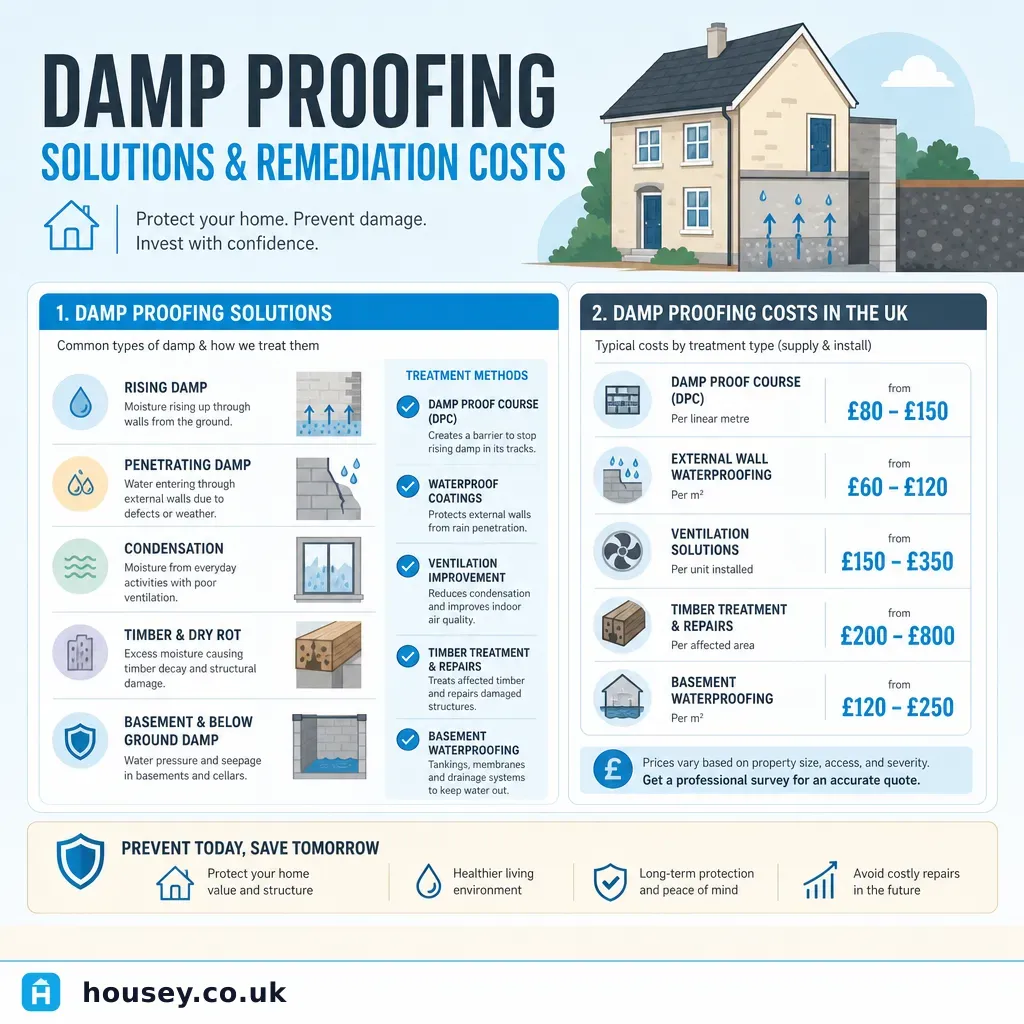
Damp Proofing Solutions and Remediation Costs
Damp proofing costs depend on the type of damp present: ventilation improvements for condensation start at around £300–£700, chemical DPC injection plus replastering typically costs £1,500–£3,500, and full basement waterproofing can reach £7,000–£15,000 or more.
 Improvement & Build
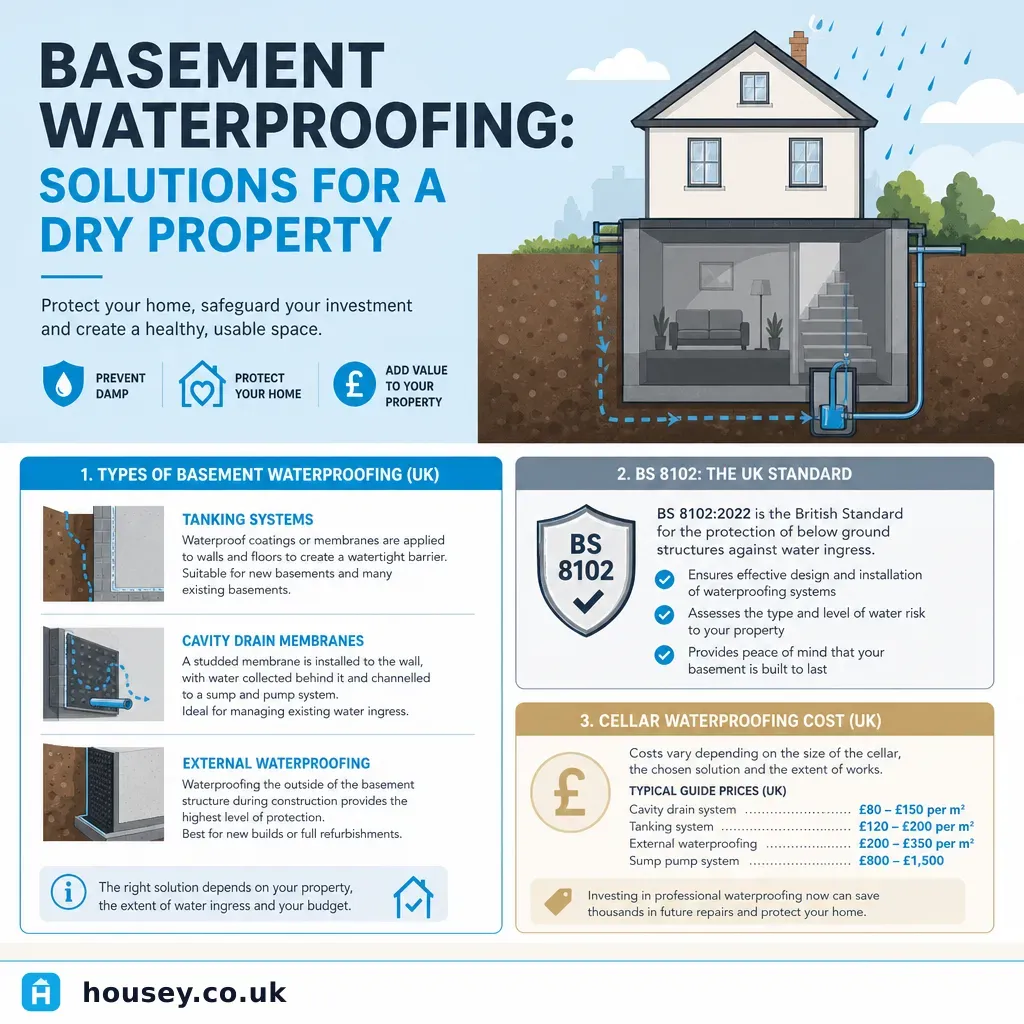
Basement Waterproofing: Solutions for a Dry Property
Basement waterproofing in the UK is governed by BS 8102:2022 and uses three recognised system types: Type A (barrier), Type B (structurally integral), and Type C (drained cavity).
 Improvement & Build
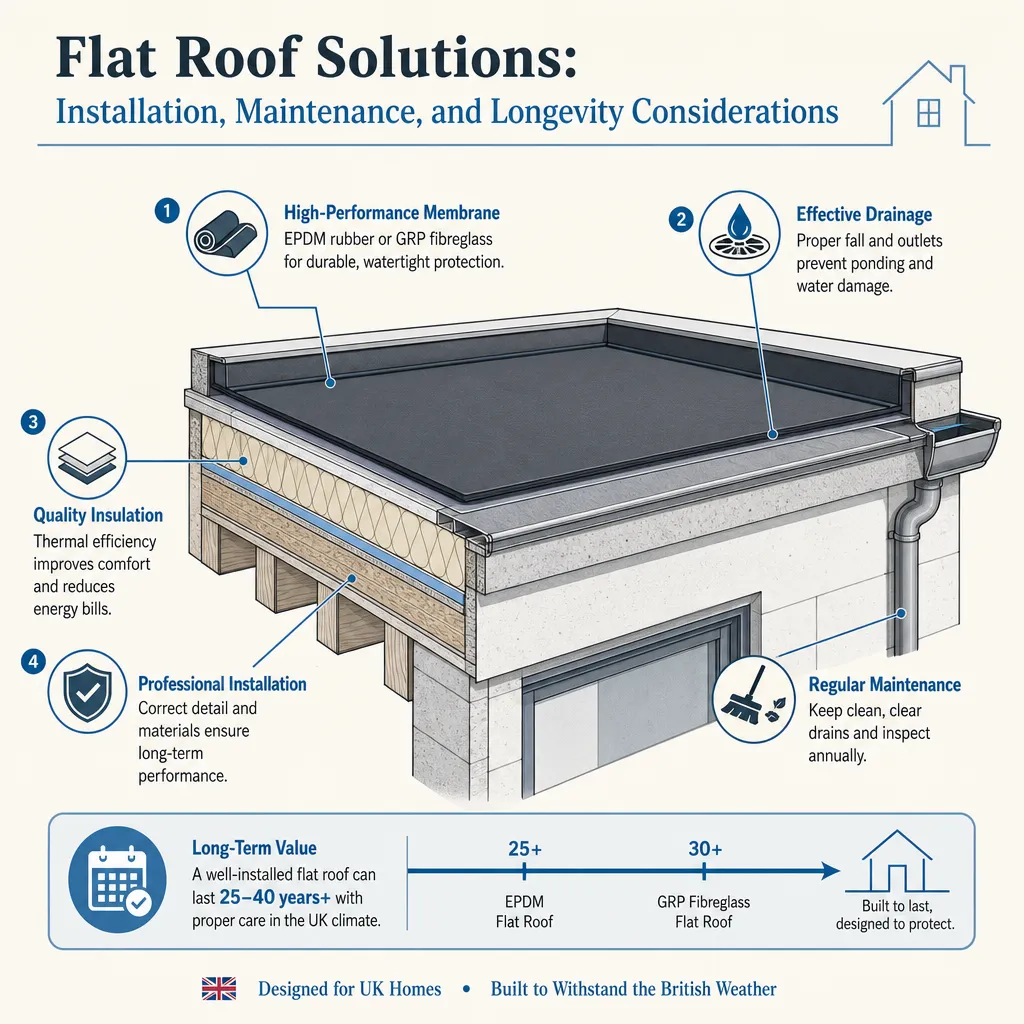
Flat Roof Solutions: Installation, Maintenance, and Longevity Considerations
Flat roofs use several waterproofing systems — EPDM rubber, GRP fibreglass, liquid-applied coatings, modified bitumen felt, lead, and zinc — each with different lifespans and installation requirements.
 Improvement & Build
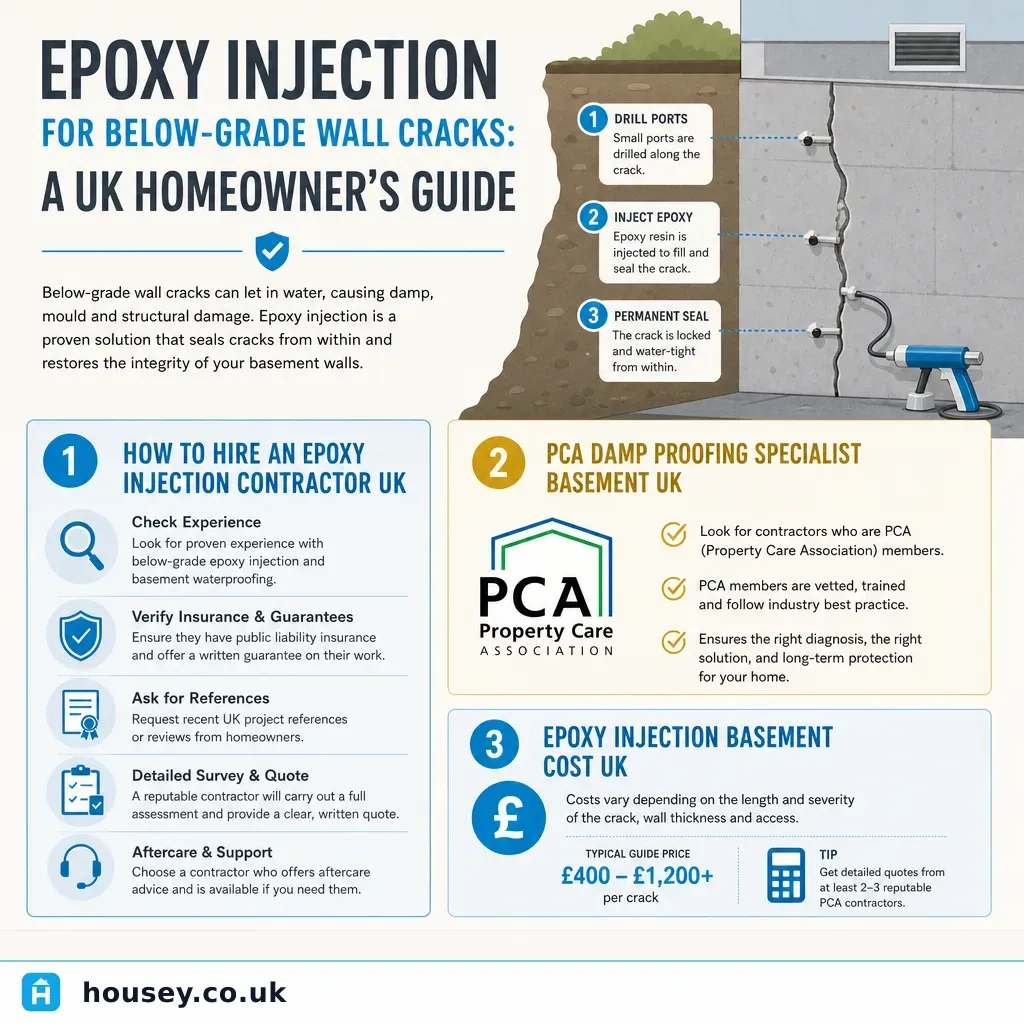
Epoxy Injection for Below-Grade Wall Cracks: A UK Homeowner's Guide
Epoxy injection seals stable, non-moving cracks in below-grade concrete walls but will not work on masonry, actively moving cracks, or as a standalone fix for habitable basement conversions.
 Improvement & Build
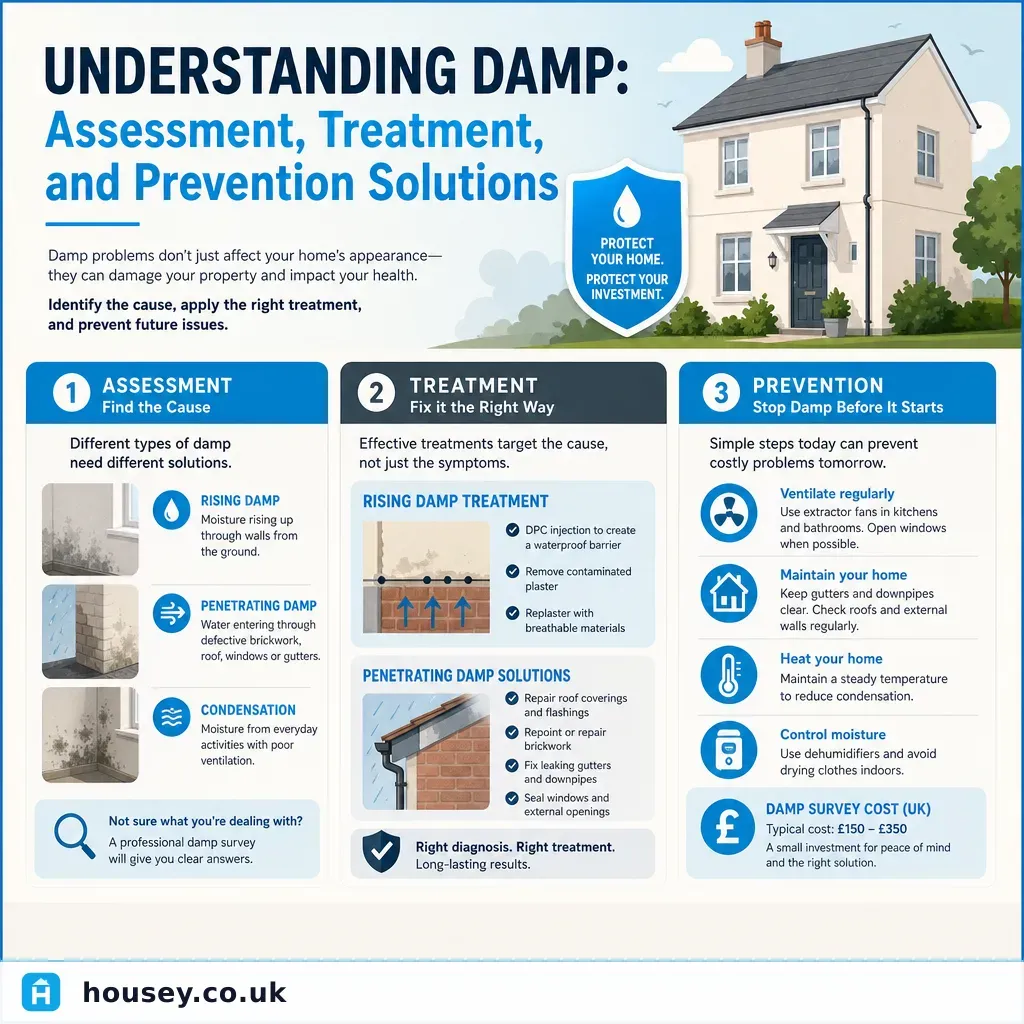
Understanding Damp: Assessment, Treatment, and Prevention Solutions
Damp in UK homes usually falls into three categories — rising damp, penetrating damp, and condensation — each requiring a different remedy.