Basement Window Styles and Selection for Below-Ground Spaces
By Housey · Last reviewed 26th of May 2026
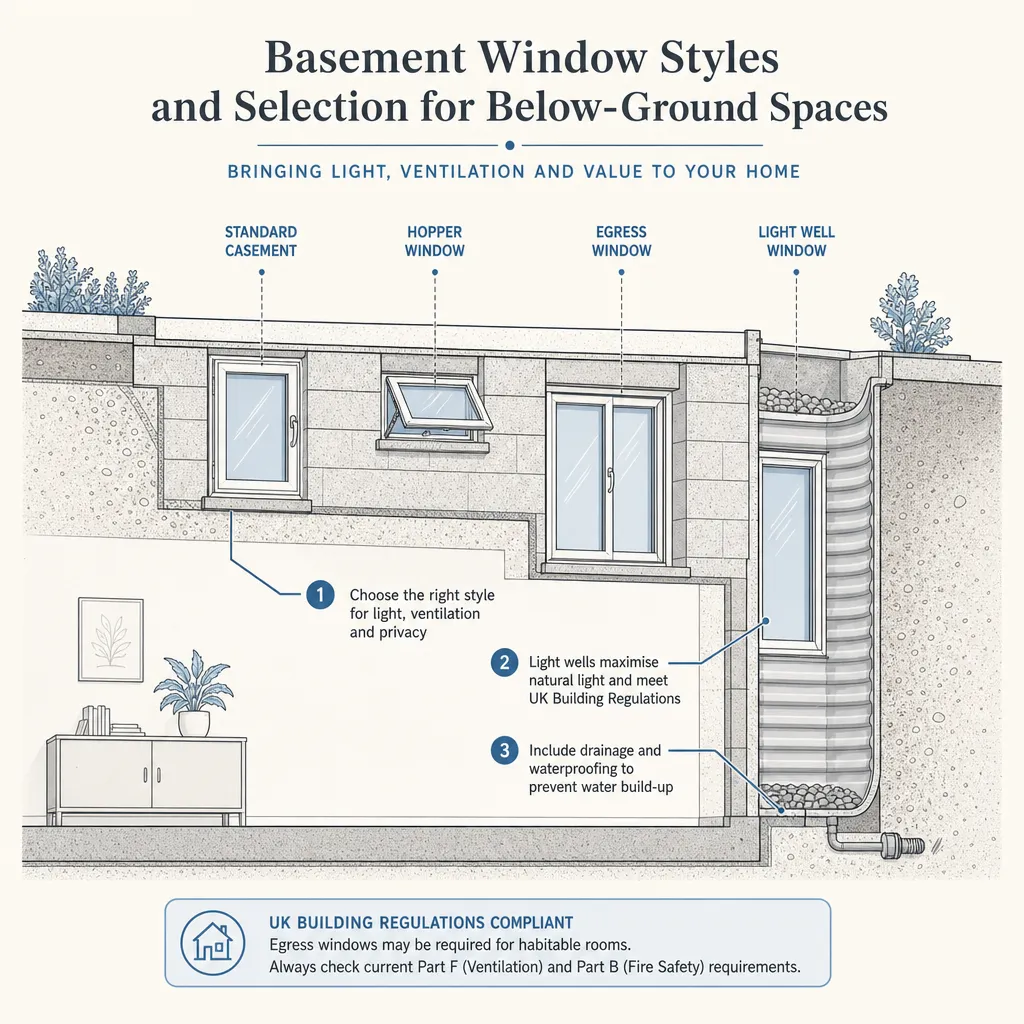
Basement Window Styles and Selection for Below-Ground Spaces
The decision about basement windows often arises mid-project — after the structural shell has been agreed but before finishing specifications are locked in. In UK homes, below-ground spaces present a distinct set of challenges that ordinary window products are not designed to handle: hydrostatic pressure, condensation risk, drainage requirements, and compliance with Building Regulations governing habitable and non-habitable below-ground rooms. Getting the specification wrong can mean persistent damp, inadequate ventilation, or glazing that is unsafe in an emergency.
Key points
- Building Regulations Approved Document F requires a minimum ventilation opening equivalent to 1/20th of the floor area for habitable basement rooms.
- Approved Document K requires guarding at basement windows where the drop to the inside is 600 mm or more from finished floor level.
- Light wells must have a drainage outlet connected to a soakaway or surface water drain to prevent water pooling against the window frame.
- Basement windows forming a means of escape must provide a clear opening of at least 0.33 m², at least 450 mm in both height and width, per Approved Document B.
- Frame materials for below-ground windows should resist prolonged moisture contact; uPVC and aluminium typically outperform untreated timber in below-ground conditions.
What makes basement windows different from above-ground glazing
Standard double-glazed units are designed for walls above the damp-proof course. Basement windows face a different set of stresses: the frame and surrounding masonry may be subject to lateral water pressure depending on ground conditions, condensation is more persistent at lower levels, and external drainage must be actively managed to prevent the light well becoming a water reservoir.
The depth of the window sill below external ground level is the most important variable. Where the sill is more than 300 mm below ground level, a light well (also called an area well or areaway) is typically required, and the well's drainage becomes as critical as the window specification itself.
Window styles suited to below-ground spaces
Not all window configurations are practical below ground. The opening mechanism, ease of cleaning, and resistance to wind-driven water all vary between types.
Window style | How it opens | Suited to basements? | Key consideration |
|---|---|---|---|
Hopper (inward-tilting) | Top-hinged, tilts inward at the bottom | Yes — good ventilation, no external projection | Limited opening size; check against escape requirements if habitable room |
Casement (outward-opening) | Side-hinged, opens outward | Yes, if light well is large enough | Requires adequate well depth; drainage grate may obstruct full opening |
Tilt-and-turn | Tilts inward or opens fully inward | Good for habitable rooms needing large openings | Inward swing needs clear internal space |
Fixed light | Non-opening | For light-only, non-habitable spaces | Does not count towards Part F ventilation area |
Pivot | Rotates on horizontal or vertical axis | Occasionally used in larger light wells | Less watertight seal when open; less common in new-build basements |
For habitable basement rooms — bedrooms, living rooms, home offices — tilt-and-turn or large hopper units are generally preferred because they combine good ventilation area with an inward-opening mechanism that does not require external clearance in the light well.
Light wells: design and drainage
A light well is the excavated or built void that allows light and air to reach a below-ground window. In UK practice, light wells are typically lined with galvanised steel, precast concrete, or brick, and should:
- Extend at least 300 mm below the window sill and 150 mm above external ground level to reduce water entry.
- Have a gravel base or channel drain connected to a soakaway or surface water drainage system.
- Be fitted with a steel grating at ground level to prevent leaf accumulation and deter unauthorised access.
Well drainage is not optional. Even a well-sealed frame will eventually fail if water ponds against it under pressure. On clay-heavy UK soils — common across London, the Midlands, and parts of the South East — this risk is elevated.
Building Regulations requirements for basement windows
Several Approved Documents apply to below-ground window installations:
- Part F (Ventilation): Habitable rooms below ground require a minimum background ventilation opening equivalent to 1/20th of the floor area.
- Part K (Protection from falling): Where a basement window is at a level from which a person could fall 600 mm or more, guarding is required.
- Part B (Fire safety): If the basement is used as sleeping accommodation, a means-of-escape window is required. Minimum clear opening: 0.33 m², with height and width each no less than 450 mm, and the sill no more than 1,100 mm from floor level.
- Part L (Conservation of fuel and power): Replacement windows must achieve a whole-window U-value of no more than 1.4 W/m²K.
Building control approval is required for new habitable basement rooms. Replacing an existing window of the same size is generally notifiable under a competent person scheme (FENSA or CERTASS) rather than requiring full building control sign-off.
Waterproofing and frame specification
The window frame and its interface with the surrounding structure are a common point of water ingress in UK basements. Key considerations:
- Frame material: uPVC and powder-coated aluminium resist moisture well. Timber frames require careful specification — factory-finished engineered timber with appropriate treatment can perform well, but untreated softwood in below-ground conditions without regular maintenance is a long-term risk.
- Waterproofing interface: The waterproofing system (typically a Type A tanking or Type C drainage membrane under BS 8102:2022) must lap correctly with the window frame installation to prevent water bridging at the junction.
- Thermal bridging: Below-ground window reveals are prone to thermal bridging, increasing condensation risk. Insulated cavity closers and warm-edge spacer bars in the glazed unit help reduce this.
BS 8102:2022 (Protection of below-ground structures against water from the ground) is the applicable British Standard for below-ground waterproofing in UK construction, setting three protection grades according to intended use.
Pre-specification checklist
Before finalising basement window specifications, confirm that you have addressed the following:
When to get professional help
For most below-ground window installations, a FENSA- or CERTASS-registered installer experienced in basement projects is the starting point. However, the following situations call for additional specialist input:
- The basement is being converted to habitable use for the first time — a building control application and a structural engineer are likely required.
- Ground conditions are unknown or the property is close to other structures — a site investigation should precede any light well excavation.
- The property is listed or in a conservation area — windows may need to match specific materials or profiles, requiring listed building consent or planning permission.
- Water ingress has previously occurred near the window opening — a specialist waterproofing surveyor (accredited under the CSSW scheme via the Property Care Association) should assess before any remedial work begins.
How Housey can help
Housey connects UK homeowners with vetted window and door installers who have experience with below-ground glazing. Describe your basement window project and receive quotes from qualified local professionals.
Frequently asked questions
Do I need planning permission to install a basement window in the UK?
Replacing an existing basement window of the same size usually falls within permitted development rights and does not require planning permission. However, if you are creating a new opening, enlarging an existing one, or the property is listed or in a conservation area, you should check with your local planning authority before starting work.
What is the minimum size for a basement escape window?
Under Building Regulations Approved Document B, an escape window must provide a clear opening of at least 0.33 m², with both the height and width no less than 450 mm. The bottom of the clear opening must be no more than 1,100 mm from the floor.
Can I use a standard double-glazed casement window in a basement?
Standard casement units can be used in basement light wells if the well is deep and wide enough for the sash to open fully. You should confirm the frame's moisture resistance rating and ensure the installation interfaces correctly with the waterproofing system. A product designed specifically for below-ground use will generally perform better long-term.
How deep should a light well be for a basement window?
As a general guide, the light well base should extend at least 300 mm below the window sill level, and the sides should rise at least 150 mm above external finished ground level. Drainage from the well is essential to prevent water accumulating against the window frame.
Sources and further reading
- Building Regulations Approved Document F: Ventilation — GOV.UK
- Building Regulations Approved Document B: Fire Safety — GOV.UK
- Building Regulations Approved Document K: Protection from falling — GOV.UK
- BS 8102:2022 – Protection of below-ground structures against water from the ground — BSI
- FENSA: Competent Person Scheme for window installation — FENSA
Useful next reads
 Improvement & Build
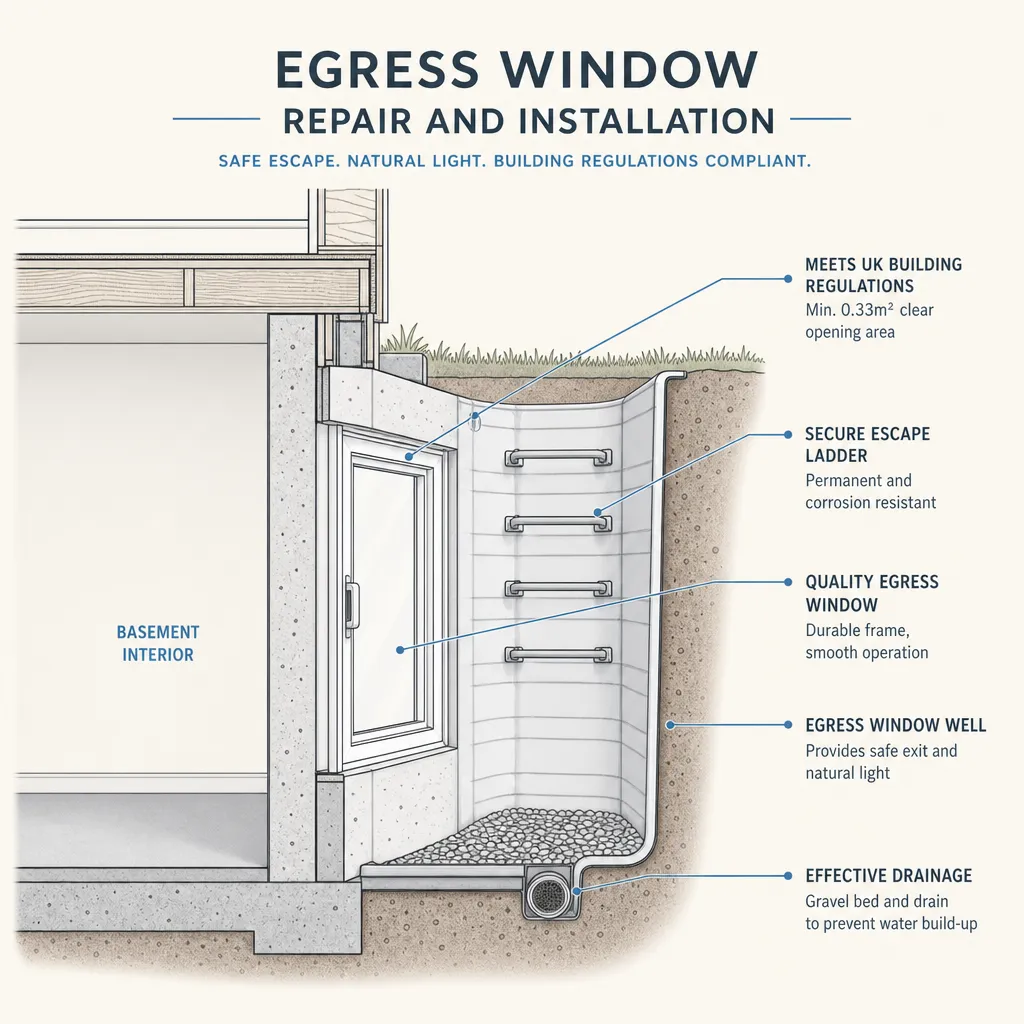
Egress Window Repair and Installation
An egress window is a window large enough to serve as an emergency escape route from a habitable room.
 Improvement & Build
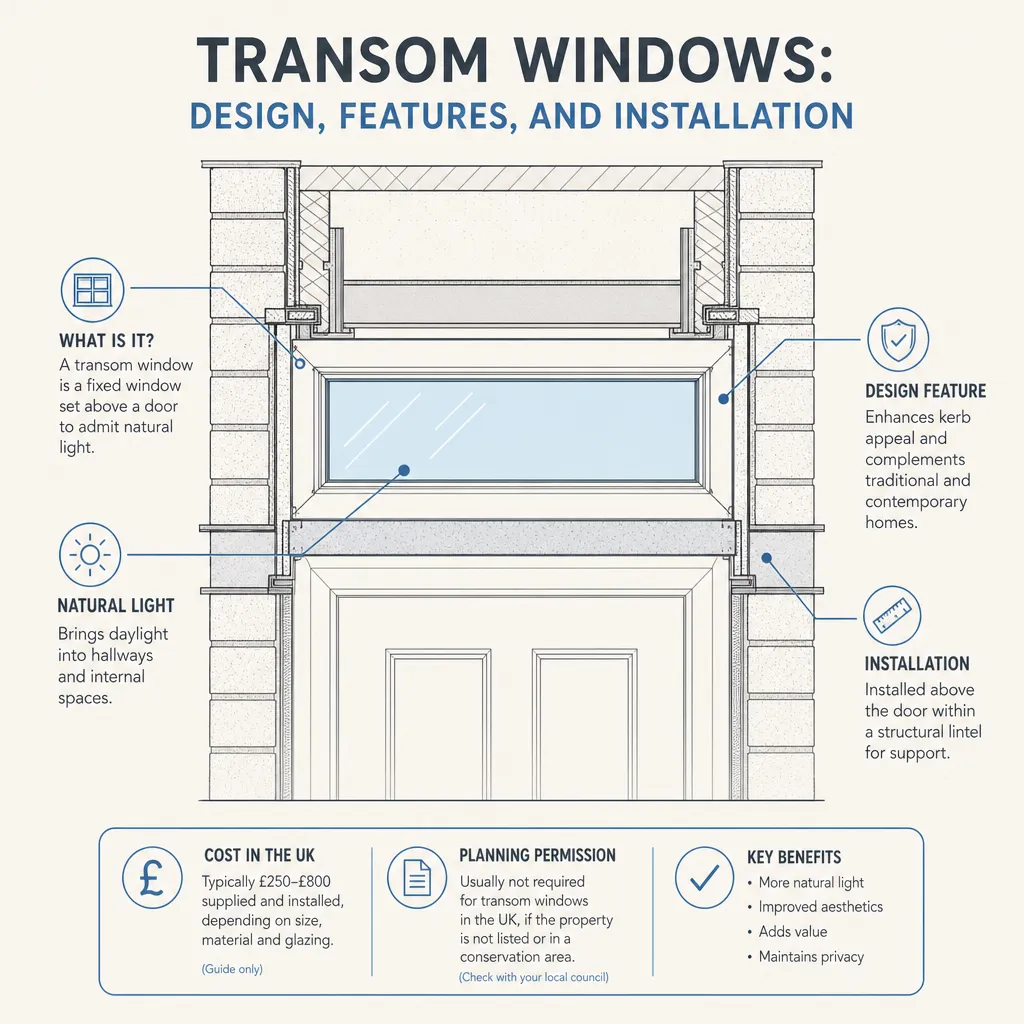
Transom Windows: Design, Features, and Installation
A transom window is a fixed or opening window positioned above a door or another window, separated by a horizontal bar called the transom.
 Improvement & Build
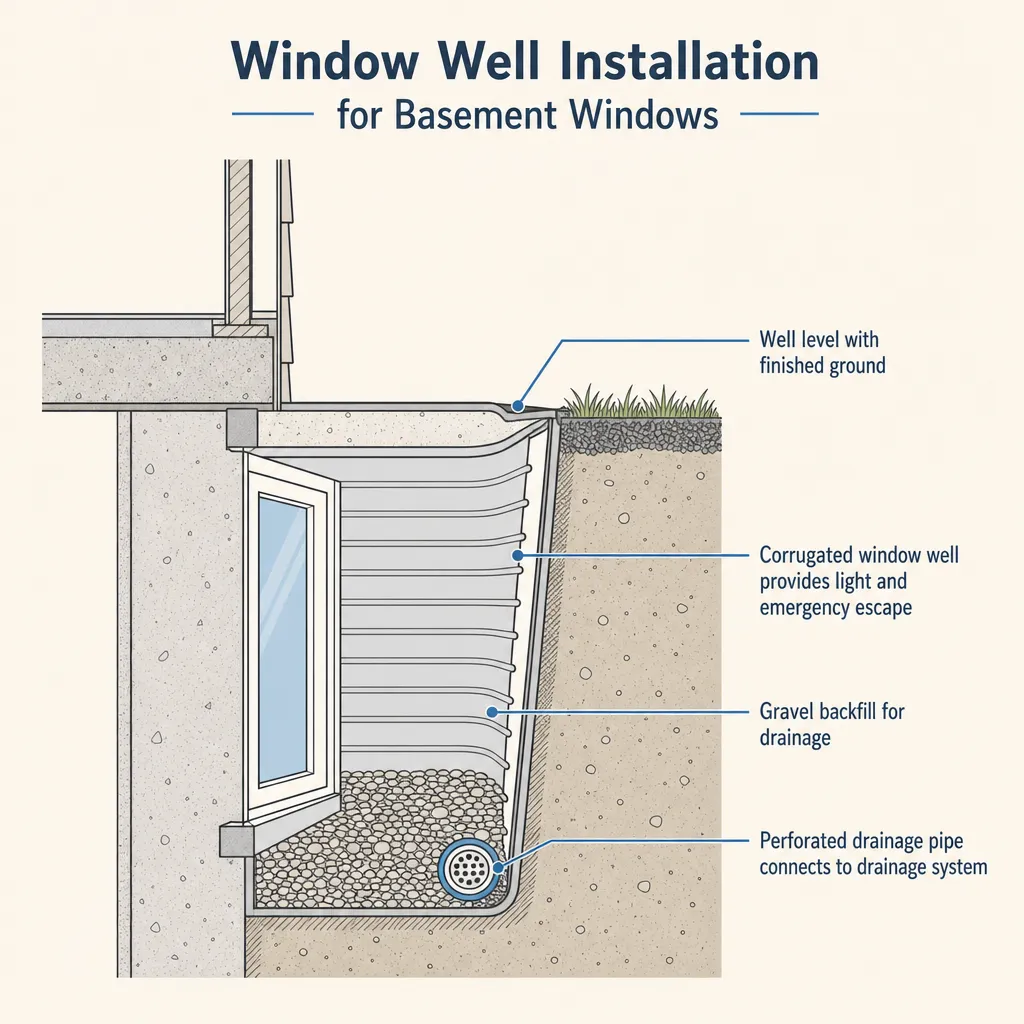
Window Well Installation for Basement Windows
Window wells (areaways) are excavated structures outside basement walls that allow natural light and ventilation into below-ground rooms.
 Improvement & Build
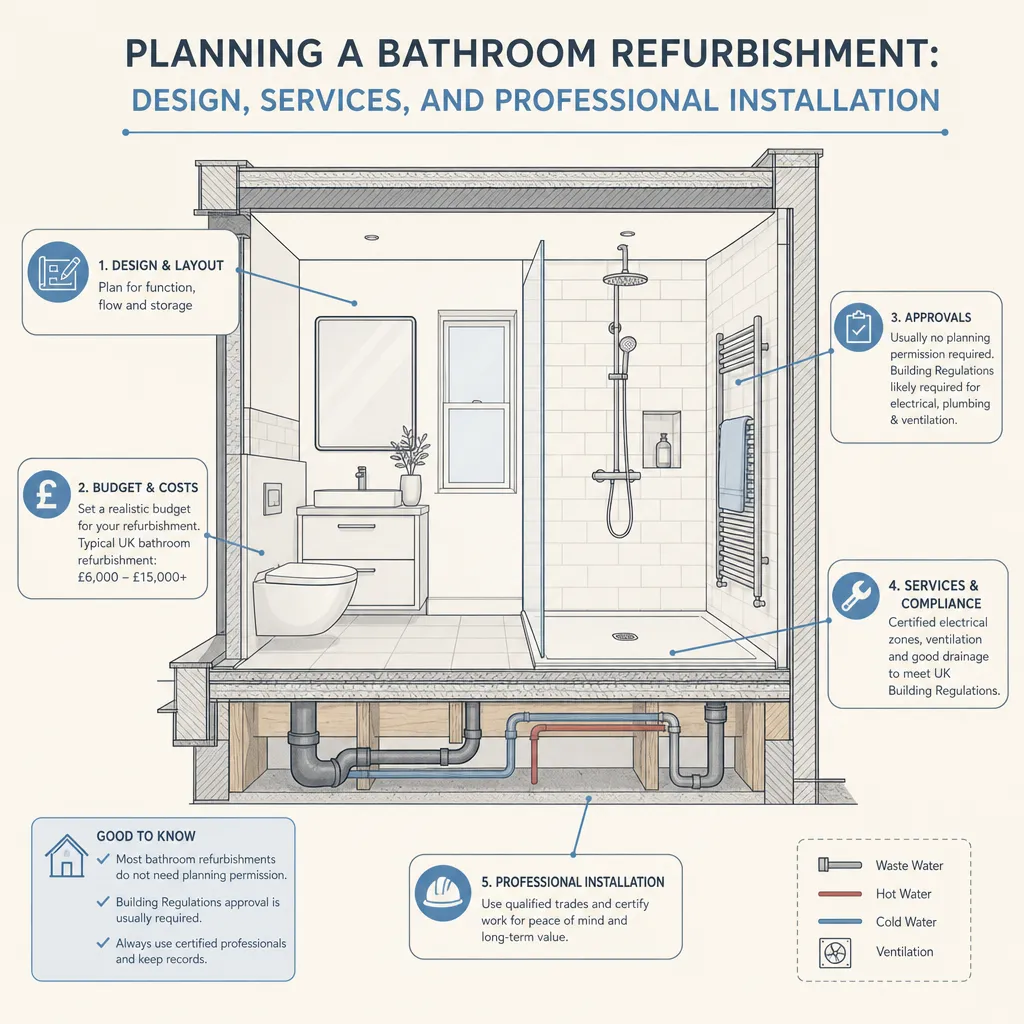
Planning a Bathroom Refurbishment: Design, Services, and Professional Installation
A bathroom refurbishment in the UK typically involves at least three trades — plumber, electrician, and tiler — and costs £4,000–£12,000 for a full project.
 Improvement & Build
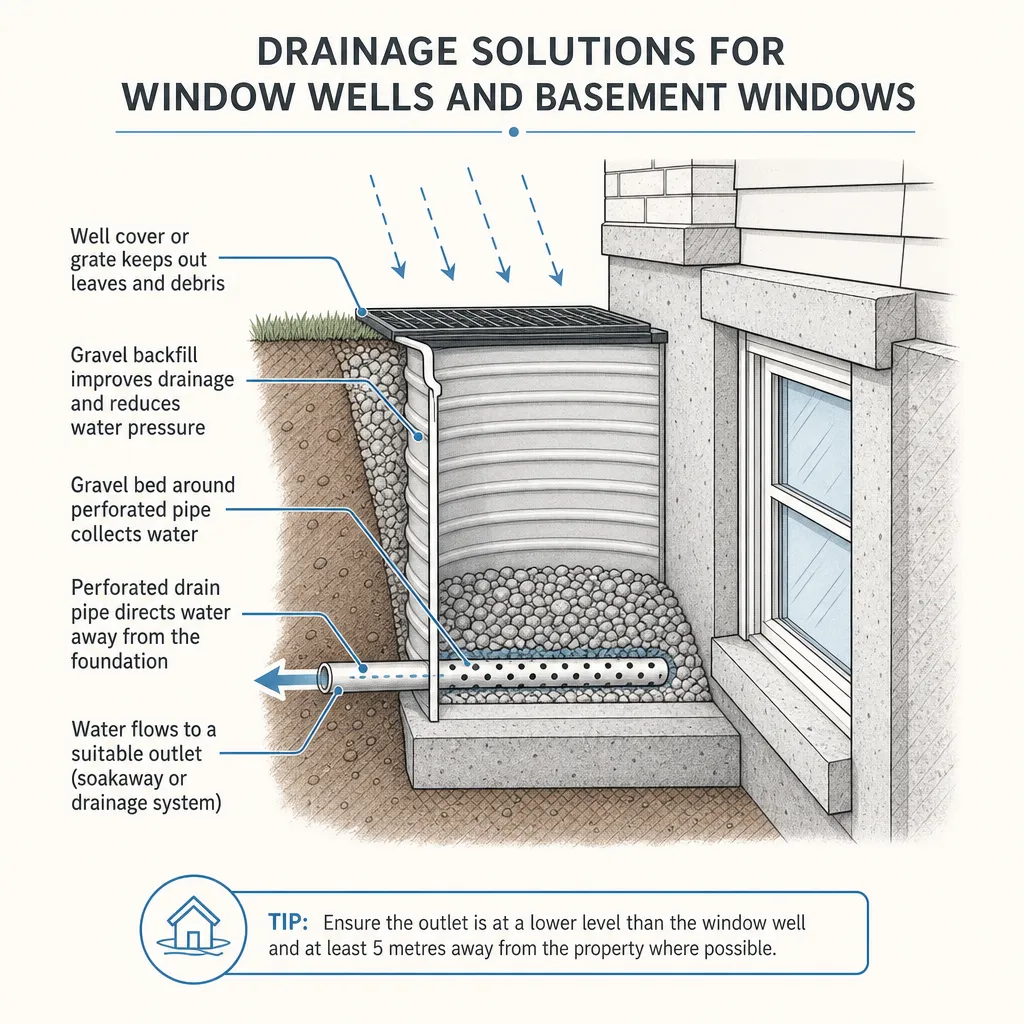
Drainage solutions for window wells and basement windows
Most UK window wells manage water through a gravel-filled sump at least 200 mm deep or a plastic liner fitted with a drain outlet connected to a soakaway or drainage system.