Bathroom Flooring: Planning, Layout and Material Selection
By Housey · Last reviewed 19th of May 2026
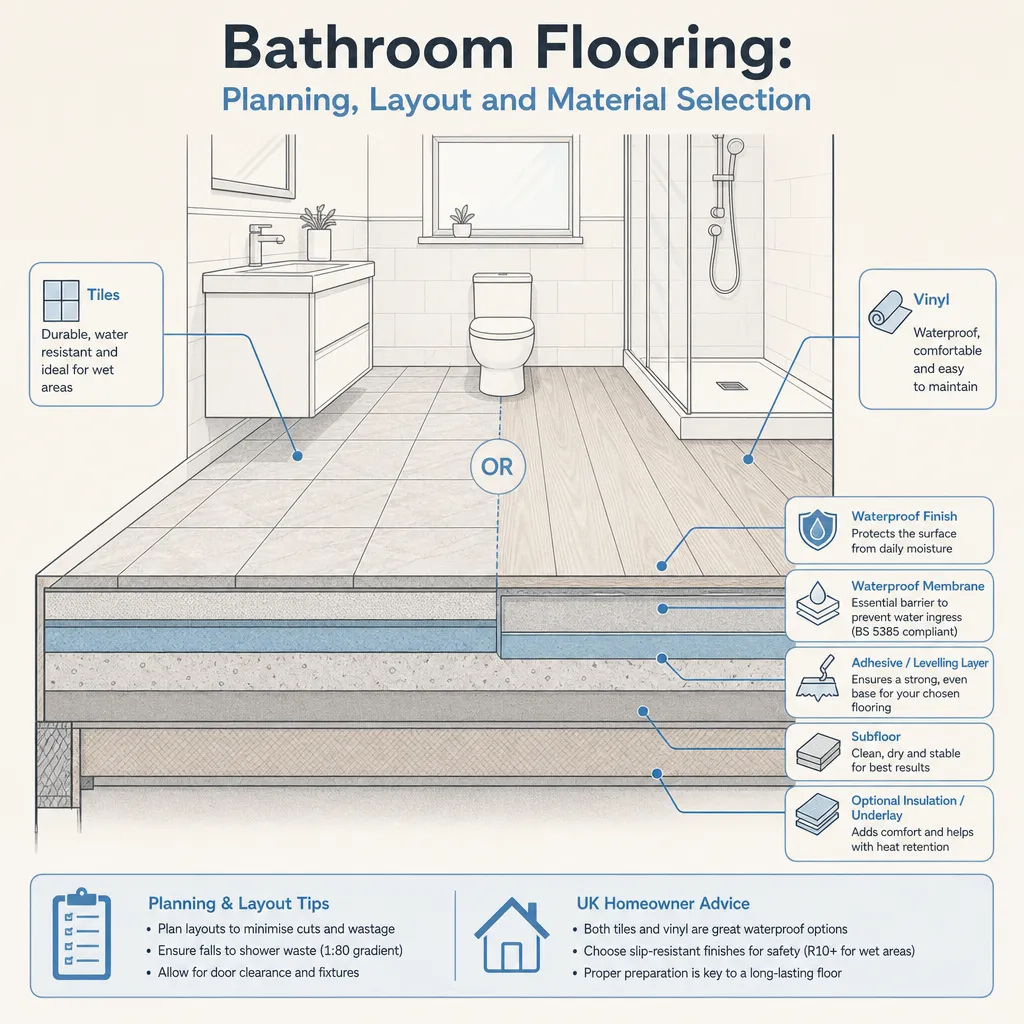
Bathroom Flooring: Planning, Layout and Material Selection
Bathroom flooring decisions arise at several points in a home improvement project: when fitting an entirely new bathroom suite, when replacing worn or damaged tiles, or during a wider ground-floor refurbishment. The bathroom is one of the most demanding environments in a UK home — wet zones, steam, thermal cycling from showers, and sometimes underfloor heating all influence how a material performs and how long it lasts. Choosing the wrong product for the subfloor condition or usage pattern is one of the most common causes of premature bathroom floor failure.
Key points
- Bathroom floor tiles used in wet barefoot areas should achieve at least a B rating on the DIN 51097 wet barefoot scale, or R9 on the DIN 51130 shod scale; product data sheets carry these ratings where tested.
- Porcelain tiles with a water absorption rate of less than 0.5% — classified BIa under ISO 10545 — are suitable for full wet-room and level-access shower applications.
- Large-format tiles (600×600mm and above) require a flat, stiff subfloor; substrate deviation should not exceed 3mm over a 2m span under BS 5385 Part 1.
- Luxury vinyl tile (LVT) with a wear layer of at least 0.3mm is generally considered residential-grade; 0.5mm and above indicates commercial-grade durability.
- Most tile adhesive manufacturers specify a maximum substrate surface temperature of 27–28°C when used over underfloor heating; check adhesive and grout compatibility before specifying.
Comparing bathroom flooring materials
Material | Water resistance | Slip resistance options | Underfloor heating | Warmth underfoot | Indicative supply cost per m² |
|---|---|---|---|---|---|
Porcelain tile | Excellent — BIa rating available | Wide range; anti-slip R9–R11 finishes | Compatible — excellent heat conductor | Cool | £20–£80+ |
Ceramic tile | Good — suitable for splash zones; less dense than porcelain | Anti-slip finishes available | Compatible | Cool | £10–£40 |
Luxury vinyl tile (LVT) | Very good — fully waterproof core products available | Textured surfaces; typically R9 | Compatible with most systems — check max temp | Warm | £20–£60 |
Natural stone (slate, limestone, travertine) | Variable — requires sealing; slate is more naturally impervious | Textured or cleft finishes reduce slip risk | Compatible — excellent conductor; heavy | Cold | £40–£150+ |
Engineered wood | Limited — bathroom use not recommended unless specifically rated for high humidity | Generally unsuitable for wet zones | Limited — check manufacturer guidance carefully | Warm | £30–£80 |
Resin or poured epoxy | Excellent — seamless, no grout joints | Slip-resistant aggregate additive required | Compatible | Moderate | £80–£150+ (typically installed price) |
Indicative UK costs, last reviewed 2026-05-19. Prices are supply-only and vary significantly by supplier, format, and finish. Installation labour is additional.
Which material should you choose?
- Choose porcelain tile if you want maximum water resistance, longevity, and the widest design range; the preferred choice for wet rooms, level-access showers, and high-traffic family bathrooms.
- Choose ceramic tile if budget is a priority and the floor is not in a fully wet zone — ceramic performs well in standard bathrooms but is less dense than porcelain and more prone to chipping.
- Choose LVT if warmth underfoot, acoustic comfort, or ease of installation on an imperfect subfloor are priorities; popular in older properties where stiffening a suspended timber floor is not practical.
- Choose natural stone if you want a premium aesthetic and are prepared to seal and maintain the surface regularly; confirm the floor structure can carry the added weight before ordering.
- Seek advice from an architectural technologist if you are designing a level-access wet room, a disabled-access adaptation, or integrating underfloor heating with a complex layout — professional specification reduces the risk of compliance issues and early failure.
- Avoid engineered or solid wood in a primary bathroom unless the product is specifically rated for high-humidity environments and the room has excellent mechanical ventilation.
Layout planning and tile sizing
How the floor is set out affects both appearance and the time needed to install it.
Tile size and room proportion: Large-format tiles (600×600mm or 600×1,200mm) can make a small bathroom feel more spacious by reducing grout lines, but they demand a very flat, stiff subfloor. In an older property — a Victorian terrace, a 1930s semi — the existing timber subfloor will usually need overboarding with 18mm exterior-grade plywood before large tiles are laid.
Laying pattern: A standard grid or brick-bond (running-bond) layout minimises tile cuts and waste. Herringbone and chevron patterns look striking but require more cuts and typically generate 15–20% more waste than a standard grid.
Starting point: Most tilers begin from the centre of the room or from the most visible threshold — usually the doorway. Dry-lay tiles before any adhesive is applied to check cut widths at the perimeter.
Waste allowance: Add at least 10% for cuts and breakage on a standard grid layout; 15% for diagonal or patterned laying; 20% for natural stone where colour or vein matching may require rejecting some tiles. Order all tiles from the same batch number to ensure colour consistency.
Grout joint width: Rectified (precisely sized) porcelain tiles can be laid with 2mm joints. Non-rectified tiles typically require 3–5mm joints to accommodate size variation. Unsanded grout suits joints under 3mm; sanded grout is used for wider joints.
Measurement checklist before ordering materials
Before placing any orders, confirm the following:
Subfloor preparation
Subfloor condition is one of the most common causes of bathroom tile failure.
Timber joisted floors: Check for flex and bounce — excessive movement will crack tile adhesive and grout. Overboard with 6mm or 12mm tile backer board (Hardiebacker or equivalent) or 18mm exterior-grade plywood, screwed at close centres, to reduce deflection to within BS 5385 tolerances.
Concrete floors: Check for level, cracks, and residual moisture. Use a damp-proof membrane if moisture readings are elevated. Self-levelling compound can correct minor undulation, but large dips or humps may require grinding or a deeper screed.
Existing tiles: Laying new tiles over old is possible if the existing layer is fully bonded, flat, and structurally sound. Two tile layers add considerable weight and height — check door clearances and the threshold detail at the bathroom entrance before proceeding.
Slip resistance: what the ratings mean
Slip resistance in domestic bathrooms is not regulated by UK Building Regulations in the same way as commercial premises, but HSE guidance and BS 8300 recommend minimum values:
- R9 (DIN 51130): Suitable for wet areas used with footwear, including bathroom approaches and en-suite entrances
- R10–R11: Higher traction for barefoot wet areas; useful in walk-in showers and pool surrounds
- B or C (DIN 51097 barefoot scale): Recommended for barefoot wet areas such as shower floors; C provides higher traction than B
- Pendulum Test Value (PTV) ≥36: Generally considered low slip risk; some specifiers use PTV ≥45 for wet bathroom floors used by elderly or mobility-impaired occupants
Many tiles marketed as anti-slip carry only an R9 rating, which is appropriate for most domestic bathrooms but may be insufficient for a level-access shower. Always check the product data sheet rather than relying on marketing descriptions alone.
Underfloor heating considerations
Electric underfloor heating (UFH) is common in UK bathroom refurbishments because of the relatively low installation cost and the ability to retrofit beneath tiles. Key points:
- Heating mat systems are typically 3–4mm thick once embedded in adhesive — confirm the resulting floor-level rise against door clearances before installation
- Most tile adhesive manufacturers specify a maximum substrate temperature of 27–28°C; check adhesive and grout technical data sheets for UFH suitability
- Porcelain and natural stone conduct heat efficiently and are the most common pairings with electric UFH
- LVT is compatible with many UFH systems but check the specific product's maximum recommended surface temperature — typically 27°C for most residential products
- On a suspended timber floor, a thermal insulation board beneath the heating mat helps direct heat upward rather than through the floor structure, improving efficiency
When to get professional help
Consider using a qualified professional if:
- The subfloor is a suspended timber floor with significant flex or bounce — overboarding may have structural implications in older properties
- You are installing a level-access shower or wet room, which requires a tanked waterproof membrane and carefully engineered drainage falls
- The bathroom is in a listed building or a conversion where structural floor alterations may require consent
- You suspect existing floor coverings may contain asbestos — common in 9×9 inch vinyl tiles laid before 1980 — and seek professional assessment before disturbing them
How Housey can help
For complex bathroom projects — including wet rooms, level-access adaptations, or bathrooms within extension or new-build projects — Housey can connect you with experienced architectural technologists who can prepare scaled layouts, specify materials to Building Regulations, and confirm compliance before you instruct a contractor.
Frequently asked questions
Can I tile over an existing bathroom floor?
You can tile over existing tiles if they are fully bonded, flat, and the subfloor is sufficiently stiff to carry the additional weight. Check that the added height does not prevent doors from closing and that the threshold detail at the bathroom entrance is workable. If in doubt, remove the existing covering so you can inspect the subfloor condition directly before laying new materials.
What is the best bathroom flooring for an older property?
In a Victorian terrace or Edwardian property, the suspended timber subfloor often requires overboarding before hard tiles are laid. Luxury vinyl tile (LVT) is more forgiving of minor subfloor imperfection and adds less weight, making it a popular choice for older properties where stiffening the floor structure is not straightforward. Always check for bounce and flex before committing to a large-format tile.
How much does bathroom floor tiling cost in the UK?
A typical bathroom floor tiling job — supply and fit — for a small to medium bathroom ranges from approximately £400 to £1,200 depending on tile choice, subfloor condition, room shape, and access. Indicative UK costs, last reviewed 2026-05-19. Always obtain at least three quotes and ask explicitly whether subfloor preparation and adhesive are included.
Do bathroom floor tiles need grout sealing?
Cement-based grout is porous and can absorb moisture, leading to staining and mould growth in a bathroom. Sealing grout joints with a penetrating sealer after installation and periodically thereafter is good practice. Epoxy grout is non-porous and does not require sealing, but it is harder to apply, less forgiving of alignment errors, and more difficult to adjust once set.
Sources and further reading
- BS 5385 Part 1: Wall and floor tiling — BSI British Standards
- HSE slip and trip guidance — Health and Safety Executive
- Building Regulations Approved Document M: Access to and use of buildings — GOV.UK
- Energy Saving Trust: underfloor heating — Energy Saving Trust
Useful next reads
 Improvement & Build
Small kitchen renovation: budgeting for costs and planning your project
A small kitchen renovation in the UK typically costs £5,000–£15,000 for a full refresh including new units, worktops, tiling, and appliances, though costs vary widely by specification, region, and whether structural changes or rewiring are involved.
 Improvement & Build
Design and Planning Guide for Timber Decking Projects
Planning a timber deck in the UK involves checking permitted development rules — in England, a deck under 300mm high that covers no more than 50% of the garden (combined with other outbuildings) is usually permitted development.
 Improvement & Build
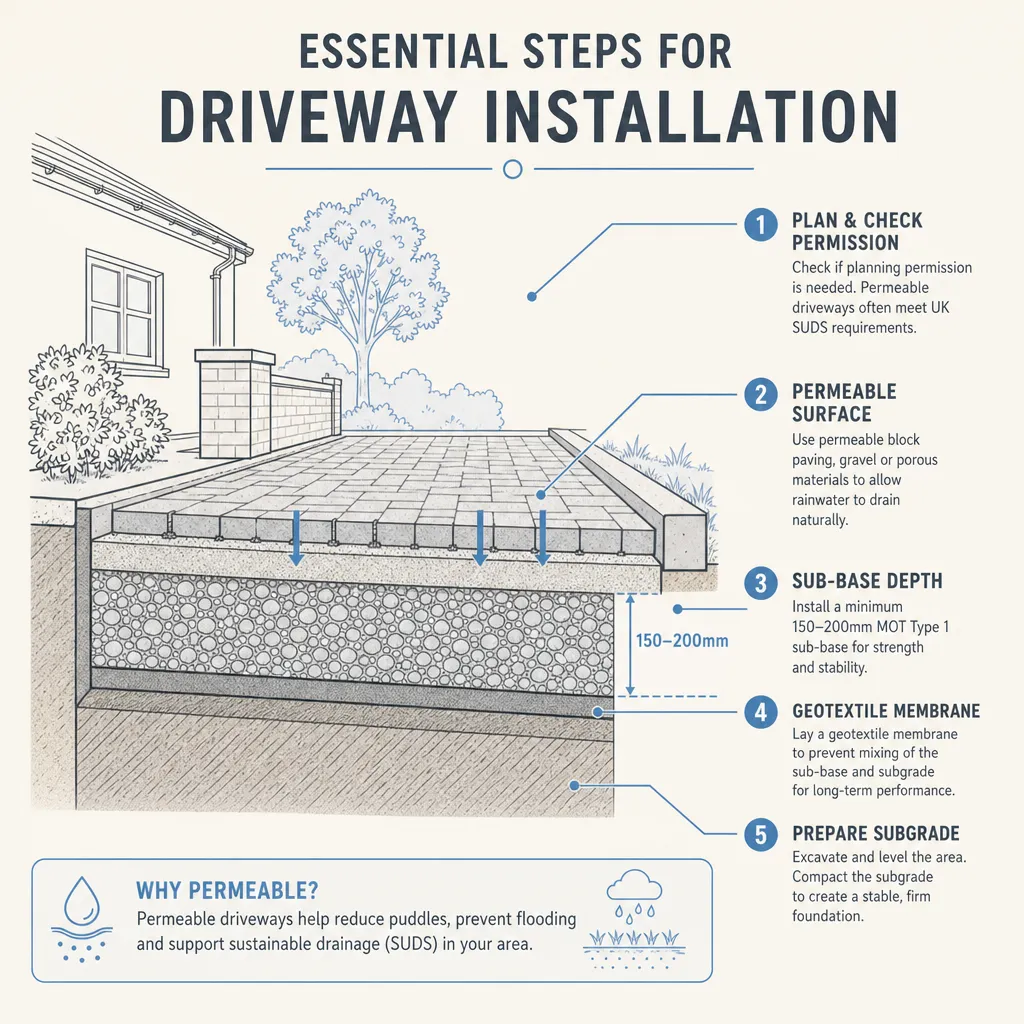
Essential Steps for Driveway Installation
Installing a driveway in England requires planning permission only when using an impermeable surface (standard tarmac, concrete, or block paving) on a front garden area over 5 m².
 Improvement & Build
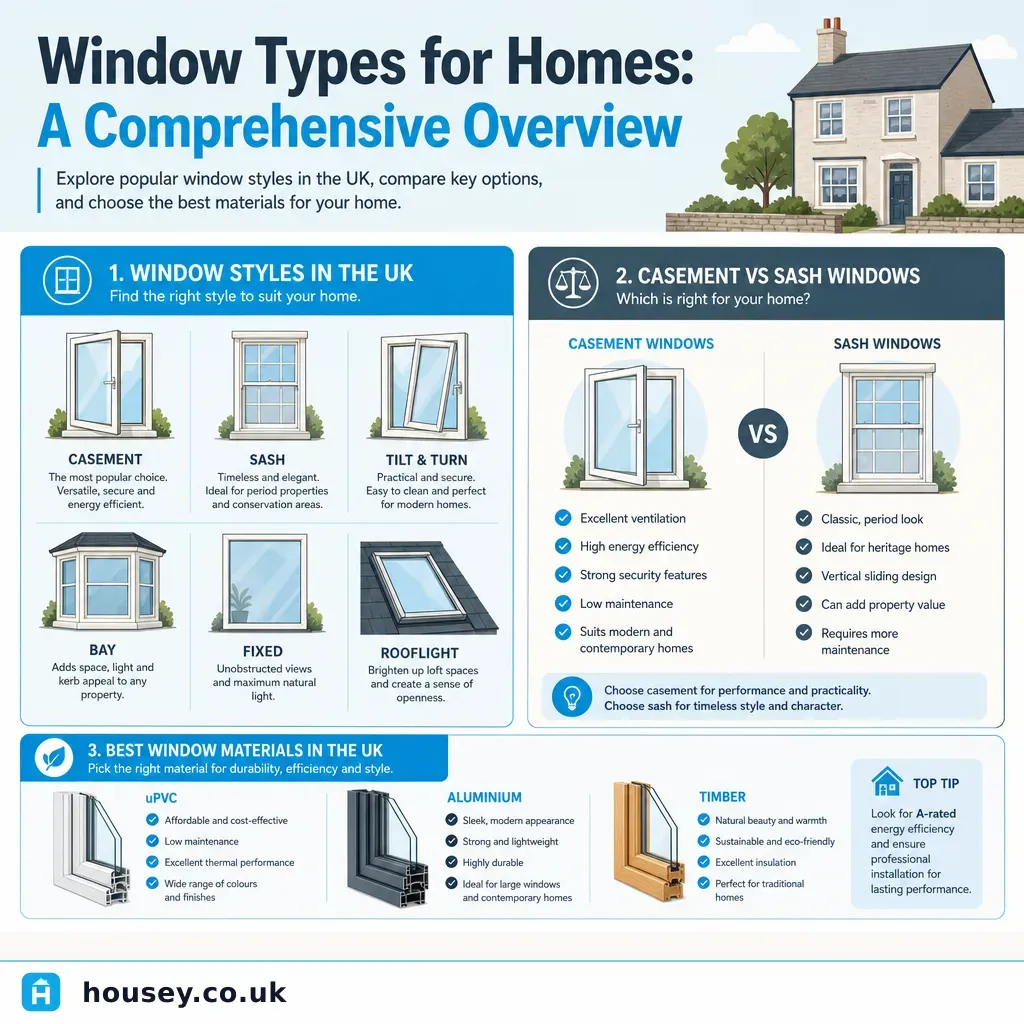
Window Types for Homes: A Comprehensive Overview
UK homes use several main window styles: casement (outward-swinging), sash (vertically sliding), tilt-and-turn, fixed light, and bay or bow.
 Improvement & Build
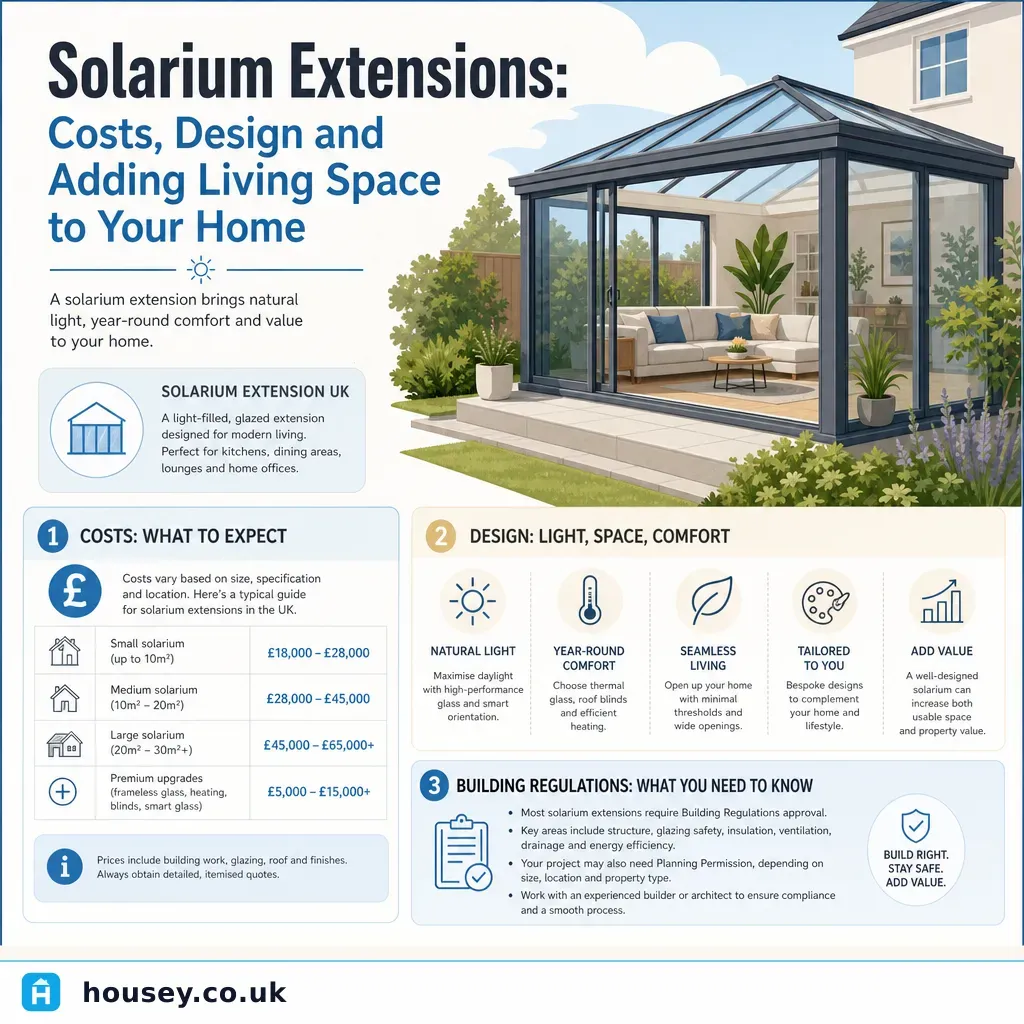
Solarium extensions: costs, design and adding living space to your home
A solarium extension is a predominantly glazed room addition with a structural glass roof, typically costing £28,000–£130,000 in the UK depending on size and specification.