Design and Planning Guide for Timber Decking Projects
By Housey · Last reviewed 30th of May 2026
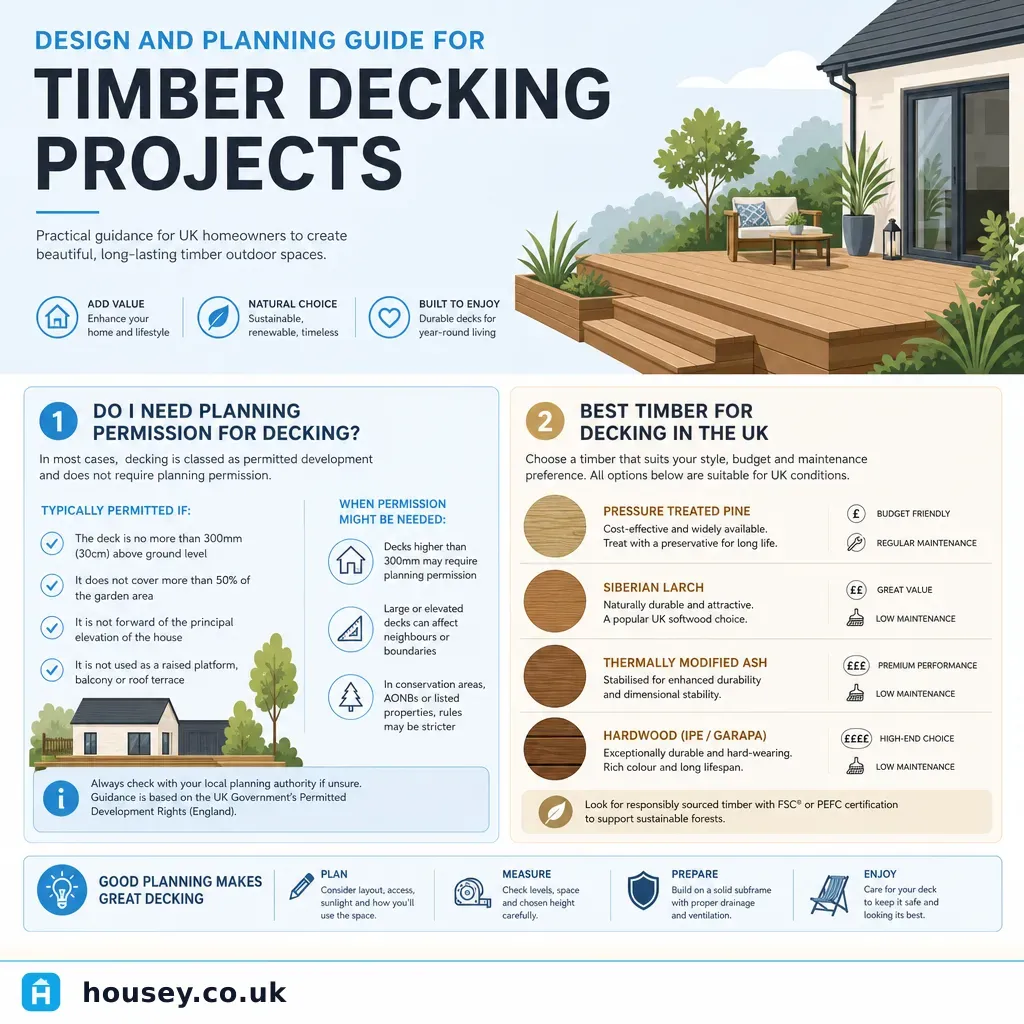
Design and Planning Guide for Timber Decking Projects
Timber decking is one of the most rewarding outdoor improvements a UK homeowner can make — but it is also one of the most frequently mishandled. Projects that overlook permitted development rules, underspecify the subframe, or choose poorly treated timber can result in enforcement notices, premature rot, or costly rebuilds within a decade. Getting the design and planning right from the start is the difference between a deck that lasts 25 years and one that needs replacing after five.
Key points
- Under Schedule 2, Part 1, Class E of the Town and Country Planning (General Permitted Development) (England) Order 2015, domestic garden decking is permitted development in England if the surface is no more than 300mm above the original ground level and combined coverage does not exceed 50% of the garden area.
- Conservation areas, National Parks, Areas of Outstanding Natural Beauty, World Heritage Sites, and listed buildings have restricted or removed permitted development rights for decking — always check with your local planning authority before starting work.
- Pressure-treated timber must meet Use Class 3 or higher under BS 8417 for above-ground outdoor applications; Use Class 4 applies where timber will be in ground contact or in permanently damp conditions.
- Joist spacing for most residential decks is 400–600mm centres; board thickness of 28–32mm is standard for these spans, and expansion gaps of 5–8mm between boards prevent buckling in wet weather.
- Building Regulations approval is not usually required for a domestic deck no more than 600mm above ground that is not structurally attached to the house, but raised decks and decks forming part of an extension may require building control notification.
Do I need planning permission for my deck?
In England, most modest ground-level timber decks fall under permitted development (PD), meaning no planning application is required provided all the conditions in Class E are met:
- The deck is within the curtilage of a house (flats and maisonettes do not benefit from this PD right).
- The deck surface is no more than 300mm above the original ground level at any point.
- The total area of the deck, combined with other outbuildings and extensions, does not exceed 50% of the original garden area.
Scotland, Wales, and Northern Ireland operate under separate planning legislation with their own PD thresholds — always verify with the relevant planning authority before starting work.
Which planning route applies to your deck?
- Permitted development (no application needed): deck at or below 300mm height, combined coverage under 50% of the original garden, house in England not subject to an Article 4 direction, and not in a conservation area, National Park, AONB, or listed.
- Check with your local planning authority: property in a conservation area, National Park, AONB, or World Heritage Site, or subject to an Article 4 direction that removes PD rights.
- Planning application required: deck more than 300mm above ground level; combined outbuilding and extension coverage exceeds 50% of the original garden; property is a listed building (listed building consent may also be required).
- Ask an architect or planning consultant: if the property has had previous extensions that may have eroded the PD allowance, or if the local authority's records are unclear about prior works.
Choosing your timber: material comparison
The right timber choice depends on budget, desired lifespan, maintenance appetite, and sustainability requirements.
Timber type | Typical lifespan | Maintenance requirement | Sustainability note | Indicative supply cost per m² |
|---|---|---|---|---|
Pressure-treated softwood (pine/redwood) | 10–15 years | Annual clean; re-oil or stain every 2–3 years | FSC-certified widely available | £15–£30 |
Larch (natural or modified) | 15–25 years | Low; weathers to silver-grey | FSC-certified widely available | £25–£45 |
Hardwood (Balau, Bangkirai, Iroko) | 25–40 years | Annual oiling | Must carry FSC or PEFC certification | £35–£70 |
Thermally modified timber (Thermowood) | 25–30 years | Low; dimensionally stable | Can be FSC-certified | £40–£65 |
Indicative UK costs, last reviewed 2026-05-30. Costs vary significantly by supplier, specification, and region. Obtain at least three detailed written quotes.
For any outdoor deck, always specify FSC-certified or PEFC-certified timber to confirm responsible chain of custody. Hardwood species without certification may originate from unverified sources.
Structural basics: subframe, joists, and foundations
A deck that looks good at installation can fail quickly if the subframe is under-specified. The most common failure points are:
Ground contact and moisture: joists must never run in direct contact with soil or retained moisture. Use concrete pad foundations, proprietary adjustable steel post bases, or elevated bearers to keep structural timber clear of the ground.
Joist size and span: for a standard 400mm joist spacing, a 47×150mm C16 graded timber joist can typically span around 2.0m between supports. Deeper joists or closer centres are needed for longer spans or heavier loads. Any structural member specified for a raised deck should be confirmed by the contractor or, for complex projects, by a structural engineer.
Fixings: use only stainless steel or hot-dip galvanised fixings throughout. Zinc-plated screws corrode rapidly in outdoor conditions, staining the timber and weakening connections.
Drainage: boards should be laid with sufficient fall (minimum 1:80) so that water drains away from the house, not towards it. A deck that traps water against a wall can cause dampness in the adjacent structure.
Homeowner checklist: before you commission a deck
Important limitations
The planning information in this guide reflects permitted development rules in England under the Town and Country Planning (General Permitted Development) (England) Order 2015 as at the date of last review. Scotland, Wales, and Northern Ireland have separate legislation. Permitted development rights can be removed by Article 4 directions, planning conditions on previous consents, or restrictive covenants in a property's title deeds. Always confirm the planning position with your local planning authority before starting work. Building Regulations requirements depend on the specific project and should be confirmed with your local building control body.
When this becomes urgent
Seek professional advice without delay if:
- Work has already started without checking planning permission and the property is in a conservation area, National Park, or other designated area.
- A raised deck is more than 600mm above ground and no structural assessment has been carried out.
- A neighbour or the local authority has raised a planning objection or formal enforcement concern.
What to ask a qualified professional
Before instructing a contractor, landscaper, or planning consultant for a decking project, ask:
- Is this deck within my permitted development rights, given my property's history and any previous extensions or outbuildings?
- Does this project require building regulations approval or notification, and will you manage that process?
- What timber species and treatment class are you specifying, and can you confirm it meets BS 8417 for the intended use?
- What foundation solution are you providing, and how will you keep structural timber clear of the ground?
- Are all fixings stainless steel or hot-dip galvanised, and will you confirm this in your written specification?
When to get professional help
Most ground-level decks can be built by a competent landscaper or specialist decking contractor. Seek additional professional input if the deck is raised more than 600mm above ground level, if the site has a significant slope requiring retaining walls or complex subframe engineering, if the property is listed or in a conservation area, or if the deck connects to or places load onto the fabric of the house.
How Housey can help
Whether you need experienced landscapers for a ground-level deck, groundworkers for sites with challenging levels or foundation requirements, or extension builders for a deck that forms part of a wider project, Housey connects you with vetted local professionals so you can compare quotes with confidence.
Frequently asked questions
Does decking timber need to be pressure-treated?
Any timber used outdoors above ground level should be pressure-treated to at least Use Class 3 under BS 8417 to provide adequate resistance to rot and insect attack. Timber in ground contact requires Use Class 4 treatment. Specify the treatment class in any contractor quote and ask for the treatment certificate.
How close to a boundary can I build decking?
Permitted development rules for decking do not specify a minimum distance from a boundary in the way that outbuilding rules do. However, a raised deck overlooking a neighbouring property may be considered to cause a loss of amenity, and the local planning authority could take that into account. If in doubt, check with your LPA.
Do I need building regulations approval for a garden deck?
Most ground-level domestic garden decks below 600mm above ground do not require building regulations approval. If the deck is raised, attaches to the house structure, or forms part of a larger build project, building control notification may be required. Your local building control body or a competent contractor can advise on your specific project.
Sources and further reading
- GPDO 2015 Schedule 2 Part 1 — Class E — legislation.gov.uk
- Planning Portal: Outbuildings and decking — Planning Portal (GOV.UK)
- Timber species and specification guidance — Timber Development UK
- FSC-certified timber sourcing — FSC UK
- Building Regulations Approved Documents — GOV.UK
Useful next reads
 Improvement & Build
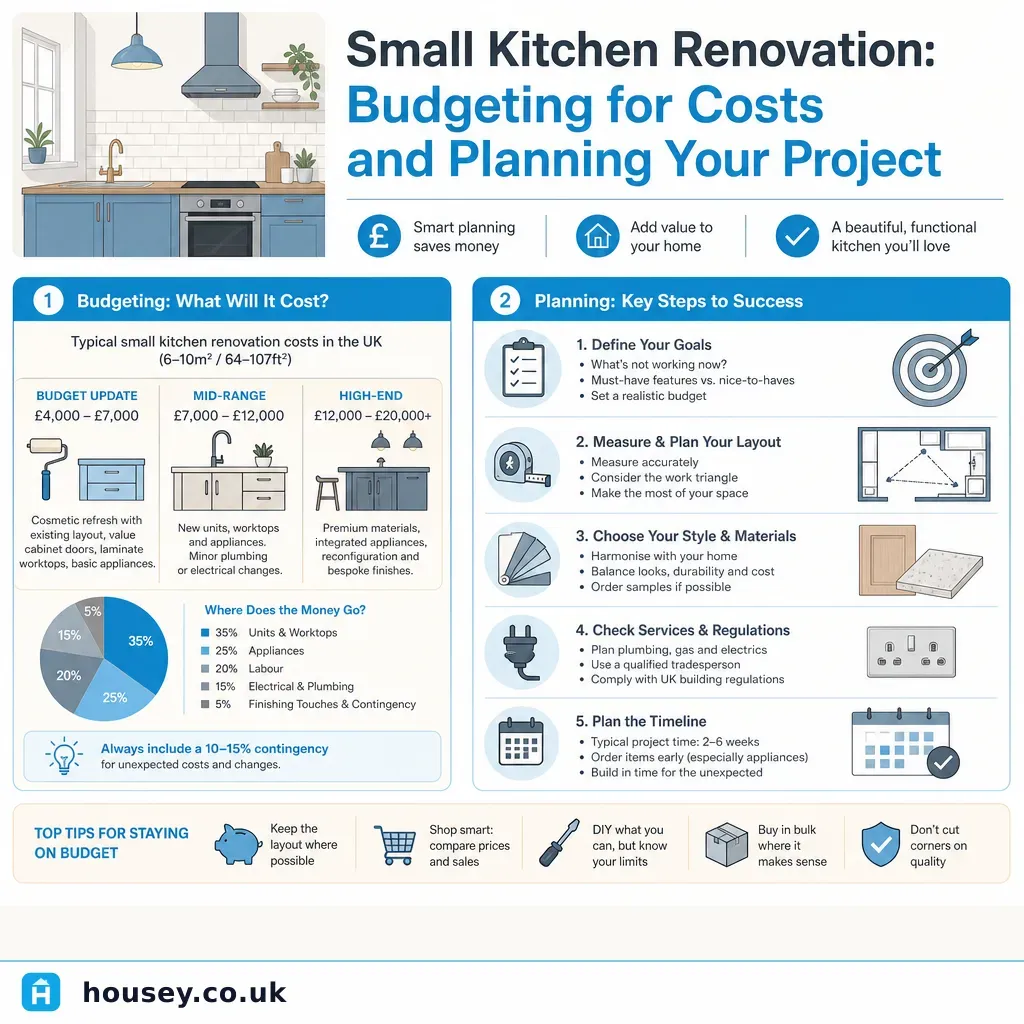
Small kitchen renovation: budgeting for costs and planning your project
A small kitchen renovation in the UK typically costs £5,000–£15,000 for a full refresh including new units, worktops, tiling, and appliances, though costs vary widely by specification, region, and whether structural changes or rewiring are involved.
 Improvement & Build
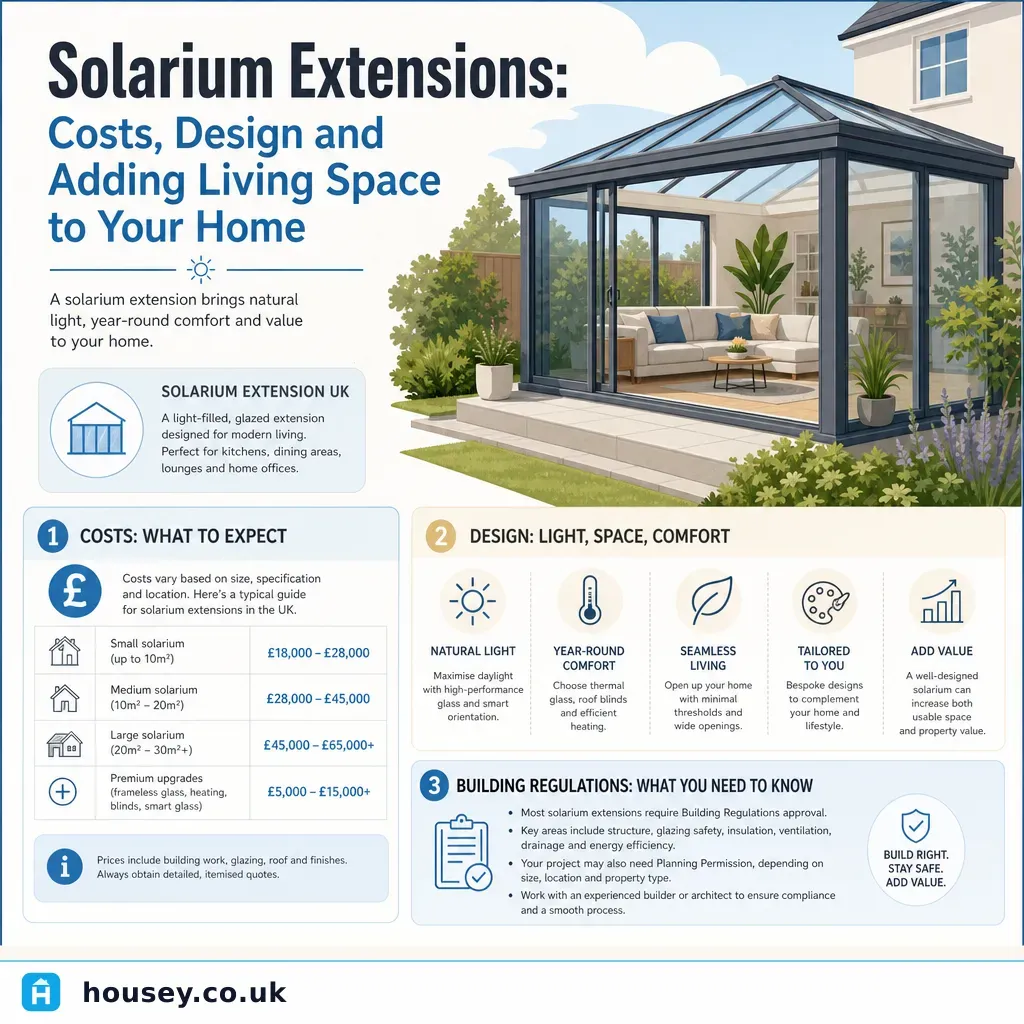
Solarium extensions: costs, design and adding living space to your home
A solarium extension is a predominantly glazed room addition with a structural glass roof, typically costing £28,000–£130,000 in the UK depending on size and specification.
 Improvement & Build
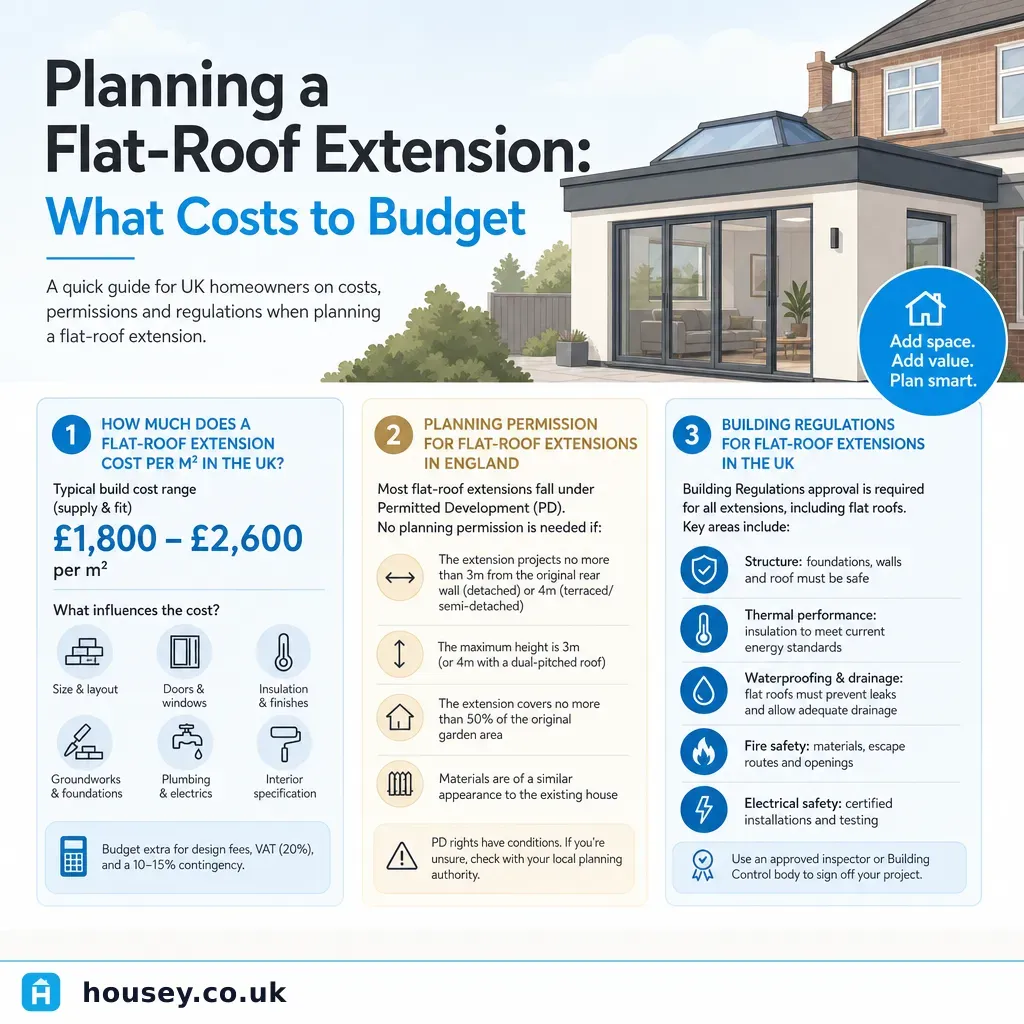
Planning a Flat-Roof Extension: What Costs to Budget
A flat-roof single-storey extension typically costs £1,500–£3,000 per m² in the UK, depending on size, specification, location, and roof membrane choice.
 Improvement & Build
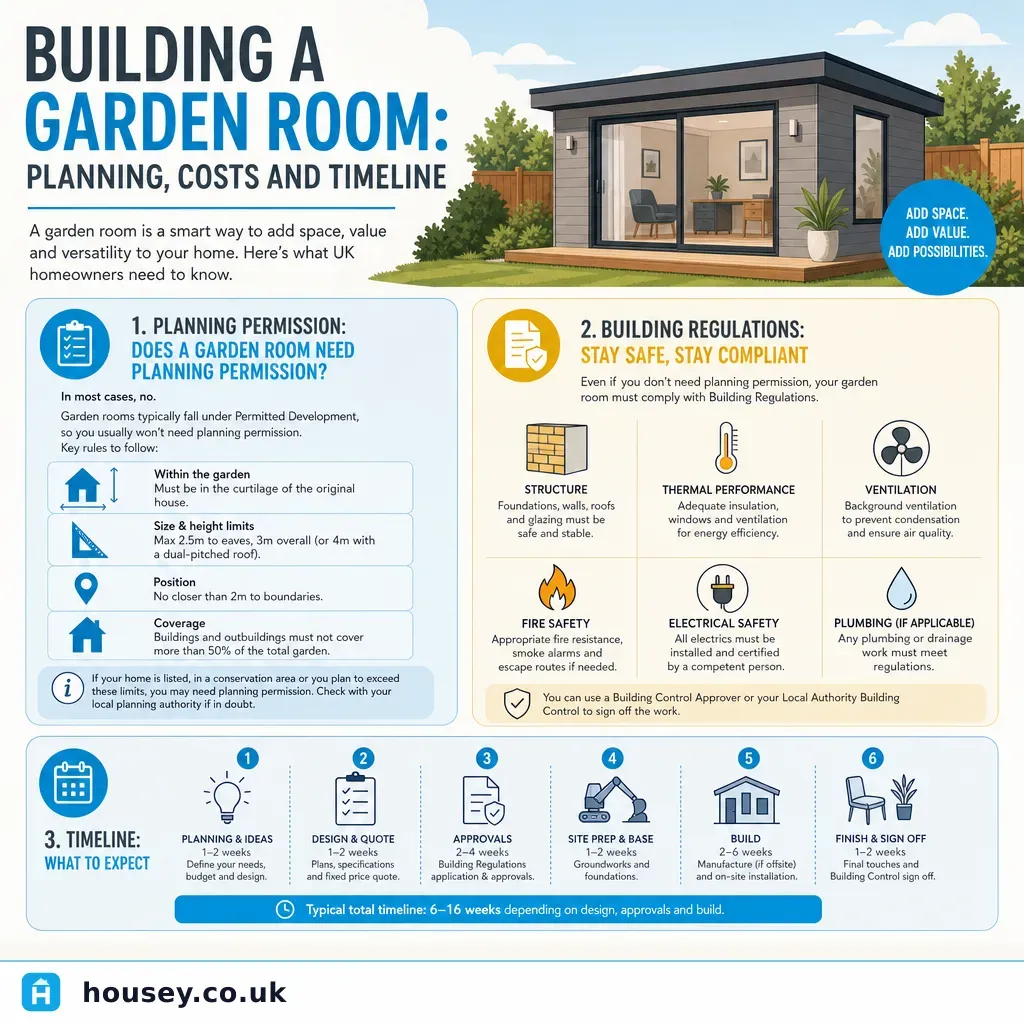
Building a Garden Room: Planning, Costs and Timeline
Most garden rooms in England fall under permitted development and don't need planning permission, provided the structure meets height, coverage, and boundary conditions.
 Improvement & Build
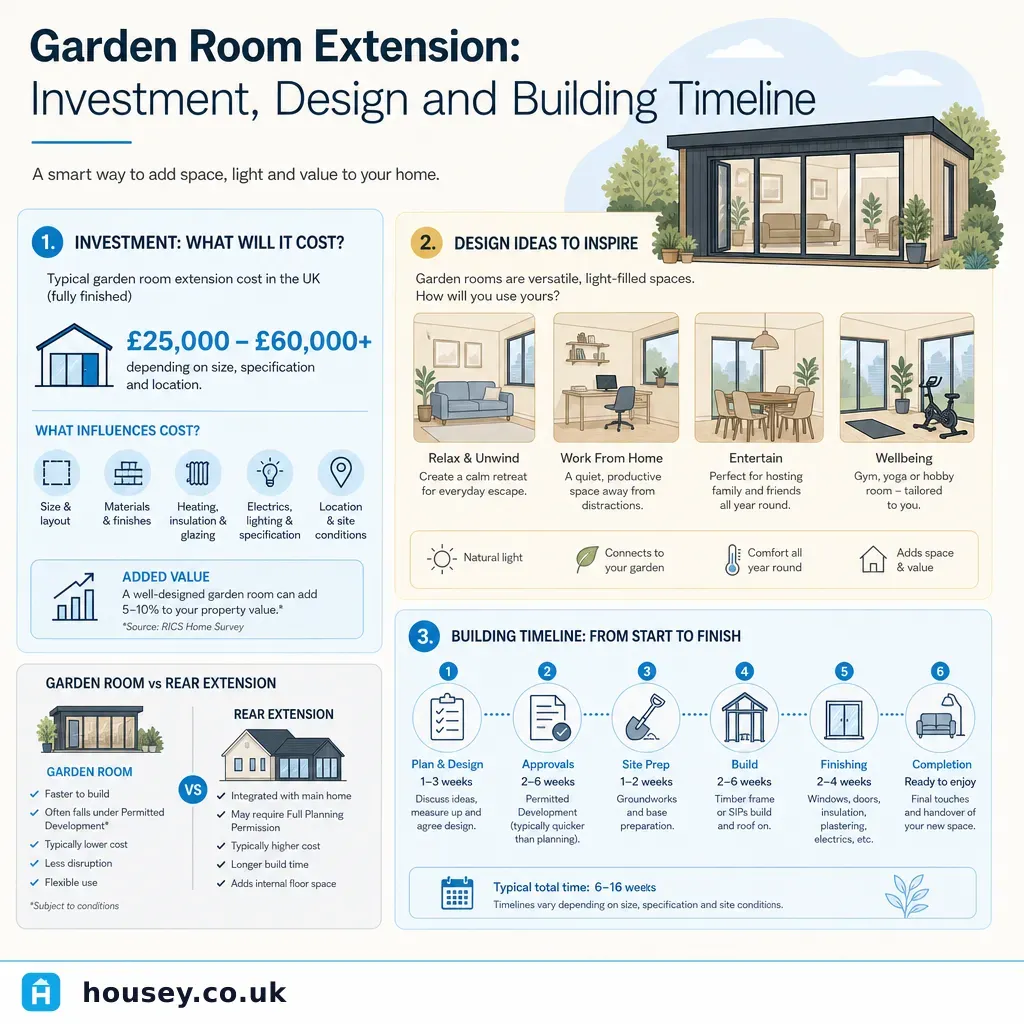
Garden Room Extension: Investment, Design and Building Timeline
A garden room or garden extension can add usable year-round space without always requiring planning permission.