Bathroom Heating Solutions and Comfort Options
By Housey · Last reviewed 11th of May 2026
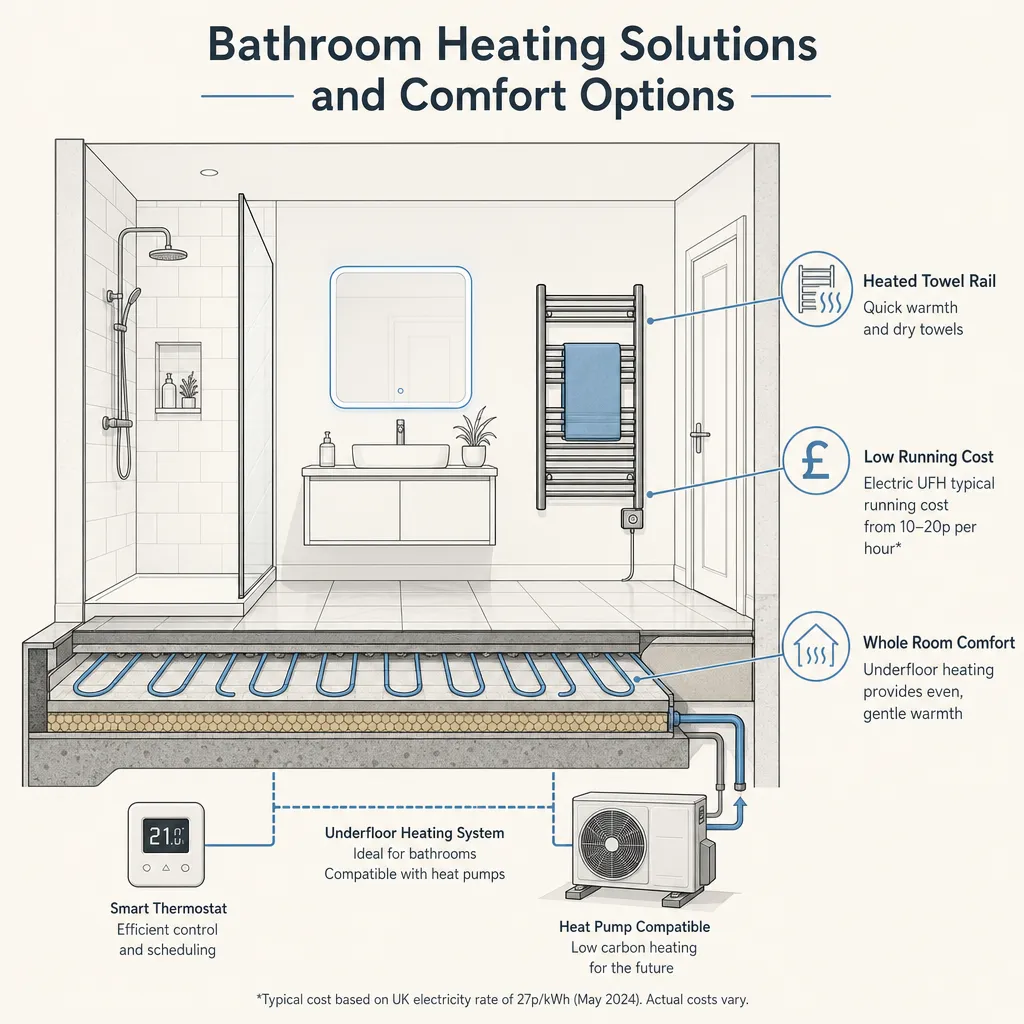
Bathroom Heating Solutions and Comfort Options
Bathrooms are among the most heavily used rooms in any home, yet they are frequently the last to receive a dedicated heating upgrade. For many UK homeowners the question of which system to install arises during a bathroom refurbishment, when replacing an ageing towel rail, or when switching to a heat pump that operates at lower flow temperatures than a conventional gas boiler. Getting the heating right affects daily comfort, energy efficiency, and — where electrical work is involved — regulatory compliance under Building Regulations Part P.
Key points
- All fixed electrical installations in bathrooms must comply with BS 7671 (IET Wiring Regulations) and Building Regulations Part P; a completion certificate is required for notifiable work in England.
- Bathrooms are classified as "special locations" under BS 7671, with proximity zones (0, 1, and 2) that strictly limit where electrical equipment can be installed relative to baths and showers.
- Wet underfloor heating (UFH) running at 35–45°C flow temperatures is compatible with air source heat pump outputs, making bathrooms a practical starting point for a heat pump retrofit.
- Heated towel rails must be sized to the room's heat loss, not just chosen for appearance — an undersized rail will warm towels but not heat the room adequately in winter.
- Electric underfloor heating typically costs £200–£600 to supply and install in an average UK bathroom; wet systems typically cost £500–£1,500 (Indicative UK costs, last reviewed 2026-05-11).
What bathroom heating options are available?
UK bathrooms can be heated using several methods, which can be used individually or in combination:
- Central heating radiator or towel rail — connected to the existing wet central heating circuit.
- Electric towel rail or panel heater — self-contained, no pipework required.
- Wet underfloor heating (UFH) — low-temperature pipes embedded in or clipped to the floor structure, fed from the central heating circuit.
- Electric underfloor heating — a heating mat or cable installed under floor tiles, independently controlled.
- Infrared heating panels — wall or ceiling-mounted, heating objects and surfaces rather than air.
Each option suits different bathroom sizes, construction types, and heating systems. Electric UFH is commonly retro-fitted under ceramic or porcelain tiles during a bathroom refurbishment, while wet UFH is more often installed during a full renovation or new build.
Electric vs wet bathroom heating: which suits your home?
System | Best for | Not ideal for | Typical professional | Main risk if wrong |
|---|---|---|---|---|
Wet towel rail on CH circuit | Homes with gas boiler or heat pump with a spare radiator port | Homes without nearby pipework | Plumber or heating engineer | Poorly balanced circuit, cold spots |
Electric towel rail | Ensuites and cloakrooms with no nearby pipework | Large bathrooms needing primary heat | Part P-registered electrician | Non-compliant installation, shock risk |
Wet underfloor heating | Full renovations, heat pump homes, ground floors | Suspended timber floors without modification | Plumber or heating engineer | Moisture damage, cracked tiles if expansion not managed |
Electric underfloor heating | Retro-fits under new tiles, small to medium bathrooms | Homes with very high electricity unit rates | Part P-registered electrician | Overheating, voided floor warranty |
Infrared panel | Listed buildings, supplementary warmth | Primary heat source in cold climates | Part P-registered electrician | Underestimated running costs |
Underfloor heating in UK bathrooms
Underfloor heating is popular in UK bathrooms because it frees wall space, provides even warmth underfoot, and — in the case of wet systems — is highly compatible with heat pumps that deliver lower flow temperatures (typically 35–55°C) than a traditional gas boiler.
Electric UFH is the most common retro-fit option. A thin heating mat is installed under floor tiles during a bathroom refurbishment, with a separate thermostat and floor-temperature probe for control. Running costs depend on floor area, the thermostat schedule, and your electricity tariff.
Wet UFH requires more planning: pipework is either screeded into a new floor build-up or clipped to a system board above the structural floor. The additional floor height — typically 12–80 mm depending on the system — must be accounted for in door clearances and bathroom fittings.
Both types require professional installation in bathrooms because of the BS 7671 zone requirements. Electric systems in bathrooms are notifiable under Part P of the Building Regulations in England; your installer should provide a completion certificate.
Towel rails and radiators: sizing matters
A common mistake is choosing a heated towel rail on appearance alone, then finding it does not provide enough heat output for the room. To heat a bathroom effectively as well as warm towels, the rail must be sized to cover the room's heat loss:
- Calculate the room's heat loss based on its dimensions, insulation levels, and window area.
- Select a rail or radiator with a BTU or watt output that meets or exceeds the heat loss figure.
- Confirm whether the unit is for a central heating circuit (wet) or electric — they are not interchangeable.
As a rough guide, a 1,200 mm × 500 mm dual-fuel towel rail typically outputs 900–1,100 BTU/h on the central heating circuit, which is often sufficient for a small UK bathroom of 4–6 m². Larger family bathrooms may need a separate radiator or supplementary heating in addition.
Which bathroom heating option should you choose?
- Choose an electric towel rail if you are refurbishing a cloakroom or ensuite with no nearby pipework and want a straightforward installation with individual room control.
- Choose a wet towel rail or radiator if you have a gas boiler or wet heat pump system with a spare port close to the bathroom.
- Choose electric UFH if you are relaying bathroom floor tiles and want reliable underfoot warmth without major plumbing work.
- Choose wet UFH if you are carrying out a full bathroom renovation, particularly if you are also installing or planning a heat pump.
- Choose an infrared panel if your bathroom is in a listed building, you want targeted supplementary heat, or UFH is impractical.
- Ask a heating engineer if your home uses a heat pump and you are unsure about flow temperatures, zone controls, or compatibility with a new bathroom zone.
Homeowner checklist before installing bathroom heating
When to get professional help
Bathroom heating installation involves both plumbing and electrical work in close proximity in a wet environment. Always use a qualified professional for:
- Any new fixed electrical installation or modification in a bathroom (BS 7671 and Part P).
- Connecting a new radiator or towel rail to a pressurised central heating circuit or heat pump system.
- Installing wet underfloor heating, particularly in homes with existing screed or sensitive floor finishes.
- Any work within Zone 1 above a bath or shower (up to 2.25 m height) — only specifically rated luminaires and shaver sockets are permitted here.
Signs that something may already be wrong:
- Towel rail that never gets fully warm even when the boiler is running.
- Cold floor despite UFH thermostat calling for heat.
- Circuit breaker tripping when bathroom heating is switched on.
- Rust-coloured water or visible corrosion at towel rail connections.
How Housey can help
If you are considering upgrading bathroom heating as part of a wider energy improvement — such as switching to a heat pump — a professional assessment can confirm compatibility and sizing before you commit to any installation. Housey connects you with qualified engineers for heat pump surveys, helping you understand how a heat pump would interact with your existing bathroom heating and whether any zone upgrades are needed.
Frequently asked questions
Do I need building regulations approval for a new heated towel rail?
Connecting a towel rail to an existing central heating circuit without new electrical work does not normally require Building Regulations approval. Installing a new electric towel rail is notifiable under Part P in England and must be carried out by a registered electrician who can self-certify the work, or it must be submitted to building control for inspection and sign-off.
Can I run an electric towel rail on a standard plug socket?
Plug-in freestanding towel rails are available and do not require Part P notification. However, fixed electric towel rails installed within a bathroom must be hardwired by a Part P-registered electrician. Standard plug sockets are not permitted within the bathroom zones defined by BS 7671 because of the increased risk of electric shock in wet locations.
Is electric underfloor heating cheaper to run than a heated towel rail?
Running costs depend on floor area, thermostat schedule, and electricity tariff rather than the type of appliance alone. Wet underfloor heating linked to a heat pump at low flow temperatures is typically the most efficient bathroom heating option over time. A like-for-like comparison requires knowing your heating system type, bathroom size, and how many hours per day the heating runs.
How long does bathroom underfloor heating take to install?
Electric underfloor heating mats under new floor tiles can usually be fitted in a single day as part of a bathroom retiling or refurbishment. Wet underfloor heating takes longer — typically two to three days — due to pipework layout, any screeding required, and the curing time needed before the system can be commissioned and tested.
Sources and further reading
- Building Regulations Approved Document P: Electrical Safety in Dwellings — GOV.UK
- BS 7671: IET Wiring Regulations — IET
- Heat Pumps: Advice and Guidance — Energy Saving Trust
- Underfloor Heating Association: Technical Guidance — Underfloor Heating Association
Useful next reads
 Energy & Retrofit
Choosing a Heating System for Your Conservatory
The most practical conservatory heating options are electric panel heaters, underfloor heating (electric or wet), infrared panels, and extending an existing central heating circuit.
 Energy & Retrofit
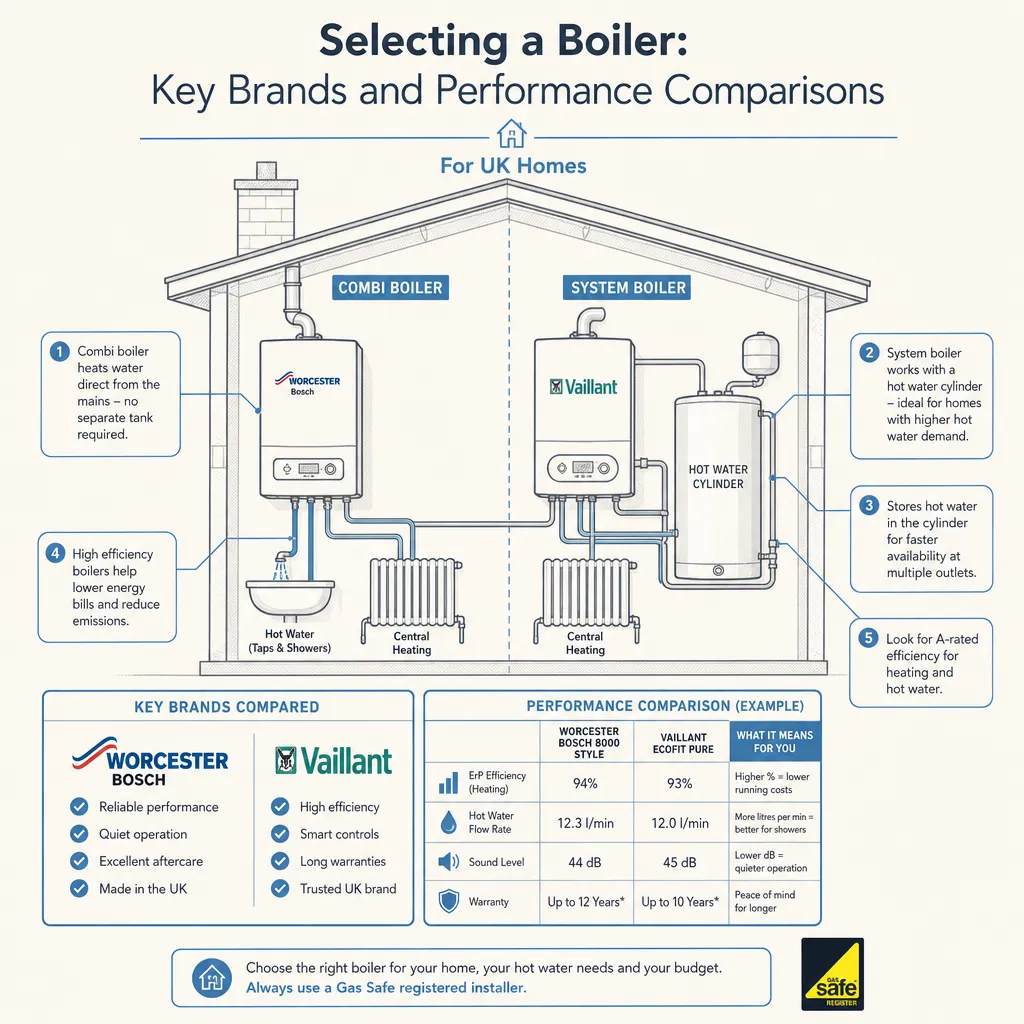
Selecting a Boiler: Key Brands and Performance Comparisons
Most UK homes are heated by a combi, system, or heat-only boiler.
 Energy & Retrofit
Practical Energy Saving Tips for Homeowners
Most UK households can meaningfully reduce their energy bills by making targeted changes: lowering the thermostat by 1°C, switching to LED lighting, and draught-proofing doors and windows.
 Energy & Retrofit
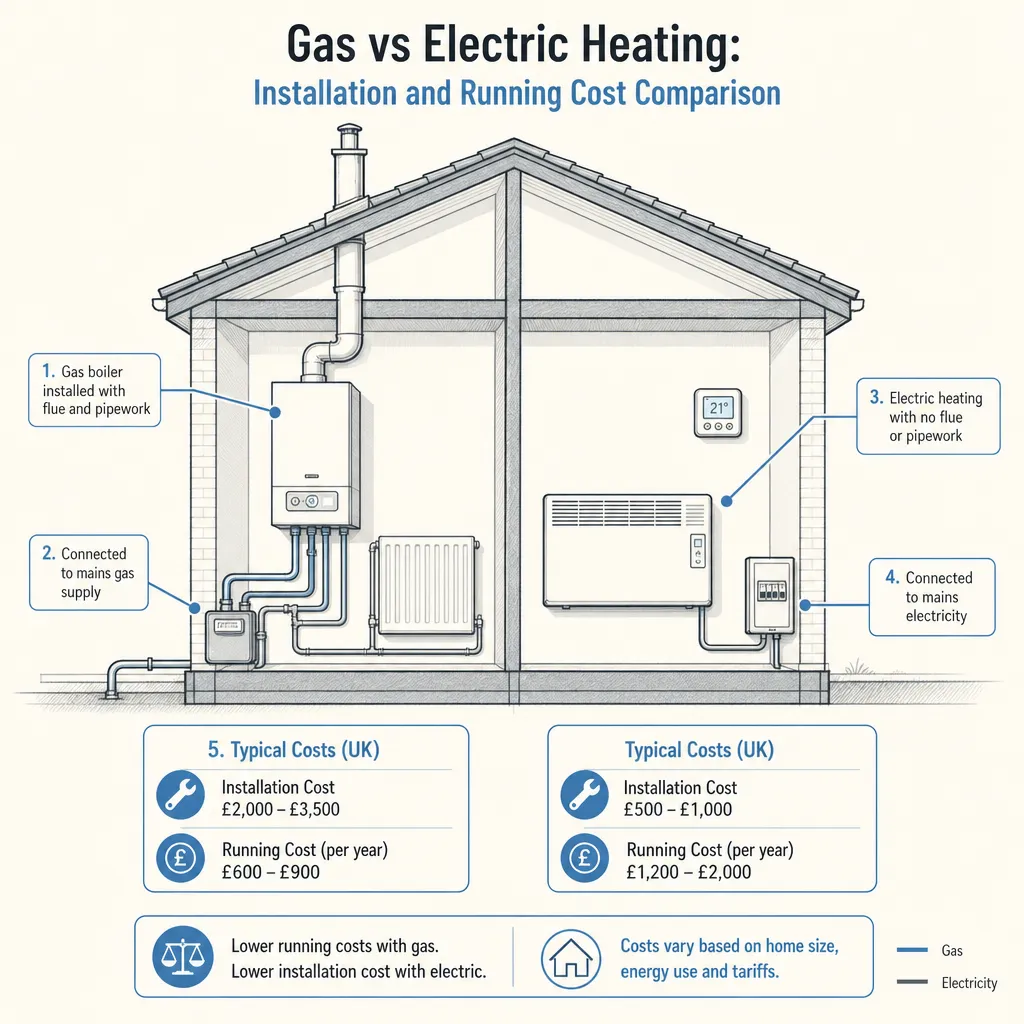
Gas vs Electric Heating: Installation and Running Cost Comparison
Gas central heating usually has lower running costs per kWh than direct electric heating in the UK, though heat pumps can change that equation.
 Energy & Retrofit
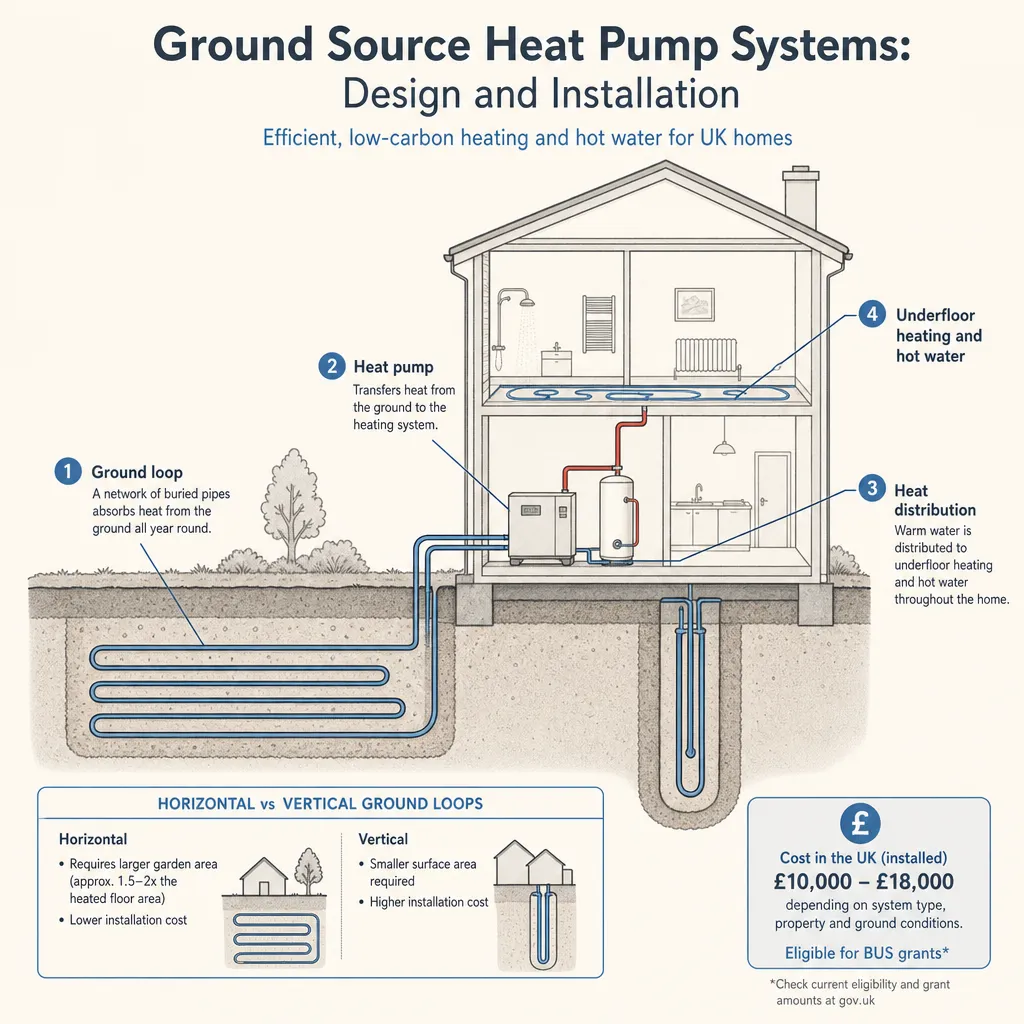
Ground Source Heat Pump Systems: Design and Installation
Ground source heat pumps extract heat from the earth through buried loops or boreholes, then upgrade it for space heating and hot water.