Choosing a Heating System for Your Conservatory
By Housey · Last reviewed 11th of May 2026

Choosing a Heating System for Your Conservatory
Conservatories are often the coldest room in the house in winter and the hottest in summer — a thermal challenge that determines how useful the space actually is year-round. As more UK homeowners treat conservatories as permanent living rooms rather than seasonal overflow space, the question of how to heat them effectively has moved from optional extra to practical necessity. The right answer depends on how well the structure is insulated, which energy source is available, and how the conservatory relates to the property's wider heating system.
Key points
- Fixed electrical heating installations in a conservatory — including hardwired panel heaters and electric underfloor heating — must be carried out by a Part P-registered electrician or notified to building control under the Building Regulations.
- Any work on a gas boiler or gas pipework, including adding a radiator to an existing wet system, must be carried out by a Gas Safe-registered engineer.
- An uninsulated polycarbonate or glass conservatory roof can account for 50–75% of total heat loss; improving the roof before adding heating often delivers better value than simply installing more output.
- MCS-certified heat pump installations require a room-by-room heat loss calculation; oversizing a heat pump reduces its coefficient of performance (COP) and increases running costs.
- Conservatories built and completed before 1 October 2008 without a fixed heating system may be treated differently under some energy efficiency regulations, but local authority interpretation varies — always verify with your building control officer.
Why conservatories are hard to heat
A standard conservatory built before roughly 2020 typically has a polycarbonate or glass roof with a U-value of 1.4–3.5 W/m²K, large glazed wall panels at around 1.0–2.0 W/m²K for double glazing, and relatively limited wall insulation below the sill. The combined effect is a heat loss rate that can overwhelm a modestly sized heating system — particularly on cold, windy evenings.
Before committing to a heating installation, consider whether insulation improvements might be more cost-effective:
- Roof upgrade: replacing a polycarbonate roof with a solid insulated or tiled roof dramatically reduces heat loss and is increasingly common. Check with building control whether the replacement triggers a regulations application.
- Thermal blinds: roof and wall blinds reduce overnight heat loss at low cost and can be fitted without any regulatory trigger.
- Draught sealing: gaps around door frames, threshold seals, and window gaskets are common in older conservatories and worth addressing before spending on heating capacity.
Heating options compared
Option | Best for | Running cost relative | Installation complexity | Building Regs trigger |
|---|---|---|---|---|
Electric panel heaters (hardwired) | Occasional use; budget-conscious | Higher per kWh | Low | Yes — Part P |
Electric underfloor heating mat | Regular use; new floor covering | Moderate to high | Moderate | Yes — Part P |
Wet underfloor heating (from boiler or heat pump) | Year-round living space | Lower if on efficient system | High | Yes — Gas Safe or MCS |
Radiator on existing central heating | Year-round use where boiler has capacity | Same as rest of house | Moderate | Yes — Gas Safe for gas work |
Infrared panels (electric) | Targeted radiant warmth; occasional use | Moderate | Low to moderate | Yes if hardwired — Part P |
Dedicated air source heat pump | Year-round use; off-gas properties | Lower long-term | High | Yes — MCS sizing required |
Suitability depends on your conservatory's construction, insulation level, and existing heating infrastructure. A qualified professional should assess your specific situation before installation.
Which heating option is right for your conservatory?
Use this decision guide to match your situation to the most appropriate approach:
- Choose hardwired electric panel heaters or infrared panels if the conservatory is used occasionally and you want a simple, low-cost installation with no pipework or boiler changes.
- Choose electric underfloor heating if you are relaying the floor as part of a wider refurbishment and want comfortable background warmth for regular use — it works well under tile or stone.
- Choose a radiator on the existing central heating circuit if your boiler has confirmed spare output capacity; ask your heating engineer to check before ordering any materials.
- Choose wet underfloor heating if you are undertaking a significant refurbishment and want the most even, comfortable heat distribution for a year-round living space.
- Choose an air source heat pump (dedicated or extending an existing system) if you are off the gas grid, have improved roof insulation, and want the lowest long-term running costs — only after a heat loss calculation by an MCS-certified installer.
- Prioritise insulation first if the conservatory currently has a polycarbonate roof or significant glazed area with no thermal blinds — adding heat to a poorly insulated structure wastes energy and money.
- Contact your building control officer if you are unsure whether your conservatory or planned heating upgrade requires formal approval.
Costs: what to expect
Indicative UK installation costs, last reviewed 2026-05-11. Actual costs depend on conservatory size, existing infrastructure, and regional labour rates. Always obtain at least three itemised quotes.
- Hardwired electric panel heaters: approximately £200–£600 per unit including installation by a Part P-registered electrician.
- Electric underfloor heating mat: approximately £500–£1,500 for a 15–25 m² conservatory including installation.
- Adding a radiator to existing central heating: approximately £400–£900 including pipework run, radiator supply, and Gas Safe-registered engineer.
- Wet underfloor heating (new installation): approximately £1,500–£4,000+ depending on floor construction and pipework routing.
- Dedicated air source heat pump: £7,000–£15,000+ installed; the Boiler Upgrade Scheme (BUS) offered a grant of £7,500 for eligible whole-home heat pump installations as of 2025–26 — confirm current eligibility with an MCS-certified installer.
Important limitations
This article provides general information about conservatory heating options in the UK. It is not a substitute for professional assessment of your specific property, heating system, or regulatory situation. Rules and requirements vary depending on:
- Your conservatory's age, construction, and current thermal performance.
- Whether the space is being used or treated as a habitable room under the Building Regulations.
- The capacity and condition of your existing boiler or heating system.
- Your local authority's interpretation of building control requirements for conservatory alterations.
- Whether any current grant schemes — ECO4, the Great British Insulation Scheme, or the Boiler Upgrade Scheme — apply to your circumstances.
Always engage a qualified, registered professional before committing to any fixed heating installation.
When this becomes urgent
Seek professional advice promptly if:
- You notice condensation, mould, or damp spreading from the conservatory into the adjoining room — adding heat without addressing moisture and ventilation can worsen these problems significantly.
- You intend to use the conservatory as a sleeping space — additional fire safety, insulation, and means-of-escape requirements apply and will require building control involvement.
- Your existing boiler is old, poorly maintained, or already struggling to heat the rest of the house — adding a further zone without a capacity check can cause system-wide problems.
- You are considering a heat pump as part of a wider whole-house retrofit — a PAS 2035-compliant retrofit assessment is required before heat pump installation under most current funding schemes.
What to ask a qualified professional
Before instructing any heating contractor, ask the following:
- Are you Gas Safe-registered (gas work), NICEIC- or NAPIT-registered (electrical work), or MCS-certified (heat pump installation)?
- What is the current heat loss of this conservatory, and what heating output do I actually need?
- Does my existing boiler have sufficient capacity to serve an additional heating zone without affecting the rest of the house?
- Will this work require a building control notification or a full application?
- Will the installation affect my home insurance or any existing product warranties?
- What annual maintenance will the system require, and what are the estimated running costs at current energy tariffs?
When to get professional help
All fixed conservatory heating installations require a qualified professional. Use:
- A Gas Safe-registered engineer for any work involving gas pipework, boilers, or gas appliances — it is a legal requirement.
- A Part P-registered or NICEIC/NAPIT-registered electrician for all hardwired electrical heating installations.
- An MCS-certified heat pump installer for air source or ground source heat pump systems.
- Your local building control authority if you are uncertain whether your conservatory alteration or heating upgrade requires formal approval before work begins.
How Housey can help
If you are planning to improve your conservatory's thermal performance before adding heating, extension builders on Housey can provide quotes for structural and insulation upgrades. For heat pump assessments, heat pump surveys on Housey connect you with MCS-certified professionals who carry out a proper heat loss calculation and advise on the correct system size for your property.
Frequently asked questions
Do I need building regulations approval to add heating to my conservatory?
Usually, any fixed heating installation triggers compliance requirements — Part P for electrical work and Gas Safe registration for gas connections. Whether you also need formal building control approval for the conservatory structure depends on whether it is exempt under the Regulations. If in doubt, contact your local building control authority before starting work.
Can I add a radiator to my existing central heating system in a conservatory?
Yes, if your boiler has sufficient spare output capacity and the existing pipework can be extended. A Gas Safe-registered heating engineer should assess the system before any work begins. Adding a radiator without checking capacity can cause uneven heat distribution throughout the house and may reduce boiler efficiency and lifespan.
Are infrared panels effective for conservatory heating?
Infrared panels heat objects and people directly rather than the air, making them responsive and useful for reducing the sensation of cold quickly in a glazed space. They suit occasional use and are simpler to install if hardwired by a Part P-registered electrician. They are less efficient than a wet system for continuous background heating.
Can I get a grant to heat my conservatory?
In most cases, mainstream schemes such as ECO4 and the Great British Insulation Scheme focus on the primary dwelling. The Boiler Upgrade Scheme covers heat pump installations replacing fossil fuel systems for the whole property, not a conservatory in isolation. Contact an MCS-certified installer or the Energy Saving Trust for up-to-date eligibility guidance.
What is the cheapest way to heat a conservatory?
The cheapest upfront option is usually a hardwired electric panel heater. For daily use, improving roof insulation first and connecting to the main central heating circuit typically offers the best balance of upfront cost and running costs over time. Running costs depend heavily on usage frequency and your energy tariff.
Sources and further reading
- Approved Document L: Conservation of fuel and power — GOV.UK
- Approved Document P: Electrical safety — dwellings — GOV.UK
- Gas Safe Register: Find a registered engineer — Gas Safe Register
- MCS: Find a certified installer — MCS — Microgeneration Certification Scheme
- Boiler Upgrade Scheme — GOV.UK
- Energy Saving Trust: Heating your home — Energy Saving Trust
- PAS 2035:2023 — Retrofitting dwellings for improved energy efficiency — BSI Group
Useful next reads
 Energy & Retrofit
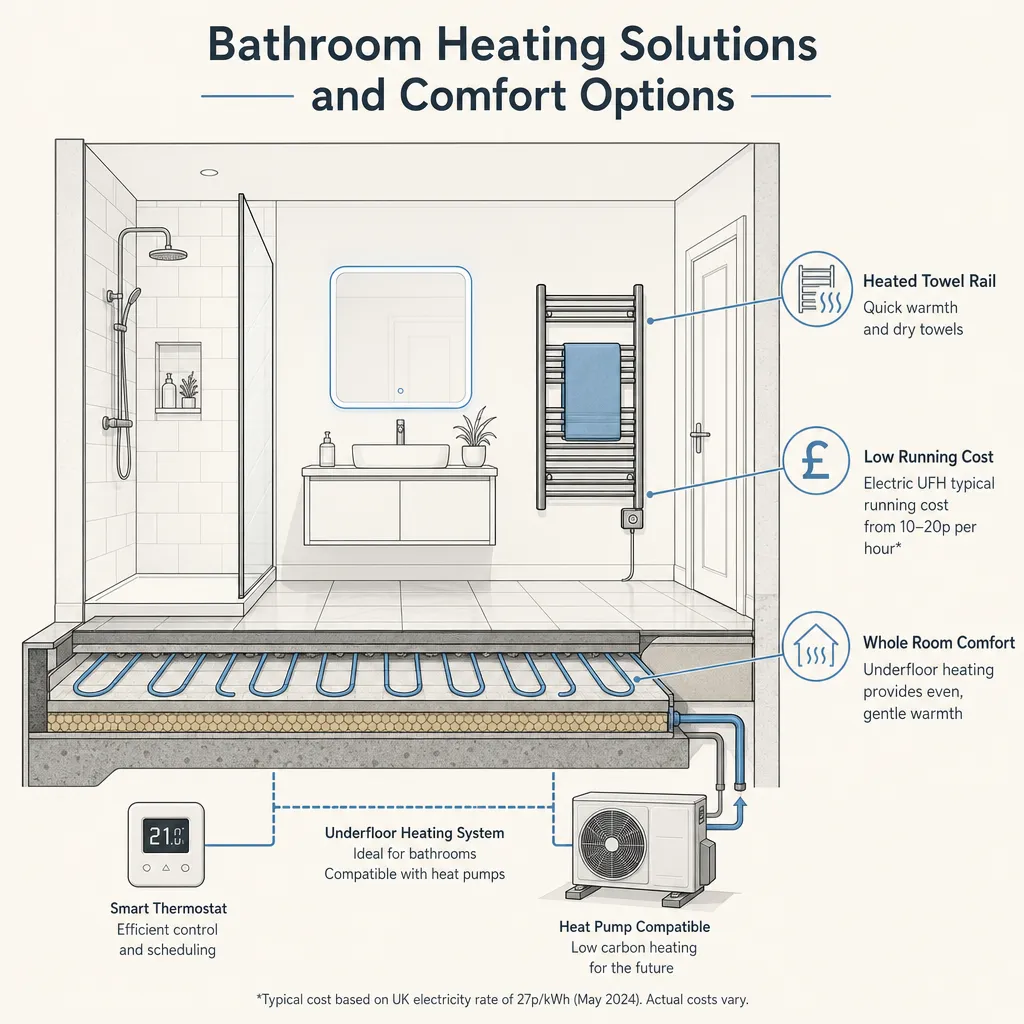
Bathroom Heating Solutions and Comfort Options
UK bathrooms can be heated using electric towel rails, wet radiators on the central heating circuit, electric or wet underfloor heating, or infrared panels.
 Energy & Retrofit
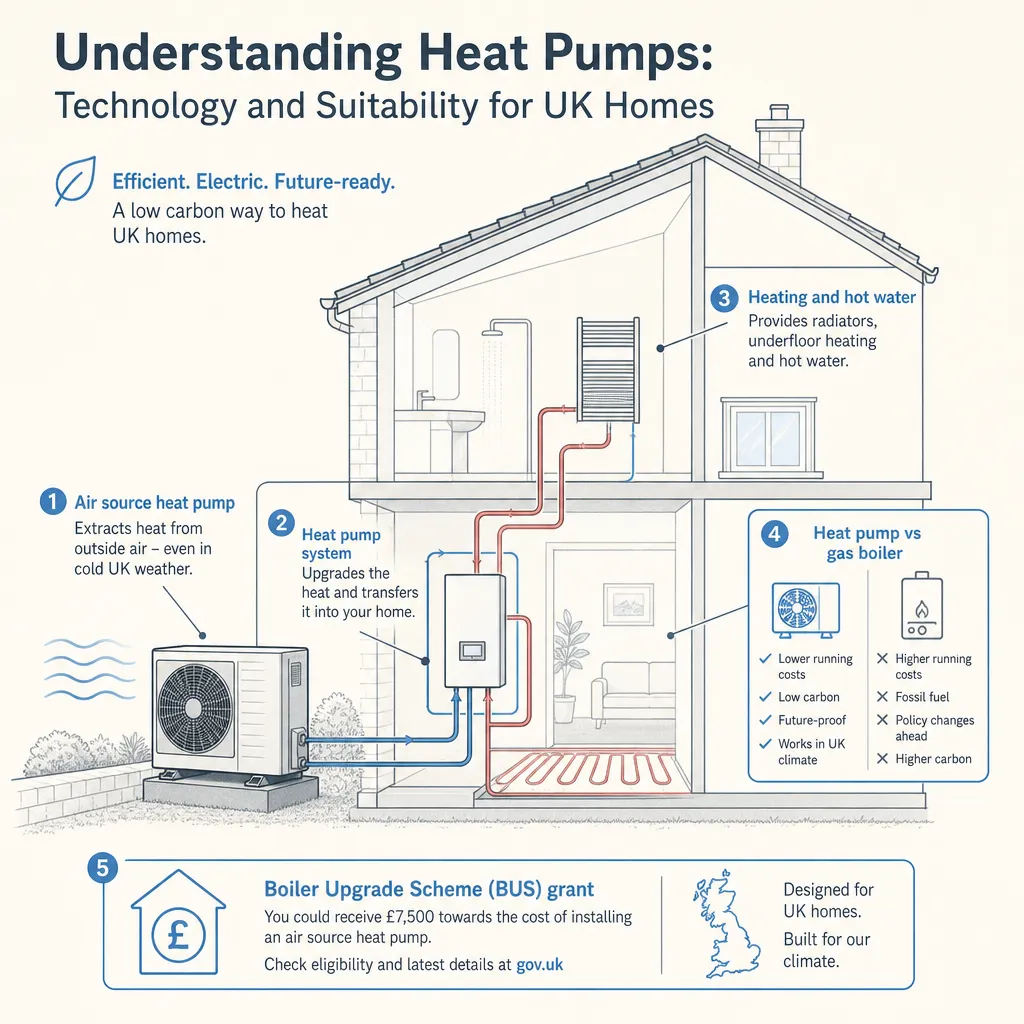
Understanding Heat Pumps: Technology and Suitability for UK Homes
Heat pumps extract heat from the air or ground and transfer it indoors, typically achieving efficiencies of 250–400% compared to a conventional boiler's near 100%.
 Energy & Retrofit
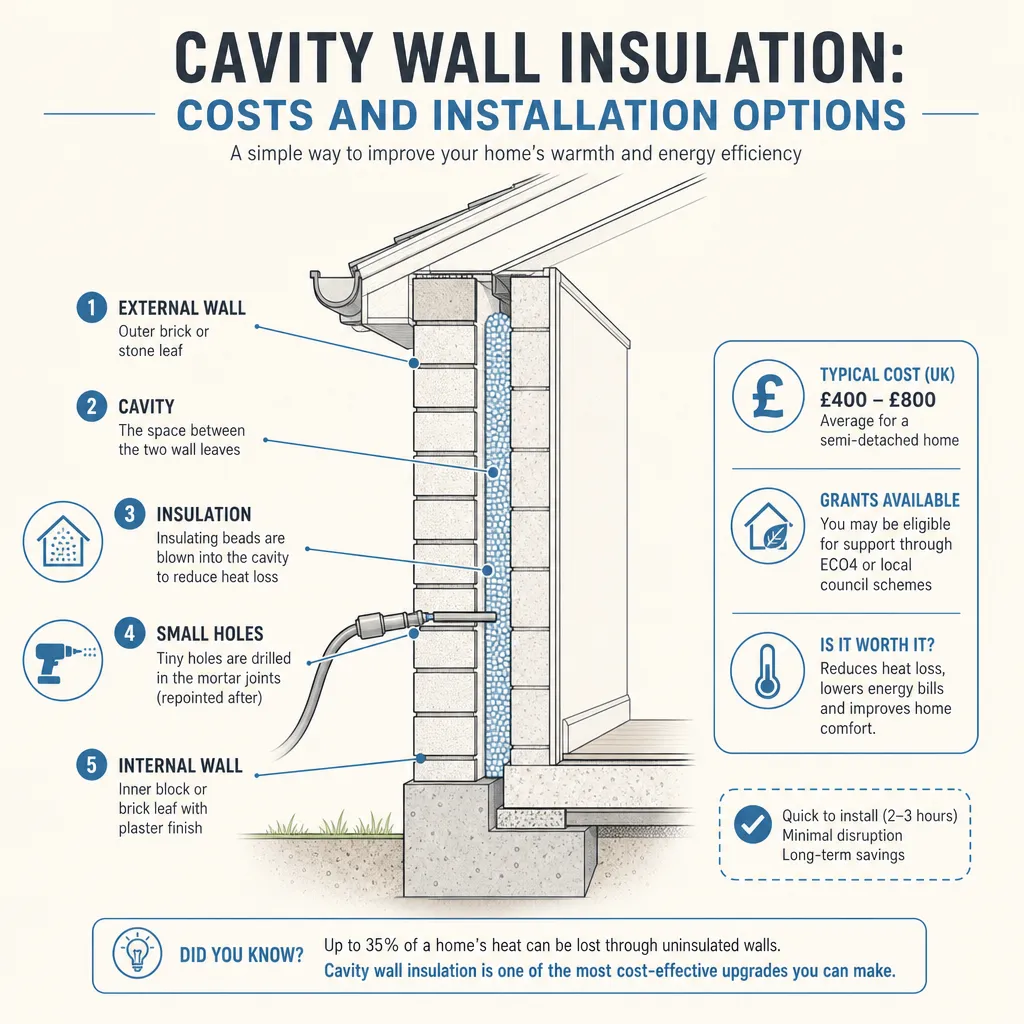
Cavity Wall Insulation: Costs and Installation Options
Cavity wall insulation typically costs £400–£1,200 for a standard UK semi-detached home, though eligible households may pay nothing under ECO4.
 Energy & Retrofit
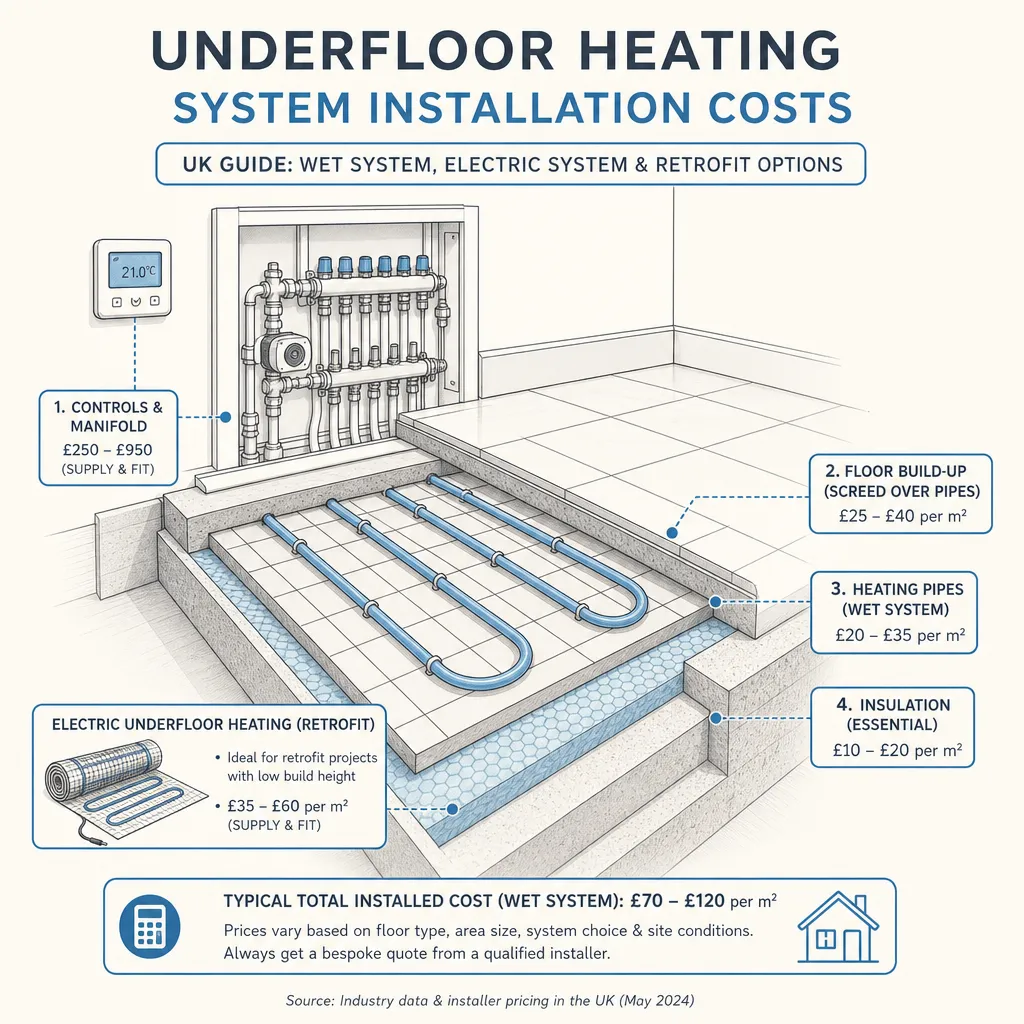
Underfloor Heating System Installation Costs
Underfloor heating installation in the UK typically costs £20–£50 per m² for electric mat or foil systems and £50–£150 per m² for wet (hydronic) systems, including labour.
 Energy & Retrofit
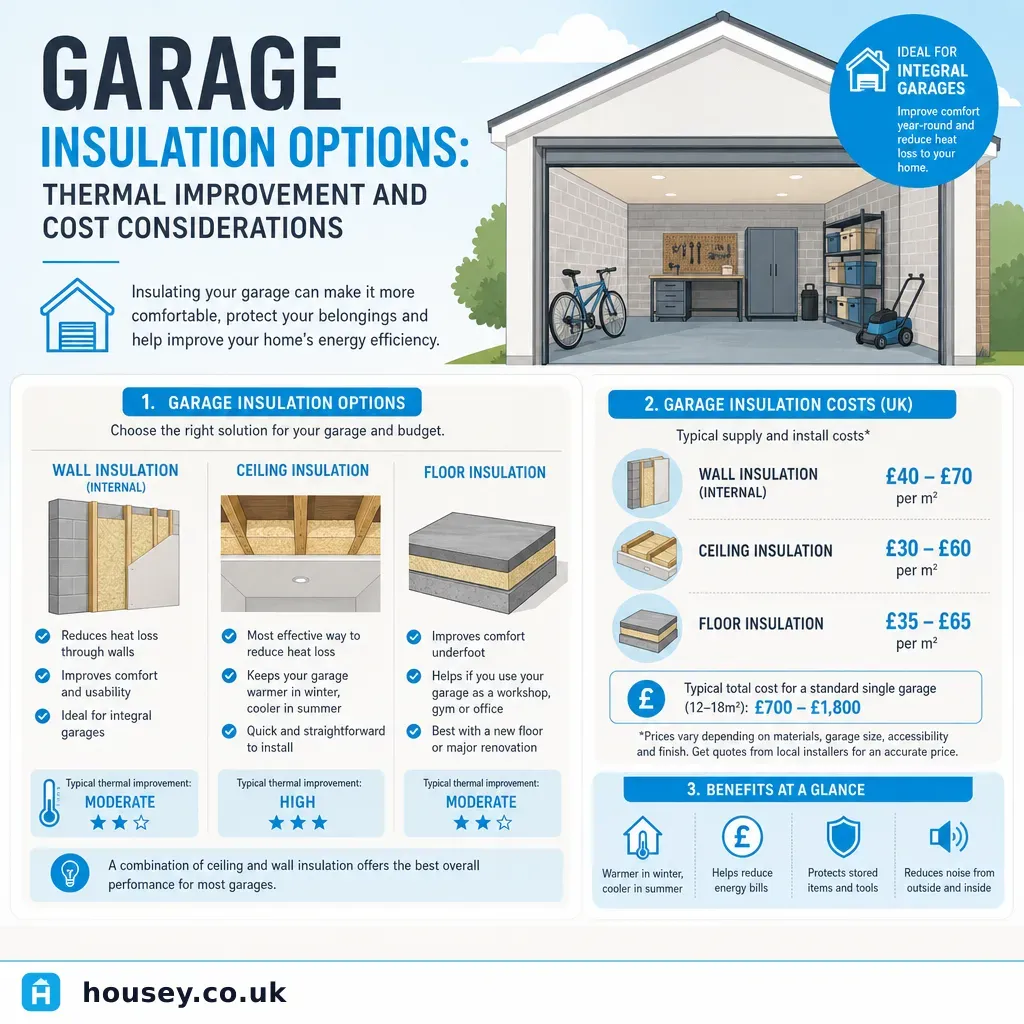
Garage Insulation Options: Thermal Improvement and Cost Considerations
Garage insulation options in the UK include mineral wool batts, rigid foam boards (PIR or EPS), and insulated garage doors.